
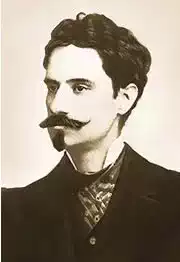
Alphonsus de Guimaraens
1870–1921
· lived 50 years
 BR
BR
BR
Alphonsus de Guimaraens, artistic name of Afonso Henriques de Lima Barreto, was a Brazilian poet, considered the greatest representative of Symbolism in Brazil. His work, marked by profound lyricism, mysticism, and an intense exploration of subjectivity, addresses themes such as death, idealized love, lost childhood, and the search for the transcendent. His poetry is characterized by musical language, full of symbols and ethereal images, which evoke a dreamlike and spiritual universe.
n. 1870-07-24, Ouro Preto · m. 1921-07-15, Mariana
54
Views
Bio
Identification and basic context
**Full name:** Afonso Henriques de Lima Barreto **Pseudonym:** Alphonsus de Guimaraens **Born:** July 24, 1854 **Place of birth:** Ouro Preto, Minas Gerais, Brazil **Died:** July 15, 1921 **Place of death:** Teresópolis, Rio de Janeiro, Brazil **Family background:** Descendant of a traditional and wealthy family from Minas Gerais, with ties to the rural aristocracy. His father was a renowned poet and politician. **Nationality:** Brazilian **Language of writing:** Portuguese **Historical context:** Lived during the period of the Second Empire and the beginning of the Republic in Brazil, a time of profound social and cultural transformations, but when traditions and the influence of the church were still strong, especially in the province.Childhood and education
Born in Ouro Preto, his childhood was spent in a privileged and cultured environment, influenced by his father, also a poet. He received a meticulous education, with private tutors and later in religious schools. He studied Law at the Faculty of São Paulo, but abandoned his studies before completing them, dedicating himself to literary and social life. His humanistic education and strong religious influence shaped his worldview and sensitivity.Literary career
Alphonsus de Guimaraens began his literary career as a poet, but also dedicated himself to criticism and essays. His poetic work, although produced in a period when Realism and Naturalism dominated, showed early characteristics that foreshadowed Symbolism. His great poetic work was published late and in fragments. He lived a bohemian and socially active life, but his literary production, although intense in terms of inspiration, was not always consistently organized. The publication of "Setenário das Dores de Nossa Senhora" (1877) and "Pau Brasil" (1879) already reveal a particular lyricism, before the consolidation of Symbolism.Work, style, and literary characteristics
**Main works:** "Pau Brasil" (1879), "Pátria" (1881), "Setenário das Dores de Nossa Senhora" (1877), "Visão de Teresópolis" (1912). **Dominant themes:** Death, longing for childhood, idealized and platonic love, spirituality, mysticism, religiosity, ethereal beauty, the search for the transcendent, melancholy, the ephemerality of life. **Form and structure:** Predominantly the sonnet, with great mastery of form and meter, but he also explored free verse. The structure of his poems is often musical and rhythmic, with an engaging cadence. **Poetic resources:** Abundant use of symbols, synesthesia, alliteration, assonance. His poetry is rich in metaphors and images that evoke the spiritual and dreamlike universe. Musicality is one of his distinguishing features. **Tone and poetic voice:** Elegiac, melancholic, mystical, devotional. The poetic voice reveals a sensitive being, tormented by earthly reality and the awareness of finitude, seeking solace in faith and transcendence. **Language and style:** Elaborate, musical language, with a vocabulary that evokes the sublime, the ethereal, the mysterious. His poetry is dense with suggestions and symbolism. **Innovations:** He is considered the main precursor and exponent of Symbolism in Brazil, introducing a sensibility and style that would profoundly influence later poetry. **Literary movements:** Precursor and main representative of Symbolism in Brazil. **Lesser-known works:** "Primeiros Cantos" (1877), "As Primícias do Amor" (1880), "Romanceiro")Cultural and historical context
Alphonsus de Guimaraens lived in a Brazil transitioning from the Empire to the Republic. In Minas Gerais, social and cultural life was still heavily influenced by traditions and the Catholic church. His poetic style, although often associated with European currents like Symbolism, had a strong personal and regional mark, rooted in the landscape and spirituality of Minas Gerais. He interacted with other intellectuals of the time, but his work maintained a remarkable uniqueness.Personal life
Son of the poet and politician Afonso de Guimarães, he inherited a taste for literature. His personal life was marked by strong religiosity and a certain melancholy. He had emotional relationships that inspired his poetry, but he lived a relatively private life, dedicated to literary creation and philosophical and spiritual reflections. His family had resources, which allowed him to dedicate himself to literature without the pressures of material necessity, unlike other poets of his time.Recognition and reception
Although his work was recognized by some contemporary critics, his full recognition as one of the greatest Brazilian poets, and the main figure of Symbolism, occurred mainly after his death. His poetry is studied and admired today for its lyrical depth, musicality, and originality, being a landmark in Brazilian literature.Influences and legacy
He was influenced by Romantic and Parnassian poetry, but his main influence came from French Symbolist poets. His legacy is immense, having paved the way for modern Brazilian poetry through his exploration of subjectivity, mysticism, and musicality. He influenced generations of poets who sought in his work a model of lyricism and spirituality.Interpretation and critical analysis
The work of Alphonsus de Guimaraens is often seen as an expression of the Brazilian soul, imbued with spirituality and melancholy. Critics highlight his ability to evoke the ineffable, the mystery of life and death, and the beauty of saudade (longing). His poetry is an invitation to introspection and contemplation of the transcendent.Curiosities and lesser-known aspects
Alphonsus de Guimaraens was known for his shyness and his devotion to Our Lady. It was said that he had visions and that his poetry was inspired by them. His connection to Minas Gerais, with its landscape and spirituality, is a striking aspect that gives his work a particular tone, different from other symbolists who focused more on urban themes.Death and memory
He died in Teresópolis in 1921, from pneumonia. His death, although not under conditions of extreme poverty like other poets, marked the end of an era. His memory is celebrated as that of one of the pillars of Brazilian poetry, an artist who, like few others, knew how to transfigure the anguish and beauty of human existence into words.Poems
0No poems found
Comments (0)
Log in
to post a comment.
No comments yet. Be the first to comment.