
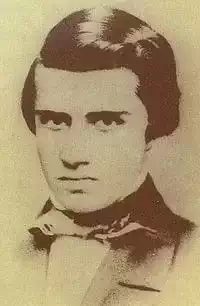
Álvares de Azevedo
 BR
BR
Álvares de Azevedo was a Brazilian poet, a prominent figure of Romanticism and one of the exponents of Ultra-Romanticism in his country. His work, marked by deep pessimism, melancholy, and the exploration of themes such as death, idealized love, and the escape from reality, reflects the anxieties of a youth who felt out of place in their time. Despite his short life, he left a legacy of poetry and prose of great intensity and lyricism, influencing later generations with his dark vision and his exploration of the gothic and the sublime.
n. 1831-09-12, São Paulo · m. 1852-04-25, Rio de Janeiro
Bio
Identification and Basic Context
Full name: Manuel Antônio Álvares de Azevedo. Pseudonyms: He was known as "the poet". Date and place of birth: September 15, 1831, in Rio de Janeiro, Brazil. Date and place of death: April 25, 1852, in Rio de Janeiro, Brazil. Family background, social class, and cultural context of origin: Born into a wealthy and intellectual family, which provided him with access to education and culture. His father was an influential poet and jurist. Nationality and language(s) of writing: Brazilian, he wrote in Portuguese. Historical context in which he lived: He lived in the second half of the 19th century, a period of great transformations in Brazil, such as the consolidation of the Empire, the peak of slavery, and cultural and literary development, with the emergence of Romanticism.Childhood and Education
Family background and social environment: He grew up in a family environment conducive to intellectual and literary development. His father was a respected intellectual. Formal education and self-education: He completed his preparatory studies at Colégio Cláudio Manuel da Costa and later enrolled in the Law School of São Paulo in 1848, where he excelled in legal studies. Initial influences (readings, culture, religion, politics): He was strongly influenced by European Romantic literature, especially German (Goethe, Schiller, Byron), and French (Chateaubriand, Lamartine). The intellectual environment of the time in Brazil also shaped him, with the cultural effervescence of Rio de Janeiro. Literary, philosophical, or artistic movements he absorbed: He absorbed the trends of Romanticism, particularly Ultra-Romanticism, with its focus on individualism, pessimism, melancholy, and the exaltation of feelings. Significant events in his youth: The early death of his mother and his own fragile health were events that intensified his pessimism and his dark view of life.Literary Career
Beginning of writing (when and how it started): He began writing poetry and prose at a very young age, standing out for his precocity and talent. Evolution over time (phases, changes in style): His work, though short, shows an evolution from more conventional lyricism to a darker and more intimate expression, characteristic of Ultra-Romanticism. Chronological evolution of his work: His literary production was concentrated between the period he studied in Rio de Janeiro and, mainly, during his years in São Paulo to pursue law. Collaborations in magazines, newspapers, and anthologies: He collaborated in several periodicals of the time, such as "Crônica Maranhense", "Guanabacoa", "Oller das Novidades", "Revista Contemporânea", and "Jornal dos Dias". His work "Lira dos Vinte Anos" was published posthumously. Activity as a critic, translator, or editor: He translated works from French and English, demonstrating his command of other languages and his interest in foreign literature.Work, Style, and Literary Characteristics
Major works with dates and production context: "Lira dos Vinte Anos" (published posthumously in 1853), "Noite na Taverna" (short stories, published posthumously in 1855), "Folhas Caídas" (poems, published posthumously in 1853). Dominant themes — love, death, time, nature, identity, spirituality, etc.: Idealized and platonic love, death as an escape from reality, boredom (spleen), melancholy, madness, the supernatural, nature as a setting of desolation, the transience of life, longing for the past, revolt against fate. Form and structure — use of sonnet, free verse, fixed form, metrical experimentation: He used the sonnet and other traditional poetic forms, but with content that subverted the expected lightness, exploring the gravity of the themes. Poetic devices (metaphor, rhythm, musicality): He employed metaphors that evoked the gothic and dark universe, a cadenced and melancholic rhythm, and a musicality that enhanced sadness and introspection. Tone and poetic voice — lyrical, satirical, elegiac, epic, ironic, confessional: The predominant tone is elegiac, confessional, and dark. There is a poetic voice that expresses anguish, disillusionment, and deep pessimism. Poetic voice (personal, universal, fragmented, etc.): The poetic voice is intensely personal, reflecting his own anxieties and disappointments, but by addressing universal themes like death and love, it achieves a dimension of universality. Language and style — vocabulary, imagery density, preferred rhetorical devices: Elevated and cultured language, with a rich vocabulary of terms referring to the sublime, the dark, and the macabre. He used hyperbole and antithesis to express the duality between the ideal and the real, life and death. Formal or thematic innovations introduced in literature: He introduced a more pronounced Ultra-Romantic theme into Brazilian literature, with a strong focus on the macabre, the gothic, and existential pessimism, anticipating some elements of Symbolism. Relationship with tradition and modernity: The greatest representative of Brazilian Ultra-Romanticism, which is part of Romanticism, dialoguing with European literary tradition and adapting it to Brazilian reality. Associated literary movements (e.g., symbolism, modernism): Ultra-Romanticism, Romanticism. Lesser-known or unpublished works: His short stories collected in "Noite na Taverna" are less known than his poetry but are of great importance for understanding his worldview.Work, Style, and Literary Characteristics
Cultural and Historical Context Relationship with historical events (wars, revolutions, regimes): He lived during the Second Reign, a period of relative political stability in Brazil, but his work focused on internal and existential issues rather than historical events. Relationship with other writers or literary circles: He was friends with other young intellectuals and law students who shared his literary and romantic ideals, forming a group united by idealism and literary production. Generation or movement to which he belongs (e.g., Romanticism, Modernism, Surrealism): He belongs to the Second Generation of Brazilian Romanticism, known as "Mal do Século" (Sickness of the Century) or Ultra-Romanticism. Political or philosophical stance: He did not express explicit political positions in his work, but his individualism and pessimism can be seen as a form of distancing himself from the social and political issues of his time. Influence of society and culture on his work: 19th-century Brazilian society, with its contradictions and the emergence of a national identity, served as a backdrop for his work, which, however, turned to universal and internal themes. Dialogues and tensions with contemporaries: His work dialogued with the production of other romantics, but his ultra-romantic and pessimistic tone set him apart and, at times, distanced him from broader reception at the time. Critical reception during his life versus posthumous recognition: During his lifetime, his work had limited reception due to his short existence and the late publication of his major works. Recognition of his importance came mainly after his death, when "Lira dos Vinte Anos" and "Noite na Taverna" were published and acclaimed.Work, Style, and Literary Characteristics
Personal Life Significant affective and familial relationships and how they shaped his work: The loss of his mother and his relationship with his father influenced his views on life and death. Idealized, often inaccessible love, is a central theme in his poetry. Friendships and literary rivalries: He had a circle of close friends, also law students and writers, with whom he shared ideas and literary aspirations. Personal experiences and crises, illnesses, or conflicts: He suffered from tuberculosis, an illness that accompanied and debilitated him, contributing to his pessimism and obsession with death. His fragile health marked his youth. Parallel professions (if he didn't live solely from poetry): He was a law student. He did not practice a profession as he died very young. Religious, spiritual, or philosophical beliefs: His work suggests a deep existential anguish and a search for meaning, but his pessimistic view and attraction to the macabre indicate a distance from traditional religious doctrines. Political positions and civic engagement: There is no record of civic engagement or notable political positions.Work, Style, and Literary Characteristics
Recognition and Reception Place in national and international literature: He is considered one of the greatest poets of Brazilian Romanticism and one of the main representatives of Ultra-Romanticism. His work is studied and valued by critics. Awards, distinctions, and institutional recognition: Due to his early death, he did not have time to receive awards during his lifetime. Recognition came posthumously with the publication of his works. Critical reception at the time and over time: Reception during his lifetime was limited. Posthumous recognition consolidated his position as a poet of great sensitivity and depth. Popularity versus academic recognition: He is an academically studied figure and admired by readers interested in Romanticism and poetry with dark and existential themes.Work, Style, and Literary Characteristics
Influences and Legacy Authors who influenced him: Lord Byron, Johann Wolfgang von Goethe, Friedrich Schiller, Victor Hugo, Alfred de Musset, Alphonse de Lamartine, Edgar Allan Poe. Poets and movements he influenced: He influenced subsequent Brazilian poetry with his dark themes, pessimism, and exploration of the gothic and the sublime. He was a precursor in addressing themes that would be revisited in other literary aesthetics. Impact on national and world literature and later generations of poets: He left an indelible mark on Brazilian literature, being one of the pillars of Romanticism. His work continues to be read and studied as a reflection of youthful anxieties and the human condition. Entry into the literary canon: He is a consolidated figure in the canon of Brazilian literature, present in anthologies and studies on 19th-century Romanticism and poetry. Translations and international dissemination: His work, although recognized in Brazil, has less international dissemination compared to other romantic authors, but it is studied in Brazilian and Lusophone literature courses. Adaptations (music, theater, cinema): The atmosphere of his short stories, especially "Noite na Taverna", has inspired theatrical and film adaptations, exploring the gothic and dark nature of his narratives. Academic studies dedicated to his work: His work is the subject of many academic studies, which analyze its themes, style, and insertion in the context of Brazilian Romanticism.Work, Style, and Literary Characteristics
Interpretation and Critical Analysis Possible readings of his work: The work can be read as an expression of the romantic "sickness of the soul," existential boredom, amorous disillusionment, and the search for an unattainable transcendence. Also as a way of dealing with one's own mortality. Philosophical and existential themes: The fleetingness of life, the pursuit of the ideal, the impossibility of pure love, the attraction to death as a refuge, the mismatch between the self and the world, existential anguish. Controversies or critical debates: One debate concerns his classification as a merely pessimistic and superficial poet, versus the view of his work as a profound exploration of the human soul in conflict with reality and finitude.Work, Style, and Literary Characteristics
Curiosities and Lesser-Known Aspects Lesser-known aspects of his personality: Despite his melancholic and dark image, accounts indicate that in life he was a lively young man with a sense of humor, especially within his circle of friends. Contradictions between life and work: The contradiction lies in his youth and the premature maturity and pessimism that permeate his work, often anticipating the death that would claim him. Striking or anecdotal episodes that illuminate the author's profile: His dedication to legal studies, despite his passion for poetry, and his active participation in intellectual debates with his university colleagues. Objects, places, or rituals associated with poetic creation: The city of São Paulo, during his studies, and the Rio de Janeiro of his childhood were important settings. Reading and writing were his main rituals. Writing habits: He wrote with intensity and speed, often inspired by his emotions and readings, as if sensing the brevity of his life. Curious episodes: His death during a smallpox epidemic in Rio de Janeiro contributed to the tragic aura of his life and work. Manuscripts, diaries, or correspondence: Manuscripts of his poems and letters are preserved, revealing his intimacy, his thoughts, and his relationship with friends and family.Work, Style, and Literary Characteristics
Death and Memory Circumstances of death: He died at the age of 20 in Rio de Janeiro, from tuberculosis, at a time when the disease was incurable and highly contagious. Posthumous publications: His most important works, "Lira dos Vinte Anos" and "Noite na Taverna", were published posthumously, consolidating his fame and his position in Brazilian literature.Poems
0No poems found
Comments (0)
No comments yet. Be the first to comment.