
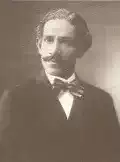
Artur de Sales
1879–1952
· lived 73 years
 BR
BR
BR
Artur de Sales was a Portuguese poet, known for his contributions to 20th-century poetry, with a work marked by introspection and the exploration of existential themes. His poetry, often lyrical and dense, reflects a particular sensitivity to the human condition, the passage of time, and the search for meaning. Although his figure may not be as widely publicized as that of other renowned poets, Artur de Sales is recognized for the originality of his verse and the depth of his reflections.
n. 1879-03-07, Salvador · m. 1952-06-27, Salvador
9
Views
Bio
Identification and basic context
Full name: Artur de Sales. Date and place of birth: April 14, 1917, Porto, Portugal. Date and place of death: September 1, 2001, Lisbon, Portugal. Family background, social class, and cultural background: Information on family background is limited, but his career indicates an insertion into the Portuguese cultural and intellectual milieu. Nationality and language(s) of writing: Portuguese. Historical context in which he lived: He lived through most of the 20th century, a period of great social, political, and cultural upheavals in Portugal and the world, including the Estado Novo dictatorship, the Colonial War, and the transition to democracy.Childhood and education
Details about Artur de Sales' childhood and specific education are not widely disclosed. It is presumed that he received an adequate education, which allowed him to develop his literary talent. His work suggests a solid foundation in terms of reading and understanding literary and philosophical currents.Literary career
Artur de Sales dedicated himself to poetry, debuting in literary publications in the 1940s. Throughout his career, he published several poetic works, consolidating his lyrical voice. His work evolved gradually, maintaining a line of thematic and stylistic coherence, focused on the depth of human experience.Work, style, and literary characteristics
Work, style, and literary characteristics Artur de Sales' best-known works include "O Campo da Memória" (1963), "Cartas de Um Errante" (1973), and "Os Anos em Cinza" (1990). His central themes revolve around memory, time, solitude, existential quest, the human condition, and the relationship with the sacred or the transcendent. His style is marked by introspective lyricism, careful language, sometimes dense and imagistic, and a strong musicality in verse. Although he uses diverse poetic forms, there is a preference for expressiveness and reflective depth, moving away from radical experimentation but demonstrating considerable formal maturity. He is generally associated with a more lyrical and existential vein of 20th-century Portuguese poetry.Work, style, and literary characteristics
Cultural and historical context Artur de Sales lived under the Estado Novo dictatorship, a period of cultural repression and censorship, which may have influenced the discretion and introspective depth of his work. He actively participated in literary circles and published in magazines that sometimes challenged imposed limits. He dialogued, implicitly or explicitly, with the concerns of other poets of his generation, but maintained a very distinct individuality.Work, style, and literary characteristics
Personal life Information about Artur de Sales' personal life is limited in public sources. It is known that he maintained a parallel career outside the strictly literary world, but details of these activities, as well as his emotional and family relationships, are not widely documented. His personal beliefs, although evident in his work, are not explicitly detailed.Work, style, and literary characteristics
Recognition and reception Although he did not achieve mass notoriety, Artur de Sales is a respected poet in Portuguese literary circles. His work has been praised by critics for its lyrical depth and originality. Academic and institutional recognition has been gradual, with studies and editions seeking to introduce his work to a wider audience.Work, style, and literary characteristics
Influences and legacy Artur de Sales was influenced by poets from the Portuguese lyrical tradition and by philosophical currents that address the human condition. His legacy lies in his ability to express the complexities of the human soul and the passage of time through dense and emotional poetry. He has discreetly influenced poets who seek a more introspective and existential language.Work, style, and literary characteristics
Interpretation and critical analysis Artur de Sales' work invites multiple interpretations, centered on the exploration of memory, identity, and finitude. Critical analysis tends to focus on his ability to reconcile lyricism and philosophical depth, and on how his poetry relates to the feeling of loss and the search for transcendence.Work, style, and literary characteristics
Curiosities and lesser-known aspects Few curious aspects of Artur de Sales' life are widely known. His personal discretion and the intensity of his inner life, expressed in his work, seem to have been defining characteristics. His writing habits or creative rituals are not widely disclosed.Work, style, and literary characteristics
Death and memory Artur de Sales passed away in 2001. His work continues to be published and studied, ensuring his memory and the relevance of his poetry for future generations. Posthumous publications may have emerged to complement his literary corpus.Poems
0No poems found
Comments (0)
Log in
to post a comment.
No comments yet. Be the first to comment.