
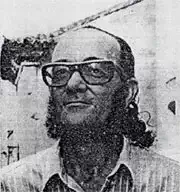
Bandeira Tribuzi
1927–1977
· lived 50 years
 BR
BR
BR
Bandeira Tribuzi was a Brazilian poet, essayist, and professor, a prominent figure in contemporary poetry. His work is characterized by the exploration of existential themes, the relationship of man with the city and nature, and reflection on language and art. With dense poetry, which transitions between lyricism and philosophical reflection, Tribuzi addresses the complexity of the human experience in a constantly changing world. He also stood out for his academic activity and critical intervention.
n. 1927-02-02, São Luís · m. 1977-09-08, São Luís, Maranhão
44
Views
Bio
Identification and Basic Context
Manuel Bandeira Tribuzi was a Brazilian poet, essayist, university professor, and literary critic. Born in Rio de Janeiro, he established himself as one of the most important voices in contemporary Brazilian poetry, with a body of work marked by erudition and reflective depth.Childhood and Education
From an early age, he showed an interest in reading and writing. His academic education was solid, having dedicated himself to the study of literature, philosophy, and arts, areas that would profoundly influence his poetic and essayistic work. The cultural environment of Rio de Janeiro, where he lived, also shaped his worldview.Literary Career
His literary career began with the publication of poems in various magazines and anthologies, gradually gaining recognition for the originality and power of his expression. Over time, his work evolved, exploring new thematic and stylistic approaches, but always maintaining a continuity in his concern with language and the human condition. In addition to poetry, he distinguished himself as an essayist, analyzing the work of other poets and writers and reflecting on the nature of art itself.Work, Style, and Literary Characteristics
Bandeira Tribuzi's work is marked by a profound reflection on the human experience, the relationship between the individual and the city, nature, time, and memory. His poetry transitions between lyricism and erudition, with a rich and precise vocabulary, and careful formal construction. He explores language as raw material, questioning its limits and its possibilities of expressing the complexity of reality. Themes of identity, solitude, the passage of time, and the search for meaning are recurrent. His style is characterized by its imagery density, subtle irony, and a tone that is sometimes contemplative, sometimes incisive. His poetry dialogues with tradition, but also with the anxieties of modernity.Cultural and Historical Context
Bandeira Tribuzi was part of the Brazilian cultural context of the second half of the 20th century and the beginning of the 21st century, a period of great social, political, and technological transformations. His work reflects these changes, addressing man's relationship with the urban space and contemporary society. He was a contemporary of important writers and intellectuals with whom he shared debates and reflections on literature and culture.Personal Life
Beyond his activity as a poet and professor, Tribuzi maintained an active intellectual life, participating in cultural debates and contributing to the formation of new generations of writers and readers. His dedication to study and reflection on art and life was a constant.Recognition and Reception
His poetic and essayistic work gained solid recognition in the Brazilian literary and academic circles. He is considered one of the important poets of his generation, admired for the originality of his thought and the quality of his writing.Influences and Legacy
Bandeira Tribuzi was influenced by various literary and philosophical currents, from the classics of poetry to contemporary thinkers. His legacy lies in his contribution to Brazilian poetry, for his ability to articulate existential experience with critical reflection on language and art, opening new perspectives for contemporary poetry.Interpretation and Critical Analysis
Critics have highlighted the existential depth of Tribuzi's poetry, his ability to capture the nuances of urban experience, and his reflection on the very nature of poetic creation. His work is an invitation to meditate on the human condition in the modern world.Curiosities and Lesser-Known Aspects
Known for his erudition and his rigorous approach to language, Bandeira Tribuzi dedicated himself intensely to the study and practice of poetry, exploring its multiple facets.Death and Memory
He passed away in Rio de Janeiro, leaving a vast body of work and a significant legacy for Brazilian literature. His memory is preserved through his books and the impact of his work on future generations.Poems
0No poems found
Comments (0)
Log in
to post a comment.
No comments yet. Be the first to comment.