
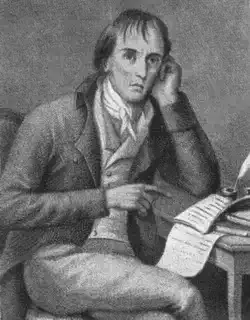
Bocage
1765–1805
· lived 40 years
 PT
PT
Manuel Maria de Barbosa l'Hedois du Bocage was a Portuguese poet and possibly the greatest representative of Lusitanian Arcadianism.
n. 1765-09-15, Setúbal · m. 1805-12-21, Lisboa
84
Views
Bio
Portuguese poet born in Setúbal, of French descent on his mother's side. His vocation was encouraged by his family environment. Madame Fiquet du Bocage, a great-aunt of the poet, was an illustrious poet at the time and had translated the Swiss pre-romantic poet Gessner. Bocage's own father read the English pre-romantic Young and cultivated poetry in his spare time. Also marking him, as he himself underlined, was the death of his mother at the age of ten ("At two lustrums devouring death / stole from me, tender mother, your sweet pleasure"). He attended the Royal Academy of Navy Guards, which he entered in 1783, giving himself over, more than to his studies, to the literary bohemianism of Lisbon at the time, frequenting taverns, especially the Nicola, in Rossio, to which his name remains forever linked, as a famous improviser of verses. He embarked for Goa (1786) and served in the garrison of Daman (1789). Later, he deserted, embarking for Macau, and from there returned to Lisbon in 1790, the year in which the New Arcadia was founded, which he joined, adopting the poetic name Elmano Sadino. He was expelled from it in 1794, due to his independent, sarcastic, and undisciplined spirit.
Restless and attracted to bohemian life, he was arrested on August 10, 1797, accused of ideas against the social order, expressed in the "Epístola a Marília", an anti-religious text, and in the sonnet dedicated to Napoleon, a symbol of the revolutionary ideal of the time. Tried, all things considered, with some benevolence for "error against religion", the Inquisition ordered that the prisoner be "indoctrinated". Obliged by sentence to retire to the Hospício das Necessidades, he dedicated himself there to the study and translation of various works, among which Ovid's Metamorphoses. He was released in 1799, converting to a more orderly life at the home of his sister, Maria Francisca, whom he supported with translation work. Marked by the tribulations of his journey, his life ended prematurely and with painful regret, evident in his final poems.
Bocage is a pre-romantic poet in whom Arcadianism is still very much present. From his poems radiates the anguished sense of existence and annihilation, expressed in dramatic oppositions (love, heaven and hell, death, horror and liberation) and a taste for the macabre, simultaneously with the Arcadian conventionalism of allegories. Among the poetic forms he cultivated, the sonnet stands out.
Often evoking the parallelism between his life and that of Camões, he died at the age of 40 in Lisbon, leaving published, in three volumes, Rimas (1791, 1799 and 1804), completed with the posthumous publication of new volumes and works on his poetic creation (Poesia de Manuel Maria de Barbosa du Bocage, by Inocêncio da Silva, 1853, and Obras Poéticas de Bocage, by Teófilo Braga, 1875).
Poems
0No poems found
Comments (0)
No comments yet. Be the first to comment.