
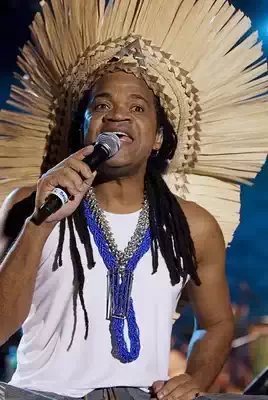
Carlinhos Brown
b. 1962
 BR
BR
BR
Carlinhos Brown is a multifaceted and innovative Brazilian musician, composer, singer, and percussionist. Known for his contagious energy and his fusion of Afro-Brazilian rhythms with elements of pop and electronic music, he is one of the main figures responsible for the international projection of Bahian music. His work spans various genres, demonstrating unique versatility and a commitment to Brazilian sound and cultural identity.
n. 1962-11-23, Salvador
26
Views
Bio
Identification and basic context
Carlinhos Brown, the stage name of Antônio Carlos Santos de Freitas, is a renowned Brazilian musician, composer, percussionist, and singer. Born in Salvador, Bahia, he is a central figure in Brazilian popular music, known for his creativity and innovation.Childhood and training
He grew up in the Candeal neighborhood of Salvador, where from an early age he had contact with the rich Afro-Brazilian musical culture. His musical training was largely self-taught, absorbing local rhythms and traditions. Percussion became his primary language, and he soon stood out for his skill and originality.Literary journey
Carlinhos Brown's journey is primarily musical. He began his career as a percussionist, accompanying various Brazilian music artists. In parallel, he started composing and developing his own style, which blended diverse influences. He became one of the most sought-after names for collaborations and productions, also releasing albums under his own name.Work, style, and literary characteristics
Brown's work is marked by the fusion of Brazilian rhythms, especially those from Bahia such as samba de roda and ijexá, with elements of pop, funk, soul, and electronic music. His albums, such as "Tribal Brazil" (1996), "O Começo do Fim do Mundo" (1997), and "Candy Star" (2007), explore percussion in an innovative way, creating unique soundscapes. His compositions frequently address social themes, Afro-Brazilian identity, and the celebration of life. His performance is energetic and vibrant, with an emphasis on the creative use of percussion instruments.Work, style, and literary characteristics
Cultural and historical context Carlinhos Brown emerged during a period of great effervescence in Bahian music, contributing significantly to the popularization of new rhythms and sounds that gained national and international projection. His music dialogues with Africa's heritage in Brazil and with global musical trends.Work, style, and literary characteristics
Personal life Brown is known for his strong connection with the Candeal community, where he developed social projects focused on education and culture through music. He is a defender of the preservation of Afro-Brazilian culture and an example of success that maintains his roots.Work, style, and literary characteristics
Recognition and reception He has received numerous awards and distinctions throughout his career, both in Brazil and internationally. He is widely respected as one of the greatest innovators in Brazilian music, with a solid and influential career.Work, style, and literary characteristics
Influences and legacy Brown was influenced by the music of his homeland and by artists of soul, funk, and jazz. His legacy lies in redefining Brazilian percussive music, creating a distinctive sound that opened doors for other artists, and in his contribution to social projects that transform lives through art.Work, style, and literary characteristics
Interpretation and critical analysis Music critics frequently highlight the originality and sophistication of his compositions, his mastery in the use of percussion, and his ability to create bridges between the traditional and the contemporary in Brazilian music.Work, style, and literary characteristics
Curiosities and lesser-known aspects Brown is also known for his work as a judge on television shows, where he demonstrates his musical knowledge and charisma. His skill with multiple percussion instruments is remarkable.Work, style, and literary characteristics
Death and memory Carlinhos Brown is alive and in full creative activity, continuing his important contribution to Brazilian music and culture.Poems
0No poems found
Comments (0)
Log in
to post a comment.
No comments yet. Be the first to comment.