
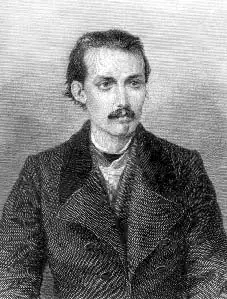
Casimiro de Abreu
 BR
BR
Casimiro de Abreu was a Brazilian poet of Romanticism, known for his lyrical and sentimental poetry, which nostalgically evokes childhood, simple country life, and longing for his homeland. His work, though relatively scarce, deeply marked Brazilian literature with its delicacy, musicality, and exploration of universal themes such as lost innocence and familial love. Considered one of the main exponents of the second romantic generation in Brazil, Casimiro de Abreu left a legacy of verses that continue to move with their candor and representation of an idealized world, marked by purity and affection.
n. 1839-01-04, São João da Barra · m. 1860-10-18, Nova Friburgo
Bio
Identification and Basic Context
Casimiro José de Abreu, known as Casimiro de Abreu, was born in 1837 and died in 1860. He was a Brazilian poet, a prominent figure of Romanticism in Brazil.Childhood and Education
Born in Vila Rica (current Ouro Preto), Minas Gerais, into a family of means. He spent part of his childhood and adolescence on the family farm in Aldeia da Passagem, Rio de Janeiro, a period that would be idealized in his work. He had an irregular schooling, marked more by self-education and personal readings. His youth was shaped by an idyllic rural environment and strong family ties, influences that would profoundly reflect in his poetry.Literary Career
His literary activity began in adolescence, with the publication of poems in newspapers and magazines of the time. His poetic work, although concentrated in a short period of his life, was published posthumously in the collection "Primeiros Cantos" (1865) and "Segundos Cantos" (1866). His poetry is representative of the second romantic generation, the "mal du siècle" (sickness of the century), characterized by melancholy, sentimentalism, and escapism.Work, Style, and Literary Characteristics
Casimiro de Abreu's best-known work is the collection "Primeiros Cantos," which includes poems like "Meus Oito Anos" and "Canção do Exílio" (different from Gonçalves Dias's). The dominant themes are childhood, longing for homeland, family, maternal love, and the idealization of simple and rural life. The most used poetic form is the sonnet, but also free verse, with accessible, musical, and tender language. The tone of his poetry is predominantly lyrical, sentimental, and nostalgic, with a poetic voice that expresses his subjectivity and his connection to nature and childhood memories. His style is characterized by simplicity, candor, and emotiveness.Cultural and Historical Context
Casimiro de Abreu lived during the period of the Second Reign in Brazil, a time of imperial consolidation and important social and political transformations. His literary generation, Romanticism, sought to consolidate a Brazilian cultural identity, often through the exaltation of nature and the past. His work, despite being personal, reflects the "mal du siècle" that characterized many European and Brazilian romantics, with a feeling of melancholy and maladjustment.Personal Life
Casimiro de Abreu had a personal life marked by fragile health and premature death. His connection to his family, especially his mother, was a pillar in his life and work. His death occurred in circumstances of poverty and hardship, after an attempt to establish himself as a merchant in Rio de Janeiro.Recognition and Reception
Although he received little recognition during his lifetime due to his early death, Casimiro de Abreu's work gained great popularity after his death, becoming one of the most read and beloved poets of Brazilian Romanticism. His poetry is frequently included in anthologies and taught in schools.Influences and Legacy
Casimiro de Abreu was influenced by European romantic poets and by Gonçalves Dias. His legacy lies in the way he captured the essence of childhood and longing with a simple and touching language, influencing later poets who explored similar themes.Interpretation and Critical Analysis
Casimiro de Abreu's work is often analyzed from the perspective of romantic sentimentalism, nostalgia, and idealization of the past. His poetry is seen as a reflection of the search for refuge in an idealized world, in the face of the difficulties of adult life.Curiosities and Lesser-Known Aspects
His premature death and the circumstances in which it occurred (tuberculosis, in abject poverty) contrast with the purity and sweetness of his poetry. A municipality in the state of Rio de Janeiro was named after him in his honor.Death and Memory
Casimiro de Abreu died of tuberculosis in 1860, at the age of 23. His work was gathered and published posthumously, ensuring his literary immortality.Poems
0No poems found
Comments (0)
No comments yet. Be the first to comment.