
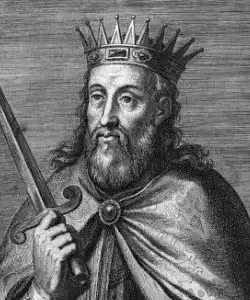
D. Dinis
1261–1325
· lived 63 years
 PT
PT
PT
Dom Dinis was a king of Portugal known as "the Farmer" and "the Poet". During his reign, Portugal experienced a period of significant economic and cultural development. He was a patron of arts and sciences, promoting education and the creation of cultural institutions. His poetic output, mostly composed of "cantigas de amigo" and "cantigas de amor", reflects the troubadour sensibility of the time, addressing themes such as nature, saudade, and the dilemmas of courtly love, with a rich and musical language.
n. 1261-10-09, Lisboa · m. 1325-01-07, Santarém
97
Views
Bio
Identification and basic context
Dom Dinis I of Portugal, nicknamed "the Farmer" and "the Poet", was the sixth king of Portugal. He was born in Lisbon and reigned from 1279 to 1325. He is a central figure in Portuguese medieval history, not only as a monarch but also as one of the most important troubadours of Galician-Portuguese lyric poetry.Childhood and education
Dom Dinis was the son of Afonso III and his second wife, Queen D. Beatriz of Castile. He received the education befitting a prince of his time, with military, political, and cultural training. His interest in culture and arts manifested early, having had contact with the troubadour tradition.Literary career
D. Dinis's literary career is intrinsically linked to his activity as king and patron. He is the author of a vast corpus of lyric songs, mostly "cantigas de amigo" and "cantigas de amor", found in the Galician-Portuguese songbooks. His poetic output reflects the influence of Provençal lyric poetry and the Galician tradition.Work, style, and literary characteristics
D. Dinis's songs explore themes such as courtly love, saudade, nature, and morality. In "cantiga de amigo", he stands out for his ability to create a lyrical and melancholic atmosphere, often using the voice of a maiden who laments the absence of her beloved. In "cantiga de amor", he addresses the sufferings and ideals of idealized love. His style is characterized by musicality, formal simplicity, and richness of imagery, with a vocabulary that reflects the spoken language of the time.Cultural and historical context
D. Dinis's reign was a period of consolidation for the kingdom of Portugal, with important administrative, economic, and cultural reforms. He promulgated the first general charter of rights (foral), encouraged agriculture and trade, and founded the University of Coimbra. It was also a period of intense cultural activity, with the proliferation of troubadour poetry, of which D. Dinis was one of the greatest exponents.Personal life
Dom Dinis married D. Isabel of Aragon, known as Saint Isabel of Portugal. He had several children, including Afonso IV, his successor. His reign was marked by conflicts with the Church and nobility, but also by a remarkable diplomatic and administrative capacity. His figure as "the Poet-King" became legendary.Recognition and reception
During his lifetime, D. Dinis was widely recognized as a poet of merit. His work was copied and disseminated in songbooks, and his influence endured. Over the centuries, his figure as monarch and poet has been the subject of study and admiration, consolidating his place in the history and literature of Portugal.Influences and legacy
D. Dinis influenced Galician-Portuguese poetry and left a lasting legacy in Portuguese literature. His work is fundamental for understanding medieval lyric poetry and the formation of the Portuguese language. His actions as a promoter of culture and education contributed to the intellectual development of the kingdom.Interpretation and critical analysis
D. Dinis's poetry has been analyzed from various perspectives, highlighting his contribution to the consolidation of Portuguese cultural identity and his mastery in expressing universal human feelings through the troubadour form.Curiosities and lesser-known aspects
The nickname "the Farmer" is due to his policy of encouraging agriculture and the settlement of the kingdom. His connection with poetry is so strong that many of his contemporaries saw him more as a poet than as a king.Death and memory
Dom Dinis died at the Monastery of Odivelas. His memory is celebrated as that of one of Portugal's most important kings, "the Poet-King", whose cultural and literary achievements significantly shaped the country's identity and history.Poems
0No poems found
Comments (0)
Log in
to post a comment.
No comments yet. Be the first to comment.