
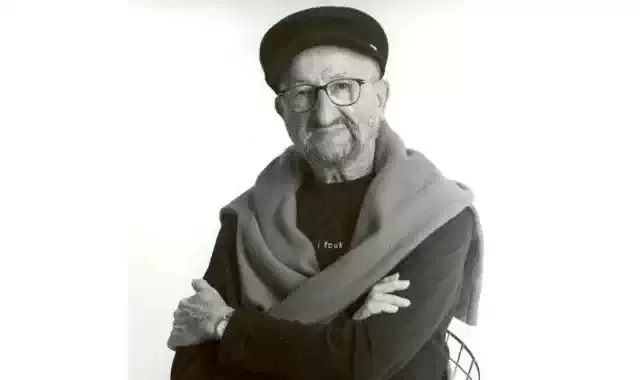
Décio Pignatari
1927–2012
· lived 85 years
 BR
BR
BR
Décio Pignatari was a Brazilian poet, translator, and essayist, a central figure of concretism. His work is marked by formal experimentation and the search for a concise and visual poetic language, exploring the relationships between word, image, and sound, and addressing contemporary themes with a critical and innovative perspective.
n. 1927-08-20, Jundiaí · m. 2012-12-02, São Paulo
38
Views
Bio
Identification and basic context
Décio Pignatari was a prominent Brazilian poet, translator, essayist, and literary critic, considered one of the founders and theorists of the Concrete movement in Brazil. Born in São Paulo, his literary output spanned decades, leaving a significant legacy in experimental poetry and cultural criticism.Childhood and education
Décio Pignatari was born into a family of intellectuals and received a vast and diversified intellectual education. He had contact with various literary and artistic currents from an early age, which contributed to his innovative and experimental vision. His studies and readings were fundamental to the development of his theories on poetry and language.Literary career
Décio Pignatari's literary career is inseparable from his involvement in Concrete poetry, a movement of which he was one of the main ideators alongside Augusto de Campos and Haroldo de Campos. From the outset, Pignatari sought to break away from traditional poetic forms, exploring the visuality of the poem, the conciseness of language, and the relationship between the word and other means of expression. His work as a translator and essayist was also fundamental in disseminating Concrete ideas and reflecting on poetic language.Work, style, and literary characteristics
Work, style, and literary characteristics Décio Pignatari's work is characterized by formal experimentation and the search for a poetic language that integrates visuality, sonority, and conciseness. He is one of the exponents of Concrete poetry, with poems that often resemble diagrams or verbal sculptures, where white space and the graphic arrangement of words are as important as their literal meaning. Recurring themes in his work include criticism of consumer society, reflection on language and communication in the modern era, exploration of eroticism, and the deconstruction of myths. His language is often marked by irony, wordplay, and synthesis. Pignatari stood out for his innovation in the use of free verse, exploring the page as a space for visual and sonic creation. His ability to connect poetry with other arts, such as graphic design and music, is a remarkable characteristic.Work, style, and literary characteristics
Cultural and historical context Décio Pignatari was active during a period of intense cultural effervescence in Brazil, especially in the 1950s and 1960s, with the emergence and consolidation of the Concrete movement. He was involved in debates about modernity, Brazilian cultural identity, and the role of art in society. His work engages with international avant-garde movements but seeks a language that also reflects Brazilian reality.Work, style, and literary characteristics
Personal life Décio Pignatari led a life dedicated to study and intellectual production. His work as a university professor and his active participation in literary and cultural debates shaped his career. His relationships with other artists and intellectuals of his generation, especially the other Concrete poets, were fundamental for the exchange of ideas and the development of his artistic and theoretical projects.Work, style, and literary characteristics
Recognition and reception Décio Pignatari received wide recognition for his contribution to poetry and literary theory, especially within the scope of Concrete poetry. His work is studied in universities, and its importance is highlighted in anthologies and literary criticism. The recognition of his work as a translator and essayist is also notable, solidifying his position as a reference intellectual.Work, style, and literary characteristics
Influences and legacy Pignatari was influenced by various avant-garde currents, such as Futurism, Dadaism, and Surrealism, in addition to delving into studies on semiotics and linguistics. His legacy is immense, mainly for consolidating Concrete poetry as a relevant artistic movement in Brazil and worldwide. His work continues to inspire poets and artists who seek to innovate in language and explore the expressive possibilities of the word.Work, style, and literary characteristics
Interpretation and critical analysis Décio Pignatari's work is a fertile ground for critical analysis, especially concerning the relationship between form and content, language and society. His poetic innovations are frequently discussed from the perspective of semiotics and communication theory. The critiques he makes of modern society through his poems are also a central point of study.Work, style, and literary characteristics
Curiosities and lesser-known aspects Lesser-known aspects of his life may include details about his creative process, his reading and writing habits, or episodes that reveal his human side beyond the rigorous intellectual. His work as a translator of several important works is also an area to be explored to understand the breadth of his interests and knowledge.Work, style, and literary characteristics
Death and memory Décio Pignatari passed away in São Paulo, leaving an expressive legacy in Brazilian poetry and literary criticism. His memory is preserved through the continued study of his work, posthumous publications, and the influence he exerted on subsequent generations of artists and thinkers.Poems
0No poems found
Comments (0)
Log in
to post a comment.
No comments yet. Be the first to comment.