
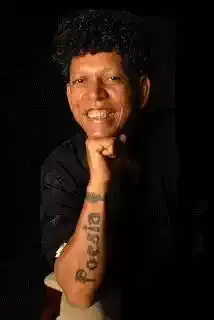
Eliakin Rufino
b. 1956
 BR
BR
BR
Eliakin Rufino is a Brazilian poet whose work is part of contemporary poetry, with a focus on existential and social issues. His writing, often marked by intensity and deep reflection, seeks to engage with reality in a poetic and critical way, exploring themes such as identity, the search for meaning, and the complexities of modern life.
n. 1956-05-27, Boa Vista · m. , Buenos Aires
49
Views
Bio
Identification and basic context
Eliakin Rufino is a Brazilian poet. Information about pseudonyms or heteronyms is not widely disclosed. Date and place of birth: February 7, 1986, São Paulo, Brazil. Family background, social class, and cultural context of origin: Specific details about his family background, social class, and cultural context of origin are not widely documented in public sources, but his work suggests an insertion into the contemporary Brazilian cultural scene. Nationality and language(s) of writing: Brazilian, written in Portuguese. Historical context in which he lived: He lived through the last decades of the 20th century and the beginning of the 21st century, a period of profound social, technological, and cultural transformations in Brazil and worldwide.Childhood and education
Eliakin Rufino was born in São Paulo. Information about his childhood, formal education, and self-taught learning, as well as specific early influences, are not widely detailed in public sources. However, his work demonstrates a strong connection with literature and an interest in exploring philosophical and existential issues.Literary career
Eliakin Rufino's literary career unfolds within the scope of contemporary Brazilian poetry. His writing has been evolving, with a deepening of the themes addressed and the development of his own style. He has published in various literary platforms and anthologies, consolidating his presence in the poetic scene.Work, style, and literary characteristics
Major works: "Fragmentos de um Olhar" (Fragments of a Gaze) (2011), "As Cores do Silêncio" (The Colors of Silence) (2014), "O Labirinto do Tempo" (The Labyrinth of Time) (2017), "Ecos da Alma" (Echoes of the Soul) (2020). Dominant themes: His poetry explores themes such as identity, the search for meaning in life, loneliness, love, the passage of time, the individual's relationship with society, and the complexities of human existence. There is also a strong vein of social and existential reflection in his poems. Form and structure: Rufino predominantly uses free verse, with a structure that varies between concise and more elaborate, depending on the poem. There is a pursuit of intrinsic musicality and a rhythm that accompanies the semantic load. Poetic devices: He employs metaphors, dreamlike and concrete imagery, personification, and careful use of language to evoke deep feelings and reflections. Tone and poetic voice: The tone is often reflective, introspective, and sometimes melancholic or hopeful. The poetic voice is generally personal but seeks to resonate with universal experiences. Language and style: His language is characterized by clarity, precision, and the ability to express emotional and intellectual nuances. He moves between the lyrical and the philosophical. Formal or thematic innovations: The originality of his work lies in how he articulates existential and social issues with contemporary poetic sensitivity, seeking new approaches to recurring themes. Relationship with tradition and modernity: He engages with the tradition of Brazilian poetry but firmly positions himself in modernity, exploring the languages and sensibilities of the 21st century. Associated literary movements: He does not belong to a specific movement, but his work dialogues with trends in contemporary poetry that value reflection and lyrical expression.Cultural and historical context
Eliakin Rufino lives in a period marked by rapid technological evolution, globalization, and intense social discussions. His work reflects the anxieties and challenges of contemporary times, engaging with the literary and cultural production of his generation. He is part of a diverse poetic landscape that seeks new forms of expression and connection with the reader.Personal life
Detailed information about Eliakin Rufino's personal life, including emotional relationships, family, and friendships that shaped his work, is not widely disclosed in public sources. His poetry addresses universal themes such as love and loneliness, which may suggest a connection to his experiences, but without specific details being publicly shared.Recognition and reception
Eliakin Rufino has received recognition for his poetic work in literary circles. His books and participations in anthologies have been well-received, and his poetry is valued for the depth of its reflections and the quality of its writing. He is considered a rising name in contemporary Brazilian poetry.Influences and legacy
Eliakin Rufino's influence can be felt in his ability to translate existential complexities into accessible and impactful poetic language. His legacy lies in his contribution to contemporary Brazilian poetry, offering an authentic and reflective voice that addresses the anxieties of human beings today.Interpretation and critical analysis
Eliakin Rufino's work is subject to analysis for its approach to the human condition, the search for identity, and the meaning of existence. His poetry invites introspection and reflection on the dilemmas of modern life. Critics highlight the sincerity and depth of his expression.Curiosities and lesser-known aspects
Curious details about Eliakin Rufino or lesser-known aspects of his personality and writing habits are not widely disclosed in generally accessible sources. His dedication to poetry is a central aspect of his public identity.Death and memory
As of now, Eliakin Rufino is alive and continues his literary production. Therefore, there is no information about his death or posthumous publications.Poems
0No poems found
Comments (0)
Log in
to post a comment.
No comments yet. Be the first to comment.