
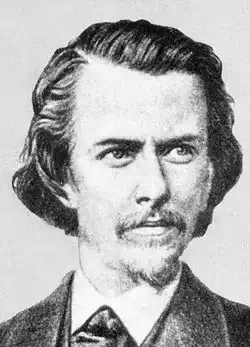
Fagundes Varela
1841–1875
· lived 33 years
 BR
BR
BR
Luís Nicolau Fagundes Varela was a Brazilian poet, a prominent figure of Romanticism in his country. His work is characterized by sensitivity, melancholy, and themes such as love, death, and religiosity, with a strong influence from European Romanticism. He was also an intellectual engaged in social and political debates of his time.
n. 1841-08-17, São João Marcos · m. 1875-02-18, Niterói
51
Views
Bio
Identification and Basic Context
Luís Nicolau Fagundes Varela, known as Fagundes Varela, was a Brazilian poet. He was born in Rio de Janeiro on February 17, 1841, and died in the same city on April 18, 1875. He is one of the central figures of the second generation of Brazilian Romanticism, also known as the "Ulraromantic Generation" or "Mal du Siècle" (Sickness of the Century). He wrote in Portuguese.Childhood and Education
Fagundes Varela had a childhood marked by family losses and fragile health. His intellectual formation was influenced by reading European romantic poets, such as Lord Byron and Alfred de Musset, and by the intellectual atmosphere of Rio de Janeiro in the 19th century. The melancholy and pessimism that marked his work were, in part, shaped by his personal experiences and the cultural atmosphere of the time.Literary Career
The beginning of his literary career occurred in his youth, with the publication of poems in newspapers and magazines. His work evolved over time but retained the mark of ultraromanticism, focusing on themes such as idealized love, the ephemerality of life, death, and longing. He published in "Obras Poéticas" (1861), "Rimas" (1865), and "Cantos de Vária Natureza" (1866).Work, Style, and Literary Characteristics
Fagundes Varela's main works include "Obras Poéticas" and "Rimas." His dominant themes are platonic and unrequited love, death as liberation, nature as a mirror of the soul, and profound melancholy. He predominantly used the sonnet and other fixed forms, with a style marked by musicality, elevated language, and exacerbated sentimentalism. The tone is elegiac and confessional, reflecting a poetic voice immersed in pain and longing. His language is rich in adjectives and images that evoke fragility and transience. Fagundes Varela is an exponent of ultraromanticism, with a strong influence from Byron.Work, Style, and Literary Characteristics
Cultural and Historical Context Fagundes Varela lived in a period of important debates in Brazil, including abolitionist and republican issues, although his work does not have direct political engagement. His generation, ultraromanticism, marked a period of introspection and intense subjectivity in Brazilian literature, in contrast to the Indianist nationalism of the first romantic generation. He was a contemporary of Castro Alves, with whom he maintained a friendship and literary rivalry.Work, Style, and Literary Characteristics
Personal Life Fagundes Varela's personal life was marked by tragedy and illness. The loss of his fiancée, who inspired many of his poems, and his own poor health contributed to the melancholic tone and obsession with death in his work. He did not live off poetry, having held public office.Work, Style, and Literary Characteristics
Recognition and Reception Fagundes Varela is widely recognized as one of the greatest poets of Brazilian Romanticism. His work was well-received at the time and has become consolidated over time as one of the pillars of national poetry. His popularity with readers of the time was high, and his academic recognition is unquestionable.Work, Style, and Literary Characteristics
Influences and Legacy He was influenced by poets such as Lord Byron and Alfred de Musset. His legacy is the consolidation of ultraromanticism in Brazil and the influence on poets who explored similar themes. His poetry, although seen as dated by some later critics, is still studied for its historical and aesthetic importance.Work, Style, and Literary Characteristics
Interpretation and Critical Analysis Fagundes Varela's work is often analyzed from the perspective of the "Mal du Siècle," exploring existential anguish, maladjustment to reality, and the search for an unattainable ideal. Criticism discusses the intensity of his sentimentalism and his contribution to Brazilian love and elegiac lyricism.Work, Style, and Literary Characteristics
Curiosities and Lesser-Known Aspects One of the best-known aspects of his life is the profound melancholy that accompanied him and is reflected in his verses. His fragile health and romantic losses are recurring themes in his biography and his work.Work, Style, and Literary Characteristics
Death and Memory Fagundes Varela died young, at the age of 34, due to an illness. His premature death reinforced the image of the poet as a sensitive being destined for a brief life, fueling the romantic aura around his figure. His complete works were gathered and published after his death, ensuring their preservation and dissemination.Poems
0No poems found
Comments (0)
Log in
to post a comment.
No comments yet. Be the first to comment.