
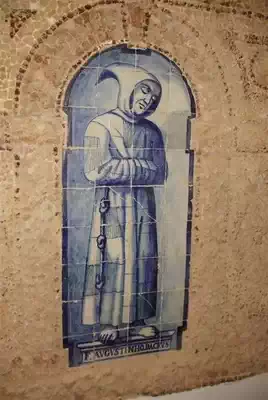
Frei Agostinho da Cruz
1540–1619
· lived 79 years
 PT
PT
PT
Friar Agostinho da Cruz was a 17th-century Portuguese friar and poet, a prominent figure of the literary Baroque. His poetic work, marked by spirituality and mysticism, reflects the profound religiosity of the era and the tension between the earthly and the divine. It is characterized by cultivated language, the exploration of themes such as the love of God, the ephemerality of life, and the search for transcendence, often through traditional poetic forms.
n. 1540-05-03, Ponte da Barca · m. 1619-05-14, Setúbal
8
Views
Bio
Identification and basic context
Friar Agostinho da Cruz, whose secular name is uncertain, was a Portuguese friar and poet, born in the mid-17th century. He is a relevant figure of the Baroque period in Portugal. He wrote in Portuguese.Childhood and education
Little is known about the childhood and specific education of Friar Agostinho da Cruz, but his entry into religious life, in a convent of the Order of Saint Francis, profoundly shaped his worldview and his literary production. His training within the religious order instilled in him a strong theological and philosophical foundation, which would be central to his work.Literary career
The literary career of Friar Agostinho da Cruz is intrinsically linked to his religious life. His poetry, predominantly mystical and spiritual in nature, flourished in the context of the Baroque. He published his most significant work, "Flores de Apolo" (Flowers of Apollo), which brought together poems on various themes, but with a strong religious and moral leaning.Work, style, and literary characteristics
The work of Friar Agostinho da Cruz is an exponent of Portuguese Baroque, with an emphasis on mysticism and spirituality. Dominant themes include divine love, contemplation of God, the ephemerality of earthly life, penance, and the search for salvation. His language is cultivated, rich in metaphors and hyperboles, characteristic of the Baroque style, with a strong use of antitheses and paradoxes to express the tension between the spiritual and the material. He frequently used traditional poetic forms, such as the sonnet, but with unique intensity and depth. The tone of his poetry is generally devotional and introspective.Cultural and historical context
Friar Agostinho da Cruz lived in a period of intense religiosity and profound social and political transformations in Portugal, marked by the Restoration of Independence and the hegemony of the Society of Jesus in the intellectual landscape. His work is part of the Baroque context, a period of formal exuberance and intense spirituality, often in response to the uncertainties and turbulences of the time. His poetic production reflects the religious environment and the literary production of his era.Personal life
As a friar, the personal life of Friar Agostinho da Cruz was governed by the rules of his religious order. His experiences and his dedication to monastic and spiritual life were the raw material for his poetry. The pursuit of union with the divine and reflection on the human condition were central to his existence.Recognition and reception
Although his work circulated mainly in religious and scholarly circles of the time, Friar Agostinho da Cruz is today recognized as an important poet of the Portuguese Baroque, with a distinct mystical voice. His inclusion in anthologies of religious and Baroque poetry attests to his literary relevance.Influences and legacy
Friar Agostinho da Cruz was influenced by the Christian mystical tradition and by the religious poets of his time. His legacy lies in his ability to translate mystical experience and the depth of faith into verse, contributing to the diversity of Portuguese Baroque poetry. His work is studied as an example of religious expression in literature.Interpretation and critical analysis
The work of Friar Agostinho da Cruz is often interpreted in light of mystical theology and ascetic philosophy. Critical analyses highlight his ability to combine poetic form with the expression of complex states of soul, such as spiritual ecstasy and the suffering of the soul in search of God.Curiosities and lesser-known aspects
The fact that his secular identity is little known contributes to a certain mystery surrounding his figure, accentuating the idea that his work is the expression of a soul dedicated to the divine. His poetry, despite a often melancholic tone, is also a hymn to divine love.Death and memory
Friar Agostinho da Cruz died during the 17th century. His work, especially "Flores de Apolo", has survived the passage of time, and is today valued for its literary merits and its importance in the context of the Portuguese Baroque.Poems
0No poems found
Comments (0)
Log in
to post a comment.
No comments yet. Be the first to comment.