
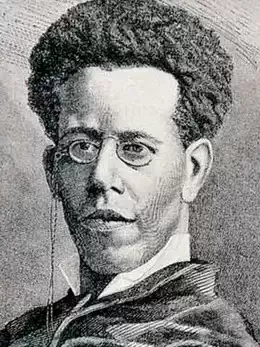
Gonçalves Crespo
1846–1883
· lived 37 years
 BR
BR
BR
António Feliciano de Castilho was a Portuguese poet and writer, a prominent figure of Romanticism in Portugal. His work is marked by tender and religious lyricism, exploring themes such as faith, nature, and saudade. He was a fervent defender of the Portuguese language and an influential mentor to generations of writers. His vast literary output encompasses poetry, prose, and translation, leaving a lasting legacy in Lusophone literature.
n. 1846-03-11, Rio de Janeiro · m. 1883-06-11, Lisboa
46
Views
Bio
Identification and Basic Context
António Feliciano de Castilho e Correia da Silva was a Portuguese poet, writer, translator, and pedagogue. He was born in Lisbon and lived most of his life in the capital, but spent long periods in Alferrarede, where he owned property.Childhood and Education
Castilho became blind at the age of six due to an illness. However, his visual impairment did not prevent him from becoming one of the most cultured and prolific Portuguese writers of the 19th century. He was educated at home and showed a remarkable talent for writing and language learning from an early age. His readings and his memory skills compensated for the absence of sight.Literary Career
His literary career began early, with the publication of his first poems during his adolescence. Castilho had an extensive and multifaceted literary career, encompassing poetry, prose, literary criticism, translation, and pedagogy. He was a central figure in the Portuguese literary scene, associated with the Romantic current, albeit with his own characteristics.Work, Style, and Literary Characteristics
Castilho's work is vast and diverse. In poetry, his religious themes, nature, saudade, and love stand out. His style is marked by tender lyricism, careful language, and unparalleled musicality. He published several works, including "A Primavera", "Os Ciúmes do Bardo", "Escavações Poéticas", and "A Noite do Castelo". He was also a notable translator, rendering works by Homer, Virgil, and Camões, among others, into Portuguese. A striking characteristic of his work was his dedication to education and the dissemination of the Portuguese language.Cultural and Historical Context
Castilho lived in a time of great transformations in Portugal, marked by Liberalism, the Liberal Wars, and intense cultural debate. He was an intellectual of great prestige, close to the academic and literary circles of the time. His work reflects the values and concerns of Portuguese Romanticism, but also a social and religious conservatism that put him at odds with the authors of the Generation of '70.Personal Life
Blind from an early age, Castilho developed extraordinary memory and hearing abilities. He married Ana da Piedade de Castilho and had children. He was known for his religiosity and affable character, but also for his stubbornness in defending his literary and ideological positions. He was an influential member of the Lisbon Academy of Sciences.Recognition and Reception
Castilho was one of the most popular and acclaimed poets of his time, receiving various tributes and distinctions. However, his work was also subjected to fierce criticism from the Generation of '70, who accused him of anachronism and of defending an archaic literary language. Despite the controversies, his place in the history of Portuguese literature is undeniable.Influences and Legacy
Castilho was influenced by classical and romantic authors. His legacy lies in his vast poetic and translational work, his dedication to the Portuguese language, and his influence on many writers who admired him. His defense of literary tradition and the cultivated norm of the language marked 19th-century Portuguese literature.Interpretation and Critical Analysis
Castilho's work has been the subject of various interpretations, being valued for its lyricism and musicality, but criticized for a certain formal and thematic conservatism. His positions in defense of the Portuguese language and against the innovations of the Generation of '70 marked the literary debate of his time.Curiosities and Lesser-Known Aspects
His early blindness did not prevent him from becoming an expert in languages and literature. He developed a prodigious memory that allowed him to recite long passages from literary works. He was also an excellent pianist.Death and Memory
António Feliciano de Castilho passed away in Lisbon. His memory is celebrated as that of one of the greatest Portuguese romantic poets, whose works continue to be studied and appreciated for their beauty and historical importance.Poems
0No poems found
Comments (0)
Log in
to post a comment.
No comments yet. Be the first to comment.