
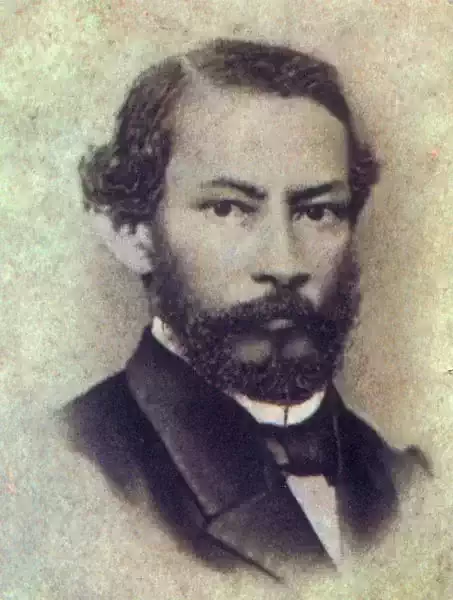
Gonçalves Dias
1823–1864
· lived 41 years
 BR
BR
BR
Antônio Gonçalves Dias was one of the main poets of the first generation of Brazilian Romanticism, known as "Indianism." His work is marked by the exaltation of Brazilian nature and the idealized figure of the indigenous person as a national hero. His poetry, of great lyricism and musicality, celebrated Brazil's identity and landscape, contributing to the formation of a national literary consciousness and the valorization of the country's cultural roots.
n. 1823-08-10, Caxias · m. 1864-11-03, Guimarães
59
Views
Bio
Identification and Basic Context
Antônio Gonçalves Dias was born on August 10, 1823, in Caxias, Maranhão, and passed away on November 3, 1864, included, Portugal. He is considered one of the greatest poets of the first generation of Brazilian Romanticism, the Indianist phase. His work is fundamental to the construction of Brazilian national identity, through the exaltation of the homeland, the exuberant nature, and the figure of the indigenous person as a national hero. His nationality was Brazilian, and he wrote in Portuguese.Childhood and Education
Gonçalves Dias's childhood was marked by his mixed-race origin, being the son of a white Portuguese man and a mulatto woman. This condition, which could have been seen as an obstacle, was transformed by him into one of the pillars of his work, by celebrating Brazilian diversity. He studied in Coimbra, Portugal, where he graduated in Law, absorbing influences from European Romanticism. His academic training and travels through Brazil and Europe enriched his worldview and poetic sensibility.Literary Career
His entry into literature occurred with the publication of "Primeiros Cantos" (First Songs) (1846), a work that established him as the main voice of Indianist Romanticism. In "Segundos Cantos" (Second Songs) (1848) and "Últimos Cantos" (Last Songs) (1851), he consolidated his style and deepened themes such as love, longing, and patriotism. He also worked as a professor, journalist, and member of the Brazilian Historical and Geographical Institute, dedicating himself to research and the preservation of national memory. His work, although concentrated in a relatively short period, had a lasting impact.Work, Style, and Literary Characteristics
Gonçalves Dias's best-known works include "Canção do Exílio" (Song of Exile), "I-Juca Pirama," "Os Timbiras," and "Meditação" (Meditation). The central themes of his poetry are the exaltation of the homeland, Brazilian nature, idealized love, and the figure of the indigenous person as a symbol of Brazil's strength and purity. His style is characterized by intense lyricism, unique musicality, and a language that seeks to express the country's feelings and beauties. He used free verse and fixed forms, with great rhythmic mastery. The poetic voice is often personal and effusive, conveying a deep love for Brazil. He was a pioneer in creating genuinely Brazilian poetry, breaking away from purely European models and finding inspiration in the land and its people.Cultural and Historical Context
Gonçalves Dias lived during the Second Reign, a period of consolidation of the Brazilian State and the search for a national identity. Indianist Romanticism was a movement that aligned with this need, finding in the indigenous person the ideal representative of Brazil's original purity and strength. His work engaged with the nationalist aspirations of the intellectual elite of the time and the desire to build a distinctly Brazilian culture.Personal Life
His life was marked by travels, both within Brazil and abroad. The longing for his homeland, felt during his studies in Portugal, became a recurring theme in his work. He married and had children, but his life was tragically cut short by tuberculosis, a disease that also affected other members of his family. His dedication to poetry and studies about Brazil was evident, and he sought to balance his literary production with public service.Recognition and Reception
Gonçalves Dias achieved great recognition during his lifetime as the leading poet of his generation and one of the founders of Brazilian literature. "Canção do Exílio" became an unofficial national anthem, sung by generations. His work was enthusiastically received by critics and the public, consolidating his place in the Brazilian literary canon as the father of Indianism and one of the greatest lyric poets of our literature.Influences and Legacy
Gonçalves Dias was influenced by European romantic poets, such as Almeida Garrett and Lord Byron, but he managed to transpose these influences to the Brazilian reality. His legacy is immeasurable for the formation of Brazil's literary identity. He inspired countless writers and artists to look at the land and its people with pride and admiration, making the indigenous person a national symbol and Brazilian nature a central literary theme. His work continues to be studied and celebrated for its beauty and its role in the construction of Brazilianness.Interpretation and Critical Analysis
Literary criticism has highlighted in Gonçalves Dias his ability to create a poetic language that reflects the Brazilian soul, combining romantic lyricism with the exaltation of the land. The idealization of the indigenous person is a frequently addressed point, seen as a strategy to build a national hero in a country without European epic traditions. His work is considered a milestone in the search for authentically national literature.Curiosities and Lesser-Known Aspects
A curiosity is that, despite his fame, Gonçalves Dias died in Portugal, far from his homeland, due to an illness. "Canção do Exílio" is so emblematic that verses like "My land has palm trees / Where the Sabiá sings" have become synonymous with Brazilianness. He also dedicated himself to ethnographic studies of indigenous peoples, showing an interest that went beyond mere poetic inspiration.Death and Memory
Gonçalves Dias passed away on November 3, 1864, included, Portugal, where he was seeking treatment for tuberculosis. His premature death, at the age of 41, left a great void in Brazilian literature. His memory is perpetuated as one of the pillars of our literature, the poet who gave voice to the homeland and its people, immortalizing Brazil's beauty in immortal verses.Poems
0No poems found
Comments (0)
Log in
to post a comment.
No comments yet. Be the first to comment.