
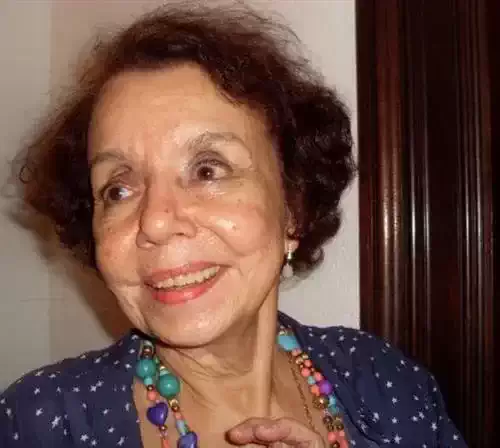
Helena Parente Cunha
1929–2023
· lived 94 years
 BR
BR
BR
Helena Parente Cunha was a Brazilian poet, essayist, and literary critic. Her poetic work is marked by reflective depth, exploring themes such as memory, time, and the human condition with precise and evocative language. As an essayist and critic, she dedicated herself to the analysis of Brazilian literature, with special attention to modern and contemporary poetry.
n. 1929, Salvador · m. 2023-02-11
19
Views
Bio
Identification and basic context
Helena Parente Cunha was a prominent Brazilian poet, essayist, and literary critic. Born in Rio de Janeiro, she lived much of her life in the city. Her work encompasses both poetic creation and critical reflection on literature, consolidating her as an important figure in the Brazilian cultural scene.Childhood and education
Raised in Rio de Janeiro, her intellectual formation was marked by an environment of interest in arts and letters. She deepened her studies in literature, which would be fundamental to her career as an essayist and critic.Literary career
Helena Parente Cunha's literary career began with poetry, but quickly expanded to the writing of essays and literary criticism. Her poetic work is characterized by lyrical and reflective density, while her critical texts profoundly analyzed Brazilian poetry, especially modern and contemporary. She collaborated in various publications, disseminating her sharp insight into literary production.Work, style, and literary characteristics
Work, style, and literary characteristics Among her poetic works, "O Verbo e o Tempo" and "Música de Câmera" stand out. Her poetic style is marked by conciseness, the exploration of subtle imagery, and thematic depth, addressing memory, the ephemerality of time, the human condition, and the nature of language itself. In her essays, she demonstrated a profound knowledge of Brazilian literature, analyzing authors and movements with rigor and sensitivity. Her criticism is recognized for its clarity, precision, and ability to dialogue with works in a way that reveals their complexities.Work, style, and literary characteristics
Cultural and historical context Helena Parente Cunha lived and produced in a period of cultural and literary effervescence in Brazil, especially in Rio de Janeiro. Her role as a critic contributed to the debate and understanding of the literature produced in her time, engaging with other intellectuals and artists.Work, style, and literary characteristics
Personal life Although the details of her personal life are less publicized compared to her intellectual work, her dedication to literature permeated her existence, influencing her relationships and her worldview.Work, style, and literary characteristics
Recognition and reception Helena Parente Cunha gained recognition for her work, both poetic and critical. Her role as an essayist and literary critic earned her a prominent place in the study of Brazilian literature, serving as a reference for new generations of researchers and readers.Work, style, and literary characteristics
Influences and legacy Her work, both poetic and critical, is influenced by a solid literary background and a deep dialogue with the tradition and modernity of Brazilian poetry. Her legacy lies in her contribution to the understanding of Brazilian poetry, in her own lyrical production, and in the way she articulated creation with criticism.Work, style, and literary characteristics
Interpretation and critical analysis Helena Parente Cunha's work is often interpreted as a meditation on language, memory, and temporality. Her poetry invites introspection, while her essays offer tools for in-depth analysis of literature.Work, style, and literary characteristics
Curiosities and lesser-known aspects Her dedication to poetry and criticism reveals a personality deeply oriented towards the word and its multiple dimensions.Work, style, and literary characteristics
Death and memory Helena Parente Cunha passed away in Rio de Janeiro, leaving an important legacy for Brazilian literature, both in her poetic work and in her contribution to literary criticism.Poems
0No poems found
Comments (0)
Log in
to post a comment.
No comments yet. Be the first to comment.