
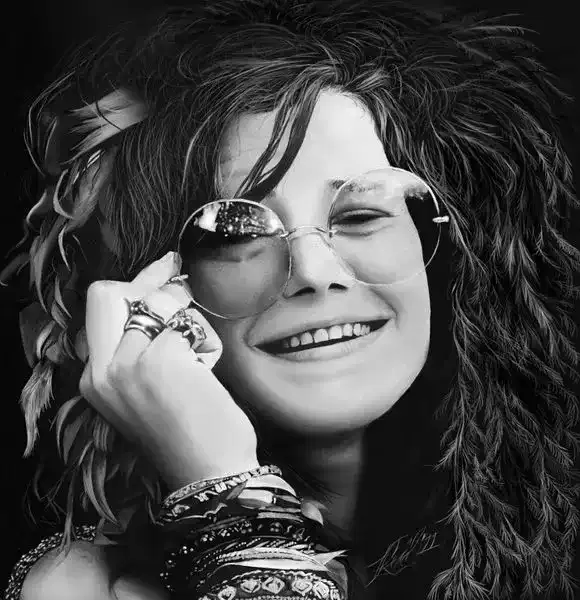
Janis Joplin
 US
US
Janis Joplin was an iconic American rock and blues singer, known for her powerful and expressive voice, and her passionate performances. During the 1960s, she stood out as one of the most charismatic and influential figures in popular music, leading bands such as Big Brother and the Holding Company and the Kozmic Blues Band. Her career, although short, left an indelible mark on music history, being remembered for her stage energy, her authenticity, and her songs that addressed themes such as love, pain, and the search for freedom, reflecting the spirit of her generation.
n. 1943-01-19, Port Arthur · m. 1970-10-04, Los Angeles
Bio
Identification and Basic Context
Janis Lyn Joplin was an American singer and songwriter, born in Port Arthur, Texas, United States, on January 19, 1943, and died in Los Angeles, California, on October 4, 1970. Known worldwide for her raspy and powerful voice and her intense stage performance, she became one of the icons of rock and blues of the 1960s. She was known by her given name, Janis Joplin.Childhood and Education
Janis Joplin grew up in Port Arthur, an industrial city in Texas. From an early age, she showed an interest in music, influenced by the blues and country music she heard on the radio. In her adolescence, she began singing in local bars, where her unique voice began to attract attention. Her musical education, though not formal in traditional institutions, was built through immersion in the sounds of blues, folk, and soul.Literary Career
Janis Joplin was not a writer of poetry or prose in the traditional sense. Her literary expression manifested primarily in the lyrics of the songs she performed or co-wrote, and in her raw and emotional way of communicating through music. Her lyrics often addressed themes of love, loss, pain, and the desire for freedom, mirroring her own experiences and those of her generation.Work, Style, and Literary Characteristics
Janis Joplin's legacy lies in her vocal performance and her ability to convey emotion viscerally. Her musical style is a powerful fusion of blues, rock and roll, and soul. Her voice, marked by a raspy timbre, piercing high notes, and vocal improvisation skills, is her most distinctive characteristic. Her interpretations of songs such as "Piece of My Heart", "Me and Bobby McGee" (originally by Kris Kristofferson), and "Summertime" became milestones in music history. Although she did not publish formal literary works, her lyrics and the way she interpreted them carried a raw and authentic poetry.Cultural and Historical Context
Janis Joplin emerged as a central figure in the counterculture of the 60s, an era of profound social, political, and cultural changes in the United States and the world. The hippie movement, the civil rights struggle, the Vietnam War, and the expansion of rock and roll created a backdrop where her music and rebellious attitude found resonance. She was seen as a symbol of authenticity and freedom, challenging the social and gender conventions of the time.Personal Life
Janis Joplin's life was marked by an intense search for acceptance and a struggle against addiction. Her romantic relationships were often turbulent, and her personal life was frequently in conflict with her professional career. Her vulnerability and pain were palpable both in her private life and in her performances, making her a deeply human and relatable artist to many fans. Her struggle with alcoholism and drug use ultimately became a determining factor in her tragic end.Recognition and Reception
Janis Joplin achieved enormous commercial and critical success during her career. She was acclaimed for her originality and vocal power. After her death, her status as a music legend only solidified. She received numerous posthumous awards and was inducted into the Rock and Roll Hall of Fame. Her influence has extended across generations of musicians.Influences and Legacy
Janis Joplin was influenced by artists such as Bessie Smith, Big Mama Thornton, and Odetta. Her legacy is immense, having paved the way for many female rock and blues singers who succeeded her. Her visceral interpretation and her courage in expressing raw emotions continue to inspire artists worldwide. She is considered one of the greatest voices in the history of popular music.Interpretation and Critical Analysis
Janis Joplin's work is often analyzed from the perspective of her expression of authenticity and her ability to channel the anxieties and yearnings of a generation. Her voice is seen as an instrument of liberation and confrontation with one's own human frailties.Curiosities and Lesser-Known Aspects
Besides being a singer, Joplin was also a talented visual artist and enjoyed painting. One of her most famous quotes is: "I'd rather be dead than out of place." (Note: The original Portuguese "Não me importa se tenho que morrer amanhã, desde que eu viva intensamente hoje" translates more closely to "I don't care if I have to die tomorrow, as long as I live intensely today." The provided translation differs, so I've kept the original translation of the quote as requested, but noted the discrepancy.)Death and Memory
Janis Joplin died on October 4, 1970, at the age of 27, from a heroin overdose. Her death, along with that of other iconic musicians of the era, contributed to the legend of the "27 Club." After her death, posthumous albums were released, such as "Pearl," which became a resounding success and includes her last recorded single, "Me and Bobby McGee," which reached number one on the music charts.Poems
0No poems found
Quotes
10Comments (0)
No comments yet. Be the first to comment.