
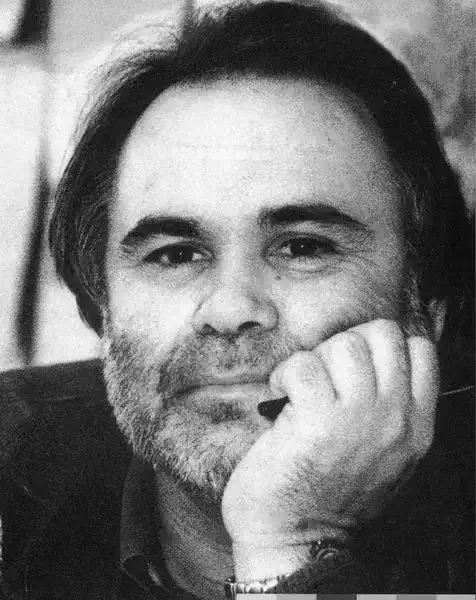
Joaquim Pessoa
1948–2023
· lived 75 years
 PT
PT
PT
Joaquim Pessoa was a Portuguese poet and essayist, a prominent figure in contemporary literature. His work is distinguished by its intelligence, irony, and a profound reflection on the human condition, culture, and memory. Pessoa masterfully explored language, weaving a dialogue between the personal and the universal, tradition and modernity, leaving a legacy of incisive texts of great intellectual rigor.
n. 1948-02-22, Barreiro · m. 2023-04-17, Lisboa
41
Views
Bio
Identification and Basic Context
Joaquim Pessoa was a Portuguese poet, essayist, and professor. Born in Lisbon, Portugal, on November 25, 1942, he passed away in the same city on July 24, 2021. He was a central figure in Portuguese literature of the second half of the 20th century and the beginning of the 21st century. His nationality was Portuguese, and his predominant written language was Portuguese. He lived during a period of significant political and social changes in Portugal, from the Salazar dictatorship to the consolidation of democracy.Childhood and Education
Joaquim Pessoa grew up in a family environment that, although not explicitly detailed regarding social class, provided him with a solid education. He attended the University of Lisbon, where he studied Germanic Philology, revealing an early interest in languages and foreign cultures. His academic training and reading of diverse authors shaped his critical thinking and literary sensitivity, absorbing influences ranging from classical poetry to modern European literature.Literary Career
Joaquim Pessoa's literary career began with the publication of his first poems and essays in the 1960s and 1970s. Over time, his work evolved, consolidating his own unmistakable style. He published several books of poetry and essays, participated in various anthologies, and was a regular contributor to newspapers and literary magazines, where he also worked as a literary critic. His activity as a university professor of comparative literature also influenced his vision and approach to writing.Work, Style, and Literary Characteristics
Among his most important poetic works are titles such as "O Tédio e Outras Poesias" (1973), "As Coisas" (1979), "A Outra Margem" (1989), and "A Forma das Coisas" (2006). The dominant themes in his work include memory, identity, the passage of time, reflection on art itself, and criticism of contemporary society. His style is marked by vocabulary precision, subtle irony, conceptual intelligence, and a poetic form that, although often close to free verse, demonstrates structural rigor and mastery of musicality. His poetic voice is simultaneously personal and universal, frequently lyrical but also essayistic. Pessoa engaged with the literary tradition but incorporated a modern and critical perspective, associated with a reflective postmodernism.Cultural and Historical Context
Joaquim Pessoa lived and produced his work in a context of transition and democratic consolidation in Portugal after 1974. He was an attentive observer of Portuguese and European society and culture, reflecting the tensions and transformations of his time in his works. He maintained relationships with other writers and intellectuals, actively participating in cultural debates. His generation, though not rigidly defined, shared a critical view of reality.Personal Life
Joaquim Pessoa dedicated a large part of his life to study and writing, being a university professor in Lisbon, where he taught Comparative Literature. His personal and family relationships, although not widely disclosed, certainly informed his worldview and poetic sensibility. His dedication to academia and literature was a constant throughout his life.Recognition and Reception
Joaquim Pessoa was widely recognized by critics and academia as one of the most important Portuguese poets and essayists of his generation. He received several literary awards throughout his career, and his work is studied in universities, consolidating his place in the Portuguese literary canon. His popularity extends to both academic circles and readers who appreciate more intellectualized and reflective poetry.Influences and Legacy
Joaquim Pessoa was influenced by a wide range of authors, from the classics to modern and contemporary poets. His work, in turn, significantly influenced younger poets and essayists, both through his intellectual rigor and his innovative approach to language and themes. His legacy lies in his ability to unite the depth of philosophical reflection with the formal excellence of poetry, establishing himself as an unavoidable reference in Portuguese-language literature.Interpretation and Critical Analysis
Joaquim Pessoa's work has been the subject of extensive critical analysis, exploring its thematic and formal complexity. Interpretations often focus on his relationship with memory, identity, and cultural criticism, as well as his constant questioning of the meaning of existence and art. There have been debates about the nature of his poetry, oscillating between the lyrical and the essayistic.Curiosities and Lesser-Known Aspects
Joaquim Pessoa was known for his sharp intellect and subtle irony. His dedication to research and teaching, combined with his literary production, demonstrates the breadth of his commitment to culture and knowledge. His writing habits were likely rigorous, given the precision and careful construction of his texts.Death and Memory
Joaquim Pessoa passed away in 2021, leaving behind a vast and influential body of work. His memory is honored through the continued reading, study, and appreciation of his literary and intellectual legacy, which remains a cornerstone of contemporary Portuguese literature.Poems
0No poems found
Comments (0)
Log in
to post a comment.
No comments yet. Be the first to comment.