
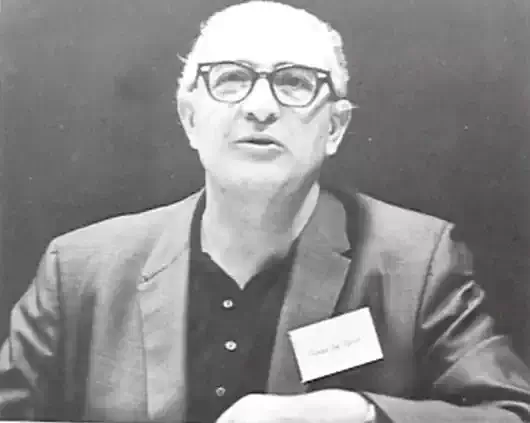
Jorge de Sena
 PT
PT
Jorge de Sena was a poet, translator, essayist, and university professor of great relevance in Portuguese-language literature. His poetic work is marked by erudition, existential reflection, and formal experimentation, addressing themes such as love, death, time, history, and the human condition with an intense and complex language. Distinguished by his critical intelligence and vast culture, Jorge de Sena left a significant legacy, not only in poetry but also in his literary studies and civic engagement, being an unavoidable figure in the intellectual landscape of the 20th century.
n. 1919-11-02, Lisboa · m. 1978-06-04, Santa Bárbara
Bio
Identification and basic context
Jorge de Sena, full name Jorge de São Romão Sequeira de Sena, was born on November 2, 1919, and passed away on June 4, 1978. He was of Portuguese nationality and wrote in Portuguese.Childhood and education
Born into an upper-middle-class family. His childhood was marked by fragile health and intense intellectual activity. He attended secondary school at Liceu Passos Manuel and Liceu Camões in Lisbon. He graduated in Civil Engineering from the University of Coimbra in 1945, but his literary vocation was always paramount. He absorbed influences from classical literature, philosophy, and existentialist thought. A significant event was his experience as a scholar at Columbia University in New York, where he deepened his literary studies and came into contact with American cultural effervescence.Literary career
The beginning of his poetic writing dates back to adolescence. His literary career is marked by continuous evolution, transitioning through different stylistic phases, always with a common thread of erudition and deep reflection. He published his poetic work from the 1940s onwards, with collections such as "Páginas" (1946) and "Os Poetas e os Dias" (1955). He actively collaborated in various literary and cultural publications, both in Portugal and abroad. He was also a notable translator and an influential literary critic and essayist.Work, style, and literary characteristics
His main poetic works include "Metamorfoses" (1963), "Fidelidade" (1971), and "Perguntas e Respostas" (1978). The dominant themes in his work are love, death, time, history, the human condition, identity, and homeland. Sena explored various poetic forms, from the sonnet to experimentation with free verse and innovative metrical structures. It is characterized by an intense rhythm, musicality, and abundant use of metaphors and rhetorical devices. The tone of his poetry can vary from lyrical to elegiac, from confessional to reflective, with a poetic voice that seeks universality through individual experience. His language is dense, erudite, and precise, marked by a strong imagistic charge. He introduced formal and thematic innovations, engaging with classical tradition and literary modernity, often associated with Modernism.Work, style, and literary characteristics
Cultural and historical context Jorge de Sena lived and wrote during a period of great historical and political upheaval, including the dictatorship of the Estado Novo in Portugal. His work reflects a deep critical awareness of the social and political reality, and his anti-fascist stance led to his exile. He belonged to a generation of intellectuals who sought to renew Portuguese culture. His work engages with contemporaries such as Sophia de Mello Breyner Andresen and Miguel Torga, but also with universal literary tradition.Work, style, and literary characteristics
Personal life He married the writer and literary critic Mértis Machado. His life was marked by experiences of voluntary exile and existential crises that shaped his worldview and his poetry. He was a university professor at various institutions in the United States, dedicating his life to teaching and literary research, in addition to his own creative work.Work, style, and literary characteristics
Recognition and reception Jorge de Sena is considered one of the greatest Portuguese poets of the 20th century, with a prominent place in Lusophone and international literature. He received several awards and distinctions throughout his career. His critical reception has been consistently high, recognizing the depth and quality of his work.Work, style, and literary characteristics
Influences and legacy Jorge de Sena was influenced by poets such as Fernando Pessoa, Luís de Camões, and by classical Greco-Latin poetry. He influenced later generations of poets and writers through his erudition, thematic complexity, and formal innovation. His work is part of the Portuguese literary canon and has been widely studied and translated.Work, style, and literary characteristics
Interpretation and critical analysis Jorge de Sena's work has been the subject of numerous critical analyses, highlighting his philosophical and existential depth, the complexity of his language, and the universality of his concerns. Critical debates often focus on the relationship between his personal life and his literary production.Work, style, and literary characteristics
Curiosities and lesser-known aspects Sena was known for his sharp intelligence and his argumentation skills. A curious aspect of his life is his engineering background, which contrasts with his deep dedication to the humanities. His manuscripts and correspondence reveal an intense creative process and a constant search for perfection.Work, style, and literary characteristics
Death and memory Jorge de Sena died of cancer in Santa Barbara, California. His works continue to be published, and his memory is preserved through studies, critical editions, and cultural events dedicated to his figure and work.Poems
0No poems found
Comments (0)
No comments yet. Be the first to comment.