
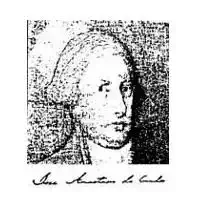
José Anastácio da Cunha
1744–1787
· lived 43 years
 PT
PT
PT
José Anastácio da Cunha was a Portuguese mathematician and poet, a prominent figure of the Enlightenment in Portugal. His poetic work, although less extensive than his scientific output, reveals a remarkable sensibility and a style that anticipates certain trends of Romanticism. He is remembered for his keen intellect and his contribution to various fields of knowledge, leaving a legacy that transcends the boundaries of science and literature.
n. 1744-01-01, Lisboa · m. 1787-01-01, Lisboa
25
Views
Bio
Identification and basic context
José Anastácio da Silva da Cunha was a distinguished Portuguese mathematician, poet, and thinker, born in 1744 and died in 1787. He is a representative figure of the late 18th century, a period of great intellectual and scientific effervescence in Portugal and Europe. His education and professional activity link him to the academic and scientific world of the time, but his curious and sensitive spirit also brought him closer to the world of letters.Childhood and education
José Anastácio da Cunha was born in Portugal, into a family that provided him with a solid education. He showed exceptional talent for mathematics from an early age, which led him to pursue higher studies at the University of Coimbra. His education was not limited to mathematics; he possessed vast knowledge in various fields of learning, including philosophy, literature, and natural sciences, revealing an encyclopedic spirit typical of the Enlightenment era.Literary career
Although he is better known for his contributions to mathematics, José Anastácio da Cunha's poetic vein is equally noteworthy. His literary work, though not voluminous, reflects a deep sensibility and a style that, in certain aspects, foreshadows Romanticism. His poems explore themes such as nature, human feelings, and philosophical reflection, often with a melancholy and delicacy that distinguish him from the more formalist poetry of his time. His poetic output is, in large part, posthumous, which may have contributed to its lesser dissemination during his lifetime.Work, style, and literary characteristics
José Anastácio da Cunha's poetic work is marked by the expressiveness of feelings and an attentive observation of nature. Themes such as the ephemerality of life, the beauty of the natural world, and the search for a deeper meaning to existence are recurrent. His style is characterized by clarity, musicality, and a certain introspection that brings him closer to later sensibilities. His poems, often elegiac, reveal an emotional depth and a capacity for synthesis that are distinctive. His work is a testament to the confluence of Enlightenment reason and the sensibility that was emerging at the end of the 18th century.Cultural and historical context
José Anastácio da Cunha lived in a period of transition in Portugal, marked by Pombaline reforms and the influence of Enlightenment ideas. He was one of the intellectuals who sought to modernize scientific and philosophical thought in the country. His mathematical work, particularly in the fields of algebra and probability theory, placed him at the forefront of knowledge at the time. However, his literary output, though less celebrated, demonstrates the breadth of his interests and his ability to move between rigorous scientific logic and free poetic expression.Personal life
Few details of José Anastácio da Cunha's personal life are widely known. It is known that he dedicated a large part of his life to study and intellectual production. His dedication to science and art suggests a thoughtful character and a deep interest in knowledge. His philosophical convictions aligned with the Enlightenment spirit, valuing reason and the pursuit of truth.Recognition and reception
During his lifetime, José Anastácio da Cunha was recognized mainly for his mathematical work. His facet as a poet, although admired by some contemporaries and later critics, did not achieve the same prominence. However, his inclusion in anthologies and studies on 18th-century Portuguese literature has been cementing his place as an author of merit, whose poetic work is valued for its originality and its contribution to the evolution of literary sensibility in Portugal.Influences and legacy
José Anastácio da Cunha's influences on Portuguese literature are subtle but significant. His ability to fuse rationality with emotion, and his view of nature, foreshadow elements that would be explored with greater depth by Romanticism. His legacy lies in his dual contribution to science and poetry, demonstrating the possible harmony between the rigor of thought and the beauty of artistic expression. His poetic work is an invitation to reflect on the relationship between man, nature, and the universe.Interpretation and critical analysis
José Anastácio da Cunha's poetic work has been the subject of critical analysis that highlights its originality and modernity. His ability to express complex feelings lyrically and his contemplative view of nature are frequently emphasized points. His poetry is seen as an important link between 18th-century aesthetics and the emerging new sensibilities, anticipating Romantic subjectivity and emotionality.Curiosities and lesser-known aspects
A curiosity about José Anastácio da Cunha is his academic background, which led him to become a mathematics professor at the University of Coimbra. His mathematical work, such as "Ensaio sobre a Melhoria das Casas de Moeda" (Essay on the Improvement of Mints), demonstrates pragmatism and an innovative vision for the time. His foray into poetry, however, reveals a more intimate and reflective side of his spirit.Death and memory
José Anastácio da Cunha died in 1787, victim of an illness. His memory endures not only for his scientific studies but also for his poetic work, which has been progressively rediscovered and valued by literary criticism, consolidating his status as a multifaceted and important figure in Portuguese culture.Poems
0No poems found
Comments (0)
Log in
to post a comment.
No comments yet. Be the first to comment.