
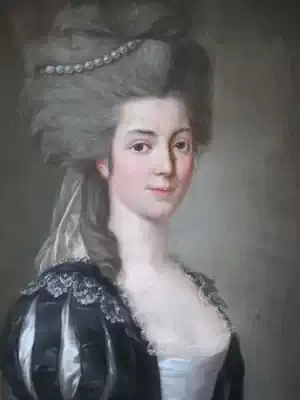
Marquesa de Alorna
1750–1839
· lived 88 years
 PT
PT
PT
The Marquise of Alorna was a prominent figure in Portuguese literature, known for her erudite and reflective poetry. Her work addresses themes such as spirituality, the ephemerality of life, and the pursuit of wisdom, in a style marked by clarity and philosophical depth. As one of the first female voices to stand out in Portuguese literature, she left a significant intellectual and literary legacy, influencing later generations.
n. 1750-10-31, Lisboa · m. 1839-10-11, Lisboa
28
Views
Bio
Identification and Basic Context
Leonor de Almeida Portugal de Lorena e Lencastre, 4th Marquise of Alorna and 15th Lady of Alvito, better known as the Marquise of Alorna, was a Portuguese poet and noblewoman. She was born in Lisbon on October 31, 1750, and died in the same city on January 24, 1839. Belonging to one of the most illustrious families of the Portuguese nobility, she lived in a period of great political and cultural transformations in Portugal. She was of Portuguese nationality and wrote in Portuguese.Childhood and Education
The Marquise of Alorna had a childhood marked by wealth and access to a privileged education, typical of the nobility of the time. She received a solid education at home, with private tutors, which allowed her to acquire knowledge in various fields, including literature, philosophy, and languages. She absorbed influences from Enlightenment thought and the philosophical and literary currents of her time, which shaped her worldview and her intellectual output.Literary Career
The literary career of the Marquise of Alorna began in her youth with the publication of her first poetic works. Her literary output was marked by maturity and depth, evolving over time to explore philosophical and existential themes with greater intensity. She actively collaborated with other intellectuals and published her works in anthologies and her own editions, consolidating her position as one of the most relevant literary voices of her time.Work, Style, and Literary Characteristics
The work of the Marquise of Alorna consists mainly of poetry, with emphasis on "Obras Poéticas" (Poetic Works). The dominant themes in her work include spirituality, the ephemerality of life, the pursuit of wisdom, reflection on the human condition, and the transience of worldly glories. Her style is characterized by clarity, formal elegance, and philosophical depth, often inspired by Stoicism and Enlightenment thought. She uses careful language and poetic devices that give a reflective and melancholic tone to her verses. Her work fits into the context of Arcadianism and foreshadows Neoclassicism, with a strong didactic and moralizing vein.Cultural and Historical Context
The Marquise of Alorna lived in a turbulent period of Portuguese history, which included the Enlightenment, the Lisbon Earthquake of 1755, and the Napoleonic Wars. Her privileged social position allowed her to move in intellectual circles and actively participate in the cultural debate of the time. She was a reference figure for other writers and intellectuals, being associated with the so-called "Generation of 1770" or the "Lusitanian Arcadia" group. Her work reflects the tensions between traditional thought and new Enlightenment ideas.Personal Life
As a noblewoman of high standing, the personal life of the Marquise of Alorna was influenced by the social conventions of her time. Her family and affective relationships, as well as her religious and philosophical convictions, appear to have played an important role in her work, especially in its spiritual and moral aspects. Although not known for parallel professions, her literary and intellectual activity was her main mark.Recognition and Reception
The Marquise of Alorna enjoyed considerable recognition during her lifetime, being acclaimed as one of the most important Portuguese poetesses. She received honorary distinctions and her name was celebrated in literary and academic circles. Her work was widely disseminated and admired, consolidating her place in the canon of Portuguese literature.Influences and Legacy
The Marquise of Alorna was influenced by classical and contemporary authors, as well as by the philosophical currents of the Enlightenment. Her legacy lies in her erudite and philosophical poetry, which paved the way for future generations of poets, especially for women writers. Her work continues to be studied and appreciated for its literary quality and the depth of its reflections.Interpretation and Critical Analysis
The work of the Marquise of Alorna has been the subject of various critical interpretations, which highlight her philosophical depth, her spiritual sensitivity, and her formal mastery. Her reflections on life, death, and the search for a transcendent meaning continue to be relevant themes for critical analysis.Curiosities and Lesser-Known Aspects
A curious aspect of the Marquise of Alorna's life is her later religious conversion, which influenced her writing, giving it a more mystical and devotional tone. Her vast culture and her correspondence with important intellectual figures of the time reveal a complex and multifaceted personality.Death and Memory
The Marquise of Alorna died in 1839, leaving a lasting literary legacy. Her memory is preserved through her work, which continues to be studied and admired, and through her role as one of the precursors of women's literature in Portugal.Poems
0No poems found
Comments (0)
Log in
to post a comment.
No comments yet. Be the first to comment.