
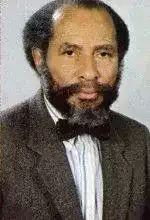
Onésimo Silveira
 CV
CV
Onésimo Silveira was a Cape Verdean poet, writer, activist, and politician. His poetic work is deeply marked by Cape Verdean identity, saudade, the land, and the fight against oppression and injustice. He was a prominent figure in the cultural and political affirmation of Cape Verde, both in his literary aspect and his civic intervention. His writing, which moves between lyricism and social denunciation, reflects a strong commitment to the emancipation of his people and the valorization of Creole culture. His poetry is a testament to the resilience and hope of a people grappling with history and geography.
n. 1935-01-01, Mindelo · m. 2021-04-29, Lisboa, Portugal
Bio
Identification and basic context
Onésimo Silveira, born in Cape Verde, was a poet, writer, journalist, activist, and politician. He is recognized for his literary work and his intense civic and political activity, particularly in the struggle for Cape Verde's independence and the affirmation of its cultural identity. He was a central figure in the archipelago's contemporary history.Childhood and education
Born on an island marked by aridity and the struggle for survival, Onésimo Silveira's childhood and education were shaped by the social and economic context of Cape Verde under Portuguese colonial rule. His education, possibly with strong components of self-teaching, instilled in him a deep sense of belonging and a critical awareness of inequalities.Literary career
Onésimo Silveira's literary career began early, expressing the reality and aspirations of the Cape Verdean people. His poetry addresses themes such as the land, the sea, saudade, emigration, colonial oppression, and the hope for freedom. His work was not limited to poetry, also encompassing prose and journalism. He collaborated in various publications, contributing to the dissemination of Cape Verdean culture and cause.Work, style, and literary characteristics
Onésimo Silveira's work is diverse and deeply rooted in Cape Verdean reality. His poetry is often characterized by a lyricism that merges with social and political denunciation. Themes such as the arid land, forced emigration, colonial oppression, and the hope for emancipation are central. His style is marked by a language that sometimes incorporates elements of creolization, a strong emotional charge, and a rhythm that evokes Cape Verdean orality and music. He uses varied metrics, from more traditional forms to free verse, always in service of expressing deep feelings and a message of struggle and resilience. His writing reflects a strong commitment to Creole cultural identity and the quest for a dignified place for his people.Cultural and historical context
Onésimo Silveira lived and worked in a historical context of anti-colonial struggle and national affirmation of Cape Verde. He was a prominent figure in the independence movement, and his work reflects the political and social tensions of the time. His political and cultural activism was intrinsically linked to his literary production, the latter serving as a vehicle for awareness and mobilization. He belonged to a generation of intellectuals and activists who fought for the self-determination of Portuguese-speaking African territories.Personal life
Beyond his literary and political work, Onésimo Silveira dedicated part of his life to diplomacy and public service, representing Cape Verde's interests on various fronts. His political convictions and commitment to the cause of independence significantly shaped his personal and professional trajectory.Recognition and reception
Onésimo Silveira is widely recognized as one of the most important figures in Cape Verdean literature and history. His poetic work and political intervention are pillars in the construction of national identity. He received several distinctions, and his name is associated with the struggle for freedom and the valorization of Cape Verdean culture.Influences and legacy
His work is influenced by his Cape Verdean condition, African culture, and the Portuguese language, but also by the experience of the diaspora and the anti-colonial struggle. Onésimo Silveira's legacy lies in his contribution to Lusophone literature, his defense of Creole identity, and his role as an activist for freedom and social justice. He influenced generations of Cape Verdeans and other Lusophone peoples in their search for self-knowledge and affirmation.Interpretation and critical analysis
Onésimo Silveira's work has been analyzed from the perspectives of post-colonial literature, protest poetry, and the expression of Cape Verdean identity. His poetry invites reflection on identity, land, memory, and resistance.Curiosities and lesser-known aspects
His multifaceted activity as a poet, journalist, activist, and diplomat demonstrates the breadth of his commitment to Cape Verde. More specific details about his writing habits or anecdotal episodes from his personal life may not be widely publicized.Death and memory
Onésimo Silveira's death left a void in Cape Verdean culture and politics. His memory is perpetuated through the recognition of his literary work and his legacy as one of the founding fathers of the Cape Verdean nation.Poems
0No poems found
Comments (0)
No comments yet. Be the first to comment.