
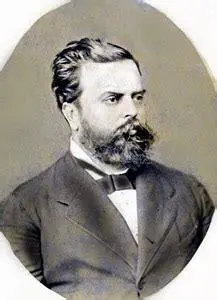
Pedro Luís Pereira de Sousa
1839–1884
· lived 44 years
 BR
BR
BR
Pedro Luís Pereira de Sousa was a Portuguese jurist and poet, known for his lyrical work and his involvement in the academic and political life of his time. Although he had a prominent career in the field of law, his poetic vein marked Portuguese literature. His writing reflects sensitivity and reflection on universal themes.
n. 1839-12-13, Araruama · m. 1884-07-16, Bananal
142
Views
Bio
Identification and basic context
Pedro Luís Pereira de Sousa was a Portuguese jurist and poet. He was born in Porto and died in the same city. His poetic work is part of the literary context of the 19th century in Portugal, a period of effervescent transition.Childhood and education
Coming from a wealthy family, he had access to a good education. He studied Law at the University of Coimbra, where he graduated, following an academic path that would become central to his life. His youth was marked by the intellectual effervescence of the time.Literary career
The beginning of his literary activity occurred with the publication of poems in newspapers and magazines of the time. His work evolved gradually, maintaining a consistent lyrical tone, but addressing increasingly profound themes. He published in various anthologies, consolidating his presence in the literary scene.Work, style, and literary characteristics
His main work, 'Cantigas', published in 1871, is an example of the lyrical style characteristic of the period. The dominant themes include love, saudade (longing), nature, and the ephemerality of life. Sousa's poetic form tends to be more traditional, with elaborate metrics, although he does not shy away from free verse in certain experiments. His language is refined, with rich vocabulary and remarkable musicality. His style is marked by delicacy and introspection, approaching late Romanticism and Parnassian influences. He introduced a particular sensitivity in his approach to common themes, giving them new depth.Work, style, and literary characteristics
Cultural and historical context He lived in a period of great transformations in Portugal, with the Constitutional Monarchy taking its first steps and society undergoing modernization. His connection to the academic and legal world allowed him to be in contact with other intellectuals and literary circles. The generation to which he belonged shared an interest in the renewal of Portuguese poetry.Work, style, and literary characteristics
Personal life He married and had a family, dedicating himself diligently to his profession as a jurist. His personal and family relationships, although not widely documented in their connection to his work, certainly provided a backdrop for his lyrical sensibility. He was known for his thoughtful and dedicated demeanor.Work, style, and literary characteristics
Recognition and reception During his lifetime, he was recognized in the academic and literary circles of his time, although his work did not achieve the fame of other contemporaries. His poetry was appreciated for its lyrical quality and depth. Academic recognition has been consolidating over time, with studies that highlight his importance.Work, style, and literary characteristics
Influences and legacy Sousa's influences seem to come from the great Portuguese and European lyrical poets. His legacy lies in his contribution to Portuguese lyrical poetry, enriching it with his unique sensibility and formal mastery. His work, though discreet, holds an honorable place in Portuguese literature.Work, style, and literary characteristics
Interpretation and critical analysis Pedro Luís Pereira de Sousa's work has been interpreted as an expression of melancholy and the search for meaning in a transitional era. Critical analysis focuses on his ability to combine form and content, conveying deep emotions with elegance.Work, style, and literary characteristics
Curiosities and lesser-known aspects Although he is better known as a jurist, his passion for poetry was genuine and constant. Few details about his writing habits or anecdotal episodes are widely publicized, suggesting a more reserved personality.Work, style, and literary characteristics
Death and memory He died in his hometown, leaving behind a body of work that, although not extensive, endures as a testament to his poetic art and his contribution to Portuguese literature.Poems
0No poems found
Comments (0)
Log in
to post a comment.
No comments yet. Be the first to comment.