
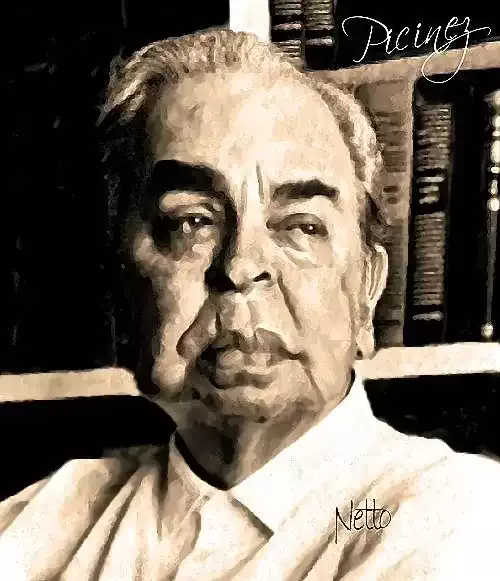
Pedro Nava
1903–1984
· lived 81 years
 BR
BR
BR
Pedro Nava was a Brazilian doctor and writer, known for his autobiographical and memorialistic work, which vividly portrays the life and customs of Brazil in different eras. His writing, marked by a prodigious memory and an engaging style, transports the reader into his personal experiences and family history, offering an intimate and detailed portrait of the country.
n. 1903-01-01, Juiz de Fora · m. 1984-01-01, Rio de Janeiro, RJ
34
Views
Bio
Identification and basic context
Pedro Nava was a Brazilian doctor, writer, and memorialist. He was born on June 5, 1903, in Rio de Janeiro, and passed away on January 14, 1984, in Jacarepaguá, Rio de Janeiro. He became famous for his autobiographical work that narrates his family's life and Brazil's customs in different eras. His nationality is Brazilian, and his writing language is Portuguese. He lived through a period of great transformations in Brazil, from the Old Republic to the military regime.Childhood and education
Pedro Nava was born into a wealthy and influential family, which provided him with a privileged childhood. His initial education took place in traditional schools in Rio de Janeiro. Subsequently, he graduated in Medicine from the University of Rio de Janeiro (now UFRJ) in 1925. His youth was marked by travels and experiences that would later form the basis of his memorialistic writing.Literary career
Although trained in medicine and with an active professional career, Pedro Nava's literary path gained prominence later in life. He began publishing his memoirs in the 1940s, but it was from the 1970s onwards that his work achieved greater recognition and popularity, with the publication of "Baú de Memórias," "Chão de Flores," and "O Círio de Nazaré." His writing, more than fiction, was a deep dive into his memories and the history of his family and Brazil.Work, style, and literary characteristics
Work, style, and literary characteristics Pedro Nava's works, such as "Baú de Memórias" (1973), "Chão de Flores" (1974), "O Círio de Nazaré" (1975), "A Capital da Sensatez" (1977), and "O Desate" (1978), are profoundly autobiographical and memorialistic. The central themes are memory, childhood, family, Brazilian social customs, the passage of time, and the country's history, especially of Rio de Janeiro and Minas Gerais. His style is characterized by rich, detailed, and engaging language, a prodigious memory that accurately evokes scenes and sensations, and a tone that shifts between nostalgic, humorous, and critical. Nava uses narrative resources that create a strong connection with the reader, inviting them to relive the past.Work, style, and literary characteristics
Cultural and historical context Pedro Nava produced his work during a period of intense social and political transformations in Brazil. His writing offers a retrospective look at the Old Republic and subsequent decades, depicting customs, values, and settings that were undergoing change or disappearing. He engaged with the cultural context of his time, but his work stands out for rescuing a past that often risked being forgotten.Work, style, and literary characteristics
Personal life As a doctor, Pedro Nava had a solid career. His personal life was marked by his extensive family, whose members and stories are central to his work. Memory was a fundamental facet of his personality, and his dedication to memorialistic writing became a passion that occupied much of his mature years.Work, style, and literary characteristics
Recognition and reception Although he had a respected medical career, Pedro Nava's greatest recognition came with his literary work. The publication of his memoirs was a success with the public and critics, especially from the 1970s onwards. His ability to recall the past with such vividness and detail earned him a prominent place in Brazilian literature, being considered one of the country's great memorialists.Work, style, and literary characteristics
Influences and legacy Pedro Nava, with his work, influenced how the memorialist genre is viewed in Brazil, valuing individual memory as a key to understanding collective history. His legacy lies in preserving a rich and detailed panorama of past Brazilian life, transmitting to future generations vivid and personal knowledge of a bygone era. His writing is a valuable testament to memory and culture.Work, style, and literary characteristics
Interpretation and critical analysis Nava's work is frequently analyzed from the perspective of memory and subjectivity, exploring how the past is reconstructed and interpreted. Critics highlight his skill in transforming personal experiences into universal narratives about the passage of time and the human condition.Work, style, and literary characteristics
Curiosities and lesser-known aspects A curiosity about Pedro Nava is his impressive memory capacity, which allowed him to recall vivid details from his childhood and youth. His writing was not just an act of remembrance but a true art of storytelling, which captivated readers with its authenticity and richness of detail.Work, style, and literary characteristics
Death and memory Pedro Nava passed away in 1984, leaving behind a literary collection that continues to be read and studied. His work perpetuates his memory and that of the eras he depicted, ensuring that his testimony and his vision of Brazil remain alive.Poems
0No poems found
Comments (0)
Log in
to post a comment.
No comments yet. Be the first to comment.