
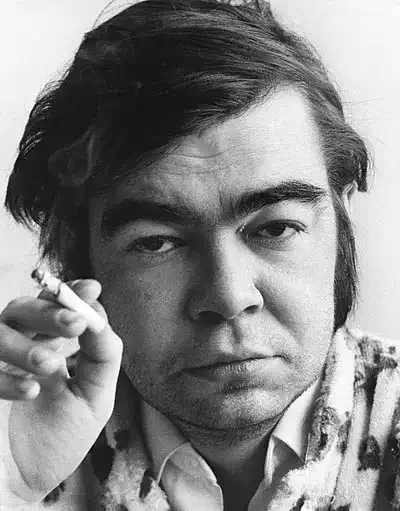
Pentti Saarikoski
1937–1983
· lived 45 years
 FI
FI
FI
Pentti Saarikoski was a Finnish poet and writer, a central figure in post-war Finnish poetry. His work is known for its lyrical intensity, its reflections on the human condition, society, and identity, and its formal experimentation. Saarikoski is considered one of Finland's most important poets, whose work continues to resonate for its honesty and depth.
n. 1937-09-02, Impilahti · m. 1983-08-24, Joensuu
24
Views
Bio
Identification and Basic Context
Pentti Saarikoski was a prominent Finnish poet and writer. Born in 1937, he passed away in 1983. He is widely regarded as one of the most significant figures in 20th-century Finnish literature.Childhood and Education
Saarikoski grew up during a period of great turmoil in Finland, marked by World War II. His upbringing was influenced by the experiences of the war and the social changes that followed. From a young age, he showed an early interest in writing and literature.Literary Career
His literary career began to gain prominence in the 1950s and 1960s, a period of cultural and social effervescence in Finland. Saarikoski published extensively, producing poetry, prose, and essays. His work evolved over time, reflecting his personal experiences and his reflections on the world.Work, Style, and Literary Characteristics
Saarikoski's main works include cycles of poems that explore the individual's relationship with society, nature, politics, and existence itself. His dominant themes encompass alienation, the search for meaning, social criticism, and melancholy. His style is marked by direct, colloquial language, often contrasting with the depth of his reflections. He masterfully used free verse, exploring rhythm and musicality in an innovative way. His poetic voice is often personal and confessional, yet resonates with universal human experience. He introduced new thematic and formal approaches to Finnish poetry, aligning with modernist and experimental currents.Cultural and Historical Context
Saarikoski lived in a period of intense political and cultural activity in Finland and internationally. The Cold War, counterculture movements, and social changes had a visible impact on his work. He was a politically engaged poet, and his opinions and activism are often reflected in his writings. He was associated with a group of modernist writers seeking to renew Finnish literature.Personal Life
Saarikoski's life was marked by intense intellectual activity and social and political involvement. He had significant relationships that shaped his perspective on life and love. His personal experiences, sometimes turbulent, shine through in his work, lending it a raw authenticity.Recognition and Reception
Pentti Saarikoski achieved a prominent place in Finnish literature. His work was widely recognized by critics and the public, solidifying his position as one of the most influential poets of his generation. His recognition transcended Finland's borders, with translations of his work into several languages.Influences and Legacy
Saarikoski was influenced by international poets and European literature. In turn, he significantly influenced later Finnish poetry, inspiring generations of writers with his direct style, emotional honesty, and critical view of society. His legacy is that of a poet who dared to address difficult themes with courage and lyricism.Interpretation and Critical Analysis
Saarikoski's work has been the subject of numerous interpretations, focusing on his exploration of the existential condition, his social critique, and his search for authenticity. His poetry is seen as a reflection of the tensions of modernity and the incessant search for meaning.Curiosities and Lesser-Known Aspects
Saarikoski was a traveler and lived in several countries, experiences that enriched his perspective and his work. He was known for his strong personality and firm convictions.Death and Memory
Pentti Saarikoski died in 1983, leaving behind a vast and impactful body of work. His memory is preserved through the continued reading and study of his poetry, which remains relevant and inspiring.Poems
0No poems found
Comments (0)
Log in
to post a comment.
No comments yet. Be the first to comment.