
Quotes
Quotes to inspire and reflect
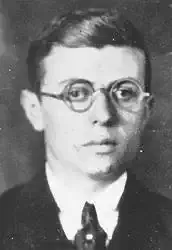
Hell is other people.
Human life begins on the far side of despair.
I am condemned to be free.
Man is a useless passion.
When the rich wage war it’s the poor who die.
Existence precedes and rules essence.
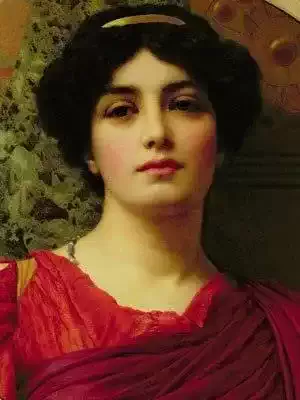
Just as the sweet-apple reddens on the high branch, high on the highest, and the apple-pickers missed it, or rather did not miss it out, but could not reach it.
Some say an army of cavalry or of infantry or a fleet of ships is the most beautiful thing on the black earth. But I say it is whatever one loves.
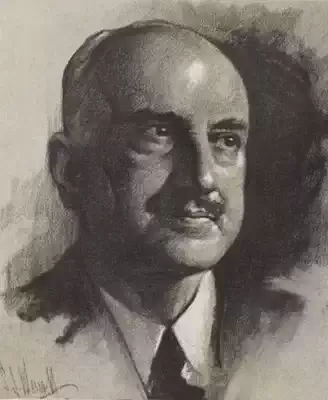
Those who cannot remember the past are condemned to repeat it.
There is no cure for birth and death save to enjoy the interval.
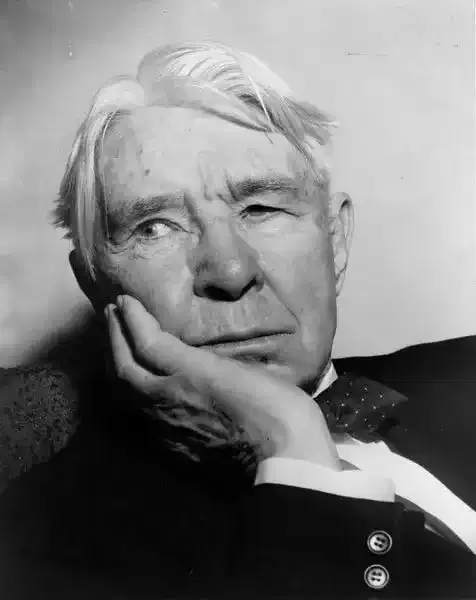
Slang is a language that rolls up its sleeves, spits on its hands and goes to work.
Fanaticism consists in redoubling your effort when you have forgotten your aim.
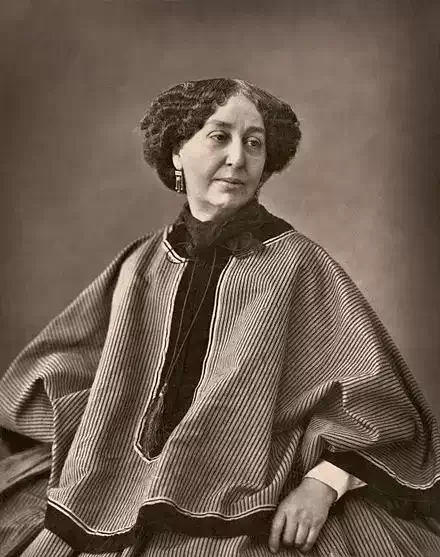
There is only one happiness in life, to love and be loved.
Poetry is the achievement of the synthesis of hyacinths and biscuits.
We cannot tear out a single page of our life, but we can throw the book in the fire.
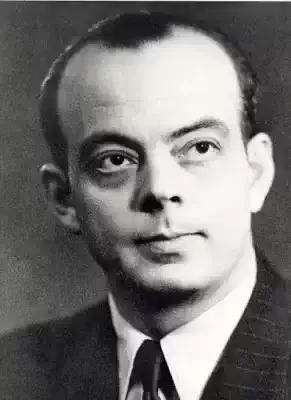
Experience shows us that love does not consist in gazing at each other but in looking together in the same direction.
Grown-ups never understand anything for themselves, and it is tiresome for children to be always and forever explaining things to them.
It is only with the heart that one can see rightly; what is essential is invisible to the eye.
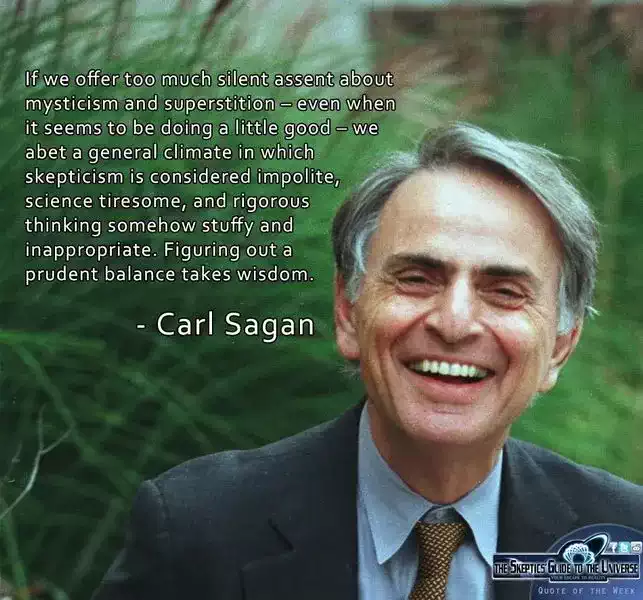
If you wish to make an apple pie from scratch, you must first invent the universe.
To me, it underscores our responsibility to deal more kindly with one another, and to preserve and cherish the pale blue dot, the only home we’ve ever known.
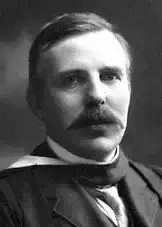
We haven’t got the money, so we’ve got to think!
It was quite the most incredible event that has ever happened to me in my life. It was almost as incredible as if you fired a 15–inch shell at a piece of tissue paper and it came back and hit you.
If your experiment needs statistics, you ought to have done a better experiment.
All science is either physics or stamp collecting.
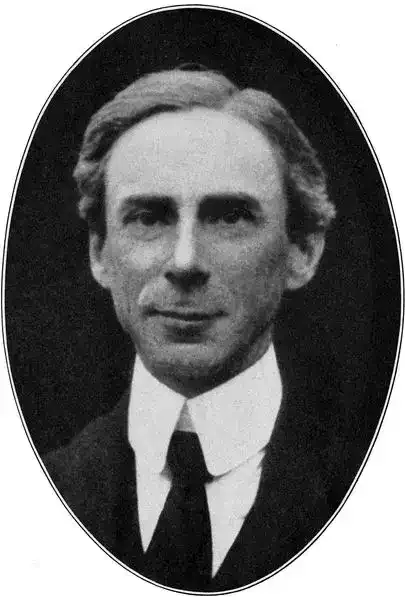
Fear is the main source of superstition, and one of the main sources of cruelty.
‘Change’ is scientific, ‘progress’ is ethical; change is indubitable, whereas progress is a matter of controversy.
Man is a credulous animal, and must believe something; in the absence of good grounds for belief, he will be satisfied with bad ones.
The infliction of cruelty with a good conscience is a delight to moralists. That is why they invented Hell.
Mathematics, rightly viewed, possesses not only truth, but supreme beauty—a beauty cold and austere, like that of sculpture.
Every man, wherever he goes, is encompassed by a cloud of comforting convictions, which move with him like flies on a summer day.
The law of causality, I believe, like much that passes muster among philosophers, is a relic of a bygone age, surviving, like the monarchy, only because it is erroneously supposed to do no harm.
Only on the firm foundation of unyielding despair, can the soul’s habitation henceforth be safely built.
To fear love is to fear life, and those who fear life are already three parts dead.
Mathematics may be defined as the subject in which we never know what we are talking about, nor whether what we are saying is true.
Work is of two kinds: first, altering the position of matter at or near the earth’s surface relatively to other such matter; second, telling other people to do so. The first kind is unpleasant and ill paid; the second is pleasant and highly paid.
To be able to fill leisure intelligently is the last product of civilization.
Of all forms of caution, caution in love is perhaps the most fatal to true happiness.
A sense of duty is useful in work, but offensive in personal relations. People wish to be liked, not to be endured with patient resignation.
One should as a rule respect public opinion in so far as is necessary to avoid starvation and to keep out of prison, but anything that goes beyond this is voluntary submission to an unnecessary tyranny.
One of the symptoms of approaching nervous breakdown is the belief that one’s work is terribly important, and that to take a holiday would bring all kinds of disaster.
Boredom is … a vital problem for the moralist, since half the sins of mankind are caused by the fear of it.
Men who are unhappy, like men who sleep badly, are always proud of the fact.

Fine art is that in which the hand, the head, and the heart of man go together.
There is no wealth but life.
When we build, let us think that we build for ever.
Remember that the most beautiful things in the world are the most useless; peacocks and lilies for instance.
Mountains are the beginning and the end of all natural scenery.
All books are divisible into two classes, the books of the hour, and the books of all time.