
Quotes
Quotes to inspire and reflect
Love seeketh only self to please, To bind another to its delight, Joys in another’s loss of ease, And builds a Hell in Heaven’s despite.
Hear the voice of the Bard! Who Present, Past, and Future sees, Whose ears have heard The Holy Word That walk’d among the ancient trees.
Turn away no more. Why wilt thou turn away? The starry floor, The wat’ry shore Is giv’n thee till the break of day.
What is it men in women do require? The lineaments of Gratified Desire. What is it women do in men require? The lineaments of Gratified Desire.
He who binds to himself a joy Does the winged life destroy; But he who kisses the joy as it flies Lives in eternity’s sunrise.
Abstinence sows sand all over The ruddy limbs and flaming hair, But Desire gratified Plants fruits of life and beauty there.
If you trap the moment before it’s ripe, The tears of repentance you’ll certainly wipe; But if once you let the ripe moment go You can never wipe off the tears of woe.
Love to faults is always blind, Always is to joy inclin’d, Lawless, wing’d, and unconfin’d, And breaks all chains from every mind.
I ask’d a thief to steal me a peach: He turned up his eyes. I ask’d a lithe lady to lie her down: Holy and meek, she cries. As soon as I went An angel came. He wink’d at the thief And smil’d at the dame— And without one word said Had a peach from the tree, And still as a maid Enjoy’d the lady.
For every thing that lives is Holy.
Never seek to tell thy love Love that never told can be; For the gentle wind does move Silently, invisibly. I told my love, I told my love, I told her all my heart; Trembling, cold, in ghastly fears— Ah, she doth depart. Soon as she was gone from me A traveler came by Silently, invisibly— Oh, was no deny.
One Law for the Lion & Ox is Oppression.
Enough! or too much.
Sooner murder an infant in its cradle than nurse unacted desires.
Truth can never be told so as to be understood, and not be believ’d.
Improvement makes straight roads; but the crooked roads without improvement are roads of genius.
You never know what is enough unless you know what is more than enough.
The tygers of wrath are wiser than the horses of instruction.
Think in the morning. Act in the noon. Eat in the evening. Sleep in the night.
The pride of the peacock is the glory of God. The lust of the goat is the bounty of God. The wrath of the lion is the wisdom of God. The nakedness of woman is the work of God.
The cistern contains: the fountain overflows.
Eternity is in love with the production of time.
No bird soars too high, if he soars with his own wings.
The road of excess leads to the palace of wisdom.
Does the Eagle know what is in the pit? Or wilt thou go ask the Mole? Can Wisdom be put in a silver rod? Or Love in a golden bowl?
When the voices of children are heard on the green And laughing is heard on the hill, My heart is at rest within my breast And everything else is still.
Can I see another’s woe, And not be in sorrow too? Can I see another’s grief, And not seek for kind relief?
The moon like a flower In heaven’s high bower, With silent delight, Sits and smiles on the night.
And all must love the human form, In heathen, turk, or jew; Where Mercy, Love, & Pity dwell There God is dwelling too.
To Mercy, Pity, Peace, and Love All pray in their distress; And to these virtues of delight Return their thankfulness.
For Mercy has a human heart, Pity, a human face, And Love, the human form divine, And Peace, the human dress.
When my mother died I was very young, And my father sold me while yet my tongue Could scarcely cry ’weep! ’weep! ’weep! ’weep! So your chimneys I sweep, and in soot I sleep.
I’ll shade him from the heat till he can bear To lean in joy upon our Father’s knee; And then I’ll stand and stroke his silver hair, And be like him and he will then love me.
And we are put on earth a little space, That we may learn to bear the beams of love, And these black bodies and this sunburnt face Is but a cloud, and like a shady grove.
My mother bore me in the southern wild, And I am black, but O! my soul is white; White as an angel is the English child, But I am black as if bereav’d of light.
Little Lamb, I’ll tell thee, Little Lamb, I’ll tell thee: He is called by thy name, For he calls himself a Lamb. He is meek and he is mild; He became a little child. I a child, and thou a lamb, We are called by his name. Little Lamb, God bless thee! Little Lamb, God bless thee!
Little Lamb, who made thee? Dost thou know who made thee? Gave thee life and bid thee feed By the stream and o’er the mead; Gave thee clothing of delight, Softest clothing, woolly, bright.
Piping down the valleys wild, Piping songs of pleasant glee, On a cloud I saw a child, And he laughing said to me: “Pipe a song about a Lamb.” So I piped with merry cheer; “Piper, pipe that song again.” So I piped; he wept to hear.
And I made a rural pen, And I stain’d the water clear, And I wrote my happy songs Every child may joy to hear.
He loves to sit and hear me sing, Then, laughing, sports and plays with me; Then stretches out my golden wing, And mocks my loss of liberty.
Like a fiend in a cloud, With howling woe, After night I do crowd, And with night will go.

Black as the devil, Hot as hell, Pure as an angel, Sweet as love. 1
How sweet I roam’d from field to field, And tasted all the summer’s pride, Till I the prince of love beheld, Who in the sunny beams did glide!
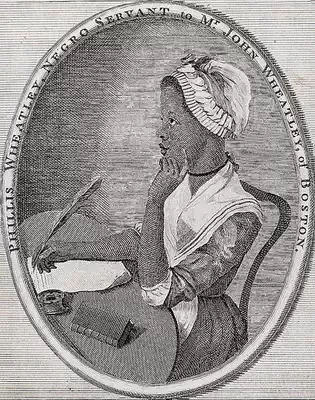
I, young in life, by seeming cruel fate Was snatch’d from Afric ’s fancy’d happy seat: What pangs excruciating must molest, What sorrows labour in my parent’s breast? Steel’d was that soul and by no misery mov’d That from a father seiz’d his babe belov’d: Such, such my case. And can I then but pray Others may never feel tyrannic sway?
You write with ease to show your breeding, But easy writing’s curst hard reading.
Through all the drama—whether damned or not— Love gilds the scene, and women guide the plot.
Here’s to the maiden of bashful fifteen; Here’s to the widow of fifty; Here’s to the flaunting, extravagant quean, And here’s to the housewife that’s thrifty. I’ll warrant she’ll prove an excuse for the glass.
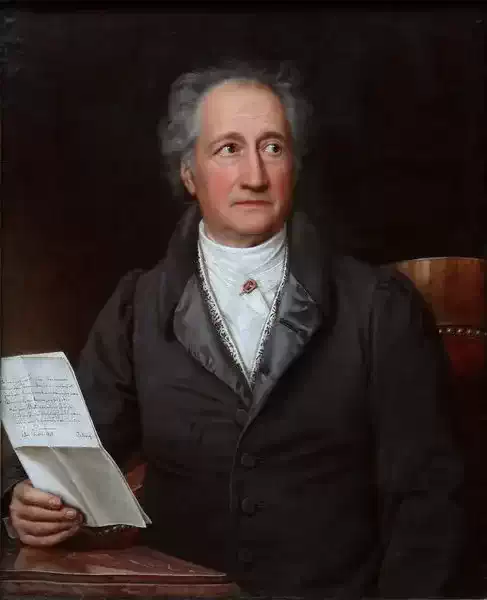
Create, artist! Do not talk!