

Poems in this topic
Others

Robert Louis Stevenson
At Last She Comes
At Last She Comes
AT last she comes, O never more
In this dear patience of my pain
To leave me lonely as before,
Or leave my soul alone again.
AT last she comes, O never more
In this dear patience of my pain
To leave me lonely as before,
Or leave my soul alone again.
330
Robert Louis Stevenson
As In Their Flight The Birds Of Song
As In Their Flight The Birds Of Song
AS in their flight the birds of song
Halt here and there in sweet and sunny dales,
But halt not overlong;
The time one rural song to sing
They pause; then following bounteous gales
Steer forward on the wing:
Sun-servers they, from first to last,
Upon the sun they wait
To ride the sailing blast.
So he awhile in our contested state,
Awhile abode, not longer, for his Sun -
Mother we say, no tenderer name we know -
With whose diviner glow
His early days had shone,
Now to withdraw her radiance had begun.
Or lest a wrong I say, not she withdrew,
But the loud stream of men day after day
And great dust columns of the common way
Between them grew and grew:
And he and she for evermore might yearn,
But to the spring the rivulets not return
Nor to the bosom comes the child again.
And he (O may we fancy so!),
He, feeling time forever flow
And flowing bear him forth and far away
From that dear ingle where his life began
And all his treasure lay -
He, waxing into man,
And ever farther, ever closer wound
In this obstreperous world's ignoble round,
From that poor prospect turned his face away.
337
Robert Louis Stevenson
Air Of Diabelli's
Air Of Diabelli's
CALL it to mind, O my love.
Dear were your eyes as the day,
Bright as the day and the sky;
Like the stream of gold and the sky above,
Dear were your eyes in the grey.
We have lived, my love, O, we have lived, my love!
Now along the silent river, azure
Through the sky's inverted image,
Softly swam the boat that bore our love,
Swiftly ran the shallow of our love
Through the heaven's inverted image,
In the reedy mazes round the river.
See along the silent river,
See of old the lover's shallop steer.
Berried brake and reedy island,
Heaven below and only heaven above.
Through the sky's inverted image
Swiftly swam the boat that bore our love.
Berried brake and reedy island,
Mirrored flower and shallop gliding by.
All the earth and all the sky were ours,
Silent sat the wafted lovers,
Bound with grain and watched by all the sky,
Hand to hand and eye to . . . eye.
Days of April, airs of Eden,
Call to mind how bright the vanished angel hours,
Golden hours of evening,
When our boat drew homeward filled with flowers.
O darling, call them to mind; love the past, my love.
Days of April, airs of Eden.
How the glory died through golden hours,
And the shining moon arising;
How the boat drew homeward filled with flowers.
Age and winter close us slowly in.
Level river, cloudless heaven,
Islanded reed mazes, silver weirs;
How the silent boat with silver
Threads the inverted forest as she goes,
Broke the trembling green of mirrored trees.
O, remember, and remember
How the berries hung in garlands.
Still in the river see the shallop floats.
Hark! Chimes the falling oar.
Still in the mind
Hark to the song of the past!
Dream, and they pass in their dreams.
Those that loved of yore, O those that loved of yore!
Hark through the stillness, O darling, hark!
Through it all the ear of the mind
Knows the boat of love. Hark!
Chimes the falling oar.
O half in vain they grew old.
Now the halcyon days are over,
Age and winter close us slowly round,
And these sounds at fall of even
Dim the sight and muffle all the sound.
And at the married fireside, sleep of soul and sleep of fancy,
Joan and Darby.
Silence of the world without a sound;
And beside the winter faggot
Joan and Darby sit and dose and dream and wake -
Dream they hear the flowing, singing river,
See the berries in the island brake;
Dream they hear the weir,
See the gliding shallop mar the stream.
Hark! in your dreams do you hear?
Snow has filled the drifted forest;
Ice has bound the . . . stream.
Frost has bound our flowing river;
Snow has whitened all our island brake.
Berried brake and reedy island,
Heaven below and only heaven above azure
Through the sky's inverted image
Safely swam the boat that bore our love.
Dear were your eyes as the day,
Bright ran the stream, bright hung the sky above.
Days of April, airs of Eden.
How the glory died through golden hours,
And the shining moon arising,
How the boat drew homeward filled with flowers.
Bright were your eyes in the night:
We have lived, my love;
O, we have loved, my love.
Now the . . . days are over,
Age and winter close us slowly round.
Vainly time departs, and vainly
Age and winter come and close us round.
Hark the river's long continuous sound.
Hear the river ripples in the reeds.
Lo, in dreams they see their shallop
Run the lilies down and drown the weeds
Mid the sound of crackling faggots.
So in dreams the new created
Happy past returns, to-day recedes,
And they hear once more,
From the old years,
Yesterday returns, to-day recedes,
And they hear with aged hearing warbles
Love's own river ripple in the weeds.
And again the lover's shallop;
Lo, the shallop sheds the streaming weeds;
And afar in foreign countries
In the ears of aged lovers.
And again in winter evens
Starred with lilies . . . with stirring weeds.
In these ears of aged lovers
Love's own river ripples in the reeds.
368
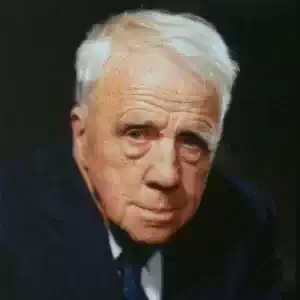
Robert Frost
Two Look at Two
Two Look at Two
Love and forgetting might have carried them
A little further up the mountain side
With night so near, but not much further up.
They must have halted soon in any case
With thoughts of a path back, how rough it was
With rock and washout, and unsafe in darkness;
When they were halted by a tumbled wall
With barbed-wire binding. They stood facing this,
Spending what onward impulse they still had
In One last look the way they must not go,
On up the failing path, where, if a stone
Or earthslide moved at night, it moved itself;
No footstep moved it. 'This is all,' they sighed,
Good-night to woods.' But not so; there was more.
A doe from round a spruce stood looking at them
Across the wall, as near the wall as they.
She saw them in their field, they her in hers.
The difficulty of seeing what stood still,
Like some up-ended boulder split in two,
Was in her clouded eyes; they saw no fear there.
She seemed to think that two thus they were safe.
Then, as if they were something that, though strange,
She could not trouble her mind with too long,
She sighed and passed unscared along the wall.
'This, then, is all. What more is there to ask?'
But no, not yet. A snort to bid them wait.
A buck from round the spruce stood looking at them
Across the wall as near the wall as they.
This was an antlered buck of lusty nostril,
Not the same doe come back into her place.
He viewed them quizzically with jerks of head,
As if to ask, 'Why don't you make some motion?
Or give some sign of life? Because you can't.
I doubt if you're as living as you look."
Thus till he had them almost feeling dared
To stretch a proffering hand -- and a spell-breaking.
Then he too passed unscared along the wall.
Two had seen two, whichever side you spoke from.
'This must be all.' It was all. Still they stood,
A great wave from it going over them,
As if the earth in one unlooked-for favour
Had made them certain earth returned their love.
457
Robert Frost
The Soldier
The Soldier
He is that fallen lance that lies as hurled,
That lies unlifted now, come dew, come rust,
But still lies pointed as it ploughed the dust.
If we who sight along it round the world,
See nothing worthy to have been its mark,
It is because like men we look too near,
Forgetting that as fitted to the sphere,
Our missiles always make too short an arc.
They fall, they rip the grass, they intersect
The curve of earth, and striking, break their own;
They make us cringe for metal-point on stone.
But this we know, the obstacle that checked
And tripped the body, shot the spirit on
Further than target ever showed or shone.
514
Robert Frost
The Secret Sits
The Secret Sits
We dance round in a ring and suppose,
But the Secret sits in the middle and knows.
We dance round in a ring and suppose,
But the Secret sits in the middle and knows.
445
Robert Frost
The Secret Sits
The Secret Sits
We dance round in a ring and suppose,
But the Secret sits in the middle and knows.
We dance round in a ring and suppose,
But the Secret sits in the middle and knows.
445
Robert Frost
The Lockless Door
The Lockless Door
It went many years,
But at last came a knock,
And I thought of the door
With no lock to lock.
I blew out the light,
I tip-toed the floor,
And raised both hands
In prayer to the door.
But the knock came again
My window was wide;
I climbed on the sill
And descended outside.
Back over the sill
I bade a "Come in"
To whoever the knock
At the door may have been.
So at a knock
I emptied my cage
To hide in the world
And alter with age.
518
Robert Frost
The Aim Was Song
The Aim Was Song
Before man to blow to right
The wind once blew itself untaught,
And did its loudest day and night
In any rough place where it caught.
Man came to tell it what was wrong:
It hadn't found the place to blow;
It blew too hard - the aim was song.
And listen - how it ought to go!
He took a little in his mouth,
And held it long enough for north
To be converted into south,
And then by measure blew it forth.
By measure. It was word and note,
The wind the wind had meant to be -
A little through the lips and throat.
The aim was song - the wind could see.
509
Robert Frost
The Bear
The Bear
The bear puts both arms around the tree above her
And draws it down as if it were a lover
And its chokecherries lips to kiss good-by,
Then lets it snap back upright in the sky.
Her next step rocks a boulder on the wall
(She's making her cross-country in the fall).
Her great weight creaks the barbed wire in its staples
As she flings over and off down through the maples,
Leaving on one wire tooth a lock of hair.
Such is the uncaged progress of the bear.
The world has room to make a bear feel free;
The universe seems cramped to you and me.
Man acts more like the poor bear in a cage,
That all day fights a nervous inward rage,
His mood rejecting all his mind suggests.
He paces back and forth and never rests
The me-nail click and shuffle of his feet,
The telescope at one end of his beat,
And at the other end the microscope,
Two instruments of nearly equal hope,
And in conjunction giving quite a spread.
Or if he rests from scientific tread,
'Tis only to sit back and sway his head
Through ninety-odd degrees of arc, it seems,
Between two metaphysical extremes.
He sits back on his fundamental butt
With lifted snout and eyes (if any) shut
(He almost looks religious but he's not),
And back and forth he sways from cheek to cheek,
At one extreme agreeing with one Greek
At the other agreeing with another Greek
Which may be thought, but only so to speak.
A baggy figure, equally pathetic
When sedentary and when peripatetic.
528
Robert Frost
Rose Pogonias
Rose Pogonias
A saturated meadow,
Sun-shaped and jewel-small,
A circle scarcely wider
Than the trees around were tall;
Where winds were quite excluded,
And the air was stifling sweet
With the breath of many flowers, --
A temple of the heat.
There we bowed us in the burning,
As the sun's right worship is,
To pick where none could miss them
A thousand orchises;
For though the grass was scattered,
yet every second spear
Seemed tipped with wings of color,
That tinged the atmosphere.
We raised a simple prayer
Before we left the spot,
That in the general mowing
That place might be forgot;
Or if not all so favored,
Obtain such grace of hours,
that none should mow the grass there
While so confused with flowers.
516
Robert Frost
Stars
Stars
How countlessly they congregate
O'er our tumultuous snow,
Which flows in shapes as tall as trees
When wintry winds do blow!--
As if with keenness for our fate,
Our faltering few steps on
To white rest, and a place of rest
Invisible at dawn,--
And yet with neither love nor hate,
Those stars like some snow-white
Minerva's snow-white marble eyes
Without the gift of sight.
509
Robert Frost
Reluctance
Reluctance
Out through the fields and the woods And over the walls I have wended; I have
climbed the hills of view And looked at the world, and descended; I have come by the
highway home, And lo, it is ended. The leaves are all dead on the group, Save those
that the oak is keeping To ravel them one by one And let them go scraping and
creeping Out over the crusted snow, When others are sleeping. And the dead leaves
lie huddled and still, No longer blown hither and thither; The last long aster is gone;
The flowers of the witch-hazel wither; The heart is still aching to seek, But the feel
question 'Whither?' Ah, when to the heart of man Was it ever less than a treason To
go with the drift of things, To yield with a grace to reason, And bow and accept the end
Of a love or a season?
460
Robert Frost
Putting In The Seed
Putting In The Seed
You come to fetch me from my work to-night
When supper's on the table, and we'll see
If I can leave off burying the white
Soft petals fallen from the apple tree
(Soft petals, yes, but not so barren quite,
Mingled with these, smooth bean and wrinkled pea);
And go along with you ere you lose sight
Of what you came for and become like me,
Slave to a Springtime passion for the earth.
How Love burns through the Putting in the Seed
On through the watching for that early birth
When, just as the soil tarnishes with weed,
The sturdy seedling with arched body comes
Shouldering its way and shedding the earth crumbs.
643
Robert Frost
One Step Backward Taken
One Step Backward Taken
Not only sands and gravels
Were once more on their travels,
But gulping muddy gallons
Great boulders off their balance
Bumped heads together dully
And started down the gully.
Whole capes caked off in slices.
I felt my standpoint shaken
In the universal crisis.
But with one step backward taken
I saved myself from going.
A world torn loose went by me.
Then the rain stopped and the blowing,
And the sun came out to dry me.
377
Robert Frost
On Looking Up by Chance at the Constellations
On Looking Up by Chance at the Constellations
You'll wait a long, long time for anything much
To happen in heaven beyond the floats of cloud
And the Northern Lights that run like tingling nerves.
The sun and moon get crossed, but they never touch,
Nor strike out fire from each other nor crash out loud.
The planets seem to interfere in their curves -
But nothing ever happens, no harm is done.
We may as well go patiently on with our life,
And look elsewhere than to stars and moon and sun
For the shocks and changes we need to keep us sane.
It is true the longest drout will end in rain,
The longest peace in China will end in strife.
Still it wouldn't reward the watcher to stay awake
In hopes of seeing the calm of heaven break
On his particular time and personal sight.
That calm seems certainly safe to last to-night.
470
Robert Frost
My November Guest
My November Guest
My Sorrow, when she's here with me,
Thinks these dark days of autumn rain
Are beautiful as days can be;
She loves the bare, the withered tree;
She walks the sodden pasture lane.
Her pleasure will not let me stay.
She talks and I am fain to list:
She's glad the birds are gone away,
She's glad her simple worsted grey
Is silver now with clinging mist.
The desolate, deserted trees,
The faded earth, the heavy sky,
The beauties she so truly sees,
She thinks I have no eye for these,
And vexes me for reason why.
Not yesterday I learned to know
The love of bare November days
Before the coming of the snow,
But it were vain to tell her so,
And they are better for her praise
546
Robert Frost
Mowing
Mowing
There was never a sound beside the wood but one,
And that was my long scythe whispering to the ground.
What was it it whispered? I knew not well myself;
Perhaps it was something about the heat of the sun,
Something, perhaps, about the lack of sound--
And that was why it whispered and did not speak.
It was no dream of the gift of idle hours,
Or easy gold at the hand of fay or elf:
Anything more than the truth would have seemed too weak
To the earnest love that laid the swale in rows,
Not without feeble-pointed spikes of flowers
(Pale orchises), and scared a bright green snake.
The fact is the sweetest dream that labour knows.
My long scythe whispered and left the hay to make.
826
Robert Frost
Leaves Compared with Flowers
Leaves Compared with Flowers
A tree's leaves may be ever so good,
So may its bar, so may its wood;
But unless you put the right thing to its root
It never will show much flower or fruit.
But I may be one who does not care
Ever to have tree bloom or bear.
Leaves for smooth and bark for rough,
Leaves and bark may be tree enough.
Some giant trees have bloom so small
They might as well have none at all.
Late in life I have come on fern.
Now lichens are due to have their turn.
I bade men tell me which in brief,
Which is fairer, flower or leaf.
They did not have the wit to say,
Leaves by night and flowers by day.
Leaves and bar, leaves and bark,
To lean against and hear in the dark.
Petals I may have once pursued.
Leaves are all my darker mood.
446
Robert Frost
Home Burial
Home Burial
He saw her from the bottom of the stairs
Before she saw him. She was starting down,
Looking back over her shoulder at some fear.
She took a doubtful step and then undid it
To raise herself and look again. He spoke
Advancing toward her: "What is it you see
From up there always? -- for I want to know."
She turned and sank upon her skirts at that,
And her face changed from terrified to dull.
He said to gain time: "What is it you see?"
Mounting until she cowered under him.
"I will find out now -- you must tell me, dear."
She, in her place, refused him any help,
With the least stiffening of her neck and silence.
She let him look, sure that he wouldn't see,
Blind creature; and a while he didn't see.
But at last he murmured, "Oh" and again, "Oh."
"What is it -- what?" she said.
"Just that I see."
"You don't," she challenged. "Tell me what it is."
"The wonder is I didn't see at once.
I never noticed it from here before.
I must be wonted to it -- that's the reason.
The little graveyard where my people are!
So small the window frames the whole of it.
Not so much larger than a bedroom, is it?
There are three stones of slate and one of marble,
Broad-shouldered little slabs there in the sunlight
On the sidehill. We haven't to mind those.
But I understand: it is not the stones,
But the child's mound ----"
"Don't, don't, don't,
don't," she cried.
She withdrew, shrinking from beneath his arm
That rested on the banister, and slid downstairs;
And turned on him with such a daunting look,
He said twice over before he knew himself:
"Can't a man speak of his own child he's lost?"
"Not you! -- Oh, where's my hat? Oh, I don't need it!
I must get out of here. I must get air.--
I don't know rightly whether any man can."
"Amy! Don't go to someone else this time.
Listen to me. I won't come down the stairs."
He sat and fixed his chin between his fists.
"There's something I should like to ask you, dear."
"You don't know how to ask it."
"Help me, then."
Her fingers moved the latch for all reply.
"My words are nearly always an offense.
I don't know how to speak of anything
So as to please you. But I might be taught,
I should suppose. I can't say I see how.
A man must partly give up being a man
With womenfolk. We could have some arrangement
By which I'd bind myself to keep hands off
Anything special you're a-mind to name.
Though I don't like such things 'twixt those that love.
Two that don't love can't live together without them.
But two that do can't live together with them."
She moved the latch a little. "Don't -- don't go.
Don't carry it to someone else this time.
Tell me about it if it's something human.
Let me into your grief. I'm not so much
Unlike other folks as your standing there
Apart would make me out. Give me my chance.
I do think, though, you overdo it a little.
What was it brought you up to think it the thing
To take your mother-loss of a first child
So inconsolably -- in the face of love.
You'd think his memory might be satisfied ----"
"There you go sneering now!"
"I'm not, I'm not!
You make me angry. I'll come down to you.
God, what a woman! And it's come to this,
A man can't speak of his own child that's dead."
"You can't because you don't know how to speak.
If you had any feelings, you that dug
With your own hand -- how could you? -- his little grave;
I saw you from that very window there,
Making the gravel leap and leap in air,
Leap up, like that, like that, and land so lightly
And roll back down the mound beside the hole.
I thought, Who is that man? I didn't know you.
And I crept down the stairs and up the stairs
To look again, and still your spade kept lifting.
Then you came in. I heard your rumbling voice
Out in the kitchen, and I don't know why,
But I went near to see with my own eyes.
You could sit there with the stains on your shoes
Of the fresh earth from your own baby's grave
And talk about your everyday concerns.
You had stood the spade up against the wall
Outside there in the entry, for I saw it."
"I shall laugh the worst laugh I ever laughed.
I'm cursed. God, if I don't believe I'm cursed."
"I can repeat the very words you were saying:
'Three foggy mornings and one rainy day
Will rot the best birch fence a man can build.'
Think of it, talk like that at such a time!
What had how long it takes a birch to rot
To do with what was in the darkened parlour?
You couldn't care! The nearest friends can go
With anyone to death, comes so far short
They might as well not try to go at all.
No, from the time when one is sick to death,
One is alone, and he dies more alone.
Friends make pretense of following to the grave,
But before one is in it, their minds are turned
And making the best of their way back to life
And living people, and things they understand.
But the world's evil. I won't have grief so
If I can change it. Oh, I won't, I won't!"
"There, you have said it all and you feel better.
You won't go now. You're crying. Close the door.
The heart's gone out of it: why keep it up?
Amyl There's someone coming down the road!"
"You -- oh, you think the talk is all. I must go --
Somewhere out of this house. How can I make you ----"
"If -- you -- do!" She was opening the door wider.
"Where do you mean to go? First tell me that.
I'll follow and bring you back by force. I will! --"
591
Robert Frost
Ghost House
Ghost House
I dwell in a lonely house I know
That vanished many a summer ago,
And left no trace but the cellar walls,
And a cellar in which the daylight falls,
And the purple-stemmed wild raspberries grow.
O'er ruined fences the grape-vines shield
The woods come back to the mowing field;
The orchard tree has grown one copse
Of new wood and old where the woodpecker chops;
The footpath down to the well is healed.
I dwell with a strangely aching heart
In that vanished abode there far apart
On that disused and forgotten road
That has no dust-bath now for the toad.
Night comes; the black bats tumble and dart;
The whippoorwill is coming to shout
And hush and cluck and flutter about:
I hear him begin far enough away
Full many a time to say his say
Before he arrives to say it out.
It is under the small, dim, summer star.
I know not who these mute folk are
Who share the unlit place with me--
Those stones out under the low-limbed tree
Doubtless bear names that the mosses mar.
They are tireless folk, but slow and sad,
Though two, close-keeping, are lass and lad,--
With none among them that ever sings,
And yet, in view of how many things,
As sweet companions as might be had.
579