

Poems in this theme
Travel and Horizons
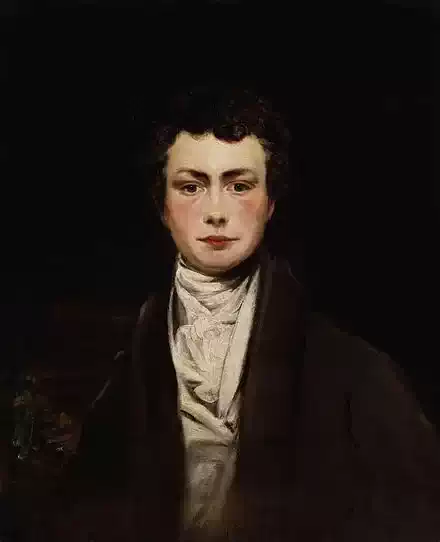
Thomas Moore
Though the Last Glimpse of Erin With Sorrow I See
Though the Last Glimpse of Erin With Sorrow I See
Though the last glimpse of Erin with sorrow I see,
Yet wherever thou art shall seem Erin to me;
In exile thy bosom shall still be my home,
And thine eyes make my climate wherever we roam.
To the gloom of some desert or cold rocky shore,
Where the eye of the stranger can haunt us no more,
I will fly with my Coulin, and think the rough wind
Less rude than the foes we leave frowning behind.
And I'll gaze on thy gold hair as graceful it wreathes,
And hang o'er thy soft harp, as wildly it breathes;
Nor dread that the cold-hearted Saxon will tear
One chord from that harp, or one lock from that hair.
Though the last glimpse of Erin with sorrow I see,
Yet wherever thou art shall seem Erin to me;
In exile thy bosom shall still be my home,
And thine eyes make my climate wherever we roam.
To the gloom of some desert or cold rocky shore,
Where the eye of the stranger can haunt us no more,
I will fly with my Coulin, and think the rough wind
Less rude than the foes we leave frowning behind.
And I'll gaze on thy gold hair as graceful it wreathes,
And hang o'er thy soft harp, as wildly it breathes;
Nor dread that the cold-hearted Saxon will tear
One chord from that harp, or one lock from that hair.
157
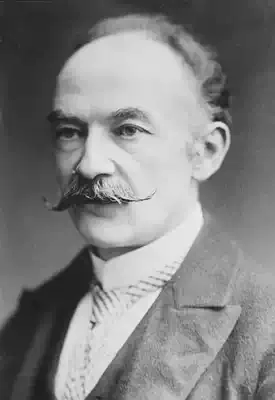
Thomas Hardy
The Bridge of Lodi (Spring, )
The Bridge of Lodi (Spring, )
I
When of tender mind and body
I was moved by minstrelsy,
And that strain "The Bridge of Lodi"
Brought a strange delight to me.
II
In the battle-breathing jingle
Of its forward-footing tune
I could see the armies mingle,
And the columns cleft and hewn
III
On that far-famed spot by Lodi
Where Napoleon clove his way
To his fame, when like a god he
Bent the nations to his sway.
IV
Hence the tune came capering to me
While I traced the Rhone and Po;
Nor could Milan's Marvel woo me
From the spot englamoured so.
V
And to-day, sunlit and smiling,
Here I stand upon the scene,
With its saffron walls, dun tiling,
And its meads of maiden green,
VI
Even as when the trackway thundered
With the charge of grenadiers,
And the blood of forty hundred
Splashed its parapets and piers . . .
VII
Any ancient crone I'd toady
Like a lass in young-eyed prime,
Could she tell some tale of Lodi
At that moving mighty time.
VIII
So, I ask the wives of Lodi
For traditions of that day;
But alas! not anybody
Seems to know of such a fray.
IX
And they heed but transitory
Marketings in cheese and meat,
Till I judge that Lodi's story
Is extinct in Lodi's street.
X
Yet while here and there they thrid them
In their zest to sell and buy,
Let me sit me down amid them
And behold those thousands die . . .
XI
- Not a creature cares in Lodi
How Napoleon swept each arch,
Or where up and downward trod he,
Or for his memorial March!
XII
So that wherefore should I be here,
Watching Adda lip the lea,
When the whole romance to see here
Is the dream I bring with me?
XIII
And why sing "The Bridge of Lodi"
As I sit thereon and swing,
When none shows by smile or nod he
Guesses why or what I sing? . . .
XIV
Since all Lodi, low and head ones,
Seem to pass that story by,
It may be the Lodi-bred ones
Rate it truly, and not I.
XV
Once engrossing Bridge of Lodi,
Is thy claim to glory gone?
Must I pipe a palinody,
Or be silent thereupon?
XVI
And if here, from strand to steeple,
Be no stone to fame the fight,
Must I say the Lodi people
Are but viewing crime aright?
Nay; I'll sing "The Bridge of Lodi" -
That long-loved, romantic thing,
Though none show by smile or nod he
Guesses why and what I sing!
I
When of tender mind and body
I was moved by minstrelsy,
And that strain "The Bridge of Lodi"
Brought a strange delight to me.
II
In the battle-breathing jingle
Of its forward-footing tune
I could see the armies mingle,
And the columns cleft and hewn
III
On that far-famed spot by Lodi
Where Napoleon clove his way
To his fame, when like a god he
Bent the nations to his sway.
IV
Hence the tune came capering to me
While I traced the Rhone and Po;
Nor could Milan's Marvel woo me
From the spot englamoured so.
V
And to-day, sunlit and smiling,
Here I stand upon the scene,
With its saffron walls, dun tiling,
And its meads of maiden green,
VI
Even as when the trackway thundered
With the charge of grenadiers,
And the blood of forty hundred
Splashed its parapets and piers . . .
VII
Any ancient crone I'd toady
Like a lass in young-eyed prime,
Could she tell some tale of Lodi
At that moving mighty time.
VIII
So, I ask the wives of Lodi
For traditions of that day;
But alas! not anybody
Seems to know of such a fray.
IX
And they heed but transitory
Marketings in cheese and meat,
Till I judge that Lodi's story
Is extinct in Lodi's street.
X
Yet while here and there they thrid them
In their zest to sell and buy,
Let me sit me down amid them
And behold those thousands die . . .
XI
- Not a creature cares in Lodi
How Napoleon swept each arch,
Or where up and downward trod he,
Or for his memorial March!
XII
So that wherefore should I be here,
Watching Adda lip the lea,
When the whole romance to see here
Is the dream I bring with me?
XIII
And why sing "The Bridge of Lodi"
As I sit thereon and swing,
When none shows by smile or nod he
Guesses why or what I sing? . . .
XIV
Since all Lodi, low and head ones,
Seem to pass that story by,
It may be the Lodi-bred ones
Rate it truly, and not I.
XV
Once engrossing Bridge of Lodi,
Is thy claim to glory gone?
Must I pipe a palinody,
Or be silent thereupon?
XVI
And if here, from strand to steeple,
Be no stone to fame the fight,
Must I say the Lodi people
Are but viewing crime aright?
Nay; I'll sing "The Bridge of Lodi" -
That long-loved, romantic thing,
Though none show by smile or nod he
Guesses why and what I sing!
243
Thomas Hardy
At Lulworth Cove a Century Back
At Lulworth Cove a Century Back
Had I but lived a hundred years ago
I might have gone, as I have gone this year,
By Warmwell Cross on to a Cove I know,
And Time have placed his finger on me there:
"You see that man?" -- I might have looked, and said,
"O yes: I see him. One that boat has brought
Which dropped down Channel round Saint Alban's Head.
So commonplace a youth calls not my thought."
"You see that man?" -- "Why yes; I told you; yes:
Of an idling town-sort; thin; hair brown in hue;
And as the evening light scants less and less
He looks up at a star, as many do."
"You see that man?" -- "Nay, leave me!" then I plead,
"I have fifteen miles to vamp across the lea,
And it grows dark, and I am weary-kneed:
I have said the third time; yes, that man I see!"
"Good. That man goes to Rome -- to death, despair;
And no one notes him now but you and I:
A hundred years, and the world will follow him there,
And bend with reverence where his ashes lie."
Had I but lived a hundred years ago
I might have gone, as I have gone this year,
By Warmwell Cross on to a Cove I know,
And Time have placed his finger on me there:
"You see that man?" -- I might have looked, and said,
"O yes: I see him. One that boat has brought
Which dropped down Channel round Saint Alban's Head.
So commonplace a youth calls not my thought."
"You see that man?" -- "Why yes; I told you; yes:
Of an idling town-sort; thin; hair brown in hue;
And as the evening light scants less and less
He looks up at a star, as many do."
"You see that man?" -- "Nay, leave me!" then I plead,
"I have fifteen miles to vamp across the lea,
And it grows dark, and I am weary-kneed:
I have said the third time; yes, that man I see!"
"Good. That man goes to Rome -- to death, despair;
And no one notes him now but you and I:
A hundred years, and the world will follow him there,
And bend with reverence where his ashes lie."
243

Spike Milligan
Jumbo Jet
Jumbo Jet
I saw a little elephant standing in my garden,
I said 'You don't belong in here', he said 'I beg you pardon?',
I said 'This place is England, what are you doing here?',
He said 'Ah, then I must be lost' and then 'Oh dear, oh dear'.
'I should be back in Africa, on Saranghetti's Plain',
'Pray, where is the nearest station where I can catch a train?'.
He caught the bus to Finchley and then to Mincing lane,
And over the Embankment, where he got lost, again.
The police they put him in a cell, but it was far too small,
So they tied him to a lampost and he slept against the wall.
But as the policemen lay sleeping by the twinkling light of dawn,
The lampost and the wall were there, but the elephant was gone!
So if you see an elephant, in a Jumbo Jet,
You can be sure that Africa's the place he's trying to get!
I saw a little elephant standing in my garden,
I said 'You don't belong in here', he said 'I beg you pardon?',
I said 'This place is England, what are you doing here?',
He said 'Ah, then I must be lost' and then 'Oh dear, oh dear'.
'I should be back in Africa, on Saranghetti's Plain',
'Pray, where is the nearest station where I can catch a train?'.
He caught the bus to Finchley and then to Mincing lane,
And over the Embankment, where he got lost, again.
The police they put him in a cell, but it was far too small,
So they tied him to a lampost and he slept against the wall.
But as the policemen lay sleeping by the twinkling light of dawn,
The lampost and the wall were there, but the elephant was gone!
So if you see an elephant, in a Jumbo Jet,
You can be sure that Africa's the place he's trying to get!
472

Siegfried Sassoon
Morning Express
Morning Express
Along the wind-swept platform, pinched and white,
The travellers stand in pools of wintry light,
Offering themselves to morn’s long, slanting arrows.
The train’s due; porters trundle laden barrows.
The train steams in, volleying resplendent clouds
Of sun-blown vapour. Hither and about,
Scared people hurry, storming the doors in crowds.
The officials seem to waken with a shout,
Resolved to hoist and plunder; some to the vans
Leap; others rumble the milk in gleaming cans.
Boys, indolent-eyed, from baskets leaning back,
Question each face; a man with a hammer steals
Stooping from coach to coach; with clang and clack
Touches and tests, and listens to the wheels.
Guard sounds a warning whistle, points to the clock
With brandished flag, and on his folded flock
Claps the last door: the monster grunts: ‘Enough!’
Tightening his load of links with pant and puff.
Under the arch, then forth into blue day,
Glide the processional windows on their way,
And glimpse the stately folk who sit at ease
To view the world like kings taking the seas
in prosperous weather: drifting banners tell
Their progress to the counties; with them goes
The clamour of their journeying; while those
Who sped them stand to wave a last farewell.
Along the wind-swept platform, pinched and white,
The travellers stand in pools of wintry light,
Offering themselves to morn’s long, slanting arrows.
The train’s due; porters trundle laden barrows.
The train steams in, volleying resplendent clouds
Of sun-blown vapour. Hither and about,
Scared people hurry, storming the doors in crowds.
The officials seem to waken with a shout,
Resolved to hoist and plunder; some to the vans
Leap; others rumble the milk in gleaming cans.
Boys, indolent-eyed, from baskets leaning back,
Question each face; a man with a hammer steals
Stooping from coach to coach; with clang and clack
Touches and tests, and listens to the wheels.
Guard sounds a warning whistle, points to the clock
With brandished flag, and on his folded flock
Claps the last door: the monster grunts: ‘Enough!’
Tightening his load of links with pant and puff.
Under the arch, then forth into blue day,
Glide the processional windows on their way,
And glimpse the stately folk who sit at ease
To view the world like kings taking the seas
in prosperous weather: drifting banners tell
Their progress to the counties; with them goes
The clamour of their journeying; while those
Who sped them stand to wave a last farewell.
86
Siegfried Sassoon
A Wanderer
A Wanderer
When Watkin shifts the burden of his cares
And all that irked him in his bound employ,
Once more become a vagrom-hearted boy,
He moves to roundelays and jocund airs;
Loitering with dusty harvestmen, he shares
Old ale and sunshine; or, with maids half-coy,
Pays court to shadows; fools himself with joy,
Shaking a leg at junketings and fairs.
Sometimes, returning down his breezy miles,
A snatch of wayward April he will bring,
Piping the daffodilly that beguiles
Foolhardy lovers in the surge of spring.
And then once more by lanes and field-path stiles
Up the green world he wanders like a king.
When Watkin shifts the burden of his cares
And all that irked him in his bound employ,
Once more become a vagrom-hearted boy,
He moves to roundelays and jocund airs;
Loitering with dusty harvestmen, he shares
Old ale and sunshine; or, with maids half-coy,
Pays court to shadows; fools himself with joy,
Shaking a leg at junketings and fairs.
Sometimes, returning down his breezy miles,
A snatch of wayward April he will bring,
Piping the daffodilly that beguiles
Foolhardy lovers in the surge of spring.
And then once more by lanes and field-path stiles
Up the green world he wanders like a king.
76

Sarah Teasdale
Sunset: St. Louis
Sunset: St. Louis
Hushed in the smoky haze of summer sunset,
When I came home again from far-off places,
How many times I saw my western city
Dream by her river.
Then for an hour the water wore a mantle
Of tawny gold and mauve and misted turquoise
Under the tall and darkened arches bearing
Gray, high-flung bridges.
Against the sunset, water-towers and steeples
Flickered with fire up the slope to westward,
And old warehouses poured their purple shadows
Across the levee.
High over them the black train swept with thunder,
Cleaving the city, leaving far beneath it
Wharf-boats moored beside the old side-wheelers
Resting in twilight.
Hushed in the smoky haze of summer sunset,
When I came home again from far-off places,
How many times I saw my western city
Dream by her river.
Then for an hour the water wore a mantle
Of tawny gold and mauve and misted turquoise
Under the tall and darkened arches bearing
Gray, high-flung bridges.
Against the sunset, water-towers and steeples
Flickered with fire up the slope to westward,
And old warehouses poured their purple shadows
Across the levee.
High over them the black train swept with thunder,
Cleaving the city, leaving far beneath it
Wharf-boats moored beside the old side-wheelers
Resting in twilight.
399
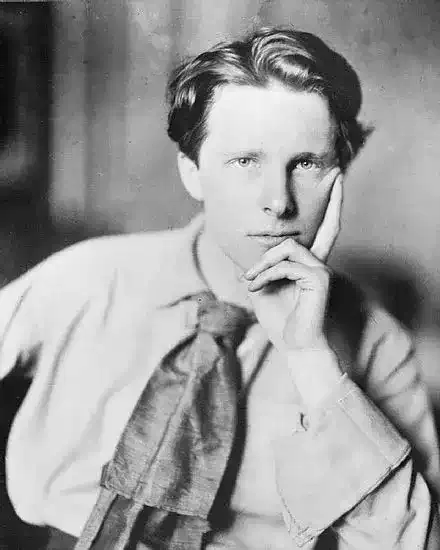
Rupert Brooke
The Song of the Pilgrims
The Song of the Pilgrims
(Halted around the fire by night, after moon-set, they sing this beneath the
trees.)
What light of unremembered skies
Hast thou relumed within our eyes,
Thou whom we seek, whom we shall find?…
A certain odour on the wind,
Thy hidden face beyond the west,
These things have called us; on a quest
Older than any road we trod,
More endless than desire.…
Far God,
Sigh with thy cruel voice, that fills
The soul with longing for dim hills
And faint horizons! For there come
Grey moments of the antient dumb
Sickness of travel, when no song
Can cheer us; but the way seems long;
And one remembers.…
Ah! the beat
Of weary unreturning feet,
And songs of pilgrims unreturning!…
The fires we left are always burning
On the old shrines of home. Our kin
Have built them temples, and therein
Pray to the Gods we know; and dwell
In little houses lovable,
Being happy (we remember how!)
And peaceful even to death...
O Thou,
God of all long desirous roaming,
Our hearts are sick of fruitless homing,
And crying after lost desire.
Hearten us onward! as with fire
Consuming dreams of other bliss.
The best Thou givest, giving this
Sufficient thing—to travel still
Over the plain, beyond the hill,
Unhesitating through the shade,
Amid the silence unafraid,
Till, at some sudden turn, one sees
Against the black and muttering trees
Thine altar, wonderfully white,
Among the Forests of the Night.
(Halted around the fire by night, after moon-set, they sing this beneath the
trees.)
What light of unremembered skies
Hast thou relumed within our eyes,
Thou whom we seek, whom we shall find?…
A certain odour on the wind,
Thy hidden face beyond the west,
These things have called us; on a quest
Older than any road we trod,
More endless than desire.…
Far God,
Sigh with thy cruel voice, that fills
The soul with longing for dim hills
And faint horizons! For there come
Grey moments of the antient dumb
Sickness of travel, when no song
Can cheer us; but the way seems long;
And one remembers.…
Ah! the beat
Of weary unreturning feet,
And songs of pilgrims unreturning!…
The fires we left are always burning
On the old shrines of home. Our kin
Have built them temples, and therein
Pray to the Gods we know; and dwell
In little houses lovable,
Being happy (we remember how!)
And peaceful even to death...
O Thou,
God of all long desirous roaming,
Our hearts are sick of fruitless homing,
And crying after lost desire.
Hearten us onward! as with fire
Consuming dreams of other bliss.
The best Thou givest, giving this
Sufficient thing—to travel still
Over the plain, beyond the hill,
Unhesitating through the shade,
Amid the silence unafraid,
Till, at some sudden turn, one sees
Against the black and muttering trees
Thine altar, wonderfully white,
Among the Forests of the Night.
201
Rupert Brooke
The Old Vicarage, Grantchester
The Old Vicarage, Grantchester
Just now the lilac is in bloom,
All before my little room;
And in my flower-beds, I think,
Smile the carnation and the pink;
And down the borders, well I know,
The poppy and the pansy blow . . .
Oh! there the chestnuts, summer through,
Beside the river make for you
A tunnel of green gloom, and sleep
Deeply above; and green and deep
The stream mysterious glides beneath,
Green as a dream and deep as death.
-- Oh, damn! I know it! and I know
How the May fields all golden show,
And when the day is young and sweet,
Gild gloriously the bare feet
That run to bathe . . .
`Du lieber Gott!'
Here am I, sweating, sick, and hot,
And there the shadowed waters fresh
Lean up to embrace the naked flesh.
Temperamentvoll German Jews
Drink beer around; -- and THERE the dews
Are soft beneath a morn of gold.
Here tulips bloom as they are told;
Unkempt about those hedges blows
An English unofficial rose;
And there the unregulated sun
Slopes down to rest when day is done,
And wakes a vague unpunctual star,
A slippered Hesper; and there are
Meads towards Haslingfield and Coton
Where das Betreten's not verboten.
ei'qe genoi mhn . . . would I were
In Grantchester, in Grantchester! --
Some, it may be, can get in touch
With Nature there, or Earth, or such.
And clever modern men have seen
A Faun a-peeping through the green,
And felt the Classics were not dead,
To glimpse a Naiad's reedy head,
Or hear the Goat-foot piping low: . . .
But these are things I do not know.
I only know that you may lie
Day long and watch the Cambridge sky,
And, flower-lulled in sleepy grass,
Hear the cool lapse of hours pass,
Until the centuries blend and blur
In Grantchester, in Grantchester. . . .
Still in the dawnlit waters cool
His ghostly Lordship swims his pool,
And tries the strokes, essays the tricks,
Long learnt on Hellespont, or Styx.
Dan Chaucer hears his river still
Chatter beneath a phantom mill.
Tennyson notes, with studious eye,
How Cambridge waters hurry by . . .
And in that garden, black and white,
Creep whispers through the grass all night;
And spectral dance, before the dawn,
A hundred Vicars down the lawn;
Curates, long dust, will come and go
On lissom, clerical, printless toe;
And oft between the boughs is seen
The sly shade of a Rural Dean . . .
Till, at a shiver in the skies,
Vanishing with Satanic cries,
The prim ecclesiastic rout
Leaves but a startled sleeper-out,
Grey heavens, the first bird's drowsy calls,
The falling house that never falls.
epsilon-iota'-theta-epsilon gamma-epsilon-nu-omicron-iota -mu-eta-nu
God! I will pack, and take a train,
And get me to England once again!
For England's the one land, I know,
Where men with Splendid Hearts may go;
And Cambridgeshire, of all England,
The shire for Men who Understand;
And of THAT district I prefer
The lovely hamlet Grantchester.
For Cambridge people rarely smile,
Being urban, squat, and packed with guile;
And Royston men in the far South
Are black and fierce and strange of mouth;
At Over they fling oaths at one,
And worse than oaths at Trumpington,
And Ditton girls are mean and dirty,
And there's none in Harston under thirty,
And folks in Shelford and those parts
Have twisted lips and twisted hearts,
And Barton men make Cockney rhymes,
And Coton's full of nameless crimes,
And things are done you'd not believe
At Madingley on Christmas Eve.
Strong men have run for miles and miles,
When one from Cherry Hinton smiles;
Strong men have blanched, and shot their wives,
Rather than send them to St. Ives;
Strong men have cried like babes, bydam,
To hear what happened at Babraham.
But Grantchester! ah, Grantchester!
There's peace and holy quiet there,
Great clouds along pacific skies,
And men and women with straight eyes,
Lithe children lovelier than a dream,
A bosky wood, a slumbrous stream,
And little kindly winds that creep
Round twilight corners, half asleep.
In Grantchester their skins are white;
They bathe by day, they bathe by night;
The women there do all they ought;
The men observe the Rules of Thought.
They love the Good; they worship Truth;
They laugh uproariously in youth;
(And when they get to feeling old,
They up and shoot themselves, I'm told) . . .
Ah God! to see the branches stir
Across the moon at Grantchester!
To smell the thrilling-sweet and rotten
Unforgettable, unforgotten
River-smell, and hear the breeze
Sobbing in the little trees.
Say, do the elm-clumps greatly stand
Still guardians of that holy land?
The chestnuts shade, in reverend dream,
The yet unacademic stream?
Is dawn a secret shy and cold
Anadyomene, silver-gold?
And sunset still a golden sea
From Haslingfield to Madingley?
And after, ere the night is born,
Do hares come out about the corn?
Oh, is the water sweet and cool,
Gentle and brown, above the pool?
And laughs the immortal river still
Under the mill, under the mill?
Say, is there Beauty yet to find?
And Certainty? and Quiet kind?
Deep meadows yet, for to forget
The lies, and truths, and pain? . . . oh! yet
Stands the Church clock at ten to three?
And is there honey still for tea?
Just now the lilac is in bloom,
All before my little room;
And in my flower-beds, I think,
Smile the carnation and the pink;
And down the borders, well I know,
The poppy and the pansy blow . . .
Oh! there the chestnuts, summer through,
Beside the river make for you
A tunnel of green gloom, and sleep
Deeply above; and green and deep
The stream mysterious glides beneath,
Green as a dream and deep as death.
-- Oh, damn! I know it! and I know
How the May fields all golden show,
And when the day is young and sweet,
Gild gloriously the bare feet
That run to bathe . . .
`Du lieber Gott!'
Here am I, sweating, sick, and hot,
And there the shadowed waters fresh
Lean up to embrace the naked flesh.
Temperamentvoll German Jews
Drink beer around; -- and THERE the dews
Are soft beneath a morn of gold.
Here tulips bloom as they are told;
Unkempt about those hedges blows
An English unofficial rose;
And there the unregulated sun
Slopes down to rest when day is done,
And wakes a vague unpunctual star,
A slippered Hesper; and there are
Meads towards Haslingfield and Coton
Where das Betreten's not verboten.
ei'qe genoi mhn . . . would I were
In Grantchester, in Grantchester! --
Some, it may be, can get in touch
With Nature there, or Earth, or such.
And clever modern men have seen
A Faun a-peeping through the green,
And felt the Classics were not dead,
To glimpse a Naiad's reedy head,
Or hear the Goat-foot piping low: . . .
But these are things I do not know.
I only know that you may lie
Day long and watch the Cambridge sky,
And, flower-lulled in sleepy grass,
Hear the cool lapse of hours pass,
Until the centuries blend and blur
In Grantchester, in Grantchester. . . .
Still in the dawnlit waters cool
His ghostly Lordship swims his pool,
And tries the strokes, essays the tricks,
Long learnt on Hellespont, or Styx.
Dan Chaucer hears his river still
Chatter beneath a phantom mill.
Tennyson notes, with studious eye,
How Cambridge waters hurry by . . .
And in that garden, black and white,
Creep whispers through the grass all night;
And spectral dance, before the dawn,
A hundred Vicars down the lawn;
Curates, long dust, will come and go
On lissom, clerical, printless toe;
And oft between the boughs is seen
The sly shade of a Rural Dean . . .
Till, at a shiver in the skies,
Vanishing with Satanic cries,
The prim ecclesiastic rout
Leaves but a startled sleeper-out,
Grey heavens, the first bird's drowsy calls,
The falling house that never falls.
epsilon-iota'-theta-epsilon gamma-epsilon-nu-omicron-iota -mu-eta-nu
God! I will pack, and take a train,
And get me to England once again!
For England's the one land, I know,
Where men with Splendid Hearts may go;
And Cambridgeshire, of all England,
The shire for Men who Understand;
And of THAT district I prefer
The lovely hamlet Grantchester.
For Cambridge people rarely smile,
Being urban, squat, and packed with guile;
And Royston men in the far South
Are black and fierce and strange of mouth;
At Over they fling oaths at one,
And worse than oaths at Trumpington,
And Ditton girls are mean and dirty,
And there's none in Harston under thirty,
And folks in Shelford and those parts
Have twisted lips and twisted hearts,
And Barton men make Cockney rhymes,
And Coton's full of nameless crimes,
And things are done you'd not believe
At Madingley on Christmas Eve.
Strong men have run for miles and miles,
When one from Cherry Hinton smiles;
Strong men have blanched, and shot their wives,
Rather than send them to St. Ives;
Strong men have cried like babes, bydam,
To hear what happened at Babraham.
But Grantchester! ah, Grantchester!
There's peace and holy quiet there,
Great clouds along pacific skies,
And men and women with straight eyes,
Lithe children lovelier than a dream,
A bosky wood, a slumbrous stream,
And little kindly winds that creep
Round twilight corners, half asleep.
In Grantchester their skins are white;
They bathe by day, they bathe by night;
The women there do all they ought;
The men observe the Rules of Thought.
They love the Good; they worship Truth;
They laugh uproariously in youth;
(And when they get to feeling old,
They up and shoot themselves, I'm told) . . .
Ah God! to see the branches stir
Across the moon at Grantchester!
To smell the thrilling-sweet and rotten
Unforgettable, unforgotten
River-smell, and hear the breeze
Sobbing in the little trees.
Say, do the elm-clumps greatly stand
Still guardians of that holy land?
The chestnuts shade, in reverend dream,
The yet unacademic stream?
Is dawn a secret shy and cold
Anadyomene, silver-gold?
And sunset still a golden sea
From Haslingfield to Madingley?
And after, ere the night is born,
Do hares come out about the corn?
Oh, is the water sweet and cool,
Gentle and brown, above the pool?
And laughs the immortal river still
Under the mill, under the mill?
Say, is there Beauty yet to find?
And Certainty? and Quiet kind?
Deep meadows yet, for to forget
The lies, and truths, and pain? . . . oh! yet
Stands the Church clock at ten to three?
And is there honey still for tea?
226
Rupert Brooke
Song of the Pilgrims, The
Song of the Pilgrims, The
(Halted around the fire by night, after moon-set, they sing this beneath the trees.)
What light of unremembered skies
Hast thou relumed within our eyes,
Thou whom we seek, whom we shall find? . . .
A certain odour on the wind,
Thy hidden face beyond the west,
These things have called us; on a quest
Older than any road we trod,
More endless than desire. . . .
Far God,
Sigh with thy cruel voice, that fills
The soul with longing for dim hills
And faint horizons! For there come
Grey moments of the antient dumb
Sickness of travel, when no song
Can cheer us; but the way seems long;
And one remembers. . . .
Ah! the beat
Of weary unreturning feet,
And songs of pilgrims unreturning! . . .
The fires we left are always burning
On the old shrines of home. Our kin
Have built them temples, and therein
Pray to the Gods we know; and dwell
In little houses lovable,
Being happy (we remember how!)
And peaceful even to death. . . .
O Thou,
God of all long desirous roaming,
Our hearts are sick of fruitless homing,
And crying after lost desire.
Hearten us onward! as with fire
Consuming dreams of other bliss.
The best Thou givest, giving this
Sufficient thing -- to travel still
Over the plain, beyond the hill,
Unhesitating through the shade,
Amid the silence unafraid,
Till, at some sudden turn, one sees
Against the black and muttering trees
Thine altar, wonderfully white,
Among the Forests of the Night.
(Halted around the fire by night, after moon-set, they sing this beneath the trees.)
What light of unremembered skies
Hast thou relumed within our eyes,
Thou whom we seek, whom we shall find? . . .
A certain odour on the wind,
Thy hidden face beyond the west,
These things have called us; on a quest
Older than any road we trod,
More endless than desire. . . .
Far God,
Sigh with thy cruel voice, that fills
The soul with longing for dim hills
And faint horizons! For there come
Grey moments of the antient dumb
Sickness of travel, when no song
Can cheer us; but the way seems long;
And one remembers. . . .
Ah! the beat
Of weary unreturning feet,
And songs of pilgrims unreturning! . . .
The fires we left are always burning
On the old shrines of home. Our kin
Have built them temples, and therein
Pray to the Gods we know; and dwell
In little houses lovable,
Being happy (we remember how!)
And peaceful even to death. . . .
O Thou,
God of all long desirous roaming,
Our hearts are sick of fruitless homing,
And crying after lost desire.
Hearten us onward! as with fire
Consuming dreams of other bliss.
The best Thou givest, giving this
Sufficient thing -- to travel still
Over the plain, beyond the hill,
Unhesitating through the shade,
Amid the silence unafraid,
Till, at some sudden turn, one sees
Against the black and muttering trees
Thine altar, wonderfully white,
Among the Forests of the Night.
209
Rupert Brooke
Dawn
Dawn
Opposite me two Germans snore and sweat.
Through sullen swirling gloom we jolt and roar.
We have been here for ever: even yet
A dim watch tells two hours, two aeons, more.
The windows are tight-shut and slimy-wet
With a night's foetor. There are two hours more;
Two hours to dawn and Milan; two hours yet.
Opposite me two Germans sweat and snore. . . .
One of them wakes, and spits, and sleeps again.
The darkness shivers. A wan light through the rain
Strikes on our faces, drawn and white. Somewhere
A new day sprawls; and, inside, the foul air
Is chill, and damp, and fouler than before. . . .
Opposite me two Germans sweat and snore.
Opposite me two Germans snore and sweat.
Through sullen swirling gloom we jolt and roar.
We have been here for ever: even yet
A dim watch tells two hours, two aeons, more.
The windows are tight-shut and slimy-wet
With a night's foetor. There are two hours more;
Two hours to dawn and Milan; two hours yet.
Opposite me two Germans sweat and snore. . . .
One of them wakes, and spits, and sleeps again.
The darkness shivers. A wan light through the rain
Strikes on our faces, drawn and white. Somewhere
A new day sprawls; and, inside, the foul air
Is chill, and damp, and fouler than before. . . .
Opposite me two Germans sweat and snore.
223
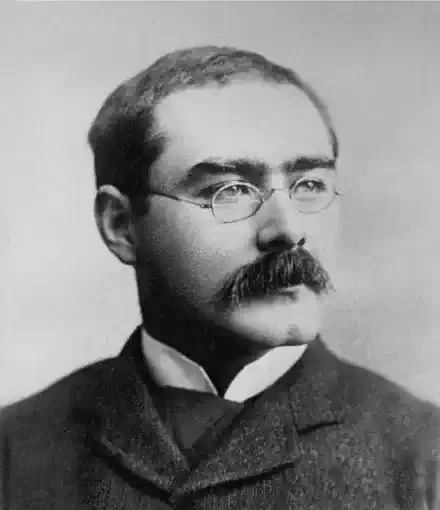
Rudyard Kipling
The Sing-Song of Old Man Kangaroo
The Sing-Song of Old Man Kangaroo
This is the mouth-filling song of the race that was run by a Boomer.
Run in a single burst--only event of its kind--
Started by Big God Nqong from Warrigaborrigarooma,
Old Man Kangaroo first, Yellow-Dog Dingo behind.
Kangaroo bounded away, his back-legs working like pistons--
Bounded from morning till dark, twenty-five feet at a bound.
Yellow-Dog Dingo lay like a yellow cloud in the distance--
Much too busy to bark. My! but they covered the ground!
Nobody knows where they went, or followed the track that they flew in,
For that Continent hadn't been given a name.
They ran thirty degrees from Torres Straits to Leeuwin
(Look at the Atlas, please then they ran back as they came.
S'posing you could trot from Adelaide to the Pacific
For an afternoon's run -- half what these gentlemen did--
You would feel rather hot, but your legs would develop terrific,
Yes, my importunate son, you'd be a Marvellous Kid!
This is the mouth-filling song of the race that was run by a Boomer.
Run in a single burst--only event of its kind--
Started by Big God Nqong from Warrigaborrigarooma,
Old Man Kangaroo first, Yellow-Dog Dingo behind.
Kangaroo bounded away, his back-legs working like pistons--
Bounded from morning till dark, twenty-five feet at a bound.
Yellow-Dog Dingo lay like a yellow cloud in the distance--
Much too busy to bark. My! but they covered the ground!
Nobody knows where they went, or followed the track that they flew in,
For that Continent hadn't been given a name.
They ran thirty degrees from Torres Straits to Leeuwin
(Look at the Atlas, please then they ran back as they came.
S'posing you could trot from Adelaide to the Pacific
For an afternoon's run -- half what these gentlemen did--
You would feel rather hot, but your legs would develop terrific,
Yes, my importunate son, you'd be a Marvellous Kid!
641
Rudyard Kipling
The Second Voyage
The Second Voyage
We've sent our little Cupids all ashore --
They were frightened, they were tired, they were cold:
Our sails of silk and purple go to store,
And we've cut away our mast of beaten gold
(Foul weather!)
Oh 'tis hemp and singing pine for to stand against the brine,
But Love he is our master as of old!
The sea has shorn our galleries away,
The salt has soiled our gilding past remede;
Our paint is flaked and blistered by the spray,
Our sides are half a fathom furred in weed
(Foul weather!)
And the Doves of Venus fled and the petrels came instead,
But Love he was our master at our need!
'Was Youth would keep no vigil at the bow,
'Was Pleasure at the helm too drunk to steer --
We've shipped three able quartermasters now.
Men call them Custom, Reverence, and Fear
(Foul weather!)
They are old and scarred and plain, but we'll run no risk again
From any Port o' Paphos mutineer!
We seek no more the tempest for delight,
We skirt no more the indraught and the shoal --
We ask no more of any day or night
Than to come with least adventure to our goal
(Foul weather!)
What we find we needs must brook, but we do not go to look,
Nor tempt the Lord our God that saved us whole.
Yet, caring so, not overmuch we care
To brace and trim for every foolish blast,
If the squall be pleased to seep us unaware,
He may bellow off to leeward like the last
(Foul weather!)
We will blame it on the deep (for the watch must have their sleep),
And Love can come and wake us when 'tis past.
Oh launch them down with music from the beach,
Oh warp them out with garlands from the quays --
Most resolute -- a damsel unto each --
New prows that seek the old Hesperides!
(Foul weather!)
Though we know their voyage is vain, yet we see our path again
In the saffroned bridesails scenting all the seas!
(Foul weather!)
We've sent our little Cupids all ashore --
They were frightened, they were tired, they were cold:
Our sails of silk and purple go to store,
And we've cut away our mast of beaten gold
(Foul weather!)
Oh 'tis hemp and singing pine for to stand against the brine,
But Love he is our master as of old!
The sea has shorn our galleries away,
The salt has soiled our gilding past remede;
Our paint is flaked and blistered by the spray,
Our sides are half a fathom furred in weed
(Foul weather!)
And the Doves of Venus fled and the petrels came instead,
But Love he was our master at our need!
'Was Youth would keep no vigil at the bow,
'Was Pleasure at the helm too drunk to steer --
We've shipped three able quartermasters now.
Men call them Custom, Reverence, and Fear
(Foul weather!)
They are old and scarred and plain, but we'll run no risk again
From any Port o' Paphos mutineer!
We seek no more the tempest for delight,
We skirt no more the indraught and the shoal --
We ask no more of any day or night
Than to come with least adventure to our goal
(Foul weather!)
What we find we needs must brook, but we do not go to look,
Nor tempt the Lord our God that saved us whole.
Yet, caring so, not overmuch we care
To brace and trim for every foolish blast,
If the squall be pleased to seep us unaware,
He may bellow off to leeward like the last
(Foul weather!)
We will blame it on the deep (for the watch must have their sleep),
And Love can come and wake us when 'tis past.
Oh launch them down with music from the beach,
Oh warp them out with garlands from the quays --
Most resolute -- a damsel unto each --
New prows that seek the old Hesperides!
(Foul weather!)
Though we know their voyage is vain, yet we see our path again
In the saffroned bridesails scenting all the seas!
(Foul weather!)
453
Rudyard Kipling
The Merchantmen
The Merchantmen
King Solomon drew merchantmen,
Because of his desire
For peacocks, apes, and ivory,
From Tarshish unto Tyre:
With cedars out of Lebanon
Which Hiram rafted down,
But we be only sailormen
That use in London Town.
Coastwise -- cross-seas -- round the world and back again --
Where the flaw shall head us or the full Trade suits --
Plain-sail -- storm-sail -- lay your board and tack again --
And that's the way we'll pay Paddy Doyle for his boots!
We bring no store of ingots,
Of spice or precious stones,
But that we have we gathered
With sweat and aching bones:
In flame beneath the tropics,
In frost upon the floe,
And jeopardy of every wind
That does between them go.
And some we got by purchase,
And some we had by trade,
And some we found by courtesy
Of pike and carronade --
At midnight, 'mid-sea meetings,
For charity to keep,
And light the rolling homeward-bound
That rode a foot too deep.
By sport of bitter weather
We're walty, strained, and scarred
From the kentledge on the kelson
To the slings upon the yard.
Six oceans had their will of us
To carry all away --
Our galley's in the Baltic,
And our boom's in Mossel Bay!
We've floundered off the Texel,
Awash with sodden deals,
We've slipped from Valparaiso
With the Norther at our heels:
We've ratched beyond the Crossets
That tusk the Southern Pole,
And dipped our gunnels under
To the dread Agulhas roll.
Beyond all outer charting
We sailed where none have sailed,
And saw the land-lights burning
On islands none have hailed;
Our hair stood up for wonder,
But, when the night was done,
There danced the deep to windward
Blue-empty 'neath the sun!
Strange consorts rode beside us
And brought us evil luck;
The witch-fire climbed our channels,
And flared on vane and truck:
Till, through the red tornado,
That lashed us nigh to blind,
We saw The Dutchman plunging,
Full canvas, head to wind!
We've heard the Midnight Leadsman
That calls the black deep down --
Ay, thrice we've heard The Swimmer,
The Thing that may not drown.
On frozen bunt and gasket
The sleet-cloud drave her hosts,
When, manned by more than signed with us,
We passed the Isle o' Ghosts!
And north, amid the hummocks,
A biscuit-toss below,
We met the silent shallop
That frighted whalers know;
For, down a cruel ice-lane,
That opened as he sped,
We saw dead Henry Hudson
Steer, North by West, his dead.
So dealt God's waters with us
Beneath the roaring skies,
So walked His signs and marvels
All naked to our eyes:
But we were heading homeward
With trade to lose or make --
Good Lord, they slipped behind us
In the tailing of our wake!
Let go, let go the anchors;
Now shamed at heart are we
To bring so poor a cargo home
That had for gift the sea!
Let go the great bow-anchors --
Ah, fools were we and blind --
The worst we stored with utter toil,
The best we left behind!
Coastwise -- cross-seas -- round the world and back again,
Whither flaw shall fail us or the Trades drive down:
Plain-sail -- storm-sail -- lay your board and tack again --
And all to bring a cargo up to London Town!
King Solomon drew merchantmen,
Because of his desire
For peacocks, apes, and ivory,
From Tarshish unto Tyre:
With cedars out of Lebanon
Which Hiram rafted down,
But we be only sailormen
That use in London Town.
Coastwise -- cross-seas -- round the world and back again --
Where the flaw shall head us or the full Trade suits --
Plain-sail -- storm-sail -- lay your board and tack again --
And that's the way we'll pay Paddy Doyle for his boots!
We bring no store of ingots,
Of spice or precious stones,
But that we have we gathered
With sweat and aching bones:
In flame beneath the tropics,
In frost upon the floe,
And jeopardy of every wind
That does between them go.
And some we got by purchase,
And some we had by trade,
And some we found by courtesy
Of pike and carronade --
At midnight, 'mid-sea meetings,
For charity to keep,
And light the rolling homeward-bound
That rode a foot too deep.
By sport of bitter weather
We're walty, strained, and scarred
From the kentledge on the kelson
To the slings upon the yard.
Six oceans had their will of us
To carry all away --
Our galley's in the Baltic,
And our boom's in Mossel Bay!
We've floundered off the Texel,
Awash with sodden deals,
We've slipped from Valparaiso
With the Norther at our heels:
We've ratched beyond the Crossets
That tusk the Southern Pole,
And dipped our gunnels under
To the dread Agulhas roll.
Beyond all outer charting
We sailed where none have sailed,
And saw the land-lights burning
On islands none have hailed;
Our hair stood up for wonder,
But, when the night was done,
There danced the deep to windward
Blue-empty 'neath the sun!
Strange consorts rode beside us
And brought us evil luck;
The witch-fire climbed our channels,
And flared on vane and truck:
Till, through the red tornado,
That lashed us nigh to blind,
We saw The Dutchman plunging,
Full canvas, head to wind!
We've heard the Midnight Leadsman
That calls the black deep down --
Ay, thrice we've heard The Swimmer,
The Thing that may not drown.
On frozen bunt and gasket
The sleet-cloud drave her hosts,
When, manned by more than signed with us,
We passed the Isle o' Ghosts!
And north, amid the hummocks,
A biscuit-toss below,
We met the silent shallop
That frighted whalers know;
For, down a cruel ice-lane,
That opened as he sped,
We saw dead Henry Hudson
Steer, North by West, his dead.
So dealt God's waters with us
Beneath the roaring skies,
So walked His signs and marvels
All naked to our eyes:
But we were heading homeward
With trade to lose or make --
Good Lord, they slipped behind us
In the tailing of our wake!
Let go, let go the anchors;
Now shamed at heart are we
To bring so poor a cargo home
That had for gift the sea!
Let go the great bow-anchors --
Ah, fools were we and blind --
The worst we stored with utter toil,
The best we left behind!
Coastwise -- cross-seas -- round the world and back again,
Whither flaw shall fail us or the Trades drive down:
Plain-sail -- storm-sail -- lay your board and tack again --
And all to bring a cargo up to London Town!
473
Rudyard Kipling
The Long Trail
The Long Trail
There's a whisper down the field where the year has shot her yield,
And the ricks stand grey to the sun,
Singing: "Over then, come over, for the bee has quit the dover,
"And your English summer's done."
You have heard the beat of the off-shore wind,
And the thresh of the deep-sea rain;
You have heard the song -- how long? how long?
Pull out on the trail again!
Ha' done with the Tents of Shem, dear lass,
We've seen the seasons through,
And it's time to turn the old trail, our own trail, the out trail,
Pull out, pull out, on the Long Trail-the trail that is always new!
It's North you may run to the rime-ringed sun
Or South to the blind Hom's hate;
Or East all the way into Mississippi Bay,
Or West to the Golden Gate --
Where the blindest bluffs hold good, dear lass,
And the wildest tales are true,
And the men bulk big on the old trail, our own trail, the out trail,
And life runs large on the Long Trail -- the trail that is always new.
The days are sick and cold, and the skies are grey and old
And the twice-breathed airs blow damp;
And I'd sell my tired soul for the bucking beam-sea roll
Of a black Bilbao tramp,
With her load-line over her hatch, dear lass,
And a drunken Dago crew,
And her nose held down on the old trail, our own trail, the out trail
From Cadiz south on the Long Trail-the trail that is always new.
There be triple ways to take, of the eagle or the snake,
Or the way of a man with a maid;
But the sweetest way to me is a ship's upon the sea
In the heel of the North-East Trade.
Can you hear the crash on her brows, dear lass.
And the drum of the racing screw,
As she ships it green on the old trail, our own trail, the out trail,
As she lifts and 'scends on the Long Trail -- the trail that is always new?
See the shaking funnels roar, with the Peter at the fore,
And the fenders grind and heave,
And the derricks clack and grate, as the tackle hooks the crate,
And the fall-rope whines through the sheave;
It's "Gang-plank up and in," dear lass,
It's "Hawsers warp her through!"
And it's "All clear aft" on the old trail, our own trail, the out trail,
We're backing down on the Long Trail -- the trail that is always new.
O the mutter overside, when the port-fog holds us tied,
And the sirens hoot their dread,
When foot by foot we creep o'er the hueless, viewless deep
To the sob of the questing lead!
It's down by the Lower Hope, dear lass,
With the Grinfleet Sands in view,
Till the Mouse swings green on the old trail, our own trail, the out trail,
And the Gull Light lifts on the Long Trail -- the trail that is always new.
O the blazing tropic night, when the wake's a welt of light
That holds the hot sky tame,
And the steady fore-foot snores through the planet-powdered floors
Where the scared whale flukes in flame!
Her plates are flaked by the sun, dear lass
And her ropes are taut with the dew,
For we're booming down on the old trail, our own trail, the out trail,
We're sagging south on the Long Trail -- the trail that is always new.
Then home, get her home, where the drunken rollers comb,
And the shouting seas drive by,
And the engines stamp and ring, and the wet bows reel and swing,
And the Southern Cross rides high!
Yes, the old lost stars wheel back, dear lass,
That blaze in the velvet blue.
They're all old friends on the old trail, our own trail, the out trail,
They're God's own guides on the Long Trail -- the trail that is always new.
Fly forward, O my heart, from the Foreland to the Start
We're steaming all too slow,
And it's twenty thousand mile to our little lazy isle
Where the trumpet-orchids blow!
You have heard the call of the off-shore wind
And the voice of the deep-sea rain;
You have heard the song-how long? how long?
Pull out on the trail again!
The Lord knows what we may find, dear lass,
And The Deuce knows we may do
But we're back once more on the old trail, our own trail, the out trail,
We're down, hull-down, on the Long Trail -- the trail that is always new!
There's a whisper down the field where the year has shot her yield,
And the ricks stand grey to the sun,
Singing: "Over then, come over, for the bee has quit the dover,
"And your English summer's done."
You have heard the beat of the off-shore wind,
And the thresh of the deep-sea rain;
You have heard the song -- how long? how long?
Pull out on the trail again!
Ha' done with the Tents of Shem, dear lass,
We've seen the seasons through,
And it's time to turn the old trail, our own trail, the out trail,
Pull out, pull out, on the Long Trail-the trail that is always new!
It's North you may run to the rime-ringed sun
Or South to the blind Hom's hate;
Or East all the way into Mississippi Bay,
Or West to the Golden Gate --
Where the blindest bluffs hold good, dear lass,
And the wildest tales are true,
And the men bulk big on the old trail, our own trail, the out trail,
And life runs large on the Long Trail -- the trail that is always new.
The days are sick and cold, and the skies are grey and old
And the twice-breathed airs blow damp;
And I'd sell my tired soul for the bucking beam-sea roll
Of a black Bilbao tramp,
With her load-line over her hatch, dear lass,
And a drunken Dago crew,
And her nose held down on the old trail, our own trail, the out trail
From Cadiz south on the Long Trail-the trail that is always new.
There be triple ways to take, of the eagle or the snake,
Or the way of a man with a maid;
But the sweetest way to me is a ship's upon the sea
In the heel of the North-East Trade.
Can you hear the crash on her brows, dear lass.
And the drum of the racing screw,
As she ships it green on the old trail, our own trail, the out trail,
As she lifts and 'scends on the Long Trail -- the trail that is always new?
See the shaking funnels roar, with the Peter at the fore,
And the fenders grind and heave,
And the derricks clack and grate, as the tackle hooks the crate,
And the fall-rope whines through the sheave;
It's "Gang-plank up and in," dear lass,
It's "Hawsers warp her through!"
And it's "All clear aft" on the old trail, our own trail, the out trail,
We're backing down on the Long Trail -- the trail that is always new.
O the mutter overside, when the port-fog holds us tied,
And the sirens hoot their dread,
When foot by foot we creep o'er the hueless, viewless deep
To the sob of the questing lead!
It's down by the Lower Hope, dear lass,
With the Grinfleet Sands in view,
Till the Mouse swings green on the old trail, our own trail, the out trail,
And the Gull Light lifts on the Long Trail -- the trail that is always new.
O the blazing tropic night, when the wake's a welt of light
That holds the hot sky tame,
And the steady fore-foot snores through the planet-powdered floors
Where the scared whale flukes in flame!
Her plates are flaked by the sun, dear lass
And her ropes are taut with the dew,
For we're booming down on the old trail, our own trail, the out trail,
We're sagging south on the Long Trail -- the trail that is always new.
Then home, get her home, where the drunken rollers comb,
And the shouting seas drive by,
And the engines stamp and ring, and the wet bows reel and swing,
And the Southern Cross rides high!
Yes, the old lost stars wheel back, dear lass,
That blaze in the velvet blue.
They're all old friends on the old trail, our own trail, the out trail,
They're God's own guides on the Long Trail -- the trail that is always new.
Fly forward, O my heart, from the Foreland to the Start
We're steaming all too slow,
And it's twenty thousand mile to our little lazy isle
Where the trumpet-orchids blow!
You have heard the call of the off-shore wind
And the voice of the deep-sea rain;
You have heard the song-how long? how long?
Pull out on the trail again!
The Lord knows what we may find, dear lass,
And The Deuce knows we may do
But we're back once more on the old trail, our own trail, the out trail,
We're down, hull-down, on the Long Trail -- the trail that is always new!
446
Rudyard Kipling
The Crab That Played with the Sea
The Crab That Played with the Sea
China-going P. & O.'s
Pass Pau Amma's playground close,
And his Pusat Tasek lies
Near the track of most B.I.'s.
N.Y.K. and N.D.L.
Know Pau Amma's home as well
As the Fisher of the Sea knows
"Bens," M.M.'s and Rubattinos.
But (and this is rather queer)
A.T.L.'s can qiot come here;
O. and O. and D.O.A.
Must go round another way.
Orient, Anchor, Bibby, Hall,
Never go that way at all.
U.C.S. would have a fit
If it found itself on it.
And if "Beavers" took their cargoes
To Penang instead of Lagos,
Or a fat Shaw-Savill bore
Passengers to Singapore,
Or a White Star were to try a
Little trip to Sourabaya,
Or a B.S.A. went on
Past Natal to Cheribon,
The the great Mr. Lloyds would come
Whith a wire and drag them home!
. . . . .
You will know what my riddle means
When you've eaten mangosteens.
China-going P. & O.'s
Pass Pau Amma's playground close,
And his Pusat Tasek lies
Near the track of most B.I.'s.
N.Y.K. and N.D.L.
Know Pau Amma's home as well
As the Fisher of the Sea knows
"Bens," M.M.'s and Rubattinos.
But (and this is rather queer)
A.T.L.'s can qiot come here;
O. and O. and D.O.A.
Must go round another way.
Orient, Anchor, Bibby, Hall,
Never go that way at all.
U.C.S. would have a fit
If it found itself on it.
And if "Beavers" took their cargoes
To Penang instead of Lagos,
Or a fat Shaw-Savill bore
Passengers to Singapore,
Or a White Star were to try a
Little trip to Sourabaya,
Or a B.S.A. went on
Past Natal to Cheribon,
The the great Mr. Lloyds would come
Whith a wire and drag them home!
. . . . .
You will know what my riddle means
When you've eaten mangosteens.
583
Rudyard Kipling
The Coiner
The Coiner
To be sung by the unlearned to the tune of "King John and the Abbot of
Canterbury," and by the learned to "Tempest-a-brewing."
Against the Bermudas we foundered, whereby
This Master, that Swabber, yon Bo'sun, and I
(Our pinnace and crew being drowned in the main)
Must beg for our bread through old England again.
For a bite and a sup, and a bed of clean straw,
We'll tell you such marvels as man never saw,
On a Magical Island which no one did spy
Save this Master, that Swabber, yon Bo'sun, and I.
Seven months among Mermaids and Devils and Sprites,
And Voices that howl in the cedars o'nights,
With further enchantments we underwent there.
Good Sirs, 'tis a tale to draw guts from a bear!
'Twixt Dover and Southwark it paid us our way,
Where we found some poor players were labouring a play;
And, willing to search what such business might be,
We entered the yard, both to hear and to see.
One hailed us for seamen and courteous-ly
Did guide us apart to a tavern near by
Where we told him our tale (as to many of late),
And he gave us good cheer, so we gave him good weight.
Mulled sack and strong waters on bellies well lined
With beef and black pudding do strengthen the mind;
And seeing him greedy for marvels, at last
From plain salted truth to flat leasing we passed.
But he, when on midnight our reckoning he paid,
Says, "Never match coins with a Coiner by trade,
Or he'll turn your lead pieces to metal as rare
As shall fill him this globe, and leave something to spare...."
We slept where they laid us, and when we awoke
Was a crown or five shillings in every man's poke.
We bit them and rang them, and, finding them good,
We drank to that Coiner as honest men should!
For a cup and a crust, and a truss, etc.
To be sung by the unlearned to the tune of "King John and the Abbot of
Canterbury," and by the learned to "Tempest-a-brewing."
Against the Bermudas we foundered, whereby
This Master, that Swabber, yon Bo'sun, and I
(Our pinnace and crew being drowned in the main)
Must beg for our bread through old England again.
For a bite and a sup, and a bed of clean straw,
We'll tell you such marvels as man never saw,
On a Magical Island which no one did spy
Save this Master, that Swabber, yon Bo'sun, and I.
Seven months among Mermaids and Devils and Sprites,
And Voices that howl in the cedars o'nights,
With further enchantments we underwent there.
Good Sirs, 'tis a tale to draw guts from a bear!
'Twixt Dover and Southwark it paid us our way,
Where we found some poor players were labouring a play;
And, willing to search what such business might be,
We entered the yard, both to hear and to see.
One hailed us for seamen and courteous-ly
Did guide us apart to a tavern near by
Where we told him our tale (as to many of late),
And he gave us good cheer, so we gave him good weight.
Mulled sack and strong waters on bellies well lined
With beef and black pudding do strengthen the mind;
And seeing him greedy for marvels, at last
From plain salted truth to flat leasing we passed.
But he, when on midnight our reckoning he paid,
Says, "Never match coins with a Coiner by trade,
Or he'll turn your lead pieces to metal as rare
As shall fill him this globe, and leave something to spare...."
We slept where they laid us, and when we awoke
Was a crown or five shillings in every man's poke.
We bit them and rang them, and, finding them good,
We drank to that Coiner as honest men should!
For a cup and a crust, and a truss, etc.
476
Rudyard Kipling
The Beginning of the Armadilloes
The Beginning of the Armadilloes
I've never sailed the Amazon,
I've never reached Brazil;
But the Don and Magdalena,
They can go there when they will!
Yes, weekly from Southampton
Great steamers, white and gold,
Go rolling down to Rio
(Roll down--roll down to Rio!).
And I'd like to roll to Rio
Some day before I'm old!
I've never seen a Jaguar,
Nor yet an Armadill--
He's dilloing in his armour,
And I s'pose I never will,
Unless I go to Rio
These wonders to behold--
Roll down--roll down to Rio--
Roll really down to Rio!
Oh, I'd love to roll to Rio
Some day before I'm old!
I've never sailed the Amazon,
I've never reached Brazil;
But the Don and Magdalena,
They can go there when they will!
Yes, weekly from Southampton
Great steamers, white and gold,
Go rolling down to Rio
(Roll down--roll down to Rio!).
And I'd like to roll to Rio
Some day before I'm old!
I've never seen a Jaguar,
Nor yet an Armadill--
He's dilloing in his armour,
And I s'pose I never will,
Unless I go to Rio
These wonders to behold--
Roll down--roll down to Rio--
Roll really down to Rio!
Oh, I'd love to roll to Rio
Some day before I'm old!
470
Rudyard Kipling
Sea-Wife
Sea-Wife
There dwells a wife by the Northern Gate,
And a wealthy wife is she;
She breeds a breed o' rovin' men
And casts them over sea.
And some are drowned in deep water,
And some in sight o' shore,
And word goes back to the weary wife
And ever she sends more.
For since that wife had gate or gear,
Or hearth or garth or bield,
She willed her sons to the white harvest,
And that is a bitter yield.
She wills her sons to the wet ploughing,
To ride the horse of tree,
And syne her sons come back again
Far-spent from out the sea.
The good wife's sons come home again
With little into their hands,
But the lore of men that ha' dealt with men
In the new and naked lands;
But the faith of men that ha' brothered men
By more than easy breath,
And the eyes o' men that ha' read wi' men
In the open books of death.
Rich are they, rich in wonders seen,
But poor in the goods o' men;
So what they ha' got by the skin o' their teeth
They sell for their teeth again.
For whether they lose to the naked life
Or win to their hearts' desire,
They tell it all to the weary wife
That nods beside the fire.
Her hearth is wide to every wind
That makes the white ash spin;
And tide and tide and 'tween the tides
Her sons go out and in;
(Out with great mirth that do desire
Hazard of trackless ways,
In with content to wait their watch
And warm before the blaze);
And some return by failing light,
And some in waking dream,
For she hears the heels of the dripping ghosts
That ride the rough roof-beam.
Home, they come home from all the ports,
The living and the dead;
The good wife's sons come home again
For her blessing on their head!
There dwells a wife by the Northern Gate,
And a wealthy wife is she;
She breeds a breed o' rovin' men
And casts them over sea.
And some are drowned in deep water,
And some in sight o' shore,
And word goes back to the weary wife
And ever she sends more.
For since that wife had gate or gear,
Or hearth or garth or bield,
She willed her sons to the white harvest,
And that is a bitter yield.
She wills her sons to the wet ploughing,
To ride the horse of tree,
And syne her sons come back again
Far-spent from out the sea.
The good wife's sons come home again
With little into their hands,
But the lore of men that ha' dealt with men
In the new and naked lands;
But the faith of men that ha' brothered men
By more than easy breath,
And the eyes o' men that ha' read wi' men
In the open books of death.
Rich are they, rich in wonders seen,
But poor in the goods o' men;
So what they ha' got by the skin o' their teeth
They sell for their teeth again.
For whether they lose to the naked life
Or win to their hearts' desire,
They tell it all to the weary wife
That nods beside the fire.
Her hearth is wide to every wind
That makes the white ash spin;
And tide and tide and 'tween the tides
Her sons go out and in;
(Out with great mirth that do desire
Hazard of trackless ways,
In with content to wait their watch
And warm before the blaze);
And some return by failing light,
And some in waking dream,
For she hears the heels of the dripping ghosts
That ride the rough roof-beam.
Home, they come home from all the ports,
The living and the dead;
The good wife's sons come home again
For her blessing on their head!
468
Rudyard Kipling
Chant-Pagan
Chant-Pagan
ENGLISH IRREGULAR, DISCHARGED
Me that 'ave been what I've been --
Me that 'ave gone where I've gone --
Me that 'ave seen what I've seen --
'Ow can I ever take on
With awful old England again,
An' 'ouses both sides of the street,
And 'edges two sides of the lane,
And the parson an' gentry between,
An' touchin' my 'at when we meet --
Me that 'ave been what I've been?
Me that 'ave watched 'arf a world
'Eave up all shiny with dew,
Kopje on kop to the sun,
An' as soon as the mist let 'em through
Our 'elios winkin' like fun --
Three sides of a ninety-mile square,
Over valleys as big as a shire --
"Are ye there? Are ye there? Are ye there?"
An' then the blind drum of our fire . . .
An' I'm rollin' 'is lawns for the Squire,
Me!
Me htat 'ave rode through the dark
Forty mile, often, on end,
Along the Ma'ollisberg Range,
With only the stars for my mark
An' only the night for my friend,
An' things runnin' off as you pass,
An' things jumpin' up in the grass,
An' the silence, the shine an' the size
Of the 'igh, unexpressible skies --
I am takin' some letters almost
As much as a mile to the post,
An' "mind you come back with the change!"
Me!
Me that saw Barberton took
When we dropped through the clouds on their 'ead,
An' they 'ove the guns over and fled --
Me that was through Di'mond I'll,
An' Pieters an' Springs an' Belfast --
From Dundee to Vereeniging all --
Me that stuck out to the last
(An' five bloomin' bars on my chest) --
I am doin' my Sunday-school best,
By the 'elp of the Squire an' 'is wife
(Not to mention the 'ousemaid an' cook),
To come in an' 'ands up an' be still,
An' honestly work for my bread,
My livin' in that state of life
To which it shall please God to call
Me!
Me that 'ave followed my trade
In the place where the Lightnin's are made;
"Twixt the Rains and the Sun and the Moon --
Me that lay down an' got up
Three years with the sky for my roof --
That 'ave ridden my 'unger an' thirst
Six thousand raw mile on the hoof,
With the Vaal and the Orange for cup,
An' the Brandwater Basin for dish, --
Oh! it's 'ard to be'ave as they wish
(Too 'ard, an' a little too soon),
I'll 'ave to think over it first --
Me!
I will arise an' get 'ence --
I will trek South and make sure
If it's only my fancy or not
That the sunshine of England is pale,
And the breezes of England are stale,
An' there's something' gone small with the lot.
For I know of a sun an' a wind,
An' some plains and a mountain be'ind,
An' some graves by a barb-wire fence,
An' a Dutchman I've fought 'oo might give
Me a job where I ever inclined
To look in an' offsaddle an' live
Where there's neither a road nor a tree --
But only my Maker an' me,
An I think it will kill me or cure,
So I think I will go there an' see.
ENGLISH IRREGULAR, DISCHARGED
Me that 'ave been what I've been --
Me that 'ave gone where I've gone --
Me that 'ave seen what I've seen --
'Ow can I ever take on
With awful old England again,
An' 'ouses both sides of the street,
And 'edges two sides of the lane,
And the parson an' gentry between,
An' touchin' my 'at when we meet --
Me that 'ave been what I've been?
Me that 'ave watched 'arf a world
'Eave up all shiny with dew,
Kopje on kop to the sun,
An' as soon as the mist let 'em through
Our 'elios winkin' like fun --
Three sides of a ninety-mile square,
Over valleys as big as a shire --
"Are ye there? Are ye there? Are ye there?"
An' then the blind drum of our fire . . .
An' I'm rollin' 'is lawns for the Squire,
Me!
Me htat 'ave rode through the dark
Forty mile, often, on end,
Along the Ma'ollisberg Range,
With only the stars for my mark
An' only the night for my friend,
An' things runnin' off as you pass,
An' things jumpin' up in the grass,
An' the silence, the shine an' the size
Of the 'igh, unexpressible skies --
I am takin' some letters almost
As much as a mile to the post,
An' "mind you come back with the change!"
Me!
Me that saw Barberton took
When we dropped through the clouds on their 'ead,
An' they 'ove the guns over and fled --
Me that was through Di'mond I'll,
An' Pieters an' Springs an' Belfast --
From Dundee to Vereeniging all --
Me that stuck out to the last
(An' five bloomin' bars on my chest) --
I am doin' my Sunday-school best,
By the 'elp of the Squire an' 'is wife
(Not to mention the 'ousemaid an' cook),
To come in an' 'ands up an' be still,
An' honestly work for my bread,
My livin' in that state of life
To which it shall please God to call
Me!
Me that 'ave followed my trade
In the place where the Lightnin's are made;
"Twixt the Rains and the Sun and the Moon --
Me that lay down an' got up
Three years with the sky for my roof --
That 'ave ridden my 'unger an' thirst
Six thousand raw mile on the hoof,
With the Vaal and the Orange for cup,
An' the Brandwater Basin for dish, --
Oh! it's 'ard to be'ave as they wish
(Too 'ard, an' a little too soon),
I'll 'ave to think over it first --
Me!
I will arise an' get 'ence --
I will trek South and make sure
If it's only my fancy or not
That the sunshine of England is pale,
And the breezes of England are stale,
An' there's something' gone small with the lot.
For I know of a sun an' a wind,
An' some plains and a mountain be'ind,
An' some graves by a barb-wire fence,
An' a Dutchman I've fought 'oo might give
Me a job where I ever inclined
To look in an' offsaddle an' live
Where there's neither a road nor a tree --
But only my Maker an' me,
An I think it will kill me or cure,
So I think I will go there an' see.
499
Rudyard Kipling
Anchor Song
Anchor Song
Heh! Walk her round. Heave, ah heave her short again!
Over, snatch her over, there, and hold her on the pawl.
Loose all sail, and brace your yards back and full --
Ready jib to pay her off and heave short all!
Well, ah fare you well; we can stay no more with you, my love --
Down, set down your liquor and your girl from off your knee;
For the wind has come to say:
"You must take me while you may,
If you'd go to Mother Carey
(Walk her down to Mother Carey!),
Oh, we're bound to Mother Carey where she feeds her chicks at sea!"
Heh! Walk her round. Break, ah break it out o' that!
Break our starboard-bower out, apeak, awash, and clear.
Port -- port she casts, with the harbour-mud beneath her foot,
And that's the last o' bottom we shall see this year!
Well, ah fare you well, for we've got to take her out again --
Take her out in ballast, riding light and cargo-free.
And it's time to clear and quit
When the hawser grips the bitt,
So we'll pay you with the foresheet and a promise from the sea!
Heh! Tally on. Aft and walk away with her!
Handsome to the cathead, now; O tally on the fall!
Stop, seize and fish, and easy on the davit-guy.
Up, well up the fluke of her, and inboard haul!
Well, ah fare you well, for the Channel wind's took hold of us,
Choking down our voices as we snatch the gaskets free.
And it's blowing up for night,
And she's dropping Light on Light,
And she's snorting under bonnets for a breath of open sea,
Wheel, full and by; but she'll smell her road alone to-night.
Sick she is and harbour-sick -- O sick to clear the land!
Roll down to Brest with the old Red Ensign over us --
Carry on and thrash her out with all she'll stand!
Well, ah fare you well, and it's Ushant slams the door on us,
Whirling like a windmill through the dirty scud to lee:
Till the last, last flicker goes
From the tumbling water-rows,
And we're off to Mother Carey
(Walk her down to Mother Carey!),
Oh, we're bound for Mother Carey where she feeds her chicks at sea!
Heh! Walk her round. Heave, ah heave her short again!
Over, snatch her over, there, and hold her on the pawl.
Loose all sail, and brace your yards back and full --
Ready jib to pay her off and heave short all!
Well, ah fare you well; we can stay no more with you, my love --
Down, set down your liquor and your girl from off your knee;
For the wind has come to say:
"You must take me while you may,
If you'd go to Mother Carey
(Walk her down to Mother Carey!),
Oh, we're bound to Mother Carey where she feeds her chicks at sea!"
Heh! Walk her round. Break, ah break it out o' that!
Break our starboard-bower out, apeak, awash, and clear.
Port -- port she casts, with the harbour-mud beneath her foot,
And that's the last o' bottom we shall see this year!
Well, ah fare you well, for we've got to take her out again --
Take her out in ballast, riding light and cargo-free.
And it's time to clear and quit
When the hawser grips the bitt,
So we'll pay you with the foresheet and a promise from the sea!
Heh! Tally on. Aft and walk away with her!
Handsome to the cathead, now; O tally on the fall!
Stop, seize and fish, and easy on the davit-guy.
Up, well up the fluke of her, and inboard haul!
Well, ah fare you well, for the Channel wind's took hold of us,
Choking down our voices as we snatch the gaskets free.
And it's blowing up for night,
And she's dropping Light on Light,
And she's snorting under bonnets for a breath of open sea,
Wheel, full and by; but she'll smell her road alone to-night.
Sick she is and harbour-sick -- O sick to clear the land!
Roll down to Brest with the old Red Ensign over us --
Carry on and thrash her out with all she'll stand!
Well, ah fare you well, and it's Ushant slams the door on us,
Whirling like a windmill through the dirty scud to lee:
Till the last, last flicker goes
From the tumbling water-rows,
And we're off to Mother Carey
(Walk her down to Mother Carey!),
Oh, we're bound for Mother Carey where she feeds her chicks at sea!
513

Robert W. Service
The Rhyme Of The Restless Ones
The Rhyme Of The Restless Ones
We couldn't sit and study for the law;
The stagnation of a bank we couldn't stand;
For our riot blood was surging, and we didn't need much urging
To excitements and excesses that are banned.
So we took to wine and drink and other things,
And the devil in us struggled to be free;
Till our friends rose up in wrath, and they pointed out the path,
And they paid our debts and packed us o'er the sea.
Oh, they shook us off and shipped us o'er the foam,
To the larger lands that lure a man to roam;
And we took the chance they gave
Of a far and foreign grave,
And we bade good-by for evermore to home.
And some of us are climbing on the peak,
And some of us are camping on the plain;
By pine and palm you'll find us, with never claim to bind us,
By track and trail you'll meet us once again.
We are the fated serfs to freedom -- sky and sea;
We have failed where slummy cities overflow;
But the stranger ways of earth know our pride and know our worth,
And we go into the dark as fighters go.
Yes, we go into the night as brave men go,
Though our faces they be often streaked with woe;
Yet we're hard as cats to kill,
And our hearts are reckless still,
And we've danced with death a dozen times or so.
And you'll find us in Alaska after gold,
And you'll find us herding cattle in the South.
We like strong drink and fun, and, when the race is run,
We often die with curses in our mouth.
We are wild as colts unbroke, but never mean.
Of our sins we've shoulders broad to bear the blame;
But we'll never stay in town and we'll never settle down,
And we'll never have an object or an aim.
No, there's that in us that time can never tame;
And life will always seem a careless game;
And they'd better far forget -Those
who say they love us yet --
Forget, blot out with bitterness our name.
We couldn't sit and study for the law;
The stagnation of a bank we couldn't stand;
For our riot blood was surging, and we didn't need much urging
To excitements and excesses that are banned.
So we took to wine and drink and other things,
And the devil in us struggled to be free;
Till our friends rose up in wrath, and they pointed out the path,
And they paid our debts and packed us o'er the sea.
Oh, they shook us off and shipped us o'er the foam,
To the larger lands that lure a man to roam;
And we took the chance they gave
Of a far and foreign grave,
And we bade good-by for evermore to home.
And some of us are climbing on the peak,
And some of us are camping on the plain;
By pine and palm you'll find us, with never claim to bind us,
By track and trail you'll meet us once again.
We are the fated serfs to freedom -- sky and sea;
We have failed where slummy cities overflow;
But the stranger ways of earth know our pride and know our worth,
And we go into the dark as fighters go.
Yes, we go into the night as brave men go,
Though our faces they be often streaked with woe;
Yet we're hard as cats to kill,
And our hearts are reckless still,
And we've danced with death a dozen times or so.
And you'll find us in Alaska after gold,
And you'll find us herding cattle in the South.
We like strong drink and fun, and, when the race is run,
We often die with curses in our mouth.
We are wild as colts unbroke, but never mean.
Of our sins we've shoulders broad to bear the blame;
But we'll never stay in town and we'll never settle down,
And we'll never have an object or an aim.
No, there's that in us that time can never tame;
And life will always seem a careless game;
And they'd better far forget -Those
who say they love us yet --
Forget, blot out with bitterness our name.
225
Robert W. Service
The Parson's Son
The Parson's Son
This is the song of the parson's son, as he squats in his shack alone,
On the wild, weird nights, when the Northern Lights shoot up from the frozen zone,
And it's sixty below, and couched in the snow the hungry huskies moan:
"I'm one of the Arctic brotherhood, I'm an old-time pioneer.
I came with the first -- O God! how I've cursed this Yukon -- but still I'm here.
I've sweated athirst in its summer heat, I've frozen and starved in its cold;
I've followed my dreams by its thousand streams, I've toiled and moiled for its gold.
"Look at my eyes -- been snow-blind twice; look where my foot's half gone;
And that gruesome scar on my left cheek, where the frost-fiend bit to the bone.
Each one a brand of this devil's land, where I've played and I've lost the game,
A broken wreck with a craze for `hooch', and never a cent to my name.
"This mining is only a gamble; the worst is as good as the best;
I was in with the bunch and I might have come out right on top with the rest;
With Cormack, Ladue and Macdonald -- O God! but it's hell to think
Of the thousands and thousands I've squandered on cards and women and drink.
"In the early days we were just a few, and we hunted and fished around,
Nor dreamt by our lonely camp-fires of the wealth that lay under the ground.
We traded in skins and whiskey, and I've often slept under the shade
Of that lone birch tree on Bonanza, where the first big find was made.
"We were just like a great big family, and every man had his squaw,
And we lived such a wild, free, fearless life beyond the pale of the law;
Till sudden there came a whisper, and it maddened us every man,
And I got in on Bonanza before the big rush began.
"Oh, those Dawson days, and the sin and the blaze, and the town all open wide!
(If God made me in His likeness, sure He let the devil inside.)
But we all were mad, both the good and the bad, and as for the women, well --
No spot on the map in so short a space has hustled more souls to hell.
"Money was just like dirt there, easy to get and to spend.
I was all caked in on a dance-hall jade, but she shook me in the end.
It put me queer, and for near a year I never drew sober breath,
Till I found myself in the bughouse ward with a claim staked out on death.
"Twenty years in the Yukon, struggling along its creeks;
Roaming its giant valleys, scaling its god-like peaks;
Bathed in its fiery sunsets, fighting its fiendish cold --
Twenty years in the Yukon . . . twenty years -- and I'm old.
"Old and weak, but no matter, there's `hooch' in the bottle still.
I'll hitch up the dogs to-morrow, and mush down the trail to Bill.
It's so long dark, and I'm lonesome -- I'll just lay down on the bed;
To-morrow I'll go . . . to-morrow . . . I guess I'll play on the red.
". . . Come, Kit, your pony is saddled. I'm waiting, dear, in the court . . .
. . . Minnie, you devil, I'll kill you if you skip with that flossy sport . . .
. . . How much does it go to the pan, Bill? . . . play up, School, and play the game . . .
. . . Our Father, which art in heaven, hallowed be Thy name . . ."
This was the song of the parson's son, as he lay in his bunk alone,
Ere the fire went out and the cold crept in, and his blue lips ceased to moan,
And the hunger-maddened malamutes had torn him flesh from bone.
This is the song of the parson's son, as he squats in his shack alone,
On the wild, weird nights, when the Northern Lights shoot up from the frozen zone,
And it's sixty below, and couched in the snow the hungry huskies moan:
"I'm one of the Arctic brotherhood, I'm an old-time pioneer.
I came with the first -- O God! how I've cursed this Yukon -- but still I'm here.
I've sweated athirst in its summer heat, I've frozen and starved in its cold;
I've followed my dreams by its thousand streams, I've toiled and moiled for its gold.
"Look at my eyes -- been snow-blind twice; look where my foot's half gone;
And that gruesome scar on my left cheek, where the frost-fiend bit to the bone.
Each one a brand of this devil's land, where I've played and I've lost the game,
A broken wreck with a craze for `hooch', and never a cent to my name.
"This mining is only a gamble; the worst is as good as the best;
I was in with the bunch and I might have come out right on top with the rest;
With Cormack, Ladue and Macdonald -- O God! but it's hell to think
Of the thousands and thousands I've squandered on cards and women and drink.
"In the early days we were just a few, and we hunted and fished around,
Nor dreamt by our lonely camp-fires of the wealth that lay under the ground.
We traded in skins and whiskey, and I've often slept under the shade
Of that lone birch tree on Bonanza, where the first big find was made.
"We were just like a great big family, and every man had his squaw,
And we lived such a wild, free, fearless life beyond the pale of the law;
Till sudden there came a whisper, and it maddened us every man,
And I got in on Bonanza before the big rush began.
"Oh, those Dawson days, and the sin and the blaze, and the town all open wide!
(If God made me in His likeness, sure He let the devil inside.)
But we all were mad, both the good and the bad, and as for the women, well --
No spot on the map in so short a space has hustled more souls to hell.
"Money was just like dirt there, easy to get and to spend.
I was all caked in on a dance-hall jade, but she shook me in the end.
It put me queer, and for near a year I never drew sober breath,
Till I found myself in the bughouse ward with a claim staked out on death.
"Twenty years in the Yukon, struggling along its creeks;
Roaming its giant valleys, scaling its god-like peaks;
Bathed in its fiery sunsets, fighting its fiendish cold --
Twenty years in the Yukon . . . twenty years -- and I'm old.
"Old and weak, but no matter, there's `hooch' in the bottle still.
I'll hitch up the dogs to-morrow, and mush down the trail to Bill.
It's so long dark, and I'm lonesome -- I'll just lay down on the bed;
To-morrow I'll go . . . to-morrow . . . I guess I'll play on the red.
". . . Come, Kit, your pony is saddled. I'm waiting, dear, in the court . . .
. . . Minnie, you devil, I'll kill you if you skip with that flossy sport . . .
. . . How much does it go to the pan, Bill? . . . play up, School, and play the game . . .
. . . Our Father, which art in heaven, hallowed be Thy name . . ."
This was the song of the parson's son, as he lay in his bunk alone,
Ere the fire went out and the cold crept in, and his blue lips ceased to moan,
And the hunger-maddened malamutes had torn him flesh from bone.
218
Robert W. Service
The Man From Eldorado
The Man From Eldorado
He's the man from Eldorado, and he's just arrived in town,
In moccasins and oily buckskin shirt.
He's gaunt as any Indian, and pretty nigh as brown;
He's greasy, and he smells of sweat and dirt.
He sports a crop of whiskers that would shame a healthy hog;
Hard work has racked his joints and stooped his back;
He slops along the sidewalk followed by his yellow dog,
But he's got a bunch of gold-dust in his sack.
He seems a little wistful as he blinks at all the lights,
And maybe he is thinking of his claim
And the dark and dwarfish cabin where he lay and dreamed at nights,
(Thank God, he'll never see the place again!)
Where he lived on tinned tomatoes, beef embalmed and sourdough bread,
On rusty beans and bacon furred with mould;
His stomach's out of kilter and his system full of lead,
But it's over, and his poke is full of gold.
He has panted at the windlass, he has loaded in the drift,
He has pounded at the face of oozy clay;
He has taxed himself to sickness, dark and damp and double shift,
He has labored like a demon night and day.
And now, praise God, it's over, and he seems to breathe again
Of new-mown hay, the warm, wet, friendly loam;
He sees a snowy orchard in a green and dimpling plain,
And a little vine-clad cottage, and it's--Home.
II
He's the man from Eldorado, and he's had a bite and sup,
And he's met in with a drouthy friend or two;
He's cached away his gold-dust, but he's sort of bucking up,
So he's kept enough to-night to see him through.
His eye is bright and genial, his tongue no longer lags;
`His heart is brimming o'er with joy and mirth;
He may be far from savory, he may be clad in rags,
`But to-night he feels as if he owns the earth.
Says he: "Boys, here is where the shaggy North and I will shake;
I thought I'd never manage to get free.
I kept on making misses; but at last I've got my stake;
There's no more thawing frozen muck for me.
I am going to God's Country, where I'll live the simple life;
I'll buy a bit of land and make a start;
I'll carve a little homestead, and I'll win a little wife,
And raise ten little kids to cheer my heart."
They signified their sympathy by crowding to the bar;
They bellied up three deep and drank his health.
He shed a radiant smile around and smoked a rank cigar;
They wished him honor, happiness and wealth.
They drank unto his wife to be--that unsuspecting maid;
They drank unto his children half a score;
And when they got through drinking very tenderly they laid
The man from Eldorado on the floor.
III
He's the man from Eldorado, and he's only starting in
To cultivate a thousand-dollar jag.
His poke is full of gold-dust and his heart is full of sin,
And he's dancing with a girl called Muckluck Mag.
She's as light as any fairy; she's as pretty as a peach;
She's mistress of the witchcraft to beguile;
There's sunshine in her manner, there is music in her speech,
And there's concentrated honey in her smile.
Oh, the fever of the dance-hall and the glitter and the shine,
The beauty, and the jewels, and the whirl,
The madness of the music, the rapture of the wine,
The languorous allurement of a girl!
She is like a lost madonna; he is gaunt, unkempt and grim;
But she fondles him and gazes in his eyes;
Her kisses seek his heavy lips, and soon it seems to him
He has staked a little claim in Paradise.
"Who's for a juicy two-step?" cries the master of the floor;
The music throbs with soft, seductive beat.
There's glitter, gilt and gladness; there are pretty girls galore;
There's a woolly man with moccasins on feet.
They know they've got him going; he is buying wine for all;
They crowd around as buzzards at a feast,
Then when his poke is empty they boost him from the hall,
And spurn him in the gutter like a beast.
He's the man from Eldorado, and he's painting red the town;
Behind he leaves a trail of yellow dust;
In a whirl of senseless riot he is ramping up and down;
There's nothing checks his madness and his lust.
And soon the word is passed around--it travels like a flame;
They fight to clutch his hand and call him friend,
The chevaliers of lost repute, the dames of sorry fame;
Then comes the grim awakening--the end.
IV
He's the man from Eldorado, and he gives a grand affair;
There's feasting, dancing, wine without restraint.
The smooth Beau Brummels of the bar, the faro men, are there;
The tinhorns and purveyors of red paint;
The sleek and painted women, their predacious eyes aglow-Sure
Klondike City never saw the like;
Then Muckluck Mag proposed the toast, "The giver of the show,
The livest sport that ever hit the pike."
The "live one" rises to his feet; he stammers to reply-And
then there comes before his muddled brain
A vision of green vastitudes beneath an April sky,
And clover pastures drenched with silver rain.
He knows that it can never be, that he is down and out;
Life leers at him with foul and fetid breath;
And then amid the revelry, the song and cheer and shout,
He suddenly grows grim and cold as death.
He grips the table tensely, and he says: "Dear friends of mine,
I've let you dip your fingers in my purse;
I've crammed you at my table, and I've drowned you in my wine,
And I've little left to give you but--my curse.
I've failed supremely in my plans; it's rather late to whine;
My poke is mighty weasened up and small.
I thank you each for coming here; the happiness is mine-And
now, you thieves and harlots, take it all."
He twists the thong from off his poke; he swings it o'er his head;
The nuggets fall around their feet like grain.
They rattle over roof and wall; they scatter, roll and spread;
The dust is like a shower of golden rain.
The guests a moment stand aghast, then grovel on the floor;
They fight, and snarl, and claw, like beasts of prey;
And then, as everybody grabbed and everybody swore,
The man from Eldorado slipped away.
V
He's the man from Eldorado, and they found him stiff and dead,
Half covered by the freezing ooze and dirt.
A clotted Colt was in his hand, a hole was in his head,
And he wore an old and oily buckskin shirt.
His eyes were fixed and horrible, as one who hails the end;
The frost had set him rigid as a log;
And there, half lying on his breast, his last and only friend,
There crouched and whined a mangy yellow dog.
He's the man from Eldorado, and he's just arrived in town,
In moccasins and oily buckskin shirt.
He's gaunt as any Indian, and pretty nigh as brown;
He's greasy, and he smells of sweat and dirt.
He sports a crop of whiskers that would shame a healthy hog;
Hard work has racked his joints and stooped his back;
He slops along the sidewalk followed by his yellow dog,
But he's got a bunch of gold-dust in his sack.
He seems a little wistful as he blinks at all the lights,
And maybe he is thinking of his claim
And the dark and dwarfish cabin where he lay and dreamed at nights,
(Thank God, he'll never see the place again!)
Where he lived on tinned tomatoes, beef embalmed and sourdough bread,
On rusty beans and bacon furred with mould;
His stomach's out of kilter and his system full of lead,
But it's over, and his poke is full of gold.
He has panted at the windlass, he has loaded in the drift,
He has pounded at the face of oozy clay;
He has taxed himself to sickness, dark and damp and double shift,
He has labored like a demon night and day.
And now, praise God, it's over, and he seems to breathe again
Of new-mown hay, the warm, wet, friendly loam;
He sees a snowy orchard in a green and dimpling plain,
And a little vine-clad cottage, and it's--Home.
II
He's the man from Eldorado, and he's had a bite and sup,
And he's met in with a drouthy friend or two;
He's cached away his gold-dust, but he's sort of bucking up,
So he's kept enough to-night to see him through.
His eye is bright and genial, his tongue no longer lags;
`His heart is brimming o'er with joy and mirth;
He may be far from savory, he may be clad in rags,
`But to-night he feels as if he owns the earth.
Says he: "Boys, here is where the shaggy North and I will shake;
I thought I'd never manage to get free.
I kept on making misses; but at last I've got my stake;
There's no more thawing frozen muck for me.
I am going to God's Country, where I'll live the simple life;
I'll buy a bit of land and make a start;
I'll carve a little homestead, and I'll win a little wife,
And raise ten little kids to cheer my heart."
They signified their sympathy by crowding to the bar;
They bellied up three deep and drank his health.
He shed a radiant smile around and smoked a rank cigar;
They wished him honor, happiness and wealth.
They drank unto his wife to be--that unsuspecting maid;
They drank unto his children half a score;
And when they got through drinking very tenderly they laid
The man from Eldorado on the floor.
III
He's the man from Eldorado, and he's only starting in
To cultivate a thousand-dollar jag.
His poke is full of gold-dust and his heart is full of sin,
And he's dancing with a girl called Muckluck Mag.
She's as light as any fairy; she's as pretty as a peach;
She's mistress of the witchcraft to beguile;
There's sunshine in her manner, there is music in her speech,
And there's concentrated honey in her smile.
Oh, the fever of the dance-hall and the glitter and the shine,
The beauty, and the jewels, and the whirl,
The madness of the music, the rapture of the wine,
The languorous allurement of a girl!
She is like a lost madonna; he is gaunt, unkempt and grim;
But she fondles him and gazes in his eyes;
Her kisses seek his heavy lips, and soon it seems to him
He has staked a little claim in Paradise.
"Who's for a juicy two-step?" cries the master of the floor;
The music throbs with soft, seductive beat.
There's glitter, gilt and gladness; there are pretty girls galore;
There's a woolly man with moccasins on feet.
They know they've got him going; he is buying wine for all;
They crowd around as buzzards at a feast,
Then when his poke is empty they boost him from the hall,
And spurn him in the gutter like a beast.
He's the man from Eldorado, and he's painting red the town;
Behind he leaves a trail of yellow dust;
In a whirl of senseless riot he is ramping up and down;
There's nothing checks his madness and his lust.
And soon the word is passed around--it travels like a flame;
They fight to clutch his hand and call him friend,
The chevaliers of lost repute, the dames of sorry fame;
Then comes the grim awakening--the end.
IV
He's the man from Eldorado, and he gives a grand affair;
There's feasting, dancing, wine without restraint.
The smooth Beau Brummels of the bar, the faro men, are there;
The tinhorns and purveyors of red paint;
The sleek and painted women, their predacious eyes aglow-Sure
Klondike City never saw the like;
Then Muckluck Mag proposed the toast, "The giver of the show,
The livest sport that ever hit the pike."
The "live one" rises to his feet; he stammers to reply-And
then there comes before his muddled brain
A vision of green vastitudes beneath an April sky,
And clover pastures drenched with silver rain.
He knows that it can never be, that he is down and out;
Life leers at him with foul and fetid breath;
And then amid the revelry, the song and cheer and shout,
He suddenly grows grim and cold as death.
He grips the table tensely, and he says: "Dear friends of mine,
I've let you dip your fingers in my purse;
I've crammed you at my table, and I've drowned you in my wine,
And I've little left to give you but--my curse.
I've failed supremely in my plans; it's rather late to whine;
My poke is mighty weasened up and small.
I thank you each for coming here; the happiness is mine-And
now, you thieves and harlots, take it all."
He twists the thong from off his poke; he swings it o'er his head;
The nuggets fall around their feet like grain.
They rattle over roof and wall; they scatter, roll and spread;
The dust is like a shower of golden rain.
The guests a moment stand aghast, then grovel on the floor;
They fight, and snarl, and claw, like beasts of prey;
And then, as everybody grabbed and everybody swore,
The man from Eldorado slipped away.
V
He's the man from Eldorado, and they found him stiff and dead,
Half covered by the freezing ooze and dirt.
A clotted Colt was in his hand, a hole was in his head,
And he wore an old and oily buckskin shirt.
His eyes were fixed and horrible, as one who hails the end;
The frost had set him rigid as a log;
And there, half lying on his breast, his last and only friend,
There crouched and whined a mangy yellow dog.
192