

Quotes in this theme
Society and the World
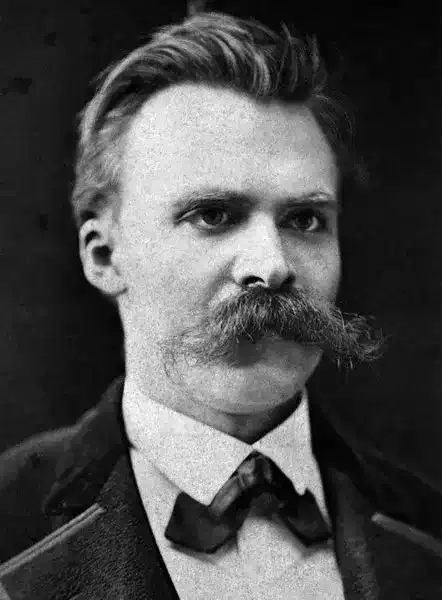
Friedrich Nietzsche
Hypocrisy has its place in the ages of strong belief: in which even when one is compelled to exhibit a different belief one does not abandon the belief on already has.
9
Friedrich Nietzsche
What do you consider the most humane? - To spare someone shame. What is the seal of liberation? - To no longer be ashamed in front of oneself.
10
Friedrich Nietzsche
What do you consider the most humane? - To spare someone shame. What is the seal of liberation? - To no longer be ashamed in front of oneself.
10
Friedrich Nietzsche
The desire to annoy no one, to harm no one, can equally well be the sign of a just as of an anxious disposition.
12
Friedrich Nietzsche
Psychology has falsified love as surrender and altruism, while it is an appropriation or a bestowal following from a super-abundance of personality. Only the most complete persons can love. The depersonalized and objective are the worst lovers.
11
Friedrich Nietzsche
Our crime against criminals lies in the fact that we treat them like rascals.
10
Friedrich Nietzsche
Our crime against criminals lies in the fact that we treat them like rascals.
10
Friedrich Nietzsche
To predict the behavior of ordinary people in advance, you only have to assume that they will always try to escape a disagreeable situation with the smallest possible expenditure of intelligence.
8
Friedrich Nietzsche
The deepest and most sublime hatred is a hatred which creates ideals and transforms values—something whose like has never been seen on earth
7
Friedrich Nietzsche
One must have a good memory to be able to keep the promises one has given. One must have strong powers of imagination to be able to have pity. So closely is morality bound to the quality of the intellect.
8
Friedrich Nietzsche
It is not the victory of science that distinguishes our nineteenth century, but the victory of scientific method over science.
9
Friedrich Nietzsche
It is not the victory of science that distinguishes our nineteenth century, but the victory of scientific method over science.
9
Friedrich Nietzsche
How can a man become great if he does not feel in himself the force and the will to inflict great pain
8
Friedrich Nietzsche
Man has been reared by his errors: first he never saw himself other than imperfectly, second he attributed to himself imaginary qualities, third he felt himself in a false order of rank with animal and nature, fourth he continually invented new tables of values and for a time took each of them to be eternal and unconditional...If one deducts the effect of these four errors, one has also deducted away humanity, humaneness, and 'human dignity'.
8
Friedrich Nietzsche
Man has been reared by his errors: first he never saw himself other than imperfectly, second he attributed to himself imaginary qualities, third he felt himself in a false order of rank with animal and nature, fourth he continually invented new tables of values and for a time took each of them to be eternal and unconditional...If one deducts the effect of these four errors, one has also deducted away humanity, humaneness, and 'human dignity'.
8
Friedrich Nietzsche
Yet tell me, my brothers: if a goal for humanity is still lacking, is there not still lacking--humanity itself?
6
Friedrich Nietzsche
People have always wanted to 'improve' human beings; for the most part, this has been called morality.
7
Friedrich Nietzsche
People have always wanted to 'improve' human beings; for the most part, this has been called morality.
7
Friedrich Nietzsche
But thus do I counsel you, my friends: distrust all in whom the impulse to punish is powerful!
9
Friedrich Nietzsche
Like a last signpost to the other path, Napoleon appeared, the most isolated and late-born man there has even been, and in him the problem of the noble ideal as such made flesh--one might well ponder what kind of problem it is; Napoleon this synthesis of the inhuman and the superhuman
12
Friedrich Nietzsche
The conviction reigns that it is only through the sacrifices and accomplishments of the ancestors that the tribe exists--and that one has to pay them back with sacrifices and accomplishments; one thus recognizes a debt that constantly grows greater, since these forebears never cease, in their continued existence as powerful spirits, to accord the tribe new advantages and new strength.
9