

Poems in this topic
Emotions and Feelings
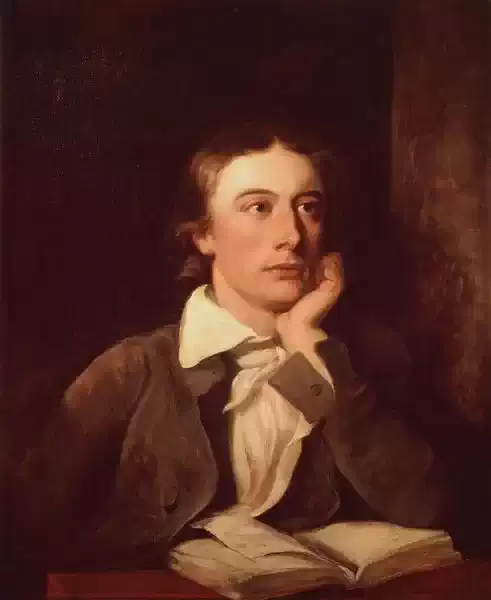
John Keats
Ode on Melancholy
Ode on Melancholy
No, no! go not to Lethe, neither twist
Wolf's-bane, tight-rooted, for its poisonous wine;
Nor suffer thy pale forehead to be kissed
By nightshade, ruby grape of Proserpine;
Make not your rosary of yew-berries,
Nor let the beetle nor the death-moth be
Your mournful Psyche, nor the downy owl
A partner in your sorrow's mysteries;
For shade to shade will come too drowsily,
And drown the wakeful anguish of the soul.
But when the melancholy fit shall fall
Sudden from heaven like a weeping cloud,
That fosters the droop-headed flowers all,
And hides the green hill in an April shroud;
Then glut thy sorrow on a morning rose,
Or on the rainbow of the salt sand-wave,
Or on the wealth of globed peonies;
Or if thy mistress some rich anger shows,
Emprison her soft hand, and let her rave,
And feed deep, deep upon her peerless eyes.
She dwells with Beauty -- Beauty that must die;
And Joy, whose hand is ever at his lips
Bidding adieu; and aching Pleasure nigh,
Turning to poison while the bee-mouth sips;
Ay, in the very temple of delight
Veiled Melancholy has her sovran shrine,
Though seen of none save him whose strenuous
tongue
Can burst Joy's grape against his palate fine;
His soul shall taste the sadness of her might,
And be among her cloudy trophies hung.
No, no! go not to Lethe, neither twist
Wolf's-bane, tight-rooted, for its poisonous wine;
Nor suffer thy pale forehead to be kissed
By nightshade, ruby grape of Proserpine;
Make not your rosary of yew-berries,
Nor let the beetle nor the death-moth be
Your mournful Psyche, nor the downy owl
A partner in your sorrow's mysteries;
For shade to shade will come too drowsily,
And drown the wakeful anguish of the soul.
But when the melancholy fit shall fall
Sudden from heaven like a weeping cloud,
That fosters the droop-headed flowers all,
And hides the green hill in an April shroud;
Then glut thy sorrow on a morning rose,
Or on the rainbow of the salt sand-wave,
Or on the wealth of globed peonies;
Or if thy mistress some rich anger shows,
Emprison her soft hand, and let her rave,
And feed deep, deep upon her peerless eyes.
She dwells with Beauty -- Beauty that must die;
And Joy, whose hand is ever at his lips
Bidding adieu; and aching Pleasure nigh,
Turning to poison while the bee-mouth sips;
Ay, in the very temple of delight
Veiled Melancholy has her sovran shrine,
Though seen of none save him whose strenuous
tongue
Can burst Joy's grape against his palate fine;
His soul shall taste the sadness of her might,
And be among her cloudy trophies hung.
661
John Keats
O Blush Not So!
O Blush Not So!
O BLUSH not so! O blush not so!
Or I shall think you knowing;
And if you smile the blushing while,
Then maidenheads are going.
There's a blush for want, and a blush for shan't,
And a blush for having done it;
There's a blush for thought, and a blush for nought,
And a blush for just begun it.
O sigh not so! O sigh not so!
For it sounds of Eve's sweet pippin;
By these loosen'd lips you have tasted the pips
And fought in an amorous nipping.
Will you play once more at nice-cut-core,
For it only will last our youth out,
And we have the prime of the kissing time,
We have not one sweet tooth out.
There's a sigh for aye, and a sigh for nay,
And a sigh for "I can't bear it!"
O what can be done, shall we stay or run?
O cut the sweet apple and share it!
O BLUSH not so! O blush not so!
Or I shall think you knowing;
And if you smile the blushing while,
Then maidenheads are going.
There's a blush for want, and a blush for shan't,
And a blush for having done it;
There's a blush for thought, and a blush for nought,
And a blush for just begun it.
O sigh not so! O sigh not so!
For it sounds of Eve's sweet pippin;
By these loosen'd lips you have tasted the pips
And fought in an amorous nipping.
Will you play once more at nice-cut-core,
For it only will last our youth out,
And we have the prime of the kissing time,
We have not one sweet tooth out.
There's a sigh for aye, and a sigh for nay,
And a sigh for "I can't bear it!"
O what can be done, shall we stay or run?
O cut the sweet apple and share it!
549
John Keats
Lines
Lines
UNFELT unheard, unseen,
I've left my little queen,
Her languid arms in silver slumber lying:
Ah! through their nestling touch,
Who---who could tell how much
There is for madness---cruel, or complying?
Those faery lids how sleek!
Those lips how moist!---they speak,
In ripest quiet, shadows of sweet sounds:
Into my fancy's ear
Melting a burden dear,
How "Love doth know no fulness, nor no bounds."
True!---tender monitors!
I bend unto your laws:
This sweetest day for dalliance was born!
So, without more ado,
I'll feel my heaven anew,
For all the blushing of the hasty morn.
.
UNFELT unheard, unseen,
I've left my little queen,
Her languid arms in silver slumber lying:
Ah! through their nestling touch,
Who---who could tell how much
There is for madness---cruel, or complying?
Those faery lids how sleek!
Those lips how moist!---they speak,
In ripest quiet, shadows of sweet sounds:
Into my fancy's ear
Melting a burden dear,
How "Love doth know no fulness, nor no bounds."
True!---tender monitors!
I bend unto your laws:
This sweetest day for dalliance was born!
So, without more ado,
I'll feel my heaven anew,
For all the blushing of the hasty morn.
.
442
John Keats
La Belle Dame Sans Merci (Original version )
La Belle Dame Sans Merci (Original version )
Oh what can ail thee, knight-at-arms,
Alone and palely loitering?
The sedge has withered from the lake,
And no birds sing.
Oh what can ail thee, knight-at-arms,
So haggard and so woe-begone?
The squirrel's granary is full,
And the harvest's done.
I see a lily on thy brow,
With anguish moist and fever-dew,
And on thy cheeks a fading rose
Fast withereth too.
I met a lady in the meads,
Full beautiful - a faery's child,
Her hair was long, her foot was light,
And her eyes were wild.
I made a garland for her head,
And bracelets too, and fragrant zone;
She looked at me as she did love,
And made sweet moan.
I set her on my pacing steed,
And nothing else saw all day long,
For sidelong would she bend, and sing
A faery's song.
She found me roots of relish sweet,
And honey wild, and manna-dew,
And sure in language strange she said '
I love thee true'.
She took me to her elfin grot,
And there she wept and sighed full sore,
And there I shut her wild wild eyes
With kisses four.
And there she lulled me asleep
And there I dreamed - Ah! woe betide! -
The latest dream I ever dreamt
On the cold hill side.
I saw pale kings and princes too,
Pale warriors, death-pale were they all;
They cried - 'La Belle Dame sans Merci
Hath thee in thrall!'
I saw their starved lips in the gloam,
With horrid warning gaped wide,
And I awoke and found me here,
On the cold hill's side.
And this is why I sojourn here
Alone and palely loitering,
Though the sedge is withered from the lake,
And no birds sing.
Oh what can ail thee, knight-at-arms,
Alone and palely loitering?
The sedge has withered from the lake,
And no birds sing.
Oh what can ail thee, knight-at-arms,
So haggard and so woe-begone?
The squirrel's granary is full,
And the harvest's done.
I see a lily on thy brow,
With anguish moist and fever-dew,
And on thy cheeks a fading rose
Fast withereth too.
I met a lady in the meads,
Full beautiful - a faery's child,
Her hair was long, her foot was light,
And her eyes were wild.
I made a garland for her head,
And bracelets too, and fragrant zone;
She looked at me as she did love,
And made sweet moan.
I set her on my pacing steed,
And nothing else saw all day long,
For sidelong would she bend, and sing
A faery's song.
She found me roots of relish sweet,
And honey wild, and manna-dew,
And sure in language strange she said '
I love thee true'.
She took me to her elfin grot,
And there she wept and sighed full sore,
And there I shut her wild wild eyes
With kisses four.
And there she lulled me asleep
And there I dreamed - Ah! woe betide! -
The latest dream I ever dreamt
On the cold hill side.
I saw pale kings and princes too,
Pale warriors, death-pale were they all;
They cried - 'La Belle Dame sans Merci
Hath thee in thrall!'
I saw their starved lips in the gloam,
With horrid warning gaped wide,
And I awoke and found me here,
On the cold hill's side.
And this is why I sojourn here
Alone and palely loitering,
Though the sedge is withered from the lake,
And no birds sing.
462
John Keats
La Belle Dame Sans Merci (Original version )
La Belle Dame Sans Merci (Original version )
Oh what can ail thee, knight-at-arms,
Alone and palely loitering?
The sedge has withered from the lake,
And no birds sing.
Oh what can ail thee, knight-at-arms,
So haggard and so woe-begone?
The squirrel's granary is full,
And the harvest's done.
I see a lily on thy brow,
With anguish moist and fever-dew,
And on thy cheeks a fading rose
Fast withereth too.
I met a lady in the meads,
Full beautiful - a faery's child,
Her hair was long, her foot was light,
And her eyes were wild.
I made a garland for her head,
And bracelets too, and fragrant zone;
She looked at me as she did love,
And made sweet moan.
I set her on my pacing steed,
And nothing else saw all day long,
For sidelong would she bend, and sing
A faery's song.
She found me roots of relish sweet,
And honey wild, and manna-dew,
And sure in language strange she said '
I love thee true'.
She took me to her elfin grot,
And there she wept and sighed full sore,
And there I shut her wild wild eyes
With kisses four.
And there she lulled me asleep
And there I dreamed - Ah! woe betide! -
The latest dream I ever dreamt
On the cold hill side.
I saw pale kings and princes too,
Pale warriors, death-pale were they all;
They cried - 'La Belle Dame sans Merci
Hath thee in thrall!'
I saw their starved lips in the gloam,
With horrid warning gaped wide,
And I awoke and found me here,
On the cold hill's side.
And this is why I sojourn here
Alone and palely loitering,
Though the sedge is withered from the lake,
And no birds sing.
Oh what can ail thee, knight-at-arms,
Alone and palely loitering?
The sedge has withered from the lake,
And no birds sing.
Oh what can ail thee, knight-at-arms,
So haggard and so woe-begone?
The squirrel's granary is full,
And the harvest's done.
I see a lily on thy brow,
With anguish moist and fever-dew,
And on thy cheeks a fading rose
Fast withereth too.
I met a lady in the meads,
Full beautiful - a faery's child,
Her hair was long, her foot was light,
And her eyes were wild.
I made a garland for her head,
And bracelets too, and fragrant zone;
She looked at me as she did love,
And made sweet moan.
I set her on my pacing steed,
And nothing else saw all day long,
For sidelong would she bend, and sing
A faery's song.
She found me roots of relish sweet,
And honey wild, and manna-dew,
And sure in language strange she said '
I love thee true'.
She took me to her elfin grot,
And there she wept and sighed full sore,
And there I shut her wild wild eyes
With kisses four.
And there she lulled me asleep
And there I dreamed - Ah! woe betide! -
The latest dream I ever dreamt
On the cold hill side.
I saw pale kings and princes too,
Pale warriors, death-pale were they all;
They cried - 'La Belle Dame sans Merci
Hath thee in thrall!'
I saw their starved lips in the gloam,
With horrid warning gaped wide,
And I awoke and found me here,
On the cold hill's side.
And this is why I sojourn here
Alone and palely loitering,
Though the sedge is withered from the lake,
And no birds sing.
462
John Keats
Lamia. Part II
Lamia. Part II
Love in a hut, with water and a crust,
Is—Love, forgive us!—cinders, ashes, dust;
Love in a palace is perhaps at last
More grievous torment than a hermit’s fast:—
That is a doubtful tale from faery land,
Hard for the non-elect to understand.
Had Lycius liv’d to hand his story down,
He might have given the moral a fresh frown,
Or clench’d it quite: but too short was their bliss
To breed distrust and hate, that make the soft voice hiss.
Besides, there, nightly, with terrific glare,
Love, jealous grown of so complete a pair,
Hover’d and buzz’d his wings, with fearful roar,
Above the lintel of their chamber door,
And down the passage cast a glow upon the floor.
For all this came a ruin: side by side
They were enthroned, in the even tide,
Upon a couch, near to a curtaining
Whose airy texture, from a golden string,
Floated into the room, and let appear
Unveil’d the summer heaven, blue and clear,
Betwixt two marble shafts:—there they reposed,
Where use had made it sweet, with eyelids closed,
Saving a tythe which love still open kept,
That they might see each other while they almost slept;
When from the slope side of a suburb hill,
Deafening the swallow’s twitter, came a thrill
Of trumpets—Lycius started—the sounds fled,
But left a thought, a buzzing in his head.
For the first time, since first he harbour’d in
That purple-lined palace of sweet sin,
His spirit pass’d beyond its golden bourn
Into the noisy world almost forsworn.
The lady, ever watchful, penetrant,
Saw this with pain, so arguing a want
Of something more, more than her empery
Of joys; and she began to moan and sigh
Because he mused beyond her, knowing well
That but a moment’s thought is passion’s passing bell.
“Why do you sigh, fair creature?” whisper’d he:
“Why do you think?” return’d she tenderly:
“You have deserted me;—where am I now?
“Not in your heart while care weighs on your brow:
“No, no, you have dismiss’d me; and I go
“From your breast houseless: ay, it must be so.”
He answer’d, bending to her open eyes,
Where he was mirror’d small in paradise,
“My silver planet, both of eve and morn!
“Why will you plead yourself so sad forlorn,
“While I am striving how to fill my heart
“With deeper crimson, and a double smart?
“How to entangle, trammel up and snare
“Your soul in mine, and labyrinth you there
“Like the hid scent in an unbudded rose?
“Ay, a sweet kiss—you see your mighty woes.
“My thoughts! shall I unveil them? Listen then!
“What mortal hath a prize, that other men
“May be confounded and abash’d withal,
“But lets it sometimes pace abroad majestical,
“And triumph, as in thee I should rejoice
“Amid the hoarse alarm of Corinth’s voice.
“Let my foes choke, and my friends shout afar,
“While through the thronged streets your bridal car
“Wheels round its dazzling spokes.”—The lady’s cheek
Trembled; she nothing said, but, pale and meek,
Arose and knelt before him, wept a rain
Of sorrows at his words; at last with pain
Beseeching him, the while his hand she wrung,
To change his purpose. He thereat was stung,
Perverse, with stronger fancy to reclaim
Her wild and timid nature to his aim:
Besides, for all his love, in self despite,
Against his better self, he took delight
Luxurious in her sorrows, soft and new.
His passion, cruel grown, took on a hue
Fierce and sanguineous as ’twas possible
In one whose brow had no dark veins to swell.
Fine was the mitigated fury, like
Apollo’s presence when in act to strike
The serpent—Ha, the serpent! certes, she
Was none. She burnt, she lov’d the tyranny,
And, all subdued, consented to the hour
When to the bridal he should lead his paramour.
Whispering in midnight silence, said the youth,
“Sure some sweet name thou hast, though, by my truth,
“I have not ask’d it, ever thinking thee
“Not mortal, but of heavenly progeny,
“As still I do. Hast any mortal name,
“Fit appellation for this dazzling frame?
“Or friends or kinsfolk on the citied earth,
“To share our marriage feast and nuptial mirth?”
“I have no friends,” said Lamia, “no, not one;
“My presence in wide Corinth hardly known:
“My parents’ bones are in their dusty urns
“Sepulchred, where no kindled incense burns,
“Seeing all their luckless race are dead, save me,
“And I neglect the holy rite for thee.
“Even as you list invite your many guests;
“But if, as now it seems, your vision rests
“With any pleasure on me, do not bid
“Old Apollonius—from him keep me hid.”
Lycius, perplex’d at words so blind and blank,
Made close inquiry; from whose touch she shrank,
Feigning a sleep; and he to the dull shade
Of deep sleep in a moment was betray’d.
It was the custom then to bring away
The bride from home at blushing shut of day,
Veil’d, in a chariot, heralded along
By strewn flowers, torches, and a marriage song,
With other pageants: but this fair unknown
Had not a friend. So being left alone,
(Lycius was gone to summon all his kin)
And knowing surely she could never win
His foolish heart from its mad pompousness,
She set herself, high-thoughted, how to dress
The misery in fit magnificence.
She did so, but ’tis doubtful how and whence
Came, and who were her subtle servitors.
About the halls, and to and from the doors,
There was a noise of wings, till in short space
The glowing banquet-room shone with wide-arched grace.
A haunting music, sole perhaps and lone
Supportress of the faery-roof, made moan
Throughout, as fearful the whole charm might fade.
Fresh carved cedar, mimicking a glade
Of palm and plantain, met from either side,
High in the midst, in honour of the bride:
Two palms and then two plantains, and so on,
From either side their stems branch’d one to one
All down the aisled place; and beneath all
There ran a stream of lamps straight on from wall to wall.
So canopied, lay an untasted feast
Teeming with odours. Lamia, regal drest,
Silently paced about, and as she went,
In pale contented sort of discontent,
Mission’d her viewless servants to enrich
The fretted splendour of each nook and niche.
Between the tree-stems, marbled plain at first,
Came jasper pannels; then, anon, there burst
Forth creeping imagery of slighter trees,
And with the larger wove in small intricacies.
Approving all, she faded at self-will,
And shut the chamber up, close, hush’d and still,
Complete and ready for the revels rude,
When dreadful guests would come to spoil her solitude.
The day appear’d, and all the gossip rout.
O senseless Lycius! Madman! wherefore flout
The silent-blessing fate, warm cloister’d hours,
And show to common eyes these secret bowers?
The herd approach’d; each guest, with busy brain,
Arriving at the portal, gaz’d amain,
And enter’d marveling: for they knew the street,
Remember’d it from childhood all complete
Without a gap, yet ne’er before had seen
That royal porch, that high-built fair demesne;
So in they hurried all, maz’d, curious and keen:
Save one, who look’d thereon with eye severe,
And with calm-planted steps walk’d in austere;
’Twas Apollonius: something too he laugh’d,
As though some knotty problem, that had daft
His patient thought, had now begun to thaw,
And solve and melt:—’twas just as he foresaw.
He met within the murmurous vestibule
His young disciple. “’Tis no common rule,
“Lycius,” said he, “for uninvited guest
“To force himself upon you, and infest
“With an unbidden presence the bright throng
“Of younger friends; yet must I do this wrong,
“And you forgive me.” Lycius blush’d, and led
The old man through the inner doors broad-spread;
With reconciling words and courteous mien
Turning into sweet milk the sophist’s spleen.
Of wealthy lustre was the banquet-room,
Fill’d with pervading brilliance and perfume:
Before each lucid pannel fuming stood
A censer fed with myrrh and spiced wood,
Each by a sacred tripod held aloft,
Whose slender feet wide-swerv’d upon the soft
Wool-woofed carpets: fifty wreaths of smoke
From fifty censers their light voyage took
To the high roof, still mimick’d as they rose
Along the mirror’d walls by twin-clouds odorous.
Twelve sphered tables, by silk seats insphered,
High as the level of a man’s breast rear’d
On libbard’s paws, upheld the heavy gold
Of cups and goblets, and the store thrice told
Of Ceres’ horn, and, in huge vessels, wine
Came from the gloomy tun with merry shine.
Thus loaded with a feast the tables stood,
Each shrining in the midst the image of a God.
When in an antichamber every guest
Had felt the cold full sponge to pleasure press’d,
By minist’ring slaves, upon his hands and feet,
And fragrant oils with ceremony meet
Pour’d on his hair, they all mov’d to the feast
In white robes, and themselves in order placed
Around the silken couches, wondering
Whence all this mighty cost and blaze of wealth could spring.
Soft went the music the soft air along,
While fluent Greek a vowel’d undersong
Kept up among the guests discoursing low
At first, for scarcely was the wine at flow;
But when the happy vintage touch’d their brains,
Louder they talk, and louder come the strains
Of powerful instruments:—the gorgeous dyes,
The space, the splendour of the draperies,
The roof of awful richness, nectarous cheer,
Beautiful slaves, and Lamia’s self, appear,
Now, when the wine has done its rosy deed,
And every soul from human trammels freed,
No more so strange; for merry wine, sweet wine,
Will make Elysian shades not too fair, too divine.
Soon was God Bacchus at meridian height;
Flush’d were their cheeks, and bright eyes double bright:
Garlands of every green, and every scent
From vales deflower’d, or forest-trees branch rent,
In baskets of bright osier’d gold were brought
High as the handles heap’d, to suit the thought
Of every guest; that each, as he did please,
Might fancy-fit his brows, silk-pillow’d at his ease.
What wreath for Lamia? What for Lycius?
What for the sage, old Apollonius?
Upon her aching forehead be there hung
The leaves of willow and of adder’s tongue;
And for the youth, quick, let us strip for him
The thyrsus, that his watching eyes may swim
Into forgetfulness; and, for the sage,
Let spear-grass and the spiteful thistle wage
War on his temples. Do not all charms fly
At the mere touch of cold philosophy?
There was an awful rainbow once in heaven:
We know her woof, her texture; she is given
In the dull catalogue of common things.
Philosophy will clip an Angel’s wings,
Conquer all mysteries by rule and line,
Empty the haunted air, and gnomed mine—
Unweave a rainbow, as it erewhile made
The tender-person’d Lamia melt into a shade.
By her glad Lycius sitting, in chief place,
Scarce saw in all the room another face,
Till, checking his love trance, a cup he took
Full brimm’d, and opposite sent forth a look
’Cross the broad table, to beseech a glance
From his old teacher’s wrinkled countenance,
And pledge him. The bald-head philosopher
Had fix’d his eye, without a twinkle or stir
Full on the alarmed beauty of the bride,
Brow-beating her fair form, and troubling her sweet pride.
Lycius then press’d her hand, with devout touch,
As pale it lay upon the rosy couch:
’Twas icy, and the cold ran through his veins;
Then sudden it grew hot, and all the pains
Of an unnatural heat shot to his heart.
“Lamia, what means this? Wherefore dost thou start?
“Know’st thou that man?” Poor Lamia answer’d not.
He gaz’d into her eyes, and not a jot
Own’d they the lovelorn piteous appeal:
More, more he gaz’d: his human senses reel:
Some hungry spell that loveliness absorbs;
There was no recognition in those orbs.
“Lamia!” he cried—and no soft-toned reply.
The many heard, and the loud revelry
Grew hush; the stately music no more breathes;
The myrtle sicken’d in a thousand wreaths.
By faint degrees, voice, lute, and pleasure ceased;
A deadly silence step by step increased,
Until it seem’d a horrid presence there,
And not a man but felt the terror in his hair.
“Lamia!” he shriek’d; and nothing but the shriek
With its sad echo did the silence break.
“Begone, foul dream!” he cried, gazing again
In the bride’s face, where now no azure vein
Wander’d on fair-spaced temples; no soft bloom
Misted the cheek; no passion to illume
The deep-recessed vision:—all was blight;
Lamia, no longer fair, there sat a deadly white.
“Shut, shut those juggling eyes, thou ruthless man!
“Turn them aside, wretch! or the righteous ban
“Of all the Gods, whose dreadful images
“Here represent their shadowy presences,
“May pierce them on the sudden with the thorn
“Of painful blindness; leaving thee forlorn,
“In trembling dotage to the feeblest fright
“Of conscience, for their long offended might,
“For all thine impious proud-heart sophistries,
“Unlawful magic, and enticing lies.
“Corinthians! look upon that gray-beard wretch!
“Mark how, possess’d, his lashless eyelids stretch
“Around his demon eyes! Corinthians, see!
“My sweet bride withers at their potency.”
“Fool!” said the sophist, in an under-tone
Gruff with contempt; which a death-nighing moan
From Lycius answer’d, as heart-struck and lost,
He sank supine beside the aching ghost.
“Fool! Fool!” repeated he, while his eyes still
Relented not, nor mov’d; “from every ill
“Of life have I preserv’d thee to this day,
“And shall I see thee made a serpent’s prey?
Then Lamia breath’d death breath; the sophist’s eye,
Like a sharp spear, went through her utterly,
Keen, cruel, perceant, stinging: she, as well
As her weak hand could any meaning tell,
Motion’d him to be silent; vainly so,
He look’d and look’d again a level--No!
“A Serpent!” echoed he; no sooner said,
Than with a frightful scream she vanished:
And Lycius’ arms were empty of delight,
As were his limbs of life, from that same night.
On the high couch he lay!—his friends came round--
Supported him—no pulse, or breath they found,
And, in its marriage robe, the heavy body wound.
Love in a hut, with water and a crust,
Is—Love, forgive us!—cinders, ashes, dust;
Love in a palace is perhaps at last
More grievous torment than a hermit’s fast:—
That is a doubtful tale from faery land,
Hard for the non-elect to understand.
Had Lycius liv’d to hand his story down,
He might have given the moral a fresh frown,
Or clench’d it quite: but too short was their bliss
To breed distrust and hate, that make the soft voice hiss.
Besides, there, nightly, with terrific glare,
Love, jealous grown of so complete a pair,
Hover’d and buzz’d his wings, with fearful roar,
Above the lintel of their chamber door,
And down the passage cast a glow upon the floor.
For all this came a ruin: side by side
They were enthroned, in the even tide,
Upon a couch, near to a curtaining
Whose airy texture, from a golden string,
Floated into the room, and let appear
Unveil’d the summer heaven, blue and clear,
Betwixt two marble shafts:—there they reposed,
Where use had made it sweet, with eyelids closed,
Saving a tythe which love still open kept,
That they might see each other while they almost slept;
When from the slope side of a suburb hill,
Deafening the swallow’s twitter, came a thrill
Of trumpets—Lycius started—the sounds fled,
But left a thought, a buzzing in his head.
For the first time, since first he harbour’d in
That purple-lined palace of sweet sin,
His spirit pass’d beyond its golden bourn
Into the noisy world almost forsworn.
The lady, ever watchful, penetrant,
Saw this with pain, so arguing a want
Of something more, more than her empery
Of joys; and she began to moan and sigh
Because he mused beyond her, knowing well
That but a moment’s thought is passion’s passing bell.
“Why do you sigh, fair creature?” whisper’d he:
“Why do you think?” return’d she tenderly:
“You have deserted me;—where am I now?
“Not in your heart while care weighs on your brow:
“No, no, you have dismiss’d me; and I go
“From your breast houseless: ay, it must be so.”
He answer’d, bending to her open eyes,
Where he was mirror’d small in paradise,
“My silver planet, both of eve and morn!
“Why will you plead yourself so sad forlorn,
“While I am striving how to fill my heart
“With deeper crimson, and a double smart?
“How to entangle, trammel up and snare
“Your soul in mine, and labyrinth you there
“Like the hid scent in an unbudded rose?
“Ay, a sweet kiss—you see your mighty woes.
“My thoughts! shall I unveil them? Listen then!
“What mortal hath a prize, that other men
“May be confounded and abash’d withal,
“But lets it sometimes pace abroad majestical,
“And triumph, as in thee I should rejoice
“Amid the hoarse alarm of Corinth’s voice.
“Let my foes choke, and my friends shout afar,
“While through the thronged streets your bridal car
“Wheels round its dazzling spokes.”—The lady’s cheek
Trembled; she nothing said, but, pale and meek,
Arose and knelt before him, wept a rain
Of sorrows at his words; at last with pain
Beseeching him, the while his hand she wrung,
To change his purpose. He thereat was stung,
Perverse, with stronger fancy to reclaim
Her wild and timid nature to his aim:
Besides, for all his love, in self despite,
Against his better self, he took delight
Luxurious in her sorrows, soft and new.
His passion, cruel grown, took on a hue
Fierce and sanguineous as ’twas possible
In one whose brow had no dark veins to swell.
Fine was the mitigated fury, like
Apollo’s presence when in act to strike
The serpent—Ha, the serpent! certes, she
Was none. She burnt, she lov’d the tyranny,
And, all subdued, consented to the hour
When to the bridal he should lead his paramour.
Whispering in midnight silence, said the youth,
“Sure some sweet name thou hast, though, by my truth,
“I have not ask’d it, ever thinking thee
“Not mortal, but of heavenly progeny,
“As still I do. Hast any mortal name,
“Fit appellation for this dazzling frame?
“Or friends or kinsfolk on the citied earth,
“To share our marriage feast and nuptial mirth?”
“I have no friends,” said Lamia, “no, not one;
“My presence in wide Corinth hardly known:
“My parents’ bones are in their dusty urns
“Sepulchred, where no kindled incense burns,
“Seeing all their luckless race are dead, save me,
“And I neglect the holy rite for thee.
“Even as you list invite your many guests;
“But if, as now it seems, your vision rests
“With any pleasure on me, do not bid
“Old Apollonius—from him keep me hid.”
Lycius, perplex’d at words so blind and blank,
Made close inquiry; from whose touch she shrank,
Feigning a sleep; and he to the dull shade
Of deep sleep in a moment was betray’d.
It was the custom then to bring away
The bride from home at blushing shut of day,
Veil’d, in a chariot, heralded along
By strewn flowers, torches, and a marriage song,
With other pageants: but this fair unknown
Had not a friend. So being left alone,
(Lycius was gone to summon all his kin)
And knowing surely she could never win
His foolish heart from its mad pompousness,
She set herself, high-thoughted, how to dress
The misery in fit magnificence.
She did so, but ’tis doubtful how and whence
Came, and who were her subtle servitors.
About the halls, and to and from the doors,
There was a noise of wings, till in short space
The glowing banquet-room shone with wide-arched grace.
A haunting music, sole perhaps and lone
Supportress of the faery-roof, made moan
Throughout, as fearful the whole charm might fade.
Fresh carved cedar, mimicking a glade
Of palm and plantain, met from either side,
High in the midst, in honour of the bride:
Two palms and then two plantains, and so on,
From either side their stems branch’d one to one
All down the aisled place; and beneath all
There ran a stream of lamps straight on from wall to wall.
So canopied, lay an untasted feast
Teeming with odours. Lamia, regal drest,
Silently paced about, and as she went,
In pale contented sort of discontent,
Mission’d her viewless servants to enrich
The fretted splendour of each nook and niche.
Between the tree-stems, marbled plain at first,
Came jasper pannels; then, anon, there burst
Forth creeping imagery of slighter trees,
And with the larger wove in small intricacies.
Approving all, she faded at self-will,
And shut the chamber up, close, hush’d and still,
Complete and ready for the revels rude,
When dreadful guests would come to spoil her solitude.
The day appear’d, and all the gossip rout.
O senseless Lycius! Madman! wherefore flout
The silent-blessing fate, warm cloister’d hours,
And show to common eyes these secret bowers?
The herd approach’d; each guest, with busy brain,
Arriving at the portal, gaz’d amain,
And enter’d marveling: for they knew the street,
Remember’d it from childhood all complete
Without a gap, yet ne’er before had seen
That royal porch, that high-built fair demesne;
So in they hurried all, maz’d, curious and keen:
Save one, who look’d thereon with eye severe,
And with calm-planted steps walk’d in austere;
’Twas Apollonius: something too he laugh’d,
As though some knotty problem, that had daft
His patient thought, had now begun to thaw,
And solve and melt:—’twas just as he foresaw.
He met within the murmurous vestibule
His young disciple. “’Tis no common rule,
“Lycius,” said he, “for uninvited guest
“To force himself upon you, and infest
“With an unbidden presence the bright throng
“Of younger friends; yet must I do this wrong,
“And you forgive me.” Lycius blush’d, and led
The old man through the inner doors broad-spread;
With reconciling words and courteous mien
Turning into sweet milk the sophist’s spleen.
Of wealthy lustre was the banquet-room,
Fill’d with pervading brilliance and perfume:
Before each lucid pannel fuming stood
A censer fed with myrrh and spiced wood,
Each by a sacred tripod held aloft,
Whose slender feet wide-swerv’d upon the soft
Wool-woofed carpets: fifty wreaths of smoke
From fifty censers their light voyage took
To the high roof, still mimick’d as they rose
Along the mirror’d walls by twin-clouds odorous.
Twelve sphered tables, by silk seats insphered,
High as the level of a man’s breast rear’d
On libbard’s paws, upheld the heavy gold
Of cups and goblets, and the store thrice told
Of Ceres’ horn, and, in huge vessels, wine
Came from the gloomy tun with merry shine.
Thus loaded with a feast the tables stood,
Each shrining in the midst the image of a God.
When in an antichamber every guest
Had felt the cold full sponge to pleasure press’d,
By minist’ring slaves, upon his hands and feet,
And fragrant oils with ceremony meet
Pour’d on his hair, they all mov’d to the feast
In white robes, and themselves in order placed
Around the silken couches, wondering
Whence all this mighty cost and blaze of wealth could spring.
Soft went the music the soft air along,
While fluent Greek a vowel’d undersong
Kept up among the guests discoursing low
At first, for scarcely was the wine at flow;
But when the happy vintage touch’d their brains,
Louder they talk, and louder come the strains
Of powerful instruments:—the gorgeous dyes,
The space, the splendour of the draperies,
The roof of awful richness, nectarous cheer,
Beautiful slaves, and Lamia’s self, appear,
Now, when the wine has done its rosy deed,
And every soul from human trammels freed,
No more so strange; for merry wine, sweet wine,
Will make Elysian shades not too fair, too divine.
Soon was God Bacchus at meridian height;
Flush’d were their cheeks, and bright eyes double bright:
Garlands of every green, and every scent
From vales deflower’d, or forest-trees branch rent,
In baskets of bright osier’d gold were brought
High as the handles heap’d, to suit the thought
Of every guest; that each, as he did please,
Might fancy-fit his brows, silk-pillow’d at his ease.
What wreath for Lamia? What for Lycius?
What for the sage, old Apollonius?
Upon her aching forehead be there hung
The leaves of willow and of adder’s tongue;
And for the youth, quick, let us strip for him
The thyrsus, that his watching eyes may swim
Into forgetfulness; and, for the sage,
Let spear-grass and the spiteful thistle wage
War on his temples. Do not all charms fly
At the mere touch of cold philosophy?
There was an awful rainbow once in heaven:
We know her woof, her texture; she is given
In the dull catalogue of common things.
Philosophy will clip an Angel’s wings,
Conquer all mysteries by rule and line,
Empty the haunted air, and gnomed mine—
Unweave a rainbow, as it erewhile made
The tender-person’d Lamia melt into a shade.
By her glad Lycius sitting, in chief place,
Scarce saw in all the room another face,
Till, checking his love trance, a cup he took
Full brimm’d, and opposite sent forth a look
’Cross the broad table, to beseech a glance
From his old teacher’s wrinkled countenance,
And pledge him. The bald-head philosopher
Had fix’d his eye, without a twinkle or stir
Full on the alarmed beauty of the bride,
Brow-beating her fair form, and troubling her sweet pride.
Lycius then press’d her hand, with devout touch,
As pale it lay upon the rosy couch:
’Twas icy, and the cold ran through his veins;
Then sudden it grew hot, and all the pains
Of an unnatural heat shot to his heart.
“Lamia, what means this? Wherefore dost thou start?
“Know’st thou that man?” Poor Lamia answer’d not.
He gaz’d into her eyes, and not a jot
Own’d they the lovelorn piteous appeal:
More, more he gaz’d: his human senses reel:
Some hungry spell that loveliness absorbs;
There was no recognition in those orbs.
“Lamia!” he cried—and no soft-toned reply.
The many heard, and the loud revelry
Grew hush; the stately music no more breathes;
The myrtle sicken’d in a thousand wreaths.
By faint degrees, voice, lute, and pleasure ceased;
A deadly silence step by step increased,
Until it seem’d a horrid presence there,
And not a man but felt the terror in his hair.
“Lamia!” he shriek’d; and nothing but the shriek
With its sad echo did the silence break.
“Begone, foul dream!” he cried, gazing again
In the bride’s face, where now no azure vein
Wander’d on fair-spaced temples; no soft bloom
Misted the cheek; no passion to illume
The deep-recessed vision:—all was blight;
Lamia, no longer fair, there sat a deadly white.
“Shut, shut those juggling eyes, thou ruthless man!
“Turn them aside, wretch! or the righteous ban
“Of all the Gods, whose dreadful images
“Here represent their shadowy presences,
“May pierce them on the sudden with the thorn
“Of painful blindness; leaving thee forlorn,
“In trembling dotage to the feeblest fright
“Of conscience, for their long offended might,
“For all thine impious proud-heart sophistries,
“Unlawful magic, and enticing lies.
“Corinthians! look upon that gray-beard wretch!
“Mark how, possess’d, his lashless eyelids stretch
“Around his demon eyes! Corinthians, see!
“My sweet bride withers at their potency.”
“Fool!” said the sophist, in an under-tone
Gruff with contempt; which a death-nighing moan
From Lycius answer’d, as heart-struck and lost,
He sank supine beside the aching ghost.
“Fool! Fool!” repeated he, while his eyes still
Relented not, nor mov’d; “from every ill
“Of life have I preserv’d thee to this day,
“And shall I see thee made a serpent’s prey?
Then Lamia breath’d death breath; the sophist’s eye,
Like a sharp spear, went through her utterly,
Keen, cruel, perceant, stinging: she, as well
As her weak hand could any meaning tell,
Motion’d him to be silent; vainly so,
He look’d and look’d again a level--No!
“A Serpent!” echoed he; no sooner said,
Than with a frightful scream she vanished:
And Lycius’ arms were empty of delight,
As were his limbs of life, from that same night.
On the high couch he lay!—his friends came round--
Supported him—no pulse, or breath they found,
And, in its marriage robe, the heavy body wound.
532
John Keats
Lamia. Part II
Lamia. Part II
Love in a hut, with water and a crust,
Is—Love, forgive us!—cinders, ashes, dust;
Love in a palace is perhaps at last
More grievous torment than a hermit’s fast:—
That is a doubtful tale from faery land,
Hard for the non-elect to understand.
Had Lycius liv’d to hand his story down,
He might have given the moral a fresh frown,
Or clench’d it quite: but too short was their bliss
To breed distrust and hate, that make the soft voice hiss.
Besides, there, nightly, with terrific glare,
Love, jealous grown of so complete a pair,
Hover’d and buzz’d his wings, with fearful roar,
Above the lintel of their chamber door,
And down the passage cast a glow upon the floor.
For all this came a ruin: side by side
They were enthroned, in the even tide,
Upon a couch, near to a curtaining
Whose airy texture, from a golden string,
Floated into the room, and let appear
Unveil’d the summer heaven, blue and clear,
Betwixt two marble shafts:—there they reposed,
Where use had made it sweet, with eyelids closed,
Saving a tythe which love still open kept,
That they might see each other while they almost slept;
When from the slope side of a suburb hill,
Deafening the swallow’s twitter, came a thrill
Of trumpets—Lycius started—the sounds fled,
But left a thought, a buzzing in his head.
For the first time, since first he harbour’d in
That purple-lined palace of sweet sin,
His spirit pass’d beyond its golden bourn
Into the noisy world almost forsworn.
The lady, ever watchful, penetrant,
Saw this with pain, so arguing a want
Of something more, more than her empery
Of joys; and she began to moan and sigh
Because he mused beyond her, knowing well
That but a moment’s thought is passion’s passing bell.
“Why do you sigh, fair creature?” whisper’d he:
“Why do you think?” return’d she tenderly:
“You have deserted me;—where am I now?
“Not in your heart while care weighs on your brow:
“No, no, you have dismiss’d me; and I go
“From your breast houseless: ay, it must be so.”
He answer’d, bending to her open eyes,
Where he was mirror’d small in paradise,
“My silver planet, both of eve and morn!
“Why will you plead yourself so sad forlorn,
“While I am striving how to fill my heart
“With deeper crimson, and a double smart?
“How to entangle, trammel up and snare
“Your soul in mine, and labyrinth you there
“Like the hid scent in an unbudded rose?
“Ay, a sweet kiss—you see your mighty woes.
“My thoughts! shall I unveil them? Listen then!
“What mortal hath a prize, that other men
“May be confounded and abash’d withal,
“But lets it sometimes pace abroad majestical,
“And triumph, as in thee I should rejoice
“Amid the hoarse alarm of Corinth’s voice.
“Let my foes choke, and my friends shout afar,
“While through the thronged streets your bridal car
“Wheels round its dazzling spokes.”—The lady’s cheek
Trembled; she nothing said, but, pale and meek,
Arose and knelt before him, wept a rain
Of sorrows at his words; at last with pain
Beseeching him, the while his hand she wrung,
To change his purpose. He thereat was stung,
Perverse, with stronger fancy to reclaim
Her wild and timid nature to his aim:
Besides, for all his love, in self despite,
Against his better self, he took delight
Luxurious in her sorrows, soft and new.
His passion, cruel grown, took on a hue
Fierce and sanguineous as ’twas possible
In one whose brow had no dark veins to swell.
Fine was the mitigated fury, like
Apollo’s presence when in act to strike
The serpent—Ha, the serpent! certes, she
Was none. She burnt, she lov’d the tyranny,
And, all subdued, consented to the hour
When to the bridal he should lead his paramour.
Whispering in midnight silence, said the youth,
“Sure some sweet name thou hast, though, by my truth,
“I have not ask’d it, ever thinking thee
“Not mortal, but of heavenly progeny,
“As still I do. Hast any mortal name,
“Fit appellation for this dazzling frame?
“Or friends or kinsfolk on the citied earth,
“To share our marriage feast and nuptial mirth?”
“I have no friends,” said Lamia, “no, not one;
“My presence in wide Corinth hardly known:
“My parents’ bones are in their dusty urns
“Sepulchred, where no kindled incense burns,
“Seeing all their luckless race are dead, save me,
“And I neglect the holy rite for thee.
“Even as you list invite your many guests;
“But if, as now it seems, your vision rests
“With any pleasure on me, do not bid
“Old Apollonius—from him keep me hid.”
Lycius, perplex’d at words so blind and blank,
Made close inquiry; from whose touch she shrank,
Feigning a sleep; and he to the dull shade
Of deep sleep in a moment was betray’d.
It was the custom then to bring away
The bride from home at blushing shut of day,
Veil’d, in a chariot, heralded along
By strewn flowers, torches, and a marriage song,
With other pageants: but this fair unknown
Had not a friend. So being left alone,
(Lycius was gone to summon all his kin)
And knowing surely she could never win
His foolish heart from its mad pompousness,
She set herself, high-thoughted, how to dress
The misery in fit magnificence.
She did so, but ’tis doubtful how and whence
Came, and who were her subtle servitors.
About the halls, and to and from the doors,
There was a noise of wings, till in short space
The glowing banquet-room shone with wide-arched grace.
A haunting music, sole perhaps and lone
Supportress of the faery-roof, made moan
Throughout, as fearful the whole charm might fade.
Fresh carved cedar, mimicking a glade
Of palm and plantain, met from either side,
High in the midst, in honour of the bride:
Two palms and then two plantains, and so on,
From either side their stems branch’d one to one
All down the aisled place; and beneath all
There ran a stream of lamps straight on from wall to wall.
So canopied, lay an untasted feast
Teeming with odours. Lamia, regal drest,
Silently paced about, and as she went,
In pale contented sort of discontent,
Mission’d her viewless servants to enrich
The fretted splendour of each nook and niche.
Between the tree-stems, marbled plain at first,
Came jasper pannels; then, anon, there burst
Forth creeping imagery of slighter trees,
And with the larger wove in small intricacies.
Approving all, she faded at self-will,
And shut the chamber up, close, hush’d and still,
Complete and ready for the revels rude,
When dreadful guests would come to spoil her solitude.
The day appear’d, and all the gossip rout.
O senseless Lycius! Madman! wherefore flout
The silent-blessing fate, warm cloister’d hours,
And show to common eyes these secret bowers?
The herd approach’d; each guest, with busy brain,
Arriving at the portal, gaz’d amain,
And enter’d marveling: for they knew the street,
Remember’d it from childhood all complete
Without a gap, yet ne’er before had seen
That royal porch, that high-built fair demesne;
So in they hurried all, maz’d, curious and keen:
Save one, who look’d thereon with eye severe,
And with calm-planted steps walk’d in austere;
’Twas Apollonius: something too he laugh’d,
As though some knotty problem, that had daft
His patient thought, had now begun to thaw,
And solve and melt:—’twas just as he foresaw.
He met within the murmurous vestibule
His young disciple. “’Tis no common rule,
“Lycius,” said he, “for uninvited guest
“To force himself upon you, and infest
“With an unbidden presence the bright throng
“Of younger friends; yet must I do this wrong,
“And you forgive me.” Lycius blush’d, and led
The old man through the inner doors broad-spread;
With reconciling words and courteous mien
Turning into sweet milk the sophist’s spleen.
Of wealthy lustre was the banquet-room,
Fill’d with pervading brilliance and perfume:
Before each lucid pannel fuming stood
A censer fed with myrrh and spiced wood,
Each by a sacred tripod held aloft,
Whose slender feet wide-swerv’d upon the soft
Wool-woofed carpets: fifty wreaths of smoke
From fifty censers their light voyage took
To the high roof, still mimick’d as they rose
Along the mirror’d walls by twin-clouds odorous.
Twelve sphered tables, by silk seats insphered,
High as the level of a man’s breast rear’d
On libbard’s paws, upheld the heavy gold
Of cups and goblets, and the store thrice told
Of Ceres’ horn, and, in huge vessels, wine
Came from the gloomy tun with merry shine.
Thus loaded with a feast the tables stood,
Each shrining in the midst the image of a God.
When in an antichamber every guest
Had felt the cold full sponge to pleasure press’d,
By minist’ring slaves, upon his hands and feet,
And fragrant oils with ceremony meet
Pour’d on his hair, they all mov’d to the feast
In white robes, and themselves in order placed
Around the silken couches, wondering
Whence all this mighty cost and blaze of wealth could spring.
Soft went the music the soft air along,
While fluent Greek a vowel’d undersong
Kept up among the guests discoursing low
At first, for scarcely was the wine at flow;
But when the happy vintage touch’d their brains,
Louder they talk, and louder come the strains
Of powerful instruments:—the gorgeous dyes,
The space, the splendour of the draperies,
The roof of awful richness, nectarous cheer,
Beautiful slaves, and Lamia’s self, appear,
Now, when the wine has done its rosy deed,
And every soul from human trammels freed,
No more so strange; for merry wine, sweet wine,
Will make Elysian shades not too fair, too divine.
Soon was God Bacchus at meridian height;
Flush’d were their cheeks, and bright eyes double bright:
Garlands of every green, and every scent
From vales deflower’d, or forest-trees branch rent,
In baskets of bright osier’d gold were brought
High as the handles heap’d, to suit the thought
Of every guest; that each, as he did please,
Might fancy-fit his brows, silk-pillow’d at his ease.
What wreath for Lamia? What for Lycius?
What for the sage, old Apollonius?
Upon her aching forehead be there hung
The leaves of willow and of adder’s tongue;
And for the youth, quick, let us strip for him
The thyrsus, that his watching eyes may swim
Into forgetfulness; and, for the sage,
Let spear-grass and the spiteful thistle wage
War on his temples. Do not all charms fly
At the mere touch of cold philosophy?
There was an awful rainbow once in heaven:
We know her woof, her texture; she is given
In the dull catalogue of common things.
Philosophy will clip an Angel’s wings,
Conquer all mysteries by rule and line,
Empty the haunted air, and gnomed mine—
Unweave a rainbow, as it erewhile made
The tender-person’d Lamia melt into a shade.
By her glad Lycius sitting, in chief place,
Scarce saw in all the room another face,
Till, checking his love trance, a cup he took
Full brimm’d, and opposite sent forth a look
’Cross the broad table, to beseech a glance
From his old teacher’s wrinkled countenance,
And pledge him. The bald-head philosopher
Had fix’d his eye, without a twinkle or stir
Full on the alarmed beauty of the bride,
Brow-beating her fair form, and troubling her sweet pride.
Lycius then press’d her hand, with devout touch,
As pale it lay upon the rosy couch:
’Twas icy, and the cold ran through his veins;
Then sudden it grew hot, and all the pains
Of an unnatural heat shot to his heart.
“Lamia, what means this? Wherefore dost thou start?
“Know’st thou that man?” Poor Lamia answer’d not.
He gaz’d into her eyes, and not a jot
Own’d they the lovelorn piteous appeal:
More, more he gaz’d: his human senses reel:
Some hungry spell that loveliness absorbs;
There was no recognition in those orbs.
“Lamia!” he cried—and no soft-toned reply.
The many heard, and the loud revelry
Grew hush; the stately music no more breathes;
The myrtle sicken’d in a thousand wreaths.
By faint degrees, voice, lute, and pleasure ceased;
A deadly silence step by step increased,
Until it seem’d a horrid presence there,
And not a man but felt the terror in his hair.
“Lamia!” he shriek’d; and nothing but the shriek
With its sad echo did the silence break.
“Begone, foul dream!” he cried, gazing again
In the bride’s face, where now no azure vein
Wander’d on fair-spaced temples; no soft bloom
Misted the cheek; no passion to illume
The deep-recessed vision:—all was blight;
Lamia, no longer fair, there sat a deadly white.
“Shut, shut those juggling eyes, thou ruthless man!
“Turn them aside, wretch! or the righteous ban
“Of all the Gods, whose dreadful images
“Here represent their shadowy presences,
“May pierce them on the sudden with the thorn
“Of painful blindness; leaving thee forlorn,
“In trembling dotage to the feeblest fright
“Of conscience, for their long offended might,
“For all thine impious proud-heart sophistries,
“Unlawful magic, and enticing lies.
“Corinthians! look upon that gray-beard wretch!
“Mark how, possess’d, his lashless eyelids stretch
“Around his demon eyes! Corinthians, see!
“My sweet bride withers at their potency.”
“Fool!” said the sophist, in an under-tone
Gruff with contempt; which a death-nighing moan
From Lycius answer’d, as heart-struck and lost,
He sank supine beside the aching ghost.
“Fool! Fool!” repeated he, while his eyes still
Relented not, nor mov’d; “from every ill
“Of life have I preserv’d thee to this day,
“And shall I see thee made a serpent’s prey?
Then Lamia breath’d death breath; the sophist’s eye,
Like a sharp spear, went through her utterly,
Keen, cruel, perceant, stinging: she, as well
As her weak hand could any meaning tell,
Motion’d him to be silent; vainly so,
He look’d and look’d again a level--No!
“A Serpent!” echoed he; no sooner said,
Than with a frightful scream she vanished:
And Lycius’ arms were empty of delight,
As were his limbs of life, from that same night.
On the high couch he lay!—his friends came round--
Supported him—no pulse, or breath they found,
And, in its marriage robe, the heavy body wound.
Love in a hut, with water and a crust,
Is—Love, forgive us!—cinders, ashes, dust;
Love in a palace is perhaps at last
More grievous torment than a hermit’s fast:—
That is a doubtful tale from faery land,
Hard for the non-elect to understand.
Had Lycius liv’d to hand his story down,
He might have given the moral a fresh frown,
Or clench’d it quite: but too short was their bliss
To breed distrust and hate, that make the soft voice hiss.
Besides, there, nightly, with terrific glare,
Love, jealous grown of so complete a pair,
Hover’d and buzz’d his wings, with fearful roar,
Above the lintel of their chamber door,
And down the passage cast a glow upon the floor.
For all this came a ruin: side by side
They were enthroned, in the even tide,
Upon a couch, near to a curtaining
Whose airy texture, from a golden string,
Floated into the room, and let appear
Unveil’d the summer heaven, blue and clear,
Betwixt two marble shafts:—there they reposed,
Where use had made it sweet, with eyelids closed,
Saving a tythe which love still open kept,
That they might see each other while they almost slept;
When from the slope side of a suburb hill,
Deafening the swallow’s twitter, came a thrill
Of trumpets—Lycius started—the sounds fled,
But left a thought, a buzzing in his head.
For the first time, since first he harbour’d in
That purple-lined palace of sweet sin,
His spirit pass’d beyond its golden bourn
Into the noisy world almost forsworn.
The lady, ever watchful, penetrant,
Saw this with pain, so arguing a want
Of something more, more than her empery
Of joys; and she began to moan and sigh
Because he mused beyond her, knowing well
That but a moment’s thought is passion’s passing bell.
“Why do you sigh, fair creature?” whisper’d he:
“Why do you think?” return’d she tenderly:
“You have deserted me;—where am I now?
“Not in your heart while care weighs on your brow:
“No, no, you have dismiss’d me; and I go
“From your breast houseless: ay, it must be so.”
He answer’d, bending to her open eyes,
Where he was mirror’d small in paradise,
“My silver planet, both of eve and morn!
“Why will you plead yourself so sad forlorn,
“While I am striving how to fill my heart
“With deeper crimson, and a double smart?
“How to entangle, trammel up and snare
“Your soul in mine, and labyrinth you there
“Like the hid scent in an unbudded rose?
“Ay, a sweet kiss—you see your mighty woes.
“My thoughts! shall I unveil them? Listen then!
“What mortal hath a prize, that other men
“May be confounded and abash’d withal,
“But lets it sometimes pace abroad majestical,
“And triumph, as in thee I should rejoice
“Amid the hoarse alarm of Corinth’s voice.
“Let my foes choke, and my friends shout afar,
“While through the thronged streets your bridal car
“Wheels round its dazzling spokes.”—The lady’s cheek
Trembled; she nothing said, but, pale and meek,
Arose and knelt before him, wept a rain
Of sorrows at his words; at last with pain
Beseeching him, the while his hand she wrung,
To change his purpose. He thereat was stung,
Perverse, with stronger fancy to reclaim
Her wild and timid nature to his aim:
Besides, for all his love, in self despite,
Against his better self, he took delight
Luxurious in her sorrows, soft and new.
His passion, cruel grown, took on a hue
Fierce and sanguineous as ’twas possible
In one whose brow had no dark veins to swell.
Fine was the mitigated fury, like
Apollo’s presence when in act to strike
The serpent—Ha, the serpent! certes, she
Was none. She burnt, she lov’d the tyranny,
And, all subdued, consented to the hour
When to the bridal he should lead his paramour.
Whispering in midnight silence, said the youth,
“Sure some sweet name thou hast, though, by my truth,
“I have not ask’d it, ever thinking thee
“Not mortal, but of heavenly progeny,
“As still I do. Hast any mortal name,
“Fit appellation for this dazzling frame?
“Or friends or kinsfolk on the citied earth,
“To share our marriage feast and nuptial mirth?”
“I have no friends,” said Lamia, “no, not one;
“My presence in wide Corinth hardly known:
“My parents’ bones are in their dusty urns
“Sepulchred, where no kindled incense burns,
“Seeing all their luckless race are dead, save me,
“And I neglect the holy rite for thee.
“Even as you list invite your many guests;
“But if, as now it seems, your vision rests
“With any pleasure on me, do not bid
“Old Apollonius—from him keep me hid.”
Lycius, perplex’d at words so blind and blank,
Made close inquiry; from whose touch she shrank,
Feigning a sleep; and he to the dull shade
Of deep sleep in a moment was betray’d.
It was the custom then to bring away
The bride from home at blushing shut of day,
Veil’d, in a chariot, heralded along
By strewn flowers, torches, and a marriage song,
With other pageants: but this fair unknown
Had not a friend. So being left alone,
(Lycius was gone to summon all his kin)
And knowing surely she could never win
His foolish heart from its mad pompousness,
She set herself, high-thoughted, how to dress
The misery in fit magnificence.
She did so, but ’tis doubtful how and whence
Came, and who were her subtle servitors.
About the halls, and to and from the doors,
There was a noise of wings, till in short space
The glowing banquet-room shone with wide-arched grace.
A haunting music, sole perhaps and lone
Supportress of the faery-roof, made moan
Throughout, as fearful the whole charm might fade.
Fresh carved cedar, mimicking a glade
Of palm and plantain, met from either side,
High in the midst, in honour of the bride:
Two palms and then two plantains, and so on,
From either side their stems branch’d one to one
All down the aisled place; and beneath all
There ran a stream of lamps straight on from wall to wall.
So canopied, lay an untasted feast
Teeming with odours. Lamia, regal drest,
Silently paced about, and as she went,
In pale contented sort of discontent,
Mission’d her viewless servants to enrich
The fretted splendour of each nook and niche.
Between the tree-stems, marbled plain at first,
Came jasper pannels; then, anon, there burst
Forth creeping imagery of slighter trees,
And with the larger wove in small intricacies.
Approving all, she faded at self-will,
And shut the chamber up, close, hush’d and still,
Complete and ready for the revels rude,
When dreadful guests would come to spoil her solitude.
The day appear’d, and all the gossip rout.
O senseless Lycius! Madman! wherefore flout
The silent-blessing fate, warm cloister’d hours,
And show to common eyes these secret bowers?
The herd approach’d; each guest, with busy brain,
Arriving at the portal, gaz’d amain,
And enter’d marveling: for they knew the street,
Remember’d it from childhood all complete
Without a gap, yet ne’er before had seen
That royal porch, that high-built fair demesne;
So in they hurried all, maz’d, curious and keen:
Save one, who look’d thereon with eye severe,
And with calm-planted steps walk’d in austere;
’Twas Apollonius: something too he laugh’d,
As though some knotty problem, that had daft
His patient thought, had now begun to thaw,
And solve and melt:—’twas just as he foresaw.
He met within the murmurous vestibule
His young disciple. “’Tis no common rule,
“Lycius,” said he, “for uninvited guest
“To force himself upon you, and infest
“With an unbidden presence the bright throng
“Of younger friends; yet must I do this wrong,
“And you forgive me.” Lycius blush’d, and led
The old man through the inner doors broad-spread;
With reconciling words and courteous mien
Turning into sweet milk the sophist’s spleen.
Of wealthy lustre was the banquet-room,
Fill’d with pervading brilliance and perfume:
Before each lucid pannel fuming stood
A censer fed with myrrh and spiced wood,
Each by a sacred tripod held aloft,
Whose slender feet wide-swerv’d upon the soft
Wool-woofed carpets: fifty wreaths of smoke
From fifty censers their light voyage took
To the high roof, still mimick’d as they rose
Along the mirror’d walls by twin-clouds odorous.
Twelve sphered tables, by silk seats insphered,
High as the level of a man’s breast rear’d
On libbard’s paws, upheld the heavy gold
Of cups and goblets, and the store thrice told
Of Ceres’ horn, and, in huge vessels, wine
Came from the gloomy tun with merry shine.
Thus loaded with a feast the tables stood,
Each shrining in the midst the image of a God.
When in an antichamber every guest
Had felt the cold full sponge to pleasure press’d,
By minist’ring slaves, upon his hands and feet,
And fragrant oils with ceremony meet
Pour’d on his hair, they all mov’d to the feast
In white robes, and themselves in order placed
Around the silken couches, wondering
Whence all this mighty cost and blaze of wealth could spring.
Soft went the music the soft air along,
While fluent Greek a vowel’d undersong
Kept up among the guests discoursing low
At first, for scarcely was the wine at flow;
But when the happy vintage touch’d their brains,
Louder they talk, and louder come the strains
Of powerful instruments:—the gorgeous dyes,
The space, the splendour of the draperies,
The roof of awful richness, nectarous cheer,
Beautiful slaves, and Lamia’s self, appear,
Now, when the wine has done its rosy deed,
And every soul from human trammels freed,
No more so strange; for merry wine, sweet wine,
Will make Elysian shades not too fair, too divine.
Soon was God Bacchus at meridian height;
Flush’d were their cheeks, and bright eyes double bright:
Garlands of every green, and every scent
From vales deflower’d, or forest-trees branch rent,
In baskets of bright osier’d gold were brought
High as the handles heap’d, to suit the thought
Of every guest; that each, as he did please,
Might fancy-fit his brows, silk-pillow’d at his ease.
What wreath for Lamia? What for Lycius?
What for the sage, old Apollonius?
Upon her aching forehead be there hung
The leaves of willow and of adder’s tongue;
And for the youth, quick, let us strip for him
The thyrsus, that his watching eyes may swim
Into forgetfulness; and, for the sage,
Let spear-grass and the spiteful thistle wage
War on his temples. Do not all charms fly
At the mere touch of cold philosophy?
There was an awful rainbow once in heaven:
We know her woof, her texture; she is given
In the dull catalogue of common things.
Philosophy will clip an Angel’s wings,
Conquer all mysteries by rule and line,
Empty the haunted air, and gnomed mine—
Unweave a rainbow, as it erewhile made
The tender-person’d Lamia melt into a shade.
By her glad Lycius sitting, in chief place,
Scarce saw in all the room another face,
Till, checking his love trance, a cup he took
Full brimm’d, and opposite sent forth a look
’Cross the broad table, to beseech a glance
From his old teacher’s wrinkled countenance,
And pledge him. The bald-head philosopher
Had fix’d his eye, without a twinkle or stir
Full on the alarmed beauty of the bride,
Brow-beating her fair form, and troubling her sweet pride.
Lycius then press’d her hand, with devout touch,
As pale it lay upon the rosy couch:
’Twas icy, and the cold ran through his veins;
Then sudden it grew hot, and all the pains
Of an unnatural heat shot to his heart.
“Lamia, what means this? Wherefore dost thou start?
“Know’st thou that man?” Poor Lamia answer’d not.
He gaz’d into her eyes, and not a jot
Own’d they the lovelorn piteous appeal:
More, more he gaz’d: his human senses reel:
Some hungry spell that loveliness absorbs;
There was no recognition in those orbs.
“Lamia!” he cried—and no soft-toned reply.
The many heard, and the loud revelry
Grew hush; the stately music no more breathes;
The myrtle sicken’d in a thousand wreaths.
By faint degrees, voice, lute, and pleasure ceased;
A deadly silence step by step increased,
Until it seem’d a horrid presence there,
And not a man but felt the terror in his hair.
“Lamia!” he shriek’d; and nothing but the shriek
With its sad echo did the silence break.
“Begone, foul dream!” he cried, gazing again
In the bride’s face, where now no azure vein
Wander’d on fair-spaced temples; no soft bloom
Misted the cheek; no passion to illume
The deep-recessed vision:—all was blight;
Lamia, no longer fair, there sat a deadly white.
“Shut, shut those juggling eyes, thou ruthless man!
“Turn them aside, wretch! or the righteous ban
“Of all the Gods, whose dreadful images
“Here represent their shadowy presences,
“May pierce them on the sudden with the thorn
“Of painful blindness; leaving thee forlorn,
“In trembling dotage to the feeblest fright
“Of conscience, for their long offended might,
“For all thine impious proud-heart sophistries,
“Unlawful magic, and enticing lies.
“Corinthians! look upon that gray-beard wretch!
“Mark how, possess’d, his lashless eyelids stretch
“Around his demon eyes! Corinthians, see!
“My sweet bride withers at their potency.”
“Fool!” said the sophist, in an under-tone
Gruff with contempt; which a death-nighing moan
From Lycius answer’d, as heart-struck and lost,
He sank supine beside the aching ghost.
“Fool! Fool!” repeated he, while his eyes still
Relented not, nor mov’d; “from every ill
“Of life have I preserv’d thee to this day,
“And shall I see thee made a serpent’s prey?
Then Lamia breath’d death breath; the sophist’s eye,
Like a sharp spear, went through her utterly,
Keen, cruel, perceant, stinging: she, as well
As her weak hand could any meaning tell,
Motion’d him to be silent; vainly so,
He look’d and look’d again a level--No!
“A Serpent!” echoed he; no sooner said,
Than with a frightful scream she vanished:
And Lycius’ arms were empty of delight,
As were his limbs of life, from that same night.
On the high couch he lay!—his friends came round--
Supported him—no pulse, or breath they found,
And, in its marriage robe, the heavy body wound.
532
John Keats
Isabella; Or, The Pot Of Basil: A Story From Boccaccio
Isabella; Or, The Pot Of Basil: A Story From Boccaccio
I.
Fair Isabel, poor simple Isabel!
Lorenzo, a young palmer in Love's eye!
They could not in the self-same mansion dwell
Without some stir of heart, some malady;
They could not sit at meals but feel how well
It soothed each to be the other by;
They could not, sure, beneath the same roof sleep
But to each other dream, and nightly weep.
II.
With every morn their love grew tenderer,
With every eve deeper and tenderer still;
He might not in house, field, or garden stir,
But her full shape would all his seeing fill;
And his continual voice was pleasanter
To her, than noise of trees or hidden rill;
Her lute-string gave an echo of his name,
She spoilt her half-done broidery with the same.
III.
He knew whose gentle hand was at the latch,
Before the door had given her to his eyes;
And from her chamber-window he would catch
Her beauty farther than the falcon spies;
And constant as her vespers would he watch,
Because her face was turn'd to the same skies;
And with sick longing all the night outwear,
To hear her morning-step upon the stair.
IV.
A whole long month of May in this sad plight
Made their cheeks paler by the break of June:
'To morrow will I bow to my delight,
'To-morrow will I ask my lady's boon.''
O may I never see another night,
'Lorenzo, if thy lips breathe not love's tune.'-
So spake they to their pillows; but, alas,
Honeyless days and days did he let pass;
V.
Until sweet Isabella's untouch'd cheek
Fell sick within the rose's just domain,
Fell thin as a young mother's, who doth seek
By every lull to cool her infant's pain:
'How ill she is,' said he, 'I may not speak,
'And yet I will, and tell my love all plain:
'If looks speak love-laws, I will drink her tears,
'And at the least 'twill startle off her cares.'
VI.
So said he one fair morning, and all day
His heart beat awfully against his side;
And to his heart he inwardly did pray
For power to speak; but still the ruddy tide
Stifled his voice, and puls'd resolve awayFever'd
his high conceit of such a bride,
Yet brought him to the meekness of a child:
Alas! when passion is both meek and wild!
VII.
So once more he had wak'd and anguished
A dreary night of love and misery,
If Isabel's quick eye had not been wed
To every symbol on his forehead high;
She saw it waxing very pale and dead,
And straight all flush'd; so, lisped tenderly,
'Lorenzo!'-here she ceas'd her timid quest,
But in her tone and look he read the rest.
VIII.
'O Isabella, I can half perceive
'That I may speak my grief into thine ear;
'If thou didst ever any thing believe,
'Believe how I love thee, believe how near
'My soul is to its doom: I would not grieve
'Thy hand by unwelcome pressing, would not fear
'Thine eyes by gazing; but I cannot live
'Another night, and not my passion shrive.
IX.
'Love! thou art leading me from wintry cold,
'Lady! thou leadest me to summer clime,
'And I must taste the blossoms that unfold
'In its ripe warmth this gracious morning time.'
So said, his erewhile timid lips grew bold,
And poesied with hers in dewy rhyme:
Great bliss was with them, and great happiness
Grew, like a lusty flower in June's caress.
X.
Parting they seem'd to tread upon the air,
Twin roses by the zephyr blown apart
Only to meet again more close, and share
The inward fragrance of each other's heart.
She, to her chamber gone, a ditty fair
Sang, of delicious love and honey'd dart;
He with light steps went up a western hill,
And bade the sun farewell, and joy'd his fill.
XI.
All close they met again, before the dusk
Had taken from the stars its pleasant veil,
All close they met, all eves, before the dusk
Had taken from the stars its pleasant veil,
Close in a bower of hyacinth and musk,
Unknown of any, free from whispering tale.
Ah! better had it been for ever so,
Than idle ears should pleasure in their woe.
XII.
Were they unhappy then?-It cannot be-
Too many tears for lovers have been shed,
Too many sighs give we to them in fee,
Too much of pity after they are dead,
Too many doleful stories do we see,
Whose matter in bright gold were best be read;
Except in such a page where Theseus' spouse
Over the pathless waves towards him bows.
XIII.
But, for the general award of love,
The little sweet doth kill much bitterness;
Though Dido silent is in under-grove,
And Isabella's was a great distress,
Though young Lorenzo in warm Indian clove
Was not embalm'd, this truth is not the less-
Even bees, the little almsmen of spring-bowers,
Know there is richest juice in poison-flowers.
XIV.
With her two brothers this fair lady dwelt,
Enriched from ancestral merchandize,
And for them many a weary hand did swelt
In torched mines and noisy factories,
And many once proud-quiver'd loins did melt
In blood from stinging whip;-with hollow eyes
Many all day in dazzling river stood,
To take the rich-ored driftings of the flood.
XV.
For them the Ceylon diver held his breath,
And went all naked to the hungry shark;
For them his ears gush'd blood; for them in death
The seal on the cold ice with piteous bark
Lay full of darts; for them alone did seethe
A thousand men in troubles wide and dark:
Half-ignorant, they turn'd an easy wheel,
That set sharp racks at work, to pinch and peel.
XVI.
Why were they proud? Because their marble founts
Gush'd with more pride than do a wretch's tears?-
Why were they proud? Because fair orange-mounts
Were of more soft ascent than lazar stairs?-
Why were they proud? Because red-lin'd accounts
Were richer than the songs of Grecian years?-
Why were they proud? again we ask aloud,
Why in the name of Glory were they proud?
XVII.
Yet were these Florentines as self-retired
In hungry pride and gainful cowardice,
As two close Hebrews in that land inspired,
Paled in and vineyarded from beggar-spies,
The hawks of ship-mast forests-the untired
And pannier'd mules for ducats and old lies-
Quick cat's-paws on the generous stray-away,-
Great wits in Spanish, Tuscan, and Malay.
XVIII.
How was it these same ledger-men could spy
Fair Isabella in her downy nest?
How could they find out in Lorenzo's eye
A straying from his toil? Hot Egypt's pest
Into their vision covetous and sly!
How could these money-bags see east and west?-
Yet so they did-and every dealer fair
Must see behind, as doth the hunted hare.
XIX.
O eloquent and famed Boccaccio!
Of thee we now should ask forgiving boon,
And of thy spicy myrtles as they blow,
And of thy roses amorous of the moon,
And of thy lilies, that do paler grow
Now they can no more hear thy ghittern's tune,
For venturing syllables that ill beseem
The quiet glooms of such a piteous theme.
XX.
Grant thou a pardon here, and then the tale
Shall move on soberly, as it is meet;
There is no other crime, no mad assail
To make old prose in modern rhyme more sweet:
But it is done-succeed the verse or fail-
To honour thee, and thy gone spirit greet;
To stead thee as a verse in English tongue,
An echo of thee in the north-wind sung.
XXI.
These brethren having found by many signs
What love Lorenzo for their sister had,
And how she lov'd him too, each unconfines
His bitter thoughts to other, well nigh mad
That he, the servant of their trade designs,
Should in their sister's love be blithe and glad,
When 'twas their plan to coax her by degrees
To some high noble and his olive-trees.
XXII.
And many a jealous conference had they,
And many times they bit their lips alone,
Before they fix'd upon a surest way
To make the youngster for his crime atone;
And at the last, these men of cruel clay
Cut Mercy with a sharp knife to the bone;
For they resolved in some forest dim
To kill Lorenzo, and there bury him.
XXIII.
So on a pleasant morning, as he leant
Into the sun-rise, o'er the balustrade
Of the garden-terrace, towards him they bent
Their footing through the dews; and to him said,
'You seem there in the quiet of content,
'Lorenzo, and we are most loth to invade
'Calm speculation; but if you are wise,
'Bestride your steed while cold is in the skies.
XXIV.
'To-day we purpose, ay, this hour we mount
'To spur three leagues towards the Apennine;
'Come down, we pray thee, ere the hot sun count
'His dewy rosary on the eglantine.'
Lorenzo, courteously as he was wont,
Bow'd a fair greeting to these serpents' whine;
And went in haste, to get in readiness,
With belt, and spur, and bracing huntsman's dress.
XXV.
And as he to the court-yard pass'd along,
Each third step did he pause, and listen'd oft
If he could hear his lady's matin-song,
Or the light whisper of her footstep soft;
And as he thus over his passion hung,
He heard a laugh full musical aloft;
When, looking up, he saw her features bright
Smile through an in-door lattice, all delight.
XXVI.
'Love, Isabel!' said he, 'I was in pain
'Lest I should miss to bid thee a good morrow:
'Ah! what if I should lose thee, when so fain
'I am to stifle all the heavy sorrow
'Of a poor three hours' absence? but we'll gain
'Out of the amorous dark what day doth borrow.
'Good bye! I'll soon be back.'-'Good bye!' said she:-
And as he went she chanted merrily.
XXVII.
So the two brothers and their murder'd man
Rode past fair Florence, to where Arno's stream
Gurgles through straiten'd banks, and still doth fan
Itself with dancing bulrush, and the bream
Keeps head against the freshets. Sick and wan
The brothers' faces in the ford did seem,
Lorenzo's flush with love.-They pass'd the water
Into a forest quiet for the slaughter.
XXVIII.
There was Lorenzo slain and buried in,
There in that forest did his great love cease;
Ah! when a soul doth thus its freedom win,
It aches in loneliness-is ill at peace
As the break-covert blood-hounds of such sin:
They dipp'd their swords in the water, and did tease
Their horses homeward, with convulsed spur,
Each richer by his being a murderer.
XXIX.
They told their sister how, with sudden speed,
Lorenzo had ta'en ship for foreign lands,
Because of some great urgency and need
In their affairs, requiring trusty hands.
Poor Girl! put on thy stifling widow's weed,
And 'scape at once from Hope's accursed bands;
To-day thou wilt not see him, nor to-morrow,
And the next day will be a day of sorrow.
XXX.
She weeps alone for pleasures not to be;
Sorely she wept until the night came on,
And then, instead of love, O misery!
She brooded o'er the luxury alone:
His image in the dusk she seem'd to see,
And to the silence made a gentle moan,
Spreading her perfect arms upon the air,
And on her couch low murmuring, 'Where? O where?'
XXXI.
But Selfishness, Love's cousin, held not long
Its fiery vigil in her single breast;
She fretted for the golden hour, and hung
Upon the time with feverish unrest-
Not long-for soon into her heart a throng
Of higher occupants, a richer zest,
Came tragic; passion not to be subdued,
And sorrow for her love in travels rude.
XXXII.
In the mid days of autumn, on their eves
The breath of Winter comes from far away,
And the sick west continually bereaves
Of some gold tinge, and plays a roundelay
Of death among the bushes and the leaves,
To make all bare before he dares to stray
From his north cavern. So sweet Isabel
By gradual decay from beauty fell,
XXXIII.
Because Lorenzo came not. Oftentimes
She ask'd her brothers, with an eye all pale,
Striving to be itself, what dungeon climes
Could keep him off so long? They spake a tale
Time after time, to quiet her. Their crimes
Came on them, like a smoke from Hinnom's vale;
And every night in dreams they groan'd aloud,
To see their sister in her snowy shroud.
XXXIV.
And she had died in drowsy ignorance,
But for a thing more deadly dark than all;
It came like a fierce potion, drunk by chance,
Which saves a sick man from the feather'd pall
For some few gasping moments; like a lance,
Waking an Indian from his cloudy hall
With cruel pierce, and bringing him again
Sense of the gnawing fire at heart and brain.
XXXV.
It was a vision.-In the drowsy gloom,
The dull of midnight, at her couch's foot
Lorenzo stood, and wept: the forest tomb
Had marr'd his glossy hair which once could shoot
Lustre into the sun, and put cold doom
Upon his lips, and taken the soft lute
From his lorn voice, and past his loamed ears
Had made a miry channel for his tears.
XXXVI.
Strange sound it was, when the pale shadow spake;
For there was striving, in its piteous tongue,
To speak as when on earth it was awake,
And Isabella on its music hung:
Languor there was in it, and tremulous shake,
As in a palsied Druid's harp unstrung;
And through it moan'd a ghostly under-song,
Like hoarse night-gusts sepulchral briars among.
XXXVII.
Its eyes, though wild, were still all dewy bright
With love, and kept all phantom fear aloof
From the poor girl by magic of their light,
The while it did unthread the horrid woof
Of the late darken'd time,-the murderous spite
Of pride and avarice,-the dark pine roof
In the forest,-and the sodden turfed dell,
Where, without any word, from stabs he fell.
XXXVIII.
Saying moreover, 'Isabel, my sweet!
'Red whortle-berries droop above my head,
'And a large flint-stone weighs upon my feet;
'Around me beeches and high chestnuts shed
'Their leaves and prickly nuts; a sheep-fold bleat
'Comes from beyond the river to my bed:
'Go, shed one tear upon my heather-bloom,
'And it shall comfort me within the tomb.
XXXIX.
'I am a shadow now, alas! alas!
'Upon the skirts of human-nature dwelling
'Alone: I chant alone the holy mass,
'While little sounds of life are round me knelling,
'And glossy bees at noon do fieldward pass,
'And many a chapel bell the hour is telling,
'Paining me through: those sounds grow strange to me,
'And thou art distant in Humanity.
XL.
'I know what was, I feel full well what is,
'And I should rage, if spirits could go mad;
'Though I forget the taste of earthly bliss,
'That paleness warms my grave, as though I had
'A Seraph chosen from the bright abyss
'To be my spouse: thy paleness makes me glad;
'Thy beauty grows upon me, and I feel
'A greater love through all my essence steal.'
XLI.
The Spirit mourn'd 'Adieu!'-dissolv'd, and left
The atom darkness in a slow turmoil;
As when of healthful midnight sleep bereft,
Thinking on rugged hours and fruitless toil,
We put our eyes into a pillowy cleft,
And see the spangly gloom froth up and boil:
It made sad Isabella's eyelids ache,
And in the dawn she started up awake;
XLII.
'Ha! ha!' said she, 'I knew not this hard life,
'I thought the worst was simple misery;
'I thought some Fate with pleasure or with strife
'Portion'd us-happy days, or else to die;
'But there is crime-a brother's bloody knife!
'Sweet Spirit, thou hast school'd my infancy:
'I'll visit thee for this, and kiss thine eyes,
'And greet thee morn and even in the skies.'
XLIII.
When the full morning came, she had devised
How she might secret to the forest hie;
How she might find the clay, so dearly prized,
And sing to it one latest lullaby;
How her short absence might be unsurmised,
While she the inmost of the dream would try.
Resolv'd, she took with her an aged nurse,
And went into that dismal forest-hearse.
XLIV.
See, as they creep along the river side,
How she doth whisper to that aged Dame,
And, after looking round the champaign wide,
Shows her a knife.-'What feverous hectic flame
'Burns in thee, child?-What good can thee betide,
'That thou should'st smile again?'-The evening came,
And they had found Lorenzo's earthy bed;
The flint was there, the berries at his head.
XLV.
Who hath not loiter'd in a green church-yard,
And let his spirit, like a demon-mole,
Work through the clayey soil and gravel hard,
To see skull, coffin'd bones, and funeral stole;
Pitying each form that hungry Death hath marr'd,
And filling it once more with human soul?
Ah! this is holiday to what was felt
When Isabella by Lorenzo knelt.
XLVI.
She gaz'd into the fresh-thrown mould, as though
One glance did fully all its secrets tell;
Clearly she saw, as other eyes would know
Pale limbs at bottom of a crystal well;
Upon the murderous spot she seem'd to grow,
Like to a native lily of the dell:
Then with her knife, all sudden, she began
To dig more fervently than misers can.
XLVII.
Soon she turn'd up a soiled glove, whereon
Her silk had play'd in purple phantasies,
She kiss'd it with a lip more chill than stone,
And put it in her bosom, where it dries
And freezes utterly unto the bone
Those dainties made to still an infant's cries:
Then 'gan she work again; nor stay'd her care,
But to throw back at times her veiling hair.
XLVIII.
That old nurse stood beside her wondering,
Until her heart felt pity to the core
At sight of such a dismal labouring,
And so she kneeled, with her locks all hoar,
And put her lean hands to the horrid thing:
Three hours they labour'd at this travail sore;
At last they felt the kernel of the grave,
And Isabella did not stamp and rave.
XLIX.
Ah! wherefore all this wormy circumstance?
Why linger at the yawning tomb so long?
O for the gentleness of old Romance,
The simple plaining of a minstrel's song!
Fair reader, at the old tale take a glance,
For here, in truth, it doth not well belong
To speak:-O turn thee to the very tale,
And taste the music of that vision pale.
L.
With duller steel than the Persèan sword
They cut away no formless monster's head,
But one, whose gentleness did well accord
With death, as life. The ancient harps have said,
Love never dies, but lives, immortal Lord:
If Love impersonate was ever dead,
Pale Isabella kiss'd it, and low moan'd.
'Twas love; cold,-dead indeed, but not dethroned.
LI.
In anxious secrecy they took it home,
And then the prize was all for Isabel:
She calm'd its wild hair with a golden comb,
And all around each eye's sepulchral cell
Pointed each fringed lash; the smeared loam
With tears, as chilly as a dripping well,
She drench'd away:-and still she comb'd, and kept
Sighing all day-and still she kiss'd, and wept.
LII.
Then in a silken scarf,-sweet with the dews
Of precious flowers pluck'd in Araby,
And divine liquids come with odorous ooze
Through the cold serpent pipe refreshfully,-
She wrapp'd it up; and for its tomb did choose
A garden-pot, wherein she laid it by,
And cover'd it with mould, and o'er it set
Sweet Basil, which her tears kept ever wet.
LIII.
And she forgot the stars, the moon, and sun,
And she forgot the blue above the trees,
And she forgot the dells where waters run,
And she forgot the chilly autumn breeze;
She had no knowledge when the day was done,
And the new morn she saw not: but in peace
Hung over her sweet Basil evermore,
And moisten'd it with tears unto the core.
LIV.
And so she ever fed it with thin tears,
Whence thick, and green, and beautiful it grew,
So that it smelt more balmy than its peers
Of Basil-tufts in Florence; for it drew
Nurture besides, and life, from human fears,
From the fast mouldering head there shut from view:
So that the jewel, safely casketed,
Came forth, and in perfumed leafits spread.
LV.
O Melancholy, linger here awhile!
O Music, Music, breathe despondingly!
O Echo, Echo, from some sombre isle,
Unknown, Lethean, sigh to us-O sigh!
Spirits in grief, lift up your heads, and smile;
Lift up your heads, sweet Spirits, heavily,
And make a pale light in your cypress glooms,
Tinting with silver wan your marble tombs.
LVI.
Moan hither, all ye syllables of woe,
From the deep throat of sad Melpomene!
Through bronzed lyre in tragic order go,
And touch the strings into a mystery;
Sound mournfully upon the winds and low;
For simple Isabel is soon to be
Among the dead: She withers, like a palm
Cut by an Indian for its juicy balm.
LVII.
O leave the palm to wither by itself;
Let not quick Winter chill its dying hour!-
It may not be-those Baalites of pelf,
Her brethren, noted the continual shower
From her dead eyes; and many a curious elf,
Among her kindred, wonder'd that such dower
Of youth and beauty should be thrown aside
By one mark'd out to be a Noble's bride.
LVIII.
And, furthermore, her brethren wonder'd much
Why she sat drooping by the Basil green,
And why it flourish'd, as by magic touch;
Greatly they wonder'd what the thing might mean:
They could not surely give belief, that such
A very nothing would have power to wean
Her from her own fair youth, and pleasures gay,
And even remembrance of her love's delay.
LIX.
Therefore they watch'd a time when they might sift
This hidden whim; and long they watch'd in vain;
For seldom did she go to chapel-shrift,
And seldom felt she any hunger-pain;
And when she left, she hurried back, as swift
As bird on wing to breast its eggs again;
And, patient as a hen-bird, sat her there
Beside her Basil, weeping through her hair.
LX.
Yet they contriv'd to steal the Basil-pot,
And to examine it in secret place:
The thing was vile with green and livid spot,
And yet they knew it was Lorenzo's face:
The guerdon of their murder they had got,
And so left Florence in a moment's space,
Never to turn again.-Away they went,
With blood upon their heads, to banishment.
LXI.
O Melancholy, turn thine eyes away!
O Music, Music, breathe despondingly!
O Echo, Echo, on some other day,
From isles Lethean, sigh to us-O sigh!
Spirits of grief, sing not your 'Well-a-way!'
For Isabel, sweet Isabel, will die;
Will die a death too lone and incomplete,
Now they have ta'en away her Basil sweet.
LXII.
Piteous she look'd on dead and senseless things,
Asking for her lost Basil amorously:
And with melodious chuckle in the strings
Of her lorn voice, she oftentimes would cry
After the Pilgrim in his wanderings,
To ask him where her Basil was; and why
'Twas hid from her: 'For cruel 'tis,' said she,
'To steal my Basil-pot away from me.'
LXIII.
And so she pined, and so she died forlorn,
Imploring for her Basil to the last.
No heart was there in Florence but did mourn
In pity of her love, so overcast.
And a sad ditty of this story born
From mouth to mouth through all the country pass'd:
Still is the burthen sung-'O cruelty,
'To steal my Basil-pot away from me!'
I.
Fair Isabel, poor simple Isabel!
Lorenzo, a young palmer in Love's eye!
They could not in the self-same mansion dwell
Without some stir of heart, some malady;
They could not sit at meals but feel how well
It soothed each to be the other by;
They could not, sure, beneath the same roof sleep
But to each other dream, and nightly weep.
II.
With every morn their love grew tenderer,
With every eve deeper and tenderer still;
He might not in house, field, or garden stir,
But her full shape would all his seeing fill;
And his continual voice was pleasanter
To her, than noise of trees or hidden rill;
Her lute-string gave an echo of his name,
She spoilt her half-done broidery with the same.
III.
He knew whose gentle hand was at the latch,
Before the door had given her to his eyes;
And from her chamber-window he would catch
Her beauty farther than the falcon spies;
And constant as her vespers would he watch,
Because her face was turn'd to the same skies;
And with sick longing all the night outwear,
To hear her morning-step upon the stair.
IV.
A whole long month of May in this sad plight
Made their cheeks paler by the break of June:
'To morrow will I bow to my delight,
'To-morrow will I ask my lady's boon.''
O may I never see another night,
'Lorenzo, if thy lips breathe not love's tune.'-
So spake they to their pillows; but, alas,
Honeyless days and days did he let pass;
V.
Until sweet Isabella's untouch'd cheek
Fell sick within the rose's just domain,
Fell thin as a young mother's, who doth seek
By every lull to cool her infant's pain:
'How ill she is,' said he, 'I may not speak,
'And yet I will, and tell my love all plain:
'If looks speak love-laws, I will drink her tears,
'And at the least 'twill startle off her cares.'
VI.
So said he one fair morning, and all day
His heart beat awfully against his side;
And to his heart he inwardly did pray
For power to speak; but still the ruddy tide
Stifled his voice, and puls'd resolve awayFever'd
his high conceit of such a bride,
Yet brought him to the meekness of a child:
Alas! when passion is both meek and wild!
VII.
So once more he had wak'd and anguished
A dreary night of love and misery,
If Isabel's quick eye had not been wed
To every symbol on his forehead high;
She saw it waxing very pale and dead,
And straight all flush'd; so, lisped tenderly,
'Lorenzo!'-here she ceas'd her timid quest,
But in her tone and look he read the rest.
VIII.
'O Isabella, I can half perceive
'That I may speak my grief into thine ear;
'If thou didst ever any thing believe,
'Believe how I love thee, believe how near
'My soul is to its doom: I would not grieve
'Thy hand by unwelcome pressing, would not fear
'Thine eyes by gazing; but I cannot live
'Another night, and not my passion shrive.
IX.
'Love! thou art leading me from wintry cold,
'Lady! thou leadest me to summer clime,
'And I must taste the blossoms that unfold
'In its ripe warmth this gracious morning time.'
So said, his erewhile timid lips grew bold,
And poesied with hers in dewy rhyme:
Great bliss was with them, and great happiness
Grew, like a lusty flower in June's caress.
X.
Parting they seem'd to tread upon the air,
Twin roses by the zephyr blown apart
Only to meet again more close, and share
The inward fragrance of each other's heart.
She, to her chamber gone, a ditty fair
Sang, of delicious love and honey'd dart;
He with light steps went up a western hill,
And bade the sun farewell, and joy'd his fill.
XI.
All close they met again, before the dusk
Had taken from the stars its pleasant veil,
All close they met, all eves, before the dusk
Had taken from the stars its pleasant veil,
Close in a bower of hyacinth and musk,
Unknown of any, free from whispering tale.
Ah! better had it been for ever so,
Than idle ears should pleasure in their woe.
XII.
Were they unhappy then?-It cannot be-
Too many tears for lovers have been shed,
Too many sighs give we to them in fee,
Too much of pity after they are dead,
Too many doleful stories do we see,
Whose matter in bright gold were best be read;
Except in such a page where Theseus' spouse
Over the pathless waves towards him bows.
XIII.
But, for the general award of love,
The little sweet doth kill much bitterness;
Though Dido silent is in under-grove,
And Isabella's was a great distress,
Though young Lorenzo in warm Indian clove
Was not embalm'd, this truth is not the less-
Even bees, the little almsmen of spring-bowers,
Know there is richest juice in poison-flowers.
XIV.
With her two brothers this fair lady dwelt,
Enriched from ancestral merchandize,
And for them many a weary hand did swelt
In torched mines and noisy factories,
And many once proud-quiver'd loins did melt
In blood from stinging whip;-with hollow eyes
Many all day in dazzling river stood,
To take the rich-ored driftings of the flood.
XV.
For them the Ceylon diver held his breath,
And went all naked to the hungry shark;
For them his ears gush'd blood; for them in death
The seal on the cold ice with piteous bark
Lay full of darts; for them alone did seethe
A thousand men in troubles wide and dark:
Half-ignorant, they turn'd an easy wheel,
That set sharp racks at work, to pinch and peel.
XVI.
Why were they proud? Because their marble founts
Gush'd with more pride than do a wretch's tears?-
Why were they proud? Because fair orange-mounts
Were of more soft ascent than lazar stairs?-
Why were they proud? Because red-lin'd accounts
Were richer than the songs of Grecian years?-
Why were they proud? again we ask aloud,
Why in the name of Glory were they proud?
XVII.
Yet were these Florentines as self-retired
In hungry pride and gainful cowardice,
As two close Hebrews in that land inspired,
Paled in and vineyarded from beggar-spies,
The hawks of ship-mast forests-the untired
And pannier'd mules for ducats and old lies-
Quick cat's-paws on the generous stray-away,-
Great wits in Spanish, Tuscan, and Malay.
XVIII.
How was it these same ledger-men could spy
Fair Isabella in her downy nest?
How could they find out in Lorenzo's eye
A straying from his toil? Hot Egypt's pest
Into their vision covetous and sly!
How could these money-bags see east and west?-
Yet so they did-and every dealer fair
Must see behind, as doth the hunted hare.
XIX.
O eloquent and famed Boccaccio!
Of thee we now should ask forgiving boon,
And of thy spicy myrtles as they blow,
And of thy roses amorous of the moon,
And of thy lilies, that do paler grow
Now they can no more hear thy ghittern's tune,
For venturing syllables that ill beseem
The quiet glooms of such a piteous theme.
XX.
Grant thou a pardon here, and then the tale
Shall move on soberly, as it is meet;
There is no other crime, no mad assail
To make old prose in modern rhyme more sweet:
But it is done-succeed the verse or fail-
To honour thee, and thy gone spirit greet;
To stead thee as a verse in English tongue,
An echo of thee in the north-wind sung.
XXI.
These brethren having found by many signs
What love Lorenzo for their sister had,
And how she lov'd him too, each unconfines
His bitter thoughts to other, well nigh mad
That he, the servant of their trade designs,
Should in their sister's love be blithe and glad,
When 'twas their plan to coax her by degrees
To some high noble and his olive-trees.
XXII.
And many a jealous conference had they,
And many times they bit their lips alone,
Before they fix'd upon a surest way
To make the youngster for his crime atone;
And at the last, these men of cruel clay
Cut Mercy with a sharp knife to the bone;
For they resolved in some forest dim
To kill Lorenzo, and there bury him.
XXIII.
So on a pleasant morning, as he leant
Into the sun-rise, o'er the balustrade
Of the garden-terrace, towards him they bent
Their footing through the dews; and to him said,
'You seem there in the quiet of content,
'Lorenzo, and we are most loth to invade
'Calm speculation; but if you are wise,
'Bestride your steed while cold is in the skies.
XXIV.
'To-day we purpose, ay, this hour we mount
'To spur three leagues towards the Apennine;
'Come down, we pray thee, ere the hot sun count
'His dewy rosary on the eglantine.'
Lorenzo, courteously as he was wont,
Bow'd a fair greeting to these serpents' whine;
And went in haste, to get in readiness,
With belt, and spur, and bracing huntsman's dress.
XXV.
And as he to the court-yard pass'd along,
Each third step did he pause, and listen'd oft
If he could hear his lady's matin-song,
Or the light whisper of her footstep soft;
And as he thus over his passion hung,
He heard a laugh full musical aloft;
When, looking up, he saw her features bright
Smile through an in-door lattice, all delight.
XXVI.
'Love, Isabel!' said he, 'I was in pain
'Lest I should miss to bid thee a good morrow:
'Ah! what if I should lose thee, when so fain
'I am to stifle all the heavy sorrow
'Of a poor three hours' absence? but we'll gain
'Out of the amorous dark what day doth borrow.
'Good bye! I'll soon be back.'-'Good bye!' said she:-
And as he went she chanted merrily.
XXVII.
So the two brothers and their murder'd man
Rode past fair Florence, to where Arno's stream
Gurgles through straiten'd banks, and still doth fan
Itself with dancing bulrush, and the bream
Keeps head against the freshets. Sick and wan
The brothers' faces in the ford did seem,
Lorenzo's flush with love.-They pass'd the water
Into a forest quiet for the slaughter.
XXVIII.
There was Lorenzo slain and buried in,
There in that forest did his great love cease;
Ah! when a soul doth thus its freedom win,
It aches in loneliness-is ill at peace
As the break-covert blood-hounds of such sin:
They dipp'd their swords in the water, and did tease
Their horses homeward, with convulsed spur,
Each richer by his being a murderer.
XXIX.
They told their sister how, with sudden speed,
Lorenzo had ta'en ship for foreign lands,
Because of some great urgency and need
In their affairs, requiring trusty hands.
Poor Girl! put on thy stifling widow's weed,
And 'scape at once from Hope's accursed bands;
To-day thou wilt not see him, nor to-morrow,
And the next day will be a day of sorrow.
XXX.
She weeps alone for pleasures not to be;
Sorely she wept until the night came on,
And then, instead of love, O misery!
She brooded o'er the luxury alone:
His image in the dusk she seem'd to see,
And to the silence made a gentle moan,
Spreading her perfect arms upon the air,
And on her couch low murmuring, 'Where? O where?'
XXXI.
But Selfishness, Love's cousin, held not long
Its fiery vigil in her single breast;
She fretted for the golden hour, and hung
Upon the time with feverish unrest-
Not long-for soon into her heart a throng
Of higher occupants, a richer zest,
Came tragic; passion not to be subdued,
And sorrow for her love in travels rude.
XXXII.
In the mid days of autumn, on their eves
The breath of Winter comes from far away,
And the sick west continually bereaves
Of some gold tinge, and plays a roundelay
Of death among the bushes and the leaves,
To make all bare before he dares to stray
From his north cavern. So sweet Isabel
By gradual decay from beauty fell,
XXXIII.
Because Lorenzo came not. Oftentimes
She ask'd her brothers, with an eye all pale,
Striving to be itself, what dungeon climes
Could keep him off so long? They spake a tale
Time after time, to quiet her. Their crimes
Came on them, like a smoke from Hinnom's vale;
And every night in dreams they groan'd aloud,
To see their sister in her snowy shroud.
XXXIV.
And she had died in drowsy ignorance,
But for a thing more deadly dark than all;
It came like a fierce potion, drunk by chance,
Which saves a sick man from the feather'd pall
For some few gasping moments; like a lance,
Waking an Indian from his cloudy hall
With cruel pierce, and bringing him again
Sense of the gnawing fire at heart and brain.
XXXV.
It was a vision.-In the drowsy gloom,
The dull of midnight, at her couch's foot
Lorenzo stood, and wept: the forest tomb
Had marr'd his glossy hair which once could shoot
Lustre into the sun, and put cold doom
Upon his lips, and taken the soft lute
From his lorn voice, and past his loamed ears
Had made a miry channel for his tears.
XXXVI.
Strange sound it was, when the pale shadow spake;
For there was striving, in its piteous tongue,
To speak as when on earth it was awake,
And Isabella on its music hung:
Languor there was in it, and tremulous shake,
As in a palsied Druid's harp unstrung;
And through it moan'd a ghostly under-song,
Like hoarse night-gusts sepulchral briars among.
XXXVII.
Its eyes, though wild, were still all dewy bright
With love, and kept all phantom fear aloof
From the poor girl by magic of their light,
The while it did unthread the horrid woof
Of the late darken'd time,-the murderous spite
Of pride and avarice,-the dark pine roof
In the forest,-and the sodden turfed dell,
Where, without any word, from stabs he fell.
XXXVIII.
Saying moreover, 'Isabel, my sweet!
'Red whortle-berries droop above my head,
'And a large flint-stone weighs upon my feet;
'Around me beeches and high chestnuts shed
'Their leaves and prickly nuts; a sheep-fold bleat
'Comes from beyond the river to my bed:
'Go, shed one tear upon my heather-bloom,
'And it shall comfort me within the tomb.
XXXIX.
'I am a shadow now, alas! alas!
'Upon the skirts of human-nature dwelling
'Alone: I chant alone the holy mass,
'While little sounds of life are round me knelling,
'And glossy bees at noon do fieldward pass,
'And many a chapel bell the hour is telling,
'Paining me through: those sounds grow strange to me,
'And thou art distant in Humanity.
XL.
'I know what was, I feel full well what is,
'And I should rage, if spirits could go mad;
'Though I forget the taste of earthly bliss,
'That paleness warms my grave, as though I had
'A Seraph chosen from the bright abyss
'To be my spouse: thy paleness makes me glad;
'Thy beauty grows upon me, and I feel
'A greater love through all my essence steal.'
XLI.
The Spirit mourn'd 'Adieu!'-dissolv'd, and left
The atom darkness in a slow turmoil;
As when of healthful midnight sleep bereft,
Thinking on rugged hours and fruitless toil,
We put our eyes into a pillowy cleft,
And see the spangly gloom froth up and boil:
It made sad Isabella's eyelids ache,
And in the dawn she started up awake;
XLII.
'Ha! ha!' said she, 'I knew not this hard life,
'I thought the worst was simple misery;
'I thought some Fate with pleasure or with strife
'Portion'd us-happy days, or else to die;
'But there is crime-a brother's bloody knife!
'Sweet Spirit, thou hast school'd my infancy:
'I'll visit thee for this, and kiss thine eyes,
'And greet thee morn and even in the skies.'
XLIII.
When the full morning came, she had devised
How she might secret to the forest hie;
How she might find the clay, so dearly prized,
And sing to it one latest lullaby;
How her short absence might be unsurmised,
While she the inmost of the dream would try.
Resolv'd, she took with her an aged nurse,
And went into that dismal forest-hearse.
XLIV.
See, as they creep along the river side,
How she doth whisper to that aged Dame,
And, after looking round the champaign wide,
Shows her a knife.-'What feverous hectic flame
'Burns in thee, child?-What good can thee betide,
'That thou should'st smile again?'-The evening came,
And they had found Lorenzo's earthy bed;
The flint was there, the berries at his head.
XLV.
Who hath not loiter'd in a green church-yard,
And let his spirit, like a demon-mole,
Work through the clayey soil and gravel hard,
To see skull, coffin'd bones, and funeral stole;
Pitying each form that hungry Death hath marr'd,
And filling it once more with human soul?
Ah! this is holiday to what was felt
When Isabella by Lorenzo knelt.
XLVI.
She gaz'd into the fresh-thrown mould, as though
One glance did fully all its secrets tell;
Clearly she saw, as other eyes would know
Pale limbs at bottom of a crystal well;
Upon the murderous spot she seem'd to grow,
Like to a native lily of the dell:
Then with her knife, all sudden, she began
To dig more fervently than misers can.
XLVII.
Soon she turn'd up a soiled glove, whereon
Her silk had play'd in purple phantasies,
She kiss'd it with a lip more chill than stone,
And put it in her bosom, where it dries
And freezes utterly unto the bone
Those dainties made to still an infant's cries:
Then 'gan she work again; nor stay'd her care,
But to throw back at times her veiling hair.
XLVIII.
That old nurse stood beside her wondering,
Until her heart felt pity to the core
At sight of such a dismal labouring,
And so she kneeled, with her locks all hoar,
And put her lean hands to the horrid thing:
Three hours they labour'd at this travail sore;
At last they felt the kernel of the grave,
And Isabella did not stamp and rave.
XLIX.
Ah! wherefore all this wormy circumstance?
Why linger at the yawning tomb so long?
O for the gentleness of old Romance,
The simple plaining of a minstrel's song!
Fair reader, at the old tale take a glance,
For here, in truth, it doth not well belong
To speak:-O turn thee to the very tale,
And taste the music of that vision pale.
L.
With duller steel than the Persèan sword
They cut away no formless monster's head,
But one, whose gentleness did well accord
With death, as life. The ancient harps have said,
Love never dies, but lives, immortal Lord:
If Love impersonate was ever dead,
Pale Isabella kiss'd it, and low moan'd.
'Twas love; cold,-dead indeed, but not dethroned.
LI.
In anxious secrecy they took it home,
And then the prize was all for Isabel:
She calm'd its wild hair with a golden comb,
And all around each eye's sepulchral cell
Pointed each fringed lash; the smeared loam
With tears, as chilly as a dripping well,
She drench'd away:-and still she comb'd, and kept
Sighing all day-and still she kiss'd, and wept.
LII.
Then in a silken scarf,-sweet with the dews
Of precious flowers pluck'd in Araby,
And divine liquids come with odorous ooze
Through the cold serpent pipe refreshfully,-
She wrapp'd it up; and for its tomb did choose
A garden-pot, wherein she laid it by,
And cover'd it with mould, and o'er it set
Sweet Basil, which her tears kept ever wet.
LIII.
And she forgot the stars, the moon, and sun,
And she forgot the blue above the trees,
And she forgot the dells where waters run,
And she forgot the chilly autumn breeze;
She had no knowledge when the day was done,
And the new morn she saw not: but in peace
Hung over her sweet Basil evermore,
And moisten'd it with tears unto the core.
LIV.
And so she ever fed it with thin tears,
Whence thick, and green, and beautiful it grew,
So that it smelt more balmy than its peers
Of Basil-tufts in Florence; for it drew
Nurture besides, and life, from human fears,
From the fast mouldering head there shut from view:
So that the jewel, safely casketed,
Came forth, and in perfumed leafits spread.
LV.
O Melancholy, linger here awhile!
O Music, Music, breathe despondingly!
O Echo, Echo, from some sombre isle,
Unknown, Lethean, sigh to us-O sigh!
Spirits in grief, lift up your heads, and smile;
Lift up your heads, sweet Spirits, heavily,
And make a pale light in your cypress glooms,
Tinting with silver wan your marble tombs.
LVI.
Moan hither, all ye syllables of woe,
From the deep throat of sad Melpomene!
Through bronzed lyre in tragic order go,
And touch the strings into a mystery;
Sound mournfully upon the winds and low;
For simple Isabel is soon to be
Among the dead: She withers, like a palm
Cut by an Indian for its juicy balm.
LVII.
O leave the palm to wither by itself;
Let not quick Winter chill its dying hour!-
It may not be-those Baalites of pelf,
Her brethren, noted the continual shower
From her dead eyes; and many a curious elf,
Among her kindred, wonder'd that such dower
Of youth and beauty should be thrown aside
By one mark'd out to be a Noble's bride.
LVIII.
And, furthermore, her brethren wonder'd much
Why she sat drooping by the Basil green,
And why it flourish'd, as by magic touch;
Greatly they wonder'd what the thing might mean:
They could not surely give belief, that such
A very nothing would have power to wean
Her from her own fair youth, and pleasures gay,
And even remembrance of her love's delay.
LIX.
Therefore they watch'd a time when they might sift
This hidden whim; and long they watch'd in vain;
For seldom did she go to chapel-shrift,
And seldom felt she any hunger-pain;
And when she left, she hurried back, as swift
As bird on wing to breast its eggs again;
And, patient as a hen-bird, sat her there
Beside her Basil, weeping through her hair.
LX.
Yet they contriv'd to steal the Basil-pot,
And to examine it in secret place:
The thing was vile with green and livid spot,
And yet they knew it was Lorenzo's face:
The guerdon of their murder they had got,
And so left Florence in a moment's space,
Never to turn again.-Away they went,
With blood upon their heads, to banishment.
LXI.
O Melancholy, turn thine eyes away!
O Music, Music, breathe despondingly!
O Echo, Echo, on some other day,
From isles Lethean, sigh to us-O sigh!
Spirits of grief, sing not your 'Well-a-way!'
For Isabel, sweet Isabel, will die;
Will die a death too lone and incomplete,
Now they have ta'en away her Basil sweet.
LXII.
Piteous she look'd on dead and senseless things,
Asking for her lost Basil amorously:
And with melodious chuckle in the strings
Of her lorn voice, she oftentimes would cry
After the Pilgrim in his wanderings,
To ask him where her Basil was; and why
'Twas hid from her: 'For cruel 'tis,' said she,
'To steal my Basil-pot away from me.'
LXIII.
And so she pined, and so she died forlorn,
Imploring for her Basil to the last.
No heart was there in Florence but did mourn
In pity of her love, so overcast.
And a sad ditty of this story born
From mouth to mouth through all the country pass'd:
Still is the burthen sung-'O cruelty,
'To steal my Basil-pot away from me!'
716
John Keats
Isabella; Or, The Pot Of Basil: A Story From Boccaccio
Isabella; Or, The Pot Of Basil: A Story From Boccaccio
I.
Fair Isabel, poor simple Isabel!
Lorenzo, a young palmer in Love's eye!
They could not in the self-same mansion dwell
Without some stir of heart, some malady;
They could not sit at meals but feel how well
It soothed each to be the other by;
They could not, sure, beneath the same roof sleep
But to each other dream, and nightly weep.
II.
With every morn their love grew tenderer,
With every eve deeper and tenderer still;
He might not in house, field, or garden stir,
But her full shape would all his seeing fill;
And his continual voice was pleasanter
To her, than noise of trees or hidden rill;
Her lute-string gave an echo of his name,
She spoilt her half-done broidery with the same.
III.
He knew whose gentle hand was at the latch,
Before the door had given her to his eyes;
And from her chamber-window he would catch
Her beauty farther than the falcon spies;
And constant as her vespers would he watch,
Because her face was turn'd to the same skies;
And with sick longing all the night outwear,
To hear her morning-step upon the stair.
IV.
A whole long month of May in this sad plight
Made their cheeks paler by the break of June:
'To morrow will I bow to my delight,
'To-morrow will I ask my lady's boon.''
O may I never see another night,
'Lorenzo, if thy lips breathe not love's tune.'-
So spake they to their pillows; but, alas,
Honeyless days and days did he let pass;
V.
Until sweet Isabella's untouch'd cheek
Fell sick within the rose's just domain,
Fell thin as a young mother's, who doth seek
By every lull to cool her infant's pain:
'How ill she is,' said he, 'I may not speak,
'And yet I will, and tell my love all plain:
'If looks speak love-laws, I will drink her tears,
'And at the least 'twill startle off her cares.'
VI.
So said he one fair morning, and all day
His heart beat awfully against his side;
And to his heart he inwardly did pray
For power to speak; but still the ruddy tide
Stifled his voice, and puls'd resolve awayFever'd
his high conceit of such a bride,
Yet brought him to the meekness of a child:
Alas! when passion is both meek and wild!
VII.
So once more he had wak'd and anguished
A dreary night of love and misery,
If Isabel's quick eye had not been wed
To every symbol on his forehead high;
She saw it waxing very pale and dead,
And straight all flush'd; so, lisped tenderly,
'Lorenzo!'-here she ceas'd her timid quest,
But in her tone and look he read the rest.
VIII.
'O Isabella, I can half perceive
'That I may speak my grief into thine ear;
'If thou didst ever any thing believe,
'Believe how I love thee, believe how near
'My soul is to its doom: I would not grieve
'Thy hand by unwelcome pressing, would not fear
'Thine eyes by gazing; but I cannot live
'Another night, and not my passion shrive.
IX.
'Love! thou art leading me from wintry cold,
'Lady! thou leadest me to summer clime,
'And I must taste the blossoms that unfold
'In its ripe warmth this gracious morning time.'
So said, his erewhile timid lips grew bold,
And poesied with hers in dewy rhyme:
Great bliss was with them, and great happiness
Grew, like a lusty flower in June's caress.
X.
Parting they seem'd to tread upon the air,
Twin roses by the zephyr blown apart
Only to meet again more close, and share
The inward fragrance of each other's heart.
She, to her chamber gone, a ditty fair
Sang, of delicious love and honey'd dart;
He with light steps went up a western hill,
And bade the sun farewell, and joy'd his fill.
XI.
All close they met again, before the dusk
Had taken from the stars its pleasant veil,
All close they met, all eves, before the dusk
Had taken from the stars its pleasant veil,
Close in a bower of hyacinth and musk,
Unknown of any, free from whispering tale.
Ah! better had it been for ever so,
Than idle ears should pleasure in their woe.
XII.
Were they unhappy then?-It cannot be-
Too many tears for lovers have been shed,
Too many sighs give we to them in fee,
Too much of pity after they are dead,
Too many doleful stories do we see,
Whose matter in bright gold were best be read;
Except in such a page where Theseus' spouse
Over the pathless waves towards him bows.
XIII.
But, for the general award of love,
The little sweet doth kill much bitterness;
Though Dido silent is in under-grove,
And Isabella's was a great distress,
Though young Lorenzo in warm Indian clove
Was not embalm'd, this truth is not the less-
Even bees, the little almsmen of spring-bowers,
Know there is richest juice in poison-flowers.
XIV.
With her two brothers this fair lady dwelt,
Enriched from ancestral merchandize,
And for them many a weary hand did swelt
In torched mines and noisy factories,
And many once proud-quiver'd loins did melt
In blood from stinging whip;-with hollow eyes
Many all day in dazzling river stood,
To take the rich-ored driftings of the flood.
XV.
For them the Ceylon diver held his breath,
And went all naked to the hungry shark;
For them his ears gush'd blood; for them in death
The seal on the cold ice with piteous bark
Lay full of darts; for them alone did seethe
A thousand men in troubles wide and dark:
Half-ignorant, they turn'd an easy wheel,
That set sharp racks at work, to pinch and peel.
XVI.
Why were they proud? Because their marble founts
Gush'd with more pride than do a wretch's tears?-
Why were they proud? Because fair orange-mounts
Were of more soft ascent than lazar stairs?-
Why were they proud? Because red-lin'd accounts
Were richer than the songs of Grecian years?-
Why were they proud? again we ask aloud,
Why in the name of Glory were they proud?
XVII.
Yet were these Florentines as self-retired
In hungry pride and gainful cowardice,
As two close Hebrews in that land inspired,
Paled in and vineyarded from beggar-spies,
The hawks of ship-mast forests-the untired
And pannier'd mules for ducats and old lies-
Quick cat's-paws on the generous stray-away,-
Great wits in Spanish, Tuscan, and Malay.
XVIII.
How was it these same ledger-men could spy
Fair Isabella in her downy nest?
How could they find out in Lorenzo's eye
A straying from his toil? Hot Egypt's pest
Into their vision covetous and sly!
How could these money-bags see east and west?-
Yet so they did-and every dealer fair
Must see behind, as doth the hunted hare.
XIX.
O eloquent and famed Boccaccio!
Of thee we now should ask forgiving boon,
And of thy spicy myrtles as they blow,
And of thy roses amorous of the moon,
And of thy lilies, that do paler grow
Now they can no more hear thy ghittern's tune,
For venturing syllables that ill beseem
The quiet glooms of such a piteous theme.
XX.
Grant thou a pardon here, and then the tale
Shall move on soberly, as it is meet;
There is no other crime, no mad assail
To make old prose in modern rhyme more sweet:
But it is done-succeed the verse or fail-
To honour thee, and thy gone spirit greet;
To stead thee as a verse in English tongue,
An echo of thee in the north-wind sung.
XXI.
These brethren having found by many signs
What love Lorenzo for their sister had,
And how she lov'd him too, each unconfines
His bitter thoughts to other, well nigh mad
That he, the servant of their trade designs,
Should in their sister's love be blithe and glad,
When 'twas their plan to coax her by degrees
To some high noble and his olive-trees.
XXII.
And many a jealous conference had they,
And many times they bit their lips alone,
Before they fix'd upon a surest way
To make the youngster for his crime atone;
And at the last, these men of cruel clay
Cut Mercy with a sharp knife to the bone;
For they resolved in some forest dim
To kill Lorenzo, and there bury him.
XXIII.
So on a pleasant morning, as he leant
Into the sun-rise, o'er the balustrade
Of the garden-terrace, towards him they bent
Their footing through the dews; and to him said,
'You seem there in the quiet of content,
'Lorenzo, and we are most loth to invade
'Calm speculation; but if you are wise,
'Bestride your steed while cold is in the skies.
XXIV.
'To-day we purpose, ay, this hour we mount
'To spur three leagues towards the Apennine;
'Come down, we pray thee, ere the hot sun count
'His dewy rosary on the eglantine.'
Lorenzo, courteously as he was wont,
Bow'd a fair greeting to these serpents' whine;
And went in haste, to get in readiness,
With belt, and spur, and bracing huntsman's dress.
XXV.
And as he to the court-yard pass'd along,
Each third step did he pause, and listen'd oft
If he could hear his lady's matin-song,
Or the light whisper of her footstep soft;
And as he thus over his passion hung,
He heard a laugh full musical aloft;
When, looking up, he saw her features bright
Smile through an in-door lattice, all delight.
XXVI.
'Love, Isabel!' said he, 'I was in pain
'Lest I should miss to bid thee a good morrow:
'Ah! what if I should lose thee, when so fain
'I am to stifle all the heavy sorrow
'Of a poor three hours' absence? but we'll gain
'Out of the amorous dark what day doth borrow.
'Good bye! I'll soon be back.'-'Good bye!' said she:-
And as he went she chanted merrily.
XXVII.
So the two brothers and their murder'd man
Rode past fair Florence, to where Arno's stream
Gurgles through straiten'd banks, and still doth fan
Itself with dancing bulrush, and the bream
Keeps head against the freshets. Sick and wan
The brothers' faces in the ford did seem,
Lorenzo's flush with love.-They pass'd the water
Into a forest quiet for the slaughter.
XXVIII.
There was Lorenzo slain and buried in,
There in that forest did his great love cease;
Ah! when a soul doth thus its freedom win,
It aches in loneliness-is ill at peace
As the break-covert blood-hounds of such sin:
They dipp'd their swords in the water, and did tease
Their horses homeward, with convulsed spur,
Each richer by his being a murderer.
XXIX.
They told their sister how, with sudden speed,
Lorenzo had ta'en ship for foreign lands,
Because of some great urgency and need
In their affairs, requiring trusty hands.
Poor Girl! put on thy stifling widow's weed,
And 'scape at once from Hope's accursed bands;
To-day thou wilt not see him, nor to-morrow,
And the next day will be a day of sorrow.
XXX.
She weeps alone for pleasures not to be;
Sorely she wept until the night came on,
And then, instead of love, O misery!
She brooded o'er the luxury alone:
His image in the dusk she seem'd to see,
And to the silence made a gentle moan,
Spreading her perfect arms upon the air,
And on her couch low murmuring, 'Where? O where?'
XXXI.
But Selfishness, Love's cousin, held not long
Its fiery vigil in her single breast;
She fretted for the golden hour, and hung
Upon the time with feverish unrest-
Not long-for soon into her heart a throng
Of higher occupants, a richer zest,
Came tragic; passion not to be subdued,
And sorrow for her love in travels rude.
XXXII.
In the mid days of autumn, on their eves
The breath of Winter comes from far away,
And the sick west continually bereaves
Of some gold tinge, and plays a roundelay
Of death among the bushes and the leaves,
To make all bare before he dares to stray
From his north cavern. So sweet Isabel
By gradual decay from beauty fell,
XXXIII.
Because Lorenzo came not. Oftentimes
She ask'd her brothers, with an eye all pale,
Striving to be itself, what dungeon climes
Could keep him off so long? They spake a tale
Time after time, to quiet her. Their crimes
Came on them, like a smoke from Hinnom's vale;
And every night in dreams they groan'd aloud,
To see their sister in her snowy shroud.
XXXIV.
And she had died in drowsy ignorance,
But for a thing more deadly dark than all;
It came like a fierce potion, drunk by chance,
Which saves a sick man from the feather'd pall
For some few gasping moments; like a lance,
Waking an Indian from his cloudy hall
With cruel pierce, and bringing him again
Sense of the gnawing fire at heart and brain.
XXXV.
It was a vision.-In the drowsy gloom,
The dull of midnight, at her couch's foot
Lorenzo stood, and wept: the forest tomb
Had marr'd his glossy hair which once could shoot
Lustre into the sun, and put cold doom
Upon his lips, and taken the soft lute
From his lorn voice, and past his loamed ears
Had made a miry channel for his tears.
XXXVI.
Strange sound it was, when the pale shadow spake;
For there was striving, in its piteous tongue,
To speak as when on earth it was awake,
And Isabella on its music hung:
Languor there was in it, and tremulous shake,
As in a palsied Druid's harp unstrung;
And through it moan'd a ghostly under-song,
Like hoarse night-gusts sepulchral briars among.
XXXVII.
Its eyes, though wild, were still all dewy bright
With love, and kept all phantom fear aloof
From the poor girl by magic of their light,
The while it did unthread the horrid woof
Of the late darken'd time,-the murderous spite
Of pride and avarice,-the dark pine roof
In the forest,-and the sodden turfed dell,
Where, without any word, from stabs he fell.
XXXVIII.
Saying moreover, 'Isabel, my sweet!
'Red whortle-berries droop above my head,
'And a large flint-stone weighs upon my feet;
'Around me beeches and high chestnuts shed
'Their leaves and prickly nuts; a sheep-fold bleat
'Comes from beyond the river to my bed:
'Go, shed one tear upon my heather-bloom,
'And it shall comfort me within the tomb.
XXXIX.
'I am a shadow now, alas! alas!
'Upon the skirts of human-nature dwelling
'Alone: I chant alone the holy mass,
'While little sounds of life are round me knelling,
'And glossy bees at noon do fieldward pass,
'And many a chapel bell the hour is telling,
'Paining me through: those sounds grow strange to me,
'And thou art distant in Humanity.
XL.
'I know what was, I feel full well what is,
'And I should rage, if spirits could go mad;
'Though I forget the taste of earthly bliss,
'That paleness warms my grave, as though I had
'A Seraph chosen from the bright abyss
'To be my spouse: thy paleness makes me glad;
'Thy beauty grows upon me, and I feel
'A greater love through all my essence steal.'
XLI.
The Spirit mourn'd 'Adieu!'-dissolv'd, and left
The atom darkness in a slow turmoil;
As when of healthful midnight sleep bereft,
Thinking on rugged hours and fruitless toil,
We put our eyes into a pillowy cleft,
And see the spangly gloom froth up and boil:
It made sad Isabella's eyelids ache,
And in the dawn she started up awake;
XLII.
'Ha! ha!' said she, 'I knew not this hard life,
'I thought the worst was simple misery;
'I thought some Fate with pleasure or with strife
'Portion'd us-happy days, or else to die;
'But there is crime-a brother's bloody knife!
'Sweet Spirit, thou hast school'd my infancy:
'I'll visit thee for this, and kiss thine eyes,
'And greet thee morn and even in the skies.'
XLIII.
When the full morning came, she had devised
How she might secret to the forest hie;
How she might find the clay, so dearly prized,
And sing to it one latest lullaby;
How her short absence might be unsurmised,
While she the inmost of the dream would try.
Resolv'd, she took with her an aged nurse,
And went into that dismal forest-hearse.
XLIV.
See, as they creep along the river side,
How she doth whisper to that aged Dame,
And, after looking round the champaign wide,
Shows her a knife.-'What feverous hectic flame
'Burns in thee, child?-What good can thee betide,
'That thou should'st smile again?'-The evening came,
And they had found Lorenzo's earthy bed;
The flint was there, the berries at his head.
XLV.
Who hath not loiter'd in a green church-yard,
And let his spirit, like a demon-mole,
Work through the clayey soil and gravel hard,
To see skull, coffin'd bones, and funeral stole;
Pitying each form that hungry Death hath marr'd,
And filling it once more with human soul?
Ah! this is holiday to what was felt
When Isabella by Lorenzo knelt.
XLVI.
She gaz'd into the fresh-thrown mould, as though
One glance did fully all its secrets tell;
Clearly she saw, as other eyes would know
Pale limbs at bottom of a crystal well;
Upon the murderous spot she seem'd to grow,
Like to a native lily of the dell:
Then with her knife, all sudden, she began
To dig more fervently than misers can.
XLVII.
Soon she turn'd up a soiled glove, whereon
Her silk had play'd in purple phantasies,
She kiss'd it with a lip more chill than stone,
And put it in her bosom, where it dries
And freezes utterly unto the bone
Those dainties made to still an infant's cries:
Then 'gan she work again; nor stay'd her care,
But to throw back at times her veiling hair.
XLVIII.
That old nurse stood beside her wondering,
Until her heart felt pity to the core
At sight of such a dismal labouring,
And so she kneeled, with her locks all hoar,
And put her lean hands to the horrid thing:
Three hours they labour'd at this travail sore;
At last they felt the kernel of the grave,
And Isabella did not stamp and rave.
XLIX.
Ah! wherefore all this wormy circumstance?
Why linger at the yawning tomb so long?
O for the gentleness of old Romance,
The simple plaining of a minstrel's song!
Fair reader, at the old tale take a glance,
For here, in truth, it doth not well belong
To speak:-O turn thee to the very tale,
And taste the music of that vision pale.
L.
With duller steel than the Persèan sword
They cut away no formless monster's head,
But one, whose gentleness did well accord
With death, as life. The ancient harps have said,
Love never dies, but lives, immortal Lord:
If Love impersonate was ever dead,
Pale Isabella kiss'd it, and low moan'd.
'Twas love; cold,-dead indeed, but not dethroned.
LI.
In anxious secrecy they took it home,
And then the prize was all for Isabel:
She calm'd its wild hair with a golden comb,
And all around each eye's sepulchral cell
Pointed each fringed lash; the smeared loam
With tears, as chilly as a dripping well,
She drench'd away:-and still she comb'd, and kept
Sighing all day-and still she kiss'd, and wept.
LII.
Then in a silken scarf,-sweet with the dews
Of precious flowers pluck'd in Araby,
And divine liquids come with odorous ooze
Through the cold serpent pipe refreshfully,-
She wrapp'd it up; and for its tomb did choose
A garden-pot, wherein she laid it by,
And cover'd it with mould, and o'er it set
Sweet Basil, which her tears kept ever wet.
LIII.
And she forgot the stars, the moon, and sun,
And she forgot the blue above the trees,
And she forgot the dells where waters run,
And she forgot the chilly autumn breeze;
She had no knowledge when the day was done,
And the new morn she saw not: but in peace
Hung over her sweet Basil evermore,
And moisten'd it with tears unto the core.
LIV.
And so she ever fed it with thin tears,
Whence thick, and green, and beautiful it grew,
So that it smelt more balmy than its peers
Of Basil-tufts in Florence; for it drew
Nurture besides, and life, from human fears,
From the fast mouldering head there shut from view:
So that the jewel, safely casketed,
Came forth, and in perfumed leafits spread.
LV.
O Melancholy, linger here awhile!
O Music, Music, breathe despondingly!
O Echo, Echo, from some sombre isle,
Unknown, Lethean, sigh to us-O sigh!
Spirits in grief, lift up your heads, and smile;
Lift up your heads, sweet Spirits, heavily,
And make a pale light in your cypress glooms,
Tinting with silver wan your marble tombs.
LVI.
Moan hither, all ye syllables of woe,
From the deep throat of sad Melpomene!
Through bronzed lyre in tragic order go,
And touch the strings into a mystery;
Sound mournfully upon the winds and low;
For simple Isabel is soon to be
Among the dead: She withers, like a palm
Cut by an Indian for its juicy balm.
LVII.
O leave the palm to wither by itself;
Let not quick Winter chill its dying hour!-
It may not be-those Baalites of pelf,
Her brethren, noted the continual shower
From her dead eyes; and many a curious elf,
Among her kindred, wonder'd that such dower
Of youth and beauty should be thrown aside
By one mark'd out to be a Noble's bride.
LVIII.
And, furthermore, her brethren wonder'd much
Why she sat drooping by the Basil green,
And why it flourish'd, as by magic touch;
Greatly they wonder'd what the thing might mean:
They could not surely give belief, that such
A very nothing would have power to wean
Her from her own fair youth, and pleasures gay,
And even remembrance of her love's delay.
LIX.
Therefore they watch'd a time when they might sift
This hidden whim; and long they watch'd in vain;
For seldom did she go to chapel-shrift,
And seldom felt she any hunger-pain;
And when she left, she hurried back, as swift
As bird on wing to breast its eggs again;
And, patient as a hen-bird, sat her there
Beside her Basil, weeping through her hair.
LX.
Yet they contriv'd to steal the Basil-pot,
And to examine it in secret place:
The thing was vile with green and livid spot,
And yet they knew it was Lorenzo's face:
The guerdon of their murder they had got,
And so left Florence in a moment's space,
Never to turn again.-Away they went,
With blood upon their heads, to banishment.
LXI.
O Melancholy, turn thine eyes away!
O Music, Music, breathe despondingly!
O Echo, Echo, on some other day,
From isles Lethean, sigh to us-O sigh!
Spirits of grief, sing not your 'Well-a-way!'
For Isabel, sweet Isabel, will die;
Will die a death too lone and incomplete,
Now they have ta'en away her Basil sweet.
LXII.
Piteous she look'd on dead and senseless things,
Asking for her lost Basil amorously:
And with melodious chuckle in the strings
Of her lorn voice, she oftentimes would cry
After the Pilgrim in his wanderings,
To ask him where her Basil was; and why
'Twas hid from her: 'For cruel 'tis,' said she,
'To steal my Basil-pot away from me.'
LXIII.
And so she pined, and so she died forlorn,
Imploring for her Basil to the last.
No heart was there in Florence but did mourn
In pity of her love, so overcast.
And a sad ditty of this story born
From mouth to mouth through all the country pass'd:
Still is the burthen sung-'O cruelty,
'To steal my Basil-pot away from me!'
I.
Fair Isabel, poor simple Isabel!
Lorenzo, a young palmer in Love's eye!
They could not in the self-same mansion dwell
Without some stir of heart, some malady;
They could not sit at meals but feel how well
It soothed each to be the other by;
They could not, sure, beneath the same roof sleep
But to each other dream, and nightly weep.
II.
With every morn their love grew tenderer,
With every eve deeper and tenderer still;
He might not in house, field, or garden stir,
But her full shape would all his seeing fill;
And his continual voice was pleasanter
To her, than noise of trees or hidden rill;
Her lute-string gave an echo of his name,
She spoilt her half-done broidery with the same.
III.
He knew whose gentle hand was at the latch,
Before the door had given her to his eyes;
And from her chamber-window he would catch
Her beauty farther than the falcon spies;
And constant as her vespers would he watch,
Because her face was turn'd to the same skies;
And with sick longing all the night outwear,
To hear her morning-step upon the stair.
IV.
A whole long month of May in this sad plight
Made their cheeks paler by the break of June:
'To morrow will I bow to my delight,
'To-morrow will I ask my lady's boon.''
O may I never see another night,
'Lorenzo, if thy lips breathe not love's tune.'-
So spake they to their pillows; but, alas,
Honeyless days and days did he let pass;
V.
Until sweet Isabella's untouch'd cheek
Fell sick within the rose's just domain,
Fell thin as a young mother's, who doth seek
By every lull to cool her infant's pain:
'How ill she is,' said he, 'I may not speak,
'And yet I will, and tell my love all plain:
'If looks speak love-laws, I will drink her tears,
'And at the least 'twill startle off her cares.'
VI.
So said he one fair morning, and all day
His heart beat awfully against his side;
And to his heart he inwardly did pray
For power to speak; but still the ruddy tide
Stifled his voice, and puls'd resolve awayFever'd
his high conceit of such a bride,
Yet brought him to the meekness of a child:
Alas! when passion is both meek and wild!
VII.
So once more he had wak'd and anguished
A dreary night of love and misery,
If Isabel's quick eye had not been wed
To every symbol on his forehead high;
She saw it waxing very pale and dead,
And straight all flush'd; so, lisped tenderly,
'Lorenzo!'-here she ceas'd her timid quest,
But in her tone and look he read the rest.
VIII.
'O Isabella, I can half perceive
'That I may speak my grief into thine ear;
'If thou didst ever any thing believe,
'Believe how I love thee, believe how near
'My soul is to its doom: I would not grieve
'Thy hand by unwelcome pressing, would not fear
'Thine eyes by gazing; but I cannot live
'Another night, and not my passion shrive.
IX.
'Love! thou art leading me from wintry cold,
'Lady! thou leadest me to summer clime,
'And I must taste the blossoms that unfold
'In its ripe warmth this gracious morning time.'
So said, his erewhile timid lips grew bold,
And poesied with hers in dewy rhyme:
Great bliss was with them, and great happiness
Grew, like a lusty flower in June's caress.
X.
Parting they seem'd to tread upon the air,
Twin roses by the zephyr blown apart
Only to meet again more close, and share
The inward fragrance of each other's heart.
She, to her chamber gone, a ditty fair
Sang, of delicious love and honey'd dart;
He with light steps went up a western hill,
And bade the sun farewell, and joy'd his fill.
XI.
All close they met again, before the dusk
Had taken from the stars its pleasant veil,
All close they met, all eves, before the dusk
Had taken from the stars its pleasant veil,
Close in a bower of hyacinth and musk,
Unknown of any, free from whispering tale.
Ah! better had it been for ever so,
Than idle ears should pleasure in their woe.
XII.
Were they unhappy then?-It cannot be-
Too many tears for lovers have been shed,
Too many sighs give we to them in fee,
Too much of pity after they are dead,
Too many doleful stories do we see,
Whose matter in bright gold were best be read;
Except in such a page where Theseus' spouse
Over the pathless waves towards him bows.
XIII.
But, for the general award of love,
The little sweet doth kill much bitterness;
Though Dido silent is in under-grove,
And Isabella's was a great distress,
Though young Lorenzo in warm Indian clove
Was not embalm'd, this truth is not the less-
Even bees, the little almsmen of spring-bowers,
Know there is richest juice in poison-flowers.
XIV.
With her two brothers this fair lady dwelt,
Enriched from ancestral merchandize,
And for them many a weary hand did swelt
In torched mines and noisy factories,
And many once proud-quiver'd loins did melt
In blood from stinging whip;-with hollow eyes
Many all day in dazzling river stood,
To take the rich-ored driftings of the flood.
XV.
For them the Ceylon diver held his breath,
And went all naked to the hungry shark;
For them his ears gush'd blood; for them in death
The seal on the cold ice with piteous bark
Lay full of darts; for them alone did seethe
A thousand men in troubles wide and dark:
Half-ignorant, they turn'd an easy wheel,
That set sharp racks at work, to pinch and peel.
XVI.
Why were they proud? Because their marble founts
Gush'd with more pride than do a wretch's tears?-
Why were they proud? Because fair orange-mounts
Were of more soft ascent than lazar stairs?-
Why were they proud? Because red-lin'd accounts
Were richer than the songs of Grecian years?-
Why were they proud? again we ask aloud,
Why in the name of Glory were they proud?
XVII.
Yet were these Florentines as self-retired
In hungry pride and gainful cowardice,
As two close Hebrews in that land inspired,
Paled in and vineyarded from beggar-spies,
The hawks of ship-mast forests-the untired
And pannier'd mules for ducats and old lies-
Quick cat's-paws on the generous stray-away,-
Great wits in Spanish, Tuscan, and Malay.
XVIII.
How was it these same ledger-men could spy
Fair Isabella in her downy nest?
How could they find out in Lorenzo's eye
A straying from his toil? Hot Egypt's pest
Into their vision covetous and sly!
How could these money-bags see east and west?-
Yet so they did-and every dealer fair
Must see behind, as doth the hunted hare.
XIX.
O eloquent and famed Boccaccio!
Of thee we now should ask forgiving boon,
And of thy spicy myrtles as they blow,
And of thy roses amorous of the moon,
And of thy lilies, that do paler grow
Now they can no more hear thy ghittern's tune,
For venturing syllables that ill beseem
The quiet glooms of such a piteous theme.
XX.
Grant thou a pardon here, and then the tale
Shall move on soberly, as it is meet;
There is no other crime, no mad assail
To make old prose in modern rhyme more sweet:
But it is done-succeed the verse or fail-
To honour thee, and thy gone spirit greet;
To stead thee as a verse in English tongue,
An echo of thee in the north-wind sung.
XXI.
These brethren having found by many signs
What love Lorenzo for their sister had,
And how she lov'd him too, each unconfines
His bitter thoughts to other, well nigh mad
That he, the servant of their trade designs,
Should in their sister's love be blithe and glad,
When 'twas their plan to coax her by degrees
To some high noble and his olive-trees.
XXII.
And many a jealous conference had they,
And many times they bit their lips alone,
Before they fix'd upon a surest way
To make the youngster for his crime atone;
And at the last, these men of cruel clay
Cut Mercy with a sharp knife to the bone;
For they resolved in some forest dim
To kill Lorenzo, and there bury him.
XXIII.
So on a pleasant morning, as he leant
Into the sun-rise, o'er the balustrade
Of the garden-terrace, towards him they bent
Their footing through the dews; and to him said,
'You seem there in the quiet of content,
'Lorenzo, and we are most loth to invade
'Calm speculation; but if you are wise,
'Bestride your steed while cold is in the skies.
XXIV.
'To-day we purpose, ay, this hour we mount
'To spur three leagues towards the Apennine;
'Come down, we pray thee, ere the hot sun count
'His dewy rosary on the eglantine.'
Lorenzo, courteously as he was wont,
Bow'd a fair greeting to these serpents' whine;
And went in haste, to get in readiness,
With belt, and spur, and bracing huntsman's dress.
XXV.
And as he to the court-yard pass'd along,
Each third step did he pause, and listen'd oft
If he could hear his lady's matin-song,
Or the light whisper of her footstep soft;
And as he thus over his passion hung,
He heard a laugh full musical aloft;
When, looking up, he saw her features bright
Smile through an in-door lattice, all delight.
XXVI.
'Love, Isabel!' said he, 'I was in pain
'Lest I should miss to bid thee a good morrow:
'Ah! what if I should lose thee, when so fain
'I am to stifle all the heavy sorrow
'Of a poor three hours' absence? but we'll gain
'Out of the amorous dark what day doth borrow.
'Good bye! I'll soon be back.'-'Good bye!' said she:-
And as he went she chanted merrily.
XXVII.
So the two brothers and their murder'd man
Rode past fair Florence, to where Arno's stream
Gurgles through straiten'd banks, and still doth fan
Itself with dancing bulrush, and the bream
Keeps head against the freshets. Sick and wan
The brothers' faces in the ford did seem,
Lorenzo's flush with love.-They pass'd the water
Into a forest quiet for the slaughter.
XXVIII.
There was Lorenzo slain and buried in,
There in that forest did his great love cease;
Ah! when a soul doth thus its freedom win,
It aches in loneliness-is ill at peace
As the break-covert blood-hounds of such sin:
They dipp'd their swords in the water, and did tease
Their horses homeward, with convulsed spur,
Each richer by his being a murderer.
XXIX.
They told their sister how, with sudden speed,
Lorenzo had ta'en ship for foreign lands,
Because of some great urgency and need
In their affairs, requiring trusty hands.
Poor Girl! put on thy stifling widow's weed,
And 'scape at once from Hope's accursed bands;
To-day thou wilt not see him, nor to-morrow,
And the next day will be a day of sorrow.
XXX.
She weeps alone for pleasures not to be;
Sorely she wept until the night came on,
And then, instead of love, O misery!
She brooded o'er the luxury alone:
His image in the dusk she seem'd to see,
And to the silence made a gentle moan,
Spreading her perfect arms upon the air,
And on her couch low murmuring, 'Where? O where?'
XXXI.
But Selfishness, Love's cousin, held not long
Its fiery vigil in her single breast;
She fretted for the golden hour, and hung
Upon the time with feverish unrest-
Not long-for soon into her heart a throng
Of higher occupants, a richer zest,
Came tragic; passion not to be subdued,
And sorrow for her love in travels rude.
XXXII.
In the mid days of autumn, on their eves
The breath of Winter comes from far away,
And the sick west continually bereaves
Of some gold tinge, and plays a roundelay
Of death among the bushes and the leaves,
To make all bare before he dares to stray
From his north cavern. So sweet Isabel
By gradual decay from beauty fell,
XXXIII.
Because Lorenzo came not. Oftentimes
She ask'd her brothers, with an eye all pale,
Striving to be itself, what dungeon climes
Could keep him off so long? They spake a tale
Time after time, to quiet her. Their crimes
Came on them, like a smoke from Hinnom's vale;
And every night in dreams they groan'd aloud,
To see their sister in her snowy shroud.
XXXIV.
And she had died in drowsy ignorance,
But for a thing more deadly dark than all;
It came like a fierce potion, drunk by chance,
Which saves a sick man from the feather'd pall
For some few gasping moments; like a lance,
Waking an Indian from his cloudy hall
With cruel pierce, and bringing him again
Sense of the gnawing fire at heart and brain.
XXXV.
It was a vision.-In the drowsy gloom,
The dull of midnight, at her couch's foot
Lorenzo stood, and wept: the forest tomb
Had marr'd his glossy hair which once could shoot
Lustre into the sun, and put cold doom
Upon his lips, and taken the soft lute
From his lorn voice, and past his loamed ears
Had made a miry channel for his tears.
XXXVI.
Strange sound it was, when the pale shadow spake;
For there was striving, in its piteous tongue,
To speak as when on earth it was awake,
And Isabella on its music hung:
Languor there was in it, and tremulous shake,
As in a palsied Druid's harp unstrung;
And through it moan'd a ghostly under-song,
Like hoarse night-gusts sepulchral briars among.
XXXVII.
Its eyes, though wild, were still all dewy bright
With love, and kept all phantom fear aloof
From the poor girl by magic of their light,
The while it did unthread the horrid woof
Of the late darken'd time,-the murderous spite
Of pride and avarice,-the dark pine roof
In the forest,-and the sodden turfed dell,
Where, without any word, from stabs he fell.
XXXVIII.
Saying moreover, 'Isabel, my sweet!
'Red whortle-berries droop above my head,
'And a large flint-stone weighs upon my feet;
'Around me beeches and high chestnuts shed
'Their leaves and prickly nuts; a sheep-fold bleat
'Comes from beyond the river to my bed:
'Go, shed one tear upon my heather-bloom,
'And it shall comfort me within the tomb.
XXXIX.
'I am a shadow now, alas! alas!
'Upon the skirts of human-nature dwelling
'Alone: I chant alone the holy mass,
'While little sounds of life are round me knelling,
'And glossy bees at noon do fieldward pass,
'And many a chapel bell the hour is telling,
'Paining me through: those sounds grow strange to me,
'And thou art distant in Humanity.
XL.
'I know what was, I feel full well what is,
'And I should rage, if spirits could go mad;
'Though I forget the taste of earthly bliss,
'That paleness warms my grave, as though I had
'A Seraph chosen from the bright abyss
'To be my spouse: thy paleness makes me glad;
'Thy beauty grows upon me, and I feel
'A greater love through all my essence steal.'
XLI.
The Spirit mourn'd 'Adieu!'-dissolv'd, and left
The atom darkness in a slow turmoil;
As when of healthful midnight sleep bereft,
Thinking on rugged hours and fruitless toil,
We put our eyes into a pillowy cleft,
And see the spangly gloom froth up and boil:
It made sad Isabella's eyelids ache,
And in the dawn she started up awake;
XLII.
'Ha! ha!' said she, 'I knew not this hard life,
'I thought the worst was simple misery;
'I thought some Fate with pleasure or with strife
'Portion'd us-happy days, or else to die;
'But there is crime-a brother's bloody knife!
'Sweet Spirit, thou hast school'd my infancy:
'I'll visit thee for this, and kiss thine eyes,
'And greet thee morn and even in the skies.'
XLIII.
When the full morning came, she had devised
How she might secret to the forest hie;
How she might find the clay, so dearly prized,
And sing to it one latest lullaby;
How her short absence might be unsurmised,
While she the inmost of the dream would try.
Resolv'd, she took with her an aged nurse,
And went into that dismal forest-hearse.
XLIV.
See, as they creep along the river side,
How she doth whisper to that aged Dame,
And, after looking round the champaign wide,
Shows her a knife.-'What feverous hectic flame
'Burns in thee, child?-What good can thee betide,
'That thou should'st smile again?'-The evening came,
And they had found Lorenzo's earthy bed;
The flint was there, the berries at his head.
XLV.
Who hath not loiter'd in a green church-yard,
And let his spirit, like a demon-mole,
Work through the clayey soil and gravel hard,
To see skull, coffin'd bones, and funeral stole;
Pitying each form that hungry Death hath marr'd,
And filling it once more with human soul?
Ah! this is holiday to what was felt
When Isabella by Lorenzo knelt.
XLVI.
She gaz'd into the fresh-thrown mould, as though
One glance did fully all its secrets tell;
Clearly she saw, as other eyes would know
Pale limbs at bottom of a crystal well;
Upon the murderous spot she seem'd to grow,
Like to a native lily of the dell:
Then with her knife, all sudden, she began
To dig more fervently than misers can.
XLVII.
Soon she turn'd up a soiled glove, whereon
Her silk had play'd in purple phantasies,
She kiss'd it with a lip more chill than stone,
And put it in her bosom, where it dries
And freezes utterly unto the bone
Those dainties made to still an infant's cries:
Then 'gan she work again; nor stay'd her care,
But to throw back at times her veiling hair.
XLVIII.
That old nurse stood beside her wondering,
Until her heart felt pity to the core
At sight of such a dismal labouring,
And so she kneeled, with her locks all hoar,
And put her lean hands to the horrid thing:
Three hours they labour'd at this travail sore;
At last they felt the kernel of the grave,
And Isabella did not stamp and rave.
XLIX.
Ah! wherefore all this wormy circumstance?
Why linger at the yawning tomb so long?
O for the gentleness of old Romance,
The simple plaining of a minstrel's song!
Fair reader, at the old tale take a glance,
For here, in truth, it doth not well belong
To speak:-O turn thee to the very tale,
And taste the music of that vision pale.
L.
With duller steel than the Persèan sword
They cut away no formless monster's head,
But one, whose gentleness did well accord
With death, as life. The ancient harps have said,
Love never dies, but lives, immortal Lord:
If Love impersonate was ever dead,
Pale Isabella kiss'd it, and low moan'd.
'Twas love; cold,-dead indeed, but not dethroned.
LI.
In anxious secrecy they took it home,
And then the prize was all for Isabel:
She calm'd its wild hair with a golden comb,
And all around each eye's sepulchral cell
Pointed each fringed lash; the smeared loam
With tears, as chilly as a dripping well,
She drench'd away:-and still she comb'd, and kept
Sighing all day-and still she kiss'd, and wept.
LII.
Then in a silken scarf,-sweet with the dews
Of precious flowers pluck'd in Araby,
And divine liquids come with odorous ooze
Through the cold serpent pipe refreshfully,-
She wrapp'd it up; and for its tomb did choose
A garden-pot, wherein she laid it by,
And cover'd it with mould, and o'er it set
Sweet Basil, which her tears kept ever wet.
LIII.
And she forgot the stars, the moon, and sun,
And she forgot the blue above the trees,
And she forgot the dells where waters run,
And she forgot the chilly autumn breeze;
She had no knowledge when the day was done,
And the new morn she saw not: but in peace
Hung over her sweet Basil evermore,
And moisten'd it with tears unto the core.
LIV.
And so she ever fed it with thin tears,
Whence thick, and green, and beautiful it grew,
So that it smelt more balmy than its peers
Of Basil-tufts in Florence; for it drew
Nurture besides, and life, from human fears,
From the fast mouldering head there shut from view:
So that the jewel, safely casketed,
Came forth, and in perfumed leafits spread.
LV.
O Melancholy, linger here awhile!
O Music, Music, breathe despondingly!
O Echo, Echo, from some sombre isle,
Unknown, Lethean, sigh to us-O sigh!
Spirits in grief, lift up your heads, and smile;
Lift up your heads, sweet Spirits, heavily,
And make a pale light in your cypress glooms,
Tinting with silver wan your marble tombs.
LVI.
Moan hither, all ye syllables of woe,
From the deep throat of sad Melpomene!
Through bronzed lyre in tragic order go,
And touch the strings into a mystery;
Sound mournfully upon the winds and low;
For simple Isabel is soon to be
Among the dead: She withers, like a palm
Cut by an Indian for its juicy balm.
LVII.
O leave the palm to wither by itself;
Let not quick Winter chill its dying hour!-
It may not be-those Baalites of pelf,
Her brethren, noted the continual shower
From her dead eyes; and many a curious elf,
Among her kindred, wonder'd that such dower
Of youth and beauty should be thrown aside
By one mark'd out to be a Noble's bride.
LVIII.
And, furthermore, her brethren wonder'd much
Why she sat drooping by the Basil green,
And why it flourish'd, as by magic touch;
Greatly they wonder'd what the thing might mean:
They could not surely give belief, that such
A very nothing would have power to wean
Her from her own fair youth, and pleasures gay,
And even remembrance of her love's delay.
LIX.
Therefore they watch'd a time when they might sift
This hidden whim; and long they watch'd in vain;
For seldom did she go to chapel-shrift,
And seldom felt she any hunger-pain;
And when she left, she hurried back, as swift
As bird on wing to breast its eggs again;
And, patient as a hen-bird, sat her there
Beside her Basil, weeping through her hair.
LX.
Yet they contriv'd to steal the Basil-pot,
And to examine it in secret place:
The thing was vile with green and livid spot,
And yet they knew it was Lorenzo's face:
The guerdon of their murder they had got,
And so left Florence in a moment's space,
Never to turn again.-Away they went,
With blood upon their heads, to banishment.
LXI.
O Melancholy, turn thine eyes away!
O Music, Music, breathe despondingly!
O Echo, Echo, on some other day,
From isles Lethean, sigh to us-O sigh!
Spirits of grief, sing not your 'Well-a-way!'
For Isabel, sweet Isabel, will die;
Will die a death too lone and incomplete,
Now they have ta'en away her Basil sweet.
LXII.
Piteous she look'd on dead and senseless things,
Asking for her lost Basil amorously:
And with melodious chuckle in the strings
Of her lorn voice, she oftentimes would cry
After the Pilgrim in his wanderings,
To ask him where her Basil was; and why
'Twas hid from her: 'For cruel 'tis,' said she,
'To steal my Basil-pot away from me.'
LXIII.
And so she pined, and so she died forlorn,
Imploring for her Basil to the last.
No heart was there in Florence but did mourn
In pity of her love, so overcast.
And a sad ditty of this story born
From mouth to mouth through all the country pass'd:
Still is the burthen sung-'O cruelty,
'To steal my Basil-pot away from me!'
716
John Keats
King Stephen
King Stephen
A FRAGMENT OF A TRAGEDY
ACT I.
SCENE I. Field of Battle.
Alarum. Enter King STEPHEN, Knights, and Soldiers.
Stephen. If shame can on a soldier's vein-swoll’n front
Spread deeper crimson than the battle's toil,
Blush in your casing helmets! for see, see!
Yonder my chivalry, my pride of war,
Wrench'd with an iron hand from firm array,
Are routed loose about the plashy meads,
Of honour forfeit. O that my known voice
Could reach your dastard ears, and fright you more!
Fly, cowards, fly! Glocester is at your backs!
Throw your slack bridles o'er the flurried manes,
Ply well the rowel with faint trembling heels,
Scampering to death at last!
First Knight. The enemy
Bears his flaunt standard close upon their rear.
Second Knight. Sure of a bloody prey, seeing the fens
Will swamp them girth-deep.
Stephen. Over head and ears,
No matter! 'Tis a gallant enemy;
How like a comet he goes streaming on.
But we must plague him in the flank, hey, friends?
We are well breathed, follow!
Enter Earl BALDWIN and Soldiers, as defeated.
Stephen. De Redvers!
What is the monstrous bugbear that can fright
Baldwin?
Baldwin. No scare-crow, but the fortunate star
Of boisterous Chester, whose fell truncheon now
Points level to the goal of victory.
This way he comes, and if you would maintain
Your person unaffronted by vile odds,
Take horse, my Lord.
Stephen. And which way spur for life?
Now I thank Heaven I am in the toils,
That soldiers may bear witness how my arm
Can burst the meshes. Not the eagle more
Loves to beat up against a tyrannous blast,
Than I to meet the torrent of my foes.
This is a brag, be 't so, but if I fall,
Carve it upon my 'scutcheon'd sepulchre.
On, fellow soldiers! Earl of Redvers, back!
Not twenty Earls of Chester shall brow-beat
The diadem. [Exeunt. Alarum.
SCENE II. Another part of the Field.
Trumpets sounding a Victory. Enter GLOCESTER. Knights, and Forces.
Glocester. Now may we lift our bruised vizors up,
And take the flattering freshness of the air,
While the wide din of battle dies away
Into times past, yet to be echoed sure
In the silent pages of our chroniclers.
First Knight. Will Stephen's death be marked there, my good
Lord,
Or that we gave him lodging in yon towers?
Glocester. Fain would I know the great usurper's fate.
Enter two Captains severally.
First Captain. My Lord!
Second Captain. Most noble Earl!
First Captain. The King
Second Captain. The Empress greets
Glocester. What of the King?
First Captain. He sole and lone maintains
A hopeless bustle mid our swarming arms,
And with a nimble savageness attacks,
Escapes, makes fiercer onset, then anew
Eludes death, giving death to most that dare
Trespass within the circuit of his sword!
He must by this have fallen. Baldwin is taken;
And for the Duke of Bretagne, like a stag
He flies, for the Welsh beagles to hunt down.
God save the Empress!
Glocester. Now our dreaded Queen:
What message from her Highness?
Second Captain. Royal Maud
From the throng'd towers of Lincoln hath look'd down,
Like Pallas from the walls of Ilion,
And seen her enemies havock'd at her feet.
She greets most noble Glocester from her heart,
Intreating him, his captains, and brave knights,
To grace a banquet. The high city gates
Are envious which shall see your triumph pass;
The streets are full of music.
Enter Second Knight.
Glocester. Whence come you?
Second Knight. From Stephen, my good Prince, Stephen!
Stephen!
Glocester. Why do you make such echoing of his name?
Second Knight. Because I think, my lord, he is no man,
But a fierce demon, Anointed safe from wounds,
And misbaptized with a Christian name.
Glocester. A mighty soldier! Does he still hold out?
Second Knight. He shames our victory. His valour still
Keeps elbow-room amid our eager swords,
And holds our bladed falchions all aloof
His gleaming battle-axe being slaughter-sick,
Smote on the morion of a Flemish knight,
Broke short in his hand; upon the which he flung
The heft away with such a vengeful force,
It paunch'd the Earl of Chester's horse, who then
Spleen-hearted came in full career at him.
Glocester. Did no one take him at a vantage then?
Second Knight. Three then with tiger leap upon him flew,
Whom, with his sword swift-drawn and nimbly held,
He stung away again, and stood to breathe,
Smiling. Anon upon him rush'd once more
A throng of foes, and in this renew'd strife,
My sword met his and snapp'd off at the hilts.
Glocester. Come, lead me to this Mars and let us move
In silence, not insulting his sad doom
With clamorous trumpets. To the Empress bear
My salutation as befits the time.
[Exeunt GLOCESTER and Forces.
SCENE III. The Field of Battle. Enter STEPHEN unarmed.
Stephen. Another sword! And what if I could seize
One from Bellona's gleaming armoury,
Or choose the fairest of her sheaved spears!
Where are my enemies? Here, close at hand,
Here come the testy brood. O for a sword!
I'm faint a biting sword! A noble sword!
A hedge-stake or a ponderous stone to hurl
With brawny vengeance, like the labourer Cain.
Come on! Farewell my kingdom, and all hail
Thou superb, plum'd, and helmeted renown,
All hail I would not truck this brilliant day
To rule in Pylos with a Nestor's beard
Come on!
Enter DE KAIMS and Knights, &c.
De Kaims. Is 't madness, or a hunger after death,
That makes thee thus unarm'd throw taunts at us?
Yield, Stephen, or my sword's point dip in
'he gloomy current of a traitor's heart.
Stephen. Do it, De Kaims, I will not budge an inch.
De Kaims. Yes, of thy madness thou shalt take the meed.
Stephen. Darest thou?
De Kaims. How dare, against a man disarmed?
Stephen. What weapons has the lion but himself?
Come not near me, De Kaims, for by the price
Of all the glory I have won this day,
Being a king, I will not yield alive
To any but the second man of the realm,
Robert of Glocester.
De Kaims. Thou shalt vail to me.
Stephen. Shall I, when I have sworn against it, sir?
Thou think'st it brave to take a breathing king,
That, on a court-day bow'd to haughty Maud,
The awed presence-chamber may be bold
To whisper, there's the man who took alive
Stephen me prisoner. Certes, De Kaims,
The ambition is a noble one.
De Kaims. 'Tis true,
And, Stephen, I must compass it.
Stephen. No, no,
Do not tempt me to throttle you on the gorge,
Or with my gauntlet crush your hollow breast,
Just when your knighthood is grown ripe and full
For lordship.
A Soldier. Is an honest yeoman's spear
Of no use at a need? Take that.
Stephen. Ah, dastard!
De Kaims. What, you are vulnerable! my prisoner I
Stephen. No, not yet. I disclaim it, and demand
Death as a sovereign right unto a king
Who 'sdains to yield to any but his peer,
If not in title, yet in noble deeds,
The Earl of Glocester. Stab to the hilts, De Kaims,
For I will never by mean hands be led
From this so famous field. Do ye hear! Be quick!
[Trumpets. Enter the Earl of CHESTER and Knights.
SCENE IV. A Presence Chamber. Queen MAUD in a Chair of State, the
Earls of GLOCESTER and CHESTER, Lords, Attendants.
Maud. Glocester, no more: I will behold that Boulogne:
Set him before me. Not for the poor sake
Of regal pomp and a vain-glorious hour,
As thou with wary speech, yet near enough,
Hast hinted.
Glocester. Faithful counsel have I given ;
If wary, for your Highness' benefit.
Maud. The Heavens forbid that I should not think so,
For by thy valour have I won this realm,
Which by thy wisdom I will ever keep.
To sage advisers let me ever bend
'A meek attentive ear, so that they treat
Of the wide kingdom's rule and government,
Not trenching on our actions personal.
Advis'd, not school'd, I would be; and henceforth
Spoken to in clear, plain, and open terms,
Not side-ways sermon'd at.
Glocester. Then, in plain terms,
Once more for the fallen king
Maud. Your pardon, Brother,
I would no more of that; for, as I said,
‘Tis not for worldly pomp I wish to see
The rebel, but as dooming judge to give
A sentence something worthy of his guilt.
Glocester. If 't must be so, I'll bring him to your presence.
[Exit GLOCESTER,
Maud. A meaner summoner might do as well
My Lord of Chester, is 't true what I hear
Of Stephen of Boulogne, our prisoner,
That he, as a fit penance for his crimes,
Eats wholesome, sweet, and palatable food
Off Glocester's golden dishes drinks pure wine,
Lodgest soft?
Chester. More than that, my gracious Queen,
Has anger'd me. The noble Earl, methinks,
Full soldier as he is, and without peer
In counsel, dreams too much among his books.
It may read well, but sure 'tis out of date
To play the Alexander with Darius.
Maud. Truth! I think so. By Heavens it shall not last!
Chester. It would amaze your Highness now to mark
How Glocester overstrains his courtesy
To that crime-loving rebel, that Boulogne
Maud. That ingrate!
Chester. For whose vast ingratitude
To our late sovereign lord, your noble sire,
The generous Earl condoles in his mishaps,
And with a sort of lackeying friendliness,
Talks off the mighty frowning from his brow,
Woos him to hold a duet in a smile,
Or, if it please him, play an hour at chess
Maud. A perjured slave!
Chester. And for his perjury,
Glocester has fit rewards nay, I believe,
He sets his bustling household's wits at work
For flatteries to ease this Stephen's hours,
And make a heaven of his purgatory ;
Adorning bondage with the pleasant gloss
Of feasts and music, and all idle shows
Of indoor pageantry; while syren whispers,
Predestined for his ear, 'scape as half-check'd
From lips the courtliest and the rubiest
Of all the realm, admiring of his deeds.
Maud. A frost upon his summer!
Chester. A queen's nod
Can make his June December. Here he comes
A FRAGMENT OF A TRAGEDY
ACT I.
SCENE I. Field of Battle.
Alarum. Enter King STEPHEN, Knights, and Soldiers.
Stephen. If shame can on a soldier's vein-swoll’n front
Spread deeper crimson than the battle's toil,
Blush in your casing helmets! for see, see!
Yonder my chivalry, my pride of war,
Wrench'd with an iron hand from firm array,
Are routed loose about the plashy meads,
Of honour forfeit. O that my known voice
Could reach your dastard ears, and fright you more!
Fly, cowards, fly! Glocester is at your backs!
Throw your slack bridles o'er the flurried manes,
Ply well the rowel with faint trembling heels,
Scampering to death at last!
First Knight. The enemy
Bears his flaunt standard close upon their rear.
Second Knight. Sure of a bloody prey, seeing the fens
Will swamp them girth-deep.
Stephen. Over head and ears,
No matter! 'Tis a gallant enemy;
How like a comet he goes streaming on.
But we must plague him in the flank, hey, friends?
We are well breathed, follow!
Enter Earl BALDWIN and Soldiers, as defeated.
Stephen. De Redvers!
What is the monstrous bugbear that can fright
Baldwin?
Baldwin. No scare-crow, but the fortunate star
Of boisterous Chester, whose fell truncheon now
Points level to the goal of victory.
This way he comes, and if you would maintain
Your person unaffronted by vile odds,
Take horse, my Lord.
Stephen. And which way spur for life?
Now I thank Heaven I am in the toils,
That soldiers may bear witness how my arm
Can burst the meshes. Not the eagle more
Loves to beat up against a tyrannous blast,
Than I to meet the torrent of my foes.
This is a brag, be 't so, but if I fall,
Carve it upon my 'scutcheon'd sepulchre.
On, fellow soldiers! Earl of Redvers, back!
Not twenty Earls of Chester shall brow-beat
The diadem. [Exeunt. Alarum.
SCENE II. Another part of the Field.
Trumpets sounding a Victory. Enter GLOCESTER. Knights, and Forces.
Glocester. Now may we lift our bruised vizors up,
And take the flattering freshness of the air,
While the wide din of battle dies away
Into times past, yet to be echoed sure
In the silent pages of our chroniclers.
First Knight. Will Stephen's death be marked there, my good
Lord,
Or that we gave him lodging in yon towers?
Glocester. Fain would I know the great usurper's fate.
Enter two Captains severally.
First Captain. My Lord!
Second Captain. Most noble Earl!
First Captain. The King
Second Captain. The Empress greets
Glocester. What of the King?
First Captain. He sole and lone maintains
A hopeless bustle mid our swarming arms,
And with a nimble savageness attacks,
Escapes, makes fiercer onset, then anew
Eludes death, giving death to most that dare
Trespass within the circuit of his sword!
He must by this have fallen. Baldwin is taken;
And for the Duke of Bretagne, like a stag
He flies, for the Welsh beagles to hunt down.
God save the Empress!
Glocester. Now our dreaded Queen:
What message from her Highness?
Second Captain. Royal Maud
From the throng'd towers of Lincoln hath look'd down,
Like Pallas from the walls of Ilion,
And seen her enemies havock'd at her feet.
She greets most noble Glocester from her heart,
Intreating him, his captains, and brave knights,
To grace a banquet. The high city gates
Are envious which shall see your triumph pass;
The streets are full of music.
Enter Second Knight.
Glocester. Whence come you?
Second Knight. From Stephen, my good Prince, Stephen!
Stephen!
Glocester. Why do you make such echoing of his name?
Second Knight. Because I think, my lord, he is no man,
But a fierce demon, Anointed safe from wounds,
And misbaptized with a Christian name.
Glocester. A mighty soldier! Does he still hold out?
Second Knight. He shames our victory. His valour still
Keeps elbow-room amid our eager swords,
And holds our bladed falchions all aloof
His gleaming battle-axe being slaughter-sick,
Smote on the morion of a Flemish knight,
Broke short in his hand; upon the which he flung
The heft away with such a vengeful force,
It paunch'd the Earl of Chester's horse, who then
Spleen-hearted came in full career at him.
Glocester. Did no one take him at a vantage then?
Second Knight. Three then with tiger leap upon him flew,
Whom, with his sword swift-drawn and nimbly held,
He stung away again, and stood to breathe,
Smiling. Anon upon him rush'd once more
A throng of foes, and in this renew'd strife,
My sword met his and snapp'd off at the hilts.
Glocester. Come, lead me to this Mars and let us move
In silence, not insulting his sad doom
With clamorous trumpets. To the Empress bear
My salutation as befits the time.
[Exeunt GLOCESTER and Forces.
SCENE III. The Field of Battle. Enter STEPHEN unarmed.
Stephen. Another sword! And what if I could seize
One from Bellona's gleaming armoury,
Or choose the fairest of her sheaved spears!
Where are my enemies? Here, close at hand,
Here come the testy brood. O for a sword!
I'm faint a biting sword! A noble sword!
A hedge-stake or a ponderous stone to hurl
With brawny vengeance, like the labourer Cain.
Come on! Farewell my kingdom, and all hail
Thou superb, plum'd, and helmeted renown,
All hail I would not truck this brilliant day
To rule in Pylos with a Nestor's beard
Come on!
Enter DE KAIMS and Knights, &c.
De Kaims. Is 't madness, or a hunger after death,
That makes thee thus unarm'd throw taunts at us?
Yield, Stephen, or my sword's point dip in
'he gloomy current of a traitor's heart.
Stephen. Do it, De Kaims, I will not budge an inch.
De Kaims. Yes, of thy madness thou shalt take the meed.
Stephen. Darest thou?
De Kaims. How dare, against a man disarmed?
Stephen. What weapons has the lion but himself?
Come not near me, De Kaims, for by the price
Of all the glory I have won this day,
Being a king, I will not yield alive
To any but the second man of the realm,
Robert of Glocester.
De Kaims. Thou shalt vail to me.
Stephen. Shall I, when I have sworn against it, sir?
Thou think'st it brave to take a breathing king,
That, on a court-day bow'd to haughty Maud,
The awed presence-chamber may be bold
To whisper, there's the man who took alive
Stephen me prisoner. Certes, De Kaims,
The ambition is a noble one.
De Kaims. 'Tis true,
And, Stephen, I must compass it.
Stephen. No, no,
Do not tempt me to throttle you on the gorge,
Or with my gauntlet crush your hollow breast,
Just when your knighthood is grown ripe and full
For lordship.
A Soldier. Is an honest yeoman's spear
Of no use at a need? Take that.
Stephen. Ah, dastard!
De Kaims. What, you are vulnerable! my prisoner I
Stephen. No, not yet. I disclaim it, and demand
Death as a sovereign right unto a king
Who 'sdains to yield to any but his peer,
If not in title, yet in noble deeds,
The Earl of Glocester. Stab to the hilts, De Kaims,
For I will never by mean hands be led
From this so famous field. Do ye hear! Be quick!
[Trumpets. Enter the Earl of CHESTER and Knights.
SCENE IV. A Presence Chamber. Queen MAUD in a Chair of State, the
Earls of GLOCESTER and CHESTER, Lords, Attendants.
Maud. Glocester, no more: I will behold that Boulogne:
Set him before me. Not for the poor sake
Of regal pomp and a vain-glorious hour,
As thou with wary speech, yet near enough,
Hast hinted.
Glocester. Faithful counsel have I given ;
If wary, for your Highness' benefit.
Maud. The Heavens forbid that I should not think so,
For by thy valour have I won this realm,
Which by thy wisdom I will ever keep.
To sage advisers let me ever bend
'A meek attentive ear, so that they treat
Of the wide kingdom's rule and government,
Not trenching on our actions personal.
Advis'd, not school'd, I would be; and henceforth
Spoken to in clear, plain, and open terms,
Not side-ways sermon'd at.
Glocester. Then, in plain terms,
Once more for the fallen king
Maud. Your pardon, Brother,
I would no more of that; for, as I said,
‘Tis not for worldly pomp I wish to see
The rebel, but as dooming judge to give
A sentence something worthy of his guilt.
Glocester. If 't must be so, I'll bring him to your presence.
[Exit GLOCESTER,
Maud. A meaner summoner might do as well
My Lord of Chester, is 't true what I hear
Of Stephen of Boulogne, our prisoner,
That he, as a fit penance for his crimes,
Eats wholesome, sweet, and palatable food
Off Glocester's golden dishes drinks pure wine,
Lodgest soft?
Chester. More than that, my gracious Queen,
Has anger'd me. The noble Earl, methinks,
Full soldier as he is, and without peer
In counsel, dreams too much among his books.
It may read well, but sure 'tis out of date
To play the Alexander with Darius.
Maud. Truth! I think so. By Heavens it shall not last!
Chester. It would amaze your Highness now to mark
How Glocester overstrains his courtesy
To that crime-loving rebel, that Boulogne
Maud. That ingrate!
Chester. For whose vast ingratitude
To our late sovereign lord, your noble sire,
The generous Earl condoles in his mishaps,
And with a sort of lackeying friendliness,
Talks off the mighty frowning from his brow,
Woos him to hold a duet in a smile,
Or, if it please him, play an hour at chess
Maud. A perjured slave!
Chester. And for his perjury,
Glocester has fit rewards nay, I believe,
He sets his bustling household's wits at work
For flatteries to ease this Stephen's hours,
And make a heaven of his purgatory ;
Adorning bondage with the pleasant gloss
Of feasts and music, and all idle shows
Of indoor pageantry; while syren whispers,
Predestined for his ear, 'scape as half-check'd
From lips the courtliest and the rubiest
Of all the realm, admiring of his deeds.
Maud. A frost upon his summer!
Chester. A queen's nod
Can make his June December. Here he comes
498
John Keats
King Stephen
King Stephen
A FRAGMENT OF A TRAGEDY
ACT I.
SCENE I. Field of Battle.
Alarum. Enter King STEPHEN, Knights, and Soldiers.
Stephen. If shame can on a soldier's vein-swoll’n front
Spread deeper crimson than the battle's toil,
Blush in your casing helmets! for see, see!
Yonder my chivalry, my pride of war,
Wrench'd with an iron hand from firm array,
Are routed loose about the plashy meads,
Of honour forfeit. O that my known voice
Could reach your dastard ears, and fright you more!
Fly, cowards, fly! Glocester is at your backs!
Throw your slack bridles o'er the flurried manes,
Ply well the rowel with faint trembling heels,
Scampering to death at last!
First Knight. The enemy
Bears his flaunt standard close upon their rear.
Second Knight. Sure of a bloody prey, seeing the fens
Will swamp them girth-deep.
Stephen. Over head and ears,
No matter! 'Tis a gallant enemy;
How like a comet he goes streaming on.
But we must plague him in the flank, hey, friends?
We are well breathed, follow!
Enter Earl BALDWIN and Soldiers, as defeated.
Stephen. De Redvers!
What is the monstrous bugbear that can fright
Baldwin?
Baldwin. No scare-crow, but the fortunate star
Of boisterous Chester, whose fell truncheon now
Points level to the goal of victory.
This way he comes, and if you would maintain
Your person unaffronted by vile odds,
Take horse, my Lord.
Stephen. And which way spur for life?
Now I thank Heaven I am in the toils,
That soldiers may bear witness how my arm
Can burst the meshes. Not the eagle more
Loves to beat up against a tyrannous blast,
Than I to meet the torrent of my foes.
This is a brag, be 't so, but if I fall,
Carve it upon my 'scutcheon'd sepulchre.
On, fellow soldiers! Earl of Redvers, back!
Not twenty Earls of Chester shall brow-beat
The diadem. [Exeunt. Alarum.
SCENE II. Another part of the Field.
Trumpets sounding a Victory. Enter GLOCESTER. Knights, and Forces.
Glocester. Now may we lift our bruised vizors up,
And take the flattering freshness of the air,
While the wide din of battle dies away
Into times past, yet to be echoed sure
In the silent pages of our chroniclers.
First Knight. Will Stephen's death be marked there, my good
Lord,
Or that we gave him lodging in yon towers?
Glocester. Fain would I know the great usurper's fate.
Enter two Captains severally.
First Captain. My Lord!
Second Captain. Most noble Earl!
First Captain. The King
Second Captain. The Empress greets
Glocester. What of the King?
First Captain. He sole and lone maintains
A hopeless bustle mid our swarming arms,
And with a nimble savageness attacks,
Escapes, makes fiercer onset, then anew
Eludes death, giving death to most that dare
Trespass within the circuit of his sword!
He must by this have fallen. Baldwin is taken;
And for the Duke of Bretagne, like a stag
He flies, for the Welsh beagles to hunt down.
God save the Empress!
Glocester. Now our dreaded Queen:
What message from her Highness?
Second Captain. Royal Maud
From the throng'd towers of Lincoln hath look'd down,
Like Pallas from the walls of Ilion,
And seen her enemies havock'd at her feet.
She greets most noble Glocester from her heart,
Intreating him, his captains, and brave knights,
To grace a banquet. The high city gates
Are envious which shall see your triumph pass;
The streets are full of music.
Enter Second Knight.
Glocester. Whence come you?
Second Knight. From Stephen, my good Prince, Stephen!
Stephen!
Glocester. Why do you make such echoing of his name?
Second Knight. Because I think, my lord, he is no man,
But a fierce demon, Anointed safe from wounds,
And misbaptized with a Christian name.
Glocester. A mighty soldier! Does he still hold out?
Second Knight. He shames our victory. His valour still
Keeps elbow-room amid our eager swords,
And holds our bladed falchions all aloof
His gleaming battle-axe being slaughter-sick,
Smote on the morion of a Flemish knight,
Broke short in his hand; upon the which he flung
The heft away with such a vengeful force,
It paunch'd the Earl of Chester's horse, who then
Spleen-hearted came in full career at him.
Glocester. Did no one take him at a vantage then?
Second Knight. Three then with tiger leap upon him flew,
Whom, with his sword swift-drawn and nimbly held,
He stung away again, and stood to breathe,
Smiling. Anon upon him rush'd once more
A throng of foes, and in this renew'd strife,
My sword met his and snapp'd off at the hilts.
Glocester. Come, lead me to this Mars and let us move
In silence, not insulting his sad doom
With clamorous trumpets. To the Empress bear
My salutation as befits the time.
[Exeunt GLOCESTER and Forces.
SCENE III. The Field of Battle. Enter STEPHEN unarmed.
Stephen. Another sword! And what if I could seize
One from Bellona's gleaming armoury,
Or choose the fairest of her sheaved spears!
Where are my enemies? Here, close at hand,
Here come the testy brood. O for a sword!
I'm faint a biting sword! A noble sword!
A hedge-stake or a ponderous stone to hurl
With brawny vengeance, like the labourer Cain.
Come on! Farewell my kingdom, and all hail
Thou superb, plum'd, and helmeted renown,
All hail I would not truck this brilliant day
To rule in Pylos with a Nestor's beard
Come on!
Enter DE KAIMS and Knights, &c.
De Kaims. Is 't madness, or a hunger after death,
That makes thee thus unarm'd throw taunts at us?
Yield, Stephen, or my sword's point dip in
'he gloomy current of a traitor's heart.
Stephen. Do it, De Kaims, I will not budge an inch.
De Kaims. Yes, of thy madness thou shalt take the meed.
Stephen. Darest thou?
De Kaims. How dare, against a man disarmed?
Stephen. What weapons has the lion but himself?
Come not near me, De Kaims, for by the price
Of all the glory I have won this day,
Being a king, I will not yield alive
To any but the second man of the realm,
Robert of Glocester.
De Kaims. Thou shalt vail to me.
Stephen. Shall I, when I have sworn against it, sir?
Thou think'st it brave to take a breathing king,
That, on a court-day bow'd to haughty Maud,
The awed presence-chamber may be bold
To whisper, there's the man who took alive
Stephen me prisoner. Certes, De Kaims,
The ambition is a noble one.
De Kaims. 'Tis true,
And, Stephen, I must compass it.
Stephen. No, no,
Do not tempt me to throttle you on the gorge,
Or with my gauntlet crush your hollow breast,
Just when your knighthood is grown ripe and full
For lordship.
A Soldier. Is an honest yeoman's spear
Of no use at a need? Take that.
Stephen. Ah, dastard!
De Kaims. What, you are vulnerable! my prisoner I
Stephen. No, not yet. I disclaim it, and demand
Death as a sovereign right unto a king
Who 'sdains to yield to any but his peer,
If not in title, yet in noble deeds,
The Earl of Glocester. Stab to the hilts, De Kaims,
For I will never by mean hands be led
From this so famous field. Do ye hear! Be quick!
[Trumpets. Enter the Earl of CHESTER and Knights.
SCENE IV. A Presence Chamber. Queen MAUD in a Chair of State, the
Earls of GLOCESTER and CHESTER, Lords, Attendants.
Maud. Glocester, no more: I will behold that Boulogne:
Set him before me. Not for the poor sake
Of regal pomp and a vain-glorious hour,
As thou with wary speech, yet near enough,
Hast hinted.
Glocester. Faithful counsel have I given ;
If wary, for your Highness' benefit.
Maud. The Heavens forbid that I should not think so,
For by thy valour have I won this realm,
Which by thy wisdom I will ever keep.
To sage advisers let me ever bend
'A meek attentive ear, so that they treat
Of the wide kingdom's rule and government,
Not trenching on our actions personal.
Advis'd, not school'd, I would be; and henceforth
Spoken to in clear, plain, and open terms,
Not side-ways sermon'd at.
Glocester. Then, in plain terms,
Once more for the fallen king
Maud. Your pardon, Brother,
I would no more of that; for, as I said,
‘Tis not for worldly pomp I wish to see
The rebel, but as dooming judge to give
A sentence something worthy of his guilt.
Glocester. If 't must be so, I'll bring him to your presence.
[Exit GLOCESTER,
Maud. A meaner summoner might do as well
My Lord of Chester, is 't true what I hear
Of Stephen of Boulogne, our prisoner,
That he, as a fit penance for his crimes,
Eats wholesome, sweet, and palatable food
Off Glocester's golden dishes drinks pure wine,
Lodgest soft?
Chester. More than that, my gracious Queen,
Has anger'd me. The noble Earl, methinks,
Full soldier as he is, and without peer
In counsel, dreams too much among his books.
It may read well, but sure 'tis out of date
To play the Alexander with Darius.
Maud. Truth! I think so. By Heavens it shall not last!
Chester. It would amaze your Highness now to mark
How Glocester overstrains his courtesy
To that crime-loving rebel, that Boulogne
Maud. That ingrate!
Chester. For whose vast ingratitude
To our late sovereign lord, your noble sire,
The generous Earl condoles in his mishaps,
And with a sort of lackeying friendliness,
Talks off the mighty frowning from his brow,
Woos him to hold a duet in a smile,
Or, if it please him, play an hour at chess
Maud. A perjured slave!
Chester. And for his perjury,
Glocester has fit rewards nay, I believe,
He sets his bustling household's wits at work
For flatteries to ease this Stephen's hours,
And make a heaven of his purgatory ;
Adorning bondage with the pleasant gloss
Of feasts and music, and all idle shows
Of indoor pageantry; while syren whispers,
Predestined for his ear, 'scape as half-check'd
From lips the courtliest and the rubiest
Of all the realm, admiring of his deeds.
Maud. A frost upon his summer!
Chester. A queen's nod
Can make his June December. Here he comes
A FRAGMENT OF A TRAGEDY
ACT I.
SCENE I. Field of Battle.
Alarum. Enter King STEPHEN, Knights, and Soldiers.
Stephen. If shame can on a soldier's vein-swoll’n front
Spread deeper crimson than the battle's toil,
Blush in your casing helmets! for see, see!
Yonder my chivalry, my pride of war,
Wrench'd with an iron hand from firm array,
Are routed loose about the plashy meads,
Of honour forfeit. O that my known voice
Could reach your dastard ears, and fright you more!
Fly, cowards, fly! Glocester is at your backs!
Throw your slack bridles o'er the flurried manes,
Ply well the rowel with faint trembling heels,
Scampering to death at last!
First Knight. The enemy
Bears his flaunt standard close upon their rear.
Second Knight. Sure of a bloody prey, seeing the fens
Will swamp them girth-deep.
Stephen. Over head and ears,
No matter! 'Tis a gallant enemy;
How like a comet he goes streaming on.
But we must plague him in the flank, hey, friends?
We are well breathed, follow!
Enter Earl BALDWIN and Soldiers, as defeated.
Stephen. De Redvers!
What is the monstrous bugbear that can fright
Baldwin?
Baldwin. No scare-crow, but the fortunate star
Of boisterous Chester, whose fell truncheon now
Points level to the goal of victory.
This way he comes, and if you would maintain
Your person unaffronted by vile odds,
Take horse, my Lord.
Stephen. And which way spur for life?
Now I thank Heaven I am in the toils,
That soldiers may bear witness how my arm
Can burst the meshes. Not the eagle more
Loves to beat up against a tyrannous blast,
Than I to meet the torrent of my foes.
This is a brag, be 't so, but if I fall,
Carve it upon my 'scutcheon'd sepulchre.
On, fellow soldiers! Earl of Redvers, back!
Not twenty Earls of Chester shall brow-beat
The diadem. [Exeunt. Alarum.
SCENE II. Another part of the Field.
Trumpets sounding a Victory. Enter GLOCESTER. Knights, and Forces.
Glocester. Now may we lift our bruised vizors up,
And take the flattering freshness of the air,
While the wide din of battle dies away
Into times past, yet to be echoed sure
In the silent pages of our chroniclers.
First Knight. Will Stephen's death be marked there, my good
Lord,
Or that we gave him lodging in yon towers?
Glocester. Fain would I know the great usurper's fate.
Enter two Captains severally.
First Captain. My Lord!
Second Captain. Most noble Earl!
First Captain. The King
Second Captain. The Empress greets
Glocester. What of the King?
First Captain. He sole and lone maintains
A hopeless bustle mid our swarming arms,
And with a nimble savageness attacks,
Escapes, makes fiercer onset, then anew
Eludes death, giving death to most that dare
Trespass within the circuit of his sword!
He must by this have fallen. Baldwin is taken;
And for the Duke of Bretagne, like a stag
He flies, for the Welsh beagles to hunt down.
God save the Empress!
Glocester. Now our dreaded Queen:
What message from her Highness?
Second Captain. Royal Maud
From the throng'd towers of Lincoln hath look'd down,
Like Pallas from the walls of Ilion,
And seen her enemies havock'd at her feet.
She greets most noble Glocester from her heart,
Intreating him, his captains, and brave knights,
To grace a banquet. The high city gates
Are envious which shall see your triumph pass;
The streets are full of music.
Enter Second Knight.
Glocester. Whence come you?
Second Knight. From Stephen, my good Prince, Stephen!
Stephen!
Glocester. Why do you make such echoing of his name?
Second Knight. Because I think, my lord, he is no man,
But a fierce demon, Anointed safe from wounds,
And misbaptized with a Christian name.
Glocester. A mighty soldier! Does he still hold out?
Second Knight. He shames our victory. His valour still
Keeps elbow-room amid our eager swords,
And holds our bladed falchions all aloof
His gleaming battle-axe being slaughter-sick,
Smote on the morion of a Flemish knight,
Broke short in his hand; upon the which he flung
The heft away with such a vengeful force,
It paunch'd the Earl of Chester's horse, who then
Spleen-hearted came in full career at him.
Glocester. Did no one take him at a vantage then?
Second Knight. Three then with tiger leap upon him flew,
Whom, with his sword swift-drawn and nimbly held,
He stung away again, and stood to breathe,
Smiling. Anon upon him rush'd once more
A throng of foes, and in this renew'd strife,
My sword met his and snapp'd off at the hilts.
Glocester. Come, lead me to this Mars and let us move
In silence, not insulting his sad doom
With clamorous trumpets. To the Empress bear
My salutation as befits the time.
[Exeunt GLOCESTER and Forces.
SCENE III. The Field of Battle. Enter STEPHEN unarmed.
Stephen. Another sword! And what if I could seize
One from Bellona's gleaming armoury,
Or choose the fairest of her sheaved spears!
Where are my enemies? Here, close at hand,
Here come the testy brood. O for a sword!
I'm faint a biting sword! A noble sword!
A hedge-stake or a ponderous stone to hurl
With brawny vengeance, like the labourer Cain.
Come on! Farewell my kingdom, and all hail
Thou superb, plum'd, and helmeted renown,
All hail I would not truck this brilliant day
To rule in Pylos with a Nestor's beard
Come on!
Enter DE KAIMS and Knights, &c.
De Kaims. Is 't madness, or a hunger after death,
That makes thee thus unarm'd throw taunts at us?
Yield, Stephen, or my sword's point dip in
'he gloomy current of a traitor's heart.
Stephen. Do it, De Kaims, I will not budge an inch.
De Kaims. Yes, of thy madness thou shalt take the meed.
Stephen. Darest thou?
De Kaims. How dare, against a man disarmed?
Stephen. What weapons has the lion but himself?
Come not near me, De Kaims, for by the price
Of all the glory I have won this day,
Being a king, I will not yield alive
To any but the second man of the realm,
Robert of Glocester.
De Kaims. Thou shalt vail to me.
Stephen. Shall I, when I have sworn against it, sir?
Thou think'st it brave to take a breathing king,
That, on a court-day bow'd to haughty Maud,
The awed presence-chamber may be bold
To whisper, there's the man who took alive
Stephen me prisoner. Certes, De Kaims,
The ambition is a noble one.
De Kaims. 'Tis true,
And, Stephen, I must compass it.
Stephen. No, no,
Do not tempt me to throttle you on the gorge,
Or with my gauntlet crush your hollow breast,
Just when your knighthood is grown ripe and full
For lordship.
A Soldier. Is an honest yeoman's spear
Of no use at a need? Take that.
Stephen. Ah, dastard!
De Kaims. What, you are vulnerable! my prisoner I
Stephen. No, not yet. I disclaim it, and demand
Death as a sovereign right unto a king
Who 'sdains to yield to any but his peer,
If not in title, yet in noble deeds,
The Earl of Glocester. Stab to the hilts, De Kaims,
For I will never by mean hands be led
From this so famous field. Do ye hear! Be quick!
[Trumpets. Enter the Earl of CHESTER and Knights.
SCENE IV. A Presence Chamber. Queen MAUD in a Chair of State, the
Earls of GLOCESTER and CHESTER, Lords, Attendants.
Maud. Glocester, no more: I will behold that Boulogne:
Set him before me. Not for the poor sake
Of regal pomp and a vain-glorious hour,
As thou with wary speech, yet near enough,
Hast hinted.
Glocester. Faithful counsel have I given ;
If wary, for your Highness' benefit.
Maud. The Heavens forbid that I should not think so,
For by thy valour have I won this realm,
Which by thy wisdom I will ever keep.
To sage advisers let me ever bend
'A meek attentive ear, so that they treat
Of the wide kingdom's rule and government,
Not trenching on our actions personal.
Advis'd, not school'd, I would be; and henceforth
Spoken to in clear, plain, and open terms,
Not side-ways sermon'd at.
Glocester. Then, in plain terms,
Once more for the fallen king
Maud. Your pardon, Brother,
I would no more of that; for, as I said,
‘Tis not for worldly pomp I wish to see
The rebel, but as dooming judge to give
A sentence something worthy of his guilt.
Glocester. If 't must be so, I'll bring him to your presence.
[Exit GLOCESTER,
Maud. A meaner summoner might do as well
My Lord of Chester, is 't true what I hear
Of Stephen of Boulogne, our prisoner,
That he, as a fit penance for his crimes,
Eats wholesome, sweet, and palatable food
Off Glocester's golden dishes drinks pure wine,
Lodgest soft?
Chester. More than that, my gracious Queen,
Has anger'd me. The noble Earl, methinks,
Full soldier as he is, and without peer
In counsel, dreams too much among his books.
It may read well, but sure 'tis out of date
To play the Alexander with Darius.
Maud. Truth! I think so. By Heavens it shall not last!
Chester. It would amaze your Highness now to mark
How Glocester overstrains his courtesy
To that crime-loving rebel, that Boulogne
Maud. That ingrate!
Chester. For whose vast ingratitude
To our late sovereign lord, your noble sire,
The generous Earl condoles in his mishaps,
And with a sort of lackeying friendliness,
Talks off the mighty frowning from his brow,
Woos him to hold a duet in a smile,
Or, if it please him, play an hour at chess
Maud. A perjured slave!
Chester. And for his perjury,
Glocester has fit rewards nay, I believe,
He sets his bustling household's wits at work
For flatteries to ease this Stephen's hours,
And make a heaven of his purgatory ;
Adorning bondage with the pleasant gloss
Of feasts and music, and all idle shows
Of indoor pageantry; while syren whispers,
Predestined for his ear, 'scape as half-check'd
From lips the courtliest and the rubiest
Of all the realm, admiring of his deeds.
Maud. A frost upon his summer!
Chester. A queen's nod
Can make his June December. Here he comes
498
John Keats
In Drear-Nighted December
In Drear-Nighted December
IN drear-nighted December,
Too happy, happy tree,
Thy branches ne'er remember
Their green felicity:
The north cannot undo them
With a sleety whistle through them;
Nor frozen thawings glue them
From budding at the prime.
In drear-nighted December,
Too happy, happy brook,
Thy bubblings ne'er remember
Apollo's summer look;
But with a sweet forgetting,
They stay their crystal fretting,
Never, never petting
About the frozen time.
Ah! would 'twere so with many
A gentle girl and boy!
But were there ever any
Writhed not at passed joy?
The feel of not to feel it,
When there is none to heal it
Nor numbed sense to steel it,
Was never said in rhyme.
IN drear-nighted December,
Too happy, happy tree,
Thy branches ne'er remember
Their green felicity:
The north cannot undo them
With a sleety whistle through them;
Nor frozen thawings glue them
From budding at the prime.
In drear-nighted December,
Too happy, happy brook,
Thy bubblings ne'er remember
Apollo's summer look;
But with a sweet forgetting,
They stay their crystal fretting,
Never, never petting
About the frozen time.
Ah! would 'twere so with many
A gentle girl and boy!
But were there ever any
Writhed not at passed joy?
The feel of not to feel it,
When there is none to heal it
Nor numbed sense to steel it,
Was never said in rhyme.
450
John Keats
In Drear-Nighted December
In Drear-Nighted December
IN drear-nighted December,
Too happy, happy tree,
Thy branches ne'er remember
Their green felicity:
The north cannot undo them
With a sleety whistle through them;
Nor frozen thawings glue them
From budding at the prime.
In drear-nighted December,
Too happy, happy brook,
Thy bubblings ne'er remember
Apollo's summer look;
But with a sweet forgetting,
They stay their crystal fretting,
Never, never petting
About the frozen time.
Ah! would 'twere so with many
A gentle girl and boy!
But were there ever any
Writhed not at passed joy?
The feel of not to feel it,
When there is none to heal it
Nor numbed sense to steel it,
Was never said in rhyme.
IN drear-nighted December,
Too happy, happy tree,
Thy branches ne'er remember
Their green felicity:
The north cannot undo them
With a sleety whistle through them;
Nor frozen thawings glue them
From budding at the prime.
In drear-nighted December,
Too happy, happy brook,
Thy bubblings ne'er remember
Apollo's summer look;
But with a sweet forgetting,
They stay their crystal fretting,
Never, never petting
About the frozen time.
Ah! would 'twere so with many
A gentle girl and boy!
But were there ever any
Writhed not at passed joy?
The feel of not to feel it,
When there is none to heal it
Nor numbed sense to steel it,
Was never said in rhyme.
450
John Keats
Hyperion. Book I
Hyperion. Book I
Deep in the shady sadness of a vale
Far sunken from the healthy breath of morn,
Far from the fiery noon, and eve's one star,
Sat gray-hair'd Saturn, quiet as a stone,
Still as the silence round about his lair;
Forest on forest hung above his head
Like cloud on cloud. No stir of air was there,
Not so much life as on a summer's day
Robs not one light seed from the feather'd grass,
But where the dead leaf fell, there did it rest.
A stream went voiceless by, still deadened more
By reason of his fallen divinity
Spreading a shade: the Naiad 'mid her reeds
Press'd her cold finger closer to her lips.
Along the margin-sand large foot-marks went,
No further than to where his feet had stray'd,
And slept there since. Upon the sodden ground
His old right hand lay nerveless, listless, dead,
Unsceptred; and his realmless eyes were closed;
While his bow'd head seem'd list'ning to the Earth,
His ancient mother, for some comfort yet.
It seem'd no force could wake him from his place;
But there came one, who with a kindred hand
Touch'd his wide shoulders, after bending low
With reverence, though to one who knew it not.
She was a Goddess of the infant world;
By her in stature the tall Amazon
Had stood a pigmy's height: she would have ta'en
Achilles by the hair and bent his neck;
Or with a finger stay'd Ixion's wheel.
Her face was large as that of Memphian sphinx,
Pedestal'd haply in a palace court,
When sages look'd to Egypt for their lore.
But oh! how unlike marble was that face:
How beautiful, if sorrow had not made
Sorrow more beautiful than Beauty's self.
There was a listening fear in her regard,
As if calamity had but begun;
As if the vanward clouds of evil days
Had spent their malice, and the sullen rear
Was with its stored thunder labouring up.
One hand she press'd upon that aching spot
Where beats the human heart, as if just there,
Though an immortal, she felt cruel pain:
The other upon Saturn's bended neck
She laid, and to the level of his ear
Leaning with parted lips, some words she spake
In solemn tenor and deep organ tone:
Some mourning words, which in our feeble tongue
Would come in these like accents; O how frail
To that large utterance of the early Gods!
'Saturn, look up!--though wherefore, poor old King?
I have no comfort for thee, no not one:
I cannot say, 'O wherefore sleepest thou?'
For heaven is parted from thee, and the earth
Knows thee not, thus afflicted, for a God;
And ocean too, with all its solemn noise,
Has from thy sceptre pass'd; and all the air
Is emptied of thine hoary majesty.
Thy thunder, conscious of the new command,
Rumbles reluctant o'er our fallen house;
And thy sharp lightning in unpractised hands
Scorches and burns our once serene domain.
O aching time! O moments big as years!
All as ye pass swell out the monstrous truth,
And press it so upon our weary griefs
That unbelief has not a space to breathe.
Saturn, sleep on:--O thoughtless, why did I
Thus violate thy slumbrous solitude?
Why should I ope thy melancholy eyes?
Saturn, sleep on! while at thy feet I weep.'
As when, upon a tranced summer-night,
Those green-rob'd senators of mighty woods,
Tall oaks, branch-charmed by the earnest stars,
Dream, and so dream all night without a stir,
Save from one gradual solitary gust
Which comes upon the silence, and dies off,
As if the ebbing air had but one wave;
So came these words and went; the while in tears
She touch'd her fair large forehead to the ground,
Just where her fallen hair might be outspread
A soft and silken mat for Saturn's feet.
One moon, with alteration slow, had shed
Her silver seasons four upon the night,
And still these two were postured motionless,
Like natural sculpture in cathedral cavern;
The frozen God still couchant on the earth,
And the sad Goddess weeping at his feet:
Until at length old Saturn lifted up
His faded eyes, and saw his kingdom gone,
And all the gloom and sorrow ofthe place,
And that fair kneeling Goddess; and then spake,
As with a palsied tongue, and while his beard
Shook horrid with such aspen-malady:
'O tender spouse of gold Hyperion,
Thea, I feel thee ere I see thy face;
Look up, and let me see our doom in it;
Look up, and tell me if this feeble shape
Is Saturn's; tell me, if thou hear'st the voice
Of Saturn; tell me, if this wrinkling brow,
Naked and bare of its great diadem,
Peers like the front of Saturn? Who had power
To make me desolate? Whence came the strength?
How was it nurtur'd to such bursting forth,
While Fate seem'd strangled in my nervous grasp?
But it is so; and I am smother'd up,
And buried from all godlike exercise
Of influence benign on planets pale,
Of admonitions to the winds and seas,
Of peaceful sway above man's harvesting,
And all those acts which Deity supreme
Doth ease its heart of love in.--I am gone
Away from my own bosom: I have left
My strong identity, my real self,
Somewhere between the throne, and where I sit
Here on this spot of earth. Search, Thea, search!
Open thine eyes eterne, and sphere them round
Upon all space: space starr'd, and lorn of light;
Space region'd with life-air; and barren void;
Spaces of fire, and all the yawn of hell.--
Search, Thea, search! and tell me, if thou seest
A certain shape or shadow, making way
With wings or chariot fierce to repossess
A heaven he lost erewhile: it must--it must
Be of ripe progress--Saturn must be King.
Yes, there must be a golden victory;
There must be Gods thrown down, and trumpets blown
Of triumph calm, and hymns of festival
Upon the gold clouds metropolitan,
Voices of soft proclaim, and silver stir
Of strings in hollow shells; and there shall be
Beautiful things made new, for the surprise
Of the sky-children; I will give command:
Thea! Thea! Thea! where is Saturn?'
This passion lifted him upon his feet,
And made his hands to struggle in the air,
His Druid locks to shake and ooze with sweat,
His eyes to fever out, his voice to cease.
He stood, and heard not Thea's sobbing deep;
A little time, and then again he snatch'd
Utterance thus.--'But cannot I create?
Cannot I form? Cannot I fashion forth
Another world, another universe,
To overbear and crumble this to nought?
Where is another Chaos? Where?'--That word
Found way unto Olympus, and made quake
The rebel three.--Thea was startled up,
And in her bearing was a sort of hope,
As thus she quick-voic'd spake, yet full of awe.
'This cheers our fallen house: come to our friends,
O Saturn! come away, and give them heart;
I know the covert, for thence came I hither.'
Thus brief; then with beseeching eyes she went
With backward footing through the shade a space:
He follow'd, and she turn'd to lead the way
Through aged boughs, that yielded like the mist
Which eagles cleave upmounting from their nest.
Meanwhile in other realms big tears were shed,
More sorrow like to this, and such like woe,
Too huge for mortal tongue or pen of scribe:
The Titans fierce, self-hid, or prison-bound,
Groan'd for the old allegiance once more,
And listen'd in sharp pain for Saturn's voice.
But one of the whole mammoth-brood still kept
His sov'reigny, and rule, and majesy;--
Blazing Hyperion on his orbed fire
Still sat, still snuff'd the incense, teeming up
From man to the sun's God: yet unsecure:
For as among us mortals omens drear
Fright and perplex, so also shuddered he--
Not at dog's howl, or gloom-bird's hated screech,
Or the familiar visiting of one
Upon the first toll of his passing-bell,
Or prophesyings of the midnight lamp;
But horrors, portion'd to a giant nerve,
Oft made Hyperion ache. His palace bright,
Bastion'd with pyramids of glowing gold,
And touch'd with shade of bronzed obelisks,
Glar'd a blood-red through all its thousand courts,
Arches, and domes, and fiery galleries;
And all its curtains of Aurorian clouds
Flush'd angerly: while sometimes eagles' wings,
Unseen before by Gods or wondering men,
Darken'd the place; and neighing steeds were heard
Not heard before by Gods or wondering men.
Also, when he would taste the spicy wreaths
Of incense, breath'd aloft from sacred hills,
Instead of sweets, his ample palate took
Savor of poisonous brass and metal sick:
And so, when harbor'd in the sleepy west,
After the full completion of fair day,--
For rest divine upon exalted couch,
And slumber in the arms of melody,
He pac'd away the pleasant hours of ease
With stride colossal, on from hall to hall;
While far within each aisle and deep recess,
His winged minions in close clusters stood,
Amaz'd and full offear; like anxious men
Who on wide plains gather in panting troops,
When earthquakes jar their battlements and towers.
Even now, while Saturn, rous'd from icy trance,
Went step for step with Thea through the woods,
Hyperion, leaving twilight in the rear,
Came slope upon the threshold of the west;
Then, as was wont, his palace-door flew ope
In smoothest silence, save what solemn tubes,
Blown by the serious Zephyrs, gave of sweet
And wandering sounds, slow-breathed melodies;
And like a rose in vermeil tint and shape,
In fragrance soft, and coolness to the eye,
That inlet to severe magnificence
Stood full blown, for the God to enter in.
He enter'd, but he enter'd full of wrath;
His flaming robes stream'd out beyond his heels,
And gave a roar, as if of earthly fire,
That scar'd away the meek ethereal Hours
And made their dove-wings tremble. On he flared
From stately nave to nave, from vault to vault,
Through bowers of fragrant and enwreathed light,
And diamond-paved lustrous long arcades,
Until he reach'd the great main cupola;
There standing fierce beneath, he stampt his foot,
And from the basements deep to the high towers
Jarr'd his own golden region; and before
The quavering thunder thereupon had ceas'd,
His voice leapt out, despite of godlike curb,
To this result: 'O dreams of day and night!
O monstrous forms! O effigies of pain!
O spectres busy in a cold, cold gloom!
O lank-eared phantoms of black-weeded pools!
Why do I know ye? why have I seen ye? why
Is my eternal essence thus distraught
To see and to behold these horrors new?
Saturn is fallen, am I too to fall?
Am I to leave this haven of my rest,
This cradle of my glory, this soft clime,
This calm luxuriance of blissful light,
These crystalline pavilions, and pure fanes,
Of all my lucent empire? It is left
Deserted, void, nor any haunt of mine.
The blaze, the splendor, and the symmetry,
I cannot see but darkness, death, and darkness.
Even here, into my centre of repose,
The shady visions come to domineer,
Insult, and blind, and stifle up my pomp.-Fall!--
No, by Tellus and her briny robes!
Over the fiery frontier of my realms
I will advance a terrible right arm
Shall scare that infant thunderer, rebel Jove,
And bid old Saturn take his throne again.'--
He spake, and ceas'd, the while a heavier threat
Held struggle with his throat but came not forth;
For as in theatres of crowded men
Hubbub increases more they call out 'Hush!'
So at Hyperion's words the phantoms pale
Bestirr'd themselves, thrice horrible and cold;
And from the mirror'd level where he stood
A mist arose, as from a scummy marsh.
At this, through all his bulk an agony
Crept gradual, from the feet unto the crown,
Like a lithe serpent vast and muscular
Making slow way, with head and neck convuls'd
From over-strained might. Releas'd, he fled
To the eastern gates, and full six dewy hours
Before the dawn in season due should blush,
He breath'd fierce breath against the sleepy portals,
Clear'd them of heavy vapours, burst them wide
Suddenly on the ocean's chilly streams.
The planet orb of fire, whereon he rode
Each day from east to west the heavens through,
Spun round in sable curtaining of clouds;
Not therefore veiled quite, blindfold, and hid,
But ever and anon the glancing spheres,
Circles, and arcs, and broad-belting colure,
Glow'd through, and wrought upon the muffling dark
Sweet-shaped lightnings from the nadir deep
Up to the zenith,--hieroglyphics old,
Which sages and keen-eyed astrologers
Then living on the earth, with laboring thought
Won from the gaze of many centuries:
Now lost, save what we find on remnants huge
Of stone, or rnarble swart; their import gone,
Their wisdom long since fled.--Two wings this orb
Possess'd for glory, two fair argent wings,
Ever exalted at the God's approach:
And now, from forth the gloom their plumes immense
Rose, one by one, till all outspreaded were;
While still the dazzling globe maintain'd eclipse,
Awaiting for Hyperion's command.
Fain would he have commanded, fain took throne
And bid the day begin, if but for change.
He might not:--No, though a primeval God:
The sacred seasons might not be disturb'd.
Therefore the operations of the dawn
Stay'd in their birth, even as here 'tis told.
Those silver wings expanded sisterly,
Eager to sail their orb; the porches wide
Open'd upon the dusk demesnes of night
And the bright Titan, phrenzied with new woes,
Unus'd to bend, by hard compulsion bent
His spirit to the sorrow of the time;
And all along a dismal rack of clouds,
Upon the boundaries of day and night,
He stretch'd himself in grief and radiance faint.
There as he lay, the Heaven with its stars
Look'd down on him with pity, and the voice
Of Coelus, from the universal space,
Thus whisper'd low and solemn in his ear:
'O brightest of my children dear, earth-born
And sky-engendered, son of mysteries
All unrevealed even to the powers
Which met at thy creating; at whose joys
And palpitations sweet, and pleasures soft,
I, Coelus, wonder, how they came and whence;
And at the fruits thereof what shapes they be,
Distinct, and visible; symbols divine,
Manifestations of that beauteous life
Diffus'd unseen throughout eternal space:
Of these new-form'd art thou, O brightest child!
Of these, thy brethren and the Goddesses!
There is sad feud among ye, and rebellion
Of son against his sire. I saw him fall,
I saw my first-born tumbled from his throne!
To me his arms were spread, to me his voice
Found way from forth the thunders round his head!
Pale wox I, and in vapours hid my face.
Art thou, too, near such doom? vague fear there is:
For I have seen my sons most unlike Gods.
Divine ye were created, and divine
In sad demeanour, solemn, undisturb'd,
Unruffled, like high Gods, ye liv'd and ruled:
Now I behold in you fear, hope, and wrath;
Actions of rage and passion; even as
I see them, on the mortal world beneath,
In men who die.--This is the grief, O son!
Sad sign of ruin, sudden dismay, and fall!
Yet do thou strive; as thou art capable,
As thou canst move about, an evident God;
And canst oppose to each malignant hour
Ethereal presence:--I am but a voice;
My life is but the life of winds and tides,
No more than winds and tides can I avail:--
But thou canst.--Be thou therefore in the van
Of circumstance; yea, seize the arrow's barb
Before the tense string murmur.--To the earth!
For there thou wilt find Saturn, and his woes.
Meantime I will keep watch on thy bright sun,
And of thy seasons be a careful nurse.'--
Ere half this region-whisper had come down,
Hyperion arose, and on the stars
Lifted his curved lids, and kept them wide
Until it ceas'd; and still he kept them wide:
And still they were the same bright, patient stars.
Then with a slow incline of his broad breast,
Like to a diver in the pearly seas,
Forward he stoop'd over the airy shore,
And plung'd all noiseless into the deep night.
Deep in the shady sadness of a vale
Far sunken from the healthy breath of morn,
Far from the fiery noon, and eve's one star,
Sat gray-hair'd Saturn, quiet as a stone,
Still as the silence round about his lair;
Forest on forest hung above his head
Like cloud on cloud. No stir of air was there,
Not so much life as on a summer's day
Robs not one light seed from the feather'd grass,
But where the dead leaf fell, there did it rest.
A stream went voiceless by, still deadened more
By reason of his fallen divinity
Spreading a shade: the Naiad 'mid her reeds
Press'd her cold finger closer to her lips.
Along the margin-sand large foot-marks went,
No further than to where his feet had stray'd,
And slept there since. Upon the sodden ground
His old right hand lay nerveless, listless, dead,
Unsceptred; and his realmless eyes were closed;
While his bow'd head seem'd list'ning to the Earth,
His ancient mother, for some comfort yet.
It seem'd no force could wake him from his place;
But there came one, who with a kindred hand
Touch'd his wide shoulders, after bending low
With reverence, though to one who knew it not.
She was a Goddess of the infant world;
By her in stature the tall Amazon
Had stood a pigmy's height: she would have ta'en
Achilles by the hair and bent his neck;
Or with a finger stay'd Ixion's wheel.
Her face was large as that of Memphian sphinx,
Pedestal'd haply in a palace court,
When sages look'd to Egypt for their lore.
But oh! how unlike marble was that face:
How beautiful, if sorrow had not made
Sorrow more beautiful than Beauty's self.
There was a listening fear in her regard,
As if calamity had but begun;
As if the vanward clouds of evil days
Had spent their malice, and the sullen rear
Was with its stored thunder labouring up.
One hand she press'd upon that aching spot
Where beats the human heart, as if just there,
Though an immortal, she felt cruel pain:
The other upon Saturn's bended neck
She laid, and to the level of his ear
Leaning with parted lips, some words she spake
In solemn tenor and deep organ tone:
Some mourning words, which in our feeble tongue
Would come in these like accents; O how frail
To that large utterance of the early Gods!
'Saturn, look up!--though wherefore, poor old King?
I have no comfort for thee, no not one:
I cannot say, 'O wherefore sleepest thou?'
For heaven is parted from thee, and the earth
Knows thee not, thus afflicted, for a God;
And ocean too, with all its solemn noise,
Has from thy sceptre pass'd; and all the air
Is emptied of thine hoary majesty.
Thy thunder, conscious of the new command,
Rumbles reluctant o'er our fallen house;
And thy sharp lightning in unpractised hands
Scorches and burns our once serene domain.
O aching time! O moments big as years!
All as ye pass swell out the monstrous truth,
And press it so upon our weary griefs
That unbelief has not a space to breathe.
Saturn, sleep on:--O thoughtless, why did I
Thus violate thy slumbrous solitude?
Why should I ope thy melancholy eyes?
Saturn, sleep on! while at thy feet I weep.'
As when, upon a tranced summer-night,
Those green-rob'd senators of mighty woods,
Tall oaks, branch-charmed by the earnest stars,
Dream, and so dream all night without a stir,
Save from one gradual solitary gust
Which comes upon the silence, and dies off,
As if the ebbing air had but one wave;
So came these words and went; the while in tears
She touch'd her fair large forehead to the ground,
Just where her fallen hair might be outspread
A soft and silken mat for Saturn's feet.
One moon, with alteration slow, had shed
Her silver seasons four upon the night,
And still these two were postured motionless,
Like natural sculpture in cathedral cavern;
The frozen God still couchant on the earth,
And the sad Goddess weeping at his feet:
Until at length old Saturn lifted up
His faded eyes, and saw his kingdom gone,
And all the gloom and sorrow ofthe place,
And that fair kneeling Goddess; and then spake,
As with a palsied tongue, and while his beard
Shook horrid with such aspen-malady:
'O tender spouse of gold Hyperion,
Thea, I feel thee ere I see thy face;
Look up, and let me see our doom in it;
Look up, and tell me if this feeble shape
Is Saturn's; tell me, if thou hear'st the voice
Of Saturn; tell me, if this wrinkling brow,
Naked and bare of its great diadem,
Peers like the front of Saturn? Who had power
To make me desolate? Whence came the strength?
How was it nurtur'd to such bursting forth,
While Fate seem'd strangled in my nervous grasp?
But it is so; and I am smother'd up,
And buried from all godlike exercise
Of influence benign on planets pale,
Of admonitions to the winds and seas,
Of peaceful sway above man's harvesting,
And all those acts which Deity supreme
Doth ease its heart of love in.--I am gone
Away from my own bosom: I have left
My strong identity, my real self,
Somewhere between the throne, and where I sit
Here on this spot of earth. Search, Thea, search!
Open thine eyes eterne, and sphere them round
Upon all space: space starr'd, and lorn of light;
Space region'd with life-air; and barren void;
Spaces of fire, and all the yawn of hell.--
Search, Thea, search! and tell me, if thou seest
A certain shape or shadow, making way
With wings or chariot fierce to repossess
A heaven he lost erewhile: it must--it must
Be of ripe progress--Saturn must be King.
Yes, there must be a golden victory;
There must be Gods thrown down, and trumpets blown
Of triumph calm, and hymns of festival
Upon the gold clouds metropolitan,
Voices of soft proclaim, and silver stir
Of strings in hollow shells; and there shall be
Beautiful things made new, for the surprise
Of the sky-children; I will give command:
Thea! Thea! Thea! where is Saturn?'
This passion lifted him upon his feet,
And made his hands to struggle in the air,
His Druid locks to shake and ooze with sweat,
His eyes to fever out, his voice to cease.
He stood, and heard not Thea's sobbing deep;
A little time, and then again he snatch'd
Utterance thus.--'But cannot I create?
Cannot I form? Cannot I fashion forth
Another world, another universe,
To overbear and crumble this to nought?
Where is another Chaos? Where?'--That word
Found way unto Olympus, and made quake
The rebel three.--Thea was startled up,
And in her bearing was a sort of hope,
As thus she quick-voic'd spake, yet full of awe.
'This cheers our fallen house: come to our friends,
O Saturn! come away, and give them heart;
I know the covert, for thence came I hither.'
Thus brief; then with beseeching eyes she went
With backward footing through the shade a space:
He follow'd, and she turn'd to lead the way
Through aged boughs, that yielded like the mist
Which eagles cleave upmounting from their nest.
Meanwhile in other realms big tears were shed,
More sorrow like to this, and such like woe,
Too huge for mortal tongue or pen of scribe:
The Titans fierce, self-hid, or prison-bound,
Groan'd for the old allegiance once more,
And listen'd in sharp pain for Saturn's voice.
But one of the whole mammoth-brood still kept
His sov'reigny, and rule, and majesy;--
Blazing Hyperion on his orbed fire
Still sat, still snuff'd the incense, teeming up
From man to the sun's God: yet unsecure:
For as among us mortals omens drear
Fright and perplex, so also shuddered he--
Not at dog's howl, or gloom-bird's hated screech,
Or the familiar visiting of one
Upon the first toll of his passing-bell,
Or prophesyings of the midnight lamp;
But horrors, portion'd to a giant nerve,
Oft made Hyperion ache. His palace bright,
Bastion'd with pyramids of glowing gold,
And touch'd with shade of bronzed obelisks,
Glar'd a blood-red through all its thousand courts,
Arches, and domes, and fiery galleries;
And all its curtains of Aurorian clouds
Flush'd angerly: while sometimes eagles' wings,
Unseen before by Gods or wondering men,
Darken'd the place; and neighing steeds were heard
Not heard before by Gods or wondering men.
Also, when he would taste the spicy wreaths
Of incense, breath'd aloft from sacred hills,
Instead of sweets, his ample palate took
Savor of poisonous brass and metal sick:
And so, when harbor'd in the sleepy west,
After the full completion of fair day,--
For rest divine upon exalted couch,
And slumber in the arms of melody,
He pac'd away the pleasant hours of ease
With stride colossal, on from hall to hall;
While far within each aisle and deep recess,
His winged minions in close clusters stood,
Amaz'd and full offear; like anxious men
Who on wide plains gather in panting troops,
When earthquakes jar their battlements and towers.
Even now, while Saturn, rous'd from icy trance,
Went step for step with Thea through the woods,
Hyperion, leaving twilight in the rear,
Came slope upon the threshold of the west;
Then, as was wont, his palace-door flew ope
In smoothest silence, save what solemn tubes,
Blown by the serious Zephyrs, gave of sweet
And wandering sounds, slow-breathed melodies;
And like a rose in vermeil tint and shape,
In fragrance soft, and coolness to the eye,
That inlet to severe magnificence
Stood full blown, for the God to enter in.
He enter'd, but he enter'd full of wrath;
His flaming robes stream'd out beyond his heels,
And gave a roar, as if of earthly fire,
That scar'd away the meek ethereal Hours
And made their dove-wings tremble. On he flared
From stately nave to nave, from vault to vault,
Through bowers of fragrant and enwreathed light,
And diamond-paved lustrous long arcades,
Until he reach'd the great main cupola;
There standing fierce beneath, he stampt his foot,
And from the basements deep to the high towers
Jarr'd his own golden region; and before
The quavering thunder thereupon had ceas'd,
His voice leapt out, despite of godlike curb,
To this result: 'O dreams of day and night!
O monstrous forms! O effigies of pain!
O spectres busy in a cold, cold gloom!
O lank-eared phantoms of black-weeded pools!
Why do I know ye? why have I seen ye? why
Is my eternal essence thus distraught
To see and to behold these horrors new?
Saturn is fallen, am I too to fall?
Am I to leave this haven of my rest,
This cradle of my glory, this soft clime,
This calm luxuriance of blissful light,
These crystalline pavilions, and pure fanes,
Of all my lucent empire? It is left
Deserted, void, nor any haunt of mine.
The blaze, the splendor, and the symmetry,
I cannot see but darkness, death, and darkness.
Even here, into my centre of repose,
The shady visions come to domineer,
Insult, and blind, and stifle up my pomp.-Fall!--
No, by Tellus and her briny robes!
Over the fiery frontier of my realms
I will advance a terrible right arm
Shall scare that infant thunderer, rebel Jove,
And bid old Saturn take his throne again.'--
He spake, and ceas'd, the while a heavier threat
Held struggle with his throat but came not forth;
For as in theatres of crowded men
Hubbub increases more they call out 'Hush!'
So at Hyperion's words the phantoms pale
Bestirr'd themselves, thrice horrible and cold;
And from the mirror'd level where he stood
A mist arose, as from a scummy marsh.
At this, through all his bulk an agony
Crept gradual, from the feet unto the crown,
Like a lithe serpent vast and muscular
Making slow way, with head and neck convuls'd
From over-strained might. Releas'd, he fled
To the eastern gates, and full six dewy hours
Before the dawn in season due should blush,
He breath'd fierce breath against the sleepy portals,
Clear'd them of heavy vapours, burst them wide
Suddenly on the ocean's chilly streams.
The planet orb of fire, whereon he rode
Each day from east to west the heavens through,
Spun round in sable curtaining of clouds;
Not therefore veiled quite, blindfold, and hid,
But ever and anon the glancing spheres,
Circles, and arcs, and broad-belting colure,
Glow'd through, and wrought upon the muffling dark
Sweet-shaped lightnings from the nadir deep
Up to the zenith,--hieroglyphics old,
Which sages and keen-eyed astrologers
Then living on the earth, with laboring thought
Won from the gaze of many centuries:
Now lost, save what we find on remnants huge
Of stone, or rnarble swart; their import gone,
Their wisdom long since fled.--Two wings this orb
Possess'd for glory, two fair argent wings,
Ever exalted at the God's approach:
And now, from forth the gloom their plumes immense
Rose, one by one, till all outspreaded were;
While still the dazzling globe maintain'd eclipse,
Awaiting for Hyperion's command.
Fain would he have commanded, fain took throne
And bid the day begin, if but for change.
He might not:--No, though a primeval God:
The sacred seasons might not be disturb'd.
Therefore the operations of the dawn
Stay'd in their birth, even as here 'tis told.
Those silver wings expanded sisterly,
Eager to sail their orb; the porches wide
Open'd upon the dusk demesnes of night
And the bright Titan, phrenzied with new woes,
Unus'd to bend, by hard compulsion bent
His spirit to the sorrow of the time;
And all along a dismal rack of clouds,
Upon the boundaries of day and night,
He stretch'd himself in grief and radiance faint.
There as he lay, the Heaven with its stars
Look'd down on him with pity, and the voice
Of Coelus, from the universal space,
Thus whisper'd low and solemn in his ear:
'O brightest of my children dear, earth-born
And sky-engendered, son of mysteries
All unrevealed even to the powers
Which met at thy creating; at whose joys
And palpitations sweet, and pleasures soft,
I, Coelus, wonder, how they came and whence;
And at the fruits thereof what shapes they be,
Distinct, and visible; symbols divine,
Manifestations of that beauteous life
Diffus'd unseen throughout eternal space:
Of these new-form'd art thou, O brightest child!
Of these, thy brethren and the Goddesses!
There is sad feud among ye, and rebellion
Of son against his sire. I saw him fall,
I saw my first-born tumbled from his throne!
To me his arms were spread, to me his voice
Found way from forth the thunders round his head!
Pale wox I, and in vapours hid my face.
Art thou, too, near such doom? vague fear there is:
For I have seen my sons most unlike Gods.
Divine ye were created, and divine
In sad demeanour, solemn, undisturb'd,
Unruffled, like high Gods, ye liv'd and ruled:
Now I behold in you fear, hope, and wrath;
Actions of rage and passion; even as
I see them, on the mortal world beneath,
In men who die.--This is the grief, O son!
Sad sign of ruin, sudden dismay, and fall!
Yet do thou strive; as thou art capable,
As thou canst move about, an evident God;
And canst oppose to each malignant hour
Ethereal presence:--I am but a voice;
My life is but the life of winds and tides,
No more than winds and tides can I avail:--
But thou canst.--Be thou therefore in the van
Of circumstance; yea, seize the arrow's barb
Before the tense string murmur.--To the earth!
For there thou wilt find Saturn, and his woes.
Meantime I will keep watch on thy bright sun,
And of thy seasons be a careful nurse.'--
Ere half this region-whisper had come down,
Hyperion arose, and on the stars
Lifted his curved lids, and kept them wide
Until it ceas'd; and still he kept them wide:
And still they were the same bright, patient stars.
Then with a slow incline of his broad breast,
Like to a diver in the pearly seas,
Forward he stoop'd over the airy shore,
And plung'd all noiseless into the deep night.
659
John Keats
Hyperion. Book I
Hyperion. Book I
Deep in the shady sadness of a vale
Far sunken from the healthy breath of morn,
Far from the fiery noon, and eve's one star,
Sat gray-hair'd Saturn, quiet as a stone,
Still as the silence round about his lair;
Forest on forest hung above his head
Like cloud on cloud. No stir of air was there,
Not so much life as on a summer's day
Robs not one light seed from the feather'd grass,
But where the dead leaf fell, there did it rest.
A stream went voiceless by, still deadened more
By reason of his fallen divinity
Spreading a shade: the Naiad 'mid her reeds
Press'd her cold finger closer to her lips.
Along the margin-sand large foot-marks went,
No further than to where his feet had stray'd,
And slept there since. Upon the sodden ground
His old right hand lay nerveless, listless, dead,
Unsceptred; and his realmless eyes were closed;
While his bow'd head seem'd list'ning to the Earth,
His ancient mother, for some comfort yet.
It seem'd no force could wake him from his place;
But there came one, who with a kindred hand
Touch'd his wide shoulders, after bending low
With reverence, though to one who knew it not.
She was a Goddess of the infant world;
By her in stature the tall Amazon
Had stood a pigmy's height: she would have ta'en
Achilles by the hair and bent his neck;
Or with a finger stay'd Ixion's wheel.
Her face was large as that of Memphian sphinx,
Pedestal'd haply in a palace court,
When sages look'd to Egypt for their lore.
But oh! how unlike marble was that face:
How beautiful, if sorrow had not made
Sorrow more beautiful than Beauty's self.
There was a listening fear in her regard,
As if calamity had but begun;
As if the vanward clouds of evil days
Had spent their malice, and the sullen rear
Was with its stored thunder labouring up.
One hand she press'd upon that aching spot
Where beats the human heart, as if just there,
Though an immortal, she felt cruel pain:
The other upon Saturn's bended neck
She laid, and to the level of his ear
Leaning with parted lips, some words she spake
In solemn tenor and deep organ tone:
Some mourning words, which in our feeble tongue
Would come in these like accents; O how frail
To that large utterance of the early Gods!
'Saturn, look up!--though wherefore, poor old King?
I have no comfort for thee, no not one:
I cannot say, 'O wherefore sleepest thou?'
For heaven is parted from thee, and the earth
Knows thee not, thus afflicted, for a God;
And ocean too, with all its solemn noise,
Has from thy sceptre pass'd; and all the air
Is emptied of thine hoary majesty.
Thy thunder, conscious of the new command,
Rumbles reluctant o'er our fallen house;
And thy sharp lightning in unpractised hands
Scorches and burns our once serene domain.
O aching time! O moments big as years!
All as ye pass swell out the monstrous truth,
And press it so upon our weary griefs
That unbelief has not a space to breathe.
Saturn, sleep on:--O thoughtless, why did I
Thus violate thy slumbrous solitude?
Why should I ope thy melancholy eyes?
Saturn, sleep on! while at thy feet I weep.'
As when, upon a tranced summer-night,
Those green-rob'd senators of mighty woods,
Tall oaks, branch-charmed by the earnest stars,
Dream, and so dream all night without a stir,
Save from one gradual solitary gust
Which comes upon the silence, and dies off,
As if the ebbing air had but one wave;
So came these words and went; the while in tears
She touch'd her fair large forehead to the ground,
Just where her fallen hair might be outspread
A soft and silken mat for Saturn's feet.
One moon, with alteration slow, had shed
Her silver seasons four upon the night,
And still these two were postured motionless,
Like natural sculpture in cathedral cavern;
The frozen God still couchant on the earth,
And the sad Goddess weeping at his feet:
Until at length old Saturn lifted up
His faded eyes, and saw his kingdom gone,
And all the gloom and sorrow ofthe place,
And that fair kneeling Goddess; and then spake,
As with a palsied tongue, and while his beard
Shook horrid with such aspen-malady:
'O tender spouse of gold Hyperion,
Thea, I feel thee ere I see thy face;
Look up, and let me see our doom in it;
Look up, and tell me if this feeble shape
Is Saturn's; tell me, if thou hear'st the voice
Of Saturn; tell me, if this wrinkling brow,
Naked and bare of its great diadem,
Peers like the front of Saturn? Who had power
To make me desolate? Whence came the strength?
How was it nurtur'd to such bursting forth,
While Fate seem'd strangled in my nervous grasp?
But it is so; and I am smother'd up,
And buried from all godlike exercise
Of influence benign on planets pale,
Of admonitions to the winds and seas,
Of peaceful sway above man's harvesting,
And all those acts which Deity supreme
Doth ease its heart of love in.--I am gone
Away from my own bosom: I have left
My strong identity, my real self,
Somewhere between the throne, and where I sit
Here on this spot of earth. Search, Thea, search!
Open thine eyes eterne, and sphere them round
Upon all space: space starr'd, and lorn of light;
Space region'd with life-air; and barren void;
Spaces of fire, and all the yawn of hell.--
Search, Thea, search! and tell me, if thou seest
A certain shape or shadow, making way
With wings or chariot fierce to repossess
A heaven he lost erewhile: it must--it must
Be of ripe progress--Saturn must be King.
Yes, there must be a golden victory;
There must be Gods thrown down, and trumpets blown
Of triumph calm, and hymns of festival
Upon the gold clouds metropolitan,
Voices of soft proclaim, and silver stir
Of strings in hollow shells; and there shall be
Beautiful things made new, for the surprise
Of the sky-children; I will give command:
Thea! Thea! Thea! where is Saturn?'
This passion lifted him upon his feet,
And made his hands to struggle in the air,
His Druid locks to shake and ooze with sweat,
His eyes to fever out, his voice to cease.
He stood, and heard not Thea's sobbing deep;
A little time, and then again he snatch'd
Utterance thus.--'But cannot I create?
Cannot I form? Cannot I fashion forth
Another world, another universe,
To overbear and crumble this to nought?
Where is another Chaos? Where?'--That word
Found way unto Olympus, and made quake
The rebel three.--Thea was startled up,
And in her bearing was a sort of hope,
As thus she quick-voic'd spake, yet full of awe.
'This cheers our fallen house: come to our friends,
O Saturn! come away, and give them heart;
I know the covert, for thence came I hither.'
Thus brief; then with beseeching eyes she went
With backward footing through the shade a space:
He follow'd, and she turn'd to lead the way
Through aged boughs, that yielded like the mist
Which eagles cleave upmounting from their nest.
Meanwhile in other realms big tears were shed,
More sorrow like to this, and such like woe,
Too huge for mortal tongue or pen of scribe:
The Titans fierce, self-hid, or prison-bound,
Groan'd for the old allegiance once more,
And listen'd in sharp pain for Saturn's voice.
But one of the whole mammoth-brood still kept
His sov'reigny, and rule, and majesy;--
Blazing Hyperion on his orbed fire
Still sat, still snuff'd the incense, teeming up
From man to the sun's God: yet unsecure:
For as among us mortals omens drear
Fright and perplex, so also shuddered he--
Not at dog's howl, or gloom-bird's hated screech,
Or the familiar visiting of one
Upon the first toll of his passing-bell,
Or prophesyings of the midnight lamp;
But horrors, portion'd to a giant nerve,
Oft made Hyperion ache. His palace bright,
Bastion'd with pyramids of glowing gold,
And touch'd with shade of bronzed obelisks,
Glar'd a blood-red through all its thousand courts,
Arches, and domes, and fiery galleries;
And all its curtains of Aurorian clouds
Flush'd angerly: while sometimes eagles' wings,
Unseen before by Gods or wondering men,
Darken'd the place; and neighing steeds were heard
Not heard before by Gods or wondering men.
Also, when he would taste the spicy wreaths
Of incense, breath'd aloft from sacred hills,
Instead of sweets, his ample palate took
Savor of poisonous brass and metal sick:
And so, when harbor'd in the sleepy west,
After the full completion of fair day,--
For rest divine upon exalted couch,
And slumber in the arms of melody,
He pac'd away the pleasant hours of ease
With stride colossal, on from hall to hall;
While far within each aisle and deep recess,
His winged minions in close clusters stood,
Amaz'd and full offear; like anxious men
Who on wide plains gather in panting troops,
When earthquakes jar their battlements and towers.
Even now, while Saturn, rous'd from icy trance,
Went step for step with Thea through the woods,
Hyperion, leaving twilight in the rear,
Came slope upon the threshold of the west;
Then, as was wont, his palace-door flew ope
In smoothest silence, save what solemn tubes,
Blown by the serious Zephyrs, gave of sweet
And wandering sounds, slow-breathed melodies;
And like a rose in vermeil tint and shape,
In fragrance soft, and coolness to the eye,
That inlet to severe magnificence
Stood full blown, for the God to enter in.
He enter'd, but he enter'd full of wrath;
His flaming robes stream'd out beyond his heels,
And gave a roar, as if of earthly fire,
That scar'd away the meek ethereal Hours
And made their dove-wings tremble. On he flared
From stately nave to nave, from vault to vault,
Through bowers of fragrant and enwreathed light,
And diamond-paved lustrous long arcades,
Until he reach'd the great main cupola;
There standing fierce beneath, he stampt his foot,
And from the basements deep to the high towers
Jarr'd his own golden region; and before
The quavering thunder thereupon had ceas'd,
His voice leapt out, despite of godlike curb,
To this result: 'O dreams of day and night!
O monstrous forms! O effigies of pain!
O spectres busy in a cold, cold gloom!
O lank-eared phantoms of black-weeded pools!
Why do I know ye? why have I seen ye? why
Is my eternal essence thus distraught
To see and to behold these horrors new?
Saturn is fallen, am I too to fall?
Am I to leave this haven of my rest,
This cradle of my glory, this soft clime,
This calm luxuriance of blissful light,
These crystalline pavilions, and pure fanes,
Of all my lucent empire? It is left
Deserted, void, nor any haunt of mine.
The blaze, the splendor, and the symmetry,
I cannot see but darkness, death, and darkness.
Even here, into my centre of repose,
The shady visions come to domineer,
Insult, and blind, and stifle up my pomp.-Fall!--
No, by Tellus and her briny robes!
Over the fiery frontier of my realms
I will advance a terrible right arm
Shall scare that infant thunderer, rebel Jove,
And bid old Saturn take his throne again.'--
He spake, and ceas'd, the while a heavier threat
Held struggle with his throat but came not forth;
For as in theatres of crowded men
Hubbub increases more they call out 'Hush!'
So at Hyperion's words the phantoms pale
Bestirr'd themselves, thrice horrible and cold;
And from the mirror'd level where he stood
A mist arose, as from a scummy marsh.
At this, through all his bulk an agony
Crept gradual, from the feet unto the crown,
Like a lithe serpent vast and muscular
Making slow way, with head and neck convuls'd
From over-strained might. Releas'd, he fled
To the eastern gates, and full six dewy hours
Before the dawn in season due should blush,
He breath'd fierce breath against the sleepy portals,
Clear'd them of heavy vapours, burst them wide
Suddenly on the ocean's chilly streams.
The planet orb of fire, whereon he rode
Each day from east to west the heavens through,
Spun round in sable curtaining of clouds;
Not therefore veiled quite, blindfold, and hid,
But ever and anon the glancing spheres,
Circles, and arcs, and broad-belting colure,
Glow'd through, and wrought upon the muffling dark
Sweet-shaped lightnings from the nadir deep
Up to the zenith,--hieroglyphics old,
Which sages and keen-eyed astrologers
Then living on the earth, with laboring thought
Won from the gaze of many centuries:
Now lost, save what we find on remnants huge
Of stone, or rnarble swart; their import gone,
Their wisdom long since fled.--Two wings this orb
Possess'd for glory, two fair argent wings,
Ever exalted at the God's approach:
And now, from forth the gloom their plumes immense
Rose, one by one, till all outspreaded were;
While still the dazzling globe maintain'd eclipse,
Awaiting for Hyperion's command.
Fain would he have commanded, fain took throne
And bid the day begin, if but for change.
He might not:--No, though a primeval God:
The sacred seasons might not be disturb'd.
Therefore the operations of the dawn
Stay'd in their birth, even as here 'tis told.
Those silver wings expanded sisterly,
Eager to sail their orb; the porches wide
Open'd upon the dusk demesnes of night
And the bright Titan, phrenzied with new woes,
Unus'd to bend, by hard compulsion bent
His spirit to the sorrow of the time;
And all along a dismal rack of clouds,
Upon the boundaries of day and night,
He stretch'd himself in grief and radiance faint.
There as he lay, the Heaven with its stars
Look'd down on him with pity, and the voice
Of Coelus, from the universal space,
Thus whisper'd low and solemn in his ear:
'O brightest of my children dear, earth-born
And sky-engendered, son of mysteries
All unrevealed even to the powers
Which met at thy creating; at whose joys
And palpitations sweet, and pleasures soft,
I, Coelus, wonder, how they came and whence;
And at the fruits thereof what shapes they be,
Distinct, and visible; symbols divine,
Manifestations of that beauteous life
Diffus'd unseen throughout eternal space:
Of these new-form'd art thou, O brightest child!
Of these, thy brethren and the Goddesses!
There is sad feud among ye, and rebellion
Of son against his sire. I saw him fall,
I saw my first-born tumbled from his throne!
To me his arms were spread, to me his voice
Found way from forth the thunders round his head!
Pale wox I, and in vapours hid my face.
Art thou, too, near such doom? vague fear there is:
For I have seen my sons most unlike Gods.
Divine ye were created, and divine
In sad demeanour, solemn, undisturb'd,
Unruffled, like high Gods, ye liv'd and ruled:
Now I behold in you fear, hope, and wrath;
Actions of rage and passion; even as
I see them, on the mortal world beneath,
In men who die.--This is the grief, O son!
Sad sign of ruin, sudden dismay, and fall!
Yet do thou strive; as thou art capable,
As thou canst move about, an evident God;
And canst oppose to each malignant hour
Ethereal presence:--I am but a voice;
My life is but the life of winds and tides,
No more than winds and tides can I avail:--
But thou canst.--Be thou therefore in the van
Of circumstance; yea, seize the arrow's barb
Before the tense string murmur.--To the earth!
For there thou wilt find Saturn, and his woes.
Meantime I will keep watch on thy bright sun,
And of thy seasons be a careful nurse.'--
Ere half this region-whisper had come down,
Hyperion arose, and on the stars
Lifted his curved lids, and kept them wide
Until it ceas'd; and still he kept them wide:
And still they were the same bright, patient stars.
Then with a slow incline of his broad breast,
Like to a diver in the pearly seas,
Forward he stoop'd over the airy shore,
And plung'd all noiseless into the deep night.
Deep in the shady sadness of a vale
Far sunken from the healthy breath of morn,
Far from the fiery noon, and eve's one star,
Sat gray-hair'd Saturn, quiet as a stone,
Still as the silence round about his lair;
Forest on forest hung above his head
Like cloud on cloud. No stir of air was there,
Not so much life as on a summer's day
Robs not one light seed from the feather'd grass,
But where the dead leaf fell, there did it rest.
A stream went voiceless by, still deadened more
By reason of his fallen divinity
Spreading a shade: the Naiad 'mid her reeds
Press'd her cold finger closer to her lips.
Along the margin-sand large foot-marks went,
No further than to where his feet had stray'd,
And slept there since. Upon the sodden ground
His old right hand lay nerveless, listless, dead,
Unsceptred; and his realmless eyes were closed;
While his bow'd head seem'd list'ning to the Earth,
His ancient mother, for some comfort yet.
It seem'd no force could wake him from his place;
But there came one, who with a kindred hand
Touch'd his wide shoulders, after bending low
With reverence, though to one who knew it not.
She was a Goddess of the infant world;
By her in stature the tall Amazon
Had stood a pigmy's height: she would have ta'en
Achilles by the hair and bent his neck;
Or with a finger stay'd Ixion's wheel.
Her face was large as that of Memphian sphinx,
Pedestal'd haply in a palace court,
When sages look'd to Egypt for their lore.
But oh! how unlike marble was that face:
How beautiful, if sorrow had not made
Sorrow more beautiful than Beauty's self.
There was a listening fear in her regard,
As if calamity had but begun;
As if the vanward clouds of evil days
Had spent their malice, and the sullen rear
Was with its stored thunder labouring up.
One hand she press'd upon that aching spot
Where beats the human heart, as if just there,
Though an immortal, she felt cruel pain:
The other upon Saturn's bended neck
She laid, and to the level of his ear
Leaning with parted lips, some words she spake
In solemn tenor and deep organ tone:
Some mourning words, which in our feeble tongue
Would come in these like accents; O how frail
To that large utterance of the early Gods!
'Saturn, look up!--though wherefore, poor old King?
I have no comfort for thee, no not one:
I cannot say, 'O wherefore sleepest thou?'
For heaven is parted from thee, and the earth
Knows thee not, thus afflicted, for a God;
And ocean too, with all its solemn noise,
Has from thy sceptre pass'd; and all the air
Is emptied of thine hoary majesty.
Thy thunder, conscious of the new command,
Rumbles reluctant o'er our fallen house;
And thy sharp lightning in unpractised hands
Scorches and burns our once serene domain.
O aching time! O moments big as years!
All as ye pass swell out the monstrous truth,
And press it so upon our weary griefs
That unbelief has not a space to breathe.
Saturn, sleep on:--O thoughtless, why did I
Thus violate thy slumbrous solitude?
Why should I ope thy melancholy eyes?
Saturn, sleep on! while at thy feet I weep.'
As when, upon a tranced summer-night,
Those green-rob'd senators of mighty woods,
Tall oaks, branch-charmed by the earnest stars,
Dream, and so dream all night without a stir,
Save from one gradual solitary gust
Which comes upon the silence, and dies off,
As if the ebbing air had but one wave;
So came these words and went; the while in tears
She touch'd her fair large forehead to the ground,
Just where her fallen hair might be outspread
A soft and silken mat for Saturn's feet.
One moon, with alteration slow, had shed
Her silver seasons four upon the night,
And still these two were postured motionless,
Like natural sculpture in cathedral cavern;
The frozen God still couchant on the earth,
And the sad Goddess weeping at his feet:
Until at length old Saturn lifted up
His faded eyes, and saw his kingdom gone,
And all the gloom and sorrow ofthe place,
And that fair kneeling Goddess; and then spake,
As with a palsied tongue, and while his beard
Shook horrid with such aspen-malady:
'O tender spouse of gold Hyperion,
Thea, I feel thee ere I see thy face;
Look up, and let me see our doom in it;
Look up, and tell me if this feeble shape
Is Saturn's; tell me, if thou hear'st the voice
Of Saturn; tell me, if this wrinkling brow,
Naked and bare of its great diadem,
Peers like the front of Saturn? Who had power
To make me desolate? Whence came the strength?
How was it nurtur'd to such bursting forth,
While Fate seem'd strangled in my nervous grasp?
But it is so; and I am smother'd up,
And buried from all godlike exercise
Of influence benign on planets pale,
Of admonitions to the winds and seas,
Of peaceful sway above man's harvesting,
And all those acts which Deity supreme
Doth ease its heart of love in.--I am gone
Away from my own bosom: I have left
My strong identity, my real self,
Somewhere between the throne, and where I sit
Here on this spot of earth. Search, Thea, search!
Open thine eyes eterne, and sphere them round
Upon all space: space starr'd, and lorn of light;
Space region'd with life-air; and barren void;
Spaces of fire, and all the yawn of hell.--
Search, Thea, search! and tell me, if thou seest
A certain shape or shadow, making way
With wings or chariot fierce to repossess
A heaven he lost erewhile: it must--it must
Be of ripe progress--Saturn must be King.
Yes, there must be a golden victory;
There must be Gods thrown down, and trumpets blown
Of triumph calm, and hymns of festival
Upon the gold clouds metropolitan,
Voices of soft proclaim, and silver stir
Of strings in hollow shells; and there shall be
Beautiful things made new, for the surprise
Of the sky-children; I will give command:
Thea! Thea! Thea! where is Saturn?'
This passion lifted him upon his feet,
And made his hands to struggle in the air,
His Druid locks to shake and ooze with sweat,
His eyes to fever out, his voice to cease.
He stood, and heard not Thea's sobbing deep;
A little time, and then again he snatch'd
Utterance thus.--'But cannot I create?
Cannot I form? Cannot I fashion forth
Another world, another universe,
To overbear and crumble this to nought?
Where is another Chaos? Where?'--That word
Found way unto Olympus, and made quake
The rebel three.--Thea was startled up,
And in her bearing was a sort of hope,
As thus she quick-voic'd spake, yet full of awe.
'This cheers our fallen house: come to our friends,
O Saturn! come away, and give them heart;
I know the covert, for thence came I hither.'
Thus brief; then with beseeching eyes she went
With backward footing through the shade a space:
He follow'd, and she turn'd to lead the way
Through aged boughs, that yielded like the mist
Which eagles cleave upmounting from their nest.
Meanwhile in other realms big tears were shed,
More sorrow like to this, and such like woe,
Too huge for mortal tongue or pen of scribe:
The Titans fierce, self-hid, or prison-bound,
Groan'd for the old allegiance once more,
And listen'd in sharp pain for Saturn's voice.
But one of the whole mammoth-brood still kept
His sov'reigny, and rule, and majesy;--
Blazing Hyperion on his orbed fire
Still sat, still snuff'd the incense, teeming up
From man to the sun's God: yet unsecure:
For as among us mortals omens drear
Fright and perplex, so also shuddered he--
Not at dog's howl, or gloom-bird's hated screech,
Or the familiar visiting of one
Upon the first toll of his passing-bell,
Or prophesyings of the midnight lamp;
But horrors, portion'd to a giant nerve,
Oft made Hyperion ache. His palace bright,
Bastion'd with pyramids of glowing gold,
And touch'd with shade of bronzed obelisks,
Glar'd a blood-red through all its thousand courts,
Arches, and domes, and fiery galleries;
And all its curtains of Aurorian clouds
Flush'd angerly: while sometimes eagles' wings,
Unseen before by Gods or wondering men,
Darken'd the place; and neighing steeds were heard
Not heard before by Gods or wondering men.
Also, when he would taste the spicy wreaths
Of incense, breath'd aloft from sacred hills,
Instead of sweets, his ample palate took
Savor of poisonous brass and metal sick:
And so, when harbor'd in the sleepy west,
After the full completion of fair day,--
For rest divine upon exalted couch,
And slumber in the arms of melody,
He pac'd away the pleasant hours of ease
With stride colossal, on from hall to hall;
While far within each aisle and deep recess,
His winged minions in close clusters stood,
Amaz'd and full offear; like anxious men
Who on wide plains gather in panting troops,
When earthquakes jar their battlements and towers.
Even now, while Saturn, rous'd from icy trance,
Went step for step with Thea through the woods,
Hyperion, leaving twilight in the rear,
Came slope upon the threshold of the west;
Then, as was wont, his palace-door flew ope
In smoothest silence, save what solemn tubes,
Blown by the serious Zephyrs, gave of sweet
And wandering sounds, slow-breathed melodies;
And like a rose in vermeil tint and shape,
In fragrance soft, and coolness to the eye,
That inlet to severe magnificence
Stood full blown, for the God to enter in.
He enter'd, but he enter'd full of wrath;
His flaming robes stream'd out beyond his heels,
And gave a roar, as if of earthly fire,
That scar'd away the meek ethereal Hours
And made their dove-wings tremble. On he flared
From stately nave to nave, from vault to vault,
Through bowers of fragrant and enwreathed light,
And diamond-paved lustrous long arcades,
Until he reach'd the great main cupola;
There standing fierce beneath, he stampt his foot,
And from the basements deep to the high towers
Jarr'd his own golden region; and before
The quavering thunder thereupon had ceas'd,
His voice leapt out, despite of godlike curb,
To this result: 'O dreams of day and night!
O monstrous forms! O effigies of pain!
O spectres busy in a cold, cold gloom!
O lank-eared phantoms of black-weeded pools!
Why do I know ye? why have I seen ye? why
Is my eternal essence thus distraught
To see and to behold these horrors new?
Saturn is fallen, am I too to fall?
Am I to leave this haven of my rest,
This cradle of my glory, this soft clime,
This calm luxuriance of blissful light,
These crystalline pavilions, and pure fanes,
Of all my lucent empire? It is left
Deserted, void, nor any haunt of mine.
The blaze, the splendor, and the symmetry,
I cannot see but darkness, death, and darkness.
Even here, into my centre of repose,
The shady visions come to domineer,
Insult, and blind, and stifle up my pomp.-Fall!--
No, by Tellus and her briny robes!
Over the fiery frontier of my realms
I will advance a terrible right arm
Shall scare that infant thunderer, rebel Jove,
And bid old Saturn take his throne again.'--
He spake, and ceas'd, the while a heavier threat
Held struggle with his throat but came not forth;
For as in theatres of crowded men
Hubbub increases more they call out 'Hush!'
So at Hyperion's words the phantoms pale
Bestirr'd themselves, thrice horrible and cold;
And from the mirror'd level where he stood
A mist arose, as from a scummy marsh.
At this, through all his bulk an agony
Crept gradual, from the feet unto the crown,
Like a lithe serpent vast and muscular
Making slow way, with head and neck convuls'd
From over-strained might. Releas'd, he fled
To the eastern gates, and full six dewy hours
Before the dawn in season due should blush,
He breath'd fierce breath against the sleepy portals,
Clear'd them of heavy vapours, burst them wide
Suddenly on the ocean's chilly streams.
The planet orb of fire, whereon he rode
Each day from east to west the heavens through,
Spun round in sable curtaining of clouds;
Not therefore veiled quite, blindfold, and hid,
But ever and anon the glancing spheres,
Circles, and arcs, and broad-belting colure,
Glow'd through, and wrought upon the muffling dark
Sweet-shaped lightnings from the nadir deep
Up to the zenith,--hieroglyphics old,
Which sages and keen-eyed astrologers
Then living on the earth, with laboring thought
Won from the gaze of many centuries:
Now lost, save what we find on remnants huge
Of stone, or rnarble swart; their import gone,
Their wisdom long since fled.--Two wings this orb
Possess'd for glory, two fair argent wings,
Ever exalted at the God's approach:
And now, from forth the gloom their plumes immense
Rose, one by one, till all outspreaded were;
While still the dazzling globe maintain'd eclipse,
Awaiting for Hyperion's command.
Fain would he have commanded, fain took throne
And bid the day begin, if but for change.
He might not:--No, though a primeval God:
The sacred seasons might not be disturb'd.
Therefore the operations of the dawn
Stay'd in their birth, even as here 'tis told.
Those silver wings expanded sisterly,
Eager to sail their orb; the porches wide
Open'd upon the dusk demesnes of night
And the bright Titan, phrenzied with new woes,
Unus'd to bend, by hard compulsion bent
His spirit to the sorrow of the time;
And all along a dismal rack of clouds,
Upon the boundaries of day and night,
He stretch'd himself in grief and radiance faint.
There as he lay, the Heaven with its stars
Look'd down on him with pity, and the voice
Of Coelus, from the universal space,
Thus whisper'd low and solemn in his ear:
'O brightest of my children dear, earth-born
And sky-engendered, son of mysteries
All unrevealed even to the powers
Which met at thy creating; at whose joys
And palpitations sweet, and pleasures soft,
I, Coelus, wonder, how they came and whence;
And at the fruits thereof what shapes they be,
Distinct, and visible; symbols divine,
Manifestations of that beauteous life
Diffus'd unseen throughout eternal space:
Of these new-form'd art thou, O brightest child!
Of these, thy brethren and the Goddesses!
There is sad feud among ye, and rebellion
Of son against his sire. I saw him fall,
I saw my first-born tumbled from his throne!
To me his arms were spread, to me his voice
Found way from forth the thunders round his head!
Pale wox I, and in vapours hid my face.
Art thou, too, near such doom? vague fear there is:
For I have seen my sons most unlike Gods.
Divine ye were created, and divine
In sad demeanour, solemn, undisturb'd,
Unruffled, like high Gods, ye liv'd and ruled:
Now I behold in you fear, hope, and wrath;
Actions of rage and passion; even as
I see them, on the mortal world beneath,
In men who die.--This is the grief, O son!
Sad sign of ruin, sudden dismay, and fall!
Yet do thou strive; as thou art capable,
As thou canst move about, an evident God;
And canst oppose to each malignant hour
Ethereal presence:--I am but a voice;
My life is but the life of winds and tides,
No more than winds and tides can I avail:--
But thou canst.--Be thou therefore in the van
Of circumstance; yea, seize the arrow's barb
Before the tense string murmur.--To the earth!
For there thou wilt find Saturn, and his woes.
Meantime I will keep watch on thy bright sun,
And of thy seasons be a careful nurse.'--
Ere half this region-whisper had come down,
Hyperion arose, and on the stars
Lifted his curved lids, and kept them wide
Until it ceas'd; and still he kept them wide:
And still they were the same bright, patient stars.
Then with a slow incline of his broad breast,
Like to a diver in the pearly seas,
Forward he stoop'd over the airy shore,
And plung'd all noiseless into the deep night.
659
John Keats
Hither, Hither, Love
Hither, Hither, Love
HITHER hither, love--'
Tis a shady mead---
Hither, hither, love!
Let us feed and feed!
Hither, hither, sweet--'
Tis a cowslip bed---
Hither, hither, sweet!
'Tis with dew bespread!
Hither, hither, dear
By the breath of life,
Hither, hither, dear!--Be
the summer's wife!
Though one moment's pleasure
In one moment flies---
Though the passion's treasure
In one moment dies;---
Yet it has not passed--Think
how near, how near!---
And while it doth last,
Think how dear, how dear!
Hither, hither, hither
Love its boon has sent---
If I die and wither
I shall die content!
HITHER hither, love--'
Tis a shady mead---
Hither, hither, love!
Let us feed and feed!
Hither, hither, sweet--'
Tis a cowslip bed---
Hither, hither, sweet!
'Tis with dew bespread!
Hither, hither, dear
By the breath of life,
Hither, hither, dear!--Be
the summer's wife!
Though one moment's pleasure
In one moment flies---
Though the passion's treasure
In one moment dies;---
Yet it has not passed--Think
how near, how near!---
And while it doth last,
Think how dear, how dear!
Hither, hither, hither
Love its boon has sent---
If I die and wither
I shall die content!
402
John Keats
Hymn To Apollo
Hymn To Apollo
GOD of the golden bow,
And of the golden lyre,
And of the golden hair,
And of the golden fire,
Charioteer
Of the patient year,
Where---where slept thine ire,
When like a blank idiot I put on thy wreath,
Thy laurel, thy glory,
The light of thy story,
Or was I a worm---too low crawling for death?
O Delphic Apollo!
The Thunderer grasp'd and grasp'd,
The Thunderer frown'd and frown'd;
The eagle's feathery mane
For wrath became stiffen'd---the sound
Of breeding thunder
Went drowsily under,
Muttering to be unbound.
O why didst thou pity, and beg for a worm?
Why touch thy soft lute
Till the thunder was mute,
Why was I not crush'd---such a pitiful germ?
O Delphic Apollo!
The Pleiades were up,
Watching the silent air;
The seeds and roots in Earth
Were swelling for summer fare;
The Ocean, its neighbour,
Was at his old labour,
When, who---who did dare
To tie for a moment, thy plant round his brow,
And grin and look proudly,
And blaspheme so loudly,
And live for that honour, to stoop to thee now?
O Delphic Apollo!
GOD of the golden bow,
And of the golden lyre,
And of the golden hair,
And of the golden fire,
Charioteer
Of the patient year,
Where---where slept thine ire,
When like a blank idiot I put on thy wreath,
Thy laurel, thy glory,
The light of thy story,
Or was I a worm---too low crawling for death?
O Delphic Apollo!
The Thunderer grasp'd and grasp'd,
The Thunderer frown'd and frown'd;
The eagle's feathery mane
For wrath became stiffen'd---the sound
Of breeding thunder
Went drowsily under,
Muttering to be unbound.
O why didst thou pity, and beg for a worm?
Why touch thy soft lute
Till the thunder was mute,
Why was I not crush'd---such a pitiful germ?
O Delphic Apollo!
The Pleiades were up,
Watching the silent air;
The seeds and roots in Earth
Were swelling for summer fare;
The Ocean, its neighbour,
Was at his old labour,
When, who---who did dare
To tie for a moment, thy plant round his brow,
And grin and look proudly,
And blaspheme so loudly,
And live for that honour, to stoop to thee now?
O Delphic Apollo!
450
John Keats
Give Me Women, Wine, and Snuff
Give Me Women, Wine, and Snuff
GIVE me women, wine, and snuff
Untill I cry out "hold, enough!"
You may do so sans objection
Till the day of resurrection:
For, bless my beard, they aye shall be
My beloved Trinity.
GIVE me women, wine, and snuff
Untill I cry out "hold, enough!"
You may do so sans objection
Till the day of resurrection:
For, bless my beard, they aye shall be
My beloved Trinity.
486
John Keats
Give Me Women, Wine, and Snuff
Give Me Women, Wine, and Snuff
GIVE me women, wine, and snuff
Untill I cry out "hold, enough!"
You may do so sans objection
Till the day of resurrection:
For, bless my beard, they aye shall be
My beloved Trinity.
GIVE me women, wine, and snuff
Untill I cry out "hold, enough!"
You may do so sans objection
Till the day of resurrection:
For, bless my beard, they aye shall be
My beloved Trinity.
486
John Keats
Give Me Women, Wine, and Snuff
Give Me Women, Wine, and Snuff
GIVE me women, wine, and snuff
Untill I cry out "hold, enough!"
You may do so sans objection
Till the day of resurrection:
For, bless my beard, they aye shall be
My beloved Trinity.
GIVE me women, wine, and snuff
Untill I cry out "hold, enough!"
You may do so sans objection
Till the day of resurrection:
For, bless my beard, they aye shall be
My beloved Trinity.
486
John Keats
Fragment of an Ode to Maia
Fragment of an Ode to Maia
MOTHER of Hermes! and still youthful Maia!
May I sing to thee
As thou wast hymned on the shores of Baiae?
Or may I woo thee
In earlier Sicilian? or thy smiles
Seek as they once were sought, in Grecian isles,
By bards who died content on pleasant sward,
Leaving great verse unto a little clan?
O give me their old vigour! and unheard
Save of the quiet primrose, and the span
Of heaven, and few ears,
Rounded by thee, my song should die away
Content as theirs,
Rich in the simple worship of a day.
MOTHER of Hermes! and still youthful Maia!
May I sing to thee
As thou wast hymned on the shores of Baiae?
Or may I woo thee
In earlier Sicilian? or thy smiles
Seek as they once were sought, in Grecian isles,
By bards who died content on pleasant sward,
Leaving great verse unto a little clan?
O give me their old vigour! and unheard
Save of the quiet primrose, and the span
Of heaven, and few ears,
Rounded by thee, my song should die away
Content as theirs,
Rich in the simple worship of a day.
396
John Keats
Fill For Me A Brimming Bowl
Fill For Me A Brimming Bowl
Fill for me a brimming bowl
And in it let me drown my soul:
But put therein some drug, designed
To Banish Women from my mind:
For I want not the stream inspiring
That fills the mind with--fond desiring,
But I want as deep a draught
As e'er from Lethe's wave was quaff'd;
From my despairing heart to charm
The Image of the fairest form
That e'er my reveling eyes beheld,
That e'er my wandering fancy spell'd.
In vain! away I cannot chace
The melting softness of that face,
The beaminess of those bright eyes,
That breast--earth's only Paradise.
My sight will never more be blest;
For all I see has lost its zest:
Nor with delight can I explore,
The Classic page, or Muse's lore.
Had she but known how beat my heart,
And with one smile reliev'd its smart
I should have felt a sweet relief,
I should have felt ``the joy of grief.''
Yet as the Tuscan mid the snow
Of Lapland dreams on sweet Arno,
Even so for ever shall she be
The Halo of my Memory.
Fill for me a brimming bowl
And in it let me drown my soul:
But put therein some drug, designed
To Banish Women from my mind:
For I want not the stream inspiring
That fills the mind with--fond desiring,
But I want as deep a draught
As e'er from Lethe's wave was quaff'd;
From my despairing heart to charm
The Image of the fairest form
That e'er my reveling eyes beheld,
That e'er my wandering fancy spell'd.
In vain! away I cannot chace
The melting softness of that face,
The beaminess of those bright eyes,
That breast--earth's only Paradise.
My sight will never more be blest;
For all I see has lost its zest:
Nor with delight can I explore,
The Classic page, or Muse's lore.
Had she but known how beat my heart,
And with one smile reliev'd its smart
I should have felt a sweet relief,
I should have felt ``the joy of grief.''
Yet as the Tuscan mid the snow
Of Lapland dreams on sweet Arno,
Even so for ever shall she be
The Halo of my Memory.
470
John Keats
Endymion: Book IV
Endymion: Book IV
Muse of my native land! loftiest Muse!
O first-born on the mountains! by the hues
Of heaven on the spiritual air begot:
Long didst thou sit alone in northern grot,
While yet our England was a wolfish den;
Before our forests heard the talk of men;
Before the first of Druids was a child;--
Long didst thou sit amid our regions wild
Rapt in a deep prophetic solitude.
There came an eastern voice of solemn mood:--
Yet wast thou patient. Then sang forth the Nine,
Apollo's garland:--yet didst thou divine
Such home-bred glory, that they cry'd in vain,
"Come hither, Sister of the Island!" Plain
Spake fair Ausonia; and once more she spake
A higher summons:--still didst thou betake
Thee to thy native hopes. O thou hast won
A full accomplishment! The thing is done,
Which undone, these our latter days had risen
On barren souls. Great Muse, thou know'st what prison
Of flesh and bone, curbs, and confines, and frets
Our spirit's wings: despondency besets
Our pillows; and the fresh to-morrow morn
Seems to give forth its light in very scorn
Of our dull, uninspired, snail-paced lives.
Long have I said, how happy he who shrives
To thee! But then I thought on poets gone,
And could not pray:--nor can I now--so on
I move to the end in lowliness of heart.---
"Ah, woe is me! that I should fondly part
From my dear native land! Ah, foolish maid!
Glad was the hour, when, with thee, myriads bade
Adieu to Ganges and their pleasant fields!
To one so friendless the clear freshet yields
A bitter coolness, the ripe grape is sour:
Yet I would have, great gods! but one short hour
Of native air--let me but die at home."
Endymion to heaven's airy dome
Was offering up a hecatomb of vows,
When these words reach'd him. Whereupon he bows
His head through thorny-green entanglement
Of underwood, and to the sound is bent,
Anxious as hind towards her hidden fawn.
"Is no one near to help me? No fair dawn
Of life from charitable voice? No sweet saying
To set my dull and sadden'd spirit playing?
No hand to toy with mine? No lips so sweet
That I may worship them? No eyelids meet
To twinkle on my bosom? No one dies
Before me, till from these enslaving eyes
Redemption sparkles!--I am sad and lost."
Thou, Carian lord, hadst better have been tost
Into a whirlpool. Vanish into air,
Warm mountaineer! for canst thou only bear
A woman's sigh alone and in distress?
See not her charms! Is Phoebe passionless?
Phoebe is fairer far--O gaze no more:--
Yet if thou wilt behold all beauty's store,
Behold her panting in the forest grass!
Do not those curls of glossy jet surpass
For tenderness the arms so idly lain
Amongst them? Feelest not a kindred pain,
To see such lovely eyes in swimming search
After some warm delight, that seems to perch
Dovelike in the dim cell lying beyond
Their upper lids?--Hist! "O for Hermes' wand
To touch this flower into human shape!
That woodland Hyacinthus could escape
From his green prison, and here kneeling down
Call me his queen, his second life's fair crown!
Ah me, how I could love!--My soul doth melt
For the unhappy youth--Love! I have felt
So faint a kindness, such a meek surrender
To what my own full thoughts had made too tender,
That but for tears my life had fled away!--
Ye deaf and senseless minutes of the day,
And thou, old forest, hold ye this for true,
There is no lightning, no authentic dew
But in the eye of love: there's not a sound,
Melodious howsoever, can confound
The heavens and earth in one to such a death
As doth the voice of love: there's not a breath
Will mingle kindly with the meadow air,
Till it has panted round, and stolen a share
Of passion from the heart!"-
Upon a bough
He leant, wretched. He surely cannot now
Thirst for another love: O impious,
That he can even dream upon it thus!--
Thought he, "Why am I not as are the dead,
Since to a woe like this I have been led
Through the dark earth, and through the wondrous sea?
Goddess! I love thee not the less: from thee
By Juno's smile I turn not--no, no, no--
While the great waters are at ebb and flow.--
I have a triple soul! O fond pretence--
For both, for both my love is so immense,
I feel my heart is cut in twain for them."
And so he groan'd, as one by beauty slain.
The lady's heart beat quick, and he could see
Her gentle bosom heave tumultuously.
He sprang from his green covert: there she lay,
Sweet as a muskrose upon new-made hay;
With all her limbs on tremble, and her eyes
Shut softly up alive. To speak he tries.
"Fair damsel, pity me! forgive that I
Thus violate thy bower's sanctity!
O pardon me, for I am full of grief--
Grief born of thee, young angel! fairest thief!
Who stolen hast away the wings wherewith
I was to top the heavens. Dear maid, sith
Thou art my executioner, and I feel
Loving and hatred, misery and weal,
Will in a few short hours be nothing to me,
And all my story that much passion slew me;
Do smile upon the evening of my days:
And, for my tortur'd brain begins to craze,
Be thou my nurse; and let me understand
How dying I shall kiss that lily hand.--
Dost weep for me? Then should I be content.
Scowl on, ye fates! until the firmament
Outblackens Erebus, and the full-cavern'd earth
Crumbles into itself. By the cloud girth
Of Jove, those tears have given me a thirst
To meet oblivion."--As her heart would burst
The maiden sobb'd awhile, and then replied:
"Why must such desolation betide
As that thou speakest of? Are not these green nooks
Empty of all misfortune? Do the brooks
Utter a gorgon voice? Does yonder thrush,
Schooling its half-fledg'd little ones to brush
About the dewy forest, whisper tales?--
Speak not of grief, young stranger, or cold snails
Will slime the rose to night. Though if thou wilt,
Methinks 'twould be a guilt--a very guilt--
Not to companion thee, and sigh away
The light--the dusk--the dark--till break of day!"
"Dear lady," said Endymion, "'tis past:
I love thee! and my days can never last.
That I may pass in patience still speak:
Let me have music dying, and I seek
No more delight--I bid adieu to all.
Didst thou not after other climates call,
And murmur about Indian streams?"--Then she,
Sitting beneath the midmost forest tree,
For pity sang this roundelay-----
"O Sorrow,
Why dost borrow
The natural hue of health, from vermeil lips?-To
give maiden blushes
To the white rose bushes?
Or is it thy dewy hand the daisy tips?
"O Sorrow,
Why dost borrow
The lustrous passion from a falcon-eye?-To
give the glow-worm light?
Or, on a moonless night,
To tinge, on syren shores, the salt sea-spry?
"O Sorrow,
Why dost borrow
The mellow ditties from a mourning tongue?-To
give at evening pale
Unto the nightingale,
That thou mayst listen the cold dews among?
"O Sorrow,
Why dost borrow
Heart's lightness from the merriment of May?-A
lover would not tread
A cowslip on the head,
Though he should dance from eve till peep of day-Nor
any drooping flower
Held sacred for thy bower,
Wherever he may sport himself and play.
"To Sorrow
I bade good-morrow,
And thought to leave her far away behind;
But cheerly, cheerly,
She loves me dearly;
She is so constant to me, and so kind:
I would deceive her
And so leave her,
But ah! she is so constant and so kind.
"Beneath my palm trees, by the river side,
I sat a weeping: in the whole world wide
There was no one to ask me why I wept,-
And so I kept
Brimming the water-lily cups with tears
Cold as my fears.
"Beneath my palm trees, by the river side,
I sat a weeping: what enamour'd bride,
Cheated by shadowy wooer from the clouds,
But hides and shrouds
Beneath dark palm trees by a river side?
"And as I sat, over the light blue hills
There came a noise of revellers: the rills
Into the wide stream came of purple hue-
'Twas Bacchus and his crew!
The earnest trumpet spake, and silver thrills
From kissing cymbals made a merry din-
'Twas Bacchus and his kin!
Like to a moving vintage down they came,
Crown'd with green leaves, and faces all on flame;
All madly dancing through the pleasant valley,
To scare thee, Melancholy!
O then, O then, thou wast a simple name!
And I forgot thee, as the berried holly
By shepherds is forgotten, when, in June,
Tall chesnuts keep away the sun and moon:-
I rush'd into the folly!
"Within his car, aloft, young Bacchus stood,
Trifling his ivy-dart, in dancing mood,
With sidelong laughing;
And little rills of crimson wine imbrued
His plump white arms, and shoulders, enough white
For Venus' pearly bite;
And near him rode Silenus on his ass,
Pelted with flowers as he on did pass
Tipsily quaffing.
"Whence came ye, merry Damsels! whence came ye!
So many, and so many, and such glee?
Why have ye left your bowers desolate,
Your lutes, and gentler fate?-‘
We follow Bacchus! Bacchus on the wing?
A conquering!
Bacchus, young Bacchus! good or ill betide,
We dance before him thorough kingdoms wide:--
Come hither, lady fair, and joined be
To our wild minstrelsy!'
"Whence came ye, jolly Satyrs! whence came ye!
So many, and so many, and such glee?
Why have ye left your forest haunts, why left
Your nuts in oak-tree cleft?-‘
For wine, for wine we left our kernel tree;
For wine we left our heath, and yellow brooms,
And cold mushrooms;
For wine we follow Bacchus through the earth;
Great God of breathless cups and chirping mirth!--
Come hither, lady fair, and joined be
To our mad minstrelsy!'
"Over wide streams and mountains great we went,
And, save when Bacchus kept his ivy tent,
Onward the tiger and the leopard pants,
With Asian elephants:
Onward these myriads--with song and dance,
With zebras striped, and sleek Arabians' prance,
Web-footed alligators, crocodiles,
Bearing upon their scaly backs, in files,
Plump infant laughers mimicking the coil
Of seamen, and stout galley-rowers' toil:
With toying oars and silken sails they glide,
Nor care for wind and tide.
"Mounted on panthers' furs and lions' manes,
From rear to van they scour about the plains;
A three days' journey in a moment done:
And always, at the rising of the sun,
About the wilds they hunt with spear and horn,
On spleenful unicorn.
"I saw Osirian Egypt kneel adown
Before the vine-wreath crown!
I saw parch'd Abyssinia rouse and sing
To the silver cymbals' ring!
I saw the whelming vintage hotly pierce
Old Tartary the fierce!
The kings of Inde their jewel-sceptres vail,
And from their treasures scatter pearled hail;
Great Brahma from his mystic heaven groans,
And all his priesthood moans;
Before young Bacchus' eye-wink turning pale.--
Into these regions came I following him,
Sick hearted, weary--so I took a whim
To stray away into these forests drear
Alone, without a peer:
And I have told thee all thou mayest hear.
"Young stranger!
I've been a ranger
In search of pleasure throughout every clime:
Alas! 'tis not for me!
Bewitch'd I sure must be,
To lose in grieving all my maiden prime.
"Come then, Sorrow!
Sweetest Sorrow!
Like an own babe I nurse thee on my breast:
I thought to leave thee
And deceive thee,
But now of all the world I love thee best.
"There is not one,
No, no, not one
But thee to comfort a poor lonely maid;
Thou art her mother,
And her brother,
Her playmate, and her wooer in the shade."
O what a sigh she gave in finishing,
And look, quite dead to every worldly thing!
Endymion could not speak, but gazed on her;
And listened to the wind that now did stir
About the crisped oaks full drearily,
Yet with as sweet a softness as might be
Remember'd from its velvet summer song.
At last he said: "Poor lady, how thus long
Have I been able to endure that voice?
Fair Melody! kind Syren! I've no choice;
I must be thy sad servant evermore:
I cannot choose but kneel here and adore.
Alas, I must not think--by Phoebe, no!
Let me not think, soft Angel! shall it be so?
Say, beautifullest, shall I never think?
O thou could'st foster me beyond the brink
Of recollection! make my watchful care
Close up its bloodshot eyes, nor see despair!
Do gently murder half my soul, and I
Shall feel the other half so utterly!-
I'm giddy at that cheek so fair and smooth;
O let it blush so ever! let it soothe
My madness! let it mantle rosy-warm
With the tinge of love, panting in safe alarm.--
This cannot be thy hand, and yet it is;
And this is sure thine other softling--this
Thine own fair bosom, and I am so near!
Wilt fall asleep? O let me sip that tear!
And whisper one sweet word that I may know
This is this world--sweet dewy blossom!"--Woe!
Woe! Woe to that Endymion! Where is he?--
Even these words went echoing dismally
Through the wide forest--a most fearful tone,
Like one repenting in his latest moan;
And while it died away a shade pass'd by,
As of a thunder cloud. When arrows fly
Through the thick branches, poor ring-doves sleek forth
Their timid necks and tremble; so these both
Leant to each other trembling, and sat so
Waiting for some destruction--when lo,
Foot-feather'd Mercury appear'd sublime
Beyond the tall tree tops; and in less time
Than shoots the slanted hail-storm, down he dropt
Towards the ground; but rested not, nor stopt
One moment from his home: only the sward
He with his wand light touch'd, and heavenward
Swifter than sight was gone--even before
The teeming earth a sudden witness bore
Of his swift magic. Diving swans appear
Above the crystal circlings white and clear;
And catch the cheated eye in wild surprise,
How they can dive in sight and unseen rise--
So from the turf outsprang two steeds jet-black,
Each with large dark blue wings upon his back.
The youth of Caria plac'd the lovely dame
On one, and felt himself in spleen to tame
The other's fierceness. Through the air they flew,
High as the eagles. Like two drops of dew
Exhal'd to Phoebus' lips, away they are gone,
Far from the earth away--unseen, alone,
Among cool clouds and winds, but that the free,
The buoyant life of song can floating be
Above their heads, and follow them untir'd.--
Muse of my native land, am I inspir'd?
This is the giddy air, and I must spread
Wide pinions to keep here; nor do I dread
Or height, or depth, or width, or any chance
Precipitous: I have beneath my glance
Those towering horses and their mournful freight.
Could I thus sail, and see, and thus await
Fearless for power of thought, without thine aid?--
There is a sleepy dusk, an odorous shade
From some approaching wonder, and behold
Those winged steeds, with snorting nostrils bold
Snuff at its faint extreme, and seem to tire,
Dying to embers from their native fire!
There curl'd a purple mist around them; soon,
It seem'd as when around the pale new moon
Sad Zephyr droops the clouds like weeping willow:
'Twas Sleep slow journeying with head on pillow.
For the first time, since he came nigh dead born
From the old womb of night, his cave forlorn
Had he left more forlorn; for the first time,
He felt aloof the day and morning's prime--
Because into his depth Cimmerian
There came a dream, shewing how a young man,
Ere a lean bat could plump its wintery skin,
Would at high Jove's empyreal footstool win
An immortality, and how espouse
Jove's daughter, and be reckon'd of his house.
Now was he slumbering towards heaven's gate,
That he might at the threshold one hour wait
To hear the marriage melodies, and then
Sink downward to his dusky cave again.
His litter of smooth semilucent mist,
Diversely ting'd with rose and amethyst,
Puzzled those eyes that for the centre sought;
And scarcely for one moment could be caught
His sluggish form reposing motionless.
Those two on winged steeds, with all the stress
Of vision search'd for him, as one would look
Athwart the sallows of a river nook
To catch a glance at silver throated eels,--
Or from old Skiddaw's top, when fog conceals
His rugged forehead in a mantle pale,
With an eye-guess towards some pleasant vale
Descry a favourite hamlet faint and far.
These raven horses, though they foster'd are
Of earth's splenetic fire, dully drop
Their full-veined ears, nostrils blood wide, and stop;
Upon the spiritless mist have they outspread
Their ample feathers, are in slumber dead,--
And on those pinions, level in mid air,
Endymion sleepeth and the lady fair.
Slowly they sail, slowly as icy isle
Upon a calm sea drifting: and meanwhile
The mournful wanderer dreams. Behold! he walks
On heaven's pavement; brotherly he talks
To divine powers: from his hand full fain
Juno's proud birds are pecking pearly grain:
He tries the nerve of Phoebus' golden bow,
And asketh where the golden apples grow:
Upon his arm he braces Pallas' shield,
And strives in vain to unsettle and wield
A Jovian thunderbolt: arch Hebe brings
A full-brimm'd goblet, dances lightly, sings
And tantalizes long; at last he drinks,
And lost in pleasure at her feet he sinks,
Touching with dazzled lips her starlight hand.
He blows a bugle,--an ethereal band
Are visible above: the Seasons four,-Green-
kyrtled Spring, flush Summer, golden store
In Autumn's sickle, Winter frosty hoar,
Join dance with shadowy Hours; while still the blast,
In swells unmitigated, still doth last
To sway their floating morris. "Whose is this?
Whose bugle?" he inquires: they smile--"O Dis!
Why is this mortal here? Dost thou not know
Its mistress' lips? Not thou?--'Tis Dian's: lo!
She rises crescented!" He looks, 'tis she,
His very goddess: good-bye earth, and sea,
And air, and pains, and care, and suffering;
Good-bye to all but love! Then doth he spring
Towards her, and awakes--and, strange, o'erhead,
Of those same fragrant exhalations bred,
Beheld awake his very dream: the gods
Stood smiling; merry Hebe laughs and nods;
And Phoebe bends towards him crescented.
O state perplexing! On the pinion bed,
Too well awake, he feels the panting side
Of his delicious lady. He who died
For soaring too audacious in the sun,
Where that same treacherous wax began to run,
Felt not more tongue-tied than Endymion.
His heart leapt up as to its rightful throne,
To that fair shadow'd passion puls'd its way--
Ah, what perplexity! Ah, well a day!
So fond, so beauteous was his bed-fellow,
He could not help but kiss her: then he grew
Awhile forgetful of all beauty save
Young Phoebe's, golden hair'd; and so 'gan crave
Forgiveness: yet he turn'd once more to look
At the sweet sleeper,--all his soul was shook,--
She press'd his hand in slumber; so once more
He could not help but kiss her and adore.
At this the shadow wept, melting away.
The Latmian started up: "Bright goddess, stay!
Search my most hidden breast! By truth's own tongue,
I have no dædale heart: why is it wrung
To desperation? Is there nought for me,
Upon the bourne of bliss, but misery?"
These words awoke the stranger of dark tresses:
Her dawning love-look rapt Endymion blesses
With 'haviour soft. Sleep yawned from underneath.
"Thou swan of Ganges, let us no more breathe
This murky phantasm! thou contented seem'st
Pillow'd in lovely idleness, nor dream'st
What horrors may discomfort thee and me.
Ah, shouldst thou die from my heart-treachery!--
Yet did she merely weep--her gentle soul
Hath no revenge in it: as it is whole
In tenderness, would I were whole in love!
Can I prize thee, fair maid, all price above,
Even when I feel as true as innocence?
I do, I do.--What is this soul then? Whence
Came it? It does not seem my own, and I
Have no self-passion or identity.
Some fearful end must be: where, where is it?
By Nemesis, I see my spirit flit
Alone about the dark--Forgive me, sweet:
Shall we away?" He rous'd the steeds: they beat
Their wings chivalrous into the clear air,
Leaving old Sleep within his vapoury lair.
The good-night blush of eve was waning slow,
And Vesper, risen star, began to throe
In the dusk heavens silvery, when they
Thus sprang direct towards the Galaxy.
Nor did speed hinder converse soft and strange--
Eternal oaths and vows they interchange,
In such wise, in such temper, so aloof
Up in the winds, beneath a starry roof,
So witless of their doom, that verily
'Tis well nigh past man's search their hearts to see;
Whether they wept, or laugh'd, or griev'd, or toy'd--
Most like with joy gone mad, with sorrow cloy'd.
Full facing their swift flight, from ebon streak,
The moon put forth a little diamond peak,
No bigger than an unobserved star,
Or tiny point of fairy scymetar;
Bright signal that she only stoop'd to tie
Her silver sandals, ere deliciously
She bow'd into the heavens her timid head.
Slowly she rose, as though she would have fled,
While to his lady meek the Carian turn'd,
To mark if her dark eyes had yet discern'd
This beauty in its birth--Despair! despair!
He saw her body fading gaunt and spare
In the cold moonshine. Straight he seiz'd her wrist;
It melted from his grasp: her hand he kiss'd,
And, horror! kiss'd his own--he was alone.
Her steed a little higher soar'd, and then
Dropt hawkwise to the earth. There lies a den,
Beyond the seeming confines of the space
Made for the soul to wander in and trace
Its own existence, of remotest glooms.
Dark regions are around it, where the tombs
Of buried griefs the spirit sees, but scarce
One hour doth linger weeping, for the pierce
Of new-born woe it feels more inly smart:
And in these regions many a venom'd dart
At random flies; they are the proper home
Of every ill: the man is yet to come
Who hath not journeyed in this native hell.
But few have ever felt how calm and well
Sleep may be had in that deep den of all.
There anguish does not sting; nor pleasure pall:
Woe-hurricanes beat ever at the gate,
Yet all is still within and desolate.
Beset with painful gusts, within ye hear
No sound so loud as when on curtain'd bier
The death-watch tick is stifled. Enter none
Who strive therefore: on the sudden it is won.
Just when the sufferer begins to burn,
Then it is free to him; and from an urn,
Still fed by melting ice, he takes a draught--
Young Semele such richness never quaft
In her maternal longing. Happy gloom!
Dark Paradise! where pale becomes the bloom
Of health by due; where silence dreariest
Is most articulate; where hopes infest;
Where those eyes are the brightest far that keep
Their lids shut longest in a dreamless sleep.
O happy spirit-home! O wondrous soul!
Pregnant with such a den to save the whole
In thine own depth. Hail, gentle Carian!
For, never since thy griefs and woes began,
Hast thou felt so content: a grievous feud
Hath let thee to this Cave of Quietude.
Aye, his lull'd soul was there, although upborne
With dangerous speed: and so he did not mourn
Because he knew not whither he was going.
So happy was he, not the aerial blowing
Of trumpets at clear parley from the east
Could rouse from that fine relish, that high feast.
They stung the feather'd horse: with fierce alarm
He flapp'd towards the sound. Alas, no charm
Could lift Endymion's head, or he had view'd
A skyey mask, a pinion'd multitude,--
And silvery was its passing: voices sweet
Warbling the while as if to lull and greet
The wanderer in his path. Thus warbled they,
While past the vision went in bright array.
"Who, who from Dian's feast would be away?
For all the golden bowers of the day
Are empty left? Who, who away would be
From Cynthia's wedding and festivity?
Not Hesperus: lo! upon his silver wings
He leans away for highest heaven and sings,
Snapping his lucid fingers merrily!--
Ah, Zephyrus! art here, and Flora too!
Ye tender bibbers of the rain and dew,
Young playmates of the rose and daffodil,
Be careful, ere ye enter in, to fill
Your baskets high
With fennel green, and balm, and golden pines,
Savory, latter-mint, and columbines,
Cool parsley, basil sweet, and sunny thyme;
Yea, every flower and leaf of every clime,
All gather'd in the dewy morning: hie
Away! fly, fly!--
Crystalline brother of the belt of heaven,
Aquarius! to whom king Jove has given
Two liquid pulse streams 'stead of feather'd wings,
Two fan-like fountains,--thine illuminings
For Dian play:
Dissolve the frozen purity of air;
Let thy white shoulders silvery and bare
Shew cold through watery pinions; make more bright
The Star-Queen's crescent on her marriage night:
Haste, haste away!--
Castor has tamed the planet Lion, see!
And of the Bear has Pollux mastery:
A third is in the race! who is the third,
Speeding away swift as the eagle bird?
The ramping Centaur!
The Lion's mane's on end: the Bear how fierce!
The Centaur's arrow ready seems to pierce
Some enemy: far forth his bow is bent
Into the blue of heaven. He'll be shent,
Pale unrelentor,
When he shall hear the wedding lutes a playing.--
Andromeda! sweet woman! why delaying
So timidly among the stars: come hither!
Join this bright throng, and nimbly follow whither
They all are going.
Danae's Son, before Jove newly bow'd,
Has wept for thee, calling to Jove aloud.
Thee, gentle lady, did he disenthral:
Ye shall for ever live and love, for all
Thy tears are flowing.--
By Daphne's fright, behold Apollo!--"
More
Endymion heard not: down his steed him bore,
Prone to the green head of a misty hill.
His first touch of the earth went nigh to kill.
"Alas!" said he, "were I but always borne
Through dangerous winds, had but my footsteps worn
A path in hell, for ever would I bless
Horrors which nourish an uneasiness
For my own sullen conquering: to him
Who lives beyond earth's boundary, grief is dim,
Sorrow is but a shadow: now I see
The grass; I feel the solid ground--Ah, me!
It is thy voice--divinest! Where?--who? who
Left thee so quiet on this bed of dew?
Behold upon this happy earth we are;
Let us ay love each other; let us fare
On forest-fruits, and never, never go
Among the abodes of mortals here below,
Or be by phantoms duped. O destiny!
Into a labyrinth now my soul would fly,
But with thy beauty will I deaden it.
Where didst thou melt too? By thee will I sit
For ever: let our fate stop here--a kid
I on this spot will offer: Pan will bid
Us live in peace, in love and peace among
His forest wildernesses. I have clung
To nothing, lov'd a nothing, nothing seen
Or felt but a great dream! O I have been
Presumptuous against love, against the sky,
Against all elements, against the tie
Of mortals each to each, against the blooms
Of flowers, rush of rivers, and the tombs
Of heroes gone! Against his proper glory
Has my own soul conspired: so my story
Will I to children utter, and repent.
There never liv'd a mortal man, who bent
His appetite beyond his natural sphere,
But starv'd and died. My sweetest Indian, here,
Here will I kneel, for thou redeemed hast
My life from too thin breathing: gone and past
Are cloudy phantasms. Caverns lone, farewel!
And air of visions, and the monstrous swell
Of visionary seas! No, never more
Shall airy voices cheat me to the shore
Of tangled wonder, breathless and aghast.
Adieu, my daintiest Dream! although so vast
My love is still for thee. The hour may come
When we shall meet in pure elysium.
On earth I may not love thee; and therefore
Doves will I offer up, and sweetest store
All through the teeming year: so thou wilt shine
On me, and on this damsel fair of mine,
And bless our simple lives. My Indian bliss!
My river-lily bud! one human kiss!
One sigh of real breath--one gentle squeeze,
Warm as a dove's nest among summer trees,
And warm with dew at ooze from living blood!
Whither didst melt? Ah, what of that!--all good
We'll talk about--no more of dreaming.--Now,
Where shall our dwelling be? Under the brow
Of some steep mossy hill, where ivy dun
Would hide us up, although spring leaves were none;
And where dark yew trees, as we rustle through,
Will drop their scarlet berry cups of dew?
O thou wouldst joy to live in such a place;
Dusk for our loves, yet light enough to grace
Those gentle limbs on mossy bed reclin'd:
For by one step the blue sky shouldst thou find,
And by another, in deep dell below,
See, through the trees, a little river go
All in its mid-day gold and glimmering.
Honey from out the gnarled hive I'll bring,
And apples, wan with sweetness, gather thee,--
Cresses that grow where no man may them see,
And sorrel untorn by the dew-claw'd stag:
Pipes will I fashion of the syrinx flag,
That thou mayst always know whither I roam,
When it shall please thee in our quiet home
To listen and think of love. Still let me speak;
Still let me dive into the joy I seek,--
For yet the past doth prison me. The rill,
Thou haply mayst delight in, will I fill
With fairy fishes from the mountain tarn,
And thou shalt feed them from the squirrel's barn.
Its bottom will I strew with amber shells,
And pebbles blue from deep enchanted wells.
Its sides I'll plant with dew-sweet eglantine,
And honeysuckles full of clear bee-wine.
I will entice this crystal rill to trace
Love's silver name upon the meadow's face.
I'll kneel to Vesta, for a flame of fire;
And to god Phoebus, for a golden lyre;
To Empress Dian, for a hunting spear;
To Vesper, for a taper silver-clear,
That I may see thy beauty through the night;
To Flora, and a nightingale shall light
Tame on thy finger; to the River-gods,
And they shall bring thee taper fishing-rods
Of gold, and lines of Naiads' long bright tress.
Heaven shield thee for thine utter loveliness!
Thy mossy footstool shall the altar be
'Fore which I'll bend, bending, dear love, to thee:
Those lips shall be my Delphos, and shall speak
Laws to my footsteps, colour to my cheek,
Trembling or stedfastness to this same voice,
And of three sweetest pleasurings the choice:
And that affectionate light, those diamond things,
Those eyes, those passions, those supreme pearl springs,
Shall be my grief, or twinkle me to pleasure.
Say, is not bliss within our perfect seisure?
O that I could not doubt?"
The mountaineer
Thus strove by fancies vain and crude to clear
His briar'd path to some tranquillity.
It gave bright gladness to his lady's eye,
And yet the tears she wept were tears of sorrow;
Answering thus, just as the golden morrow
Beam'd upward from the vallies of the east:
"O that the flutter of this heart had ceas'd,
Or the sweet name of love had pass'd away.
Young feather'd tyrant! by a swift decay
Wilt thou devote this body to the earth:
And I do think that at my very birth
I lisp'd thy blooming titles inwardly;
For at the first, first dawn and thought of thee,
With uplift hands I blest the stars of heaven.
Art thou not cruel? Ever have I striven
To think thee kind, but ah, it will not do!
When yet a child, I heard that kisses drew
Favour from thee, and so I kisses gave
To the void air, bidding them find out love:
But when I came to feel how far above
All fancy, pride, and fickle maidenhood,
All earthly pleasure, all imagin'd good,
Was the warm tremble of a devout kiss,--
Even then, that moment, at the thought of this,
Fainting I fell into a bed of flowers,
And languish'd there three days. Ye milder powers,
Am I not cruelly wrong'd? Believe, believe
Me, dear Endymion, were I to weave
With my own fancies garlands of sweet life,
Thou shouldst be one of all. Ah, bitter strife!
I may not be thy love: I am forbidden--
Indeed I am--thwarted, affrighted, chidden,
By things I trembled at, and gorgon wrath.
Twice hast thou ask'd whither I went: henceforth
Ask me no more! I may not utter it,
Nor may I be thy love. We might commit
Ourselves at once to vengeance; we might die;
We might embrace and die: voluptuous thought!
Enlarge not to my hunger, or I'm caught
In trammels of perverse deliciousness.
No, no, that shall not be: thee will I bless,
And bid a long adieu."
The Carian
No word return'd: both lovelorn, silent, wan,
Into the vallies green together went.
Far wandering, they were perforce content
To sit beneath a fair lone beechen tree;
Nor at each other gaz'd, but heavily
Por'd on its hazle cirque of shedded leaves.
Endymion! unhappy! it nigh grieves
Me to behold thee thus in last extreme:
Ensky'd ere this, but truly that I deem
Truth the best music in a first-born song.
Thy lute-voic'd brother will I sing ere long,
And thou shalt aid--hast thou not aided me?
Yes, moonlight Emperor! felicity
Has been thy meed for many thousand years;
Yet often have I, on the brink of tears,
Mourn'd as if yet thou wert a forester,--
Forgetting the old tale.
He did not stir
His eyes from the dead leaves, or one small pulse
Of joy he might have felt. The spirit culls
Unfaded amaranth, when wild it strays
Through the old garden-ground of boyish days.
A little onward ran the very stream
By which he took his first soft poppy dream;
And on the very bark 'gainst which he leant
A crescent he had carv'd, and round it spent
His skill in little stars. The teeming tree
Had swollen and green'd the pious charactery,
But not ta'en out. Why, there was not a slope
Up which he had not fear'd the antelope;
And not a tree, beneath whose rooty shade
He had not with his tamed leopards play'd.
Nor could an arrow light, or javelin,
Fly in the air where his had never been--
And yet he knew it not.
O treachery!
Why does his lady smile, pleasing her eye
With all his sorrowing? He sees her not.
But who so stares on him? His sister sure!
Peona of the woods!--Can she endure-Impossible--
how dearly they embrace!
His lady smiles; delight is in her face;
It is no treachery.
"Dear brother mine!
Endymion, weep not so! Why shouldst thou pine
When all great Latmos so exalt wilt be?
Thank the great gods, and look not bitterly;
And speak not one pale word, and sigh no more.
Sure I will not believe thou hast such store
Of grief, to last thee to my kiss again.
Thou surely canst not bear a mind in pain,
Come hand in hand with one so beautiful.
Be happy both of you! for I will pull
The flowers of autumn for your coronals.
Pan's holy priest for young Endymion calls;
And when he is restor'd, thou, fairest dame,
Shalt be our queen. Now, is it not a shame
To see ye thus,--not very, very sad?
Perhaps ye are too happy to be glad:
O feel as if it were a common day;
Free-voic'd as one who never was away.
No tongue shall ask, whence come ye? but ye shall
Be gods of your own rest imperial.
Not even I, for one whole month, will pry
Into the hours that have pass'd us by,
Since in my arbour I did sing to thee.
O Hermes! on this very night will be
A hymning up to Cynthia, queen of light;
For the soothsayers old saw yesternight
Good visions in the air,--whence will befal,
As say these sages, health perpetual
To shepherds and their flocks; and furthermore,
In Dian's face they read the gentle lore:
Therefore for her these vesper-carols are.
Our friends will all be there from nigh and far.
Many upon thy death have ditties made;
And many, even now, their foreheads shade
With cypress, on a day of sacrifice.
New singing for our maids shalt thou devise,
And pluck the sorrow from our huntsmen's brows.
Tell me, my lady-queen, how to espouse
This wayward brother to his rightful joys!
His eyes are on thee bent, as thou didst poise
His fate most goddess-like. Help me, I pray,
To lure--Endymion, dear brother, say
What ails thee?" He could bear no more, and so
Bent his soul fiercely like a spiritual bow,
And twang'd it inwardly, and calmly said:
"I would have thee my only friend, sweet maid!
My only visitor! not ignorant though,
That those deceptions which for pleasure go
'Mong men, are pleasures real as real may be:
But there are higher ones I may not see,
If impiously an earthly realm I take.
Since I saw thee, I have been wide awake
Night after night, and day by day, until
Of the empyrean I have drunk my fill.
Let it content thee, Sister, seeing me
More happy than betides mortality.
A hermit young, I'll live in mossy cave,
Where thou alone shalt come to me, and lave
Thy spirit in the wonders I shall tell.
Through me the shepherd realm shall prosper well;
For to thy tongue will I all health confide.
And, for my sake, let this young maid abide
With thee as a dear sister. Thou alone,
Peona, mayst return to me. I own
This may sound strangely: but when, dearest girl,
Thou seest it for my happiness, no pearl
Will trespass down those cheeks. Companion fair!
Wilt be content to dwell with her, to share
This sister's love with me?" Like one resign'd
And bent by circumstance, and thereby blind
In self-commitment, thus that meek unknown:
"Aye, but a buzzing by my ears has flown,
Of jubilee to Dian:--truth I heard!
Well then, I see there is no little bird,
Tender soever, but is Jove's own care.
Long have I sought for rest, and, unaware,
Behold I find it! so exalted too!
So after my own heart! I knew, I knew
There was a place untenanted in it:
In that same void white Chastity shall sit,
And monitor me nightly to lone slumber.
With sanest lips I vow me to the number
Of Dian's sisterhood; and, kind lady,
With thy good help, this very night shall see
My future days to her fane consecrate."
As feels a dreamer what doth most create
His own particular fright, so these three felt:
Or like one who, in after ages, knelt
To Lucifer or Baal, when he'd pine
After a little sleep: or when in mine
Far under-ground, a sleeper meets his friends
Who know him not. Each diligently bends
Towards common thoughts and things for very fear;
Striving their ghastly malady to cheer,
By thinking it a thing of yes and no,
That housewives talk of. But the spirit-blow
Was struck, and all were dreamers. At the last
Endymion said: "Are not our fates all cast?
Why stand we here? Adieu, ye tender pair!
Adieu!" Whereat those maidens, with wild stare,
Walk'd dizzily away. Pained and hot
His eyes went after them, until they got
Near to a cypress grove, whose deadly maw,
In one swift moment, would what then he saw
Engulph for ever. "Stay!" he cried, "ah, stay!
Turn, damsels! hist! one word I have to say.
Sweet Indian, I would see thee once again.
It is a thing I dote on: so I'd fain,
Peona, ye should hand in hand repair
Into those holy groves, that silent are
Behind great Dian's temple. I'll be yon,
At vesper's earliest twinkle--they are gone--
But once, once, once again--" At this he press'd
His hands against his face, and then did rest
His head upon a mossy hillock green,
And so remain'd as he a corpse had been
All the long day; save when he scantly lifted
His eyes abroad, to see how shadows shifted
With the slow move of time,--sluggish and weary
Until the poplar tops, in journey dreary,
Had reach'd the river's brim. Then up he rose,
And, slowly as that very river flows,
Walk'd towards the temple grove with this lament:
"Why such a golden eve? The breeze is sent
Careful and soft, that not a leaf may fall
Before the serene father of them all
Bows down his summer head below the west.
Now am I of breath, speech, and speed possest,
But at the setting I must bid adieu
To her for the last time. Night will strew
On the damp grass myriads of lingering leaves,
And with them shall I die; nor much it grieves
To die, when summer dies on the cold sward.
Why, I have been a butterfly, a lord
Of flowers, garlands, love-knots, silly posies,
Groves, meadows, melodies, and arbour roses;
My kingdom's at its death, and just it is
That I should die with it: so in all this
We miscal grief, bale, sorrow, heartbreak, woe,
What is there to plain of? By Titan's foe
I am but rightly serv'd." So saying, he
Tripp'd lightly on, in sort of deathful glee;
Laughing at the clear stream and setting sun,
As though they jests had been: nor had he done
His laugh at nature's holy countenance,
Until that grove appear'd, as if perchance,
And then his tongue with sober seemlihed
Gave utterance as he entered: "Ha!" I said,
"King of the butterflies; but by this gloom,
And by old Rhadamanthus' tongue of doom,
This dusk religion, pomp of solitude,
And the Promethean clay by thief endued,
By old Saturnus' forelock, by his head
Shook with eternal palsy, I did wed
Myself to things of light from infancy;
And thus to be cast out, thus lorn to die,
Is sure enough to make a mortal man
Grow impious." So he inwardly began
On things for which no wording can be found;
Deeper and deeper sinking, until drown'd
Beyond the reach of music: for the choir
Of Cynthia he heard not, though rough briar
Nor muffling thicket interpos'd to dull
The vesper hymn, far swollen, soft and full,
Through the dark pillars of those sylvan aisles.
He saw not the two maidens, nor their smiles,
Wan as primroses gather'd at midnight
By chilly finger'd spring. "Unhappy wight!
Endymion!" said Peona, "we are here!
What wouldst thou ere we all are laid on bier?"
Then he embrac'd her, and his lady's hand
Press'd, saying:" Sister, I would have command,
If it were heaven's will, on our sad fate."
At which that dark-eyed stranger stood elate
And said, in a new voice, but sweet as love,
To Endymion's amaze: "By Cupid's dove,
And so thou shalt! and by the lily truth
Of my own breast thou shalt, beloved youth!"
And as she spake, into her face there came
Light, as reflected from a silver flame:
Her long black hair swell'd ampler, in display
Full golden; in her eyes a brighter day
Dawn'd blue and full of love. Aye, he beheld
Phoebe, his passion! joyous she upheld
Her lucid bow, continuing thus; "Drear, drear
Has our delaying been; but foolish fear
Withheld me first; and then decrees of fate;
And then 'twas fit that from this mortal state
Thou shouldst, my love, by some unlook'd for change
Be spiritualiz'd. Peona, we shall range
These forests, and to thee they safe shall be
As was thy cradle; hither shalt thou flee
To meet us many a time." Next Cynthia bright
Peona kiss'd, and bless'd with fair good night:
Her brother kiss'd her too, and knelt adown
Before his goddess, in a blissful swoon.
She gave her fair hands to him, and behold,
Before three swiftest kisses he had told,
They vanish'd far away!--Peona went
Home through the gloomy wood in wonderment.
Muse of my native land! loftiest Muse!
O first-born on the mountains! by the hues
Of heaven on the spiritual air begot:
Long didst thou sit alone in northern grot,
While yet our England was a wolfish den;
Before our forests heard the talk of men;
Before the first of Druids was a child;--
Long didst thou sit amid our regions wild
Rapt in a deep prophetic solitude.
There came an eastern voice of solemn mood:--
Yet wast thou patient. Then sang forth the Nine,
Apollo's garland:--yet didst thou divine
Such home-bred glory, that they cry'd in vain,
"Come hither, Sister of the Island!" Plain
Spake fair Ausonia; and once more she spake
A higher summons:--still didst thou betake
Thee to thy native hopes. O thou hast won
A full accomplishment! The thing is done,
Which undone, these our latter days had risen
On barren souls. Great Muse, thou know'st what prison
Of flesh and bone, curbs, and confines, and frets
Our spirit's wings: despondency besets
Our pillows; and the fresh to-morrow morn
Seems to give forth its light in very scorn
Of our dull, uninspired, snail-paced lives.
Long have I said, how happy he who shrives
To thee! But then I thought on poets gone,
And could not pray:--nor can I now--so on
I move to the end in lowliness of heart.---
"Ah, woe is me! that I should fondly part
From my dear native land! Ah, foolish maid!
Glad was the hour, when, with thee, myriads bade
Adieu to Ganges and their pleasant fields!
To one so friendless the clear freshet yields
A bitter coolness, the ripe grape is sour:
Yet I would have, great gods! but one short hour
Of native air--let me but die at home."
Endymion to heaven's airy dome
Was offering up a hecatomb of vows,
When these words reach'd him. Whereupon he bows
His head through thorny-green entanglement
Of underwood, and to the sound is bent,
Anxious as hind towards her hidden fawn.
"Is no one near to help me? No fair dawn
Of life from charitable voice? No sweet saying
To set my dull and sadden'd spirit playing?
No hand to toy with mine? No lips so sweet
That I may worship them? No eyelids meet
To twinkle on my bosom? No one dies
Before me, till from these enslaving eyes
Redemption sparkles!--I am sad and lost."
Thou, Carian lord, hadst better have been tost
Into a whirlpool. Vanish into air,
Warm mountaineer! for canst thou only bear
A woman's sigh alone and in distress?
See not her charms! Is Phoebe passionless?
Phoebe is fairer far--O gaze no more:--
Yet if thou wilt behold all beauty's store,
Behold her panting in the forest grass!
Do not those curls of glossy jet surpass
For tenderness the arms so idly lain
Amongst them? Feelest not a kindred pain,
To see such lovely eyes in swimming search
After some warm delight, that seems to perch
Dovelike in the dim cell lying beyond
Their upper lids?--Hist! "O for Hermes' wand
To touch this flower into human shape!
That woodland Hyacinthus could escape
From his green prison, and here kneeling down
Call me his queen, his second life's fair crown!
Ah me, how I could love!--My soul doth melt
For the unhappy youth--Love! I have felt
So faint a kindness, such a meek surrender
To what my own full thoughts had made too tender,
That but for tears my life had fled away!--
Ye deaf and senseless minutes of the day,
And thou, old forest, hold ye this for true,
There is no lightning, no authentic dew
But in the eye of love: there's not a sound,
Melodious howsoever, can confound
The heavens and earth in one to such a death
As doth the voice of love: there's not a breath
Will mingle kindly with the meadow air,
Till it has panted round, and stolen a share
Of passion from the heart!"-
Upon a bough
He leant, wretched. He surely cannot now
Thirst for another love: O impious,
That he can even dream upon it thus!--
Thought he, "Why am I not as are the dead,
Since to a woe like this I have been led
Through the dark earth, and through the wondrous sea?
Goddess! I love thee not the less: from thee
By Juno's smile I turn not--no, no, no--
While the great waters are at ebb and flow.--
I have a triple soul! O fond pretence--
For both, for both my love is so immense,
I feel my heart is cut in twain for them."
And so he groan'd, as one by beauty slain.
The lady's heart beat quick, and he could see
Her gentle bosom heave tumultuously.
He sprang from his green covert: there she lay,
Sweet as a muskrose upon new-made hay;
With all her limbs on tremble, and her eyes
Shut softly up alive. To speak he tries.
"Fair damsel, pity me! forgive that I
Thus violate thy bower's sanctity!
O pardon me, for I am full of grief--
Grief born of thee, young angel! fairest thief!
Who stolen hast away the wings wherewith
I was to top the heavens. Dear maid, sith
Thou art my executioner, and I feel
Loving and hatred, misery and weal,
Will in a few short hours be nothing to me,
And all my story that much passion slew me;
Do smile upon the evening of my days:
And, for my tortur'd brain begins to craze,
Be thou my nurse; and let me understand
How dying I shall kiss that lily hand.--
Dost weep for me? Then should I be content.
Scowl on, ye fates! until the firmament
Outblackens Erebus, and the full-cavern'd earth
Crumbles into itself. By the cloud girth
Of Jove, those tears have given me a thirst
To meet oblivion."--As her heart would burst
The maiden sobb'd awhile, and then replied:
"Why must such desolation betide
As that thou speakest of? Are not these green nooks
Empty of all misfortune? Do the brooks
Utter a gorgon voice? Does yonder thrush,
Schooling its half-fledg'd little ones to brush
About the dewy forest, whisper tales?--
Speak not of grief, young stranger, or cold snails
Will slime the rose to night. Though if thou wilt,
Methinks 'twould be a guilt--a very guilt--
Not to companion thee, and sigh away
The light--the dusk--the dark--till break of day!"
"Dear lady," said Endymion, "'tis past:
I love thee! and my days can never last.
That I may pass in patience still speak:
Let me have music dying, and I seek
No more delight--I bid adieu to all.
Didst thou not after other climates call,
And murmur about Indian streams?"--Then she,
Sitting beneath the midmost forest tree,
For pity sang this roundelay-----
"O Sorrow,
Why dost borrow
The natural hue of health, from vermeil lips?-To
give maiden blushes
To the white rose bushes?
Or is it thy dewy hand the daisy tips?
"O Sorrow,
Why dost borrow
The lustrous passion from a falcon-eye?-To
give the glow-worm light?
Or, on a moonless night,
To tinge, on syren shores, the salt sea-spry?
"O Sorrow,
Why dost borrow
The mellow ditties from a mourning tongue?-To
give at evening pale
Unto the nightingale,
That thou mayst listen the cold dews among?
"O Sorrow,
Why dost borrow
Heart's lightness from the merriment of May?-A
lover would not tread
A cowslip on the head,
Though he should dance from eve till peep of day-Nor
any drooping flower
Held sacred for thy bower,
Wherever he may sport himself and play.
"To Sorrow
I bade good-morrow,
And thought to leave her far away behind;
But cheerly, cheerly,
She loves me dearly;
She is so constant to me, and so kind:
I would deceive her
And so leave her,
But ah! she is so constant and so kind.
"Beneath my palm trees, by the river side,
I sat a weeping: in the whole world wide
There was no one to ask me why I wept,-
And so I kept
Brimming the water-lily cups with tears
Cold as my fears.
"Beneath my palm trees, by the river side,
I sat a weeping: what enamour'd bride,
Cheated by shadowy wooer from the clouds,
But hides and shrouds
Beneath dark palm trees by a river side?
"And as I sat, over the light blue hills
There came a noise of revellers: the rills
Into the wide stream came of purple hue-
'Twas Bacchus and his crew!
The earnest trumpet spake, and silver thrills
From kissing cymbals made a merry din-
'Twas Bacchus and his kin!
Like to a moving vintage down they came,
Crown'd with green leaves, and faces all on flame;
All madly dancing through the pleasant valley,
To scare thee, Melancholy!
O then, O then, thou wast a simple name!
And I forgot thee, as the berried holly
By shepherds is forgotten, when, in June,
Tall chesnuts keep away the sun and moon:-
I rush'd into the folly!
"Within his car, aloft, young Bacchus stood,
Trifling his ivy-dart, in dancing mood,
With sidelong laughing;
And little rills of crimson wine imbrued
His plump white arms, and shoulders, enough white
For Venus' pearly bite;
And near him rode Silenus on his ass,
Pelted with flowers as he on did pass
Tipsily quaffing.
"Whence came ye, merry Damsels! whence came ye!
So many, and so many, and such glee?
Why have ye left your bowers desolate,
Your lutes, and gentler fate?-‘
We follow Bacchus! Bacchus on the wing?
A conquering!
Bacchus, young Bacchus! good or ill betide,
We dance before him thorough kingdoms wide:--
Come hither, lady fair, and joined be
To our wild minstrelsy!'
"Whence came ye, jolly Satyrs! whence came ye!
So many, and so many, and such glee?
Why have ye left your forest haunts, why left
Your nuts in oak-tree cleft?-‘
For wine, for wine we left our kernel tree;
For wine we left our heath, and yellow brooms,
And cold mushrooms;
For wine we follow Bacchus through the earth;
Great God of breathless cups and chirping mirth!--
Come hither, lady fair, and joined be
To our mad minstrelsy!'
"Over wide streams and mountains great we went,
And, save when Bacchus kept his ivy tent,
Onward the tiger and the leopard pants,
With Asian elephants:
Onward these myriads--with song and dance,
With zebras striped, and sleek Arabians' prance,
Web-footed alligators, crocodiles,
Bearing upon their scaly backs, in files,
Plump infant laughers mimicking the coil
Of seamen, and stout galley-rowers' toil:
With toying oars and silken sails they glide,
Nor care for wind and tide.
"Mounted on panthers' furs and lions' manes,
From rear to van they scour about the plains;
A three days' journey in a moment done:
And always, at the rising of the sun,
About the wilds they hunt with spear and horn,
On spleenful unicorn.
"I saw Osirian Egypt kneel adown
Before the vine-wreath crown!
I saw parch'd Abyssinia rouse and sing
To the silver cymbals' ring!
I saw the whelming vintage hotly pierce
Old Tartary the fierce!
The kings of Inde their jewel-sceptres vail,
And from their treasures scatter pearled hail;
Great Brahma from his mystic heaven groans,
And all his priesthood moans;
Before young Bacchus' eye-wink turning pale.--
Into these regions came I following him,
Sick hearted, weary--so I took a whim
To stray away into these forests drear
Alone, without a peer:
And I have told thee all thou mayest hear.
"Young stranger!
I've been a ranger
In search of pleasure throughout every clime:
Alas! 'tis not for me!
Bewitch'd I sure must be,
To lose in grieving all my maiden prime.
"Come then, Sorrow!
Sweetest Sorrow!
Like an own babe I nurse thee on my breast:
I thought to leave thee
And deceive thee,
But now of all the world I love thee best.
"There is not one,
No, no, not one
But thee to comfort a poor lonely maid;
Thou art her mother,
And her brother,
Her playmate, and her wooer in the shade."
O what a sigh she gave in finishing,
And look, quite dead to every worldly thing!
Endymion could not speak, but gazed on her;
And listened to the wind that now did stir
About the crisped oaks full drearily,
Yet with as sweet a softness as might be
Remember'd from its velvet summer song.
At last he said: "Poor lady, how thus long
Have I been able to endure that voice?
Fair Melody! kind Syren! I've no choice;
I must be thy sad servant evermore:
I cannot choose but kneel here and adore.
Alas, I must not think--by Phoebe, no!
Let me not think, soft Angel! shall it be so?
Say, beautifullest, shall I never think?
O thou could'st foster me beyond the brink
Of recollection! make my watchful care
Close up its bloodshot eyes, nor see despair!
Do gently murder half my soul, and I
Shall feel the other half so utterly!-
I'm giddy at that cheek so fair and smooth;
O let it blush so ever! let it soothe
My madness! let it mantle rosy-warm
With the tinge of love, panting in safe alarm.--
This cannot be thy hand, and yet it is;
And this is sure thine other softling--this
Thine own fair bosom, and I am so near!
Wilt fall asleep? O let me sip that tear!
And whisper one sweet word that I may know
This is this world--sweet dewy blossom!"--Woe!
Woe! Woe to that Endymion! Where is he?--
Even these words went echoing dismally
Through the wide forest--a most fearful tone,
Like one repenting in his latest moan;
And while it died away a shade pass'd by,
As of a thunder cloud. When arrows fly
Through the thick branches, poor ring-doves sleek forth
Their timid necks and tremble; so these both
Leant to each other trembling, and sat so
Waiting for some destruction--when lo,
Foot-feather'd Mercury appear'd sublime
Beyond the tall tree tops; and in less time
Than shoots the slanted hail-storm, down he dropt
Towards the ground; but rested not, nor stopt
One moment from his home: only the sward
He with his wand light touch'd, and heavenward
Swifter than sight was gone--even before
The teeming earth a sudden witness bore
Of his swift magic. Diving swans appear
Above the crystal circlings white and clear;
And catch the cheated eye in wild surprise,
How they can dive in sight and unseen rise--
So from the turf outsprang two steeds jet-black,
Each with large dark blue wings upon his back.
The youth of Caria plac'd the lovely dame
On one, and felt himself in spleen to tame
The other's fierceness. Through the air they flew,
High as the eagles. Like two drops of dew
Exhal'd to Phoebus' lips, away they are gone,
Far from the earth away--unseen, alone,
Among cool clouds and winds, but that the free,
The buoyant life of song can floating be
Above their heads, and follow them untir'd.--
Muse of my native land, am I inspir'd?
This is the giddy air, and I must spread
Wide pinions to keep here; nor do I dread
Or height, or depth, or width, or any chance
Precipitous: I have beneath my glance
Those towering horses and their mournful freight.
Could I thus sail, and see, and thus await
Fearless for power of thought, without thine aid?--
There is a sleepy dusk, an odorous shade
From some approaching wonder, and behold
Those winged steeds, with snorting nostrils bold
Snuff at its faint extreme, and seem to tire,
Dying to embers from their native fire!
There curl'd a purple mist around them; soon,
It seem'd as when around the pale new moon
Sad Zephyr droops the clouds like weeping willow:
'Twas Sleep slow journeying with head on pillow.
For the first time, since he came nigh dead born
From the old womb of night, his cave forlorn
Had he left more forlorn; for the first time,
He felt aloof the day and morning's prime--
Because into his depth Cimmerian
There came a dream, shewing how a young man,
Ere a lean bat could plump its wintery skin,
Would at high Jove's empyreal footstool win
An immortality, and how espouse
Jove's daughter, and be reckon'd of his house.
Now was he slumbering towards heaven's gate,
That he might at the threshold one hour wait
To hear the marriage melodies, and then
Sink downward to his dusky cave again.
His litter of smooth semilucent mist,
Diversely ting'd with rose and amethyst,
Puzzled those eyes that for the centre sought;
And scarcely for one moment could be caught
His sluggish form reposing motionless.
Those two on winged steeds, with all the stress
Of vision search'd for him, as one would look
Athwart the sallows of a river nook
To catch a glance at silver throated eels,--
Or from old Skiddaw's top, when fog conceals
His rugged forehead in a mantle pale,
With an eye-guess towards some pleasant vale
Descry a favourite hamlet faint and far.
These raven horses, though they foster'd are
Of earth's splenetic fire, dully drop
Their full-veined ears, nostrils blood wide, and stop;
Upon the spiritless mist have they outspread
Their ample feathers, are in slumber dead,--
And on those pinions, level in mid air,
Endymion sleepeth and the lady fair.
Slowly they sail, slowly as icy isle
Upon a calm sea drifting: and meanwhile
The mournful wanderer dreams. Behold! he walks
On heaven's pavement; brotherly he talks
To divine powers: from his hand full fain
Juno's proud birds are pecking pearly grain:
He tries the nerve of Phoebus' golden bow,
And asketh where the golden apples grow:
Upon his arm he braces Pallas' shield,
And strives in vain to unsettle and wield
A Jovian thunderbolt: arch Hebe brings
A full-brimm'd goblet, dances lightly, sings
And tantalizes long; at last he drinks,
And lost in pleasure at her feet he sinks,
Touching with dazzled lips her starlight hand.
He blows a bugle,--an ethereal band
Are visible above: the Seasons four,-Green-
kyrtled Spring, flush Summer, golden store
In Autumn's sickle, Winter frosty hoar,
Join dance with shadowy Hours; while still the blast,
In swells unmitigated, still doth last
To sway their floating morris. "Whose is this?
Whose bugle?" he inquires: they smile--"O Dis!
Why is this mortal here? Dost thou not know
Its mistress' lips? Not thou?--'Tis Dian's: lo!
She rises crescented!" He looks, 'tis she,
His very goddess: good-bye earth, and sea,
And air, and pains, and care, and suffering;
Good-bye to all but love! Then doth he spring
Towards her, and awakes--and, strange, o'erhead,
Of those same fragrant exhalations bred,
Beheld awake his very dream: the gods
Stood smiling; merry Hebe laughs and nods;
And Phoebe bends towards him crescented.
O state perplexing! On the pinion bed,
Too well awake, he feels the panting side
Of his delicious lady. He who died
For soaring too audacious in the sun,
Where that same treacherous wax began to run,
Felt not more tongue-tied than Endymion.
His heart leapt up as to its rightful throne,
To that fair shadow'd passion puls'd its way--
Ah, what perplexity! Ah, well a day!
So fond, so beauteous was his bed-fellow,
He could not help but kiss her: then he grew
Awhile forgetful of all beauty save
Young Phoebe's, golden hair'd; and so 'gan crave
Forgiveness: yet he turn'd once more to look
At the sweet sleeper,--all his soul was shook,--
She press'd his hand in slumber; so once more
He could not help but kiss her and adore.
At this the shadow wept, melting away.
The Latmian started up: "Bright goddess, stay!
Search my most hidden breast! By truth's own tongue,
I have no dædale heart: why is it wrung
To desperation? Is there nought for me,
Upon the bourne of bliss, but misery?"
These words awoke the stranger of dark tresses:
Her dawning love-look rapt Endymion blesses
With 'haviour soft. Sleep yawned from underneath.
"Thou swan of Ganges, let us no more breathe
This murky phantasm! thou contented seem'st
Pillow'd in lovely idleness, nor dream'st
What horrors may discomfort thee and me.
Ah, shouldst thou die from my heart-treachery!--
Yet did she merely weep--her gentle soul
Hath no revenge in it: as it is whole
In tenderness, would I were whole in love!
Can I prize thee, fair maid, all price above,
Even when I feel as true as innocence?
I do, I do.--What is this soul then? Whence
Came it? It does not seem my own, and I
Have no self-passion or identity.
Some fearful end must be: where, where is it?
By Nemesis, I see my spirit flit
Alone about the dark--Forgive me, sweet:
Shall we away?" He rous'd the steeds: they beat
Their wings chivalrous into the clear air,
Leaving old Sleep within his vapoury lair.
The good-night blush of eve was waning slow,
And Vesper, risen star, began to throe
In the dusk heavens silvery, when they
Thus sprang direct towards the Galaxy.
Nor did speed hinder converse soft and strange--
Eternal oaths and vows they interchange,
In such wise, in such temper, so aloof
Up in the winds, beneath a starry roof,
So witless of their doom, that verily
'Tis well nigh past man's search their hearts to see;
Whether they wept, or laugh'd, or griev'd, or toy'd--
Most like with joy gone mad, with sorrow cloy'd.
Full facing their swift flight, from ebon streak,
The moon put forth a little diamond peak,
No bigger than an unobserved star,
Or tiny point of fairy scymetar;
Bright signal that she only stoop'd to tie
Her silver sandals, ere deliciously
She bow'd into the heavens her timid head.
Slowly she rose, as though she would have fled,
While to his lady meek the Carian turn'd,
To mark if her dark eyes had yet discern'd
This beauty in its birth--Despair! despair!
He saw her body fading gaunt and spare
In the cold moonshine. Straight he seiz'd her wrist;
It melted from his grasp: her hand he kiss'd,
And, horror! kiss'd his own--he was alone.
Her steed a little higher soar'd, and then
Dropt hawkwise to the earth. There lies a den,
Beyond the seeming confines of the space
Made for the soul to wander in and trace
Its own existence, of remotest glooms.
Dark regions are around it, where the tombs
Of buried griefs the spirit sees, but scarce
One hour doth linger weeping, for the pierce
Of new-born woe it feels more inly smart:
And in these regions many a venom'd dart
At random flies; they are the proper home
Of every ill: the man is yet to come
Who hath not journeyed in this native hell.
But few have ever felt how calm and well
Sleep may be had in that deep den of all.
There anguish does not sting; nor pleasure pall:
Woe-hurricanes beat ever at the gate,
Yet all is still within and desolate.
Beset with painful gusts, within ye hear
No sound so loud as when on curtain'd bier
The death-watch tick is stifled. Enter none
Who strive therefore: on the sudden it is won.
Just when the sufferer begins to burn,
Then it is free to him; and from an urn,
Still fed by melting ice, he takes a draught--
Young Semele such richness never quaft
In her maternal longing. Happy gloom!
Dark Paradise! where pale becomes the bloom
Of health by due; where silence dreariest
Is most articulate; where hopes infest;
Where those eyes are the brightest far that keep
Their lids shut longest in a dreamless sleep.
O happy spirit-home! O wondrous soul!
Pregnant with such a den to save the whole
In thine own depth. Hail, gentle Carian!
For, never since thy griefs and woes began,
Hast thou felt so content: a grievous feud
Hath let thee to this Cave of Quietude.
Aye, his lull'd soul was there, although upborne
With dangerous speed: and so he did not mourn
Because he knew not whither he was going.
So happy was he, not the aerial blowing
Of trumpets at clear parley from the east
Could rouse from that fine relish, that high feast.
They stung the feather'd horse: with fierce alarm
He flapp'd towards the sound. Alas, no charm
Could lift Endymion's head, or he had view'd
A skyey mask, a pinion'd multitude,--
And silvery was its passing: voices sweet
Warbling the while as if to lull and greet
The wanderer in his path. Thus warbled they,
While past the vision went in bright array.
"Who, who from Dian's feast would be away?
For all the golden bowers of the day
Are empty left? Who, who away would be
From Cynthia's wedding and festivity?
Not Hesperus: lo! upon his silver wings
He leans away for highest heaven and sings,
Snapping his lucid fingers merrily!--
Ah, Zephyrus! art here, and Flora too!
Ye tender bibbers of the rain and dew,
Young playmates of the rose and daffodil,
Be careful, ere ye enter in, to fill
Your baskets high
With fennel green, and balm, and golden pines,
Savory, latter-mint, and columbines,
Cool parsley, basil sweet, and sunny thyme;
Yea, every flower and leaf of every clime,
All gather'd in the dewy morning: hie
Away! fly, fly!--
Crystalline brother of the belt of heaven,
Aquarius! to whom king Jove has given
Two liquid pulse streams 'stead of feather'd wings,
Two fan-like fountains,--thine illuminings
For Dian play:
Dissolve the frozen purity of air;
Let thy white shoulders silvery and bare
Shew cold through watery pinions; make more bright
The Star-Queen's crescent on her marriage night:
Haste, haste away!--
Castor has tamed the planet Lion, see!
And of the Bear has Pollux mastery:
A third is in the race! who is the third,
Speeding away swift as the eagle bird?
The ramping Centaur!
The Lion's mane's on end: the Bear how fierce!
The Centaur's arrow ready seems to pierce
Some enemy: far forth his bow is bent
Into the blue of heaven. He'll be shent,
Pale unrelentor,
When he shall hear the wedding lutes a playing.--
Andromeda! sweet woman! why delaying
So timidly among the stars: come hither!
Join this bright throng, and nimbly follow whither
They all are going.
Danae's Son, before Jove newly bow'd,
Has wept for thee, calling to Jove aloud.
Thee, gentle lady, did he disenthral:
Ye shall for ever live and love, for all
Thy tears are flowing.--
By Daphne's fright, behold Apollo!--"
More
Endymion heard not: down his steed him bore,
Prone to the green head of a misty hill.
His first touch of the earth went nigh to kill.
"Alas!" said he, "were I but always borne
Through dangerous winds, had but my footsteps worn
A path in hell, for ever would I bless
Horrors which nourish an uneasiness
For my own sullen conquering: to him
Who lives beyond earth's boundary, grief is dim,
Sorrow is but a shadow: now I see
The grass; I feel the solid ground--Ah, me!
It is thy voice--divinest! Where?--who? who
Left thee so quiet on this bed of dew?
Behold upon this happy earth we are;
Let us ay love each other; let us fare
On forest-fruits, and never, never go
Among the abodes of mortals here below,
Or be by phantoms duped. O destiny!
Into a labyrinth now my soul would fly,
But with thy beauty will I deaden it.
Where didst thou melt too? By thee will I sit
For ever: let our fate stop here--a kid
I on this spot will offer: Pan will bid
Us live in peace, in love and peace among
His forest wildernesses. I have clung
To nothing, lov'd a nothing, nothing seen
Or felt but a great dream! O I have been
Presumptuous against love, against the sky,
Against all elements, against the tie
Of mortals each to each, against the blooms
Of flowers, rush of rivers, and the tombs
Of heroes gone! Against his proper glory
Has my own soul conspired: so my story
Will I to children utter, and repent.
There never liv'd a mortal man, who bent
His appetite beyond his natural sphere,
But starv'd and died. My sweetest Indian, here,
Here will I kneel, for thou redeemed hast
My life from too thin breathing: gone and past
Are cloudy phantasms. Caverns lone, farewel!
And air of visions, and the monstrous swell
Of visionary seas! No, never more
Shall airy voices cheat me to the shore
Of tangled wonder, breathless and aghast.
Adieu, my daintiest Dream! although so vast
My love is still for thee. The hour may come
When we shall meet in pure elysium.
On earth I may not love thee; and therefore
Doves will I offer up, and sweetest store
All through the teeming year: so thou wilt shine
On me, and on this damsel fair of mine,
And bless our simple lives. My Indian bliss!
My river-lily bud! one human kiss!
One sigh of real breath--one gentle squeeze,
Warm as a dove's nest among summer trees,
And warm with dew at ooze from living blood!
Whither didst melt? Ah, what of that!--all good
We'll talk about--no more of dreaming.--Now,
Where shall our dwelling be? Under the brow
Of some steep mossy hill, where ivy dun
Would hide us up, although spring leaves were none;
And where dark yew trees, as we rustle through,
Will drop their scarlet berry cups of dew?
O thou wouldst joy to live in such a place;
Dusk for our loves, yet light enough to grace
Those gentle limbs on mossy bed reclin'd:
For by one step the blue sky shouldst thou find,
And by another, in deep dell below,
See, through the trees, a little river go
All in its mid-day gold and glimmering.
Honey from out the gnarled hive I'll bring,
And apples, wan with sweetness, gather thee,--
Cresses that grow where no man may them see,
And sorrel untorn by the dew-claw'd stag:
Pipes will I fashion of the syrinx flag,
That thou mayst always know whither I roam,
When it shall please thee in our quiet home
To listen and think of love. Still let me speak;
Still let me dive into the joy I seek,--
For yet the past doth prison me. The rill,
Thou haply mayst delight in, will I fill
With fairy fishes from the mountain tarn,
And thou shalt feed them from the squirrel's barn.
Its bottom will I strew with amber shells,
And pebbles blue from deep enchanted wells.
Its sides I'll plant with dew-sweet eglantine,
And honeysuckles full of clear bee-wine.
I will entice this crystal rill to trace
Love's silver name upon the meadow's face.
I'll kneel to Vesta, for a flame of fire;
And to god Phoebus, for a golden lyre;
To Empress Dian, for a hunting spear;
To Vesper, for a taper silver-clear,
That I may see thy beauty through the night;
To Flora, and a nightingale shall light
Tame on thy finger; to the River-gods,
And they shall bring thee taper fishing-rods
Of gold, and lines of Naiads' long bright tress.
Heaven shield thee for thine utter loveliness!
Thy mossy footstool shall the altar be
'Fore which I'll bend, bending, dear love, to thee:
Those lips shall be my Delphos, and shall speak
Laws to my footsteps, colour to my cheek,
Trembling or stedfastness to this same voice,
And of three sweetest pleasurings the choice:
And that affectionate light, those diamond things,
Those eyes, those passions, those supreme pearl springs,
Shall be my grief, or twinkle me to pleasure.
Say, is not bliss within our perfect seisure?
O that I could not doubt?"
The mountaineer
Thus strove by fancies vain and crude to clear
His briar'd path to some tranquillity.
It gave bright gladness to his lady's eye,
And yet the tears she wept were tears of sorrow;
Answering thus, just as the golden morrow
Beam'd upward from the vallies of the east:
"O that the flutter of this heart had ceas'd,
Or the sweet name of love had pass'd away.
Young feather'd tyrant! by a swift decay
Wilt thou devote this body to the earth:
And I do think that at my very birth
I lisp'd thy blooming titles inwardly;
For at the first, first dawn and thought of thee,
With uplift hands I blest the stars of heaven.
Art thou not cruel? Ever have I striven
To think thee kind, but ah, it will not do!
When yet a child, I heard that kisses drew
Favour from thee, and so I kisses gave
To the void air, bidding them find out love:
But when I came to feel how far above
All fancy, pride, and fickle maidenhood,
All earthly pleasure, all imagin'd good,
Was the warm tremble of a devout kiss,--
Even then, that moment, at the thought of this,
Fainting I fell into a bed of flowers,
And languish'd there three days. Ye milder powers,
Am I not cruelly wrong'd? Believe, believe
Me, dear Endymion, were I to weave
With my own fancies garlands of sweet life,
Thou shouldst be one of all. Ah, bitter strife!
I may not be thy love: I am forbidden--
Indeed I am--thwarted, affrighted, chidden,
By things I trembled at, and gorgon wrath.
Twice hast thou ask'd whither I went: henceforth
Ask me no more! I may not utter it,
Nor may I be thy love. We might commit
Ourselves at once to vengeance; we might die;
We might embrace and die: voluptuous thought!
Enlarge not to my hunger, or I'm caught
In trammels of perverse deliciousness.
No, no, that shall not be: thee will I bless,
And bid a long adieu."
The Carian
No word return'd: both lovelorn, silent, wan,
Into the vallies green together went.
Far wandering, they were perforce content
To sit beneath a fair lone beechen tree;
Nor at each other gaz'd, but heavily
Por'd on its hazle cirque of shedded leaves.
Endymion! unhappy! it nigh grieves
Me to behold thee thus in last extreme:
Ensky'd ere this, but truly that I deem
Truth the best music in a first-born song.
Thy lute-voic'd brother will I sing ere long,
And thou shalt aid--hast thou not aided me?
Yes, moonlight Emperor! felicity
Has been thy meed for many thousand years;
Yet often have I, on the brink of tears,
Mourn'd as if yet thou wert a forester,--
Forgetting the old tale.
He did not stir
His eyes from the dead leaves, or one small pulse
Of joy he might have felt. The spirit culls
Unfaded amaranth, when wild it strays
Through the old garden-ground of boyish days.
A little onward ran the very stream
By which he took his first soft poppy dream;
And on the very bark 'gainst which he leant
A crescent he had carv'd, and round it spent
His skill in little stars. The teeming tree
Had swollen and green'd the pious charactery,
But not ta'en out. Why, there was not a slope
Up which he had not fear'd the antelope;
And not a tree, beneath whose rooty shade
He had not with his tamed leopards play'd.
Nor could an arrow light, or javelin,
Fly in the air where his had never been--
And yet he knew it not.
O treachery!
Why does his lady smile, pleasing her eye
With all his sorrowing? He sees her not.
But who so stares on him? His sister sure!
Peona of the woods!--Can she endure-Impossible--
how dearly they embrace!
His lady smiles; delight is in her face;
It is no treachery.
"Dear brother mine!
Endymion, weep not so! Why shouldst thou pine
When all great Latmos so exalt wilt be?
Thank the great gods, and look not bitterly;
And speak not one pale word, and sigh no more.
Sure I will not believe thou hast such store
Of grief, to last thee to my kiss again.
Thou surely canst not bear a mind in pain,
Come hand in hand with one so beautiful.
Be happy both of you! for I will pull
The flowers of autumn for your coronals.
Pan's holy priest for young Endymion calls;
And when he is restor'd, thou, fairest dame,
Shalt be our queen. Now, is it not a shame
To see ye thus,--not very, very sad?
Perhaps ye are too happy to be glad:
O feel as if it were a common day;
Free-voic'd as one who never was away.
No tongue shall ask, whence come ye? but ye shall
Be gods of your own rest imperial.
Not even I, for one whole month, will pry
Into the hours that have pass'd us by,
Since in my arbour I did sing to thee.
O Hermes! on this very night will be
A hymning up to Cynthia, queen of light;
For the soothsayers old saw yesternight
Good visions in the air,--whence will befal,
As say these sages, health perpetual
To shepherds and their flocks; and furthermore,
In Dian's face they read the gentle lore:
Therefore for her these vesper-carols are.
Our friends will all be there from nigh and far.
Many upon thy death have ditties made;
And many, even now, their foreheads shade
With cypress, on a day of sacrifice.
New singing for our maids shalt thou devise,
And pluck the sorrow from our huntsmen's brows.
Tell me, my lady-queen, how to espouse
This wayward brother to his rightful joys!
His eyes are on thee bent, as thou didst poise
His fate most goddess-like. Help me, I pray,
To lure--Endymion, dear brother, say
What ails thee?" He could bear no more, and so
Bent his soul fiercely like a spiritual bow,
And twang'd it inwardly, and calmly said:
"I would have thee my only friend, sweet maid!
My only visitor! not ignorant though,
That those deceptions which for pleasure go
'Mong men, are pleasures real as real may be:
But there are higher ones I may not see,
If impiously an earthly realm I take.
Since I saw thee, I have been wide awake
Night after night, and day by day, until
Of the empyrean I have drunk my fill.
Let it content thee, Sister, seeing me
More happy than betides mortality.
A hermit young, I'll live in mossy cave,
Where thou alone shalt come to me, and lave
Thy spirit in the wonders I shall tell.
Through me the shepherd realm shall prosper well;
For to thy tongue will I all health confide.
And, for my sake, let this young maid abide
With thee as a dear sister. Thou alone,
Peona, mayst return to me. I own
This may sound strangely: but when, dearest girl,
Thou seest it for my happiness, no pearl
Will trespass down those cheeks. Companion fair!
Wilt be content to dwell with her, to share
This sister's love with me?" Like one resign'd
And bent by circumstance, and thereby blind
In self-commitment, thus that meek unknown:
"Aye, but a buzzing by my ears has flown,
Of jubilee to Dian:--truth I heard!
Well then, I see there is no little bird,
Tender soever, but is Jove's own care.
Long have I sought for rest, and, unaware,
Behold I find it! so exalted too!
So after my own heart! I knew, I knew
There was a place untenanted in it:
In that same void white Chastity shall sit,
And monitor me nightly to lone slumber.
With sanest lips I vow me to the number
Of Dian's sisterhood; and, kind lady,
With thy good help, this very night shall see
My future days to her fane consecrate."
As feels a dreamer what doth most create
His own particular fright, so these three felt:
Or like one who, in after ages, knelt
To Lucifer or Baal, when he'd pine
After a little sleep: or when in mine
Far under-ground, a sleeper meets his friends
Who know him not. Each diligently bends
Towards common thoughts and things for very fear;
Striving their ghastly malady to cheer,
By thinking it a thing of yes and no,
That housewives talk of. But the spirit-blow
Was struck, and all were dreamers. At the last
Endymion said: "Are not our fates all cast?
Why stand we here? Adieu, ye tender pair!
Adieu!" Whereat those maidens, with wild stare,
Walk'd dizzily away. Pained and hot
His eyes went after them, until they got
Near to a cypress grove, whose deadly maw,
In one swift moment, would what then he saw
Engulph for ever. "Stay!" he cried, "ah, stay!
Turn, damsels! hist! one word I have to say.
Sweet Indian, I would see thee once again.
It is a thing I dote on: so I'd fain,
Peona, ye should hand in hand repair
Into those holy groves, that silent are
Behind great Dian's temple. I'll be yon,
At vesper's earliest twinkle--they are gone--
But once, once, once again--" At this he press'd
His hands against his face, and then did rest
His head upon a mossy hillock green,
And so remain'd as he a corpse had been
All the long day; save when he scantly lifted
His eyes abroad, to see how shadows shifted
With the slow move of time,--sluggish and weary
Until the poplar tops, in journey dreary,
Had reach'd the river's brim. Then up he rose,
And, slowly as that very river flows,
Walk'd towards the temple grove with this lament:
"Why such a golden eve? The breeze is sent
Careful and soft, that not a leaf may fall
Before the serene father of them all
Bows down his summer head below the west.
Now am I of breath, speech, and speed possest,
But at the setting I must bid adieu
To her for the last time. Night will strew
On the damp grass myriads of lingering leaves,
And with them shall I die; nor much it grieves
To die, when summer dies on the cold sward.
Why, I have been a butterfly, a lord
Of flowers, garlands, love-knots, silly posies,
Groves, meadows, melodies, and arbour roses;
My kingdom's at its death, and just it is
That I should die with it: so in all this
We miscal grief, bale, sorrow, heartbreak, woe,
What is there to plain of? By Titan's foe
I am but rightly serv'd." So saying, he
Tripp'd lightly on, in sort of deathful glee;
Laughing at the clear stream and setting sun,
As though they jests had been: nor had he done
His laugh at nature's holy countenance,
Until that grove appear'd, as if perchance,
And then his tongue with sober seemlihed
Gave utterance as he entered: "Ha!" I said,
"King of the butterflies; but by this gloom,
And by old Rhadamanthus' tongue of doom,
This dusk religion, pomp of solitude,
And the Promethean clay by thief endued,
By old Saturnus' forelock, by his head
Shook with eternal palsy, I did wed
Myself to things of light from infancy;
And thus to be cast out, thus lorn to die,
Is sure enough to make a mortal man
Grow impious." So he inwardly began
On things for which no wording can be found;
Deeper and deeper sinking, until drown'd
Beyond the reach of music: for the choir
Of Cynthia he heard not, though rough briar
Nor muffling thicket interpos'd to dull
The vesper hymn, far swollen, soft and full,
Through the dark pillars of those sylvan aisles.
He saw not the two maidens, nor their smiles,
Wan as primroses gather'd at midnight
By chilly finger'd spring. "Unhappy wight!
Endymion!" said Peona, "we are here!
What wouldst thou ere we all are laid on bier?"
Then he embrac'd her, and his lady's hand
Press'd, saying:" Sister, I would have command,
If it were heaven's will, on our sad fate."
At which that dark-eyed stranger stood elate
And said, in a new voice, but sweet as love,
To Endymion's amaze: "By Cupid's dove,
And so thou shalt! and by the lily truth
Of my own breast thou shalt, beloved youth!"
And as she spake, into her face there came
Light, as reflected from a silver flame:
Her long black hair swell'd ampler, in display
Full golden; in her eyes a brighter day
Dawn'd blue and full of love. Aye, he beheld
Phoebe, his passion! joyous she upheld
Her lucid bow, continuing thus; "Drear, drear
Has our delaying been; but foolish fear
Withheld me first; and then decrees of fate;
And then 'twas fit that from this mortal state
Thou shouldst, my love, by some unlook'd for change
Be spiritualiz'd. Peona, we shall range
These forests, and to thee they safe shall be
As was thy cradle; hither shalt thou flee
To meet us many a time." Next Cynthia bright
Peona kiss'd, and bless'd with fair good night:
Her brother kiss'd her too, and knelt adown
Before his goddess, in a blissful swoon.
She gave her fair hands to him, and behold,
Before three swiftest kisses he had told,
They vanish'd far away!--Peona went
Home through the gloomy wood in wonderment.
633
John Keats
Endymion: Book IV
Endymion: Book IV
Muse of my native land! loftiest Muse!
O first-born on the mountains! by the hues
Of heaven on the spiritual air begot:
Long didst thou sit alone in northern grot,
While yet our England was a wolfish den;
Before our forests heard the talk of men;
Before the first of Druids was a child;--
Long didst thou sit amid our regions wild
Rapt in a deep prophetic solitude.
There came an eastern voice of solemn mood:--
Yet wast thou patient. Then sang forth the Nine,
Apollo's garland:--yet didst thou divine
Such home-bred glory, that they cry'd in vain,
"Come hither, Sister of the Island!" Plain
Spake fair Ausonia; and once more she spake
A higher summons:--still didst thou betake
Thee to thy native hopes. O thou hast won
A full accomplishment! The thing is done,
Which undone, these our latter days had risen
On barren souls. Great Muse, thou know'st what prison
Of flesh and bone, curbs, and confines, and frets
Our spirit's wings: despondency besets
Our pillows; and the fresh to-morrow morn
Seems to give forth its light in very scorn
Of our dull, uninspired, snail-paced lives.
Long have I said, how happy he who shrives
To thee! But then I thought on poets gone,
And could not pray:--nor can I now--so on
I move to the end in lowliness of heart.---
"Ah, woe is me! that I should fondly part
From my dear native land! Ah, foolish maid!
Glad was the hour, when, with thee, myriads bade
Adieu to Ganges and their pleasant fields!
To one so friendless the clear freshet yields
A bitter coolness, the ripe grape is sour:
Yet I would have, great gods! but one short hour
Of native air--let me but die at home."
Endymion to heaven's airy dome
Was offering up a hecatomb of vows,
When these words reach'd him. Whereupon he bows
His head through thorny-green entanglement
Of underwood, and to the sound is bent,
Anxious as hind towards her hidden fawn.
"Is no one near to help me? No fair dawn
Of life from charitable voice? No sweet saying
To set my dull and sadden'd spirit playing?
No hand to toy with mine? No lips so sweet
That I may worship them? No eyelids meet
To twinkle on my bosom? No one dies
Before me, till from these enslaving eyes
Redemption sparkles!--I am sad and lost."
Thou, Carian lord, hadst better have been tost
Into a whirlpool. Vanish into air,
Warm mountaineer! for canst thou only bear
A woman's sigh alone and in distress?
See not her charms! Is Phoebe passionless?
Phoebe is fairer far--O gaze no more:--
Yet if thou wilt behold all beauty's store,
Behold her panting in the forest grass!
Do not those curls of glossy jet surpass
For tenderness the arms so idly lain
Amongst them? Feelest not a kindred pain,
To see such lovely eyes in swimming search
After some warm delight, that seems to perch
Dovelike in the dim cell lying beyond
Their upper lids?--Hist! "O for Hermes' wand
To touch this flower into human shape!
That woodland Hyacinthus could escape
From his green prison, and here kneeling down
Call me his queen, his second life's fair crown!
Ah me, how I could love!--My soul doth melt
For the unhappy youth--Love! I have felt
So faint a kindness, such a meek surrender
To what my own full thoughts had made too tender,
That but for tears my life had fled away!--
Ye deaf and senseless minutes of the day,
And thou, old forest, hold ye this for true,
There is no lightning, no authentic dew
But in the eye of love: there's not a sound,
Melodious howsoever, can confound
The heavens and earth in one to such a death
As doth the voice of love: there's not a breath
Will mingle kindly with the meadow air,
Till it has panted round, and stolen a share
Of passion from the heart!"-
Upon a bough
He leant, wretched. He surely cannot now
Thirst for another love: O impious,
That he can even dream upon it thus!--
Thought he, "Why am I not as are the dead,
Since to a woe like this I have been led
Through the dark earth, and through the wondrous sea?
Goddess! I love thee not the less: from thee
By Juno's smile I turn not--no, no, no--
While the great waters are at ebb and flow.--
I have a triple soul! O fond pretence--
For both, for both my love is so immense,
I feel my heart is cut in twain for them."
And so he groan'd, as one by beauty slain.
The lady's heart beat quick, and he could see
Her gentle bosom heave tumultuously.
He sprang from his green covert: there she lay,
Sweet as a muskrose upon new-made hay;
With all her limbs on tremble, and her eyes
Shut softly up alive. To speak he tries.
"Fair damsel, pity me! forgive that I
Thus violate thy bower's sanctity!
O pardon me, for I am full of grief--
Grief born of thee, young angel! fairest thief!
Who stolen hast away the wings wherewith
I was to top the heavens. Dear maid, sith
Thou art my executioner, and I feel
Loving and hatred, misery and weal,
Will in a few short hours be nothing to me,
And all my story that much passion slew me;
Do smile upon the evening of my days:
And, for my tortur'd brain begins to craze,
Be thou my nurse; and let me understand
How dying I shall kiss that lily hand.--
Dost weep for me? Then should I be content.
Scowl on, ye fates! until the firmament
Outblackens Erebus, and the full-cavern'd earth
Crumbles into itself. By the cloud girth
Of Jove, those tears have given me a thirst
To meet oblivion."--As her heart would burst
The maiden sobb'd awhile, and then replied:
"Why must such desolation betide
As that thou speakest of? Are not these green nooks
Empty of all misfortune? Do the brooks
Utter a gorgon voice? Does yonder thrush,
Schooling its half-fledg'd little ones to brush
About the dewy forest, whisper tales?--
Speak not of grief, young stranger, or cold snails
Will slime the rose to night. Though if thou wilt,
Methinks 'twould be a guilt--a very guilt--
Not to companion thee, and sigh away
The light--the dusk--the dark--till break of day!"
"Dear lady," said Endymion, "'tis past:
I love thee! and my days can never last.
That I may pass in patience still speak:
Let me have music dying, and I seek
No more delight--I bid adieu to all.
Didst thou not after other climates call,
And murmur about Indian streams?"--Then she,
Sitting beneath the midmost forest tree,
For pity sang this roundelay-----
"O Sorrow,
Why dost borrow
The natural hue of health, from vermeil lips?-To
give maiden blushes
To the white rose bushes?
Or is it thy dewy hand the daisy tips?
"O Sorrow,
Why dost borrow
The lustrous passion from a falcon-eye?-To
give the glow-worm light?
Or, on a moonless night,
To tinge, on syren shores, the salt sea-spry?
"O Sorrow,
Why dost borrow
The mellow ditties from a mourning tongue?-To
give at evening pale
Unto the nightingale,
That thou mayst listen the cold dews among?
"O Sorrow,
Why dost borrow
Heart's lightness from the merriment of May?-A
lover would not tread
A cowslip on the head,
Though he should dance from eve till peep of day-Nor
any drooping flower
Held sacred for thy bower,
Wherever he may sport himself and play.
"To Sorrow
I bade good-morrow,
And thought to leave her far away behind;
But cheerly, cheerly,
She loves me dearly;
She is so constant to me, and so kind:
I would deceive her
And so leave her,
But ah! she is so constant and so kind.
"Beneath my palm trees, by the river side,
I sat a weeping: in the whole world wide
There was no one to ask me why I wept,-
And so I kept
Brimming the water-lily cups with tears
Cold as my fears.
"Beneath my palm trees, by the river side,
I sat a weeping: what enamour'd bride,
Cheated by shadowy wooer from the clouds,
But hides and shrouds
Beneath dark palm trees by a river side?
"And as I sat, over the light blue hills
There came a noise of revellers: the rills
Into the wide stream came of purple hue-
'Twas Bacchus and his crew!
The earnest trumpet spake, and silver thrills
From kissing cymbals made a merry din-
'Twas Bacchus and his kin!
Like to a moving vintage down they came,
Crown'd with green leaves, and faces all on flame;
All madly dancing through the pleasant valley,
To scare thee, Melancholy!
O then, O then, thou wast a simple name!
And I forgot thee, as the berried holly
By shepherds is forgotten, when, in June,
Tall chesnuts keep away the sun and moon:-
I rush'd into the folly!
"Within his car, aloft, young Bacchus stood,
Trifling his ivy-dart, in dancing mood,
With sidelong laughing;
And little rills of crimson wine imbrued
His plump white arms, and shoulders, enough white
For Venus' pearly bite;
And near him rode Silenus on his ass,
Pelted with flowers as he on did pass
Tipsily quaffing.
"Whence came ye, merry Damsels! whence came ye!
So many, and so many, and such glee?
Why have ye left your bowers desolate,
Your lutes, and gentler fate?-‘
We follow Bacchus! Bacchus on the wing?
A conquering!
Bacchus, young Bacchus! good or ill betide,
We dance before him thorough kingdoms wide:--
Come hither, lady fair, and joined be
To our wild minstrelsy!'
"Whence came ye, jolly Satyrs! whence came ye!
So many, and so many, and such glee?
Why have ye left your forest haunts, why left
Your nuts in oak-tree cleft?-‘
For wine, for wine we left our kernel tree;
For wine we left our heath, and yellow brooms,
And cold mushrooms;
For wine we follow Bacchus through the earth;
Great God of breathless cups and chirping mirth!--
Come hither, lady fair, and joined be
To our mad minstrelsy!'
"Over wide streams and mountains great we went,
And, save when Bacchus kept his ivy tent,
Onward the tiger and the leopard pants,
With Asian elephants:
Onward these myriads--with song and dance,
With zebras striped, and sleek Arabians' prance,
Web-footed alligators, crocodiles,
Bearing upon their scaly backs, in files,
Plump infant laughers mimicking the coil
Of seamen, and stout galley-rowers' toil:
With toying oars and silken sails they glide,
Nor care for wind and tide.
"Mounted on panthers' furs and lions' manes,
From rear to van they scour about the plains;
A three days' journey in a moment done:
And always, at the rising of the sun,
About the wilds they hunt with spear and horn,
On spleenful unicorn.
"I saw Osirian Egypt kneel adown
Before the vine-wreath crown!
I saw parch'd Abyssinia rouse and sing
To the silver cymbals' ring!
I saw the whelming vintage hotly pierce
Old Tartary the fierce!
The kings of Inde their jewel-sceptres vail,
And from their treasures scatter pearled hail;
Great Brahma from his mystic heaven groans,
And all his priesthood moans;
Before young Bacchus' eye-wink turning pale.--
Into these regions came I following him,
Sick hearted, weary--so I took a whim
To stray away into these forests drear
Alone, without a peer:
And I have told thee all thou mayest hear.
"Young stranger!
I've been a ranger
In search of pleasure throughout every clime:
Alas! 'tis not for me!
Bewitch'd I sure must be,
To lose in grieving all my maiden prime.
"Come then, Sorrow!
Sweetest Sorrow!
Like an own babe I nurse thee on my breast:
I thought to leave thee
And deceive thee,
But now of all the world I love thee best.
"There is not one,
No, no, not one
But thee to comfort a poor lonely maid;
Thou art her mother,
And her brother,
Her playmate, and her wooer in the shade."
O what a sigh she gave in finishing,
And look, quite dead to every worldly thing!
Endymion could not speak, but gazed on her;
And listened to the wind that now did stir
About the crisped oaks full drearily,
Yet with as sweet a softness as might be
Remember'd from its velvet summer song.
At last he said: "Poor lady, how thus long
Have I been able to endure that voice?
Fair Melody! kind Syren! I've no choice;
I must be thy sad servant evermore:
I cannot choose but kneel here and adore.
Alas, I must not think--by Phoebe, no!
Let me not think, soft Angel! shall it be so?
Say, beautifullest, shall I never think?
O thou could'st foster me beyond the brink
Of recollection! make my watchful care
Close up its bloodshot eyes, nor see despair!
Do gently murder half my soul, and I
Shall feel the other half so utterly!-
I'm giddy at that cheek so fair and smooth;
O let it blush so ever! let it soothe
My madness! let it mantle rosy-warm
With the tinge of love, panting in safe alarm.--
This cannot be thy hand, and yet it is;
And this is sure thine other softling--this
Thine own fair bosom, and I am so near!
Wilt fall asleep? O let me sip that tear!
And whisper one sweet word that I may know
This is this world--sweet dewy blossom!"--Woe!
Woe! Woe to that Endymion! Where is he?--
Even these words went echoing dismally
Through the wide forest--a most fearful tone,
Like one repenting in his latest moan;
And while it died away a shade pass'd by,
As of a thunder cloud. When arrows fly
Through the thick branches, poor ring-doves sleek forth
Their timid necks and tremble; so these both
Leant to each other trembling, and sat so
Waiting for some destruction--when lo,
Foot-feather'd Mercury appear'd sublime
Beyond the tall tree tops; and in less time
Than shoots the slanted hail-storm, down he dropt
Towards the ground; but rested not, nor stopt
One moment from his home: only the sward
He with his wand light touch'd, and heavenward
Swifter than sight was gone--even before
The teeming earth a sudden witness bore
Of his swift magic. Diving swans appear
Above the crystal circlings white and clear;
And catch the cheated eye in wild surprise,
How they can dive in sight and unseen rise--
So from the turf outsprang two steeds jet-black,
Each with large dark blue wings upon his back.
The youth of Caria plac'd the lovely dame
On one, and felt himself in spleen to tame
The other's fierceness. Through the air they flew,
High as the eagles. Like two drops of dew
Exhal'd to Phoebus' lips, away they are gone,
Far from the earth away--unseen, alone,
Among cool clouds and winds, but that the free,
The buoyant life of song can floating be
Above their heads, and follow them untir'd.--
Muse of my native land, am I inspir'd?
This is the giddy air, and I must spread
Wide pinions to keep here; nor do I dread
Or height, or depth, or width, or any chance
Precipitous: I have beneath my glance
Those towering horses and their mournful freight.
Could I thus sail, and see, and thus await
Fearless for power of thought, without thine aid?--
There is a sleepy dusk, an odorous shade
From some approaching wonder, and behold
Those winged steeds, with snorting nostrils bold
Snuff at its faint extreme, and seem to tire,
Dying to embers from their native fire!
There curl'd a purple mist around them; soon,
It seem'd as when around the pale new moon
Sad Zephyr droops the clouds like weeping willow:
'Twas Sleep slow journeying with head on pillow.
For the first time, since he came nigh dead born
From the old womb of night, his cave forlorn
Had he left more forlorn; for the first time,
He felt aloof the day and morning's prime--
Because into his depth Cimmerian
There came a dream, shewing how a young man,
Ere a lean bat could plump its wintery skin,
Would at high Jove's empyreal footstool win
An immortality, and how espouse
Jove's daughter, and be reckon'd of his house.
Now was he slumbering towards heaven's gate,
That he might at the threshold one hour wait
To hear the marriage melodies, and then
Sink downward to his dusky cave again.
His litter of smooth semilucent mist,
Diversely ting'd with rose and amethyst,
Puzzled those eyes that for the centre sought;
And scarcely for one moment could be caught
His sluggish form reposing motionless.
Those two on winged steeds, with all the stress
Of vision search'd for him, as one would look
Athwart the sallows of a river nook
To catch a glance at silver throated eels,--
Or from old Skiddaw's top, when fog conceals
His rugged forehead in a mantle pale,
With an eye-guess towards some pleasant vale
Descry a favourite hamlet faint and far.
These raven horses, though they foster'd are
Of earth's splenetic fire, dully drop
Their full-veined ears, nostrils blood wide, and stop;
Upon the spiritless mist have they outspread
Their ample feathers, are in slumber dead,--
And on those pinions, level in mid air,
Endymion sleepeth and the lady fair.
Slowly they sail, slowly as icy isle
Upon a calm sea drifting: and meanwhile
The mournful wanderer dreams. Behold! he walks
On heaven's pavement; brotherly he talks
To divine powers: from his hand full fain
Juno's proud birds are pecking pearly grain:
He tries the nerve of Phoebus' golden bow,
And asketh where the golden apples grow:
Upon his arm he braces Pallas' shield,
And strives in vain to unsettle and wield
A Jovian thunderbolt: arch Hebe brings
A full-brimm'd goblet, dances lightly, sings
And tantalizes long; at last he drinks,
And lost in pleasure at her feet he sinks,
Touching with dazzled lips her starlight hand.
He blows a bugle,--an ethereal band
Are visible above: the Seasons four,-Green-
kyrtled Spring, flush Summer, golden store
In Autumn's sickle, Winter frosty hoar,
Join dance with shadowy Hours; while still the blast,
In swells unmitigated, still doth last
To sway their floating morris. "Whose is this?
Whose bugle?" he inquires: they smile--"O Dis!
Why is this mortal here? Dost thou not know
Its mistress' lips? Not thou?--'Tis Dian's: lo!
She rises crescented!" He looks, 'tis she,
His very goddess: good-bye earth, and sea,
And air, and pains, and care, and suffering;
Good-bye to all but love! Then doth he spring
Towards her, and awakes--and, strange, o'erhead,
Of those same fragrant exhalations bred,
Beheld awake his very dream: the gods
Stood smiling; merry Hebe laughs and nods;
And Phoebe bends towards him crescented.
O state perplexing! On the pinion bed,
Too well awake, he feels the panting side
Of his delicious lady. He who died
For soaring too audacious in the sun,
Where that same treacherous wax began to run,
Felt not more tongue-tied than Endymion.
His heart leapt up as to its rightful throne,
To that fair shadow'd passion puls'd its way--
Ah, what perplexity! Ah, well a day!
So fond, so beauteous was his bed-fellow,
He could not help but kiss her: then he grew
Awhile forgetful of all beauty save
Young Phoebe's, golden hair'd; and so 'gan crave
Forgiveness: yet he turn'd once more to look
At the sweet sleeper,--all his soul was shook,--
She press'd his hand in slumber; so once more
He could not help but kiss her and adore.
At this the shadow wept, melting away.
The Latmian started up: "Bright goddess, stay!
Search my most hidden breast! By truth's own tongue,
I have no dædale heart: why is it wrung
To desperation? Is there nought for me,
Upon the bourne of bliss, but misery?"
These words awoke the stranger of dark tresses:
Her dawning love-look rapt Endymion blesses
With 'haviour soft. Sleep yawned from underneath.
"Thou swan of Ganges, let us no more breathe
This murky phantasm! thou contented seem'st
Pillow'd in lovely idleness, nor dream'st
What horrors may discomfort thee and me.
Ah, shouldst thou die from my heart-treachery!--
Yet did she merely weep--her gentle soul
Hath no revenge in it: as it is whole
In tenderness, would I were whole in love!
Can I prize thee, fair maid, all price above,
Even when I feel as true as innocence?
I do, I do.--What is this soul then? Whence
Came it? It does not seem my own, and I
Have no self-passion or identity.
Some fearful end must be: where, where is it?
By Nemesis, I see my spirit flit
Alone about the dark--Forgive me, sweet:
Shall we away?" He rous'd the steeds: they beat
Their wings chivalrous into the clear air,
Leaving old Sleep within his vapoury lair.
The good-night blush of eve was waning slow,
And Vesper, risen star, began to throe
In the dusk heavens silvery, when they
Thus sprang direct towards the Galaxy.
Nor did speed hinder converse soft and strange--
Eternal oaths and vows they interchange,
In such wise, in such temper, so aloof
Up in the winds, beneath a starry roof,
So witless of their doom, that verily
'Tis well nigh past man's search their hearts to see;
Whether they wept, or laugh'd, or griev'd, or toy'd--
Most like with joy gone mad, with sorrow cloy'd.
Full facing their swift flight, from ebon streak,
The moon put forth a little diamond peak,
No bigger than an unobserved star,
Or tiny point of fairy scymetar;
Bright signal that she only stoop'd to tie
Her silver sandals, ere deliciously
She bow'd into the heavens her timid head.
Slowly she rose, as though she would have fled,
While to his lady meek the Carian turn'd,
To mark if her dark eyes had yet discern'd
This beauty in its birth--Despair! despair!
He saw her body fading gaunt and spare
In the cold moonshine. Straight he seiz'd her wrist;
It melted from his grasp: her hand he kiss'd,
And, horror! kiss'd his own--he was alone.
Her steed a little higher soar'd, and then
Dropt hawkwise to the earth. There lies a den,
Beyond the seeming confines of the space
Made for the soul to wander in and trace
Its own existence, of remotest glooms.
Dark regions are around it, where the tombs
Of buried griefs the spirit sees, but scarce
One hour doth linger weeping, for the pierce
Of new-born woe it feels more inly smart:
And in these regions many a venom'd dart
At random flies; they are the proper home
Of every ill: the man is yet to come
Who hath not journeyed in this native hell.
But few have ever felt how calm and well
Sleep may be had in that deep den of all.
There anguish does not sting; nor pleasure pall:
Woe-hurricanes beat ever at the gate,
Yet all is still within and desolate.
Beset with painful gusts, within ye hear
No sound so loud as when on curtain'd bier
The death-watch tick is stifled. Enter none
Who strive therefore: on the sudden it is won.
Just when the sufferer begins to burn,
Then it is free to him; and from an urn,
Still fed by melting ice, he takes a draught--
Young Semele such richness never quaft
In her maternal longing. Happy gloom!
Dark Paradise! where pale becomes the bloom
Of health by due; where silence dreariest
Is most articulate; where hopes infest;
Where those eyes are the brightest far that keep
Their lids shut longest in a dreamless sleep.
O happy spirit-home! O wondrous soul!
Pregnant with such a den to save the whole
In thine own depth. Hail, gentle Carian!
For, never since thy griefs and woes began,
Hast thou felt so content: a grievous feud
Hath let thee to this Cave of Quietude.
Aye, his lull'd soul was there, although upborne
With dangerous speed: and so he did not mourn
Because he knew not whither he was going.
So happy was he, not the aerial blowing
Of trumpets at clear parley from the east
Could rouse from that fine relish, that high feast.
They stung the feather'd horse: with fierce alarm
He flapp'd towards the sound. Alas, no charm
Could lift Endymion's head, or he had view'd
A skyey mask, a pinion'd multitude,--
And silvery was its passing: voices sweet
Warbling the while as if to lull and greet
The wanderer in his path. Thus warbled they,
While past the vision went in bright array.
"Who, who from Dian's feast would be away?
For all the golden bowers of the day
Are empty left? Who, who away would be
From Cynthia's wedding and festivity?
Not Hesperus: lo! upon his silver wings
He leans away for highest heaven and sings,
Snapping his lucid fingers merrily!--
Ah, Zephyrus! art here, and Flora too!
Ye tender bibbers of the rain and dew,
Young playmates of the rose and daffodil,
Be careful, ere ye enter in, to fill
Your baskets high
With fennel green, and balm, and golden pines,
Savory, latter-mint, and columbines,
Cool parsley, basil sweet, and sunny thyme;
Yea, every flower and leaf of every clime,
All gather'd in the dewy morning: hie
Away! fly, fly!--
Crystalline brother of the belt of heaven,
Aquarius! to whom king Jove has given
Two liquid pulse streams 'stead of feather'd wings,
Two fan-like fountains,--thine illuminings
For Dian play:
Dissolve the frozen purity of air;
Let thy white shoulders silvery and bare
Shew cold through watery pinions; make more bright
The Star-Queen's crescent on her marriage night:
Haste, haste away!--
Castor has tamed the planet Lion, see!
And of the Bear has Pollux mastery:
A third is in the race! who is the third,
Speeding away swift as the eagle bird?
The ramping Centaur!
The Lion's mane's on end: the Bear how fierce!
The Centaur's arrow ready seems to pierce
Some enemy: far forth his bow is bent
Into the blue of heaven. He'll be shent,
Pale unrelentor,
When he shall hear the wedding lutes a playing.--
Andromeda! sweet woman! why delaying
So timidly among the stars: come hither!
Join this bright throng, and nimbly follow whither
They all are going.
Danae's Son, before Jove newly bow'd,
Has wept for thee, calling to Jove aloud.
Thee, gentle lady, did he disenthral:
Ye shall for ever live and love, for all
Thy tears are flowing.--
By Daphne's fright, behold Apollo!--"
More
Endymion heard not: down his steed him bore,
Prone to the green head of a misty hill.
His first touch of the earth went nigh to kill.
"Alas!" said he, "were I but always borne
Through dangerous winds, had but my footsteps worn
A path in hell, for ever would I bless
Horrors which nourish an uneasiness
For my own sullen conquering: to him
Who lives beyond earth's boundary, grief is dim,
Sorrow is but a shadow: now I see
The grass; I feel the solid ground--Ah, me!
It is thy voice--divinest! Where?--who? who
Left thee so quiet on this bed of dew?
Behold upon this happy earth we are;
Let us ay love each other; let us fare
On forest-fruits, and never, never go
Among the abodes of mortals here below,
Or be by phantoms duped. O destiny!
Into a labyrinth now my soul would fly,
But with thy beauty will I deaden it.
Where didst thou melt too? By thee will I sit
For ever: let our fate stop here--a kid
I on this spot will offer: Pan will bid
Us live in peace, in love and peace among
His forest wildernesses. I have clung
To nothing, lov'd a nothing, nothing seen
Or felt but a great dream! O I have been
Presumptuous against love, against the sky,
Against all elements, against the tie
Of mortals each to each, against the blooms
Of flowers, rush of rivers, and the tombs
Of heroes gone! Against his proper glory
Has my own soul conspired: so my story
Will I to children utter, and repent.
There never liv'd a mortal man, who bent
His appetite beyond his natural sphere,
But starv'd and died. My sweetest Indian, here,
Here will I kneel, for thou redeemed hast
My life from too thin breathing: gone and past
Are cloudy phantasms. Caverns lone, farewel!
And air of visions, and the monstrous swell
Of visionary seas! No, never more
Shall airy voices cheat me to the shore
Of tangled wonder, breathless and aghast.
Adieu, my daintiest Dream! although so vast
My love is still for thee. The hour may come
When we shall meet in pure elysium.
On earth I may not love thee; and therefore
Doves will I offer up, and sweetest store
All through the teeming year: so thou wilt shine
On me, and on this damsel fair of mine,
And bless our simple lives. My Indian bliss!
My river-lily bud! one human kiss!
One sigh of real breath--one gentle squeeze,
Warm as a dove's nest among summer trees,
And warm with dew at ooze from living blood!
Whither didst melt? Ah, what of that!--all good
We'll talk about--no more of dreaming.--Now,
Where shall our dwelling be? Under the brow
Of some steep mossy hill, where ivy dun
Would hide us up, although spring leaves were none;
And where dark yew trees, as we rustle through,
Will drop their scarlet berry cups of dew?
O thou wouldst joy to live in such a place;
Dusk for our loves, yet light enough to grace
Those gentle limbs on mossy bed reclin'd:
For by one step the blue sky shouldst thou find,
And by another, in deep dell below,
See, through the trees, a little river go
All in its mid-day gold and glimmering.
Honey from out the gnarled hive I'll bring,
And apples, wan with sweetness, gather thee,--
Cresses that grow where no man may them see,
And sorrel untorn by the dew-claw'd stag:
Pipes will I fashion of the syrinx flag,
That thou mayst always know whither I roam,
When it shall please thee in our quiet home
To listen and think of love. Still let me speak;
Still let me dive into the joy I seek,--
For yet the past doth prison me. The rill,
Thou haply mayst delight in, will I fill
With fairy fishes from the mountain tarn,
And thou shalt feed them from the squirrel's barn.
Its bottom will I strew with amber shells,
And pebbles blue from deep enchanted wells.
Its sides I'll plant with dew-sweet eglantine,
And honeysuckles full of clear bee-wine.
I will entice this crystal rill to trace
Love's silver name upon the meadow's face.
I'll kneel to Vesta, for a flame of fire;
And to god Phoebus, for a golden lyre;
To Empress Dian, for a hunting spear;
To Vesper, for a taper silver-clear,
That I may see thy beauty through the night;
To Flora, and a nightingale shall light
Tame on thy finger; to the River-gods,
And they shall bring thee taper fishing-rods
Of gold, and lines of Naiads' long bright tress.
Heaven shield thee for thine utter loveliness!
Thy mossy footstool shall the altar be
'Fore which I'll bend, bending, dear love, to thee:
Those lips shall be my Delphos, and shall speak
Laws to my footsteps, colour to my cheek,
Trembling or stedfastness to this same voice,
And of three sweetest pleasurings the choice:
And that affectionate light, those diamond things,
Those eyes, those passions, those supreme pearl springs,
Shall be my grief, or twinkle me to pleasure.
Say, is not bliss within our perfect seisure?
O that I could not doubt?"
The mountaineer
Thus strove by fancies vain and crude to clear
His briar'd path to some tranquillity.
It gave bright gladness to his lady's eye,
And yet the tears she wept were tears of sorrow;
Answering thus, just as the golden morrow
Beam'd upward from the vallies of the east:
"O that the flutter of this heart had ceas'd,
Or the sweet name of love had pass'd away.
Young feather'd tyrant! by a swift decay
Wilt thou devote this body to the earth:
And I do think that at my very birth
I lisp'd thy blooming titles inwardly;
For at the first, first dawn and thought of thee,
With uplift hands I blest the stars of heaven.
Art thou not cruel? Ever have I striven
To think thee kind, but ah, it will not do!
When yet a child, I heard that kisses drew
Favour from thee, and so I kisses gave
To the void air, bidding them find out love:
But when I came to feel how far above
All fancy, pride, and fickle maidenhood,
All earthly pleasure, all imagin'd good,
Was the warm tremble of a devout kiss,--
Even then, that moment, at the thought of this,
Fainting I fell into a bed of flowers,
And languish'd there three days. Ye milder powers,
Am I not cruelly wrong'd? Believe, believe
Me, dear Endymion, were I to weave
With my own fancies garlands of sweet life,
Thou shouldst be one of all. Ah, bitter strife!
I may not be thy love: I am forbidden--
Indeed I am--thwarted, affrighted, chidden,
By things I trembled at, and gorgon wrath.
Twice hast thou ask'd whither I went: henceforth
Ask me no more! I may not utter it,
Nor may I be thy love. We might commit
Ourselves at once to vengeance; we might die;
We might embrace and die: voluptuous thought!
Enlarge not to my hunger, or I'm caught
In trammels of perverse deliciousness.
No, no, that shall not be: thee will I bless,
And bid a long adieu."
The Carian
No word return'd: both lovelorn, silent, wan,
Into the vallies green together went.
Far wandering, they were perforce content
To sit beneath a fair lone beechen tree;
Nor at each other gaz'd, but heavily
Por'd on its hazle cirque of shedded leaves.
Endymion! unhappy! it nigh grieves
Me to behold thee thus in last extreme:
Ensky'd ere this, but truly that I deem
Truth the best music in a first-born song.
Thy lute-voic'd brother will I sing ere long,
And thou shalt aid--hast thou not aided me?
Yes, moonlight Emperor! felicity
Has been thy meed for many thousand years;
Yet often have I, on the brink of tears,
Mourn'd as if yet thou wert a forester,--
Forgetting the old tale.
He did not stir
His eyes from the dead leaves, or one small pulse
Of joy he might have felt. The spirit culls
Unfaded amaranth, when wild it strays
Through the old garden-ground of boyish days.
A little onward ran the very stream
By which he took his first soft poppy dream;
And on the very bark 'gainst which he leant
A crescent he had carv'd, and round it spent
His skill in little stars. The teeming tree
Had swollen and green'd the pious charactery,
But not ta'en out. Why, there was not a slope
Up which he had not fear'd the antelope;
And not a tree, beneath whose rooty shade
He had not with his tamed leopards play'd.
Nor could an arrow light, or javelin,
Fly in the air where his had never been--
And yet he knew it not.
O treachery!
Why does his lady smile, pleasing her eye
With all his sorrowing? He sees her not.
But who so stares on him? His sister sure!
Peona of the woods!--Can she endure-Impossible--
how dearly they embrace!
His lady smiles; delight is in her face;
It is no treachery.
"Dear brother mine!
Endymion, weep not so! Why shouldst thou pine
When all great Latmos so exalt wilt be?
Thank the great gods, and look not bitterly;
And speak not one pale word, and sigh no more.
Sure I will not believe thou hast such store
Of grief, to last thee to my kiss again.
Thou surely canst not bear a mind in pain,
Come hand in hand with one so beautiful.
Be happy both of you! for I will pull
The flowers of autumn for your coronals.
Pan's holy priest for young Endymion calls;
And when he is restor'd, thou, fairest dame,
Shalt be our queen. Now, is it not a shame
To see ye thus,--not very, very sad?
Perhaps ye are too happy to be glad:
O feel as if it were a common day;
Free-voic'd as one who never was away.
No tongue shall ask, whence come ye? but ye shall
Be gods of your own rest imperial.
Not even I, for one whole month, will pry
Into the hours that have pass'd us by,
Since in my arbour I did sing to thee.
O Hermes! on this very night will be
A hymning up to Cynthia, queen of light;
For the soothsayers old saw yesternight
Good visions in the air,--whence will befal,
As say these sages, health perpetual
To shepherds and their flocks; and furthermore,
In Dian's face they read the gentle lore:
Therefore for her these vesper-carols are.
Our friends will all be there from nigh and far.
Many upon thy death have ditties made;
And many, even now, their foreheads shade
With cypress, on a day of sacrifice.
New singing for our maids shalt thou devise,
And pluck the sorrow from our huntsmen's brows.
Tell me, my lady-queen, how to espouse
This wayward brother to his rightful joys!
His eyes are on thee bent, as thou didst poise
His fate most goddess-like. Help me, I pray,
To lure--Endymion, dear brother, say
What ails thee?" He could bear no more, and so
Bent his soul fiercely like a spiritual bow,
And twang'd it inwardly, and calmly said:
"I would have thee my only friend, sweet maid!
My only visitor! not ignorant though,
That those deceptions which for pleasure go
'Mong men, are pleasures real as real may be:
But there are higher ones I may not see,
If impiously an earthly realm I take.
Since I saw thee, I have been wide awake
Night after night, and day by day, until
Of the empyrean I have drunk my fill.
Let it content thee, Sister, seeing me
More happy than betides mortality.
A hermit young, I'll live in mossy cave,
Where thou alone shalt come to me, and lave
Thy spirit in the wonders I shall tell.
Through me the shepherd realm shall prosper well;
For to thy tongue will I all health confide.
And, for my sake, let this young maid abide
With thee as a dear sister. Thou alone,
Peona, mayst return to me. I own
This may sound strangely: but when, dearest girl,
Thou seest it for my happiness, no pearl
Will trespass down those cheeks. Companion fair!
Wilt be content to dwell with her, to share
This sister's love with me?" Like one resign'd
And bent by circumstance, and thereby blind
In self-commitment, thus that meek unknown:
"Aye, but a buzzing by my ears has flown,
Of jubilee to Dian:--truth I heard!
Well then, I see there is no little bird,
Tender soever, but is Jove's own care.
Long have I sought for rest, and, unaware,
Behold I find it! so exalted too!
So after my own heart! I knew, I knew
There was a place untenanted in it:
In that same void white Chastity shall sit,
And monitor me nightly to lone slumber.
With sanest lips I vow me to the number
Of Dian's sisterhood; and, kind lady,
With thy good help, this very night shall see
My future days to her fane consecrate."
As feels a dreamer what doth most create
His own particular fright, so these three felt:
Or like one who, in after ages, knelt
To Lucifer or Baal, when he'd pine
After a little sleep: or when in mine
Far under-ground, a sleeper meets his friends
Who know him not. Each diligently bends
Towards common thoughts and things for very fear;
Striving their ghastly malady to cheer,
By thinking it a thing of yes and no,
That housewives talk of. But the spirit-blow
Was struck, and all were dreamers. At the last
Endymion said: "Are not our fates all cast?
Why stand we here? Adieu, ye tender pair!
Adieu!" Whereat those maidens, with wild stare,
Walk'd dizzily away. Pained and hot
His eyes went after them, until they got
Near to a cypress grove, whose deadly maw,
In one swift moment, would what then he saw
Engulph for ever. "Stay!" he cried, "ah, stay!
Turn, damsels! hist! one word I have to say.
Sweet Indian, I would see thee once again.
It is a thing I dote on: so I'd fain,
Peona, ye should hand in hand repair
Into those holy groves, that silent are
Behind great Dian's temple. I'll be yon,
At vesper's earliest twinkle--they are gone--
But once, once, once again--" At this he press'd
His hands against his face, and then did rest
His head upon a mossy hillock green,
And so remain'd as he a corpse had been
All the long day; save when he scantly lifted
His eyes abroad, to see how shadows shifted
With the slow move of time,--sluggish and weary
Until the poplar tops, in journey dreary,
Had reach'd the river's brim. Then up he rose,
And, slowly as that very river flows,
Walk'd towards the temple grove with this lament:
"Why such a golden eve? The breeze is sent
Careful and soft, that not a leaf may fall
Before the serene father of them all
Bows down his summer head below the west.
Now am I of breath, speech, and speed possest,
But at the setting I must bid adieu
To her for the last time. Night will strew
On the damp grass myriads of lingering leaves,
And with them shall I die; nor much it grieves
To die, when summer dies on the cold sward.
Why, I have been a butterfly, a lord
Of flowers, garlands, love-knots, silly posies,
Groves, meadows, melodies, and arbour roses;
My kingdom's at its death, and just it is
That I should die with it: so in all this
We miscal grief, bale, sorrow, heartbreak, woe,
What is there to plain of? By Titan's foe
I am but rightly serv'd." So saying, he
Tripp'd lightly on, in sort of deathful glee;
Laughing at the clear stream and setting sun,
As though they jests had been: nor had he done
His laugh at nature's holy countenance,
Until that grove appear'd, as if perchance,
And then his tongue with sober seemlihed
Gave utterance as he entered: "Ha!" I said,
"King of the butterflies; but by this gloom,
And by old Rhadamanthus' tongue of doom,
This dusk religion, pomp of solitude,
And the Promethean clay by thief endued,
By old Saturnus' forelock, by his head
Shook with eternal palsy, I did wed
Myself to things of light from infancy;
And thus to be cast out, thus lorn to die,
Is sure enough to make a mortal man
Grow impious." So he inwardly began
On things for which no wording can be found;
Deeper and deeper sinking, until drown'd
Beyond the reach of music: for the choir
Of Cynthia he heard not, though rough briar
Nor muffling thicket interpos'd to dull
The vesper hymn, far swollen, soft and full,
Through the dark pillars of those sylvan aisles.
He saw not the two maidens, nor their smiles,
Wan as primroses gather'd at midnight
By chilly finger'd spring. "Unhappy wight!
Endymion!" said Peona, "we are here!
What wouldst thou ere we all are laid on bier?"
Then he embrac'd her, and his lady's hand
Press'd, saying:" Sister, I would have command,
If it were heaven's will, on our sad fate."
At which that dark-eyed stranger stood elate
And said, in a new voice, but sweet as love,
To Endymion's amaze: "By Cupid's dove,
And so thou shalt! and by the lily truth
Of my own breast thou shalt, beloved youth!"
And as she spake, into her face there came
Light, as reflected from a silver flame:
Her long black hair swell'd ampler, in display
Full golden; in her eyes a brighter day
Dawn'd blue and full of love. Aye, he beheld
Phoebe, his passion! joyous she upheld
Her lucid bow, continuing thus; "Drear, drear
Has our delaying been; but foolish fear
Withheld me first; and then decrees of fate;
And then 'twas fit that from this mortal state
Thou shouldst, my love, by some unlook'd for change
Be spiritualiz'd. Peona, we shall range
These forests, and to thee they safe shall be
As was thy cradle; hither shalt thou flee
To meet us many a time." Next Cynthia bright
Peona kiss'd, and bless'd with fair good night:
Her brother kiss'd her too, and knelt adown
Before his goddess, in a blissful swoon.
She gave her fair hands to him, and behold,
Before three swiftest kisses he had told,
They vanish'd far away!--Peona went
Home through the gloomy wood in wonderment.
Muse of my native land! loftiest Muse!
O first-born on the mountains! by the hues
Of heaven on the spiritual air begot:
Long didst thou sit alone in northern grot,
While yet our England was a wolfish den;
Before our forests heard the talk of men;
Before the first of Druids was a child;--
Long didst thou sit amid our regions wild
Rapt in a deep prophetic solitude.
There came an eastern voice of solemn mood:--
Yet wast thou patient. Then sang forth the Nine,
Apollo's garland:--yet didst thou divine
Such home-bred glory, that they cry'd in vain,
"Come hither, Sister of the Island!" Plain
Spake fair Ausonia; and once more she spake
A higher summons:--still didst thou betake
Thee to thy native hopes. O thou hast won
A full accomplishment! The thing is done,
Which undone, these our latter days had risen
On barren souls. Great Muse, thou know'st what prison
Of flesh and bone, curbs, and confines, and frets
Our spirit's wings: despondency besets
Our pillows; and the fresh to-morrow morn
Seems to give forth its light in very scorn
Of our dull, uninspired, snail-paced lives.
Long have I said, how happy he who shrives
To thee! But then I thought on poets gone,
And could not pray:--nor can I now--so on
I move to the end in lowliness of heart.---
"Ah, woe is me! that I should fondly part
From my dear native land! Ah, foolish maid!
Glad was the hour, when, with thee, myriads bade
Adieu to Ganges and their pleasant fields!
To one so friendless the clear freshet yields
A bitter coolness, the ripe grape is sour:
Yet I would have, great gods! but one short hour
Of native air--let me but die at home."
Endymion to heaven's airy dome
Was offering up a hecatomb of vows,
When these words reach'd him. Whereupon he bows
His head through thorny-green entanglement
Of underwood, and to the sound is bent,
Anxious as hind towards her hidden fawn.
"Is no one near to help me? No fair dawn
Of life from charitable voice? No sweet saying
To set my dull and sadden'd spirit playing?
No hand to toy with mine? No lips so sweet
That I may worship them? No eyelids meet
To twinkle on my bosom? No one dies
Before me, till from these enslaving eyes
Redemption sparkles!--I am sad and lost."
Thou, Carian lord, hadst better have been tost
Into a whirlpool. Vanish into air,
Warm mountaineer! for canst thou only bear
A woman's sigh alone and in distress?
See not her charms! Is Phoebe passionless?
Phoebe is fairer far--O gaze no more:--
Yet if thou wilt behold all beauty's store,
Behold her panting in the forest grass!
Do not those curls of glossy jet surpass
For tenderness the arms so idly lain
Amongst them? Feelest not a kindred pain,
To see such lovely eyes in swimming search
After some warm delight, that seems to perch
Dovelike in the dim cell lying beyond
Their upper lids?--Hist! "O for Hermes' wand
To touch this flower into human shape!
That woodland Hyacinthus could escape
From his green prison, and here kneeling down
Call me his queen, his second life's fair crown!
Ah me, how I could love!--My soul doth melt
For the unhappy youth--Love! I have felt
So faint a kindness, such a meek surrender
To what my own full thoughts had made too tender,
That but for tears my life had fled away!--
Ye deaf and senseless minutes of the day,
And thou, old forest, hold ye this for true,
There is no lightning, no authentic dew
But in the eye of love: there's not a sound,
Melodious howsoever, can confound
The heavens and earth in one to such a death
As doth the voice of love: there's not a breath
Will mingle kindly with the meadow air,
Till it has panted round, and stolen a share
Of passion from the heart!"-
Upon a bough
He leant, wretched. He surely cannot now
Thirst for another love: O impious,
That he can even dream upon it thus!--
Thought he, "Why am I not as are the dead,
Since to a woe like this I have been led
Through the dark earth, and through the wondrous sea?
Goddess! I love thee not the less: from thee
By Juno's smile I turn not--no, no, no--
While the great waters are at ebb and flow.--
I have a triple soul! O fond pretence--
For both, for both my love is so immense,
I feel my heart is cut in twain for them."
And so he groan'd, as one by beauty slain.
The lady's heart beat quick, and he could see
Her gentle bosom heave tumultuously.
He sprang from his green covert: there she lay,
Sweet as a muskrose upon new-made hay;
With all her limbs on tremble, and her eyes
Shut softly up alive. To speak he tries.
"Fair damsel, pity me! forgive that I
Thus violate thy bower's sanctity!
O pardon me, for I am full of grief--
Grief born of thee, young angel! fairest thief!
Who stolen hast away the wings wherewith
I was to top the heavens. Dear maid, sith
Thou art my executioner, and I feel
Loving and hatred, misery and weal,
Will in a few short hours be nothing to me,
And all my story that much passion slew me;
Do smile upon the evening of my days:
And, for my tortur'd brain begins to craze,
Be thou my nurse; and let me understand
How dying I shall kiss that lily hand.--
Dost weep for me? Then should I be content.
Scowl on, ye fates! until the firmament
Outblackens Erebus, and the full-cavern'd earth
Crumbles into itself. By the cloud girth
Of Jove, those tears have given me a thirst
To meet oblivion."--As her heart would burst
The maiden sobb'd awhile, and then replied:
"Why must such desolation betide
As that thou speakest of? Are not these green nooks
Empty of all misfortune? Do the brooks
Utter a gorgon voice? Does yonder thrush,
Schooling its half-fledg'd little ones to brush
About the dewy forest, whisper tales?--
Speak not of grief, young stranger, or cold snails
Will slime the rose to night. Though if thou wilt,
Methinks 'twould be a guilt--a very guilt--
Not to companion thee, and sigh away
The light--the dusk--the dark--till break of day!"
"Dear lady," said Endymion, "'tis past:
I love thee! and my days can never last.
That I may pass in patience still speak:
Let me have music dying, and I seek
No more delight--I bid adieu to all.
Didst thou not after other climates call,
And murmur about Indian streams?"--Then she,
Sitting beneath the midmost forest tree,
For pity sang this roundelay-----
"O Sorrow,
Why dost borrow
The natural hue of health, from vermeil lips?-To
give maiden blushes
To the white rose bushes?
Or is it thy dewy hand the daisy tips?
"O Sorrow,
Why dost borrow
The lustrous passion from a falcon-eye?-To
give the glow-worm light?
Or, on a moonless night,
To tinge, on syren shores, the salt sea-spry?
"O Sorrow,
Why dost borrow
The mellow ditties from a mourning tongue?-To
give at evening pale
Unto the nightingale,
That thou mayst listen the cold dews among?
"O Sorrow,
Why dost borrow
Heart's lightness from the merriment of May?-A
lover would not tread
A cowslip on the head,
Though he should dance from eve till peep of day-Nor
any drooping flower
Held sacred for thy bower,
Wherever he may sport himself and play.
"To Sorrow
I bade good-morrow,
And thought to leave her far away behind;
But cheerly, cheerly,
She loves me dearly;
She is so constant to me, and so kind:
I would deceive her
And so leave her,
But ah! she is so constant and so kind.
"Beneath my palm trees, by the river side,
I sat a weeping: in the whole world wide
There was no one to ask me why I wept,-
And so I kept
Brimming the water-lily cups with tears
Cold as my fears.
"Beneath my palm trees, by the river side,
I sat a weeping: what enamour'd bride,
Cheated by shadowy wooer from the clouds,
But hides and shrouds
Beneath dark palm trees by a river side?
"And as I sat, over the light blue hills
There came a noise of revellers: the rills
Into the wide stream came of purple hue-
'Twas Bacchus and his crew!
The earnest trumpet spake, and silver thrills
From kissing cymbals made a merry din-
'Twas Bacchus and his kin!
Like to a moving vintage down they came,
Crown'd with green leaves, and faces all on flame;
All madly dancing through the pleasant valley,
To scare thee, Melancholy!
O then, O then, thou wast a simple name!
And I forgot thee, as the berried holly
By shepherds is forgotten, when, in June,
Tall chesnuts keep away the sun and moon:-
I rush'd into the folly!
"Within his car, aloft, young Bacchus stood,
Trifling his ivy-dart, in dancing mood,
With sidelong laughing;
And little rills of crimson wine imbrued
His plump white arms, and shoulders, enough white
For Venus' pearly bite;
And near him rode Silenus on his ass,
Pelted with flowers as he on did pass
Tipsily quaffing.
"Whence came ye, merry Damsels! whence came ye!
So many, and so many, and such glee?
Why have ye left your bowers desolate,
Your lutes, and gentler fate?-‘
We follow Bacchus! Bacchus on the wing?
A conquering!
Bacchus, young Bacchus! good or ill betide,
We dance before him thorough kingdoms wide:--
Come hither, lady fair, and joined be
To our wild minstrelsy!'
"Whence came ye, jolly Satyrs! whence came ye!
So many, and so many, and such glee?
Why have ye left your forest haunts, why left
Your nuts in oak-tree cleft?-‘
For wine, for wine we left our kernel tree;
For wine we left our heath, and yellow brooms,
And cold mushrooms;
For wine we follow Bacchus through the earth;
Great God of breathless cups and chirping mirth!--
Come hither, lady fair, and joined be
To our mad minstrelsy!'
"Over wide streams and mountains great we went,
And, save when Bacchus kept his ivy tent,
Onward the tiger and the leopard pants,
With Asian elephants:
Onward these myriads--with song and dance,
With zebras striped, and sleek Arabians' prance,
Web-footed alligators, crocodiles,
Bearing upon their scaly backs, in files,
Plump infant laughers mimicking the coil
Of seamen, and stout galley-rowers' toil:
With toying oars and silken sails they glide,
Nor care for wind and tide.
"Mounted on panthers' furs and lions' manes,
From rear to van they scour about the plains;
A three days' journey in a moment done:
And always, at the rising of the sun,
About the wilds they hunt with spear and horn,
On spleenful unicorn.
"I saw Osirian Egypt kneel adown
Before the vine-wreath crown!
I saw parch'd Abyssinia rouse and sing
To the silver cymbals' ring!
I saw the whelming vintage hotly pierce
Old Tartary the fierce!
The kings of Inde their jewel-sceptres vail,
And from their treasures scatter pearled hail;
Great Brahma from his mystic heaven groans,
And all his priesthood moans;
Before young Bacchus' eye-wink turning pale.--
Into these regions came I following him,
Sick hearted, weary--so I took a whim
To stray away into these forests drear
Alone, without a peer:
And I have told thee all thou mayest hear.
"Young stranger!
I've been a ranger
In search of pleasure throughout every clime:
Alas! 'tis not for me!
Bewitch'd I sure must be,
To lose in grieving all my maiden prime.
"Come then, Sorrow!
Sweetest Sorrow!
Like an own babe I nurse thee on my breast:
I thought to leave thee
And deceive thee,
But now of all the world I love thee best.
"There is not one,
No, no, not one
But thee to comfort a poor lonely maid;
Thou art her mother,
And her brother,
Her playmate, and her wooer in the shade."
O what a sigh she gave in finishing,
And look, quite dead to every worldly thing!
Endymion could not speak, but gazed on her;
And listened to the wind that now did stir
About the crisped oaks full drearily,
Yet with as sweet a softness as might be
Remember'd from its velvet summer song.
At last he said: "Poor lady, how thus long
Have I been able to endure that voice?
Fair Melody! kind Syren! I've no choice;
I must be thy sad servant evermore:
I cannot choose but kneel here and adore.
Alas, I must not think--by Phoebe, no!
Let me not think, soft Angel! shall it be so?
Say, beautifullest, shall I never think?
O thou could'st foster me beyond the brink
Of recollection! make my watchful care
Close up its bloodshot eyes, nor see despair!
Do gently murder half my soul, and I
Shall feel the other half so utterly!-
I'm giddy at that cheek so fair and smooth;
O let it blush so ever! let it soothe
My madness! let it mantle rosy-warm
With the tinge of love, panting in safe alarm.--
This cannot be thy hand, and yet it is;
And this is sure thine other softling--this
Thine own fair bosom, and I am so near!
Wilt fall asleep? O let me sip that tear!
And whisper one sweet word that I may know
This is this world--sweet dewy blossom!"--Woe!
Woe! Woe to that Endymion! Where is he?--
Even these words went echoing dismally
Through the wide forest--a most fearful tone,
Like one repenting in his latest moan;
And while it died away a shade pass'd by,
As of a thunder cloud. When arrows fly
Through the thick branches, poor ring-doves sleek forth
Their timid necks and tremble; so these both
Leant to each other trembling, and sat so
Waiting for some destruction--when lo,
Foot-feather'd Mercury appear'd sublime
Beyond the tall tree tops; and in less time
Than shoots the slanted hail-storm, down he dropt
Towards the ground; but rested not, nor stopt
One moment from his home: only the sward
He with his wand light touch'd, and heavenward
Swifter than sight was gone--even before
The teeming earth a sudden witness bore
Of his swift magic. Diving swans appear
Above the crystal circlings white and clear;
And catch the cheated eye in wild surprise,
How they can dive in sight and unseen rise--
So from the turf outsprang two steeds jet-black,
Each with large dark blue wings upon his back.
The youth of Caria plac'd the lovely dame
On one, and felt himself in spleen to tame
The other's fierceness. Through the air they flew,
High as the eagles. Like two drops of dew
Exhal'd to Phoebus' lips, away they are gone,
Far from the earth away--unseen, alone,
Among cool clouds and winds, but that the free,
The buoyant life of song can floating be
Above their heads, and follow them untir'd.--
Muse of my native land, am I inspir'd?
This is the giddy air, and I must spread
Wide pinions to keep here; nor do I dread
Or height, or depth, or width, or any chance
Precipitous: I have beneath my glance
Those towering horses and their mournful freight.
Could I thus sail, and see, and thus await
Fearless for power of thought, without thine aid?--
There is a sleepy dusk, an odorous shade
From some approaching wonder, and behold
Those winged steeds, with snorting nostrils bold
Snuff at its faint extreme, and seem to tire,
Dying to embers from their native fire!
There curl'd a purple mist around them; soon,
It seem'd as when around the pale new moon
Sad Zephyr droops the clouds like weeping willow:
'Twas Sleep slow journeying with head on pillow.
For the first time, since he came nigh dead born
From the old womb of night, his cave forlorn
Had he left more forlorn; for the first time,
He felt aloof the day and morning's prime--
Because into his depth Cimmerian
There came a dream, shewing how a young man,
Ere a lean bat could plump its wintery skin,
Would at high Jove's empyreal footstool win
An immortality, and how espouse
Jove's daughter, and be reckon'd of his house.
Now was he slumbering towards heaven's gate,
That he might at the threshold one hour wait
To hear the marriage melodies, and then
Sink downward to his dusky cave again.
His litter of smooth semilucent mist,
Diversely ting'd with rose and amethyst,
Puzzled those eyes that for the centre sought;
And scarcely for one moment could be caught
His sluggish form reposing motionless.
Those two on winged steeds, with all the stress
Of vision search'd for him, as one would look
Athwart the sallows of a river nook
To catch a glance at silver throated eels,--
Or from old Skiddaw's top, when fog conceals
His rugged forehead in a mantle pale,
With an eye-guess towards some pleasant vale
Descry a favourite hamlet faint and far.
These raven horses, though they foster'd are
Of earth's splenetic fire, dully drop
Their full-veined ears, nostrils blood wide, and stop;
Upon the spiritless mist have they outspread
Their ample feathers, are in slumber dead,--
And on those pinions, level in mid air,
Endymion sleepeth and the lady fair.
Slowly they sail, slowly as icy isle
Upon a calm sea drifting: and meanwhile
The mournful wanderer dreams. Behold! he walks
On heaven's pavement; brotherly he talks
To divine powers: from his hand full fain
Juno's proud birds are pecking pearly grain:
He tries the nerve of Phoebus' golden bow,
And asketh where the golden apples grow:
Upon his arm he braces Pallas' shield,
And strives in vain to unsettle and wield
A Jovian thunderbolt: arch Hebe brings
A full-brimm'd goblet, dances lightly, sings
And tantalizes long; at last he drinks,
And lost in pleasure at her feet he sinks,
Touching with dazzled lips her starlight hand.
He blows a bugle,--an ethereal band
Are visible above: the Seasons four,-Green-
kyrtled Spring, flush Summer, golden store
In Autumn's sickle, Winter frosty hoar,
Join dance with shadowy Hours; while still the blast,
In swells unmitigated, still doth last
To sway their floating morris. "Whose is this?
Whose bugle?" he inquires: they smile--"O Dis!
Why is this mortal here? Dost thou not know
Its mistress' lips? Not thou?--'Tis Dian's: lo!
She rises crescented!" He looks, 'tis she,
His very goddess: good-bye earth, and sea,
And air, and pains, and care, and suffering;
Good-bye to all but love! Then doth he spring
Towards her, and awakes--and, strange, o'erhead,
Of those same fragrant exhalations bred,
Beheld awake his very dream: the gods
Stood smiling; merry Hebe laughs and nods;
And Phoebe bends towards him crescented.
O state perplexing! On the pinion bed,
Too well awake, he feels the panting side
Of his delicious lady. He who died
For soaring too audacious in the sun,
Where that same treacherous wax began to run,
Felt not more tongue-tied than Endymion.
His heart leapt up as to its rightful throne,
To that fair shadow'd passion puls'd its way--
Ah, what perplexity! Ah, well a day!
So fond, so beauteous was his bed-fellow,
He could not help but kiss her: then he grew
Awhile forgetful of all beauty save
Young Phoebe's, golden hair'd; and so 'gan crave
Forgiveness: yet he turn'd once more to look
At the sweet sleeper,--all his soul was shook,--
She press'd his hand in slumber; so once more
He could not help but kiss her and adore.
At this the shadow wept, melting away.
The Latmian started up: "Bright goddess, stay!
Search my most hidden breast! By truth's own tongue,
I have no dædale heart: why is it wrung
To desperation? Is there nought for me,
Upon the bourne of bliss, but misery?"
These words awoke the stranger of dark tresses:
Her dawning love-look rapt Endymion blesses
With 'haviour soft. Sleep yawned from underneath.
"Thou swan of Ganges, let us no more breathe
This murky phantasm! thou contented seem'st
Pillow'd in lovely idleness, nor dream'st
What horrors may discomfort thee and me.
Ah, shouldst thou die from my heart-treachery!--
Yet did she merely weep--her gentle soul
Hath no revenge in it: as it is whole
In tenderness, would I were whole in love!
Can I prize thee, fair maid, all price above,
Even when I feel as true as innocence?
I do, I do.--What is this soul then? Whence
Came it? It does not seem my own, and I
Have no self-passion or identity.
Some fearful end must be: where, where is it?
By Nemesis, I see my spirit flit
Alone about the dark--Forgive me, sweet:
Shall we away?" He rous'd the steeds: they beat
Their wings chivalrous into the clear air,
Leaving old Sleep within his vapoury lair.
The good-night blush of eve was waning slow,
And Vesper, risen star, began to throe
In the dusk heavens silvery, when they
Thus sprang direct towards the Galaxy.
Nor did speed hinder converse soft and strange--
Eternal oaths and vows they interchange,
In such wise, in such temper, so aloof
Up in the winds, beneath a starry roof,
So witless of their doom, that verily
'Tis well nigh past man's search their hearts to see;
Whether they wept, or laugh'd, or griev'd, or toy'd--
Most like with joy gone mad, with sorrow cloy'd.
Full facing their swift flight, from ebon streak,
The moon put forth a little diamond peak,
No bigger than an unobserved star,
Or tiny point of fairy scymetar;
Bright signal that she only stoop'd to tie
Her silver sandals, ere deliciously
She bow'd into the heavens her timid head.
Slowly she rose, as though she would have fled,
While to his lady meek the Carian turn'd,
To mark if her dark eyes had yet discern'd
This beauty in its birth--Despair! despair!
He saw her body fading gaunt and spare
In the cold moonshine. Straight he seiz'd her wrist;
It melted from his grasp: her hand he kiss'd,
And, horror! kiss'd his own--he was alone.
Her steed a little higher soar'd, and then
Dropt hawkwise to the earth. There lies a den,
Beyond the seeming confines of the space
Made for the soul to wander in and trace
Its own existence, of remotest glooms.
Dark regions are around it, where the tombs
Of buried griefs the spirit sees, but scarce
One hour doth linger weeping, for the pierce
Of new-born woe it feels more inly smart:
And in these regions many a venom'd dart
At random flies; they are the proper home
Of every ill: the man is yet to come
Who hath not journeyed in this native hell.
But few have ever felt how calm and well
Sleep may be had in that deep den of all.
There anguish does not sting; nor pleasure pall:
Woe-hurricanes beat ever at the gate,
Yet all is still within and desolate.
Beset with painful gusts, within ye hear
No sound so loud as when on curtain'd bier
The death-watch tick is stifled. Enter none
Who strive therefore: on the sudden it is won.
Just when the sufferer begins to burn,
Then it is free to him; and from an urn,
Still fed by melting ice, he takes a draught--
Young Semele such richness never quaft
In her maternal longing. Happy gloom!
Dark Paradise! where pale becomes the bloom
Of health by due; where silence dreariest
Is most articulate; where hopes infest;
Where those eyes are the brightest far that keep
Their lids shut longest in a dreamless sleep.
O happy spirit-home! O wondrous soul!
Pregnant with such a den to save the whole
In thine own depth. Hail, gentle Carian!
For, never since thy griefs and woes began,
Hast thou felt so content: a grievous feud
Hath let thee to this Cave of Quietude.
Aye, his lull'd soul was there, although upborne
With dangerous speed: and so he did not mourn
Because he knew not whither he was going.
So happy was he, not the aerial blowing
Of trumpets at clear parley from the east
Could rouse from that fine relish, that high feast.
They stung the feather'd horse: with fierce alarm
He flapp'd towards the sound. Alas, no charm
Could lift Endymion's head, or he had view'd
A skyey mask, a pinion'd multitude,--
And silvery was its passing: voices sweet
Warbling the while as if to lull and greet
The wanderer in his path. Thus warbled they,
While past the vision went in bright array.
"Who, who from Dian's feast would be away?
For all the golden bowers of the day
Are empty left? Who, who away would be
From Cynthia's wedding and festivity?
Not Hesperus: lo! upon his silver wings
He leans away for highest heaven and sings,
Snapping his lucid fingers merrily!--
Ah, Zephyrus! art here, and Flora too!
Ye tender bibbers of the rain and dew,
Young playmates of the rose and daffodil,
Be careful, ere ye enter in, to fill
Your baskets high
With fennel green, and balm, and golden pines,
Savory, latter-mint, and columbines,
Cool parsley, basil sweet, and sunny thyme;
Yea, every flower and leaf of every clime,
All gather'd in the dewy morning: hie
Away! fly, fly!--
Crystalline brother of the belt of heaven,
Aquarius! to whom king Jove has given
Two liquid pulse streams 'stead of feather'd wings,
Two fan-like fountains,--thine illuminings
For Dian play:
Dissolve the frozen purity of air;
Let thy white shoulders silvery and bare
Shew cold through watery pinions; make more bright
The Star-Queen's crescent on her marriage night:
Haste, haste away!--
Castor has tamed the planet Lion, see!
And of the Bear has Pollux mastery:
A third is in the race! who is the third,
Speeding away swift as the eagle bird?
The ramping Centaur!
The Lion's mane's on end: the Bear how fierce!
The Centaur's arrow ready seems to pierce
Some enemy: far forth his bow is bent
Into the blue of heaven. He'll be shent,
Pale unrelentor,
When he shall hear the wedding lutes a playing.--
Andromeda! sweet woman! why delaying
So timidly among the stars: come hither!
Join this bright throng, and nimbly follow whither
They all are going.
Danae's Son, before Jove newly bow'd,
Has wept for thee, calling to Jove aloud.
Thee, gentle lady, did he disenthral:
Ye shall for ever live and love, for all
Thy tears are flowing.--
By Daphne's fright, behold Apollo!--"
More
Endymion heard not: down his steed him bore,
Prone to the green head of a misty hill.
His first touch of the earth went nigh to kill.
"Alas!" said he, "were I but always borne
Through dangerous winds, had but my footsteps worn
A path in hell, for ever would I bless
Horrors which nourish an uneasiness
For my own sullen conquering: to him
Who lives beyond earth's boundary, grief is dim,
Sorrow is but a shadow: now I see
The grass; I feel the solid ground--Ah, me!
It is thy voice--divinest! Where?--who? who
Left thee so quiet on this bed of dew?
Behold upon this happy earth we are;
Let us ay love each other; let us fare
On forest-fruits, and never, never go
Among the abodes of mortals here below,
Or be by phantoms duped. O destiny!
Into a labyrinth now my soul would fly,
But with thy beauty will I deaden it.
Where didst thou melt too? By thee will I sit
For ever: let our fate stop here--a kid
I on this spot will offer: Pan will bid
Us live in peace, in love and peace among
His forest wildernesses. I have clung
To nothing, lov'd a nothing, nothing seen
Or felt but a great dream! O I have been
Presumptuous against love, against the sky,
Against all elements, against the tie
Of mortals each to each, against the blooms
Of flowers, rush of rivers, and the tombs
Of heroes gone! Against his proper glory
Has my own soul conspired: so my story
Will I to children utter, and repent.
There never liv'd a mortal man, who bent
His appetite beyond his natural sphere,
But starv'd and died. My sweetest Indian, here,
Here will I kneel, for thou redeemed hast
My life from too thin breathing: gone and past
Are cloudy phantasms. Caverns lone, farewel!
And air of visions, and the monstrous swell
Of visionary seas! No, never more
Shall airy voices cheat me to the shore
Of tangled wonder, breathless and aghast.
Adieu, my daintiest Dream! although so vast
My love is still for thee. The hour may come
When we shall meet in pure elysium.
On earth I may not love thee; and therefore
Doves will I offer up, and sweetest store
All through the teeming year: so thou wilt shine
On me, and on this damsel fair of mine,
And bless our simple lives. My Indian bliss!
My river-lily bud! one human kiss!
One sigh of real breath--one gentle squeeze,
Warm as a dove's nest among summer trees,
And warm with dew at ooze from living blood!
Whither didst melt? Ah, what of that!--all good
We'll talk about--no more of dreaming.--Now,
Where shall our dwelling be? Under the brow
Of some steep mossy hill, where ivy dun
Would hide us up, although spring leaves were none;
And where dark yew trees, as we rustle through,
Will drop their scarlet berry cups of dew?
O thou wouldst joy to live in such a place;
Dusk for our loves, yet light enough to grace
Those gentle limbs on mossy bed reclin'd:
For by one step the blue sky shouldst thou find,
And by another, in deep dell below,
See, through the trees, a little river go
All in its mid-day gold and glimmering.
Honey from out the gnarled hive I'll bring,
And apples, wan with sweetness, gather thee,--
Cresses that grow where no man may them see,
And sorrel untorn by the dew-claw'd stag:
Pipes will I fashion of the syrinx flag,
That thou mayst always know whither I roam,
When it shall please thee in our quiet home
To listen and think of love. Still let me speak;
Still let me dive into the joy I seek,--
For yet the past doth prison me. The rill,
Thou haply mayst delight in, will I fill
With fairy fishes from the mountain tarn,
And thou shalt feed them from the squirrel's barn.
Its bottom will I strew with amber shells,
And pebbles blue from deep enchanted wells.
Its sides I'll plant with dew-sweet eglantine,
And honeysuckles full of clear bee-wine.
I will entice this crystal rill to trace
Love's silver name upon the meadow's face.
I'll kneel to Vesta, for a flame of fire;
And to god Phoebus, for a golden lyre;
To Empress Dian, for a hunting spear;
To Vesper, for a taper silver-clear,
That I may see thy beauty through the night;
To Flora, and a nightingale shall light
Tame on thy finger; to the River-gods,
And they shall bring thee taper fishing-rods
Of gold, and lines of Naiads' long bright tress.
Heaven shield thee for thine utter loveliness!
Thy mossy footstool shall the altar be
'Fore which I'll bend, bending, dear love, to thee:
Those lips shall be my Delphos, and shall speak
Laws to my footsteps, colour to my cheek,
Trembling or stedfastness to this same voice,
And of three sweetest pleasurings the choice:
And that affectionate light, those diamond things,
Those eyes, those passions, those supreme pearl springs,
Shall be my grief, or twinkle me to pleasure.
Say, is not bliss within our perfect seisure?
O that I could not doubt?"
The mountaineer
Thus strove by fancies vain and crude to clear
His briar'd path to some tranquillity.
It gave bright gladness to his lady's eye,
And yet the tears she wept were tears of sorrow;
Answering thus, just as the golden morrow
Beam'd upward from the vallies of the east:
"O that the flutter of this heart had ceas'd,
Or the sweet name of love had pass'd away.
Young feather'd tyrant! by a swift decay
Wilt thou devote this body to the earth:
And I do think that at my very birth
I lisp'd thy blooming titles inwardly;
For at the first, first dawn and thought of thee,
With uplift hands I blest the stars of heaven.
Art thou not cruel? Ever have I striven
To think thee kind, but ah, it will not do!
When yet a child, I heard that kisses drew
Favour from thee, and so I kisses gave
To the void air, bidding them find out love:
But when I came to feel how far above
All fancy, pride, and fickle maidenhood,
All earthly pleasure, all imagin'd good,
Was the warm tremble of a devout kiss,--
Even then, that moment, at the thought of this,
Fainting I fell into a bed of flowers,
And languish'd there three days. Ye milder powers,
Am I not cruelly wrong'd? Believe, believe
Me, dear Endymion, were I to weave
With my own fancies garlands of sweet life,
Thou shouldst be one of all. Ah, bitter strife!
I may not be thy love: I am forbidden--
Indeed I am--thwarted, affrighted, chidden,
By things I trembled at, and gorgon wrath.
Twice hast thou ask'd whither I went: henceforth
Ask me no more! I may not utter it,
Nor may I be thy love. We might commit
Ourselves at once to vengeance; we might die;
We might embrace and die: voluptuous thought!
Enlarge not to my hunger, or I'm caught
In trammels of perverse deliciousness.
No, no, that shall not be: thee will I bless,
And bid a long adieu."
The Carian
No word return'd: both lovelorn, silent, wan,
Into the vallies green together went.
Far wandering, they were perforce content
To sit beneath a fair lone beechen tree;
Nor at each other gaz'd, but heavily
Por'd on its hazle cirque of shedded leaves.
Endymion! unhappy! it nigh grieves
Me to behold thee thus in last extreme:
Ensky'd ere this, but truly that I deem
Truth the best music in a first-born song.
Thy lute-voic'd brother will I sing ere long,
And thou shalt aid--hast thou not aided me?
Yes, moonlight Emperor! felicity
Has been thy meed for many thousand years;
Yet often have I, on the brink of tears,
Mourn'd as if yet thou wert a forester,--
Forgetting the old tale.
He did not stir
His eyes from the dead leaves, or one small pulse
Of joy he might have felt. The spirit culls
Unfaded amaranth, when wild it strays
Through the old garden-ground of boyish days.
A little onward ran the very stream
By which he took his first soft poppy dream;
And on the very bark 'gainst which he leant
A crescent he had carv'd, and round it spent
His skill in little stars. The teeming tree
Had swollen and green'd the pious charactery,
But not ta'en out. Why, there was not a slope
Up which he had not fear'd the antelope;
And not a tree, beneath whose rooty shade
He had not with his tamed leopards play'd.
Nor could an arrow light, or javelin,
Fly in the air where his had never been--
And yet he knew it not.
O treachery!
Why does his lady smile, pleasing her eye
With all his sorrowing? He sees her not.
But who so stares on him? His sister sure!
Peona of the woods!--Can she endure-Impossible--
how dearly they embrace!
His lady smiles; delight is in her face;
It is no treachery.
"Dear brother mine!
Endymion, weep not so! Why shouldst thou pine
When all great Latmos so exalt wilt be?
Thank the great gods, and look not bitterly;
And speak not one pale word, and sigh no more.
Sure I will not believe thou hast such store
Of grief, to last thee to my kiss again.
Thou surely canst not bear a mind in pain,
Come hand in hand with one so beautiful.
Be happy both of you! for I will pull
The flowers of autumn for your coronals.
Pan's holy priest for young Endymion calls;
And when he is restor'd, thou, fairest dame,
Shalt be our queen. Now, is it not a shame
To see ye thus,--not very, very sad?
Perhaps ye are too happy to be glad:
O feel as if it were a common day;
Free-voic'd as one who never was away.
No tongue shall ask, whence come ye? but ye shall
Be gods of your own rest imperial.
Not even I, for one whole month, will pry
Into the hours that have pass'd us by,
Since in my arbour I did sing to thee.
O Hermes! on this very night will be
A hymning up to Cynthia, queen of light;
For the soothsayers old saw yesternight
Good visions in the air,--whence will befal,
As say these sages, health perpetual
To shepherds and their flocks; and furthermore,
In Dian's face they read the gentle lore:
Therefore for her these vesper-carols are.
Our friends will all be there from nigh and far.
Many upon thy death have ditties made;
And many, even now, their foreheads shade
With cypress, on a day of sacrifice.
New singing for our maids shalt thou devise,
And pluck the sorrow from our huntsmen's brows.
Tell me, my lady-queen, how to espouse
This wayward brother to his rightful joys!
His eyes are on thee bent, as thou didst poise
His fate most goddess-like. Help me, I pray,
To lure--Endymion, dear brother, say
What ails thee?" He could bear no more, and so
Bent his soul fiercely like a spiritual bow,
And twang'd it inwardly, and calmly said:
"I would have thee my only friend, sweet maid!
My only visitor! not ignorant though,
That those deceptions which for pleasure go
'Mong men, are pleasures real as real may be:
But there are higher ones I may not see,
If impiously an earthly realm I take.
Since I saw thee, I have been wide awake
Night after night, and day by day, until
Of the empyrean I have drunk my fill.
Let it content thee, Sister, seeing me
More happy than betides mortality.
A hermit young, I'll live in mossy cave,
Where thou alone shalt come to me, and lave
Thy spirit in the wonders I shall tell.
Through me the shepherd realm shall prosper well;
For to thy tongue will I all health confide.
And, for my sake, let this young maid abide
With thee as a dear sister. Thou alone,
Peona, mayst return to me. I own
This may sound strangely: but when, dearest girl,
Thou seest it for my happiness, no pearl
Will trespass down those cheeks. Companion fair!
Wilt be content to dwell with her, to share
This sister's love with me?" Like one resign'd
And bent by circumstance, and thereby blind
In self-commitment, thus that meek unknown:
"Aye, but a buzzing by my ears has flown,
Of jubilee to Dian:--truth I heard!
Well then, I see there is no little bird,
Tender soever, but is Jove's own care.
Long have I sought for rest, and, unaware,
Behold I find it! so exalted too!
So after my own heart! I knew, I knew
There was a place untenanted in it:
In that same void white Chastity shall sit,
And monitor me nightly to lone slumber.
With sanest lips I vow me to the number
Of Dian's sisterhood; and, kind lady,
With thy good help, this very night shall see
My future days to her fane consecrate."
As feels a dreamer what doth most create
His own particular fright, so these three felt:
Or like one who, in after ages, knelt
To Lucifer or Baal, when he'd pine
After a little sleep: or when in mine
Far under-ground, a sleeper meets his friends
Who know him not. Each diligently bends
Towards common thoughts and things for very fear;
Striving their ghastly malady to cheer,
By thinking it a thing of yes and no,
That housewives talk of. But the spirit-blow
Was struck, and all were dreamers. At the last
Endymion said: "Are not our fates all cast?
Why stand we here? Adieu, ye tender pair!
Adieu!" Whereat those maidens, with wild stare,
Walk'd dizzily away. Pained and hot
His eyes went after them, until they got
Near to a cypress grove, whose deadly maw,
In one swift moment, would what then he saw
Engulph for ever. "Stay!" he cried, "ah, stay!
Turn, damsels! hist! one word I have to say.
Sweet Indian, I would see thee once again.
It is a thing I dote on: so I'd fain,
Peona, ye should hand in hand repair
Into those holy groves, that silent are
Behind great Dian's temple. I'll be yon,
At vesper's earliest twinkle--they are gone--
But once, once, once again--" At this he press'd
His hands against his face, and then did rest
His head upon a mossy hillock green,
And so remain'd as he a corpse had been
All the long day; save when he scantly lifted
His eyes abroad, to see how shadows shifted
With the slow move of time,--sluggish and weary
Until the poplar tops, in journey dreary,
Had reach'd the river's brim. Then up he rose,
And, slowly as that very river flows,
Walk'd towards the temple grove with this lament:
"Why such a golden eve? The breeze is sent
Careful and soft, that not a leaf may fall
Before the serene father of them all
Bows down his summer head below the west.
Now am I of breath, speech, and speed possest,
But at the setting I must bid adieu
To her for the last time. Night will strew
On the damp grass myriads of lingering leaves,
And with them shall I die; nor much it grieves
To die, when summer dies on the cold sward.
Why, I have been a butterfly, a lord
Of flowers, garlands, love-knots, silly posies,
Groves, meadows, melodies, and arbour roses;
My kingdom's at its death, and just it is
That I should die with it: so in all this
We miscal grief, bale, sorrow, heartbreak, woe,
What is there to plain of? By Titan's foe
I am but rightly serv'd." So saying, he
Tripp'd lightly on, in sort of deathful glee;
Laughing at the clear stream and setting sun,
As though they jests had been: nor had he done
His laugh at nature's holy countenance,
Until that grove appear'd, as if perchance,
And then his tongue with sober seemlihed
Gave utterance as he entered: "Ha!" I said,
"King of the butterflies; but by this gloom,
And by old Rhadamanthus' tongue of doom,
This dusk religion, pomp of solitude,
And the Promethean clay by thief endued,
By old Saturnus' forelock, by his head
Shook with eternal palsy, I did wed
Myself to things of light from infancy;
And thus to be cast out, thus lorn to die,
Is sure enough to make a mortal man
Grow impious." So he inwardly began
On things for which no wording can be found;
Deeper and deeper sinking, until drown'd
Beyond the reach of music: for the choir
Of Cynthia he heard not, though rough briar
Nor muffling thicket interpos'd to dull
The vesper hymn, far swollen, soft and full,
Through the dark pillars of those sylvan aisles.
He saw not the two maidens, nor their smiles,
Wan as primroses gather'd at midnight
By chilly finger'd spring. "Unhappy wight!
Endymion!" said Peona, "we are here!
What wouldst thou ere we all are laid on bier?"
Then he embrac'd her, and his lady's hand
Press'd, saying:" Sister, I would have command,
If it were heaven's will, on our sad fate."
At which that dark-eyed stranger stood elate
And said, in a new voice, but sweet as love,
To Endymion's amaze: "By Cupid's dove,
And so thou shalt! and by the lily truth
Of my own breast thou shalt, beloved youth!"
And as she spake, into her face there came
Light, as reflected from a silver flame:
Her long black hair swell'd ampler, in display
Full golden; in her eyes a brighter day
Dawn'd blue and full of love. Aye, he beheld
Phoebe, his passion! joyous she upheld
Her lucid bow, continuing thus; "Drear, drear
Has our delaying been; but foolish fear
Withheld me first; and then decrees of fate;
And then 'twas fit that from this mortal state
Thou shouldst, my love, by some unlook'd for change
Be spiritualiz'd. Peona, we shall range
These forests, and to thee they safe shall be
As was thy cradle; hither shalt thou flee
To meet us many a time." Next Cynthia bright
Peona kiss'd, and bless'd with fair good night:
Her brother kiss'd her too, and knelt adown
Before his goddess, in a blissful swoon.
She gave her fair hands to him, and behold,
Before three swiftest kisses he had told,
They vanish'd far away!--Peona went
Home through the gloomy wood in wonderment.
633