

Poems in this topic
Emotions and Feelings
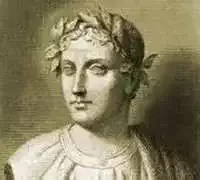
Horácio
BkI:VII Tibur
BkI:VII Tibur
Let others sing in praise of Rhodes, or Mytilene,
or Ephesus, or Corinth on the Isthmus,
or Thebes that’s known for Bacchus, or Apollo’s isle
of Delphi, or Thessalian Tempe.
There’s some whose only purpose is to celebrate
virgin Athene’s city forever,
and set indiscriminately gathered olive on their heads.
Many a poet in honour of Juno
will speak fittingly of horses, Argos, rich Mycenae.
As for me not even stubborn Sparta
or the fields of lush Larisa are quite as striking,
as Albunea’s echoing cavern,
her headlong Anio, and the groves of Tiburnus,
and Tibur’s orchards, white with flowing streams.
Bright Notus from the south often blows away the clouds
from dark skies, without bringing endless rain,
so Plancus, my friend, remember to end a sad life
and your troubles, wisely, with sweet wine,
whether it’s the camp, and gleaming standards, that hold you
or the deep shadows of your own Tibur.
They say that Teucer, fleeing from Salamis and his
father, still wreathed the garlands, leaves of poplar,
round his forehead, flushed with wine, and in speech to his friends
said these words to them as they sorrowed:
‘Wherever fortune carries us, kinder than my father,
there, O friends and comrades, we’ll adventure!
Never despair, if Teucer leads, of Teucer’s omens!
Unerring Apollo surely promised,
in the uncertain future, a second Salamis
on a fresh soil. O you brave heroes, you
who suffered worse with me often, drown your cares with wine:
tomorrow we’ll sail the wide seas again.’
Let others sing in praise of Rhodes, or Mytilene,
or Ephesus, or Corinth on the Isthmus,
or Thebes that’s known for Bacchus, or Apollo’s isle
of Delphi, or Thessalian Tempe.
There’s some whose only purpose is to celebrate
virgin Athene’s city forever,
and set indiscriminately gathered olive on their heads.
Many a poet in honour of Juno
will speak fittingly of horses, Argos, rich Mycenae.
As for me not even stubborn Sparta
or the fields of lush Larisa are quite as striking,
as Albunea’s echoing cavern,
her headlong Anio, and the groves of Tiburnus,
and Tibur’s orchards, white with flowing streams.
Bright Notus from the south often blows away the clouds
from dark skies, without bringing endless rain,
so Plancus, my friend, remember to end a sad life
and your troubles, wisely, with sweet wine,
whether it’s the camp, and gleaming standards, that hold you
or the deep shadows of your own Tibur.
They say that Teucer, fleeing from Salamis and his
father, still wreathed the garlands, leaves of poplar,
round his forehead, flushed with wine, and in speech to his friends
said these words to them as they sorrowed:
‘Wherever fortune carries us, kinder than my father,
there, O friends and comrades, we’ll adventure!
Never despair, if Teucer leads, of Teucer’s omens!
Unerring Apollo surely promised,
in the uncertain future, a second Salamis
on a fresh soil. O you brave heroes, you
who suffered worse with me often, drown your cares with wine:
tomorrow we’ll sail the wide seas again.’
275
Horácio
BkI:VII Tibur
BkI:VII Tibur
Let others sing in praise of Rhodes, or Mytilene,
or Ephesus, or Corinth on the Isthmus,
or Thebes that’s known for Bacchus, or Apollo’s isle
of Delphi, or Thessalian Tempe.
There’s some whose only purpose is to celebrate
virgin Athene’s city forever,
and set indiscriminately gathered olive on their heads.
Many a poet in honour of Juno
will speak fittingly of horses, Argos, rich Mycenae.
As for me not even stubborn Sparta
or the fields of lush Larisa are quite as striking,
as Albunea’s echoing cavern,
her headlong Anio, and the groves of Tiburnus,
and Tibur’s orchards, white with flowing streams.
Bright Notus from the south often blows away the clouds
from dark skies, without bringing endless rain,
so Plancus, my friend, remember to end a sad life
and your troubles, wisely, with sweet wine,
whether it’s the camp, and gleaming standards, that hold you
or the deep shadows of your own Tibur.
They say that Teucer, fleeing from Salamis and his
father, still wreathed the garlands, leaves of poplar,
round his forehead, flushed with wine, and in speech to his friends
said these words to them as they sorrowed:
‘Wherever fortune carries us, kinder than my father,
there, O friends and comrades, we’ll adventure!
Never despair, if Teucer leads, of Teucer’s omens!
Unerring Apollo surely promised,
in the uncertain future, a second Salamis
on a fresh soil. O you brave heroes, you
who suffered worse with me often, drown your cares with wine:
tomorrow we’ll sail the wide seas again.’
Let others sing in praise of Rhodes, or Mytilene,
or Ephesus, or Corinth on the Isthmus,
or Thebes that’s known for Bacchus, or Apollo’s isle
of Delphi, or Thessalian Tempe.
There’s some whose only purpose is to celebrate
virgin Athene’s city forever,
and set indiscriminately gathered olive on their heads.
Many a poet in honour of Juno
will speak fittingly of horses, Argos, rich Mycenae.
As for me not even stubborn Sparta
or the fields of lush Larisa are quite as striking,
as Albunea’s echoing cavern,
her headlong Anio, and the groves of Tiburnus,
and Tibur’s orchards, white with flowing streams.
Bright Notus from the south often blows away the clouds
from dark skies, without bringing endless rain,
so Plancus, my friend, remember to end a sad life
and your troubles, wisely, with sweet wine,
whether it’s the camp, and gleaming standards, that hold you
or the deep shadows of your own Tibur.
They say that Teucer, fleeing from Salamis and his
father, still wreathed the garlands, leaves of poplar,
round his forehead, flushed with wine, and in speech to his friends
said these words to them as they sorrowed:
‘Wherever fortune carries us, kinder than my father,
there, O friends and comrades, we’ll adventure!
Never despair, if Teucer leads, of Teucer’s omens!
Unerring Apollo surely promised,
in the uncertain future, a second Salamis
on a fresh soil. O you brave heroes, you
who suffered worse with me often, drown your cares with wine:
tomorrow we’ll sail the wide seas again.’
275
Horácio
BkI:VII Tibur
BkI:VII Tibur
Let others sing in praise of Rhodes, or Mytilene,
or Ephesus, or Corinth on the Isthmus,
or Thebes that’s known for Bacchus, or Apollo’s isle
of Delphi, or Thessalian Tempe.
There’s some whose only purpose is to celebrate
virgin Athene’s city forever,
and set indiscriminately gathered olive on their heads.
Many a poet in honour of Juno
will speak fittingly of horses, Argos, rich Mycenae.
As for me not even stubborn Sparta
or the fields of lush Larisa are quite as striking,
as Albunea’s echoing cavern,
her headlong Anio, and the groves of Tiburnus,
and Tibur’s orchards, white with flowing streams.
Bright Notus from the south often blows away the clouds
from dark skies, without bringing endless rain,
so Plancus, my friend, remember to end a sad life
and your troubles, wisely, with sweet wine,
whether it’s the camp, and gleaming standards, that hold you
or the deep shadows of your own Tibur.
They say that Teucer, fleeing from Salamis and his
father, still wreathed the garlands, leaves of poplar,
round his forehead, flushed with wine, and in speech to his friends
said these words to them as they sorrowed:
‘Wherever fortune carries us, kinder than my father,
there, O friends and comrades, we’ll adventure!
Never despair, if Teucer leads, of Teucer’s omens!
Unerring Apollo surely promised,
in the uncertain future, a second Salamis
on a fresh soil. O you brave heroes, you
who suffered worse with me often, drown your cares with wine:
tomorrow we’ll sail the wide seas again.’
Let others sing in praise of Rhodes, or Mytilene,
or Ephesus, or Corinth on the Isthmus,
or Thebes that’s known for Bacchus, or Apollo’s isle
of Delphi, or Thessalian Tempe.
There’s some whose only purpose is to celebrate
virgin Athene’s city forever,
and set indiscriminately gathered olive on their heads.
Many a poet in honour of Juno
will speak fittingly of horses, Argos, rich Mycenae.
As for me not even stubborn Sparta
or the fields of lush Larisa are quite as striking,
as Albunea’s echoing cavern,
her headlong Anio, and the groves of Tiburnus,
and Tibur’s orchards, white with flowing streams.
Bright Notus from the south often blows away the clouds
from dark skies, without bringing endless rain,
so Plancus, my friend, remember to end a sad life
and your troubles, wisely, with sweet wine,
whether it’s the camp, and gleaming standards, that hold you
or the deep shadows of your own Tibur.
They say that Teucer, fleeing from Salamis and his
father, still wreathed the garlands, leaves of poplar,
round his forehead, flushed with wine, and in speech to his friends
said these words to them as they sorrowed:
‘Wherever fortune carries us, kinder than my father,
there, O friends and comrades, we’ll adventure!
Never despair, if Teucer leads, of Teucer’s omens!
Unerring Apollo surely promised,
in the uncertain future, a second Salamis
on a fresh soil. O you brave heroes, you
who suffered worse with me often, drown your cares with wine:
tomorrow we’ll sail the wide seas again.’
275

Homero
The Odyssey: Book 9
The Odyssey: Book 9
And Ulysses answered, "King Alcinous, it is a good thing to hear a
bard with such a divine voice as this man has. There is nothing better
or more delightful than when a whole people make merry together,
with the guests sitting orderly to listen, while the table is loaded
with bread and meats, and the cup-bearer draws wine and fills his
cup for every man. This is indeed as fair a sight as a man can see.
Now, however, since you are inclined to ask the story of my sorrows,
and rekindle my own sad memories in respect of them, I do not know how
to begin, nor yet how to continue and conclude my tale, for the hand
of heaven has been laid heavily upon me.
"Firstly, then, I will tell you my name that you too may know it,
and one day, if I outlive this time of sorrow, may become my there
guests though I live so far away from all of you. I am Ulysses son
of Laertes, reknowned among mankind for all manner of subtlety, so
that my fame ascends to heaven. I live in Ithaca, where there is a
high mountain called Neritum, covered with forests; and not far from
it there is a group of islands very near to one another- Dulichium,
Same, and the wooded island of Zacynthus. It lies squat on the
horizon, all highest up in the sea towards the sunset, while the
others lie away from it towards dawn. It is a rugged island, but it
breeds brave men, and my eyes know none that they better love to
look upon. The goddess Calypso kept me with her in her cave, and
wanted me to marry her, as did also the cunning Aeaean goddess
Circe; but they could neither of them persuade me, for there is
nothing dearer to a man than his own country and his parents, and
however splendid a home he may have in a foreign country, if it be far
from father or mother, he does not care about it. Now, however, I will
tell you of the many hazardous adventures which by Jove's will I met
with on my return from Troy.
"When I had set sail thence the wind took me first to Ismarus, which
is the city of the Cicons. There I sacked the town and put the
people to the sword. We took their wives and also much booty, which we
divided equitably amongst us, so that none might have reason to
complain. I then said that we had better make off at once, but my
men very foolishly would not obey me, so they stayed there drinking
much wine and killing great numbers of sheep and oxen on the sea
shore. Meanwhile the Cicons cried out for help to other Cicons who
lived inland. These were more in number, and stronger, and they were
more skilled in the art of war, for they could fight, either from
chariots or on foot as the occasion served; in the morning, therefore,
they came as thick as leaves and bloom in summer, and the hand of
heaven was against us, so that we were hard pressed. They set the
battle in array near the ships, and the hosts aimed their
bronze-shod spears at one another. So long as the day waxed and it was
still morning, we held our own against them, though they were more
in number than we; but as the sun went down, towards the time when men
loose their oxen, the Cicons got the better of us, and we lost half
a dozen men from every ship we had; so we got away with those that
were left.
"Thence we sailed onward with sorrow in our hearts, but glad to have
escaped death though we had lost our comrades, nor did we leave till
we had thrice invoked each one of the poor fellows who had perished by
the hands of the Cicons. Then Jove raised the North wind against us
till it blew a hurricane, so that land and sky were hidden in thick
clouds, and night sprang forth out of the heavens. We let the ships
run before the gale, but the force of the wind tore our sails to
tatters, so we took them down for fear of shipwreck, and rowed our
hardest towards the land. There we lay two days and two nights
suffering much alike from toil and distress of mind, but on the
morning of the third day we again raised our masts, set sail, and took
our places, letting the wind and steersmen direct our ship. I should
have got home at that time unharmed had not the North wind and the
currents been against me as I was doubling Cape Malea, and set me
off my course hard by the island of Cythera.
"I was driven thence by foul winds for a space of nine days upon the
sea, but on the tenth day we reached the land of the Lotus-eater,
who live on a food that comes from a kind of flower. Here we landed to
take in fresh water, and our crews got their mid-day meal on the shore
near the ships. When they had eaten and drunk I sent two of my company
to see what manner of men the people of the place might be, and they
had a third man under them. They started at once, and went about among
the Lotus-eaters, who did them no hurt, but gave them to eat of the
lotus, which was so delicious that those who ate of it left off caring
about home, and did not even want to go back and say what had happened
to them, but were for staying and munching lotus with the
Lotus-eater without thinking further of their return; nevertheless,
though they wept bitterly I forced them back to the ships and made
them fast under the benches. Then I told the rest to go on board at
once, lest any of them should taste of the lotus and leave off wanting
to get home, so they took their places and smote the grey sea with
their oars.
"We sailed hence, always in much distress, till we came to the
land of the lawless and inhuman Cyclopes. Now the Cyclopes neither
plant nor plough, but trust in providence, and live on such wheat,
barley, and grapes as grow wild without any kind of tillage, and their
wild grapes yield them wine as the sun and the rain may grow them.
They have no laws nor assemblies of the people, but live in caves on
the tops of high mountains; each is lord and master in his family, and
they take no account of their neighbours.
"Now off their harbour there lies a wooded and fertile island not
quite close to the land of the Cyclopes, but still not far. It is
overrun with wild goats, that breed there in great numbers and are
never disturbed by foot of man; for sportsmen- who as a rule will
suffer so much hardship in forest or among mountain precipices- do not
go there, nor yet again is it ever ploughed or fed down, but it lies a
wilderness untilled and unsown from year to year, and has no living
thing upon it but only goats. For the Cyclopes have no ships, nor
yet shipwrights who could make ships for them; they cannot therefore
go from city to city, or sail over the sea to one another's country as
people who have ships can do; if they had had these they would have
colonized the island, for it is a very good one, and would yield
everything in due season. There are meadows that in some places come
right down to the sea shore, well watered and full of luscious
grass; grapes would do there excellently; there is level land for
ploughing, and it would always yield heavily at harvest time, for
the soil is deep. There is a good harbour where no cables are
wanted, nor yet anchors, nor need a ship be moored, but all one has to
do is to beach one's vessel and stay there till the wind becomes
fair for putting out to sea again. At the head of the harbour there is
a spring of clear water coming out of a cave, and there are poplars
growing all round it.
"Here we entered, but so dark was the night that some god must
have brought us in, for there was nothing whatever to be seen. A thick
mist hung all round our ships; the moon was hidden behind a mass of
clouds so that no one could have seen the island if he had looked
for it, nor were there any breakers to tell us we were close in
shore before we found ourselves upon the land itself; when, however,
we had beached the ships, we took down the sails, went ashore and
camped upon the beach till daybreak.
"When the child of morning, rosy-fingered Dawn, appeared, we admired
the island and wandered all over it, while the nymphs Jove's daughters
roused the wild goats that we might get some meat for our dinner. On
this we fetched our spears and bows and arrows from the ships, and
dividing ourselves into three bands began to shoot the goats. Heaven
sent us excellent sport; I had twelve ships with me, and each ship got
nine goats, while my own ship had ten; thus through the livelong day
to the going down of the sun we ate and drank our fill,- and we had
plenty of wine left, for each one of us had taken many jars full
when we sacked the city of the Cicons, and this had not yet run out.
While we were feasting we kept turning our eyes towards the land of
the Cyclopes, which was hard by, and saw the smoke of their stubble
fires. We could almost fancy we heard their voices and the bleating of
their sheep and goats, but when the sun went down and it came on dark,
we camped down upon the beach, and next morning I called a council.
"'Stay here, my brave fellows,' said I, 'all the rest of you,
while I go with my ship and exploit these people myself: I want to see
if they are uncivilized savages, or a hospitable and humane race.'
"I went on board, bidding my men to do so also and loose the
hawsers; so they took their places and smote the grey sea with their
oars. When we got to the land, which was not far, there, on the face
of a cliff near the sea, we saw a great cave overhung with laurels. It
was a station for a great many sheep and goats, and outside there
was a large yard, with a high wall round it made of stones built
into the ground and of trees both pine and oak. This was the abode
of a huge monster who was then away from home shepherding his
flocks. He would have nothing to do with other people, but led the
life of an outlaw. He was a horrid creature, not like a human being at
all, but resembling rather some crag that stands out boldly against
the sky on the top of a high mountain.
"I told my men to draw the ship ashore, and stay where they were,
all but the twelve best among them, who were to go along with
myself. I also took a goatskin of sweet black wine which had been
given me by Maron, Apollo son of Euanthes, who was priest of Apollo
the patron god of Ismarus, and lived within the wooded precincts of
the temple. When we were sacking the city we respected him, and spared
his life, as also his wife and child; so he made me some presents of
great value- seven talents of fine gold, and a bowl of silver, with
twelve jars of sweet wine, unblended, and of the most exquisite
flavour. Not a man nor maid in the house knew about it, but only
himself, his wife, and one housekeeper: when he drank it he mixed
twenty parts of water to one of wine, and yet the fragrance from the
mixing-bowl was so exquisite that it was impossible to refrain from
drinking. I filled a large skin with this wine, and took a wallet full
of provisions with me, for my mind misgave me that I might have to
deal with some savage who would be of great strength, and would
respect neither right nor law.
"We soon reached his cave, but he was out shepherding, so we went
inside and took stock of all that we could see. His cheese-racks
were loaded with cheeses, and he had more lambs and kids than his pens
could hold. They were kept in separate flocks; first there were the
hoggets, then the oldest of the younger lambs and lastly the very
young ones all kept apart from one another; as for his dairy, all
the vessels, bowls, and milk pails into which he milked, were swimming
with whey. When they saw all this, my men begged me to let them
first steal some cheeses, and make off with them to the ship; they
would then return, drive down the lambs and kids, put them on board
and sail away with them. It would have been indeed better if we had
done so but I would not listen to them, for I wanted to see the
owner himself, in the hope that he might give me a present. When,
however, we saw him my poor men found him ill to deal with.
"We lit a fire, offered some of the cheeses in sacrifice, ate others
of them, and then sat waiting till the Cyclops should come in with his
sheep. When he came, he brought in with him a huge load of dry
firewood to light the fire for his supper, and this he flung with such
a noise on to the floor of his cave that we hid ourselves for fear
at the far end of the cavern. Meanwhile he drove all the ewes
inside, as well as the she-goats that he was going to milk, leaving
the males, both rams and he-goats, outside in the yards. Then he
rolled a huge stone to the mouth of the cave- so huge that two and
twenty strong four-wheeled waggons would not be enough to draw it from
its place against the doorway. When he had so done he sat down and
milked his ewes and goats, all in due course, and then let each of
them have her own young. He curdled half the milk and set it aside
in wicker strainers, but the other half he poured into bowls that he
might drink it for his supper. When he had got through with all his
work, he lit the fire, and then caught sight of us, whereon he said:
"'Strangers, who are you? Where do sail from? Are you traders, or do
you sail the as rovers, with your hands against every man, and every
man's hand against you?'
"We were frightened out of our senses by his loud voice and
monstrous form, but I managed to say, 'We are Achaeans on our way home
from Troy, but by the will of Jove, and stress of weather, we have
been driven far out of our course. We are the people of Agamemnon, son
of Atreus, who has won infinite renown throughout the whole world,
by sacking so great a city and killing so many people. We therefore
humbly pray you to show us some hospitality, and otherwise make us
such presents as visitors may reasonably expect. May your excellency
fear the wrath of heaven, for we are your suppliants, and Jove takes
all respectable travellers under his protection, for he is the avenger
of all suppliants and foreigners in distress.'
"To this he gave me but a pitiless answer, 'Stranger,' said he, 'you
are a fool, or else you know nothing of this country. Talk to me,
indeed, about fearing the gods or shunning their anger? We Cyclopes do
not care about Jove or any of your blessed gods, for we are ever so
much stronger than they. I shall not spare either yourself or your
companions out of any regard for Jove, unless I am in the humour for
doing so. And now tell me where you made your ship fast when you
came on shore. Was it round the point, or is she lying straight off
the land?'
"He said this to draw me out, but I was too cunning to be caught
in that way, so I answered with a lie; 'Neptune,' said I, 'sent my
ship on to the rocks at the far end of your country, and wrecked it.
We were driven on to them from the open sea, but I and those who are
with me escaped the jaws of death.'
"The cruel wretch vouchsafed me not one word of answer, but with a
sudden clutch he gripped up two of my men at once and dashed them down
upon the ground as though they had been puppies. Their brains were
shed upon the ground, and the earth was wet with their blood. Then
he tore them limb from limb and supped upon them. He gobbled them up
like a lion in the wilderness, flesh, bones, marrow, and entrails,
without leaving anything uneaten. As for us, we wept and lifted up our
hands to heaven on seeing such a horrid sight, for we did not know
what else to do; but when the Cyclops had filled his huge paunch,
and had washed down his meal of human flesh with a drink of neat milk,
he stretched himself full length upon the ground among his sheep,
and went to sleep. I was at first inclined to seize my sword, draw it,
and drive it into his vitals, but I reflected that if I did we
should all certainly be lost, for we should never be able to shift the
stone which the monster had put in front of the door. So we stayed
sobbing and sighing where we were till morning came.
"When the child of morning, rosy-fingered Dawn, appeared, he again
lit his fire, milked his goats and ewes, all quite rightly, and then
let each have her own young one; as soon as he had got through with
all his work, he clutched up two more of my men, and began eating them
for his morning's meal. Presently, with the utmost ease, he rolled the
stone away from the door and drove out his sheep, but he at once put
it back again- as easily as though he were merely clapping the lid
on to a quiver full of arrows. As soon as he had done so he shouted,
and cried 'Shoo, shoo,' after his sheep to drive them on to the
mountain; so I was left to scheme some way of taking my revenge and
covering myself with glory.
"In the end I deemed it would be the best plan to do as follows. The
Cyclops had a great club which was lying near one of the sheep pens;
it was of green olive wood, and he had cut it intending to use it
for a staff as soon as it should be dry. It was so huge that we
could only compare it to the mast of a twenty-oared merchant vessel of
large burden, and able to venture out into open sea. I went up to this
club and cut off about six feet of it; I then gave this piece to the
men and told them to fine it evenly off at one end, which they
proceeded to do, and lastly I brought it to a point myself, charring
the end in the fire to make it harder. When I had done this I hid it
under dung, which was lying about all over the cave, and told the
men to cast lots which of them should venture along with myself to
lift it and bore it into the monster's eye while he was asleep. The
lot fell upon the very four whom I should have chosen, and I myself
made five. In the evening the wretch came back from shepherding, and
drove his flocks into the cave- this time driving them all inside, and
not leaving any in the yards; I suppose some fancy must have taken
him, or a god must have prompted him to do so. As soon as he had put
the stone back to its place against the door, he sat down, milked
his ewes and his goats all quite rightly, and then let each have her
own young one; when he had got through with all this work, he
gripped up two more of my men, and made his supper off them. So I went
up to him with an ivy-wood bowl of black wine in my hands:
"'Look here, Cyclops,' said I, you have been eating a great deal
of man's flesh, so take this and drink some wine, that you may see
what kind of liquor we had on board my ship. I was bringing it to
you as a drink-offering, in the hope that you would take compassion
upon me and further me on my way home, whereas all you do is to go
on ramping and raving most intolerably. You ought to be ashamed
yourself; how can you expect people to come see you any more if you
treat them in this way?'
"He then took the cup and drank. He was so delighted with the
taste of the wine that he begged me for another bowl full. 'Be so
kind,' he said, 'as to give me some more, and tell me your name at
once. I want to make you a present that you will be glad to have. We
have wine even in this country, for our soil grows grapes and the
sun ripens them, but this drinks like nectar and ambrosia all in one.'
"I then gave him some more; three times did I fill the bowl for him,
and three times did he drain it without thought or heed; then, when
I saw that the wine had got into his head, I said to him as
plausibly as I could: 'Cyclops, you ask my name and I will tell it
you; give me, therefore, the present you promised me; my name is
Noman; this is what my father and mother and my friends have always
called me.'
"But the cruel wretch said, 'Then I will eat all Noman's comrades
before Noman himself, and will keep Noman for the last. This is the
present that I will make him.'
As he spoke he reeled, and fell sprawling face upwards on the
ground. His great neck hung heavily backwards and a deep sleep took
hold upon him. Presently he turned sick, and threw up both wine and
the gobbets of human flesh on which he had been gorging, for he was
very drunk. Then I thrust the beam of wood far into the embers to heat
it, and encouraged my men lest any of them should turn
faint-hearted. When the wood, green though it was, was about to blaze,
I drew it out of the fire glowing with heat, and my men gathered round
me, for heaven had filled their hearts with courage. We drove the
sharp end of the beam into the monster's eye, and bearing upon it with
all my weight I kept turning it round and round as though I were
boring a hole in a ship's plank with an auger, which two men with a
wheel and strap can keep on turning as long as they choose. Even
thus did we bore the red hot beam into his eye, till the boiling blood
bubbled all over it as we worked it round and round, so that the steam
from the burning eyeball scalded his eyelids and eyebrows, and the
roots of the eye sputtered in the fire. As a blacksmith plunges an axe
or hatchet into cold water to temper it- for it is this that gives
strength to the iron- and it makes a great hiss as he does so, even
thus did the Cyclops' eye hiss round the beam of olive wood, and his
hideous yells made the cave ring again. We ran away in a fright, but
he plucked the beam all besmirched with gore from his eye, and
hurled it from him in a frenzy of rage and pain, shouting as he did so
to the other Cyclopes who lived on the bleak headlands near him; so
they gathered from all quarters round his cave when they heard him
crying, and asked what was the matter with him.
"'What ails you, Polyphemus,' said they, 'that you make such a
noise, breaking the stillness of the night, and preventing us from
being able to sleep? Surely no man is carrying off your sheep?
Surely no man is trying to kill you either by fraud or by force?
"But Polyphemus shouted to them from inside the cave, 'Noman is
killing me by fraud! Noman is killing me by force!'
"'Then,' said they, 'if no man is attacking you, you must be ill;
when Jove makes people ill, there is no help for it, and you had
better pray to your father Neptune.'
"Then they went away, and I laughed inwardly at the success of my
clever stratagem, but the Cyclops, groaning and in an agony of pain,
felt about with his hands till he found the stone and took it from the
door; then he sat in the doorway and stretched his hands in front of
it to catch anyone going out with the sheep, for he thought I might be
foolish enough to attempt this.
"As for myself I kept on puzzling to think how I could best save
my own life and those of my companions; I schemed and schemed, as
one who knows that his life depends upon it, for the danger was very
great. In the end I deemed that this plan would be the best. The
male sheep were well grown, and carried a heavy black fleece, so I
bound them noiselessly in threes together, with some of the withies on
which the wicked monster used to sleep. There was to be a man under
the middle sheep, and the two on either side were to cover him, so
that there were three sheep to each man. As for myself there was a ram
finer than any of the others, so I caught hold of him by the back,
esconced myself in the thick wool under his belly, and flung on
patiently to his fleece, face upwards, keeping a firm hold on it all
the time.
"Thus, then, did we wait in great fear of mind till morning came,
but when the child of morning, rosy-fingered Dawn, appeared, the
male sheep hurried out to feed, while the ewes remained bleating about
the pens waiting to be milked, for their udders were full to bursting;
but their master in spite of all his pain felt the backs of all the
sheep as they stood upright, without being sharp enough to find out
that the men were underneath their bellies. As the ram was going
out, last of all, heavy with its fleece and with the weight of my
crafty self; Polyphemus laid hold of it and said:
"'My good ram, what is it that makes you the last to leave my cave
this morning? You are not wont to let the ewes go before you, but lead
the mob with a run whether to flowery mead or bubbling fountain, and
are the first to come home again at night; but now you lag last of
all. Is it because you know your master has lost his eye, and are
sorry because that wicked Noman and his horrid crew have got him
down in his drink and blinded him? But I will have his life yet. If
you could understand and talk, you would tell me where the wretch is
hiding, and I would dash his brains upon the ground till they flew all
over the cave. I should thus have some satisfaction for the harm a
this no-good Noman has done me.'
"As spoke he drove the ram outside, but when we were a little way
out from the cave and yards, I first got from under the ram's belly,
and then freed my comrades; as for the sheep, which were very fat,
by constantly heading them in the right direction we managed to
drive them down to the ship. The crew rejoiced greatly at seeing those
of us who had escaped death, but wept for the others whom the
Cyclops had killed. However, I made signs to them by nodding and
frowning that they were to hush their crying, and told them to get all
the sheep on board at once and put out to sea; so they went aboard,
took their places, and smote the grey sea with their oars. Then,
when I had got as far out as my voice would reach, I began to jeer
at the Cyclops.
"'Cyclops,' said I, 'you should have taken better measure of your
man before eating up his comrades in your cave. You wretch, eat up
your visitors in your own house? You might have known that your sin
would find you out, and now Jove and the other gods have punished
you.'
"He got more and more furious as he heard me, so he tore the top
from off a high mountain, and flung it just in front of my ship so
that it was within a little of hitting the end of the rudder. The
sea quaked as the rock fell into it, and the wash of the wave it
raised carried us back towards the mainland, and forced us towards the
shore. But I snatched up a long pole and kept the ship off, making
signs to my men by nodding my head, that they must row for their
lives, whereon they laid out with a will. When we had got twice as far
as we were before, I was for jeering at the Cyclops again, but the men
begged and prayed of me to hold my tongue.
"'Do not,' they exclaimed, 'be mad enough to provoke this savage
creature further; he has thrown one rock at us already which drove
us back again to the mainland, and we made sure it had been the
death of us; if he had then heard any further sound of voices he would
have pounded our heads and our ship's timbers into a jelly with the
rugged rocks he would have heaved at us, for he can throw them a
long way.'
"But I would not listen to them, and shouted out to him in my
rage, 'Cyclops, if any one asks you who it was that put your eye out
and spoiled your beauty, say it was the valiant warrior Ulysses, son
of Laertes, who lives in Ithaca.'
"On this he groaned, and cried out, 'Alas, alas, then the old
prophecy about me is coming true. There was a prophet here, at one
time, a man both brave and of great stature, Telemus son of Eurymus,
who was an excellent seer, and did all the prophesying for the
Cyclopes till he grew old; he told me that all this would happen to me
some day, and said I should lose my sight by the hand of Ulysses. I
have been all along expecting some one of imposing presence and
superhuman strength, whereas he turns out to be a little insignificant
weakling, who has managed to blind my eye by taking advantage of me in
my drink; come here, then, Ulysses, that I may make you presents to
show my hospitality, and urge Neptune to help you forward on your
journey- for Neptune and I are father and son. He, if he so will,
shall heal me, which no one else neither god nor man can do.'
"Then I said, 'I wish I could be as sure of killing you outright and
sending you down to the house of Hades, as I am that it will take more
than Neptune to cure that eye of yours.'
"On this he lifted up his hands to the firmament of heaven and
prayed, saying, 'Hear me, great Neptune; if I am indeed your own
true-begotten son, grant that Ulysses may never reach his home
alive; or if he must get back to his friends at last, let him do so
late and in sore plight after losing all his men [let him reach his
home in another man's ship and find trouble in his house.']
"Thus did he pray, and Neptune heard his prayer. Then he picked up a
rock much larger than the first, swung it aloft and hurled it with
prodigious force. It fell just short of the ship, but was within a
little of hitting the end of the rudder. The sea quaked as the rock
fell into it, and the wash of the wave it raised drove us onwards on
our way towards the shore of the island.
"When at last we got to the island where we had left the rest of our
ships, we found our comrades lamenting us, and anxiously awaiting
our return. We ran our vessel upon the sands and got out of her on
to the sea shore; we also landed the Cyclops' sheep, and divided
them equitably amongst us so that none might have reason to
complain. As for the ram, my companions agreed that I should have it
as an extra share; so I sacrificed it on the sea shore, and burned its
thigh bones to Jove, who is the lord of all. But he heeded not my
sacrifice, and only thought how he might destroy my ships and my
comrades.
"Thus through the livelong day to the going down of the sun we
feasted our fill on meat and drink, but when the sun went down and
it came on dark, we camped upon the beach. When the child of
morning, rosy-fingered Dawn, appeared, I bade my men on board and
loose the hawsers. Then they took their places and smote the grey
sea with their oars; so we sailed on with sorrow in our hearts, but
glad to have escaped death though we had lost our comrades.
Translated by Samuel Butler
And Ulysses answered, "King Alcinous, it is a good thing to hear a
bard with such a divine voice as this man has. There is nothing better
or more delightful than when a whole people make merry together,
with the guests sitting orderly to listen, while the table is loaded
with bread and meats, and the cup-bearer draws wine and fills his
cup for every man. This is indeed as fair a sight as a man can see.
Now, however, since you are inclined to ask the story of my sorrows,
and rekindle my own sad memories in respect of them, I do not know how
to begin, nor yet how to continue and conclude my tale, for the hand
of heaven has been laid heavily upon me.
"Firstly, then, I will tell you my name that you too may know it,
and one day, if I outlive this time of sorrow, may become my there
guests though I live so far away from all of you. I am Ulysses son
of Laertes, reknowned among mankind for all manner of subtlety, so
that my fame ascends to heaven. I live in Ithaca, where there is a
high mountain called Neritum, covered with forests; and not far from
it there is a group of islands very near to one another- Dulichium,
Same, and the wooded island of Zacynthus. It lies squat on the
horizon, all highest up in the sea towards the sunset, while the
others lie away from it towards dawn. It is a rugged island, but it
breeds brave men, and my eyes know none that they better love to
look upon. The goddess Calypso kept me with her in her cave, and
wanted me to marry her, as did also the cunning Aeaean goddess
Circe; but they could neither of them persuade me, for there is
nothing dearer to a man than his own country and his parents, and
however splendid a home he may have in a foreign country, if it be far
from father or mother, he does not care about it. Now, however, I will
tell you of the many hazardous adventures which by Jove's will I met
with on my return from Troy.
"When I had set sail thence the wind took me first to Ismarus, which
is the city of the Cicons. There I sacked the town and put the
people to the sword. We took their wives and also much booty, which we
divided equitably amongst us, so that none might have reason to
complain. I then said that we had better make off at once, but my
men very foolishly would not obey me, so they stayed there drinking
much wine and killing great numbers of sheep and oxen on the sea
shore. Meanwhile the Cicons cried out for help to other Cicons who
lived inland. These were more in number, and stronger, and they were
more skilled in the art of war, for they could fight, either from
chariots or on foot as the occasion served; in the morning, therefore,
they came as thick as leaves and bloom in summer, and the hand of
heaven was against us, so that we were hard pressed. They set the
battle in array near the ships, and the hosts aimed their
bronze-shod spears at one another. So long as the day waxed and it was
still morning, we held our own against them, though they were more
in number than we; but as the sun went down, towards the time when men
loose their oxen, the Cicons got the better of us, and we lost half
a dozen men from every ship we had; so we got away with those that
were left.
"Thence we sailed onward with sorrow in our hearts, but glad to have
escaped death though we had lost our comrades, nor did we leave till
we had thrice invoked each one of the poor fellows who had perished by
the hands of the Cicons. Then Jove raised the North wind against us
till it blew a hurricane, so that land and sky were hidden in thick
clouds, and night sprang forth out of the heavens. We let the ships
run before the gale, but the force of the wind tore our sails to
tatters, so we took them down for fear of shipwreck, and rowed our
hardest towards the land. There we lay two days and two nights
suffering much alike from toil and distress of mind, but on the
morning of the third day we again raised our masts, set sail, and took
our places, letting the wind and steersmen direct our ship. I should
have got home at that time unharmed had not the North wind and the
currents been against me as I was doubling Cape Malea, and set me
off my course hard by the island of Cythera.
"I was driven thence by foul winds for a space of nine days upon the
sea, but on the tenth day we reached the land of the Lotus-eater,
who live on a food that comes from a kind of flower. Here we landed to
take in fresh water, and our crews got their mid-day meal on the shore
near the ships. When they had eaten and drunk I sent two of my company
to see what manner of men the people of the place might be, and they
had a third man under them. They started at once, and went about among
the Lotus-eaters, who did them no hurt, but gave them to eat of the
lotus, which was so delicious that those who ate of it left off caring
about home, and did not even want to go back and say what had happened
to them, but were for staying and munching lotus with the
Lotus-eater without thinking further of their return; nevertheless,
though they wept bitterly I forced them back to the ships and made
them fast under the benches. Then I told the rest to go on board at
once, lest any of them should taste of the lotus and leave off wanting
to get home, so they took their places and smote the grey sea with
their oars.
"We sailed hence, always in much distress, till we came to the
land of the lawless and inhuman Cyclopes. Now the Cyclopes neither
plant nor plough, but trust in providence, and live on such wheat,
barley, and grapes as grow wild without any kind of tillage, and their
wild grapes yield them wine as the sun and the rain may grow them.
They have no laws nor assemblies of the people, but live in caves on
the tops of high mountains; each is lord and master in his family, and
they take no account of their neighbours.
"Now off their harbour there lies a wooded and fertile island not
quite close to the land of the Cyclopes, but still not far. It is
overrun with wild goats, that breed there in great numbers and are
never disturbed by foot of man; for sportsmen- who as a rule will
suffer so much hardship in forest or among mountain precipices- do not
go there, nor yet again is it ever ploughed or fed down, but it lies a
wilderness untilled and unsown from year to year, and has no living
thing upon it but only goats. For the Cyclopes have no ships, nor
yet shipwrights who could make ships for them; they cannot therefore
go from city to city, or sail over the sea to one another's country as
people who have ships can do; if they had had these they would have
colonized the island, for it is a very good one, and would yield
everything in due season. There are meadows that in some places come
right down to the sea shore, well watered and full of luscious
grass; grapes would do there excellently; there is level land for
ploughing, and it would always yield heavily at harvest time, for
the soil is deep. There is a good harbour where no cables are
wanted, nor yet anchors, nor need a ship be moored, but all one has to
do is to beach one's vessel and stay there till the wind becomes
fair for putting out to sea again. At the head of the harbour there is
a spring of clear water coming out of a cave, and there are poplars
growing all round it.
"Here we entered, but so dark was the night that some god must
have brought us in, for there was nothing whatever to be seen. A thick
mist hung all round our ships; the moon was hidden behind a mass of
clouds so that no one could have seen the island if he had looked
for it, nor were there any breakers to tell us we were close in
shore before we found ourselves upon the land itself; when, however,
we had beached the ships, we took down the sails, went ashore and
camped upon the beach till daybreak.
"When the child of morning, rosy-fingered Dawn, appeared, we admired
the island and wandered all over it, while the nymphs Jove's daughters
roused the wild goats that we might get some meat for our dinner. On
this we fetched our spears and bows and arrows from the ships, and
dividing ourselves into three bands began to shoot the goats. Heaven
sent us excellent sport; I had twelve ships with me, and each ship got
nine goats, while my own ship had ten; thus through the livelong day
to the going down of the sun we ate and drank our fill,- and we had
plenty of wine left, for each one of us had taken many jars full
when we sacked the city of the Cicons, and this had not yet run out.
While we were feasting we kept turning our eyes towards the land of
the Cyclopes, which was hard by, and saw the smoke of their stubble
fires. We could almost fancy we heard their voices and the bleating of
their sheep and goats, but when the sun went down and it came on dark,
we camped down upon the beach, and next morning I called a council.
"'Stay here, my brave fellows,' said I, 'all the rest of you,
while I go with my ship and exploit these people myself: I want to see
if they are uncivilized savages, or a hospitable and humane race.'
"I went on board, bidding my men to do so also and loose the
hawsers; so they took their places and smote the grey sea with their
oars. When we got to the land, which was not far, there, on the face
of a cliff near the sea, we saw a great cave overhung with laurels. It
was a station for a great many sheep and goats, and outside there
was a large yard, with a high wall round it made of stones built
into the ground and of trees both pine and oak. This was the abode
of a huge monster who was then away from home shepherding his
flocks. He would have nothing to do with other people, but led the
life of an outlaw. He was a horrid creature, not like a human being at
all, but resembling rather some crag that stands out boldly against
the sky on the top of a high mountain.
"I told my men to draw the ship ashore, and stay where they were,
all but the twelve best among them, who were to go along with
myself. I also took a goatskin of sweet black wine which had been
given me by Maron, Apollo son of Euanthes, who was priest of Apollo
the patron god of Ismarus, and lived within the wooded precincts of
the temple. When we were sacking the city we respected him, and spared
his life, as also his wife and child; so he made me some presents of
great value- seven talents of fine gold, and a bowl of silver, with
twelve jars of sweet wine, unblended, and of the most exquisite
flavour. Not a man nor maid in the house knew about it, but only
himself, his wife, and one housekeeper: when he drank it he mixed
twenty parts of water to one of wine, and yet the fragrance from the
mixing-bowl was so exquisite that it was impossible to refrain from
drinking. I filled a large skin with this wine, and took a wallet full
of provisions with me, for my mind misgave me that I might have to
deal with some savage who would be of great strength, and would
respect neither right nor law.
"We soon reached his cave, but he was out shepherding, so we went
inside and took stock of all that we could see. His cheese-racks
were loaded with cheeses, and he had more lambs and kids than his pens
could hold. They were kept in separate flocks; first there were the
hoggets, then the oldest of the younger lambs and lastly the very
young ones all kept apart from one another; as for his dairy, all
the vessels, bowls, and milk pails into which he milked, were swimming
with whey. When they saw all this, my men begged me to let them
first steal some cheeses, and make off with them to the ship; they
would then return, drive down the lambs and kids, put them on board
and sail away with them. It would have been indeed better if we had
done so but I would not listen to them, for I wanted to see the
owner himself, in the hope that he might give me a present. When,
however, we saw him my poor men found him ill to deal with.
"We lit a fire, offered some of the cheeses in sacrifice, ate others
of them, and then sat waiting till the Cyclops should come in with his
sheep. When he came, he brought in with him a huge load of dry
firewood to light the fire for his supper, and this he flung with such
a noise on to the floor of his cave that we hid ourselves for fear
at the far end of the cavern. Meanwhile he drove all the ewes
inside, as well as the she-goats that he was going to milk, leaving
the males, both rams and he-goats, outside in the yards. Then he
rolled a huge stone to the mouth of the cave- so huge that two and
twenty strong four-wheeled waggons would not be enough to draw it from
its place against the doorway. When he had so done he sat down and
milked his ewes and goats, all in due course, and then let each of
them have her own young. He curdled half the milk and set it aside
in wicker strainers, but the other half he poured into bowls that he
might drink it for his supper. When he had got through with all his
work, he lit the fire, and then caught sight of us, whereon he said:
"'Strangers, who are you? Where do sail from? Are you traders, or do
you sail the as rovers, with your hands against every man, and every
man's hand against you?'
"We were frightened out of our senses by his loud voice and
monstrous form, but I managed to say, 'We are Achaeans on our way home
from Troy, but by the will of Jove, and stress of weather, we have
been driven far out of our course. We are the people of Agamemnon, son
of Atreus, who has won infinite renown throughout the whole world,
by sacking so great a city and killing so many people. We therefore
humbly pray you to show us some hospitality, and otherwise make us
such presents as visitors may reasonably expect. May your excellency
fear the wrath of heaven, for we are your suppliants, and Jove takes
all respectable travellers under his protection, for he is the avenger
of all suppliants and foreigners in distress.'
"To this he gave me but a pitiless answer, 'Stranger,' said he, 'you
are a fool, or else you know nothing of this country. Talk to me,
indeed, about fearing the gods or shunning their anger? We Cyclopes do
not care about Jove or any of your blessed gods, for we are ever so
much stronger than they. I shall not spare either yourself or your
companions out of any regard for Jove, unless I am in the humour for
doing so. And now tell me where you made your ship fast when you
came on shore. Was it round the point, or is she lying straight off
the land?'
"He said this to draw me out, but I was too cunning to be caught
in that way, so I answered with a lie; 'Neptune,' said I, 'sent my
ship on to the rocks at the far end of your country, and wrecked it.
We were driven on to them from the open sea, but I and those who are
with me escaped the jaws of death.'
"The cruel wretch vouchsafed me not one word of answer, but with a
sudden clutch he gripped up two of my men at once and dashed them down
upon the ground as though they had been puppies. Their brains were
shed upon the ground, and the earth was wet with their blood. Then
he tore them limb from limb and supped upon them. He gobbled them up
like a lion in the wilderness, flesh, bones, marrow, and entrails,
without leaving anything uneaten. As for us, we wept and lifted up our
hands to heaven on seeing such a horrid sight, for we did not know
what else to do; but when the Cyclops had filled his huge paunch,
and had washed down his meal of human flesh with a drink of neat milk,
he stretched himself full length upon the ground among his sheep,
and went to sleep. I was at first inclined to seize my sword, draw it,
and drive it into his vitals, but I reflected that if I did we
should all certainly be lost, for we should never be able to shift the
stone which the monster had put in front of the door. So we stayed
sobbing and sighing where we were till morning came.
"When the child of morning, rosy-fingered Dawn, appeared, he again
lit his fire, milked his goats and ewes, all quite rightly, and then
let each have her own young one; as soon as he had got through with
all his work, he clutched up two more of my men, and began eating them
for his morning's meal. Presently, with the utmost ease, he rolled the
stone away from the door and drove out his sheep, but he at once put
it back again- as easily as though he were merely clapping the lid
on to a quiver full of arrows. As soon as he had done so he shouted,
and cried 'Shoo, shoo,' after his sheep to drive them on to the
mountain; so I was left to scheme some way of taking my revenge and
covering myself with glory.
"In the end I deemed it would be the best plan to do as follows. The
Cyclops had a great club which was lying near one of the sheep pens;
it was of green olive wood, and he had cut it intending to use it
for a staff as soon as it should be dry. It was so huge that we
could only compare it to the mast of a twenty-oared merchant vessel of
large burden, and able to venture out into open sea. I went up to this
club and cut off about six feet of it; I then gave this piece to the
men and told them to fine it evenly off at one end, which they
proceeded to do, and lastly I brought it to a point myself, charring
the end in the fire to make it harder. When I had done this I hid it
under dung, which was lying about all over the cave, and told the
men to cast lots which of them should venture along with myself to
lift it and bore it into the monster's eye while he was asleep. The
lot fell upon the very four whom I should have chosen, and I myself
made five. In the evening the wretch came back from shepherding, and
drove his flocks into the cave- this time driving them all inside, and
not leaving any in the yards; I suppose some fancy must have taken
him, or a god must have prompted him to do so. As soon as he had put
the stone back to its place against the door, he sat down, milked
his ewes and his goats all quite rightly, and then let each have her
own young one; when he had got through with all this work, he
gripped up two more of my men, and made his supper off them. So I went
up to him with an ivy-wood bowl of black wine in my hands:
"'Look here, Cyclops,' said I, you have been eating a great deal
of man's flesh, so take this and drink some wine, that you may see
what kind of liquor we had on board my ship. I was bringing it to
you as a drink-offering, in the hope that you would take compassion
upon me and further me on my way home, whereas all you do is to go
on ramping and raving most intolerably. You ought to be ashamed
yourself; how can you expect people to come see you any more if you
treat them in this way?'
"He then took the cup and drank. He was so delighted with the
taste of the wine that he begged me for another bowl full. 'Be so
kind,' he said, 'as to give me some more, and tell me your name at
once. I want to make you a present that you will be glad to have. We
have wine even in this country, for our soil grows grapes and the
sun ripens them, but this drinks like nectar and ambrosia all in one.'
"I then gave him some more; three times did I fill the bowl for him,
and three times did he drain it without thought or heed; then, when
I saw that the wine had got into his head, I said to him as
plausibly as I could: 'Cyclops, you ask my name and I will tell it
you; give me, therefore, the present you promised me; my name is
Noman; this is what my father and mother and my friends have always
called me.'
"But the cruel wretch said, 'Then I will eat all Noman's comrades
before Noman himself, and will keep Noman for the last. This is the
present that I will make him.'
As he spoke he reeled, and fell sprawling face upwards on the
ground. His great neck hung heavily backwards and a deep sleep took
hold upon him. Presently he turned sick, and threw up both wine and
the gobbets of human flesh on which he had been gorging, for he was
very drunk. Then I thrust the beam of wood far into the embers to heat
it, and encouraged my men lest any of them should turn
faint-hearted. When the wood, green though it was, was about to blaze,
I drew it out of the fire glowing with heat, and my men gathered round
me, for heaven had filled their hearts with courage. We drove the
sharp end of the beam into the monster's eye, and bearing upon it with
all my weight I kept turning it round and round as though I were
boring a hole in a ship's plank with an auger, which two men with a
wheel and strap can keep on turning as long as they choose. Even
thus did we bore the red hot beam into his eye, till the boiling blood
bubbled all over it as we worked it round and round, so that the steam
from the burning eyeball scalded his eyelids and eyebrows, and the
roots of the eye sputtered in the fire. As a blacksmith plunges an axe
or hatchet into cold water to temper it- for it is this that gives
strength to the iron- and it makes a great hiss as he does so, even
thus did the Cyclops' eye hiss round the beam of olive wood, and his
hideous yells made the cave ring again. We ran away in a fright, but
he plucked the beam all besmirched with gore from his eye, and
hurled it from him in a frenzy of rage and pain, shouting as he did so
to the other Cyclopes who lived on the bleak headlands near him; so
they gathered from all quarters round his cave when they heard him
crying, and asked what was the matter with him.
"'What ails you, Polyphemus,' said they, 'that you make such a
noise, breaking the stillness of the night, and preventing us from
being able to sleep? Surely no man is carrying off your sheep?
Surely no man is trying to kill you either by fraud or by force?
"But Polyphemus shouted to them from inside the cave, 'Noman is
killing me by fraud! Noman is killing me by force!'
"'Then,' said they, 'if no man is attacking you, you must be ill;
when Jove makes people ill, there is no help for it, and you had
better pray to your father Neptune.'
"Then they went away, and I laughed inwardly at the success of my
clever stratagem, but the Cyclops, groaning and in an agony of pain,
felt about with his hands till he found the stone and took it from the
door; then he sat in the doorway and stretched his hands in front of
it to catch anyone going out with the sheep, for he thought I might be
foolish enough to attempt this.
"As for myself I kept on puzzling to think how I could best save
my own life and those of my companions; I schemed and schemed, as
one who knows that his life depends upon it, for the danger was very
great. In the end I deemed that this plan would be the best. The
male sheep were well grown, and carried a heavy black fleece, so I
bound them noiselessly in threes together, with some of the withies on
which the wicked monster used to sleep. There was to be a man under
the middle sheep, and the two on either side were to cover him, so
that there were three sheep to each man. As for myself there was a ram
finer than any of the others, so I caught hold of him by the back,
esconced myself in the thick wool under his belly, and flung on
patiently to his fleece, face upwards, keeping a firm hold on it all
the time.
"Thus, then, did we wait in great fear of mind till morning came,
but when the child of morning, rosy-fingered Dawn, appeared, the
male sheep hurried out to feed, while the ewes remained bleating about
the pens waiting to be milked, for their udders were full to bursting;
but their master in spite of all his pain felt the backs of all the
sheep as they stood upright, without being sharp enough to find out
that the men were underneath their bellies. As the ram was going
out, last of all, heavy with its fleece and with the weight of my
crafty self; Polyphemus laid hold of it and said:
"'My good ram, what is it that makes you the last to leave my cave
this morning? You are not wont to let the ewes go before you, but lead
the mob with a run whether to flowery mead or bubbling fountain, and
are the first to come home again at night; but now you lag last of
all. Is it because you know your master has lost his eye, and are
sorry because that wicked Noman and his horrid crew have got him
down in his drink and blinded him? But I will have his life yet. If
you could understand and talk, you would tell me where the wretch is
hiding, and I would dash his brains upon the ground till they flew all
over the cave. I should thus have some satisfaction for the harm a
this no-good Noman has done me.'
"As spoke he drove the ram outside, but when we were a little way
out from the cave and yards, I first got from under the ram's belly,
and then freed my comrades; as for the sheep, which were very fat,
by constantly heading them in the right direction we managed to
drive them down to the ship. The crew rejoiced greatly at seeing those
of us who had escaped death, but wept for the others whom the
Cyclops had killed. However, I made signs to them by nodding and
frowning that they were to hush their crying, and told them to get all
the sheep on board at once and put out to sea; so they went aboard,
took their places, and smote the grey sea with their oars. Then,
when I had got as far out as my voice would reach, I began to jeer
at the Cyclops.
"'Cyclops,' said I, 'you should have taken better measure of your
man before eating up his comrades in your cave. You wretch, eat up
your visitors in your own house? You might have known that your sin
would find you out, and now Jove and the other gods have punished
you.'
"He got more and more furious as he heard me, so he tore the top
from off a high mountain, and flung it just in front of my ship so
that it was within a little of hitting the end of the rudder. The
sea quaked as the rock fell into it, and the wash of the wave it
raised carried us back towards the mainland, and forced us towards the
shore. But I snatched up a long pole and kept the ship off, making
signs to my men by nodding my head, that they must row for their
lives, whereon they laid out with a will. When we had got twice as far
as we were before, I was for jeering at the Cyclops again, but the men
begged and prayed of me to hold my tongue.
"'Do not,' they exclaimed, 'be mad enough to provoke this savage
creature further; he has thrown one rock at us already which drove
us back again to the mainland, and we made sure it had been the
death of us; if he had then heard any further sound of voices he would
have pounded our heads and our ship's timbers into a jelly with the
rugged rocks he would have heaved at us, for he can throw them a
long way.'
"But I would not listen to them, and shouted out to him in my
rage, 'Cyclops, if any one asks you who it was that put your eye out
and spoiled your beauty, say it was the valiant warrior Ulysses, son
of Laertes, who lives in Ithaca.'
"On this he groaned, and cried out, 'Alas, alas, then the old
prophecy about me is coming true. There was a prophet here, at one
time, a man both brave and of great stature, Telemus son of Eurymus,
who was an excellent seer, and did all the prophesying for the
Cyclopes till he grew old; he told me that all this would happen to me
some day, and said I should lose my sight by the hand of Ulysses. I
have been all along expecting some one of imposing presence and
superhuman strength, whereas he turns out to be a little insignificant
weakling, who has managed to blind my eye by taking advantage of me in
my drink; come here, then, Ulysses, that I may make you presents to
show my hospitality, and urge Neptune to help you forward on your
journey- for Neptune and I are father and son. He, if he so will,
shall heal me, which no one else neither god nor man can do.'
"Then I said, 'I wish I could be as sure of killing you outright and
sending you down to the house of Hades, as I am that it will take more
than Neptune to cure that eye of yours.'
"On this he lifted up his hands to the firmament of heaven and
prayed, saying, 'Hear me, great Neptune; if I am indeed your own
true-begotten son, grant that Ulysses may never reach his home
alive; or if he must get back to his friends at last, let him do so
late and in sore plight after losing all his men [let him reach his
home in another man's ship and find trouble in his house.']
"Thus did he pray, and Neptune heard his prayer. Then he picked up a
rock much larger than the first, swung it aloft and hurled it with
prodigious force. It fell just short of the ship, but was within a
little of hitting the end of the rudder. The sea quaked as the rock
fell into it, and the wash of the wave it raised drove us onwards on
our way towards the shore of the island.
"When at last we got to the island where we had left the rest of our
ships, we found our comrades lamenting us, and anxiously awaiting
our return. We ran our vessel upon the sands and got out of her on
to the sea shore; we also landed the Cyclops' sheep, and divided
them equitably amongst us so that none might have reason to
complain. As for the ram, my companions agreed that I should have it
as an extra share; so I sacrificed it on the sea shore, and burned its
thigh bones to Jove, who is the lord of all. But he heeded not my
sacrifice, and only thought how he might destroy my ships and my
comrades.
"Thus through the livelong day to the going down of the sun we
feasted our fill on meat and drink, but when the sun went down and
it came on dark, we camped upon the beach. When the child of
morning, rosy-fingered Dawn, appeared, I bade my men on board and
loose the hawsers. Then they took their places and smote the grey
sea with their oars; so we sailed on with sorrow in our hearts, but
glad to have escaped death though we had lost our comrades.
Translated by Samuel Butler
172
Homero
The Odyssey: Book 2
The Odyssey: Book 2
Now when the child of morning, rosy-fingered Dawn, appeared,
Telemachus rose and dressed himself. He bound his sandals on to his
comely feet, girded his sword about his shoulder, and left his room
looking like an immortal god. He at once sent the criers round to call
the people in assembly, so they called them and the people gathered
thereon; then, when they were got together, he went to the place of
assembly spear in hand- not alone, for his two hounds went with him.
Minerva endowed him with a presence of such divine comeliness that all
marvelled at him as he went by, and when he took his place' in his
father's seat even the oldest councillors made way for him.
Aegyptius, a man bent double with age, and of infinite experience,
the first to speak His son Antiphus had gone with Ulysses to Ilius,
land of noble steeds, but the savage Cyclops had killed him when
they were all shut up in the cave, and had cooked his last dinner
for him, He had three sons left, of whom two still worked on their
father's land, while the third, Eurynomus, was one of the suitors;
nevertheless their father could not get over the loss of Antiphus, and
was still weeping for him when he began his speech.
"Men of Ithaca," he said, "hear my words. From the day Ulysses
left us there has been no meeting of our councillors until now; who
then can it be, whether old or young, that finds it so necessary to
convene us? Has he got wind of some host approaching, and does he wish
to warn us, or would he speak upon some other matter of public moment?
I am sure he is an excellent person, and I hope Jove will grant him
his heart's desire."
Telemachus took this speech as of good omen and rose at once, for he
was bursting with what he had to say. He stood in the middle of the
assembly and the good herald Pisenor brought him his staff. Then,
turning to Aegyptius, "Sir," said he, "it is I, as you will shortly
learn, who have convened you, for it is I who am the most aggrieved. I
have not got wind of any host approaching about which I would warn
you, nor is there any matter of public moment on which I would
speak. My grieveance is purely personal, and turns on two great
misfortunes which have fallen upon my house. The first of these is the
loss of my excellent father, who was chief among all you here present,
and was like a father to every one of you; the second is much more
serious, and ere long will be the utter ruin of my estate. The sons of
all the chief men among you are pestering my mother to marry them
against her will. They are afraid to go to her father Icarius,
asking him to choose the one he likes best, and to provide marriage
gifts for his daughter, but day by day they keep hanging about my
father's house, sacrificing our oxen, sheep, and fat goats for their
banquets, and never giving so much as a thought to the quantity of
wine they drink. No estate can stand such recklessness; we have now no
Ulysses to ward off harm from our doors, and I cannot hold my own
against them. I shall never all my days be as good a man as he was,
still I would indeed defend myself if I had power to do so, for I
cannot stand such treatment any longer; my house is being disgraced
and ruined. Have respect, therefore, to your own consciences and to
public opinion. Fear, too, the wrath of heaven, lest the gods should
be displeased and turn upon you. I pray you by Jove and Themis, who is
the beginning and the end of councils, [do not] hold back, my friends,
and leave me singlehanded- unless it be that my brave father Ulysses
did some wrong to the Achaeans which you would now avenge on me, by
aiding and abetting these suitors. Moreover, if I am to be eaten out
of house and home at all, I had rather you did the eating
yourselves, for I could then take action against you to some
purpose, and serve you with notices from house to house till I got
paid in full, whereas now I have no remedy."
With this Telemachus dashed his staff to the ground and burst into
tears. Every one was very sorry for him, but they all sat still and no
one ventured to make him an angry answer, save only Antinous, who
spoke thus:
"Telemachus, insolent braggart that you are, how dare you try to
throw the blame upon us suitors? It is your mother's fault not ours,
for she is a very artful woman. This three years past, and close on
four, she has been driving us out of our minds, by encouraging each
one of us, and sending him messages without meaning one word of what
she says. And then there was that other trick she played us. She set
up a great tambour frame in her room, and began to work on an enormous
piece of fine needlework. 'Sweet hearts,' said she, 'Ulysses is indeed
dead, still do not press me to marry again immediately, wait- for I
would not have skill in needlework perish unrecorded- till I have
completed a pall for the hero Laertes, to be in readiness against
the time when death shall take him. He is very rich, and the women
of the place will talk if he is laid out without a pall.'
"This was what she said, and we assented; whereon we could see her
working on her great web all day long, but at night she would unpick
the stitches again by torchlight. She fooled us in this way for
three years and we never found her out, but as time wore on and she
was now in her fourth year, one of her maids who knew what she was
doing told us, and we caught her in the act of undoing her work, so
she had to finish it whether she would or no. The suitors,
therefore, make you this answer, that both you and the Achaeans may
understand-'Send your mother away, and bid her marry the man of her
own and of her father's choice'; for I do not know what will happen if
she goes on plaguing us much longer with the airs she gives herself on
the score of the accomplishments Minerva has taught her, and because
she is so clever. We never yet heard of such a woman; we know all
about Tyro, Alcmena, Mycene, and the famous women of old, but they
were nothing to your mother, any one of them. It was not fair of her
to treat us in that way, and as long as she continues in the mind with
which heaven has now endowed her, so long shall we go on eating up
your estate; and I do not see why she should change, for she gets
all the honour and glory, and it is you who pay for it, not she.
Understand, then, that we will not go back to our lands, neither
here nor elsewhere, till she has made her choice and married some
one or other of us."
Telemachus answered, "Antinous, how can I drive the mother who
bore me from my father's house? My father is abroad and we do not know
whether he is alive or dead. It will be hard on me if I have to pay
Icarius the large sum which I must give him if I insist on sending his
daughter back to him. Not only will he deal rigorously with me, but
heaven will also punish me; for my mother when she leaves the house
will calf on the Erinyes to avenge her; besides, it would not be a
creditable thing to do, and I will have nothing to say to it. If you
choose to take offence at this, leave the house and feast elsewhere at
one another's houses at your own cost turn and turn about. If, on
the other hand, you elect to persist in spunging upon one man,
heaven help me, but Jove shall reckon with you in full, and when you
fall in my father's house there shall be no man to avenge you."
As he spoke Jove sent two eagles from the top of the mountain, and
they flew on and on with the wind, sailing side by side in their own
lordly flight. When they were right over the middle of the assembly
they wheeled and circled about, beating the air with their wings and
glaring death into the eyes of them that were below; then, fighting
fiercely and tearing at one another, they flew off towards the right
over the town. The people wondered as they saw them, and asked each
other what an this might be; whereon Halitherses, who was the best
prophet and reader of omens among them, spoke to them plainly and in
all honesty, saying:
"Hear me, men of Ithaca, and I speak more particularly to the
suitors, for I see mischief brewing for them. Ulysses is not going
to be away much longer; indeed he is close at hand to deal out death
and destruction, not on them alone, but on many another of us who live
in Ithaca. Let us then be wise in time, and put a stop to this
wickedness before he comes. Let the suitors do so of their own accord;
it will be better for them, for I am not prophesying without due
knowledge; everything has happened to Ulysses as I foretold when the
Argives set out for Troy, and he with them. I said that after going
through much hardship and losing all his men he should come home again
in the twentieth year and that no one would know him; and now all this
is coming true."
Eurymachus son of Polybus then said, "Go home, old man, and prophesy
to your own children, or it may be worse for them. I can read these
omens myself much better than you can; birds are always flying about
in the sunshine somewhere or other, but they seldom mean anything.
Ulysses has died in a far country, and it is a pity you are not dead
along with him, instead of prating here about omens and adding fuel to
the anger of Telemachus which is fierce enough as it is. I suppose you
think he will give you something for your family, but I tell youand
it shall surely be- when an old man like you, who should know
better, talks a young one over till he becomes troublesome, in the
first place his young friend will only fare so much the worse- he will
take nothing by it, for the suitors will prevent this- and in the
next, we will lay a heavier fine, sir, upon yourself than you will
at all like paying, for it will bear hardly upon you. As for
Telemachus, I warn him in the presence of you all to send his mother
back to her father, who will find her a husband and provide her with
all the marriage gifts so dear a daughter may expect. Till we shall go
on harassing him with our suit; for we fear no man, and care neither
for him, with all his fine speeches, nor for any fortune-telling of
yours. You may preach as much as you please, but we shall only hate
you the more. We shall go back and continue to eat up Telemachus's
estate without paying him, till such time as his mother leaves off
tormenting us by keeping us day after day on the tiptoe of
expectation, each vying with the other in his suit for a prize of such
rare perfection. Besides we cannot go after the other women whom we
should marry in due course, but for the way in which she treats us."
Then Telemachus said, "Eurymachus, and you other suitors, I shall
say no more, and entreat you no further, for the gods and the people
of Ithaca now know my story. Give me, then, a ship and a crew of
twenty men to take me hither and thither, and I will go to Sparta
and to Pylos in quest of my father who has so long been missing.
Some one may tell me something, or (and people often hear things in
this way) some heaven-sent message may direct me. If I can hear of him
as alive and on his way home I will put up with the waste you
suitors will make for yet another twelve months. If on the other
hand I hear of his death, I will return at once, celebrate his funeral
rites with all due pomp, build a barrow to his memory, and make my
mother marry again."
With these words he sat down, and Mentor who had been a friend of
Ulysses, and had been left in charge of everything with full authority
over the servants, rose to speak. He, then, plainly and in all honesty
addressed them thus:
"Hear me, men of Ithaca, I hope that you may never have a kind and
well-disposed ruler any more, nor one who will govern you equitably; I
hope that all your chiefs henceforward may be cruel and unjust, for
there is not one of you but has forgotten Ulysses, who ruled you as
though he were your father. I am not half so angry with the suitors,
for if they choose to do violence in the naughtiness of their
hearts, and wager their heads that Ulysses will not return, they can
take the high hand and eat up his estate, but as for you others I am
shocked at the way in which you all sit still without even trying to
stop such scandalous goings on-which you could do if you chose, for
you are many and they are few."
Leiocritus, son of Evenor, answered him saying, "Mentor, what
folly is all this, that you should set the people to stay us? It is
a hard thing for one man to fight with many about his victuals. Even
though Ulysses himself were to set upon us while we are feasting in
his house, and do his best to oust us, his wife, who wants him back so
very badly, would have small cause for rejoicing, and his blood
would be upon his own head if he fought against such great odds. There
is no sense in what you have been saying. Now, therefore, do you
people go about your business, and let his father's old friends,
Mentor and Halitherses, speed this boy on his journey, if he goes at
all- which I do not think he will, for he is more likely to stay where
he is till some one comes and tells him something."
On this he broke up the assembly, and every man went back to his own
abode, while the suitors returned to the house of Ulysses.
Then Telemachus went all alone by the sea side, washed his hands
in the grey waves, and prayed to Minerva.
"Hear me," he cried, "you god who visited me yesterday, and bade
me sail the seas in search of my father who has so long been
missing. I would obey you, but the Achaeans, and more particularly the
wicked suitors, are hindering me that I cannot do so."
As he thus prayed, Minerva came close up to him in the likeness
and with the voice of Mentor. "Telemachus," said she, "if you are made
of the same stuff as your father you will be neither fool nor coward
henceforward, for Ulysses never broke his word nor left his work
half done. If, then, you take after him, your voyage will not be
fruitless, but unless you have the blood of Ulysses and of Penelope in
your veins I see no likelihood of your succeeding. Sons are seldom
as good men as their fathers; they are generally worse, not better;
still, as you are not going to be either fool or coward
henceforward, and are not entirely without some share of your father's
wise discernment, I look with hope upon your undertaking. But mind you
never make common cause with any of those foolish suitors, for they
have neither sense nor virtue, and give no thought to death and to the
doom that will shortly fall on one and all of them, so that they shall
perish on the same day. As for your voyage, it shall not be long
delayed; your father was such an old friend of mine that I will find
you a ship, and will come with you myself. Now, however, return
home, and go about among the suitors; begin getting provisions ready
for your voyage; see everything well stowed, the wine in jars, and the
barley meal, which is the staff of life, in leathern bags, while I
go round the town and beat up volunteers at once. There are many ships
in Ithaca both old and new; I will run my eye over them for you and
will choose the best; we will get her ready and will put out to sea
without delay."
Thus spoke Minerva daughter of Jove, and Telemachus lost no time
in doing as the goddess told him. He went moodily and found the
suitors flaying goats and singeing pigs in the outer court. Antinous
came up to him at once and laughed as he took his hand in his own,
saying, "Telemachus, my fine fire-eater, bear no more ill blood
neither in word nor deed, but eat and drink with us as you used to do.
The Achaeans will find you in everything- a ship and a picked crew
to boot- so that you can set sail for Pylos at once and get news of
your noble father."
"Antinous," answered Telemachus, "I cannot eat in peace, nor take
pleasure of any kind with such men as you are. Was it not enough
that you should waste so much good property of mine while I was yet
a boy? Now that I am older and know more about it, I am also stronger,
and whether here among this people, or by going to Pylos, I will do
you all the harm I can. I shall go, and my going will not be in vain
though, thanks to you suitors, I have neither ship nor crew of my own,
and must be passenger not captain."
As he spoke he snatched his hand from that of Antinous. Meanwhile
the others went on getting dinner ready about the buildings, jeering
at him tauntingly as they did so.
"Telemachus," said one youngster, "means to be the death of us; I
suppose he thinks he can bring friends to help him from Pylos, or
again from Sparta, where he seems bent on going. Or will he go to
Ephyra as well, for poison to put in our wine and kill us?"
Another said, "Perhaps if Telemachus goes on board ship, he will
be like his father and perish far from his friends. In this case we
should have plenty to do, for we could then divide up his property
amongst us: as for the house we can let his mother and the man who
marries her have that."
This was how they talked. But Telemachus went down into the lofty
and spacious store-room where his father's treasure of gold and bronze
lay heaped up upon the floor, and where the linen and spare clothes
were kept in open chests. Here, too, there was a store of fragrant
olive oil, while casks of old, well-ripened wine, unblended and fit
for a god to drink, were ranged against the wall in case Ulysses
should come home again after all. The room was closed with well-made
doors opening in the middle; moreover the faithful old house-keeper
Euryclea, daughter of Ops the son of Pisenor, was in charge of
everything both night and day. Telemachus called her to the store-room
and said:
"Nurse, draw me off some of the best wine you have, after what you
are keeping for my father's own drinking, in case, poor man, he should
escape death, and find his way home again after all. Let me have
twelve jars, and see that they all have lids; also fill me some
well-sewn leathern bags with barley meal- about twenty measures in
all. Get these things put together at once, and say nothing about
it. I will take everything away this evening as soon as my mother
has gone upstairs for the night. I am going to Sparta and to Pylos
to see if I can hear anything about the return of my dear father.
When Euryclea heard this she began to cry, and spoke fondly to
him, saying, "My dear child, what ever can have put such notion as
that into your head? Where in the world do you want to go to- you, who
are the one hope of the house? Your poor father is dead and gone in
some foreign country nobody knows where, and as soon as your back is
turned these wicked ones here will be scheming to get you put out of
the way, and will share all your possessions among themselves; stay
where you are among your own people, and do not go wandering and
worrying your life out on the barren ocean."
"Fear not, nurse," answered Telemachus, "my scheme is not without
heaven's sanction; but swear that you will say nothing about all
this to my mother, till I have been away some ten or twelve days,
unless she hears of my having gone, and asks you; for I do not want
her to spoil her beauty by crying."
The old woman swore most solemnly that she would not, and when she
had completed her oath, she began drawing off the wine into jars,
and getting the barley meal into the bags, while Telemachus went
back to the suitors.
Then Minerva bethought her of another matter. She took his shape,
and went round the town to each one of the crew, telling them to
meet at the ship by sundown. She went also to Noemon son of
Phronius, and asked him to let her have a ship- which he was very
ready to do. When the sun had set and darkness was over all the
land, she got the ship into the water, put all the tackle on board her
that ships generally carry, and stationed her at the end of the
harbour. Presently the crew came up, and the goddess spoke
encouragingly to each of them.
Furthermore she went to the house of Ulysses, and threw the
suitors into a deep slumber. She caused their drink to fuddle them,
and made them drop their cups from their hands, so that instead of
sitting over their wine, they went back into the town to sleep, with
their eyes heavy and full of drowsiness. Then she took the form and
voice of Mentor, and called Telemachus to come outside.
"Telemachus," said she, "the men are on board and at their oars,
waiting for you to give your orders, so make haste and let us be off."
On this she led the way, while Telemachus followed in her steps.
When they got to the ship they found the crew waiting by the water
side, and Telemachus said, "Now my men, help me to get the stores on
board; they are all put together in the cloister, and my mother does
not know anything about it, nor any of the maid servants except one."
With these words he led the way and the others followed after.
When they had brought the things as he told them, Telemachus went on
board, Minerva going before him and taking her seat in the stern of
the vessel, while Telemachus sat beside her. Then the men loosed the
hawsers and took their places on the benches. Minerva sent them a fair
wind from the West, that whistled over the deep blue waves whereon
Telemachus told them to catch hold of the ropes and hoist sail, and
they did as he told them. They set the mast in its socket in the cross
plank, raised it, and made it fast with the forestays; then they
hoisted their white sails aloft with ropes of twisted ox hide. As
the sail bellied out with the wind, the ship flew through the deep
blue water, and the foam hissed against her bows as she sped onward.
Then they made all fast throughout the ship, filled the mixing-bowls
to the brim, and made drink offerings to the immortal gods that are
from everlasting, but more particularly to the grey-eyed daughter of
Jove.
Thus, then, the ship sped on her way through the watches of the
night from dark till dawn.
Translated by Samuel Butler
Now when the child of morning, rosy-fingered Dawn, appeared,
Telemachus rose and dressed himself. He bound his sandals on to his
comely feet, girded his sword about his shoulder, and left his room
looking like an immortal god. He at once sent the criers round to call
the people in assembly, so they called them and the people gathered
thereon; then, when they were got together, he went to the place of
assembly spear in hand- not alone, for his two hounds went with him.
Minerva endowed him with a presence of such divine comeliness that all
marvelled at him as he went by, and when he took his place' in his
father's seat even the oldest councillors made way for him.
Aegyptius, a man bent double with age, and of infinite experience,
the first to speak His son Antiphus had gone with Ulysses to Ilius,
land of noble steeds, but the savage Cyclops had killed him when
they were all shut up in the cave, and had cooked his last dinner
for him, He had three sons left, of whom two still worked on their
father's land, while the third, Eurynomus, was one of the suitors;
nevertheless their father could not get over the loss of Antiphus, and
was still weeping for him when he began his speech.
"Men of Ithaca," he said, "hear my words. From the day Ulysses
left us there has been no meeting of our councillors until now; who
then can it be, whether old or young, that finds it so necessary to
convene us? Has he got wind of some host approaching, and does he wish
to warn us, or would he speak upon some other matter of public moment?
I am sure he is an excellent person, and I hope Jove will grant him
his heart's desire."
Telemachus took this speech as of good omen and rose at once, for he
was bursting with what he had to say. He stood in the middle of the
assembly and the good herald Pisenor brought him his staff. Then,
turning to Aegyptius, "Sir," said he, "it is I, as you will shortly
learn, who have convened you, for it is I who am the most aggrieved. I
have not got wind of any host approaching about which I would warn
you, nor is there any matter of public moment on which I would
speak. My grieveance is purely personal, and turns on two great
misfortunes which have fallen upon my house. The first of these is the
loss of my excellent father, who was chief among all you here present,
and was like a father to every one of you; the second is much more
serious, and ere long will be the utter ruin of my estate. The sons of
all the chief men among you are pestering my mother to marry them
against her will. They are afraid to go to her father Icarius,
asking him to choose the one he likes best, and to provide marriage
gifts for his daughter, but day by day they keep hanging about my
father's house, sacrificing our oxen, sheep, and fat goats for their
banquets, and never giving so much as a thought to the quantity of
wine they drink. No estate can stand such recklessness; we have now no
Ulysses to ward off harm from our doors, and I cannot hold my own
against them. I shall never all my days be as good a man as he was,
still I would indeed defend myself if I had power to do so, for I
cannot stand such treatment any longer; my house is being disgraced
and ruined. Have respect, therefore, to your own consciences and to
public opinion. Fear, too, the wrath of heaven, lest the gods should
be displeased and turn upon you. I pray you by Jove and Themis, who is
the beginning and the end of councils, [do not] hold back, my friends,
and leave me singlehanded- unless it be that my brave father Ulysses
did some wrong to the Achaeans which you would now avenge on me, by
aiding and abetting these suitors. Moreover, if I am to be eaten out
of house and home at all, I had rather you did the eating
yourselves, for I could then take action against you to some
purpose, and serve you with notices from house to house till I got
paid in full, whereas now I have no remedy."
With this Telemachus dashed his staff to the ground and burst into
tears. Every one was very sorry for him, but they all sat still and no
one ventured to make him an angry answer, save only Antinous, who
spoke thus:
"Telemachus, insolent braggart that you are, how dare you try to
throw the blame upon us suitors? It is your mother's fault not ours,
for she is a very artful woman. This three years past, and close on
four, she has been driving us out of our minds, by encouraging each
one of us, and sending him messages without meaning one word of what
she says. And then there was that other trick she played us. She set
up a great tambour frame in her room, and began to work on an enormous
piece of fine needlework. 'Sweet hearts,' said she, 'Ulysses is indeed
dead, still do not press me to marry again immediately, wait- for I
would not have skill in needlework perish unrecorded- till I have
completed a pall for the hero Laertes, to be in readiness against
the time when death shall take him. He is very rich, and the women
of the place will talk if he is laid out without a pall.'
"This was what she said, and we assented; whereon we could see her
working on her great web all day long, but at night she would unpick
the stitches again by torchlight. She fooled us in this way for
three years and we never found her out, but as time wore on and she
was now in her fourth year, one of her maids who knew what she was
doing told us, and we caught her in the act of undoing her work, so
she had to finish it whether she would or no. The suitors,
therefore, make you this answer, that both you and the Achaeans may
understand-'Send your mother away, and bid her marry the man of her
own and of her father's choice'; for I do not know what will happen if
she goes on plaguing us much longer with the airs she gives herself on
the score of the accomplishments Minerva has taught her, and because
she is so clever. We never yet heard of such a woman; we know all
about Tyro, Alcmena, Mycene, and the famous women of old, but they
were nothing to your mother, any one of them. It was not fair of her
to treat us in that way, and as long as she continues in the mind with
which heaven has now endowed her, so long shall we go on eating up
your estate; and I do not see why she should change, for she gets
all the honour and glory, and it is you who pay for it, not she.
Understand, then, that we will not go back to our lands, neither
here nor elsewhere, till she has made her choice and married some
one or other of us."
Telemachus answered, "Antinous, how can I drive the mother who
bore me from my father's house? My father is abroad and we do not know
whether he is alive or dead. It will be hard on me if I have to pay
Icarius the large sum which I must give him if I insist on sending his
daughter back to him. Not only will he deal rigorously with me, but
heaven will also punish me; for my mother when she leaves the house
will calf on the Erinyes to avenge her; besides, it would not be a
creditable thing to do, and I will have nothing to say to it. If you
choose to take offence at this, leave the house and feast elsewhere at
one another's houses at your own cost turn and turn about. If, on
the other hand, you elect to persist in spunging upon one man,
heaven help me, but Jove shall reckon with you in full, and when you
fall in my father's house there shall be no man to avenge you."
As he spoke Jove sent two eagles from the top of the mountain, and
they flew on and on with the wind, sailing side by side in their own
lordly flight. When they were right over the middle of the assembly
they wheeled and circled about, beating the air with their wings and
glaring death into the eyes of them that were below; then, fighting
fiercely and tearing at one another, they flew off towards the right
over the town. The people wondered as they saw them, and asked each
other what an this might be; whereon Halitherses, who was the best
prophet and reader of omens among them, spoke to them plainly and in
all honesty, saying:
"Hear me, men of Ithaca, and I speak more particularly to the
suitors, for I see mischief brewing for them. Ulysses is not going
to be away much longer; indeed he is close at hand to deal out death
and destruction, not on them alone, but on many another of us who live
in Ithaca. Let us then be wise in time, and put a stop to this
wickedness before he comes. Let the suitors do so of their own accord;
it will be better for them, for I am not prophesying without due
knowledge; everything has happened to Ulysses as I foretold when the
Argives set out for Troy, and he with them. I said that after going
through much hardship and losing all his men he should come home again
in the twentieth year and that no one would know him; and now all this
is coming true."
Eurymachus son of Polybus then said, "Go home, old man, and prophesy
to your own children, or it may be worse for them. I can read these
omens myself much better than you can; birds are always flying about
in the sunshine somewhere or other, but they seldom mean anything.
Ulysses has died in a far country, and it is a pity you are not dead
along with him, instead of prating here about omens and adding fuel to
the anger of Telemachus which is fierce enough as it is. I suppose you
think he will give you something for your family, but I tell youand
it shall surely be- when an old man like you, who should know
better, talks a young one over till he becomes troublesome, in the
first place his young friend will only fare so much the worse- he will
take nothing by it, for the suitors will prevent this- and in the
next, we will lay a heavier fine, sir, upon yourself than you will
at all like paying, for it will bear hardly upon you. As for
Telemachus, I warn him in the presence of you all to send his mother
back to her father, who will find her a husband and provide her with
all the marriage gifts so dear a daughter may expect. Till we shall go
on harassing him with our suit; for we fear no man, and care neither
for him, with all his fine speeches, nor for any fortune-telling of
yours. You may preach as much as you please, but we shall only hate
you the more. We shall go back and continue to eat up Telemachus's
estate without paying him, till such time as his mother leaves off
tormenting us by keeping us day after day on the tiptoe of
expectation, each vying with the other in his suit for a prize of such
rare perfection. Besides we cannot go after the other women whom we
should marry in due course, but for the way in which she treats us."
Then Telemachus said, "Eurymachus, and you other suitors, I shall
say no more, and entreat you no further, for the gods and the people
of Ithaca now know my story. Give me, then, a ship and a crew of
twenty men to take me hither and thither, and I will go to Sparta
and to Pylos in quest of my father who has so long been missing.
Some one may tell me something, or (and people often hear things in
this way) some heaven-sent message may direct me. If I can hear of him
as alive and on his way home I will put up with the waste you
suitors will make for yet another twelve months. If on the other
hand I hear of his death, I will return at once, celebrate his funeral
rites with all due pomp, build a barrow to his memory, and make my
mother marry again."
With these words he sat down, and Mentor who had been a friend of
Ulysses, and had been left in charge of everything with full authority
over the servants, rose to speak. He, then, plainly and in all honesty
addressed them thus:
"Hear me, men of Ithaca, I hope that you may never have a kind and
well-disposed ruler any more, nor one who will govern you equitably; I
hope that all your chiefs henceforward may be cruel and unjust, for
there is not one of you but has forgotten Ulysses, who ruled you as
though he were your father. I am not half so angry with the suitors,
for if they choose to do violence in the naughtiness of their
hearts, and wager their heads that Ulysses will not return, they can
take the high hand and eat up his estate, but as for you others I am
shocked at the way in which you all sit still without even trying to
stop such scandalous goings on-which you could do if you chose, for
you are many and they are few."
Leiocritus, son of Evenor, answered him saying, "Mentor, what
folly is all this, that you should set the people to stay us? It is
a hard thing for one man to fight with many about his victuals. Even
though Ulysses himself were to set upon us while we are feasting in
his house, and do his best to oust us, his wife, who wants him back so
very badly, would have small cause for rejoicing, and his blood
would be upon his own head if he fought against such great odds. There
is no sense in what you have been saying. Now, therefore, do you
people go about your business, and let his father's old friends,
Mentor and Halitherses, speed this boy on his journey, if he goes at
all- which I do not think he will, for he is more likely to stay where
he is till some one comes and tells him something."
On this he broke up the assembly, and every man went back to his own
abode, while the suitors returned to the house of Ulysses.
Then Telemachus went all alone by the sea side, washed his hands
in the grey waves, and prayed to Minerva.
"Hear me," he cried, "you god who visited me yesterday, and bade
me sail the seas in search of my father who has so long been
missing. I would obey you, but the Achaeans, and more particularly the
wicked suitors, are hindering me that I cannot do so."
As he thus prayed, Minerva came close up to him in the likeness
and with the voice of Mentor. "Telemachus," said she, "if you are made
of the same stuff as your father you will be neither fool nor coward
henceforward, for Ulysses never broke his word nor left his work
half done. If, then, you take after him, your voyage will not be
fruitless, but unless you have the blood of Ulysses and of Penelope in
your veins I see no likelihood of your succeeding. Sons are seldom
as good men as their fathers; they are generally worse, not better;
still, as you are not going to be either fool or coward
henceforward, and are not entirely without some share of your father's
wise discernment, I look with hope upon your undertaking. But mind you
never make common cause with any of those foolish suitors, for they
have neither sense nor virtue, and give no thought to death and to the
doom that will shortly fall on one and all of them, so that they shall
perish on the same day. As for your voyage, it shall not be long
delayed; your father was such an old friend of mine that I will find
you a ship, and will come with you myself. Now, however, return
home, and go about among the suitors; begin getting provisions ready
for your voyage; see everything well stowed, the wine in jars, and the
barley meal, which is the staff of life, in leathern bags, while I
go round the town and beat up volunteers at once. There are many ships
in Ithaca both old and new; I will run my eye over them for you and
will choose the best; we will get her ready and will put out to sea
without delay."
Thus spoke Minerva daughter of Jove, and Telemachus lost no time
in doing as the goddess told him. He went moodily and found the
suitors flaying goats and singeing pigs in the outer court. Antinous
came up to him at once and laughed as he took his hand in his own,
saying, "Telemachus, my fine fire-eater, bear no more ill blood
neither in word nor deed, but eat and drink with us as you used to do.
The Achaeans will find you in everything- a ship and a picked crew
to boot- so that you can set sail for Pylos at once and get news of
your noble father."
"Antinous," answered Telemachus, "I cannot eat in peace, nor take
pleasure of any kind with such men as you are. Was it not enough
that you should waste so much good property of mine while I was yet
a boy? Now that I am older and know more about it, I am also stronger,
and whether here among this people, or by going to Pylos, I will do
you all the harm I can. I shall go, and my going will not be in vain
though, thanks to you suitors, I have neither ship nor crew of my own,
and must be passenger not captain."
As he spoke he snatched his hand from that of Antinous. Meanwhile
the others went on getting dinner ready about the buildings, jeering
at him tauntingly as they did so.
"Telemachus," said one youngster, "means to be the death of us; I
suppose he thinks he can bring friends to help him from Pylos, or
again from Sparta, where he seems bent on going. Or will he go to
Ephyra as well, for poison to put in our wine and kill us?"
Another said, "Perhaps if Telemachus goes on board ship, he will
be like his father and perish far from his friends. In this case we
should have plenty to do, for we could then divide up his property
amongst us: as for the house we can let his mother and the man who
marries her have that."
This was how they talked. But Telemachus went down into the lofty
and spacious store-room where his father's treasure of gold and bronze
lay heaped up upon the floor, and where the linen and spare clothes
were kept in open chests. Here, too, there was a store of fragrant
olive oil, while casks of old, well-ripened wine, unblended and fit
for a god to drink, were ranged against the wall in case Ulysses
should come home again after all. The room was closed with well-made
doors opening in the middle; moreover the faithful old house-keeper
Euryclea, daughter of Ops the son of Pisenor, was in charge of
everything both night and day. Telemachus called her to the store-room
and said:
"Nurse, draw me off some of the best wine you have, after what you
are keeping for my father's own drinking, in case, poor man, he should
escape death, and find his way home again after all. Let me have
twelve jars, and see that they all have lids; also fill me some
well-sewn leathern bags with barley meal- about twenty measures in
all. Get these things put together at once, and say nothing about
it. I will take everything away this evening as soon as my mother
has gone upstairs for the night. I am going to Sparta and to Pylos
to see if I can hear anything about the return of my dear father.
When Euryclea heard this she began to cry, and spoke fondly to
him, saying, "My dear child, what ever can have put such notion as
that into your head? Where in the world do you want to go to- you, who
are the one hope of the house? Your poor father is dead and gone in
some foreign country nobody knows where, and as soon as your back is
turned these wicked ones here will be scheming to get you put out of
the way, and will share all your possessions among themselves; stay
where you are among your own people, and do not go wandering and
worrying your life out on the barren ocean."
"Fear not, nurse," answered Telemachus, "my scheme is not without
heaven's sanction; but swear that you will say nothing about all
this to my mother, till I have been away some ten or twelve days,
unless she hears of my having gone, and asks you; for I do not want
her to spoil her beauty by crying."
The old woman swore most solemnly that she would not, and when she
had completed her oath, she began drawing off the wine into jars,
and getting the barley meal into the bags, while Telemachus went
back to the suitors.
Then Minerva bethought her of another matter. She took his shape,
and went round the town to each one of the crew, telling them to
meet at the ship by sundown. She went also to Noemon son of
Phronius, and asked him to let her have a ship- which he was very
ready to do. When the sun had set and darkness was over all the
land, she got the ship into the water, put all the tackle on board her
that ships generally carry, and stationed her at the end of the
harbour. Presently the crew came up, and the goddess spoke
encouragingly to each of them.
Furthermore she went to the house of Ulysses, and threw the
suitors into a deep slumber. She caused their drink to fuddle them,
and made them drop their cups from their hands, so that instead of
sitting over their wine, they went back into the town to sleep, with
their eyes heavy and full of drowsiness. Then she took the form and
voice of Mentor, and called Telemachus to come outside.
"Telemachus," said she, "the men are on board and at their oars,
waiting for you to give your orders, so make haste and let us be off."
On this she led the way, while Telemachus followed in her steps.
When they got to the ship they found the crew waiting by the water
side, and Telemachus said, "Now my men, help me to get the stores on
board; they are all put together in the cloister, and my mother does
not know anything about it, nor any of the maid servants except one."
With these words he led the way and the others followed after.
When they had brought the things as he told them, Telemachus went on
board, Minerva going before him and taking her seat in the stern of
the vessel, while Telemachus sat beside her. Then the men loosed the
hawsers and took their places on the benches. Minerva sent them a fair
wind from the West, that whistled over the deep blue waves whereon
Telemachus told them to catch hold of the ropes and hoist sail, and
they did as he told them. They set the mast in its socket in the cross
plank, raised it, and made it fast with the forestays; then they
hoisted their white sails aloft with ropes of twisted ox hide. As
the sail bellied out with the wind, the ship flew through the deep
blue water, and the foam hissed against her bows as she sped onward.
Then they made all fast throughout the ship, filled the mixing-bowls
to the brim, and made drink offerings to the immortal gods that are
from everlasting, but more particularly to the grey-eyed daughter of
Jove.
Thus, then, the ship sped on her way through the watches of the
night from dark till dawn.
Translated by Samuel Butler
163
Homero
The Odyssey: Book 16
The Odyssey: Book 16
Meanwhile Ulysses and the swineherd had lit a fire in the hut and
were were getting breakfast ready at daybreak for they had sent the
men out with the pigs. When Telemachus came up, the dogs did not bark,
but fawned upon him, so Ulysses, hearing the sound of feet and
noticing that the dogs did not bark, said to Eumaeus:
"Eumaeus, I hear footsteps; I suppose one of your men or some one of
your acquaintance is coming here, for the dogs are fawning urn him and
not barking."
The words were hardly out of his mouth before his son stood at the
door. Eumaeus sprang to his feet, and the bowls in which he was mixing
wine fell from his hands, as he made towards his master. He kissed his
head and both his beautiful eyes, and wept for joy. A father could not
be more delighted at the return of an only son, the child of his old
age, after ten years' absence in a foreign country and after having
gone through much hardship. He embraced him, kissed him all over as
though he had come back from the dead, and spoke fondly to him saying:
"So you are come, Telemachus, light of my eyes that you are. When
I heard you had gone to Pylos I made sure I was never going to see you
any more. Come in, my dear child, and sit down, that I may have a good
look at you now you are home again; it is not very often you come into
the country to see us herdsmen; you stick pretty close to the town
generally. I suppose you think it better to keep an eye on what the
suitors are doing."
"So be it, old friend," answered Telemachus, "but I am come now
because I want to see you, and to learn whether my mother is still
at her old home or whether some one else has married her, so that
the bed of Ulysses is without bedding and covered with cobwebs."
"She is still at the house," replied Eumaeus, "grieving and breaking
her heart, and doing nothing but weep, both night and day
continually."
As spoke he took Telemachus' spear, whereon he crossed the stone
threshold and came inside. Ulysses rose from his seat to give him
place as he entered, but Telemachus checked him; "Sit down, stranger."
said he, "I can easily find another seat, and there is one here who
will lay it for me."
Ulysses went back to his own place, and Eumaeus strewed some green
brushwood on the floor and threw a sheepskin on top of it for
Telemachus to sit upon. Then the swineherd brought them platters of
cold meat, the remains from what they had eaten the day before, and he
filled the bread baskets with bread as fast as he could. He mixed wine
also in bowls of ivy-wood, and took his seat facing Ulysses. Then they
laid their hands on the good things that were before them, and as soon
as they had had enough to eat and drink Telemachus said to Eumaeus,
"Old friend, where does this stranger come from? How did his crew
bring him to Ithaca, and who were they?-for assuredly he did not
come here by land"'
To this you answered, O swineherd Eumaeus, "My son, I will tell
you the real truth. He says he is a Cretan, and that he has been a
great traveller. At this moment he is running away from a
Thesprotian ship, and has refuge at my station, so I will put him into
your hands. Do whatever you like with him, only remember that he is
your suppliant."
"I am very much distressed," said Telemachus, "by what you have just
told me. How can I take this stranger into my house? I am as yet
young, and am not strong enough to hold my own if any man attacks
me. My mother cannot make up her mind whether to stay where she is and
look after the house out of respect for public opinion and the
memory of her husband, or whether the time is now come for her to take
the best man of those who are wooing her, and the one who will make
her the most advantageous offer; still, as the stranger has come to
your station I will find him a cloak and shirt of good wear, with a
sword and sandals, and will send him wherever he wants to go. Or if
you like you can keep him here at the station, and I will send him
clothes and food that he may be no burden on you and on your men;
but I will not have him go near the suitors, for they are very
insolent, and are sure to ill-treat him in a way that would greatly
grieve me; no matter how valiant a man may be he can do nothing
against numbers, for they will be too strong for him."
Then Ulysses said, "Sir, it is right that I should say something
myself. I am much shocked about what you have said about the
insolent way in which the suitors are behaving in despite of such a
man as you are. Tell me, do you submit to such treatment tamely, or
has some god set your people against you? May you not complain of your
brothers- for it is to these that a man may look for support,
however great his quarrel may be? I wish I were as young as you are
and in my present mind; if I were son to Ulysses, or, indeed,
Ulysses himself, I would rather some one came and cut my head off, but
I would go to the house and be the bane of every one of these men.
If they were too many for me- I being single-handed- I would rather
die fighting in my own house than see such disgraceful sights day
after day, strangers grossly maltreated, and men dragging the women
servants about the house in an unseemly way, wine drawn recklessly,
and bread wasted all to no purpose for an end that shall never be
accomplished."
And Telemachus answered, "I will tell you truly everything. There is
no emnity between me and my people, nor can I complain of brothers, to
whom a man may look for support however great his quarrel may be. Jove
has made us a race of only sons. Laertes was the only son of
Arceisius, and Ulysses only son of Laertes. I am myself the only son
of Ulysses who left me behind him when he went away, so that I have
never been of any use to him. Hence it comes that my house is in the
hands of numberless marauders; for the chiefs from all the
neighbouring islands, Dulichium, Same, Zacynthus, as also all the
principal men of Ithaca itself, are eating up my house under the
pretext of paying court to my mother, who will neither say point blank
that she will not marry, nor yet bring matters to an end, so they
are making havoc of my estate, and before long will do so with
myself into the bargain. The issue, however, rests with heaven. But do
you, old friend Eumaeus, go at once and tell Penelope that I am safe
and have returned from Pylos. Tell it to herself alone, and then
come back here without letting any one else know, for there are many
who are plotting mischief against me."
"I understand and heed you," replied Eumaeus; "you need instruct
me no further, only I am going that way say whether I had not better
let poor Laertes know that you are returned. He used to superintend
the work on his farm in spite of his bitter sorrow about Ulysses,
and he would eat and drink at will along with his servants; but they
tell me that from the day on which you set out for Pylos he has
neither eaten nor drunk as he ought to do, nor does he look after
his farm, but sits weeping and wasting the flesh from off his bones."
"More's the pity," answered Telemachus, "I am sorry for him, but
we must leave him to himself just now. If people could have everything
their own way, the first thing I should choose would be the return
of my father; but go, and give your message; then make haste back
again, and do not turn out of your way to tell Laertes. Tell my mother
to send one of her women secretly with the news at once, and let him
hear it from her."
Thus did he urge the swineherd; Eumaeus, therefore, took his
sandals, bound them to his feet, and started for the town. Minerva
watched him well off the station, and then came up to it in the form
of a woman- fair, stately, and wise. She stood against the side of the
entry, and revealed herself to Ulysses, but Telemachus could not see
her, and knew not that she was there, for the gods do not let
themselves be seen by everybody. Ulysses saw her, and so did the dogs,
for they did not bark, but went scared and whining off to the other
side of the yards. She nodded her head and motioned to Ulysses with
her eyebrows; whereon he left the hut and stood before her outside the
main wall of the yards. Then she said to him:
"Ulysses, noble son of Laertes, it is now time for you to tell
your son: do not keep him in the dark any longer, but lay your plans
for the destruction of the suitors, and then make for the town. I will
not be long in joining you, for I too am eager for the fray."
As she spoke she touched him with her golden wand. First she threw a
fair clean shirt and cloak about his shoulders; then she made him
younger and of more imposing presence; she gave him back his colour,
filled out his cheeks, and let his beard become dark again. Then she
went away and Ulysses came back inside the hut. His son was
astounded when he saw him, and turned his eyes away for fear he
might be looking upon a god.
"Stranger," said he, "how suddenly you have changed from what you
were a moment or two ago. You are dressed differently and your
colour is not the same. Are you some one or other of the gods that
live in heaven? If so, be propitious to me till I can make you due
sacrifice and offerings of wrought gold. Have mercy upon me."
And Ulysses said, "I am no god, why should you take me for one? I am
your father, on whose account you grieve and suffer so much at the
hands of lawless men."
As he spoke he kissed his son, and a tear fell from his cheek on
to the ground, for he had restrained all tears till now. but
Telemachus could not yet believe that it was his father, and said:
"You are not my father, but some god is flattering me with vain
hopes that I may grieve the more hereafter; no mortal man could of
himself contrive to do as you have been doing, and make yourself old
and young at a moment's notice, unless a god were with him. A second
ago you were old and all in rags, and now you are like some god come
down from heaven."
Ulysses answered, "Telemachus, you ought not to be so immeasurably
astonished at my being really here. There is no other Ulysses who will
come hereafter. Such as I am, it is I, who after long wandering and
much hardship have got home in the twentieth year to my own country.
What you wonder at is the work of the redoubtable goddess Minerva, who
does with me whatever she will, for she can do what she pleases. At
one moment she makes me like a beggar, and the next I am a young man
with good clothes on my back; it is an easy matter for the gods who
live in heaven to make any man look either rich or poor."
As he spoke he sat down, and Telemachus threw his arms about his
father and wept. They were both so much moved that they cried aloud
like eagles or vultures with crooked talons that have been robbed of
their half fledged young by peasants. Thus piteously did they weep,
and the sun would have gone down upon their mourning if Telemachus had
not suddenly said, "In what ship, my dear father, did your crew
bring you to Ithaca? Of what nation did they declare themselves to befor
you cannot have come by land?"
"I will tell you the truth, my son," replied Ulysses. "It was the
Phaeacians who brought me here. They are great sailors, and are in the
habit of giving escorts to any one who reaches their coasts. They took
me over the sea while I was fast asleep, and landed me in Ithaca,
after giving me many presents in bronze, gold, and raiment. These
things by heaven's mercy are lying concealed in a cave, and I am now
come here on the suggestion of Minerva that we may consult about
killing our enemies. First, therefore, give me a list of the
suitors, with their number, that I may learn who, and how many, they
are. I can then turn the matter over in my mind, and see whether we
two can fight the whole body of them ourselves, or whether we must
find others to help us."
To this Telemachus answered, "Father, I have always heard of your
renown both in the field and in council, but the task you talk of is a
very great one: I am awed at the mere thought of it; two men cannot
stand against many and brave ones. There are not ten suitors only, nor
twice ten, but ten many times over; you shall learn their number at
once. There are fifty-two chosen youths from Dulichium, and they
have six servants; from Same there are twenty-four; twenty young
Achaeans from Zacynthus, and twelve from Ithaca itself, all of them
well born. They have with them a servant Medon, a bard, and two men
who can carve at table. If we face such numbers as this, you may
have bitter cause to rue your coming, and your revenge. See whether
you cannot think of some one who would be willing to come and help
us."
"Listen to me," replied Ulysses, "and think whether Minerva and
her father Jove may seem sufficient, or whether I am to try and find
some one else as well."
"Those whom you have named," answered Telemachus, "are a couple of
good allies, for though they dwell high up among the clouds they
have power over both gods and men."
"These two," continued Ulysses, "will not keep long out of the fray,
when the suitors and we join fight in my house. Now, therefore, return
home early to-morrow morning, and go about among the suitors as
before. Later on the swineherd will bring me to the city disguised
as a miserable old beggar. If you see them ill-treating me, steel your
heart against my sufferings; even though they drag me feet foremost
out of the house, or throw things at me, look on and do nothing beyond
gently trying to make them behave more reasonably; but they will not
listen to you, for the day of their reckoning is at hand.
Furthermore I say, and lay my saying to your heart, when Minerva shall
put it in my mind, I will nod my head to you, and on seeing me do this
you must collect all the armour that is in the house and hide it in
the strong store room. Make some excuse when the suitors ask you why
you are removing it; say that you have taken it to be out of the way
of the smoke, inasmuch as it is no longer what it was when Ulysses
went away, but has become soiled and begrimed with soot. Add to this
more particularly that you are afraid Jove may set them on to
quarrel over their wine, and that they may do each other some harm
which may disgrace both banquet and wooing, for the sight of arms
sometimes tempts people to use them. But leave a sword and a spear
apiece for yourself and me, and a couple oxhide shields so that we can
snatch them up at any moment; Jove and Minerva will then soon quiet
these people. There is also another matter; if you are indeed my son
and my blood runs in your veins, let no one know that Ulysses is
within the house- neither Laertes, nor yet the swineherd, nor any of
the servants, nor even Penelope herself. Let you and me exploit the
women alone, and let us also make trial of some other of the men
servants, to see who is on our side and whose hand is against us."
"Father," replied Telemachus, "you will come to know me by and by,
and when you do you will find that I can keep your counsel. I do not
think, however, the plan you propose will turn out well for either
of us. Think it over. It will take us a long time to go the round of
the farms and exploit the men, and all the time the suitors will be
wasting your estate with impunity and without compunction. Prove the
women by all means, to see who are disloyal and who guiltless, but I
am not in favour of going round and trying the men. We can attend to
that later on, if you really have some sign from Jove that he will
support you."
Thus did they converse, and meanwhile the ship which had brought
Telemachus and his crew from Pylos had reached the town of Ithaca.
When they had come inside the harbour they drew the ship on to the
land; their servants came and took their armour from them, and they
left all the presents at the house of Clytius. Then they sent a
servant to tell Penelope that Telemachus had gone into the country,
but had sent the ship to the town to prevent her from being alarmed
and made unhappy. This servant and Eumaeus happened to meet when
they were both on the same errand of going to tell Penelope. When they
reached the House, the servant stood up and said to the queen in the
presence of the waiting women, "Your son, Madam, is now returned
from Pylos"; but Eumaeus went close up to Penelope, and said privately
that her son had given bidden him tell her. When he had given his
message he left the house with its outbuildings and went back to his
pigs again.
The suitors were surprised and angry at what had happened, so they
went outside the great wall that ran round the outer court, and held a
council near the main entrance. Eurymachus, son of Polybus, was the
first to speak.
"My friends," said he, "this voyage of Telemachus's is a very
serious matter; we had made sure that it would come to nothing. Now,
however, let us draw a ship into the water, and get a crew together to
send after the others and tell them to come back as fast as they can."
He had hardly done speaking when Amphinomus turned in his place
and saw the ship inside the harbour, with the crew lowering her sails,
and putting by their oars; so he laughed, and said to the others,
"We need not send them any message, for they are here. Some god must
have told them, or else they saw the ship go by, and could not
overtake her.
On this they rose and went to the water side. The crew then drew the
ship on shore; their servants took their armour from them, and they
went up in a body to the place of assembly, but they would not let any
one old or young sit along with them, and Antinous, son of
Eupeithes, spoke first.
"Good heavens," said he, "see how the gods have saved this man
from destruction. We kept a succession of scouts upon the headlands
all day long, and when the sun was down we never went on shore to
sleep, but waited in the ship all night till morning in the hope of
capturing and killing him; but some god has conveyed him home in spite
of us. Let us consider how we can make an end of him. He must not
escape us; our affair is never likely to come off while is alive,
for he is very shrewd, and public feeling is by no means all on our
side. We must make haste before he can call the Achaeans in
assembly; he will lose no time in doing so, for he will be furious
with us, and will tell all the world how we plotted to kill him, but
failed to take him. The people will not like this when they come to
know of it; we must see that they do us no hurt, nor drive us from our
own country into exile. Let us try and lay hold of him either on his
farm away from the town, or on the road hither. Then we can divide
up his property amongst us, and let his mother and the man who marries
her have the house. If this does not please you, and you wish
Telemachus to live on and hold his father's property, then we must not
gather here and eat up his goods in this way, but must make our offers
to Penelope each from his own house, and she can marry the man who
will give the most for her, and whose lot it is to win her."
They all held their peace until Amphinomus rose to speak. He was the
son of Nisus, who was son to king Aretias, and he was foremost among
all the suitors from the wheat-growing and well grassed island of
Dulichium; his conversation, moreover, was more agreeable to
Penelope than that of any of the other for he was a man of good
natural disposition. "My friends," said he, speaking to them plainly
and in all honestly, "I am not in favour of killing Telemachus. It
is a heinous thing to kill one who is of noble blood. Let us first
take counsel of the gods, and if the oracles of Jove advise it, I will
both help to kill him myself, and will urge everyone else to do so;
but if they dissuade us, I would have you hold your hands."
Thus did he speak, and his words pleased them well, so they rose
forthwith and went to the house of Ulysses where they took their
accustomed seats.
Then Penelope resolved that she would show herself to the suitors.
She knew of the plot against Telemachus, for the servant Medon had
overheard their counsels and had told her; she went down therefore
to the court attended by her maidens, and when she reached the suitors
she stood by one of the bearing-posts supporting the roof of the
cloister holding a veil before her face, and rebuked Antinous saying:
"Antinous, insolent and wicked schemer, they say you are the best
speaker and counsellor of any man your own age in Ithaca, but you
are nothing of the kind. Madman, why should you try to compass the
death of Telemachus, and take no heed of suppliants, whose witness
is Jove himself? It is not right for you to plot thus against one
another. Do you not remember how your father fled to this house in
fear of the people, who were enraged against him for having gone
with some Taphian pirates and plundered the Thesprotians who were at
peace with us? They wanted to tear him in pieces and eat up everything
he had, but Ulysses stayed their hands although they were
infuriated, and now you devour his property without paying for it, and
break my heart by his wooing his wife and trying to kill his son.
Leave off doing so, and stop the others also."
To this Eurymachus son of Polybus answered, "Take heart, Queen
Penelope daughter of Icarius, and do not trouble yourself about
these matters. The man is not yet born, nor never will be, who shall
lay hands upon your son Telemachus, while I yet live to look upon
the face of the earth. I say- and it shall surely be- that my spear
shall be reddened with his blood; for many a time has Ulysses taken me
on his knees, held wine up to my lips to drink, and put pieces of meat
into my hands. Therefore Telemachus is much the dearest friend I have,
and has nothing to fear from the hands of us suitors. Of course, if
death comes to him from the gods, he cannot escape it." He said this
to quiet her, but in reality he was plotting against Telemachus.
Then Penelope went upstairs again and mourned her husband till
Minerva shed sleep over her eyes. In the evening Eumaeus got back to
Ulysses and his son, who had just sacrificed a young pig of a year old
and were ready; helping one another to get supper ready; Minerva
therefore came up to Ulysses, turned him into an old man with a stroke
of her wand, and clad him in his old clothes again, for fear that
the swineherd might recognize him and not keep the secret, but go
and tell Penelope.
Telemachus was the first to speak. "So you have got back,
Eumaeus," said he. "What is the news of the town? Have the suitors
returned, or are they still waiting over yonder, to take me on my
way home?"
"I did not think of asking about that," replied Eumaeus, "when I was
in the town. I thought I would give my message and come back as soon
as I could. I met a man sent by those who had gone with you to
Pylos, and he was the first to tell the new your mother, but I can say
what I saw with my own eyes; I had just got on to the crest of the
hill of Mercury above the town when I saw a ship coming into harbour
with a number of men in her. They had many shields and spears, and I
thought it was the suitors, but I cannot be sure."
On hearing this Telemachus smiled to his father, but so that Eumaeus
could not see him.
Then, when they had finished their work and the meal was ready, they
ate it, and every man had his full share so that all were satisfied.
As soon as they had had enough to eat and drink, they laid down to
rest and enjoyed the boon of sleep.
Translated by Samuel Butler
Meanwhile Ulysses and the swineherd had lit a fire in the hut and
were were getting breakfast ready at daybreak for they had sent the
men out with the pigs. When Telemachus came up, the dogs did not bark,
but fawned upon him, so Ulysses, hearing the sound of feet and
noticing that the dogs did not bark, said to Eumaeus:
"Eumaeus, I hear footsteps; I suppose one of your men or some one of
your acquaintance is coming here, for the dogs are fawning urn him and
not barking."
The words were hardly out of his mouth before his son stood at the
door. Eumaeus sprang to his feet, and the bowls in which he was mixing
wine fell from his hands, as he made towards his master. He kissed his
head and both his beautiful eyes, and wept for joy. A father could not
be more delighted at the return of an only son, the child of his old
age, after ten years' absence in a foreign country and after having
gone through much hardship. He embraced him, kissed him all over as
though he had come back from the dead, and spoke fondly to him saying:
"So you are come, Telemachus, light of my eyes that you are. When
I heard you had gone to Pylos I made sure I was never going to see you
any more. Come in, my dear child, and sit down, that I may have a good
look at you now you are home again; it is not very often you come into
the country to see us herdsmen; you stick pretty close to the town
generally. I suppose you think it better to keep an eye on what the
suitors are doing."
"So be it, old friend," answered Telemachus, "but I am come now
because I want to see you, and to learn whether my mother is still
at her old home or whether some one else has married her, so that
the bed of Ulysses is without bedding and covered with cobwebs."
"She is still at the house," replied Eumaeus, "grieving and breaking
her heart, and doing nothing but weep, both night and day
continually."
As spoke he took Telemachus' spear, whereon he crossed the stone
threshold and came inside. Ulysses rose from his seat to give him
place as he entered, but Telemachus checked him; "Sit down, stranger."
said he, "I can easily find another seat, and there is one here who
will lay it for me."
Ulysses went back to his own place, and Eumaeus strewed some green
brushwood on the floor and threw a sheepskin on top of it for
Telemachus to sit upon. Then the swineherd brought them platters of
cold meat, the remains from what they had eaten the day before, and he
filled the bread baskets with bread as fast as he could. He mixed wine
also in bowls of ivy-wood, and took his seat facing Ulysses. Then they
laid their hands on the good things that were before them, and as soon
as they had had enough to eat and drink Telemachus said to Eumaeus,
"Old friend, where does this stranger come from? How did his crew
bring him to Ithaca, and who were they?-for assuredly he did not
come here by land"'
To this you answered, O swineherd Eumaeus, "My son, I will tell
you the real truth. He says he is a Cretan, and that he has been a
great traveller. At this moment he is running away from a
Thesprotian ship, and has refuge at my station, so I will put him into
your hands. Do whatever you like with him, only remember that he is
your suppliant."
"I am very much distressed," said Telemachus, "by what you have just
told me. How can I take this stranger into my house? I am as yet
young, and am not strong enough to hold my own if any man attacks
me. My mother cannot make up her mind whether to stay where she is and
look after the house out of respect for public opinion and the
memory of her husband, or whether the time is now come for her to take
the best man of those who are wooing her, and the one who will make
her the most advantageous offer; still, as the stranger has come to
your station I will find him a cloak and shirt of good wear, with a
sword and sandals, and will send him wherever he wants to go. Or if
you like you can keep him here at the station, and I will send him
clothes and food that he may be no burden on you and on your men;
but I will not have him go near the suitors, for they are very
insolent, and are sure to ill-treat him in a way that would greatly
grieve me; no matter how valiant a man may be he can do nothing
against numbers, for they will be too strong for him."
Then Ulysses said, "Sir, it is right that I should say something
myself. I am much shocked about what you have said about the
insolent way in which the suitors are behaving in despite of such a
man as you are. Tell me, do you submit to such treatment tamely, or
has some god set your people against you? May you not complain of your
brothers- for it is to these that a man may look for support,
however great his quarrel may be? I wish I were as young as you are
and in my present mind; if I were son to Ulysses, or, indeed,
Ulysses himself, I would rather some one came and cut my head off, but
I would go to the house and be the bane of every one of these men.
If they were too many for me- I being single-handed- I would rather
die fighting in my own house than see such disgraceful sights day
after day, strangers grossly maltreated, and men dragging the women
servants about the house in an unseemly way, wine drawn recklessly,
and bread wasted all to no purpose for an end that shall never be
accomplished."
And Telemachus answered, "I will tell you truly everything. There is
no emnity between me and my people, nor can I complain of brothers, to
whom a man may look for support however great his quarrel may be. Jove
has made us a race of only sons. Laertes was the only son of
Arceisius, and Ulysses only son of Laertes. I am myself the only son
of Ulysses who left me behind him when he went away, so that I have
never been of any use to him. Hence it comes that my house is in the
hands of numberless marauders; for the chiefs from all the
neighbouring islands, Dulichium, Same, Zacynthus, as also all the
principal men of Ithaca itself, are eating up my house under the
pretext of paying court to my mother, who will neither say point blank
that she will not marry, nor yet bring matters to an end, so they
are making havoc of my estate, and before long will do so with
myself into the bargain. The issue, however, rests with heaven. But do
you, old friend Eumaeus, go at once and tell Penelope that I am safe
and have returned from Pylos. Tell it to herself alone, and then
come back here without letting any one else know, for there are many
who are plotting mischief against me."
"I understand and heed you," replied Eumaeus; "you need instruct
me no further, only I am going that way say whether I had not better
let poor Laertes know that you are returned. He used to superintend
the work on his farm in spite of his bitter sorrow about Ulysses,
and he would eat and drink at will along with his servants; but they
tell me that from the day on which you set out for Pylos he has
neither eaten nor drunk as he ought to do, nor does he look after
his farm, but sits weeping and wasting the flesh from off his bones."
"More's the pity," answered Telemachus, "I am sorry for him, but
we must leave him to himself just now. If people could have everything
their own way, the first thing I should choose would be the return
of my father; but go, and give your message; then make haste back
again, and do not turn out of your way to tell Laertes. Tell my mother
to send one of her women secretly with the news at once, and let him
hear it from her."
Thus did he urge the swineherd; Eumaeus, therefore, took his
sandals, bound them to his feet, and started for the town. Minerva
watched him well off the station, and then came up to it in the form
of a woman- fair, stately, and wise. She stood against the side of the
entry, and revealed herself to Ulysses, but Telemachus could not see
her, and knew not that she was there, for the gods do not let
themselves be seen by everybody. Ulysses saw her, and so did the dogs,
for they did not bark, but went scared and whining off to the other
side of the yards. She nodded her head and motioned to Ulysses with
her eyebrows; whereon he left the hut and stood before her outside the
main wall of the yards. Then she said to him:
"Ulysses, noble son of Laertes, it is now time for you to tell
your son: do not keep him in the dark any longer, but lay your plans
for the destruction of the suitors, and then make for the town. I will
not be long in joining you, for I too am eager for the fray."
As she spoke she touched him with her golden wand. First she threw a
fair clean shirt and cloak about his shoulders; then she made him
younger and of more imposing presence; she gave him back his colour,
filled out his cheeks, and let his beard become dark again. Then she
went away and Ulysses came back inside the hut. His son was
astounded when he saw him, and turned his eyes away for fear he
might be looking upon a god.
"Stranger," said he, "how suddenly you have changed from what you
were a moment or two ago. You are dressed differently and your
colour is not the same. Are you some one or other of the gods that
live in heaven? If so, be propitious to me till I can make you due
sacrifice and offerings of wrought gold. Have mercy upon me."
And Ulysses said, "I am no god, why should you take me for one? I am
your father, on whose account you grieve and suffer so much at the
hands of lawless men."
As he spoke he kissed his son, and a tear fell from his cheek on
to the ground, for he had restrained all tears till now. but
Telemachus could not yet believe that it was his father, and said:
"You are not my father, but some god is flattering me with vain
hopes that I may grieve the more hereafter; no mortal man could of
himself contrive to do as you have been doing, and make yourself old
and young at a moment's notice, unless a god were with him. A second
ago you were old and all in rags, and now you are like some god come
down from heaven."
Ulysses answered, "Telemachus, you ought not to be so immeasurably
astonished at my being really here. There is no other Ulysses who will
come hereafter. Such as I am, it is I, who after long wandering and
much hardship have got home in the twentieth year to my own country.
What you wonder at is the work of the redoubtable goddess Minerva, who
does with me whatever she will, for she can do what she pleases. At
one moment she makes me like a beggar, and the next I am a young man
with good clothes on my back; it is an easy matter for the gods who
live in heaven to make any man look either rich or poor."
As he spoke he sat down, and Telemachus threw his arms about his
father and wept. They were both so much moved that they cried aloud
like eagles or vultures with crooked talons that have been robbed of
their half fledged young by peasants. Thus piteously did they weep,
and the sun would have gone down upon their mourning if Telemachus had
not suddenly said, "In what ship, my dear father, did your crew
bring you to Ithaca? Of what nation did they declare themselves to befor
you cannot have come by land?"
"I will tell you the truth, my son," replied Ulysses. "It was the
Phaeacians who brought me here. They are great sailors, and are in the
habit of giving escorts to any one who reaches their coasts. They took
me over the sea while I was fast asleep, and landed me in Ithaca,
after giving me many presents in bronze, gold, and raiment. These
things by heaven's mercy are lying concealed in a cave, and I am now
come here on the suggestion of Minerva that we may consult about
killing our enemies. First, therefore, give me a list of the
suitors, with their number, that I may learn who, and how many, they
are. I can then turn the matter over in my mind, and see whether we
two can fight the whole body of them ourselves, or whether we must
find others to help us."
To this Telemachus answered, "Father, I have always heard of your
renown both in the field and in council, but the task you talk of is a
very great one: I am awed at the mere thought of it; two men cannot
stand against many and brave ones. There are not ten suitors only, nor
twice ten, but ten many times over; you shall learn their number at
once. There are fifty-two chosen youths from Dulichium, and they
have six servants; from Same there are twenty-four; twenty young
Achaeans from Zacynthus, and twelve from Ithaca itself, all of them
well born. They have with them a servant Medon, a bard, and two men
who can carve at table. If we face such numbers as this, you may
have bitter cause to rue your coming, and your revenge. See whether
you cannot think of some one who would be willing to come and help
us."
"Listen to me," replied Ulysses, "and think whether Minerva and
her father Jove may seem sufficient, or whether I am to try and find
some one else as well."
"Those whom you have named," answered Telemachus, "are a couple of
good allies, for though they dwell high up among the clouds they
have power over both gods and men."
"These two," continued Ulysses, "will not keep long out of the fray,
when the suitors and we join fight in my house. Now, therefore, return
home early to-morrow morning, and go about among the suitors as
before. Later on the swineherd will bring me to the city disguised
as a miserable old beggar. If you see them ill-treating me, steel your
heart against my sufferings; even though they drag me feet foremost
out of the house, or throw things at me, look on and do nothing beyond
gently trying to make them behave more reasonably; but they will not
listen to you, for the day of their reckoning is at hand.
Furthermore I say, and lay my saying to your heart, when Minerva shall
put it in my mind, I will nod my head to you, and on seeing me do this
you must collect all the armour that is in the house and hide it in
the strong store room. Make some excuse when the suitors ask you why
you are removing it; say that you have taken it to be out of the way
of the smoke, inasmuch as it is no longer what it was when Ulysses
went away, but has become soiled and begrimed with soot. Add to this
more particularly that you are afraid Jove may set them on to
quarrel over their wine, and that they may do each other some harm
which may disgrace both banquet and wooing, for the sight of arms
sometimes tempts people to use them. But leave a sword and a spear
apiece for yourself and me, and a couple oxhide shields so that we can
snatch them up at any moment; Jove and Minerva will then soon quiet
these people. There is also another matter; if you are indeed my son
and my blood runs in your veins, let no one know that Ulysses is
within the house- neither Laertes, nor yet the swineherd, nor any of
the servants, nor even Penelope herself. Let you and me exploit the
women alone, and let us also make trial of some other of the men
servants, to see who is on our side and whose hand is against us."
"Father," replied Telemachus, "you will come to know me by and by,
and when you do you will find that I can keep your counsel. I do not
think, however, the plan you propose will turn out well for either
of us. Think it over. It will take us a long time to go the round of
the farms and exploit the men, and all the time the suitors will be
wasting your estate with impunity and without compunction. Prove the
women by all means, to see who are disloyal and who guiltless, but I
am not in favour of going round and trying the men. We can attend to
that later on, if you really have some sign from Jove that he will
support you."
Thus did they converse, and meanwhile the ship which had brought
Telemachus and his crew from Pylos had reached the town of Ithaca.
When they had come inside the harbour they drew the ship on to the
land; their servants came and took their armour from them, and they
left all the presents at the house of Clytius. Then they sent a
servant to tell Penelope that Telemachus had gone into the country,
but had sent the ship to the town to prevent her from being alarmed
and made unhappy. This servant and Eumaeus happened to meet when
they were both on the same errand of going to tell Penelope. When they
reached the House, the servant stood up and said to the queen in the
presence of the waiting women, "Your son, Madam, is now returned
from Pylos"; but Eumaeus went close up to Penelope, and said privately
that her son had given bidden him tell her. When he had given his
message he left the house with its outbuildings and went back to his
pigs again.
The suitors were surprised and angry at what had happened, so they
went outside the great wall that ran round the outer court, and held a
council near the main entrance. Eurymachus, son of Polybus, was the
first to speak.
"My friends," said he, "this voyage of Telemachus's is a very
serious matter; we had made sure that it would come to nothing. Now,
however, let us draw a ship into the water, and get a crew together to
send after the others and tell them to come back as fast as they can."
He had hardly done speaking when Amphinomus turned in his place
and saw the ship inside the harbour, with the crew lowering her sails,
and putting by their oars; so he laughed, and said to the others,
"We need not send them any message, for they are here. Some god must
have told them, or else they saw the ship go by, and could not
overtake her.
On this they rose and went to the water side. The crew then drew the
ship on shore; their servants took their armour from them, and they
went up in a body to the place of assembly, but they would not let any
one old or young sit along with them, and Antinous, son of
Eupeithes, spoke first.
"Good heavens," said he, "see how the gods have saved this man
from destruction. We kept a succession of scouts upon the headlands
all day long, and when the sun was down we never went on shore to
sleep, but waited in the ship all night till morning in the hope of
capturing and killing him; but some god has conveyed him home in spite
of us. Let us consider how we can make an end of him. He must not
escape us; our affair is never likely to come off while is alive,
for he is very shrewd, and public feeling is by no means all on our
side. We must make haste before he can call the Achaeans in
assembly; he will lose no time in doing so, for he will be furious
with us, and will tell all the world how we plotted to kill him, but
failed to take him. The people will not like this when they come to
know of it; we must see that they do us no hurt, nor drive us from our
own country into exile. Let us try and lay hold of him either on his
farm away from the town, or on the road hither. Then we can divide
up his property amongst us, and let his mother and the man who marries
her have the house. If this does not please you, and you wish
Telemachus to live on and hold his father's property, then we must not
gather here and eat up his goods in this way, but must make our offers
to Penelope each from his own house, and she can marry the man who
will give the most for her, and whose lot it is to win her."
They all held their peace until Amphinomus rose to speak. He was the
son of Nisus, who was son to king Aretias, and he was foremost among
all the suitors from the wheat-growing and well grassed island of
Dulichium; his conversation, moreover, was more agreeable to
Penelope than that of any of the other for he was a man of good
natural disposition. "My friends," said he, speaking to them plainly
and in all honestly, "I am not in favour of killing Telemachus. It
is a heinous thing to kill one who is of noble blood. Let us first
take counsel of the gods, and if the oracles of Jove advise it, I will
both help to kill him myself, and will urge everyone else to do so;
but if they dissuade us, I would have you hold your hands."
Thus did he speak, and his words pleased them well, so they rose
forthwith and went to the house of Ulysses where they took their
accustomed seats.
Then Penelope resolved that she would show herself to the suitors.
She knew of the plot against Telemachus, for the servant Medon had
overheard their counsels and had told her; she went down therefore
to the court attended by her maidens, and when she reached the suitors
she stood by one of the bearing-posts supporting the roof of the
cloister holding a veil before her face, and rebuked Antinous saying:
"Antinous, insolent and wicked schemer, they say you are the best
speaker and counsellor of any man your own age in Ithaca, but you
are nothing of the kind. Madman, why should you try to compass the
death of Telemachus, and take no heed of suppliants, whose witness
is Jove himself? It is not right for you to plot thus against one
another. Do you not remember how your father fled to this house in
fear of the people, who were enraged against him for having gone
with some Taphian pirates and plundered the Thesprotians who were at
peace with us? They wanted to tear him in pieces and eat up everything
he had, but Ulysses stayed their hands although they were
infuriated, and now you devour his property without paying for it, and
break my heart by his wooing his wife and trying to kill his son.
Leave off doing so, and stop the others also."
To this Eurymachus son of Polybus answered, "Take heart, Queen
Penelope daughter of Icarius, and do not trouble yourself about
these matters. The man is not yet born, nor never will be, who shall
lay hands upon your son Telemachus, while I yet live to look upon
the face of the earth. I say- and it shall surely be- that my spear
shall be reddened with his blood; for many a time has Ulysses taken me
on his knees, held wine up to my lips to drink, and put pieces of meat
into my hands. Therefore Telemachus is much the dearest friend I have,
and has nothing to fear from the hands of us suitors. Of course, if
death comes to him from the gods, he cannot escape it." He said this
to quiet her, but in reality he was plotting against Telemachus.
Then Penelope went upstairs again and mourned her husband till
Minerva shed sleep over her eyes. In the evening Eumaeus got back to
Ulysses and his son, who had just sacrificed a young pig of a year old
and were ready; helping one another to get supper ready; Minerva
therefore came up to Ulysses, turned him into an old man with a stroke
of her wand, and clad him in his old clothes again, for fear that
the swineherd might recognize him and not keep the secret, but go
and tell Penelope.
Telemachus was the first to speak. "So you have got back,
Eumaeus," said he. "What is the news of the town? Have the suitors
returned, or are they still waiting over yonder, to take me on my
way home?"
"I did not think of asking about that," replied Eumaeus, "when I was
in the town. I thought I would give my message and come back as soon
as I could. I met a man sent by those who had gone with you to
Pylos, and he was the first to tell the new your mother, but I can say
what I saw with my own eyes; I had just got on to the crest of the
hill of Mercury above the town when I saw a ship coming into harbour
with a number of men in her. They had many shields and spears, and I
thought it was the suitors, but I cannot be sure."
On hearing this Telemachus smiled to his father, but so that Eumaeus
could not see him.
Then, when they had finished their work and the meal was ready, they
ate it, and every man had his full share so that all were satisfied.
As soon as they had had enough to eat and drink, they laid down to
rest and enjoyed the boon of sleep.
Translated by Samuel Butler
191
Homero
The Iliad: Book 24
The Iliad: Book 24
The assembly now broke up and the people went their ways each to his
own ship. There they made ready their supper, and then bethought
them of the blessed boon of sleep; but Achilles still wept for
thinking of his dear comrade, and sleep, before whom all things bow,
could take no hold upon him. This way and that did he turn as he
yearned after the might and manfulness of Patroclus; he thought of all
they had done together, and all they had gone through both on the
field of battle and on the waves of the weary sea. As he dwelt on
these things he wept bitterly and lay now on his side, now on his
back, and now face downwards, till at last he rose and went out as one
distraught to wander upon the seashore. Then, when he saw dawn
breaking over beach and sea, he yoked his horses to his chariot, and
bound the body of Hector behind it that he might drag it about. Thrice
did he drag it round the tomb of the son of Menoetius, and then went
back into his tent, leaving the body on the ground full length and
with its face downwards. But Apollo would not suffer it to be
disfigured, for he pitied the man, dead though he now was; therefore
he shielded him with his golden aegis continually, that he might
take no hurt while Achilles was dragging him.
Thus shamefully did Achilles in his fury dishonour Hector; but the
blessed gods looked down in pity from heaven, and urged Mercury,
slayer of Argus, to steal the body. All were of this mind save only
Juno, Neptune, and Jove's grey-eyed daughter, who persisted in the
hate which they had ever borne towards Ilius with Priam and his
people; for they forgave not the wrong done them by Alexandrus in
disdaining the goddesses who came to him when he was in his
sheepyards, and preferring her who had offered him a wanton to his
ruin.
When, therefore, the morning of the twelfth day had now come,
Phoebus Apollo spoke among the immortals saying, "You gods ought to be
ashamed of yourselves; you are cruel and hard-hearted. Did not
Hector burn you thigh-bones of heifers and of unblemished goats? And
now dare you not rescue even his dead body, for his wife to look upon,
with his mother and child, his father Priam, and his people, who would
forthwith commit him to the flames, and give him his due funeral
rites? So, then, you would all be on the side of mad Achilles, who
knows neither right nor ruth? He is like some savage lion that in
the pride of his great strength and daring springs upon men's flocks
and gorges on them. Even so has Achilles flung aside all pity, and all
that conscience which at once so greatly banes yet greatly boons him
that will heed it. man may lose one far dearer than Achilles has losta
son, it may be, or a brother born from his own mother's womb; yet
when he has mourned him and wept over him he will let him bide, for it
takes much sorrow to kill a man; whereas Achilles, now that he has
slain noble Hector, drags him behind his chariot round the tomb of his
comrade. It were better of him, and for him, that he should not do so,
for brave though he be we gods may take it ill that he should vent his
fury upon dead clay."
Juno spoke up in a rage. "This were well," she cried, "O lord of the
silver bow, if you would give like honour to Hector and to Achilles;
but Hector was mortal and suckled at a woman's breast, whereas
Achilles is the offspring of a goddess whom I myself reared and
brought up. I married her to Peleus, who is above measure dear to
the immortals; you gods came all of you to her wedding; you feasted
along with them yourself and brought your lyre- false, and fond of low
company, that you have ever been."
Then said Jove, "Juno, be not so bitter. Their honour shall not be
equal, but of all that dwell in Ilius, Hector was dearest to the gods,
as also to myself, for his offerings never failed me. Never was my
altar stinted of its dues, nor of the drink-offerings and savour of
sacrifice which we claim of right. I shall therefore permit the body
of mighty Hector to be stolen; and yet this may hardly be without
Achilles coming to know it, for his mother keeps night and day
beside him. Let some one of you, therefore, send Thetis to me, and I
will impart my counsel to her, namely that Achilles is to accept a
ransom from Priam, and give up the body."
On this Iris fleet as the wind went forth to carry his message. Down
she plunged into the dark sea midway between Samos and rocky Imbrus;
the waters hissed as they closed over her, and she sank into the
bottom as the lead at the end of an ox-horn, that is sped to carry
death to fishes. She found Thetis sitting in a great cave with the
other sea-goddesses gathered round her; there she sat in the midst
of them weeping for her noble son who was to fall far from his own
land, on the rich plains of Troy. Iris went up to her and said,
"Rise Thetis; Jove, whose counsels fail not, bids you come to him."
And Thetis answered, "Why does the mighty god so bid me? I am in great
grief, and shrink from going in and out among the immortals. Still,
I will go, and the word that he may speak shall not be spoken in
vain."
The goddess took her dark veil, than which there can be no robe more
sombre, and went forth with fleet Iris leading the way before her. The
waves of the sea opened them a path, and when they reached the shore
they flew up into the heavens, where they found the all-seeing son
of Saturn with the blessed gods that live for ever assembled near him.
Minerva gave up her seat to her, and she sat down by the side of
father Jove. Juno then placed a fair golden cup in her hand, and spoke
to her in words of comfort, whereon Thetis drank and gave her back the
cup; and the sire of gods and men was the first to speak.
"So, goddess," said he, "for all your sorrow, and the grief that I
well know reigns ever in your heart, you have come hither to
Olympus, and I will tell you why I have sent for you. This nine days
past the immortals have been quarrelling about Achilles waster of
cities and the body of Hector. The gods would have Mercury slayer of
Argus steal the body, but in furtherance of our peace and amity
henceforward, I will concede such honour to your son as I will now
tell you. Go, then, to the host and lay these commands upon him; say
that the gods are angry with him, and that I am myself more angry than
them all, in that he keeps Hector at the ships and will not give him
up. He may thus fear me and let the body go. At the same time I will
send Iris to great Priam to bid him go to the ships of the Achaeans,
and ransom his son, taking with him such gifts for Achilles as may
give him satisfaction.
Silver-footed Thetis did as the god had told her, and forthwith down
she darted from the topmost summits of Olympus. She went to her
son's tents where she found him grieving bitterly, while his trusty
comrades round him were busy preparing their morning meal, for which
they had killed a great woolly sheep. His mother sat down beside him
and caressed him with her hand saying, "My son, how long will you keep
on thus grieving and making moan? You are gnawing at your own heart,
and think neither of food nor of woman's embraces; and yet these too
were well, for you have no long time to live, and death with the
strong hand of fate are already close beside you. Now, therefore, heed
what I say, for I come as a messenger from Jove; he says that the gods
are angry with you, and himself more angry than them all, in that
you keep Hector at the ships and will not give him up. Therefore let
him go, and accept a ransom for his body."
And Achilles answered, "So be it. If Olympian Jove of his own motion
thus commands me, let him that brings the ransom bear the body away."
Thus did mother and son talk together at the ships in long discourse
with one another. Meanwhile the son of Saturn sent Iris to the
strong city of Ilius. "Go," said he, "fleet Iris, from the mansions of
Olympus, and tell King Priam in Ilius, that he is to go to the ships
of the Achaeans and free the body of his dear son. He is to take
such gifts with him as shall give satisfaction to Achilles, and he
is to go alone, with no other Trojan, save only some honoured
servant who may drive his mules and waggon, and bring back the body of
him whom noble Achilles has slain. Let him have no thought nor fear of
death in his heart, for we will send the slayer of Argus to escort
him, and bring him within the tent of Achilles. Achilles will not kill
him nor let another do so, for he will take heed to his ways and sin
not, and he will entreat a suppliant with all honourable courtesy."
On this Iris, fleet as the wind, sped forth to deliver her
message. She went to Priam's house, and found weeping and
lamentation therein. His sons were seated round their father in the
outer courtyard, and their raiment was wet with tears: the old man sat
in the midst of them with his mantle wrapped close about his body, and
his head and neck all covered with the filth which he had clutched
as he lay grovelling in the mire. His daughters and his sons' wives
went wailing about the house, as they thought of the many and brave
men who lay dead, slain by the Argives. The messenger of Jove stood by
Priam and spoke softly to him, but fear fell upon him as she did so.
"Take heart," she said, "Priam offspring of Dardanus, take heart and
fear not. I bring no evil tidings, but am minded well towards you. I
come as a messenger from Jove, who though he be not near, takes
thought for you and pities you. The lord of Olympus bids you go and
ransom noble Hector, and take with you such gifts as shall give
satisfaction to Achilles. You are to go alone, with no Trojan, save
only some honoured servant who may drive your mules and waggon, and
bring back to the city the body of him whom noble Achilles has
slain. You are to have no thought, nor fear of death, for Jove will
send the slayer of Argus to escort you. When he has brought you within
Achilles' tent, Achilles will not kill you nor let another do so,
for he will take heed to his ways and sin not, and he will entreat a
suppliant with all honourable courtesy."
Iris went her way when she had thus spoken, and Priam told his
sons to get a mule-waggon ready, and to make the body of the waggon
fast upon the top of its bed. Then he went down into his fragrant
store-room, high-vaulted, and made of cedar-wood, where his many
treasures were kept, and he called Hecuba his wife. "Wife," said he,
"a messenger has come to me from Olympus, and has told me to go to the
ships of the Achaeans to ransom my dear son, taking with me such gifts
as shall give satisfaction to Achilles. What think you of this matter?
for my own part I am greatly moved to pass through the of the Achaeans
and go to their ships."
His wife cried aloud as she heard him, and said, "Alas, what has
become of that judgement for which you have been ever famous both
among strangers and your own people? How can you venture alone to
the ships of the Achaeans, and look into the face of him who has slain
so many of your brave sons? You must have iron courage, for if the
cruel savage sees you and lays hold on you, he will know neither
respect nor pity. Let us then weep Hector from afar here in our own
house, for when I gave him birth the threads of overruling fate were
spun for him that dogs should eat his flesh far from his parents, in
the house of that terrible man on whose liver I would fain fasten
and devour it. Thus would I avenge my son, who showed no cowardice
when Achilles slew him, and thought neither of Right nor of avoiding
battle as he stood in defence of Trojan men and Trojan women."
Then Priam said, "I would go, do not therefore stay me nor be as a
bird of ill omen in my house, for you will not move me. Had it been
some mortal man who had sent me some prophet or priest who divines
from sacrifice- I should have deemed him false and have given him no
heed; but now I have heard the goddess and seen her face to face,
therefore I will go and her saying shall not be in vain. If it be my
fate to die at the ships of the Achaeans even so would I have it;
let Achilles slay me, if I may but first have taken my son in my
arms and mourned him to my heart's comforting."
So saying he lifted the lids of his chests, and took out twelve
goodly vestments. He took also twelve cloaks of single fold, twelve
rugs, twelve fair mantles, and an equal number of shirts. He weighed
out ten talents of gold, and brought moreover two burnished tripods,
four cauldrons, and a very beautiful cup which the Thracians had given
him when he had gone to them on an embassy; it was very precious,
but he grudged not even this, so eager was he to ransom the body of
his son. Then he chased all the Trojans from the court and rebuked
them with words of anger. "Out," he cried, "shame and disgrace to me
that you are. Have you no grief in your own homes that you are come to
plague me here? Is it a small thing, think you, that the son of Saturn
has sent this sorrow upon me, to lose the bravest of my sons? Nay, you
shall prove it in person, for now he is gone the Achaeans will have
easier work in killing you. As for me, let me go down within the house
of Hades, ere mine eyes behold the sacking and wasting of the city."
He drove the men away with his staff, and they went forth as the old
man sped them. Then he called to his sons, upbraiding Helenus,
Paris, noble Agathon, Pammon, Antiphonus, Polites of the loud
battle-cry, Deiphobus, Hippothous, and Dius. These nine did the old
man call near him. "Come to me at once," he cried, "worthless sons who
do me shame; would that you had all been killed at the ships rather
than Hector. Miserable man that I am, I have had the bravest sons in
all Troy- noble Nestor, Troilus the dauntless charioteer, and Hector
who was a god among men, so that one would have thought he was son
to an immortal- yet there is not one of them left. Mars has slain them
and those of whom I am ashamed are alone left me. Liars, and light
of foot, heroes of the dance, robbers of lambs and kids from your
own people, why do you not get a waggon ready for me at once, and
put all these things upon it that I may set out on my way?"
Thus did he speak, and they feared the rebuke of their father.
They brought out a strong mule-waggon, newly made, and set the body of
the waggon fast on its bed. They took the mule-yoke from the peg on
which it hung, a yoke of boxwood with a knob on the top of it and
rings for the reins to go through. Then they brought a yoke-band
eleven cubits long, to bind the yoke to the pole; they bound it on
at the far end of the pole, and put the ring over the upright pin
making it fast with three turns of the band on either side the knob,
and bending the thong of the yoke beneath it. This done, they
brought from the store-chamber the rich ransom that was to purchase
the body of Hector, and they set it all orderly on the waggon; then
they yoked the strong harness-mules which the Mysians had on a time
given as a goodly present to Priam; but for Priam himself they yoked
horses which the old king had bred, and kept for own use.
Thus heedfully did Priam and his servant see to the yolking of their
cars at the palace. Then Hecuba came to them all sorrowful, with a
golden goblet of wine in her right hand, that they might make a
drink-offering before they set out. She stood in front of the horses
and said, "Take this, make a drink-offering to father Jove, and
since you are minded to go to the ships in spite of me, pray that
you may come safely back from the hands of your enemies. Pray to the
son of Saturn lord of the whirlwind, who sits on Ida and looks down
over all Troy, pray him to send his swift messenger on your right
hand, the bird of omen which is strongest and most dear to him of
all birds, that you may see it with your own eyes and trust it as
you go forth to the ships of the Danaans. If all-seeing Jove will
not send you this messenger, however set upon it you may be, I would
not have you go to the ships of the Argives."
And Priam answered, "Wife, I will do as you desire me; it is well to
lift hands in prayer to Jove, if so be he may have mercy upon me."
With this the old man bade the serving-woman pour pure water over
his hands, and the woman came, bearing the water in a bowl. He
washed his hands and took the cup from his wife; then he made the
drink-offering and prayed, standing in the middle of the courtyard and
turning his eyes to heaven. "Father Jove," he said, "that rulest
from Ida, most glorious and most great, grant that I may be received
kindly and compassionately in the tents of Achilles; and send your
swift messenger upon my right hand, the bird of omen which is
strongest and most dear to you of all birds, that I may see it with my
own eyes and trust it as I go forth to the ships of the Danaans."
So did he pray, and Jove the lord of counsel heard his prayer.
Forthwith he sent an eagle, the most unerring portent of all birds
that fly, the dusky hunter that men also call the Black Eagle. His
wings were spread abroad on either side as wide as the well-made and
well-bolted door of a rich man's chamber. He came to them flying
over the city upon their right hands, and when they saw him they
were glad and their hearts took comfort within them. The old man
made haste to mount his chariot, and drove out through the inner
gateway and under the echoing gatehouse of the outer court. Before him
went the mules drawing the four-wheeled waggon, and driven by wise
Idaeus; behind these were the horses, which the old man lashed with
his whip and drove swiftly through the city, while his friends
followed after, wailing and lamenting for him as though he were on his
road to death. As soon as they had come down from the city and had
reached the plain, his sons and sons-in-law who had followed him
went back to Ilius.
But Priam and Idaeus as they showed out upon the plain did not
escape the ken of all-seeing Jove, who looked down upon the old man
and pitied him; then he spoke to his son Mercury and said, "Mercury,
for it is you who are the most disposed to escort men on their way,
and to hear those whom you will hear, go, and so conduct Priam to
the ships of the Achaeans that no other of the Danaans shall see him
nor take note of him until he reach the son of Peleus."
Thus he spoke and Mercury, guide and guardian, slayer of Argus,
did as he was told. Forthwith he bound on his glittering golden
sandals with which he could fly like the wind over land and sea; he
took the wand with which he seals men's eyes in sleep, or wakes them
just as he pleases, and flew holding it in his hand till he came to
Troy and to the Hellespont. To look at, he was like a young man of
noble birth in the hey-day of his youth and beauty with the down
just coming upon his face.
Now when Priam and Idaeus had driven past the great tomb of Ilius,
they stayed their mules and horses that they might drink in the river,
for the shades of night were falling, when, therefore, Idaeus saw
Mercury standing near them he said to Priam, "Take heed, descendant of
Dardanus; here is matter which demands consideration. I see a man
who I think will presently fall upon us; let us fly with our horses,
or at least embrace his knees and implore him to take compassion
upon us?
When he heard this the old man's heart failed him, and he was in
great fear; he stayed where he was as one dazed, and the hair stood on
end over his whole body; but the bringer of good luck came up to him
and took him by the hand, saying, "Whither, father, are you thus
driving your mules and horses in the dead of night when other men
are asleep? Are you not afraid of the fierce Achaeans who are hard
by you, so cruel and relentless? Should some one of them see you
bearing so much treasure through the darkness of the flying night,
what would not your state then be? You are no longer young, and he who
is with you is too old to protect you from those who would attack you.
For myself, I will do you no harm, and I will defend you from any
one else, for you remind me of my own father."
And Priam answered, "It is indeed as you say, my dear son;
nevertheless some god has held his hand over me, in that he has sent
such a wayfarer as yourself to meet me so Opportunely; you are so
comely in mien and figure, and your judgement is so excellent that you
must come of blessed parents."
Then said the slayer of Argus, guide and guardian, "Sir, all that
you have said is right; but tell me and tell me true, are you taking
this rich treasure to send it to a foreign people where it may be
safe, or are you all leaving strong Ilius in dismay now that your
son has fallen who was the bravest man among you and was never lacking
in battle with the Achaeans?"
And Priam said, "Wo are you, my friend, and who are your parents,
that you speak so truly about the fate of my unhappy son?"
The slayer of Argus, guide and guardian, answered him, "Sir, you
would prove me, that you question me about noble Hector. Many a time
have I set eyes upon him in battle when he was driving the Argives
to their ships and putting them to the sword. We stood still and
marvelled, for Achilles in his anger with the son of Atreus suffered
us not to fight. I am his squire, and came with him in the same
ship. I am a Myrmidon, and my father's name is Polyctor: he is a
rich man and about as old as you are; he has six sons besides
myself, and I am the seventh. We cast lots, and it fell upon me to
sail hither with Achilles. I am now come from the ships on to the
plain, for with daybreak the Achaeans will set battle in array about
the city. They chafe at doing nothing, and are so eager that their
princes cannot hold them back."
Then answered Priam, "If you are indeed the squire of Achilles son
of Peleus, tell me now the Whole truth. Is my son still at the
ships, or has Achilles hewn him limb from limb, and given him to his
hounds?"
"Sir," replied the slayer of Argus, guide and guardian, "neither
hounds nor vultures have yet devoured him; he is still just lying at
the tents by the ship of Achilles, and though it is now twelve days
that he has lain there, his flesh is not wasted nor have the worms
eaten him although they feed on warriors. At daybreak Achilles drags
him cruelly round the sepulchre of his dear comrade, but it does him
no hurt. You should come yourself and see how he lies fresh as dew,
with the blood all washed away, and his wounds every one of them
closed though many pierced him with their spears. Such care have the
blessed gods taken of your brave son, for he was dear to them beyond
all measure."
The old man was comforted as he heard him and said, "My son, see
what a good thing it is to have made due offerings to the immortals;
for as sure as that he was born my son never forgot the gods that hold
Olympus, and now they requite it to him even in death. Accept
therefore at my hands this goodly chalice; guard me and with
heaven's help guide me till I come to the tent of the son of Peleus."
Then answered the slayer of Argus, guide and guardian, "Sir, you are
tempting me and playing upon my youth, but you shall not move me,
for you are offering me presents without the knowledge of Achilles
whom I fear and hold it great guiltless to defraud, lest some evil
presently befall me; but as your guide I would go with you even to
Argos itself, and would guard you so carefully whether by sea or land,
that no one should attack you through making light of him who was with
you."
The bringer of good luck then sprang on to the chariot, and
seizing the whip and reins he breathed fresh spirit into the mules and
horses. When they reached the trench and the wall that was before
the ships, those who were on guard had just been getting their
suppers, and the slayer of Argus threw them all into a deep sleep.
Then he drew back the bolts to open the gates, and took Priam inside
with the treasure he had upon his waggon. Ere long they came to the
lofty dwelling of the son of Peleus for which the Myrmidons had cut
pine and which they had built for their king; when they had built it
they thatched it with coarse tussock-grass which they had mown out
on the plain, and all round it they made a large courtyard, which
was fenced with stakes set close together. The gate was barred with
a single bolt of pine which it took three men to force into its place,
and three to draw back so as to open the gate, but Achilles could draw
it by himself. Mercury opened the gate for the old man, and brought in
the treasure that he was taking with him for the son of Peleus. Then
he sprang from the chariot on to the ground and said, "Sir, it is I,
immortal Mercury, that am come with you, for my father sent me to
escort you. I will now leave you, and will not enter into the presence
of Achilles, for it might anger him that a god should befriend
mortal men thus openly. Go you within, and embrace the knees of the
son of Peleus: beseech him by his father, his lovely mother, and his
son; thus you may move him."
With these words Mercury went back to high Olympus. Priam sprang
from his chariot to the ground, leaving Idaeus where he was, in charge
of the mules and horses. The old man went straight into the house
where Achilles, loved of the gods, was sitting. There he found him
with his men seated at a distance from him: only two, the hero
Automedon, and Alcimus of the race of Mars, were busy in attendance
about his person, for he had but just done eating and drinking, and
the table was still there. King Priam entered without their seeing
him, and going right up to Achilles he clasped his knees and kissed
the dread murderous hands that had slain so many of his sons.
As when some cruel spite has befallen a man that he should have
killed some one in his own country, and must fly to a great man's
protection in a land of strangers, and all marvel who see him, even so
did Achilles marvel as he beheld Priam. The others looked one to
another and marvelled also, but Priam besought Achilles saying, "Think
of your father, O Achilles like unto the gods, who is such even as I
am, on the sad threshold of old age. It may be that those who dwell
near him harass him, and there is none to keep war and ruin from
him. Yet when he hears of you being still alive, he is glad, and his
days are full of hope that he shall see his dear son come home to
him from Troy; but I, wretched man that I am, had the bravest in all
Troy for my sons, and there is not one of them left. I had fifty
sons when the Achaeans came here; nineteen of them were from a
single womb, and the others were borne to me by the women of my
household. The greater part of them has fierce Mars laid low, and
Hector, him who was alone left, him who was the guardian of the city
and ourselves, him have you lately slain; therefore I am now come to
the ships of the Achaeans to ransom his body from you with a great
ransom. Fear, O Achilles, the wrath of heaven; think on your own
father and have compassion upon me, who am the more pitiable, for I
have steeled myself as no man yet has ever steeled himself before
me, and have raised to my lips the hand of him who slew my son."
Thus spoke Priam, and the heart of Achilles yearned as he
bethought him of his father. He took the old man's hand and moved
him gently away. The two wept bitterly- Priam, as he lay at
Achilles' feet, weeping for Hector, and Achilles now for his father
and now for Patroclous, till the house was filled with their
lamentation. But when Achilles was now sated with grief and had
unburthened the bitterness of his sorrow, he left his seat and
raised the old man by the hand, in pity for his white hair and
beard; then he said, "Unhappy man, you have indeed been greatly
daring; how could you venture to come alone to the ships of the
Achaeans, and enter the presence of him who has slain so many of
your brave sons? You must have iron courage: sit now upon this seat,
and for all our grief we will hide our sorrows in our hearts, for
weeping will not avail us. The immortals know no care, yet the lot
they spin for man is full of sorrow; on the floor of Jove's palace
there stand two urns, the one filled with evil gifts, and the other
with good ones. He for whom Jove the lord of thunder mixes the gifts
he sends, will meet now with good and now with evil fortune; but he to
whom Jove sends none but evil gifts will be pointed at by the finger
of scorn, the hand of famine will pursue him to the ends of the world,
and he will go up and down the face of the earth, respected neither by
gods nor men. Even so did it befall Peleus; the gods endowed him
with all good things from his birth upwards, for he reigned over the
Myrmidons excelling all men in prosperity and wealth, and mortal
though he was they gave him a goddess for his bride. But even on him
too did heaven send misfortune, for there is no race of royal children
born to him in his house, save one son who is doomed to die all
untimely; nor may I take care of him now that he is growing old, for I
must stay here at Troy to be the bane of you and your children. And
you too, O Priam, I have heard that you were aforetime happy. They say
that in wealth and plenitude of offspring you surpassed all that is in
Lesbos, the realm of Makar to the northward, Phrygia that is more
inland, and those that dwell upon the great Hellespont; but from the
day when the dwellers in heaven sent this evil upon you, war and
slaughter have been about your city continually. Bear up against it,
and let there be some intervals in your sorrow. Mourn as you may for
your brave son, you will take nothing by it. You cannot raise him from
the dead, ere you do so yet another sorrow shall befall you."
And Priam answered, "O king, bid me not be seated, while Hector is
still lying uncared for in your tents, but accept the great ransom
which I have brought you, and give him to me at once that I may look
upon him. May you prosper with the ransom and reach your own land in
safety, seeing that you have suffered me to live and to look upon
the light of the sun."
Achilles looked at him sternly and said, "Vex me, sir, no longer;
I am of myself minded to give up the body of Hector. My mother,
daughter of the old man of the sea, came to me from Jove to bid me
deliver it to you. Moreover I know well, O Priam, and you cannot
hide it, that some god has brought you to the ships of the Achaeans,
for else, no man however strong and in his prime would dare to come to
our host; he could neither pass our guard unseen, nor draw the bolt of
my gates thus easily; therefore, provoke me no further, lest I sin
against the word of Jove, and suffer you not, suppliant though you
are, within my tents."
The old man feared him and obeyed. Then the son of Peleus sprang
like a lion through the door of his house, not alone, but with him
went his two squires Automedon and Alcimus who were closer to him than
any others of his comrades now that Patroclus was no more. These
unyoked the horses and mules, and bade Priam's herald and attendant be
seated within the house. They lifted the ransom for Hector's body from
the waggon. but they left two mantles and a goodly shirt, that
Achilles might wrap the body in them when he gave it to be taken home.
Then he called to his servants and ordered them to wash the body and
anoint it, but he first took it to a place where Priam should not
see it, lest if he did so, he should break out in the bitterness of
his grief, and enrage Achilles, who might then kill him and sin
against the word of Jove. When the servants had washed the body and
anointed it, and had wrapped it in a fair shirt and mantle, Achilles
himself lifted it on to a bier, and he and his men then laid it on the
waggon. He cried aloud as he did so and called on the name of his dear
comrade, "Be not angry with me, Patroclus," he said, "if you hear even
in the house of Hades that I have given Hector to his father for a
ransom. It has been no unworthy one, and I will share it equitably
with you."
Achilles then went back into the tent and took his place on the
richly inlaid seat from which he had risen, by the wall that was at
right angles to the one against which Priam was sitting. "Sir," he
said, "your son is now laid upon his bier and is ransomed according to
desire; you shall look upon him when you him away at daybreak; for the
present let us prepare our supper. Even lovely Niobe had to think
about eating, though her twelve children- six daughters and six
lusty sons- had been all slain in her house. Apollo killed the sons
with arrows from his silver bow, to punish Niobe, and Diana slew the
daughters, because Niobe had vaunted herself against Leto; she said
Leto had borne two children only, whereas she had herself borne
many- whereon the two killed the many. Nine days did they lie
weltering, and there was none to bury them, for the son of Saturn
turned the people into stone; but on the tenth day the gods in
heaven themselves buried them, and Niobe then took food, being worn
out with weeping. They say that somewhere among the rocks on the
mountain pastures of Sipylus, where the nymphs live that haunt the
river Achelous, there, they say, she lives in stone and still nurses
the sorrows sent upon her by the hand of heaven. Therefore, noble sir,
let us two now take food; you can weep for your dear son hereafter
as you are bearing him back to Ilius- and many a tear will he cost
you."
With this Achilles sprang from his seat and killed a sheep of
silvery whiteness, which his followers skinned and made ready all in
due order. They cut the meat carefully up into smaller pieces, spitted
them, and drew them off again when they were well roasted. Automedon
brought bread in fair baskets and served it round the table, while
Achilles dealt out the meat, and they laid their hands on the good
things that were before them. As soon as they had had enough to eat
and drink, Priam, descendant of Dardanus, marvelled at the strength
and beauty of Achilles for he was as a god to see, and Achilles
marvelled at Priam as he listened to him and looked upon his noble
presence. When they had gazed their fill Priam spoke first. "And
now, O king," he said, "take me to my couch that we may lie down and
enjoy the blessed boon of sleep. Never once have my eyes been closed
from the day your hands took the life of my son; I have grovelled
without ceasing in the mire of my stable-yard, making moan and
brooding over my countless sorrows. Now, moreover, I have eaten
bread and drunk wine; hitherto I have tasted nothing."
As he spoke Achilles told his men and the women-servants to set beds
in the room that was in the gatehouse, and make them with good red
rugs, and spread coverlets on the top of them with woollen cloaks
for Priam and Idaeus to wear. So the maids went out carrying a torch
and got the two beds ready in all haste. Then Achilles said laughingly
to Priam, "Dear sir, you shall lie outside, lest some counsellor of
those who in due course keep coming to advise with me should see you
here in the darkness of the flying night, and tell it to Agamemnon.
This might cause delay in the delivery of the body. And now tell me
and tell me true, for how many days would you celebrate the funeral
rites of noble Hector? Tell me, that I may hold aloof from war and
restrain the host."
And Priam answered, "Since, then, you suffer me to bury my noble son
with all due rites, do thus, Achilles, and I shall be grateful. You
know how we are pent up within our city; it is far for us to fetch
wood from the mountain, and the people live in fear. Nine days,
therefore, will we mourn Hector in my house; on the tenth day we
will bury him and there shall be a public feast in his honour; on
the eleventh we will build a mound over his ashes, and on the twelfth,
if there be need, we will fight."
And Achilles answered, "All, King Priam, shall be as you have
said. I will stay our fighting for as long a time as you have named."
As he spoke he laid his hand on the old man's right wrist, in
token that he should have no fear; thus then did Priam and his
attendant sleep there in the forecourt, full of thought, while
Achilles lay in an inner room of the house, with fair Briseis by his
side.
And now both gods and mortals were fast asleep through the
livelong night, but upon Mercury alone, the bringer of good luck,
sleep could take no hold for he was thinking all the time how to get
King Priam away from the ships without his being seen by the strong
force of sentinels. He hovered therefore over Priam's head and said,
"Sir, now that Achilles has spared your life, you seem to have no fear
about sleeping in the thick of your foes. You have paid a great
ransom, and have received the body of your son; were you still alive
and a prisoner the sons whom you have left at home would have to
give three times as much to free you; and so it would be if
Agamemnon and the other Achaeans were to know of your being here."
When he heard this the old man was afraid and roused his servant.
Mercury then yoked their horses and mules, and drove them quickly
through the host so that no man perceived them. When they came to
the ford of eddying Xanthus, begotten of immortal Jove, Mercury went
back to high Olympus, and dawn in robe of saffron began to break
over all the land. Priam and Idaeus then drove on toward the city
lamenting and making moan, and the mules drew the body of Hector. No
one neither man nor woman saw them, till Cassandra, fair as golden
Venus standing on Pergamus, caught sight of her dear father in his
chariot, and his servant that was the city's herald with him. Then she
saw him that was lying upon the bier, drawn by the mules, and with a
loud cry she went about the city saying, "Come hither Trojans, men and
women, and look on Hector; if ever you rejoiced to see him coming from
battle when he was alive, look now on him that was the glory of our
city and all our people."
At this there was not man nor woman left in the city, so great a
sorrow had possessed them. Hard by the gates they met Priam as he
was bringing in the body. Hector's wife and his mother were the
first to mourn him: they flew towards the waggon and laid their
hands upon his head, while the crowd stood weeping round them. They
would have stayed before the gates, weeping and lamenting the livelong
day to the going down of the sun, had not Priam spoken to them from
the chariot and said, "Make way for the mules to pass you.
Afterwards when I have taken the body home you shall have your fill of
weeping."
On this the people stood asunder, and made a way for the waggon.
When they had borne the body within the house they laid it upon a
bed and seated minstrels round it to lead the dirge, whereon the women
joined in the sad music of their lament. Foremost among them all
Andromache led their wailing as she clasped the head of mighty
Hector in her embrace. "Husband," she cried, "you have died young, and
leave me in your house a widow; he of whom we are the ill-starred
parents is still a mere child, and I fear he may not reach manhood.
Ere he can do so our city will be razed and overthrown, for you who
watched over it are no more- you who were its saviour, the guardian of
our wives and children. Our women will be carried away captives to the
ships, and I among them; while you, my child, who will be with me will
be put to some unseemly tasks, working for a cruel master. Or, may be,
some Achaean will hurl you (O miserable death) from our walls, to
avenge some brother, son, or father whom Hector slew; many of them
have indeed bitten the dust at his hands, for your father's hand in
battle was no light one. Therefore do the people mourn him. You have
left, O Hector, sorrow unutterable to your parents, and my own grief
is greatest of all, for you did not stretch forth your arms and
embrace me as you lay dying, nor say to me any words that might have
lived with me in my tears night and day for evermore."
Bitterly did she weep the while, and the women joined in her lament.
Hecuba in her turn took up the strains of woe. "Hector," she cried,
"dearest to me of all my children. So long as you were alive the
gods loved you well, and even in death they have not been utterly
unmindful of you; for when Achilles took any other of my sons, he
would sell him beyond the seas, to Samos Imbrus or rugged Lemnos;
and when he had slain you too with his sword, many a time did he
drag you round the sepulchre of his comrade- though this could not
give him life- yet here you lie all fresh as dew, and comely as one
whom Apollo has slain with his painless shafts."
Thus did she too speak through her tears with bitter moan, and
then Helen for a third time took up the strain of lamentation.
"Hector," said she, "dearest of all my brothers-in-law-for I am wife
to Alexandrus who brought me hither to Troy- would that I had died ere
he did so- twenty years are come and gone since I left my home and
came from over the sea, but I have never heard one word of insult or
unkindness from you. When another would chide with me, as it might
be one of your brothers or sisters or of your brothers' wives, or my
mother-in-law- for Priam was as kind to me as though he were my own
father- you would rebuke and check them with words of gentleness and
goodwill. Therefore my tears flow both for you and for my unhappy
self, for there is no one else in Troy who is kind to me, but all
shrink and shudder as they go by me."
She wept as she spoke and the vast crowd that was gathered round her
joined in her lament. Then King Priam spoke to them saying, "Bring
wood, O Trojans, to the city, and fear no cunning ambush of the
Argives, for Achilles when he dismissed me from the ships gave me
his word that they should not attack us until the morning of the
twelfth day."
Forthwith they yoked their oxen and mules and gathered together
before the city. Nine days long did they bring in great heaps wood,
and on the morning of the tenth day with many tears they took trave
Hector forth, laid his dead body upon the summit of the pile, and
set the fire thereto. Then when the child of morning rosy-fingered
dawn appeared on the eleventh day, the people again assembled, round
the pyre of mighty Hector. When they were got together, they first
quenched the fire with wine wherever it was burning, and then his
brothers and comrades with many a bitter tear gathered his white
bones, wrapped them in soft robes of purple, and laid them in a golden
urn, which they placed in a grave and covered over with large stones
set close together. Then they built a barrow hurriedly over it keeping
guard on every side lest the Achaeans should attack them before they
had finished. When they had heaped up the barrow they went back
again into the city, and being well assembled they held high feast
in the house of Priam their king.
Thus, then, did they celebrate the funeral of Hector tamer of
horses.
-THE END-
Translated by Samuel Butler
The assembly now broke up and the people went their ways each to his
own ship. There they made ready their supper, and then bethought
them of the blessed boon of sleep; but Achilles still wept for
thinking of his dear comrade, and sleep, before whom all things bow,
could take no hold upon him. This way and that did he turn as he
yearned after the might and manfulness of Patroclus; he thought of all
they had done together, and all they had gone through both on the
field of battle and on the waves of the weary sea. As he dwelt on
these things he wept bitterly and lay now on his side, now on his
back, and now face downwards, till at last he rose and went out as one
distraught to wander upon the seashore. Then, when he saw dawn
breaking over beach and sea, he yoked his horses to his chariot, and
bound the body of Hector behind it that he might drag it about. Thrice
did he drag it round the tomb of the son of Menoetius, and then went
back into his tent, leaving the body on the ground full length and
with its face downwards. But Apollo would not suffer it to be
disfigured, for he pitied the man, dead though he now was; therefore
he shielded him with his golden aegis continually, that he might
take no hurt while Achilles was dragging him.
Thus shamefully did Achilles in his fury dishonour Hector; but the
blessed gods looked down in pity from heaven, and urged Mercury,
slayer of Argus, to steal the body. All were of this mind save only
Juno, Neptune, and Jove's grey-eyed daughter, who persisted in the
hate which they had ever borne towards Ilius with Priam and his
people; for they forgave not the wrong done them by Alexandrus in
disdaining the goddesses who came to him when he was in his
sheepyards, and preferring her who had offered him a wanton to his
ruin.
When, therefore, the morning of the twelfth day had now come,
Phoebus Apollo spoke among the immortals saying, "You gods ought to be
ashamed of yourselves; you are cruel and hard-hearted. Did not
Hector burn you thigh-bones of heifers and of unblemished goats? And
now dare you not rescue even his dead body, for his wife to look upon,
with his mother and child, his father Priam, and his people, who would
forthwith commit him to the flames, and give him his due funeral
rites? So, then, you would all be on the side of mad Achilles, who
knows neither right nor ruth? He is like some savage lion that in
the pride of his great strength and daring springs upon men's flocks
and gorges on them. Even so has Achilles flung aside all pity, and all
that conscience which at once so greatly banes yet greatly boons him
that will heed it. man may lose one far dearer than Achilles has losta
son, it may be, or a brother born from his own mother's womb; yet
when he has mourned him and wept over him he will let him bide, for it
takes much sorrow to kill a man; whereas Achilles, now that he has
slain noble Hector, drags him behind his chariot round the tomb of his
comrade. It were better of him, and for him, that he should not do so,
for brave though he be we gods may take it ill that he should vent his
fury upon dead clay."
Juno spoke up in a rage. "This were well," she cried, "O lord of the
silver bow, if you would give like honour to Hector and to Achilles;
but Hector was mortal and suckled at a woman's breast, whereas
Achilles is the offspring of a goddess whom I myself reared and
brought up. I married her to Peleus, who is above measure dear to
the immortals; you gods came all of you to her wedding; you feasted
along with them yourself and brought your lyre- false, and fond of low
company, that you have ever been."
Then said Jove, "Juno, be not so bitter. Their honour shall not be
equal, but of all that dwell in Ilius, Hector was dearest to the gods,
as also to myself, for his offerings never failed me. Never was my
altar stinted of its dues, nor of the drink-offerings and savour of
sacrifice which we claim of right. I shall therefore permit the body
of mighty Hector to be stolen; and yet this may hardly be without
Achilles coming to know it, for his mother keeps night and day
beside him. Let some one of you, therefore, send Thetis to me, and I
will impart my counsel to her, namely that Achilles is to accept a
ransom from Priam, and give up the body."
On this Iris fleet as the wind went forth to carry his message. Down
she plunged into the dark sea midway between Samos and rocky Imbrus;
the waters hissed as they closed over her, and she sank into the
bottom as the lead at the end of an ox-horn, that is sped to carry
death to fishes. She found Thetis sitting in a great cave with the
other sea-goddesses gathered round her; there she sat in the midst
of them weeping for her noble son who was to fall far from his own
land, on the rich plains of Troy. Iris went up to her and said,
"Rise Thetis; Jove, whose counsels fail not, bids you come to him."
And Thetis answered, "Why does the mighty god so bid me? I am in great
grief, and shrink from going in and out among the immortals. Still,
I will go, and the word that he may speak shall not be spoken in
vain."
The goddess took her dark veil, than which there can be no robe more
sombre, and went forth with fleet Iris leading the way before her. The
waves of the sea opened them a path, and when they reached the shore
they flew up into the heavens, where they found the all-seeing son
of Saturn with the blessed gods that live for ever assembled near him.
Minerva gave up her seat to her, and she sat down by the side of
father Jove. Juno then placed a fair golden cup in her hand, and spoke
to her in words of comfort, whereon Thetis drank and gave her back the
cup; and the sire of gods and men was the first to speak.
"So, goddess," said he, "for all your sorrow, and the grief that I
well know reigns ever in your heart, you have come hither to
Olympus, and I will tell you why I have sent for you. This nine days
past the immortals have been quarrelling about Achilles waster of
cities and the body of Hector. The gods would have Mercury slayer of
Argus steal the body, but in furtherance of our peace and amity
henceforward, I will concede such honour to your son as I will now
tell you. Go, then, to the host and lay these commands upon him; say
that the gods are angry with him, and that I am myself more angry than
them all, in that he keeps Hector at the ships and will not give him
up. He may thus fear me and let the body go. At the same time I will
send Iris to great Priam to bid him go to the ships of the Achaeans,
and ransom his son, taking with him such gifts for Achilles as may
give him satisfaction.
Silver-footed Thetis did as the god had told her, and forthwith down
she darted from the topmost summits of Olympus. She went to her
son's tents where she found him grieving bitterly, while his trusty
comrades round him were busy preparing their morning meal, for which
they had killed a great woolly sheep. His mother sat down beside him
and caressed him with her hand saying, "My son, how long will you keep
on thus grieving and making moan? You are gnawing at your own heart,
and think neither of food nor of woman's embraces; and yet these too
were well, for you have no long time to live, and death with the
strong hand of fate are already close beside you. Now, therefore, heed
what I say, for I come as a messenger from Jove; he says that the gods
are angry with you, and himself more angry than them all, in that
you keep Hector at the ships and will not give him up. Therefore let
him go, and accept a ransom for his body."
And Achilles answered, "So be it. If Olympian Jove of his own motion
thus commands me, let him that brings the ransom bear the body away."
Thus did mother and son talk together at the ships in long discourse
with one another. Meanwhile the son of Saturn sent Iris to the
strong city of Ilius. "Go," said he, "fleet Iris, from the mansions of
Olympus, and tell King Priam in Ilius, that he is to go to the ships
of the Achaeans and free the body of his dear son. He is to take
such gifts with him as shall give satisfaction to Achilles, and he
is to go alone, with no other Trojan, save only some honoured
servant who may drive his mules and waggon, and bring back the body of
him whom noble Achilles has slain. Let him have no thought nor fear of
death in his heart, for we will send the slayer of Argus to escort
him, and bring him within the tent of Achilles. Achilles will not kill
him nor let another do so, for he will take heed to his ways and sin
not, and he will entreat a suppliant with all honourable courtesy."
On this Iris, fleet as the wind, sped forth to deliver her
message. She went to Priam's house, and found weeping and
lamentation therein. His sons were seated round their father in the
outer courtyard, and their raiment was wet with tears: the old man sat
in the midst of them with his mantle wrapped close about his body, and
his head and neck all covered with the filth which he had clutched
as he lay grovelling in the mire. His daughters and his sons' wives
went wailing about the house, as they thought of the many and brave
men who lay dead, slain by the Argives. The messenger of Jove stood by
Priam and spoke softly to him, but fear fell upon him as she did so.
"Take heart," she said, "Priam offspring of Dardanus, take heart and
fear not. I bring no evil tidings, but am minded well towards you. I
come as a messenger from Jove, who though he be not near, takes
thought for you and pities you. The lord of Olympus bids you go and
ransom noble Hector, and take with you such gifts as shall give
satisfaction to Achilles. You are to go alone, with no Trojan, save
only some honoured servant who may drive your mules and waggon, and
bring back to the city the body of him whom noble Achilles has
slain. You are to have no thought, nor fear of death, for Jove will
send the slayer of Argus to escort you. When he has brought you within
Achilles' tent, Achilles will not kill you nor let another do so,
for he will take heed to his ways and sin not, and he will entreat a
suppliant with all honourable courtesy."
Iris went her way when she had thus spoken, and Priam told his
sons to get a mule-waggon ready, and to make the body of the waggon
fast upon the top of its bed. Then he went down into his fragrant
store-room, high-vaulted, and made of cedar-wood, where his many
treasures were kept, and he called Hecuba his wife. "Wife," said he,
"a messenger has come to me from Olympus, and has told me to go to the
ships of the Achaeans to ransom my dear son, taking with me such gifts
as shall give satisfaction to Achilles. What think you of this matter?
for my own part I am greatly moved to pass through the of the Achaeans
and go to their ships."
His wife cried aloud as she heard him, and said, "Alas, what has
become of that judgement for which you have been ever famous both
among strangers and your own people? How can you venture alone to
the ships of the Achaeans, and look into the face of him who has slain
so many of your brave sons? You must have iron courage, for if the
cruel savage sees you and lays hold on you, he will know neither
respect nor pity. Let us then weep Hector from afar here in our own
house, for when I gave him birth the threads of overruling fate were
spun for him that dogs should eat his flesh far from his parents, in
the house of that terrible man on whose liver I would fain fasten
and devour it. Thus would I avenge my son, who showed no cowardice
when Achilles slew him, and thought neither of Right nor of avoiding
battle as he stood in defence of Trojan men and Trojan women."
Then Priam said, "I would go, do not therefore stay me nor be as a
bird of ill omen in my house, for you will not move me. Had it been
some mortal man who had sent me some prophet or priest who divines
from sacrifice- I should have deemed him false and have given him no
heed; but now I have heard the goddess and seen her face to face,
therefore I will go and her saying shall not be in vain. If it be my
fate to die at the ships of the Achaeans even so would I have it;
let Achilles slay me, if I may but first have taken my son in my
arms and mourned him to my heart's comforting."
So saying he lifted the lids of his chests, and took out twelve
goodly vestments. He took also twelve cloaks of single fold, twelve
rugs, twelve fair mantles, and an equal number of shirts. He weighed
out ten talents of gold, and brought moreover two burnished tripods,
four cauldrons, and a very beautiful cup which the Thracians had given
him when he had gone to them on an embassy; it was very precious,
but he grudged not even this, so eager was he to ransom the body of
his son. Then he chased all the Trojans from the court and rebuked
them with words of anger. "Out," he cried, "shame and disgrace to me
that you are. Have you no grief in your own homes that you are come to
plague me here? Is it a small thing, think you, that the son of Saturn
has sent this sorrow upon me, to lose the bravest of my sons? Nay, you
shall prove it in person, for now he is gone the Achaeans will have
easier work in killing you. As for me, let me go down within the house
of Hades, ere mine eyes behold the sacking and wasting of the city."
He drove the men away with his staff, and they went forth as the old
man sped them. Then he called to his sons, upbraiding Helenus,
Paris, noble Agathon, Pammon, Antiphonus, Polites of the loud
battle-cry, Deiphobus, Hippothous, and Dius. These nine did the old
man call near him. "Come to me at once," he cried, "worthless sons who
do me shame; would that you had all been killed at the ships rather
than Hector. Miserable man that I am, I have had the bravest sons in
all Troy- noble Nestor, Troilus the dauntless charioteer, and Hector
who was a god among men, so that one would have thought he was son
to an immortal- yet there is not one of them left. Mars has slain them
and those of whom I am ashamed are alone left me. Liars, and light
of foot, heroes of the dance, robbers of lambs and kids from your
own people, why do you not get a waggon ready for me at once, and
put all these things upon it that I may set out on my way?"
Thus did he speak, and they feared the rebuke of their father.
They brought out a strong mule-waggon, newly made, and set the body of
the waggon fast on its bed. They took the mule-yoke from the peg on
which it hung, a yoke of boxwood with a knob on the top of it and
rings for the reins to go through. Then they brought a yoke-band
eleven cubits long, to bind the yoke to the pole; they bound it on
at the far end of the pole, and put the ring over the upright pin
making it fast with three turns of the band on either side the knob,
and bending the thong of the yoke beneath it. This done, they
brought from the store-chamber the rich ransom that was to purchase
the body of Hector, and they set it all orderly on the waggon; then
they yoked the strong harness-mules which the Mysians had on a time
given as a goodly present to Priam; but for Priam himself they yoked
horses which the old king had bred, and kept for own use.
Thus heedfully did Priam and his servant see to the yolking of their
cars at the palace. Then Hecuba came to them all sorrowful, with a
golden goblet of wine in her right hand, that they might make a
drink-offering before they set out. She stood in front of the horses
and said, "Take this, make a drink-offering to father Jove, and
since you are minded to go to the ships in spite of me, pray that
you may come safely back from the hands of your enemies. Pray to the
son of Saturn lord of the whirlwind, who sits on Ida and looks down
over all Troy, pray him to send his swift messenger on your right
hand, the bird of omen which is strongest and most dear to him of
all birds, that you may see it with your own eyes and trust it as
you go forth to the ships of the Danaans. If all-seeing Jove will
not send you this messenger, however set upon it you may be, I would
not have you go to the ships of the Argives."
And Priam answered, "Wife, I will do as you desire me; it is well to
lift hands in prayer to Jove, if so be he may have mercy upon me."
With this the old man bade the serving-woman pour pure water over
his hands, and the woman came, bearing the water in a bowl. He
washed his hands and took the cup from his wife; then he made the
drink-offering and prayed, standing in the middle of the courtyard and
turning his eyes to heaven. "Father Jove," he said, "that rulest
from Ida, most glorious and most great, grant that I may be received
kindly and compassionately in the tents of Achilles; and send your
swift messenger upon my right hand, the bird of omen which is
strongest and most dear to you of all birds, that I may see it with my
own eyes and trust it as I go forth to the ships of the Danaans."
So did he pray, and Jove the lord of counsel heard his prayer.
Forthwith he sent an eagle, the most unerring portent of all birds
that fly, the dusky hunter that men also call the Black Eagle. His
wings were spread abroad on either side as wide as the well-made and
well-bolted door of a rich man's chamber. He came to them flying
over the city upon their right hands, and when they saw him they
were glad and their hearts took comfort within them. The old man
made haste to mount his chariot, and drove out through the inner
gateway and under the echoing gatehouse of the outer court. Before him
went the mules drawing the four-wheeled waggon, and driven by wise
Idaeus; behind these were the horses, which the old man lashed with
his whip and drove swiftly through the city, while his friends
followed after, wailing and lamenting for him as though he were on his
road to death. As soon as they had come down from the city and had
reached the plain, his sons and sons-in-law who had followed him
went back to Ilius.
But Priam and Idaeus as they showed out upon the plain did not
escape the ken of all-seeing Jove, who looked down upon the old man
and pitied him; then he spoke to his son Mercury and said, "Mercury,
for it is you who are the most disposed to escort men on their way,
and to hear those whom you will hear, go, and so conduct Priam to
the ships of the Achaeans that no other of the Danaans shall see him
nor take note of him until he reach the son of Peleus."
Thus he spoke and Mercury, guide and guardian, slayer of Argus,
did as he was told. Forthwith he bound on his glittering golden
sandals with which he could fly like the wind over land and sea; he
took the wand with which he seals men's eyes in sleep, or wakes them
just as he pleases, and flew holding it in his hand till he came to
Troy and to the Hellespont. To look at, he was like a young man of
noble birth in the hey-day of his youth and beauty with the down
just coming upon his face.
Now when Priam and Idaeus had driven past the great tomb of Ilius,
they stayed their mules and horses that they might drink in the river,
for the shades of night were falling, when, therefore, Idaeus saw
Mercury standing near them he said to Priam, "Take heed, descendant of
Dardanus; here is matter which demands consideration. I see a man
who I think will presently fall upon us; let us fly with our horses,
or at least embrace his knees and implore him to take compassion
upon us?
When he heard this the old man's heart failed him, and he was in
great fear; he stayed where he was as one dazed, and the hair stood on
end over his whole body; but the bringer of good luck came up to him
and took him by the hand, saying, "Whither, father, are you thus
driving your mules and horses in the dead of night when other men
are asleep? Are you not afraid of the fierce Achaeans who are hard
by you, so cruel and relentless? Should some one of them see you
bearing so much treasure through the darkness of the flying night,
what would not your state then be? You are no longer young, and he who
is with you is too old to protect you from those who would attack you.
For myself, I will do you no harm, and I will defend you from any
one else, for you remind me of my own father."
And Priam answered, "It is indeed as you say, my dear son;
nevertheless some god has held his hand over me, in that he has sent
such a wayfarer as yourself to meet me so Opportunely; you are so
comely in mien and figure, and your judgement is so excellent that you
must come of blessed parents."
Then said the slayer of Argus, guide and guardian, "Sir, all that
you have said is right; but tell me and tell me true, are you taking
this rich treasure to send it to a foreign people where it may be
safe, or are you all leaving strong Ilius in dismay now that your
son has fallen who was the bravest man among you and was never lacking
in battle with the Achaeans?"
And Priam said, "Wo are you, my friend, and who are your parents,
that you speak so truly about the fate of my unhappy son?"
The slayer of Argus, guide and guardian, answered him, "Sir, you
would prove me, that you question me about noble Hector. Many a time
have I set eyes upon him in battle when he was driving the Argives
to their ships and putting them to the sword. We stood still and
marvelled, for Achilles in his anger with the son of Atreus suffered
us not to fight. I am his squire, and came with him in the same
ship. I am a Myrmidon, and my father's name is Polyctor: he is a
rich man and about as old as you are; he has six sons besides
myself, and I am the seventh. We cast lots, and it fell upon me to
sail hither with Achilles. I am now come from the ships on to the
plain, for with daybreak the Achaeans will set battle in array about
the city. They chafe at doing nothing, and are so eager that their
princes cannot hold them back."
Then answered Priam, "If you are indeed the squire of Achilles son
of Peleus, tell me now the Whole truth. Is my son still at the
ships, or has Achilles hewn him limb from limb, and given him to his
hounds?"
"Sir," replied the slayer of Argus, guide and guardian, "neither
hounds nor vultures have yet devoured him; he is still just lying at
the tents by the ship of Achilles, and though it is now twelve days
that he has lain there, his flesh is not wasted nor have the worms
eaten him although they feed on warriors. At daybreak Achilles drags
him cruelly round the sepulchre of his dear comrade, but it does him
no hurt. You should come yourself and see how he lies fresh as dew,
with the blood all washed away, and his wounds every one of them
closed though many pierced him with their spears. Such care have the
blessed gods taken of your brave son, for he was dear to them beyond
all measure."
The old man was comforted as he heard him and said, "My son, see
what a good thing it is to have made due offerings to the immortals;
for as sure as that he was born my son never forgot the gods that hold
Olympus, and now they requite it to him even in death. Accept
therefore at my hands this goodly chalice; guard me and with
heaven's help guide me till I come to the tent of the son of Peleus."
Then answered the slayer of Argus, guide and guardian, "Sir, you are
tempting me and playing upon my youth, but you shall not move me,
for you are offering me presents without the knowledge of Achilles
whom I fear and hold it great guiltless to defraud, lest some evil
presently befall me; but as your guide I would go with you even to
Argos itself, and would guard you so carefully whether by sea or land,
that no one should attack you through making light of him who was with
you."
The bringer of good luck then sprang on to the chariot, and
seizing the whip and reins he breathed fresh spirit into the mules and
horses. When they reached the trench and the wall that was before
the ships, those who were on guard had just been getting their
suppers, and the slayer of Argus threw them all into a deep sleep.
Then he drew back the bolts to open the gates, and took Priam inside
with the treasure he had upon his waggon. Ere long they came to the
lofty dwelling of the son of Peleus for which the Myrmidons had cut
pine and which they had built for their king; when they had built it
they thatched it with coarse tussock-grass which they had mown out
on the plain, and all round it they made a large courtyard, which
was fenced with stakes set close together. The gate was barred with
a single bolt of pine which it took three men to force into its place,
and three to draw back so as to open the gate, but Achilles could draw
it by himself. Mercury opened the gate for the old man, and brought in
the treasure that he was taking with him for the son of Peleus. Then
he sprang from the chariot on to the ground and said, "Sir, it is I,
immortal Mercury, that am come with you, for my father sent me to
escort you. I will now leave you, and will not enter into the presence
of Achilles, for it might anger him that a god should befriend
mortal men thus openly. Go you within, and embrace the knees of the
son of Peleus: beseech him by his father, his lovely mother, and his
son; thus you may move him."
With these words Mercury went back to high Olympus. Priam sprang
from his chariot to the ground, leaving Idaeus where he was, in charge
of the mules and horses. The old man went straight into the house
where Achilles, loved of the gods, was sitting. There he found him
with his men seated at a distance from him: only two, the hero
Automedon, and Alcimus of the race of Mars, were busy in attendance
about his person, for he had but just done eating and drinking, and
the table was still there. King Priam entered without their seeing
him, and going right up to Achilles he clasped his knees and kissed
the dread murderous hands that had slain so many of his sons.
As when some cruel spite has befallen a man that he should have
killed some one in his own country, and must fly to a great man's
protection in a land of strangers, and all marvel who see him, even so
did Achilles marvel as he beheld Priam. The others looked one to
another and marvelled also, but Priam besought Achilles saying, "Think
of your father, O Achilles like unto the gods, who is such even as I
am, on the sad threshold of old age. It may be that those who dwell
near him harass him, and there is none to keep war and ruin from
him. Yet when he hears of you being still alive, he is glad, and his
days are full of hope that he shall see his dear son come home to
him from Troy; but I, wretched man that I am, had the bravest in all
Troy for my sons, and there is not one of them left. I had fifty
sons when the Achaeans came here; nineteen of them were from a
single womb, and the others were borne to me by the women of my
household. The greater part of them has fierce Mars laid low, and
Hector, him who was alone left, him who was the guardian of the city
and ourselves, him have you lately slain; therefore I am now come to
the ships of the Achaeans to ransom his body from you with a great
ransom. Fear, O Achilles, the wrath of heaven; think on your own
father and have compassion upon me, who am the more pitiable, for I
have steeled myself as no man yet has ever steeled himself before
me, and have raised to my lips the hand of him who slew my son."
Thus spoke Priam, and the heart of Achilles yearned as he
bethought him of his father. He took the old man's hand and moved
him gently away. The two wept bitterly- Priam, as he lay at
Achilles' feet, weeping for Hector, and Achilles now for his father
and now for Patroclous, till the house was filled with their
lamentation. But when Achilles was now sated with grief and had
unburthened the bitterness of his sorrow, he left his seat and
raised the old man by the hand, in pity for his white hair and
beard; then he said, "Unhappy man, you have indeed been greatly
daring; how could you venture to come alone to the ships of the
Achaeans, and enter the presence of him who has slain so many of
your brave sons? You must have iron courage: sit now upon this seat,
and for all our grief we will hide our sorrows in our hearts, for
weeping will not avail us. The immortals know no care, yet the lot
they spin for man is full of sorrow; on the floor of Jove's palace
there stand two urns, the one filled with evil gifts, and the other
with good ones. He for whom Jove the lord of thunder mixes the gifts
he sends, will meet now with good and now with evil fortune; but he to
whom Jove sends none but evil gifts will be pointed at by the finger
of scorn, the hand of famine will pursue him to the ends of the world,
and he will go up and down the face of the earth, respected neither by
gods nor men. Even so did it befall Peleus; the gods endowed him
with all good things from his birth upwards, for he reigned over the
Myrmidons excelling all men in prosperity and wealth, and mortal
though he was they gave him a goddess for his bride. But even on him
too did heaven send misfortune, for there is no race of royal children
born to him in his house, save one son who is doomed to die all
untimely; nor may I take care of him now that he is growing old, for I
must stay here at Troy to be the bane of you and your children. And
you too, O Priam, I have heard that you were aforetime happy. They say
that in wealth and plenitude of offspring you surpassed all that is in
Lesbos, the realm of Makar to the northward, Phrygia that is more
inland, and those that dwell upon the great Hellespont; but from the
day when the dwellers in heaven sent this evil upon you, war and
slaughter have been about your city continually. Bear up against it,
and let there be some intervals in your sorrow. Mourn as you may for
your brave son, you will take nothing by it. You cannot raise him from
the dead, ere you do so yet another sorrow shall befall you."
And Priam answered, "O king, bid me not be seated, while Hector is
still lying uncared for in your tents, but accept the great ransom
which I have brought you, and give him to me at once that I may look
upon him. May you prosper with the ransom and reach your own land in
safety, seeing that you have suffered me to live and to look upon
the light of the sun."
Achilles looked at him sternly and said, "Vex me, sir, no longer;
I am of myself minded to give up the body of Hector. My mother,
daughter of the old man of the sea, came to me from Jove to bid me
deliver it to you. Moreover I know well, O Priam, and you cannot
hide it, that some god has brought you to the ships of the Achaeans,
for else, no man however strong and in his prime would dare to come to
our host; he could neither pass our guard unseen, nor draw the bolt of
my gates thus easily; therefore, provoke me no further, lest I sin
against the word of Jove, and suffer you not, suppliant though you
are, within my tents."
The old man feared him and obeyed. Then the son of Peleus sprang
like a lion through the door of his house, not alone, but with him
went his two squires Automedon and Alcimus who were closer to him than
any others of his comrades now that Patroclus was no more. These
unyoked the horses and mules, and bade Priam's herald and attendant be
seated within the house. They lifted the ransom for Hector's body from
the waggon. but they left two mantles and a goodly shirt, that
Achilles might wrap the body in them when he gave it to be taken home.
Then he called to his servants and ordered them to wash the body and
anoint it, but he first took it to a place where Priam should not
see it, lest if he did so, he should break out in the bitterness of
his grief, and enrage Achilles, who might then kill him and sin
against the word of Jove. When the servants had washed the body and
anointed it, and had wrapped it in a fair shirt and mantle, Achilles
himself lifted it on to a bier, and he and his men then laid it on the
waggon. He cried aloud as he did so and called on the name of his dear
comrade, "Be not angry with me, Patroclus," he said, "if you hear even
in the house of Hades that I have given Hector to his father for a
ransom. It has been no unworthy one, and I will share it equitably
with you."
Achilles then went back into the tent and took his place on the
richly inlaid seat from which he had risen, by the wall that was at
right angles to the one against which Priam was sitting. "Sir," he
said, "your son is now laid upon his bier and is ransomed according to
desire; you shall look upon him when you him away at daybreak; for the
present let us prepare our supper. Even lovely Niobe had to think
about eating, though her twelve children- six daughters and six
lusty sons- had been all slain in her house. Apollo killed the sons
with arrows from his silver bow, to punish Niobe, and Diana slew the
daughters, because Niobe had vaunted herself against Leto; she said
Leto had borne two children only, whereas she had herself borne
many- whereon the two killed the many. Nine days did they lie
weltering, and there was none to bury them, for the son of Saturn
turned the people into stone; but on the tenth day the gods in
heaven themselves buried them, and Niobe then took food, being worn
out with weeping. They say that somewhere among the rocks on the
mountain pastures of Sipylus, where the nymphs live that haunt the
river Achelous, there, they say, she lives in stone and still nurses
the sorrows sent upon her by the hand of heaven. Therefore, noble sir,
let us two now take food; you can weep for your dear son hereafter
as you are bearing him back to Ilius- and many a tear will he cost
you."
With this Achilles sprang from his seat and killed a sheep of
silvery whiteness, which his followers skinned and made ready all in
due order. They cut the meat carefully up into smaller pieces, spitted
them, and drew them off again when they were well roasted. Automedon
brought bread in fair baskets and served it round the table, while
Achilles dealt out the meat, and they laid their hands on the good
things that were before them. As soon as they had had enough to eat
and drink, Priam, descendant of Dardanus, marvelled at the strength
and beauty of Achilles for he was as a god to see, and Achilles
marvelled at Priam as he listened to him and looked upon his noble
presence. When they had gazed their fill Priam spoke first. "And
now, O king," he said, "take me to my couch that we may lie down and
enjoy the blessed boon of sleep. Never once have my eyes been closed
from the day your hands took the life of my son; I have grovelled
without ceasing in the mire of my stable-yard, making moan and
brooding over my countless sorrows. Now, moreover, I have eaten
bread and drunk wine; hitherto I have tasted nothing."
As he spoke Achilles told his men and the women-servants to set beds
in the room that was in the gatehouse, and make them with good red
rugs, and spread coverlets on the top of them with woollen cloaks
for Priam and Idaeus to wear. So the maids went out carrying a torch
and got the two beds ready in all haste. Then Achilles said laughingly
to Priam, "Dear sir, you shall lie outside, lest some counsellor of
those who in due course keep coming to advise with me should see you
here in the darkness of the flying night, and tell it to Agamemnon.
This might cause delay in the delivery of the body. And now tell me
and tell me true, for how many days would you celebrate the funeral
rites of noble Hector? Tell me, that I may hold aloof from war and
restrain the host."
And Priam answered, "Since, then, you suffer me to bury my noble son
with all due rites, do thus, Achilles, and I shall be grateful. You
know how we are pent up within our city; it is far for us to fetch
wood from the mountain, and the people live in fear. Nine days,
therefore, will we mourn Hector in my house; on the tenth day we
will bury him and there shall be a public feast in his honour; on
the eleventh we will build a mound over his ashes, and on the twelfth,
if there be need, we will fight."
And Achilles answered, "All, King Priam, shall be as you have
said. I will stay our fighting for as long a time as you have named."
As he spoke he laid his hand on the old man's right wrist, in
token that he should have no fear; thus then did Priam and his
attendant sleep there in the forecourt, full of thought, while
Achilles lay in an inner room of the house, with fair Briseis by his
side.
And now both gods and mortals were fast asleep through the
livelong night, but upon Mercury alone, the bringer of good luck,
sleep could take no hold for he was thinking all the time how to get
King Priam away from the ships without his being seen by the strong
force of sentinels. He hovered therefore over Priam's head and said,
"Sir, now that Achilles has spared your life, you seem to have no fear
about sleeping in the thick of your foes. You have paid a great
ransom, and have received the body of your son; were you still alive
and a prisoner the sons whom you have left at home would have to
give three times as much to free you; and so it would be if
Agamemnon and the other Achaeans were to know of your being here."
When he heard this the old man was afraid and roused his servant.
Mercury then yoked their horses and mules, and drove them quickly
through the host so that no man perceived them. When they came to
the ford of eddying Xanthus, begotten of immortal Jove, Mercury went
back to high Olympus, and dawn in robe of saffron began to break
over all the land. Priam and Idaeus then drove on toward the city
lamenting and making moan, and the mules drew the body of Hector. No
one neither man nor woman saw them, till Cassandra, fair as golden
Venus standing on Pergamus, caught sight of her dear father in his
chariot, and his servant that was the city's herald with him. Then she
saw him that was lying upon the bier, drawn by the mules, and with a
loud cry she went about the city saying, "Come hither Trojans, men and
women, and look on Hector; if ever you rejoiced to see him coming from
battle when he was alive, look now on him that was the glory of our
city and all our people."
At this there was not man nor woman left in the city, so great a
sorrow had possessed them. Hard by the gates they met Priam as he
was bringing in the body. Hector's wife and his mother were the
first to mourn him: they flew towards the waggon and laid their
hands upon his head, while the crowd stood weeping round them. They
would have stayed before the gates, weeping and lamenting the livelong
day to the going down of the sun, had not Priam spoken to them from
the chariot and said, "Make way for the mules to pass you.
Afterwards when I have taken the body home you shall have your fill of
weeping."
On this the people stood asunder, and made a way for the waggon.
When they had borne the body within the house they laid it upon a
bed and seated minstrels round it to lead the dirge, whereon the women
joined in the sad music of their lament. Foremost among them all
Andromache led their wailing as she clasped the head of mighty
Hector in her embrace. "Husband," she cried, "you have died young, and
leave me in your house a widow; he of whom we are the ill-starred
parents is still a mere child, and I fear he may not reach manhood.
Ere he can do so our city will be razed and overthrown, for you who
watched over it are no more- you who were its saviour, the guardian of
our wives and children. Our women will be carried away captives to the
ships, and I among them; while you, my child, who will be with me will
be put to some unseemly tasks, working for a cruel master. Or, may be,
some Achaean will hurl you (O miserable death) from our walls, to
avenge some brother, son, or father whom Hector slew; many of them
have indeed bitten the dust at his hands, for your father's hand in
battle was no light one. Therefore do the people mourn him. You have
left, O Hector, sorrow unutterable to your parents, and my own grief
is greatest of all, for you did not stretch forth your arms and
embrace me as you lay dying, nor say to me any words that might have
lived with me in my tears night and day for evermore."
Bitterly did she weep the while, and the women joined in her lament.
Hecuba in her turn took up the strains of woe. "Hector," she cried,
"dearest to me of all my children. So long as you were alive the
gods loved you well, and even in death they have not been utterly
unmindful of you; for when Achilles took any other of my sons, he
would sell him beyond the seas, to Samos Imbrus or rugged Lemnos;
and when he had slain you too with his sword, many a time did he
drag you round the sepulchre of his comrade- though this could not
give him life- yet here you lie all fresh as dew, and comely as one
whom Apollo has slain with his painless shafts."
Thus did she too speak through her tears with bitter moan, and
then Helen for a third time took up the strain of lamentation.
"Hector," said she, "dearest of all my brothers-in-law-for I am wife
to Alexandrus who brought me hither to Troy- would that I had died ere
he did so- twenty years are come and gone since I left my home and
came from over the sea, but I have never heard one word of insult or
unkindness from you. When another would chide with me, as it might
be one of your brothers or sisters or of your brothers' wives, or my
mother-in-law- for Priam was as kind to me as though he were my own
father- you would rebuke and check them with words of gentleness and
goodwill. Therefore my tears flow both for you and for my unhappy
self, for there is no one else in Troy who is kind to me, but all
shrink and shudder as they go by me."
She wept as she spoke and the vast crowd that was gathered round her
joined in her lament. Then King Priam spoke to them saying, "Bring
wood, O Trojans, to the city, and fear no cunning ambush of the
Argives, for Achilles when he dismissed me from the ships gave me
his word that they should not attack us until the morning of the
twelfth day."
Forthwith they yoked their oxen and mules and gathered together
before the city. Nine days long did they bring in great heaps wood,
and on the morning of the tenth day with many tears they took trave
Hector forth, laid his dead body upon the summit of the pile, and
set the fire thereto. Then when the child of morning rosy-fingered
dawn appeared on the eleventh day, the people again assembled, round
the pyre of mighty Hector. When they were got together, they first
quenched the fire with wine wherever it was burning, and then his
brothers and comrades with many a bitter tear gathered his white
bones, wrapped them in soft robes of purple, and laid them in a golden
urn, which they placed in a grave and covered over with large stones
set close together. Then they built a barrow hurriedly over it keeping
guard on every side lest the Achaeans should attack them before they
had finished. When they had heaped up the barrow they went back
again into the city, and being well assembled they held high feast
in the house of Priam their king.
Thus, then, did they celebrate the funeral of Hector tamer of
horses.
-THE END-
Translated by Samuel Butler
171
Homero
The Iliad: Book 17
The Iliad: Book 17
Brave Menelaus son of Atreus now came to know that Patroclus had
fallen, and made his way through the front ranks clad in full armour
to bestride him. As a cow stands lowing over her first calf, even so
did yellow-haired Menelaus bestride Patroclus. He held his round
shield and his spear in front of him, resolute to kill any who
should dare face him. But the son of Panthous had also noted the body,
and came up to Menelaus saying, "Menelaus, son of Atreus, draw back,
leave the body, and let the bloodstained spoils be. I was first of the
Trojans and their brave allies to drive my spear into Patroclus, let
me, therefore, have my full glory among the Trojans, or I will take
aim and kill you."
To this Menelaus answered in great anger "By father Jove, boasting
is an ill thing. The pard is not more bold, nor the lion nor savage
wild-boar, which is fiercest and most dauntless of all creatures, than
are the proud sons of Panthous. Yet Hyperenor did not see out the days
of his youth when he made light of me and withstood me, deeming me the
meanest soldier among the Danaans. His own feet never bore him back to
gladden his wife and parents. Even so shall I make an end of you
too, if you withstand me; get you back into the crowd and do not
face me, or it shall be worse for you. Even a fool may be wise after
the event."
Euphorbus would not listen, and said, "Now indeed, Menelaus, shall
you pay for the death of my brother over whom you vaunted, and whose
wife you widowed in her bridal chamber, while you brought grief
unspeakable on his parents. I shall comfort these poor people if I
bring your head and armour and place them in the hands of Panthous and
noble Phrontis. The time is come when this matter shall be fought
out and settled, for me or against me."
As he spoke he struck Menelaus full on the shield, but the spear did
not go through, for the shield turned its point. Menelaus then took
aim, praying to father Jove as he did so; Euphorbus was drawing
back, and Menelaus struck him about the roots of his throat, leaning
his whole weight on the spear, so as to drive it home. The point
went clean through his neck, and his armour rang rattling round him as
he fell heavily to the ground. His hair which was like that of the
Graces, and his locks so deftly bound in bands of silver and gold,
were all bedrabbled with blood. As one who has grown a fine young
olive tree in a clear space where there is abundance of water- the
plant is full of promise, and though the winds beat upon it from every
quarter it puts forth its white blossoms till the blasts of some
fierce hurricane sweep down upon it and level it with the ground- even
so did Menelaus strip the fair youth Euphorbus of his armour after
he had slain him. Or as some fierce lion upon the mountains in the
pride of his strength fastens on the finest heifer in a herd as it
is feeding- first he breaks her neck with his strong jaws, and then
gorges on her blood and entrails; dogs and shepherds raise a hue and
cry against him, but they stand aloof and will not come close to
him, for they are pale with fear- even so no one had the courage to
face valiant Menelaus. The son of Atreus would have then carried off
the armour of the son of Panthous with ease, had not Phoebus Apollo
been angry, and in the guise of Mentes chief of the Cicons incited
Hector to attack him. "Hector," said he, "you are now going after
the horses of the noble son of Aeacus, but you will not take them;
they cannot be kept in hand and driven by mortal man, save only by
Achilles, who is son to an immortal mother. Meanwhile Menelaus son
of Atreus has bestridden the body of Patroclus and killed the
noblest of the Trojans, Euphorbus son of Panthous, so that he can
fight no more."
The god then went back into the toil and turmoil, but the soul of
Hector was darkened with a cloud of grief; he looked along the ranks
and saw Euphorbus lying on the ground with the blood still flowing
from his wound, and Menelaus stripping him of his armour. On this he
made his way to the front like a flame of fire, clad in his gleaming
armour, and crying with a loud voice. When the son of Atreus heard
him, he said to himself in his dismay, "Alas! what shall I do? I may
not let the Trojans take the armour of Patroclus who has fallen
fighting on my behalf, lest some Danaan who sees me should cry shame
upon me. Still if for my honour's sake I fight Hector and the
Trojans single-handed, they will prove too many for me, for Hector
is bringing them up in force. Why, however, should I thus hesitate?
When a man fights in despite of heaven with one whom a god
befriends, he will soon rue it. Let no Danaan think ill of me if I
give place to Hector, for the hand of heaven is with him. Yet, if I
could find Ajax, the two of us would fight Hector and heaven too, if
we might only save the body of Patroclus for Achilles son of Peleus.
This, of many evils would be the least."
While he was thus in two minds, the Trojans came up to him with
Hector at their head; he therefore drew back and left the body,
turning about like some bearded lion who is being chased by dogs and
men from a stockyard with spears and hue and cry, whereon he is
daunted and slinks sulkily off- even so did Menelaus son of Atreus
turn and leave the body of Patroclus. When among the body of his
men, he looked around for mighty Ajax son of Telamon, and presently
saw him on the extreme left of the fight, cheering on his men and
exhorting them to keep on fighting, for Phoebus Apollo had spread a
great panic among them. He ran up to him and said, "Ajax, my good
friend, come with me at once to dead Patroclus, if so be that we may
take the body to Achilles- as for his armour, Hector already has it."
These words stirred the heart of Ajax, and he made his way among the
front ranks, Menelaus going with him. Hector had stripped Patroclus of
his armour, and was dragging him away to cut off his head and take the
body to fling before the dogs of Troy. But Ajax came up with his
shield like wall before him, on which Hector withdrew under shelter of
his men, and sprang on to his chariot, giving the armour over to the
Trojans to take to the city, as a great trophy for himself; Ajax,
therefore, covered the body of Patroclus with his broad shield and
bestrode him; as a lion stands over his whelps if hunters have come
upon him in a forest when he is with his little ones- in the pride and
fierceness of his strength he draws his knit brows down till they
cover his eyes- even so did Ajax bestride the body of Patroclus, and
by his side stood Menelaus son of Atreus, nursing great sorrow in
his heart.
Then Glaucus son of Hippolochus looked fiercely at Hector and
rebuked him sternly. "Hector," said he, "you make a brave show, but in
fight you are sadly wanting. A runaway like yourself has no claim to
so great a reputation. Think how you may now save your town and
citadel by the hands of your own people born in Ilius; for you will
get no Lycians to fight for you, seeing what thanks they have had
for their incessant hardships. Are you likely, sir, to do anything
to help a man of less note, after leaving Sarpedon, who was at once
your guest and comrade in arms, to be the spoil and prey of the
Danaans? So long as he lived he did good service both to your city and
yourself; yet you had no stomach to save his body from the dogs. If
the Lycians will listen to me, they will go home and leave Troy to its
fate. If the Trojans had any of that daring fearless spirit which lays
hold of men who are fighting for their country and harassing those who
would attack it, we should soon bear off Patroclus into Ilius. Could
we get this dead man away and bring him into the city of Priam, the
Argives would readily give up the armour of Sarpedon, and we should
get his body to boot. For he whose squire has been now killed is the
foremost man at the ships of the Achaeans- he and his close-fighting
followers. Nevertheless you dared not make a stand against Ajax, nor
face him, eye to eye, with battle all round you, for he is a braver
man than you are."
Hector scowled at him and answered, "Glaucus, you should know
better. I have held you so far as a man of more understanding than any
in all Lycia, but now I despise you for saying that I am afraid of
Ajax. I fear neither battle nor the din of chariots, but Jove's will
is stronger than ours; Jove at one time makes even a strong man draw
back and snatches victory from his grasp, while at another he will set
him on to fight. Come hither then, my friend, stand by me and see
indeed whether I shall play the coward the whole day through as you
say, or whether I shall not stay some even of the boldest Danaans from
fighting round the body of Patroclus."
As he spoke he called loudly on the Trojans saying, "Trojans,
Lycians, and Dardanians, fighters in close combat, be men, my friends,
and fight might and main, while I put on the goodly armour of
Achilles, which I took when I killed Patroclus."
With this Hector left the fight, and ran full speed after his men
who were taking the armour of Achilles to Troy, but had not yet got
far. Standing for a while apart from the woeful fight, he changed
his armour. His own he sent to the strong city of Ilius and to the
Trojans, while he put on the immortal armour of the son of Peleus,
which the gods had given to Peleus, who in his age gave it to his son;
but the son did not grow old in his father's armour.
When Jove, lord of the storm-cloud, saw Hector standing aloof and
arming himself in the armour of the son of Peleus, he wagged his
head and muttered to himself saying, "A! poor wretch, you arm in the
armour of a hero, before whom many another trembles, and you reck
nothing of the doom that is already close upon you. You have killed
his comrade so brave and strong, but it was not well that you should
strip the armour from his head and shoulders. I do indeed endow you
with great might now, but as against this you shall not return from
battle to lay the armour of the son of Peleus before Andromache."
The son of Saturn bowed his portentous brows, and Hector fitted
the armour to his body, while terrible Mars entered into him, and
filled his whole body with might and valour. With a shout he strode in
among the allies, and his armour flashed about him so that he seemed
to all of them like the great son of Peleus himself. He went about
among them and cheered them on- Mesthles, Glaucus, Medon,
Thersilochus, Asteropaeus, Deisenor and Hippothous, Phorcys,
Chromius and Ennomus the augur. All these did he exhort saying,
"Hear me, allies from other cities who are here in your thousands,
it was not in order to have a crowd about me that I called you
hither each from his several city, but that with heart and soul you
might defend the wives and little ones of the Trojans from the
fierce Achaeans. For this do I oppress my people with your food and
the presents that make you rich. Therefore turn, and charge at the
foe, to stand or fall as is the game of war; whoever shall bring
Patroclus, dead though he be, into the hands of the Trojans, and shall
make Ajax give way before him, I will give him one half of the
spoils while I keep the other. He will thus share like honour with
myself."
When he had thus spoken they charged full weight upon the Danaans
with their spears held out before them, and the hopes of each ran high
that he should force Ajax son of Telamon to yield up the body- fools
that they were, for he was about to take the lives of many. Then
Ajax said to Menelaus, "My good friend Menelaus, you and I shall
hardly come out of this fight alive. I am less concerned for the
body of Patroclus, who will shortly become meat for the dogs and
vultures of Troy, than for the safety of my own head and yours. Hector
has wrapped us round in a storm of battle from every quarter, and
our destruction seems now certain. Call then upon the princes of the
Danaans if there is any who can hear us."
Menelaus did as he said, and shouted to the Danaans for help at
the top of his voice. "My friends," he cried, "princes and counsellors
of the Argives, all you who with Agamemnon and Menelaus drink at the
public cost, and give orders each to his own people as Jove vouchsafes
him power and glory, the fight is so thick about me that I cannot
distinguish you severally; come on, therefore, every man unbidden, and
think it shame that Patroclus should become meat and morsel for Trojan
hounds."
Fleet Ajax son of Oileus heard him and was first to force his way
through the fight and run to help him. Next came Idomeneus and
Meriones his esquire, peer of murderous Mars. As for the others that
came into the fight after these, who of his own self could name them?
The Trojans with Hector at their head charged in a body. As a
great wave that comes thundering in at the mouth of some heaven-born
river, and the rocks that jut into the sea ring with the roar of the
breakers that beat and buffet them- even with such a roar did the
Trojans come on; but the Achaeans in singleness of heart stood firm
about the son of Menoetius, and fenced him with their bronze
shields. Jove, moreover, hid the brightness of their helmets in a
thick cloud, for he had borne no grudge against the son of Menoetius
while he was still alive and squire to the descendant of Aeacus;
therefore he was loth to let him fall a prey to the dogs of his foes
the Trojans, and urged his comrades on to defend him.
At first the Trojans drove the Achaeans back, and they withdrew from
the dead man daunted. The Trojans did not succeed in killing any
one, nevertheless they drew the body away. But the Achaeans did not
lose it long, for Ajax, foremost of all the Danaans after the son of
Peleus alike in stature and prowess, quickly rallied them and made
towards the front like a wild boar upon the mountains when he stands
at bay in the forest glades and routs the hounds and lusty youths that
have attacked him- even so did Ajax son of Telamon passing easily in
among the phalanxes of the Trojans, disperse those who had
bestridden Patroclus and were most bent on winning glory by dragging
him off to their city. At this moment Hippothous brave son of the
Pelasgian Lethus, in his zeal for Hector and the Trojans, was dragging
the body off by the foot through the press of the fight, having
bound a strap round the sinews near the ancle; but a mischief soon
befell him from which none of those could save him who would have
gladly done so, for the son of Telamon sprang forward and smote him on
his bronze-cheeked helmet. The plumed headpiece broke about the
point of the weapon, struck at once by the spear and by the strong
hand of Ajax, so that the bloody brain came oozing out through the
crest-socket. His strength then failed him and he let Patroclus'
foot drop from his hand, as he fell full length dead upon the body;
thus he died far from the fertile land of Larissa, and never repaid
his parents the cost of bringing him up, for his life was cut short
early by the spear of mighty Ajax. Hector then took aim at Ajax with a
spear, but he saw it coming and just managed to avoid it; the spear
passed on and struck Schedius son of noble Iphitus, captain of the
Phoceans, who dwelt in famed Panopeus and reigned over much people; it
struck him under the middle of the collar-bone the bronze point went
right through him, coming out at the bottom of his shoulder-blade, and
his armour rang rattling round him as he fell heavily to the ground.
Ajax in his turn struck noble Phorcys son of Phaenops in the middle of
the belly as he was bestriding Hippothous, and broke the plate of
his cuirass; whereon the spear tore out his entrails and he clutched
the ground in his palm as he fell to earth. Hector and those who
were in the front rank then gave ground, while the Argives raised a
loud cry of triumph, and drew off the bodies of Phorcys and Hippothous
which they stripped presently of their armour.
The Trojans would now have been worsted by the brave Achaeans and
driven back to Ilius through their own cowardice, while the Argives,
so great was their courage and endurance, would have achieved a
triumph even against the will of Jove, if Apollo had not roused
Aeneas, in the likeness of Periphas son of Epytus, an attendant who
had grown old in the service of Aeneas' aged father, and was at all
times devoted to him. In his likeness, then, Apollo said, "Aeneas, can
you not manage, even though heaven be against us, to save high
Ilius? I have known men, whose numbers, courage, and self-reliance
have saved their people in spite of Jove, whereas in this case he
would much rather give victory to us than to the Danaans, if you would
only fight instead of being so terribly afraid."
Aeneas knew Apollo when he looked straight at him, and shouted to
Hector saying, "Hector and all other Trojans and allies, shame on us
if we are beaten by the Achaeans and driven back to Ilius through
our own cowardice. A god has just come up to me and told me that
Jove the supreme disposer will be with us. Therefore let us make for
the Danaans, that it may go hard with them ere they bear away dead
Patroclus to the ships."
As he spoke he sprang out far in front of the others, who then
rallied and again faced the Achaeans. Aeneas speared Leiocritus son of
Arisbas, a valiant follower of Lycomedes, and Lycomedes was moved with
pity as he saw him fall; he therefore went close up, and speared
Apisaon son of Hippasus shepherd of his people in the liver under
the midriff, so that he died; he had come from fertile Paeonia and was
the best man of them all after Asteropaeus. Asteropaeus flew forward
to avenge him and attack the Danaans, but this might no longer be,
inasmuch as those about Patroclus were well covered by their
shields, and held their spears in front of them, for Ajax had given
them strict orders that no man was either to give ground, or to
stand out before the others, but all were to hold well together
about the body and fight hand to hand. Thus did huge Ajax bid them,
and the earth ran red with blood as the corpses fell thick on one
another alike on the side of the Trojans and allies, and on that of
the Danaans; for these last, too, fought no bloodless fight though
many fewer of them perished, through the care they took to defend
and stand by one another.
Thus did they fight as it were a flaming fire; it seemed as though
it had gone hard even with the sun and moon, for they were hidden over
all that part where the bravest heroes were fighting about the dead
son of Menoetius, whereas the other Danaans and Achaeans fought at
their ease in full daylight with brilliant sunshine all round them,
and there was not a cloud to be seen neither on plain nor mountain.
These last moreover would rest for a while and leave off fighting, for
they were some distance apart and beyond the range of one another's
weapons, whereas those who were in the thick of the fray suffered both
from battle and darkness. All the best of them were being worn out
by the great weight of their armour, but the two valiant heroes,
Thrasymedes and Antilochus, had not yet heard of the death of
Patroclus, and believed him to be still alive and leading the van
against the Trojans; they were keeping themselves in reserve against
the death or rout of their own comrades, for so Nestor had ordered
when he sent them from the ships into battle.
Thus through the livelong day did they wage fierce war, and the
sweat of their toil rained ever on their legs under them, and on their
hands and eyes, as they fought over the squire of the fleet son of
Peleus. It was as when a man gives a great ox-hide all drenched in fat
to his men, and bids them stretch it; whereon they stand round it in a
ring and tug till the moisture leaves it, and the fat soaks in for the
many that pull at it, and it is well stretched- even so did the two
sides tug the dead body hither and thither within the compass of but a
little space- the Trojans steadfastly set on drag ing it into Ilius,
while the Achaeans were no less so on taking it to their ships; and
fierce was the fight between them. Not Mars himself the lord of hosts,
nor yet Minerva, even in their fullest fury could make light of such a
battle.
Such fearful turmoil of men and horses did Jove on that day ordain
round the body of Patroclus. Meanwhile Achilles did not know that he
had fallen, for the fight was under the wall of Troy a long way off
the ships. He had no idea, therefore, that Patroclus was dead, and
deemed that he would return alive as soon as he had gone close up to
the gates. He knew that he was not to sack the city neither with nor
without himself, for his mother had often told him this when he had
sat alone with her, and she had informed him of the counsels of
great Jove. Now, however, she had not told him how great a disaster
had befallen him in the death of the one who was far dearest to him of
all his comrades.
The others still kept on charging one another round the body with
their pointed spears and killing each other. Then would one say, "My
friends, we can never again show our faces at the ships- better, and
greatly better, that earth should open and swallow us here in this
place, than that we should let the Trojans have the triumph of bearing
off Patroclus to their city."
The Trojans also on their part spoke to one another saying,
"Friends, though we fall to a man beside this body, let none shrink
from fighting." With such words did they exhort each other. They
fought and fought, and an iron clank rose through the void air to
the brazen vault of heaven. The horses of the descendant of Aeacus
stood out of the fight and wept when they heard that their driver
had been laid low by the hand of murderous Hector. Automedon,
valiant son of Diores, lashed them again and again; many a time did he
speak kindly to them, and many a time did he upbraid them, but they
would neither go back to the ships by the waters of the broad
Hellespont, nor yet into battle among the Achaeans; they stood with
their chariot stock still, as a pillar set over the tomb of some
dead man or woman, and bowed their heads to the ground. Hot tears fell
from their eyes as they mourned the loss of their charioteer, and
their noble manes drooped all wet from under the yokestraps on
either side the yoke.
The son of Saturn saw them and took pity upon their sorrow. He
wagged his head, and muttered to himself, saying, "Poor things, why
did we give you to King Peleus who is a mortal, while you are
yourselves ageless and immortal? Was it that you might share the
sorrows that befall mankind? for of all creatures that live and move
upon the earth there is none so pitiable as he is- still, Hector son
of Priam shall drive neither you nor your chariot. I will not have it.
It is enough that he should have the armour over which he vaunts so
vainly. Furthermore I will give you strength of heart and limb to bear
Automedon safely to the ships from battle, for I shall let the Trojans
triumph still further, and go on killing till they reach the ships;
whereon night shall fall and darkness overshadow the land."
As he spoke he breathed heart and strength into the horses so that
they shook the dust from out of their manes, and bore their chariot
swiftly into the fight that raged between Trojans and Achaeans. Behind
them fought Automedon full of sorrow for his comrade, as a vulture
amid a flock of geese. In and out, and here and there, full speed he
dashed amid the throng of the Trojans, but for all the fury of his
pursuit he killed no man, for he could not wield his spear and keep
his horses in hand when alone in the chariot; at last, however, a
comrade, Alcimedon, son of Laerces son of Haemon caught sight of him
and came up behind his chariot. "Automedon," said he, "what god has
put this folly into your heart and robbed you of your right mind, that
you fight the Trojans in the front rank single-handed? He who was your
comrade is slain, and Hector plumes himself on being armed in the
armour of the descendant of Aeacus."
Automedon son of Diores answered, "Alcimedon, there is no one else
who can control and guide the immortal steeds so well as you can, save
only Patroclus- while he was alive- peer of gods in counsel. Take then
the whip and reins, while I go down from the car and fight.
Alcimedon sprang on to the chariot, and caught up the whip and
reins, while Automedon leaped from off the car. When Hector saw him he
said to Aeneas who was near him, "Aeneas, counsellor of the
mail-clad Trojans, I see the steeds of the fleet son of Aeacus come
into battle with weak hands to drive them. I am sure, if you think
well, that we might take them; they will not dare face us if we both
attack them."
The valiant son of Anchises was of the same mind, and the pair
went right on, with their shoulders covered under shields of tough dry
ox-hide, overlaid with much bronze. Chromius and Aretus went also with
them, and their hearts beat high with hope that they might kill the
men and capture the horses- fools that they were, for they were not to
return scatheless from their meeting with Automedon, who prayed to
father Jove and was forthwith filled with courage and strength
abounding. He turned to his trusty comrade Alcimedon and said,
"Alcimedon, keep your horses so close up that I may feel their
breath upon my back; I doubt that we shall not stay Hector son of
Priam till he has killed us and mounted behind the horses; he will
then either spread panic among the ranks of the Achaeans, or himself
be killed among the foremost."
On this he cried out to the two Ajaxes and Menelaus, "Ajaxes
captains of the Argives, and Menelaus, give the dead body over to them
that are best able to defend it, and come to the rescue of us
living; for Hector and Aeneas who are the two best men among the
Trojans, are pressing us hard in the full tide of war. Nevertheless
the issue lies on the lap of heaven, I will therefore hurl my spear
and leave the rest to Jove."
He poised and hurled as he spoke, whereon the spear struck the round
shield of Aretus, and went right through it for the shield stayed it
not, so that it was driven through his belt into the lower part of his
belly. As when some sturdy youth, axe in hand, deals his blow behind
the horns of an ox and severs the tendons at the back of its neck so
that it springs forward and then drops, even so did Aretus give one
bound and then fall on his back the spear quivering in his body till
it made an end of him. Hector then aimed a spear at Automedon but he
saw it coming and stooped forward to avoid it, so that it flew past
him and the point stuck in the ground, while the butt-end went on
quivering till Mars robbed it of its force. They would then have
fought hand to hand with swords had not the two Ajaxes forced their
way through the crowd when they heard their comrade calling, and
parted them for all their fury- for Hector, Aeneas, and Chromius
were afraid and drew back, leaving Aretus to lie there struck to the
heart. Automedon, peer of fleet Mars, then stripped him of his
armour and vaunted over him saying, "I have done little to assuage
my sorrow for the son of Menoetius, for the man I have killed is not
so good as he was."
As he spoke he took the blood-stained spoils and laid them upon
his chariot; then he mounted the car with his hands and feet all
steeped in gore as a lion that has been gorging upon a bull.
And now the fierce groanful fight again raged about Patroclus, for
Minerva came down from heaven and roused its fury by the command of
far-seeing Jove, who had changed his mind and sent her to encourage
the Danaans. As when Jove bends his bright bow in heaven in token to
mankind either of war or of the chill storms that stay men from
their labour and plague the flocks- even so, wrapped in such radiant
raiment, did Minerva go in among the host and speak man by man to
each. First she took the form and voice of Phoenix and spoke to
Menelaus son of Atreus, who was standing near her. "Menelaus," said
she, "it will be shame and dishonour to you, if dogs tear the noble
comrade of Achilles under the walls of Troy. Therefore be staunch, and
urge your men to be so also."
Menelaus answered, "Phoenix, my good old friend, may Minerva
vouchsafe me strength and keep the darts from off me, for so shall I
stand by Patroclus and defend him; his death has gone to my heart, but
Hector is as a raging fire and deals his blows without ceasing, for
Jove is now granting him a time of triumph."
Minerva was pleased at his having named herself before any of the
other gods. Therefore she put strength into his knees and shoulders,
and made him as bold as a fly, which, though driven off will yet
come again and bite if it can, so dearly does it love man's bloodeven
so bold as this did she make him as he stood over Patroclus and
threw his spear. Now there was among the Trojans a man named Podes,
son of Eetion, who was both rich and valiant. Hector held him in the
highest honour for he was his comrade and boon companion; the spear of
Menelaus struck this man in the girdle just as he had turned in
flight, and went right through him. Whereon he fell heavily forward,
and Menelaus son of Atreus drew off his body from the Trojans into the
ranks of his own people.
Apollo then went up to Hector and spurred him on to fight, in the
likeness of Phaenops son of Asius who lived in Abydos and was the most
favoured of all Hector's guests. In his likeness Apollo said, "Hector,
who of the Achaeans will fear you henceforward now that you have
quailed before Menelaus who has ever been rated poorly as a soldier?
Yet he has now got a corpse away from the Trojans single-handed, and
has slain your own true comrade, a man brave among the foremost, Podes
son of Eetion.
A dark cloud of grief fell upon Hector as he heard, and he made
his way to the front clad in full armour. Thereon the son of Saturn
seized his bright tasselled aegis, and veiled Ida in cloud: he sent
forth his lightnings and his thunders, and as he shook his aegis he
gave victory to the Trojans and routed the Achaeans.
The panic was begun by Peneleos the Boeotian, for while keeping
his face turned ever towards the foe he had been hit with a spear on
the upper part of the shoulder; a spear thrown by Polydamas had grazed
the top of the bone, for Polydamas had come up to him and struck him
from close at hand. Then Hector in close combat struck Leitus son of
noble Alectryon in the hand by the wrist, and disabled him from
fighting further. He looked about him in dismay, knowing that never
again should he wield spear in battle with the Trojans. While Hector
was in pursuit of Leitus, Idomeneus struck him on the breastplate over
his chest near the nipple; but the spear broke in the shaft, and the
Trojans cheered aloud. Hector then aimed at Idomeneus son of Deucalion
as he was standing on his chariot, and very narrowly missed him, but
the spear hit Coiranus, a follower and charioteer of Meriones who
had come with him from Lyctus. Idomeneus had left the ships on foot
and would have afforded a great triumph to the Trojans if Coiranus had
not driven quickly up to him, he therefore brought life and rescue
to Idomeneus, but himself fell by the hand of murderous Hector. For
Hector hit him on the jaw under the ear; the end of the spear drove
out his teeth and cut his tongue in two pieces, so that he fell from
his chariot and let the reins fall to the ground. Meriones gathered
them up from the ground and took them into his own hands, then he said
to Idomeneus, "Lay on, till you get back to the ships, for you must
see that the day is no longer ours."
On this Idomeneus lashed the horses to the ships, for fear had taken
hold upon him.
Ajax and Menelaus noted how Jove had turned the scale in favour of
the Trojans, and Ajax was first to speak. "Alas," said he, "even a
fool may see that father Jove is helping the Trojans. All their
weapons strike home; no matter whether it be a brave man or a coward
that hurls them, Jove speeds all alike, whereas ours fall each one
of them without effect. What, then, will be best both as regards
rescuing the body, and our return to the joy of our friends who will
be grieving as they look hitherwards; for they will make sure that
nothing can now check the terrible hands of Hector, and that he will
fling himself upon our ships. I wish that some one would go and tell
the son of Peleus at once, for I do not think he can have yet heard
the sad news that the dearest of his friends has fallen. But I can see
not a man among the Achaeans to send, for they and their chariots
are alike hidden in darkness. O father Jove, lift this cloud from over
the sons of the Achaeans; make heaven serene, and let us see; if you
will that we perish, let us fall at any rate by daylight."
Father Jove heard him and had compassion upon his tears. Forthwith
he chased away the cloud of darkness, so that the sun shone out and
all the fighting was revealed. Ajax then said to Menelaus, "Look,
Menelaus, and if Antilochus son of Nestor be still living, send him at
once to tell Achilles that by far the dearest to him of all his
comrades has fallen."
Menelaus heeded his words and went his way as a lion from a
stockyard- the lion is tired of attacking the men and hounds, who keep
watch the whole night through and will not let him feast on the fat of
their herd. In his lust of meat he makes straight at them but in vain,
for darts from strong hands assail him, and burning brands which daunt
him for all his hunger, so in the morning he slinks sulkily away- even
so did Menelaus sorely against his will leave Patroclus, in great fear
lest the Achaeans should be driven back in rout and let him fall
into the hands of the foe. He charged Meriones and the two Ajaxes
straitly saying, "Ajaxes and Meriones, leaders of the Argives, now
indeed remember how good Patroclus was; he was ever courteous while
alive, bear it in mind now that he is dead."
With this Menelaus left them, looking round him as keenly as an
eagle, whose sight they say is keener than that of any other birdhowever
high he may be in the heavens, not a hare that runs can escape
him by crouching under bush or thicket, for he will swoop down upon it
and make an end of it- even so, O Menelaus, did your keen eyes range
round the mighty host of your followers to see if you could find the
son of Nestor still alive. Presently Menelaus saw him on the extreme
left of the battle cheering on his men and exhorting them to fight
boldly. Menelaus went up to him and said, "Antilochus, come here and
listen to sad news, which I would indeed were untrue. You must see
with your own eyes that heaven is heaping calamity upon the Danaans,
and giving victory to the Trojans. Patroclus has fallen, who was the
bravest of the Achaeans, and sorely will the Danaans miss him. Run
instantly to the ships and tell Achilles, that he may come to rescue
the body and bear it to the ships. As for the armour, Hector already
has it."
Antilochus was struck with horror. For a long time he was
speechless; his eyes filled with tears and he could find no utterance,
but he did as Menelaus had said, and set off running as soon as he had
given his armour to a comrade, Laodocus, who was wheeling his horses
round, close beside him.
Thus, then, did he run weeping from the field, to carry the bad news
to Achilles son of Peleus. Nor were you, O Menelaus, minded to succour
his harassed comrades, when Antilochus had left the Pylians- and
greatly did they miss him- but he sent them noble Thrasymedes, and
himself went back to Patroclus. He came running up to the two Ajaxes
and said, "I have sent Antilochus to the ships to tell Achilles, but
rage against Hector as he may, he cannot come, for he cannot fight
without armour. What then will be our best plan both as regards
rescuing the dead, and our own escape from death amid the battle-cries
of the Trojans?"
Ajax answered, "Menelaus, you have said well: do you, then, and
Meriones stoop down, raise the body, and bear it out of the fray,
while we two behind you keep off Hector and the Trojans, one in
heart as in name, and long used to fighting side by side with one
another."
On this Menelaus and Meriones took the dead man in their arms and
lifted him high aloft with a great effort. The Trojan host raised a
hue and cry behind them when they saw the Achaeans bearing the body
away, and flew after them like hounds attacking a wounded boar at
the loo of a band of young huntsmen. For a while the hounds fly at him
as though they would tear him in pieces, but now and again he turns on
them in a fury, scaring and scattering them in all directions- even so
did the Trojans for a while charge in a body, striking with sword
and with spears pointed ai both the ends, but when the two Ajaxes
faced them and stood at bay, they would turn pale and no man dared
press on to fight further about the dead.
In this wise did the two heroes strain every nerve to bear the
body to the ships out of the fight. The battle raged round them like
fierce flames that when once kindled spread like wildfire over a city,
and the houses fall in the glare of its burning- even such was the
roar and tramp of men and horses that pursued them as they bore
Patroclus from the field. Or as mules that put forth all their
strength to draw some beam or great piece of ship's timber down a
rough mountain-track, and they pant and sweat as they, go even so
did Menelaus and pant and sweat as they bore the body of Patroclus.
Behind them the two Ajaxes held stoutly out. As some wooded
mountain-spur that stretches across a plain will turn water and
check the flow even of a great river, nor is there any stream strong
enough to break through it- even so did the two Ajaxes face the
Trojans and stern the tide of their fighting though they kept
pouring on towards them and foremost among them all was Aeneas son
of Anchises with valiant Hector. As a flock of daws or starlings
fall to screaming and chattering when they see a falcon, foe to i'll
small birds, come soaring near them, even so did the Achaean youth
raise a babel of cries as they fled before Aeneas and Hector,
unmindful of their former prowess. In the rout of the Danaans much
goodly armour fell round about the trench, and of fighting there was
no end.
Translated by Samuel Butler
Brave Menelaus son of Atreus now came to know that Patroclus had
fallen, and made his way through the front ranks clad in full armour
to bestride him. As a cow stands lowing over her first calf, even so
did yellow-haired Menelaus bestride Patroclus. He held his round
shield and his spear in front of him, resolute to kill any who
should dare face him. But the son of Panthous had also noted the body,
and came up to Menelaus saying, "Menelaus, son of Atreus, draw back,
leave the body, and let the bloodstained spoils be. I was first of the
Trojans and their brave allies to drive my spear into Patroclus, let
me, therefore, have my full glory among the Trojans, or I will take
aim and kill you."
To this Menelaus answered in great anger "By father Jove, boasting
is an ill thing. The pard is not more bold, nor the lion nor savage
wild-boar, which is fiercest and most dauntless of all creatures, than
are the proud sons of Panthous. Yet Hyperenor did not see out the days
of his youth when he made light of me and withstood me, deeming me the
meanest soldier among the Danaans. His own feet never bore him back to
gladden his wife and parents. Even so shall I make an end of you
too, if you withstand me; get you back into the crowd and do not
face me, or it shall be worse for you. Even a fool may be wise after
the event."
Euphorbus would not listen, and said, "Now indeed, Menelaus, shall
you pay for the death of my brother over whom you vaunted, and whose
wife you widowed in her bridal chamber, while you brought grief
unspeakable on his parents. I shall comfort these poor people if I
bring your head and armour and place them in the hands of Panthous and
noble Phrontis. The time is come when this matter shall be fought
out and settled, for me or against me."
As he spoke he struck Menelaus full on the shield, but the spear did
not go through, for the shield turned its point. Menelaus then took
aim, praying to father Jove as he did so; Euphorbus was drawing
back, and Menelaus struck him about the roots of his throat, leaning
his whole weight on the spear, so as to drive it home. The point
went clean through his neck, and his armour rang rattling round him as
he fell heavily to the ground. His hair which was like that of the
Graces, and his locks so deftly bound in bands of silver and gold,
were all bedrabbled with blood. As one who has grown a fine young
olive tree in a clear space where there is abundance of water- the
plant is full of promise, and though the winds beat upon it from every
quarter it puts forth its white blossoms till the blasts of some
fierce hurricane sweep down upon it and level it with the ground- even
so did Menelaus strip the fair youth Euphorbus of his armour after
he had slain him. Or as some fierce lion upon the mountains in the
pride of his strength fastens on the finest heifer in a herd as it
is feeding- first he breaks her neck with his strong jaws, and then
gorges on her blood and entrails; dogs and shepherds raise a hue and
cry against him, but they stand aloof and will not come close to
him, for they are pale with fear- even so no one had the courage to
face valiant Menelaus. The son of Atreus would have then carried off
the armour of the son of Panthous with ease, had not Phoebus Apollo
been angry, and in the guise of Mentes chief of the Cicons incited
Hector to attack him. "Hector," said he, "you are now going after
the horses of the noble son of Aeacus, but you will not take them;
they cannot be kept in hand and driven by mortal man, save only by
Achilles, who is son to an immortal mother. Meanwhile Menelaus son
of Atreus has bestridden the body of Patroclus and killed the
noblest of the Trojans, Euphorbus son of Panthous, so that he can
fight no more."
The god then went back into the toil and turmoil, but the soul of
Hector was darkened with a cloud of grief; he looked along the ranks
and saw Euphorbus lying on the ground with the blood still flowing
from his wound, and Menelaus stripping him of his armour. On this he
made his way to the front like a flame of fire, clad in his gleaming
armour, and crying with a loud voice. When the son of Atreus heard
him, he said to himself in his dismay, "Alas! what shall I do? I may
not let the Trojans take the armour of Patroclus who has fallen
fighting on my behalf, lest some Danaan who sees me should cry shame
upon me. Still if for my honour's sake I fight Hector and the
Trojans single-handed, they will prove too many for me, for Hector
is bringing them up in force. Why, however, should I thus hesitate?
When a man fights in despite of heaven with one whom a god
befriends, he will soon rue it. Let no Danaan think ill of me if I
give place to Hector, for the hand of heaven is with him. Yet, if I
could find Ajax, the two of us would fight Hector and heaven too, if
we might only save the body of Patroclus for Achilles son of Peleus.
This, of many evils would be the least."
While he was thus in two minds, the Trojans came up to him with
Hector at their head; he therefore drew back and left the body,
turning about like some bearded lion who is being chased by dogs and
men from a stockyard with spears and hue and cry, whereon he is
daunted and slinks sulkily off- even so did Menelaus son of Atreus
turn and leave the body of Patroclus. When among the body of his
men, he looked around for mighty Ajax son of Telamon, and presently
saw him on the extreme left of the fight, cheering on his men and
exhorting them to keep on fighting, for Phoebus Apollo had spread a
great panic among them. He ran up to him and said, "Ajax, my good
friend, come with me at once to dead Patroclus, if so be that we may
take the body to Achilles- as for his armour, Hector already has it."
These words stirred the heart of Ajax, and he made his way among the
front ranks, Menelaus going with him. Hector had stripped Patroclus of
his armour, and was dragging him away to cut off his head and take the
body to fling before the dogs of Troy. But Ajax came up with his
shield like wall before him, on which Hector withdrew under shelter of
his men, and sprang on to his chariot, giving the armour over to the
Trojans to take to the city, as a great trophy for himself; Ajax,
therefore, covered the body of Patroclus with his broad shield and
bestrode him; as a lion stands over his whelps if hunters have come
upon him in a forest when he is with his little ones- in the pride and
fierceness of his strength he draws his knit brows down till they
cover his eyes- even so did Ajax bestride the body of Patroclus, and
by his side stood Menelaus son of Atreus, nursing great sorrow in
his heart.
Then Glaucus son of Hippolochus looked fiercely at Hector and
rebuked him sternly. "Hector," said he, "you make a brave show, but in
fight you are sadly wanting. A runaway like yourself has no claim to
so great a reputation. Think how you may now save your town and
citadel by the hands of your own people born in Ilius; for you will
get no Lycians to fight for you, seeing what thanks they have had
for their incessant hardships. Are you likely, sir, to do anything
to help a man of less note, after leaving Sarpedon, who was at once
your guest and comrade in arms, to be the spoil and prey of the
Danaans? So long as he lived he did good service both to your city and
yourself; yet you had no stomach to save his body from the dogs. If
the Lycians will listen to me, they will go home and leave Troy to its
fate. If the Trojans had any of that daring fearless spirit which lays
hold of men who are fighting for their country and harassing those who
would attack it, we should soon bear off Patroclus into Ilius. Could
we get this dead man away and bring him into the city of Priam, the
Argives would readily give up the armour of Sarpedon, and we should
get his body to boot. For he whose squire has been now killed is the
foremost man at the ships of the Achaeans- he and his close-fighting
followers. Nevertheless you dared not make a stand against Ajax, nor
face him, eye to eye, with battle all round you, for he is a braver
man than you are."
Hector scowled at him and answered, "Glaucus, you should know
better. I have held you so far as a man of more understanding than any
in all Lycia, but now I despise you for saying that I am afraid of
Ajax. I fear neither battle nor the din of chariots, but Jove's will
is stronger than ours; Jove at one time makes even a strong man draw
back and snatches victory from his grasp, while at another he will set
him on to fight. Come hither then, my friend, stand by me and see
indeed whether I shall play the coward the whole day through as you
say, or whether I shall not stay some even of the boldest Danaans from
fighting round the body of Patroclus."
As he spoke he called loudly on the Trojans saying, "Trojans,
Lycians, and Dardanians, fighters in close combat, be men, my friends,
and fight might and main, while I put on the goodly armour of
Achilles, which I took when I killed Patroclus."
With this Hector left the fight, and ran full speed after his men
who were taking the armour of Achilles to Troy, but had not yet got
far. Standing for a while apart from the woeful fight, he changed
his armour. His own he sent to the strong city of Ilius and to the
Trojans, while he put on the immortal armour of the son of Peleus,
which the gods had given to Peleus, who in his age gave it to his son;
but the son did not grow old in his father's armour.
When Jove, lord of the storm-cloud, saw Hector standing aloof and
arming himself in the armour of the son of Peleus, he wagged his
head and muttered to himself saying, "A! poor wretch, you arm in the
armour of a hero, before whom many another trembles, and you reck
nothing of the doom that is already close upon you. You have killed
his comrade so brave and strong, but it was not well that you should
strip the armour from his head and shoulders. I do indeed endow you
with great might now, but as against this you shall not return from
battle to lay the armour of the son of Peleus before Andromache."
The son of Saturn bowed his portentous brows, and Hector fitted
the armour to his body, while terrible Mars entered into him, and
filled his whole body with might and valour. With a shout he strode in
among the allies, and his armour flashed about him so that he seemed
to all of them like the great son of Peleus himself. He went about
among them and cheered them on- Mesthles, Glaucus, Medon,
Thersilochus, Asteropaeus, Deisenor and Hippothous, Phorcys,
Chromius and Ennomus the augur. All these did he exhort saying,
"Hear me, allies from other cities who are here in your thousands,
it was not in order to have a crowd about me that I called you
hither each from his several city, but that with heart and soul you
might defend the wives and little ones of the Trojans from the
fierce Achaeans. For this do I oppress my people with your food and
the presents that make you rich. Therefore turn, and charge at the
foe, to stand or fall as is the game of war; whoever shall bring
Patroclus, dead though he be, into the hands of the Trojans, and shall
make Ajax give way before him, I will give him one half of the
spoils while I keep the other. He will thus share like honour with
myself."
When he had thus spoken they charged full weight upon the Danaans
with their spears held out before them, and the hopes of each ran high
that he should force Ajax son of Telamon to yield up the body- fools
that they were, for he was about to take the lives of many. Then
Ajax said to Menelaus, "My good friend Menelaus, you and I shall
hardly come out of this fight alive. I am less concerned for the
body of Patroclus, who will shortly become meat for the dogs and
vultures of Troy, than for the safety of my own head and yours. Hector
has wrapped us round in a storm of battle from every quarter, and
our destruction seems now certain. Call then upon the princes of the
Danaans if there is any who can hear us."
Menelaus did as he said, and shouted to the Danaans for help at
the top of his voice. "My friends," he cried, "princes and counsellors
of the Argives, all you who with Agamemnon and Menelaus drink at the
public cost, and give orders each to his own people as Jove vouchsafes
him power and glory, the fight is so thick about me that I cannot
distinguish you severally; come on, therefore, every man unbidden, and
think it shame that Patroclus should become meat and morsel for Trojan
hounds."
Fleet Ajax son of Oileus heard him and was first to force his way
through the fight and run to help him. Next came Idomeneus and
Meriones his esquire, peer of murderous Mars. As for the others that
came into the fight after these, who of his own self could name them?
The Trojans with Hector at their head charged in a body. As a
great wave that comes thundering in at the mouth of some heaven-born
river, and the rocks that jut into the sea ring with the roar of the
breakers that beat and buffet them- even with such a roar did the
Trojans come on; but the Achaeans in singleness of heart stood firm
about the son of Menoetius, and fenced him with their bronze
shields. Jove, moreover, hid the brightness of their helmets in a
thick cloud, for he had borne no grudge against the son of Menoetius
while he was still alive and squire to the descendant of Aeacus;
therefore he was loth to let him fall a prey to the dogs of his foes
the Trojans, and urged his comrades on to defend him.
At first the Trojans drove the Achaeans back, and they withdrew from
the dead man daunted. The Trojans did not succeed in killing any
one, nevertheless they drew the body away. But the Achaeans did not
lose it long, for Ajax, foremost of all the Danaans after the son of
Peleus alike in stature and prowess, quickly rallied them and made
towards the front like a wild boar upon the mountains when he stands
at bay in the forest glades and routs the hounds and lusty youths that
have attacked him- even so did Ajax son of Telamon passing easily in
among the phalanxes of the Trojans, disperse those who had
bestridden Patroclus and were most bent on winning glory by dragging
him off to their city. At this moment Hippothous brave son of the
Pelasgian Lethus, in his zeal for Hector and the Trojans, was dragging
the body off by the foot through the press of the fight, having
bound a strap round the sinews near the ancle; but a mischief soon
befell him from which none of those could save him who would have
gladly done so, for the son of Telamon sprang forward and smote him on
his bronze-cheeked helmet. The plumed headpiece broke about the
point of the weapon, struck at once by the spear and by the strong
hand of Ajax, so that the bloody brain came oozing out through the
crest-socket. His strength then failed him and he let Patroclus'
foot drop from his hand, as he fell full length dead upon the body;
thus he died far from the fertile land of Larissa, and never repaid
his parents the cost of bringing him up, for his life was cut short
early by the spear of mighty Ajax. Hector then took aim at Ajax with a
spear, but he saw it coming and just managed to avoid it; the spear
passed on and struck Schedius son of noble Iphitus, captain of the
Phoceans, who dwelt in famed Panopeus and reigned over much people; it
struck him under the middle of the collar-bone the bronze point went
right through him, coming out at the bottom of his shoulder-blade, and
his armour rang rattling round him as he fell heavily to the ground.
Ajax in his turn struck noble Phorcys son of Phaenops in the middle of
the belly as he was bestriding Hippothous, and broke the plate of
his cuirass; whereon the spear tore out his entrails and he clutched
the ground in his palm as he fell to earth. Hector and those who
were in the front rank then gave ground, while the Argives raised a
loud cry of triumph, and drew off the bodies of Phorcys and Hippothous
which they stripped presently of their armour.
The Trojans would now have been worsted by the brave Achaeans and
driven back to Ilius through their own cowardice, while the Argives,
so great was their courage and endurance, would have achieved a
triumph even against the will of Jove, if Apollo had not roused
Aeneas, in the likeness of Periphas son of Epytus, an attendant who
had grown old in the service of Aeneas' aged father, and was at all
times devoted to him. In his likeness, then, Apollo said, "Aeneas, can
you not manage, even though heaven be against us, to save high
Ilius? I have known men, whose numbers, courage, and self-reliance
have saved their people in spite of Jove, whereas in this case he
would much rather give victory to us than to the Danaans, if you would
only fight instead of being so terribly afraid."
Aeneas knew Apollo when he looked straight at him, and shouted to
Hector saying, "Hector and all other Trojans and allies, shame on us
if we are beaten by the Achaeans and driven back to Ilius through
our own cowardice. A god has just come up to me and told me that
Jove the supreme disposer will be with us. Therefore let us make for
the Danaans, that it may go hard with them ere they bear away dead
Patroclus to the ships."
As he spoke he sprang out far in front of the others, who then
rallied and again faced the Achaeans. Aeneas speared Leiocritus son of
Arisbas, a valiant follower of Lycomedes, and Lycomedes was moved with
pity as he saw him fall; he therefore went close up, and speared
Apisaon son of Hippasus shepherd of his people in the liver under
the midriff, so that he died; he had come from fertile Paeonia and was
the best man of them all after Asteropaeus. Asteropaeus flew forward
to avenge him and attack the Danaans, but this might no longer be,
inasmuch as those about Patroclus were well covered by their
shields, and held their spears in front of them, for Ajax had given
them strict orders that no man was either to give ground, or to
stand out before the others, but all were to hold well together
about the body and fight hand to hand. Thus did huge Ajax bid them,
and the earth ran red with blood as the corpses fell thick on one
another alike on the side of the Trojans and allies, and on that of
the Danaans; for these last, too, fought no bloodless fight though
many fewer of them perished, through the care they took to defend
and stand by one another.
Thus did they fight as it were a flaming fire; it seemed as though
it had gone hard even with the sun and moon, for they were hidden over
all that part where the bravest heroes were fighting about the dead
son of Menoetius, whereas the other Danaans and Achaeans fought at
their ease in full daylight with brilliant sunshine all round them,
and there was not a cloud to be seen neither on plain nor mountain.
These last moreover would rest for a while and leave off fighting, for
they were some distance apart and beyond the range of one another's
weapons, whereas those who were in the thick of the fray suffered both
from battle and darkness. All the best of them were being worn out
by the great weight of their armour, but the two valiant heroes,
Thrasymedes and Antilochus, had not yet heard of the death of
Patroclus, and believed him to be still alive and leading the van
against the Trojans; they were keeping themselves in reserve against
the death or rout of their own comrades, for so Nestor had ordered
when he sent them from the ships into battle.
Thus through the livelong day did they wage fierce war, and the
sweat of their toil rained ever on their legs under them, and on their
hands and eyes, as they fought over the squire of the fleet son of
Peleus. It was as when a man gives a great ox-hide all drenched in fat
to his men, and bids them stretch it; whereon they stand round it in a
ring and tug till the moisture leaves it, and the fat soaks in for the
many that pull at it, and it is well stretched- even so did the two
sides tug the dead body hither and thither within the compass of but a
little space- the Trojans steadfastly set on drag ing it into Ilius,
while the Achaeans were no less so on taking it to their ships; and
fierce was the fight between them. Not Mars himself the lord of hosts,
nor yet Minerva, even in their fullest fury could make light of such a
battle.
Such fearful turmoil of men and horses did Jove on that day ordain
round the body of Patroclus. Meanwhile Achilles did not know that he
had fallen, for the fight was under the wall of Troy a long way off
the ships. He had no idea, therefore, that Patroclus was dead, and
deemed that he would return alive as soon as he had gone close up to
the gates. He knew that he was not to sack the city neither with nor
without himself, for his mother had often told him this when he had
sat alone with her, and she had informed him of the counsels of
great Jove. Now, however, she had not told him how great a disaster
had befallen him in the death of the one who was far dearest to him of
all his comrades.
The others still kept on charging one another round the body with
their pointed spears and killing each other. Then would one say, "My
friends, we can never again show our faces at the ships- better, and
greatly better, that earth should open and swallow us here in this
place, than that we should let the Trojans have the triumph of bearing
off Patroclus to their city."
The Trojans also on their part spoke to one another saying,
"Friends, though we fall to a man beside this body, let none shrink
from fighting." With such words did they exhort each other. They
fought and fought, and an iron clank rose through the void air to
the brazen vault of heaven. The horses of the descendant of Aeacus
stood out of the fight and wept when they heard that their driver
had been laid low by the hand of murderous Hector. Automedon,
valiant son of Diores, lashed them again and again; many a time did he
speak kindly to them, and many a time did he upbraid them, but they
would neither go back to the ships by the waters of the broad
Hellespont, nor yet into battle among the Achaeans; they stood with
their chariot stock still, as a pillar set over the tomb of some
dead man or woman, and bowed their heads to the ground. Hot tears fell
from their eyes as they mourned the loss of their charioteer, and
their noble manes drooped all wet from under the yokestraps on
either side the yoke.
The son of Saturn saw them and took pity upon their sorrow. He
wagged his head, and muttered to himself, saying, "Poor things, why
did we give you to King Peleus who is a mortal, while you are
yourselves ageless and immortal? Was it that you might share the
sorrows that befall mankind? for of all creatures that live and move
upon the earth there is none so pitiable as he is- still, Hector son
of Priam shall drive neither you nor your chariot. I will not have it.
It is enough that he should have the armour over which he vaunts so
vainly. Furthermore I will give you strength of heart and limb to bear
Automedon safely to the ships from battle, for I shall let the Trojans
triumph still further, and go on killing till they reach the ships;
whereon night shall fall and darkness overshadow the land."
As he spoke he breathed heart and strength into the horses so that
they shook the dust from out of their manes, and bore their chariot
swiftly into the fight that raged between Trojans and Achaeans. Behind
them fought Automedon full of sorrow for his comrade, as a vulture
amid a flock of geese. In and out, and here and there, full speed he
dashed amid the throng of the Trojans, but for all the fury of his
pursuit he killed no man, for he could not wield his spear and keep
his horses in hand when alone in the chariot; at last, however, a
comrade, Alcimedon, son of Laerces son of Haemon caught sight of him
and came up behind his chariot. "Automedon," said he, "what god has
put this folly into your heart and robbed you of your right mind, that
you fight the Trojans in the front rank single-handed? He who was your
comrade is slain, and Hector plumes himself on being armed in the
armour of the descendant of Aeacus."
Automedon son of Diores answered, "Alcimedon, there is no one else
who can control and guide the immortal steeds so well as you can, save
only Patroclus- while he was alive- peer of gods in counsel. Take then
the whip and reins, while I go down from the car and fight.
Alcimedon sprang on to the chariot, and caught up the whip and
reins, while Automedon leaped from off the car. When Hector saw him he
said to Aeneas who was near him, "Aeneas, counsellor of the
mail-clad Trojans, I see the steeds of the fleet son of Aeacus come
into battle with weak hands to drive them. I am sure, if you think
well, that we might take them; they will not dare face us if we both
attack them."
The valiant son of Anchises was of the same mind, and the pair
went right on, with their shoulders covered under shields of tough dry
ox-hide, overlaid with much bronze. Chromius and Aretus went also with
them, and their hearts beat high with hope that they might kill the
men and capture the horses- fools that they were, for they were not to
return scatheless from their meeting with Automedon, who prayed to
father Jove and was forthwith filled with courage and strength
abounding. He turned to his trusty comrade Alcimedon and said,
"Alcimedon, keep your horses so close up that I may feel their
breath upon my back; I doubt that we shall not stay Hector son of
Priam till he has killed us and mounted behind the horses; he will
then either spread panic among the ranks of the Achaeans, or himself
be killed among the foremost."
On this he cried out to the two Ajaxes and Menelaus, "Ajaxes
captains of the Argives, and Menelaus, give the dead body over to them
that are best able to defend it, and come to the rescue of us
living; for Hector and Aeneas who are the two best men among the
Trojans, are pressing us hard in the full tide of war. Nevertheless
the issue lies on the lap of heaven, I will therefore hurl my spear
and leave the rest to Jove."
He poised and hurled as he spoke, whereon the spear struck the round
shield of Aretus, and went right through it for the shield stayed it
not, so that it was driven through his belt into the lower part of his
belly. As when some sturdy youth, axe in hand, deals his blow behind
the horns of an ox and severs the tendons at the back of its neck so
that it springs forward and then drops, even so did Aretus give one
bound and then fall on his back the spear quivering in his body till
it made an end of him. Hector then aimed a spear at Automedon but he
saw it coming and stooped forward to avoid it, so that it flew past
him and the point stuck in the ground, while the butt-end went on
quivering till Mars robbed it of its force. They would then have
fought hand to hand with swords had not the two Ajaxes forced their
way through the crowd when they heard their comrade calling, and
parted them for all their fury- for Hector, Aeneas, and Chromius
were afraid and drew back, leaving Aretus to lie there struck to the
heart. Automedon, peer of fleet Mars, then stripped him of his
armour and vaunted over him saying, "I have done little to assuage
my sorrow for the son of Menoetius, for the man I have killed is not
so good as he was."
As he spoke he took the blood-stained spoils and laid them upon
his chariot; then he mounted the car with his hands and feet all
steeped in gore as a lion that has been gorging upon a bull.
And now the fierce groanful fight again raged about Patroclus, for
Minerva came down from heaven and roused its fury by the command of
far-seeing Jove, who had changed his mind and sent her to encourage
the Danaans. As when Jove bends his bright bow in heaven in token to
mankind either of war or of the chill storms that stay men from
their labour and plague the flocks- even so, wrapped in such radiant
raiment, did Minerva go in among the host and speak man by man to
each. First she took the form and voice of Phoenix and spoke to
Menelaus son of Atreus, who was standing near her. "Menelaus," said
she, "it will be shame and dishonour to you, if dogs tear the noble
comrade of Achilles under the walls of Troy. Therefore be staunch, and
urge your men to be so also."
Menelaus answered, "Phoenix, my good old friend, may Minerva
vouchsafe me strength and keep the darts from off me, for so shall I
stand by Patroclus and defend him; his death has gone to my heart, but
Hector is as a raging fire and deals his blows without ceasing, for
Jove is now granting him a time of triumph."
Minerva was pleased at his having named herself before any of the
other gods. Therefore she put strength into his knees and shoulders,
and made him as bold as a fly, which, though driven off will yet
come again and bite if it can, so dearly does it love man's bloodeven
so bold as this did she make him as he stood over Patroclus and
threw his spear. Now there was among the Trojans a man named Podes,
son of Eetion, who was both rich and valiant. Hector held him in the
highest honour for he was his comrade and boon companion; the spear of
Menelaus struck this man in the girdle just as he had turned in
flight, and went right through him. Whereon he fell heavily forward,
and Menelaus son of Atreus drew off his body from the Trojans into the
ranks of his own people.
Apollo then went up to Hector and spurred him on to fight, in the
likeness of Phaenops son of Asius who lived in Abydos and was the most
favoured of all Hector's guests. In his likeness Apollo said, "Hector,
who of the Achaeans will fear you henceforward now that you have
quailed before Menelaus who has ever been rated poorly as a soldier?
Yet he has now got a corpse away from the Trojans single-handed, and
has slain your own true comrade, a man brave among the foremost, Podes
son of Eetion.
A dark cloud of grief fell upon Hector as he heard, and he made
his way to the front clad in full armour. Thereon the son of Saturn
seized his bright tasselled aegis, and veiled Ida in cloud: he sent
forth his lightnings and his thunders, and as he shook his aegis he
gave victory to the Trojans and routed the Achaeans.
The panic was begun by Peneleos the Boeotian, for while keeping
his face turned ever towards the foe he had been hit with a spear on
the upper part of the shoulder; a spear thrown by Polydamas had grazed
the top of the bone, for Polydamas had come up to him and struck him
from close at hand. Then Hector in close combat struck Leitus son of
noble Alectryon in the hand by the wrist, and disabled him from
fighting further. He looked about him in dismay, knowing that never
again should he wield spear in battle with the Trojans. While Hector
was in pursuit of Leitus, Idomeneus struck him on the breastplate over
his chest near the nipple; but the spear broke in the shaft, and the
Trojans cheered aloud. Hector then aimed at Idomeneus son of Deucalion
as he was standing on his chariot, and very narrowly missed him, but
the spear hit Coiranus, a follower and charioteer of Meriones who
had come with him from Lyctus. Idomeneus had left the ships on foot
and would have afforded a great triumph to the Trojans if Coiranus had
not driven quickly up to him, he therefore brought life and rescue
to Idomeneus, but himself fell by the hand of murderous Hector. For
Hector hit him on the jaw under the ear; the end of the spear drove
out his teeth and cut his tongue in two pieces, so that he fell from
his chariot and let the reins fall to the ground. Meriones gathered
them up from the ground and took them into his own hands, then he said
to Idomeneus, "Lay on, till you get back to the ships, for you must
see that the day is no longer ours."
On this Idomeneus lashed the horses to the ships, for fear had taken
hold upon him.
Ajax and Menelaus noted how Jove had turned the scale in favour of
the Trojans, and Ajax was first to speak. "Alas," said he, "even a
fool may see that father Jove is helping the Trojans. All their
weapons strike home; no matter whether it be a brave man or a coward
that hurls them, Jove speeds all alike, whereas ours fall each one
of them without effect. What, then, will be best both as regards
rescuing the body, and our return to the joy of our friends who will
be grieving as they look hitherwards; for they will make sure that
nothing can now check the terrible hands of Hector, and that he will
fling himself upon our ships. I wish that some one would go and tell
the son of Peleus at once, for I do not think he can have yet heard
the sad news that the dearest of his friends has fallen. But I can see
not a man among the Achaeans to send, for they and their chariots
are alike hidden in darkness. O father Jove, lift this cloud from over
the sons of the Achaeans; make heaven serene, and let us see; if you
will that we perish, let us fall at any rate by daylight."
Father Jove heard him and had compassion upon his tears. Forthwith
he chased away the cloud of darkness, so that the sun shone out and
all the fighting was revealed. Ajax then said to Menelaus, "Look,
Menelaus, and if Antilochus son of Nestor be still living, send him at
once to tell Achilles that by far the dearest to him of all his
comrades has fallen."
Menelaus heeded his words and went his way as a lion from a
stockyard- the lion is tired of attacking the men and hounds, who keep
watch the whole night through and will not let him feast on the fat of
their herd. In his lust of meat he makes straight at them but in vain,
for darts from strong hands assail him, and burning brands which daunt
him for all his hunger, so in the morning he slinks sulkily away- even
so did Menelaus sorely against his will leave Patroclus, in great fear
lest the Achaeans should be driven back in rout and let him fall
into the hands of the foe. He charged Meriones and the two Ajaxes
straitly saying, "Ajaxes and Meriones, leaders of the Argives, now
indeed remember how good Patroclus was; he was ever courteous while
alive, bear it in mind now that he is dead."
With this Menelaus left them, looking round him as keenly as an
eagle, whose sight they say is keener than that of any other birdhowever
high he may be in the heavens, not a hare that runs can escape
him by crouching under bush or thicket, for he will swoop down upon it
and make an end of it- even so, O Menelaus, did your keen eyes range
round the mighty host of your followers to see if you could find the
son of Nestor still alive. Presently Menelaus saw him on the extreme
left of the battle cheering on his men and exhorting them to fight
boldly. Menelaus went up to him and said, "Antilochus, come here and
listen to sad news, which I would indeed were untrue. You must see
with your own eyes that heaven is heaping calamity upon the Danaans,
and giving victory to the Trojans. Patroclus has fallen, who was the
bravest of the Achaeans, and sorely will the Danaans miss him. Run
instantly to the ships and tell Achilles, that he may come to rescue
the body and bear it to the ships. As for the armour, Hector already
has it."
Antilochus was struck with horror. For a long time he was
speechless; his eyes filled with tears and he could find no utterance,
but he did as Menelaus had said, and set off running as soon as he had
given his armour to a comrade, Laodocus, who was wheeling his horses
round, close beside him.
Thus, then, did he run weeping from the field, to carry the bad news
to Achilles son of Peleus. Nor were you, O Menelaus, minded to succour
his harassed comrades, when Antilochus had left the Pylians- and
greatly did they miss him- but he sent them noble Thrasymedes, and
himself went back to Patroclus. He came running up to the two Ajaxes
and said, "I have sent Antilochus to the ships to tell Achilles, but
rage against Hector as he may, he cannot come, for he cannot fight
without armour. What then will be our best plan both as regards
rescuing the dead, and our own escape from death amid the battle-cries
of the Trojans?"
Ajax answered, "Menelaus, you have said well: do you, then, and
Meriones stoop down, raise the body, and bear it out of the fray,
while we two behind you keep off Hector and the Trojans, one in
heart as in name, and long used to fighting side by side with one
another."
On this Menelaus and Meriones took the dead man in their arms and
lifted him high aloft with a great effort. The Trojan host raised a
hue and cry behind them when they saw the Achaeans bearing the body
away, and flew after them like hounds attacking a wounded boar at
the loo of a band of young huntsmen. For a while the hounds fly at him
as though they would tear him in pieces, but now and again he turns on
them in a fury, scaring and scattering them in all directions- even so
did the Trojans for a while charge in a body, striking with sword
and with spears pointed ai both the ends, but when the two Ajaxes
faced them and stood at bay, they would turn pale and no man dared
press on to fight further about the dead.
In this wise did the two heroes strain every nerve to bear the
body to the ships out of the fight. The battle raged round them like
fierce flames that when once kindled spread like wildfire over a city,
and the houses fall in the glare of its burning- even such was the
roar and tramp of men and horses that pursued them as they bore
Patroclus from the field. Or as mules that put forth all their
strength to draw some beam or great piece of ship's timber down a
rough mountain-track, and they pant and sweat as they, go even so
did Menelaus and pant and sweat as they bore the body of Patroclus.
Behind them the two Ajaxes held stoutly out. As some wooded
mountain-spur that stretches across a plain will turn water and
check the flow even of a great river, nor is there any stream strong
enough to break through it- even so did the two Ajaxes face the
Trojans and stern the tide of their fighting though they kept
pouring on towards them and foremost among them all was Aeneas son
of Anchises with valiant Hector. As a flock of daws or starlings
fall to screaming and chattering when they see a falcon, foe to i'll
small birds, come soaring near them, even so did the Achaean youth
raise a babel of cries as they fled before Aeneas and Hector,
unmindful of their former prowess. In the rout of the Danaans much
goodly armour fell round about the trench, and of fighting there was
no end.
Translated by Samuel Butler
167
Homero
The Iliad: Book 19
The Iliad: Book 19
Now when Dawn in robe of saffron was hasting from the streams of
Oceanus, to bring light to mortals and immortals, Thetis reached the
ships with the armour that the god had given her. She found her son
fallen about the body of Patroclus and weeping bitterly. Many also
of his followers were weeping round him, but when the goddess came
among them she clasped his hand in her own, saying, "My son, grieve as
we may we must let this man lie, for it is by heaven's will that he
has fallen; now, therefore, accept from Vulcan this rich and goodly
armour, which no man has ever yet borne upon his shoulders."
As she spoke she set the armour before Achilles, and it rang out
bravely as she did so. The Myrmidons were struck with awe, and none
dared look full at it, for they were afraid; but Achilles was roused
to still greater fury, and his eyes gleamed with a fierce light, for
he was glad when he handled the splendid present which the god had
made him. Then, as soon as he had satisfied himself with looking at
it, he said to his mother, "Mother, the god has given me armour,
meet handiwork for an immortal and such as no living could have
fashioned; I will now arm, but I much fear that flies will settle upon
the son of Menoetius and breed worms about his wounds, so that his
body, now he is dead, will be disfigured and the flesh will rot."
Silver-footed Thetis answered, "My son, be not disquieted about this
matter. I will find means to protect him from the swarms of noisome
flies that prey on the bodies of men who have been killed in battle.
He may lie for a whole year, and his flesh shall still be as sound
as ever, or even sounder. Call, therefore, the Achaean heroes in
assembly; unsay your anger against Agamemnon; arm at once, and fight
with might and main."
As she spoke she put strength and courage into his heart, and she
then dropped ambrosia and red nectar into the wounds of Patroclus,
that his body might suffer no change.
Then Achilles went out upon the seashore, and with a loud cry called
on the Achaean heroes. On this even those who as yet had stayed always
at the ships, the pilots and helmsmen, and even the stewards who
were about the ships and served out rations, all came to the place
of assembly because Achilles had shown himself after having held aloof
so long from fighting. Two sons of Mars, Ulysses and the son of
Tydeus, came limping, for their wounds still pained them; nevertheless
they came, and took their seats in the front row of the assembly. Last
of all came Agamemnon, king of men, he too wounded, for Coon son of
Antenor had struck him with a spear in battle.
When the Achaeans were got together Achilles rose and said, "Son
of Atreus, surely it would have been better alike for both you and me,
when we two were in such high anger about Briseis, surely it would
have been better, had Diana's arrow slain her at the ships on the
day when I took her after having sacked Lyrnessus. For so, many an
Achaean the less would have bitten dust before the foe in the days
of my anger. It has been well for Hector and the Trojans, but the
Achaeans will long indeed remember our quarrel. Now, however, let it
be, for it is over. If we have been angry, necessity has schooled
our anger. I put it from me: I dare not nurse it for ever;
therefore, bid the Achaeans arm forthwith that I may go out against
the Trojans, and learn whether they will be in a mind to sleep by
the ships or no. Glad, I ween, will he be to rest his knees who may
fly my spear when I wield it."
Thus did he speak, and the Achaeans rejoiced in that he had put away
his anger.
Then Agamemnon spoke, rising in his place, and not going into the
middle of the assembly. "Danaan heroes," said he, "servants of Mars,
it is well to listen when a man stands up to speak, and it is not
seemly to interrupt him, or it will go hard even with a practised
speaker. Who can either hear or speak in an uproar? Even the finest
orator will be disconcerted by it. I will expound to the son of
Peleus, and do you other Achaeans heed me and mark me well. Often have
the Achaeans spoken to me of this matter and upbraided me, but it
was not I that did it: Jove, and Fate, and Erinys that walks in
darkness struck me mad when we were assembled on the day that I took
from Achilles the meed that had been awarded to him. What could I
do? All things are in the hand of heaven, and Folly, eldest of
Jove's daughters, shuts men's eyes to their destruction. She walks
delicately, not on the solid earth, but hovers over the heads of men
to make them stumble or to ensnare them.
"Time was when she fooled Jove himself, who they say is greatest
whether of gods or men; for Juno, woman though she was, beguiled him
on the day when Alcmena was to bring forth mighty Hercules in the fair
city of Thebes. He told it out among the gods saying, 'Hear me all
gods and goddesses, that I may speak even as I am minded; this day
shall an Ilithuia, helper of women who are in labour, bring a man
child into the world who shall be lord over all that dwell about him
who are of my blood and lineage.' Then said Juno all crafty and full
of guile, 'You will play false, and will not hold to your word.
Swear me, O Olympian, swear me a great oath, that he who shall this
day fall between the feet of a woman, shall be lord over all that
dwell about him who are of your blood and lineage.'
"Thus she spoke, and Jove suspected her not, but swore the great
oath, to his much ruing thereafter. For Juno darted down from the high
summit of Olympus, and went in haste to Achaean Argos where she knew
that the noble wife of Sthenelus son of Perseus then was. She being
with child and in her seventh month, Juno brought the child to birth
though there was a month still wanting, but she stayed the offspring
of Alcmena, and kept back the Ilithuiae. Then she went to tell Jove
the son of Saturn, and said, 'Father Jove, lord of the lightning- I
have a word for your ear. There is a fine child born this day,
Eurystheus, son to Sthenelus the son of Perseus; he is of your
lineage; it is well, therefore, that he should reign over the
Argives.'
"On this Jove was stung to the very quick, and in his rage he caught
Folly by the hair, and swore a great oath that never should she
again invade starry heaven and Olympus, for she was the bane of all.
Then he whirled her round with a twist of his hand, and flung her down
from heaven so that she fell on to the fields of mortal men; and he
was ever angry with her when he saw his son groaning under the cruel
labours that Eurystheus laid upon him. Even so did I grieve when
mighty Hector was killing the Argives at their ships, and all the time
I kept thinking of Folly who had so baned me. I was blind, and Jove
robbed me of my reason; I will now make atonement, and will add much
treasure by way of amends. Go, therefore, into battle, you and your
people with you. I will give you all that Ulysses offered you
yesterday in your tents: or if it so please you, wait, though you
would fain fight at once, and my squires shall bring the gifts from my
ship, that you may see whether what I give you is enough."
And Achilles answered, "Son of Atreus, king of men Agamemnon, you
can give such gifts as you think proper, or you can withhold them:
it is in your own hands. Let us now set battle in array; it is not
well to tarry talking about trifles, for there is a deed which is as
yet to do. Achilles shall again be seen fighting among the foremost,
and laying low the ranks of the Trojans: bear this in mind each one of
you when he is fighting."
Then Ulysses said, "Achilles, godlike and brave, send not the
Achaeans thus against Ilius to fight the Trojans fasting, for the
battle will be no brief one, when it is once begun, and heaven has
filled both sides with fury; bid them first take food both bread and
wine by the ships, for in this there is strength and stay. No man
can do battle the livelong day to the going down of the sun if he is
without food; however much he may want to fight his strength will fail
him before he knows it; hunger and thirst will find him out, and his
limbs will grow weary under him. But a man can fight all day if he
is full fed with meat and wine; his heart beats high, and his strength
will stay till he has routed all his foes; therefore, send the
people away and bid them prepare their meal; King Agamemnon will bring
out the gifts in presence of the assembly, that all may see them and
you may be satisfied. Moreover let him swear an oath before the
Argives that he has never gone up into the couch of Briseis, nor
been with her after the manner of men and women; and do you, too, show
yourself of a gracious mind; let Agamemnon entertain you in his
tents with a feast of reconciliation, that so you may have had your
dues in full. As for you, son of Atreus, treat people more righteously
in future; it is no disgrace even to a king that he should make amends
if he was wrong in the first instance."
And King Agamemnon answered, "Son of Laertes, your words please me
well, for throughout you have spoken wisely. I will swear as you would
have me do; I do so of my own free will, neither shall I take the name
of heaven in vain. Let, then, Achilles wait, though he would fain
fight at once, and do you others wait also, till the gifts come from
my tent and we ratify the oath with sacrifice. Thus, then, do I charge
you: take some noble young Achaeans with you, and bring from my
tents the gifts that I promised yesterday to Achilles, and bring the
women also; furthermore let Talthybius find me a boar from those
that are with the host, and make it ready for sacrifice to Jove and to
the sun."
Then said Achilles, "Son of Atreus, king of men Agamemnon, see to
these matters at some other season, when there is breathing time and
when I am calmer. Would you have men eat while the bodies of those
whom Hector son of Priam slew are still lying mangled upon the
plain? Let the sons of the Achaeans, say I, fight fasting and
without food, till we have avenged them; afterwards at the going
down of the sun let them eat their fill. As for me, Patroclus is lying
dead in my tent, all hacked and hewn, with his feet to the door, and
his comrades are mourning round him. Therefore I can take thought of
nothing save only slaughter and blood and the rattle in the throat
of the dying."
Ulysses answered, "Achilles, son of Peleus, mightiest of all the
Achaeans, in battle you are better than I, and that more than a
little, but in counsel I am much before you, for I am older and of
greater knowledge. Therefore be patient under my words. Fighting is
a thing of which men soon surfeit, and when Jove, who is wars steward,
weighs the upshot, it may well prove that the straw which our
sickles have reaped is far heavier than the grain. It may not be
that the Achaeans should mourn the dead with their bellies; day by day
men fall thick and threefold continually; when should we have
respite from our sorrow? Let us mourn our dead for a day and bury them
out of sight and mind, but let those of us who are left eat and
drink that we may arm and fight our foes more fiercely. In that hour
let no man hold back, waiting for a second summons; such summons shall
bode ill for him who is found lagging behind at our ships; let us
rather sally as one man and loose the fury of war upon the Trojans."
When he had thus spoken he took with him the sons of Nestor, with
Meges son of Phyleus, Thoas, Meriones, Lycomedes son of Creontes,
and Melanippus, and went to the tent of Agamemnon son of Atreus. The
word was not sooner said than the deed was done: they brought out
the seven tripods which Agamemnon had promised, with the twenty
metal cauldrons and the twelve horses; they also brought the women
skilled in useful arts, seven in number, with Briseis, which made
eight. Ulysses weighed out the ten talents of gold and then led the
way back, while the young Achaeans brought the rest of the gifts,
and laid them in the middle of the assembly.
Agamemnon then rose, and Talthybius whose voice was like that of a
god came to him with the boar. The son of Atreus drew the knife
which he wore by the scabbard of his mighty sword, and began by
cutting off some bristles from the boar, lifting up his hands in
prayer as he did so. The other Achaeans sat where they were all silent
and orderly to hear the king, and Agamemnon looked into the vault of
heaven and prayed saying, "I call Jove the first and mightiest of
all gods to witness, I call also Earth and Sun and the Erinyes who
dwell below and take vengeance on him who shall swear falsely, that
I have laid no hand upon the girl Briseis, neither to take her to my
bed nor otherwise, but that she has remained in my tents inviolate. If
I swear falsely may heaven visit me with all the penalties which it
metes out to those who perjure themselves."
He cut the boar's throat as he spoke, whereon Talthybius whirled
it round his head, and flung it into the wide sea to feed the
fishes. Then Achilles also rose and said to the Argives, "Father Jove,
of a truth you blind men's eyes and bane them. The son of Atreus had
not else stirred me to so fierce an anger, nor so stubbornly taken
Briseis from me against my will. Surely Jove must have counselled
the destruction of many an Argive. Go, now, and take your food that we
may begin fighting."
On this he broke up the assembly, and every man went back to his own
ship. The Myrmidons attended to the presents and took them away to the
ship of Achilles. They placed them in his tents, while the
stable-men drove the horses in among the others.
Briseis, fair as Venus, when she saw the mangled body of
Patroclus, flung herself upon it and cried aloud, tearing her
breast, her neck, and her lovely face with both her hands. Beautiful
as a goddess she wept and said, "Patroclus, dearest friend, when I
went hence I left you living; I return, O prince, to find you dead;
thus do fresh sorrows multiply upon me one after the other. I saw
him to whom my father and mother married me, cut down before our city,
and my three own dear brothers perished with him on the self-same day;
but you, Patroclus, even when Achilles slew my husband and sacked
the city of noble Mynes, told me that I was not to weep, for you
said you would make Achilles marry me, and take me back with him to
Phthia, we should have a wedding feast among the Myrmidons. You were
always kind to me and I shall never cease to grieve for you."
She wept as she spoke, and the women joined in her lament-making
as though their tears were for Patroclus, but in truth each was
weeping for her own sorrows. The elders of the Achaeans gathered round
Achilles and prayed him to take food, but he groaned and would not
do so. "I pray you," said he, "if any comrade will hear me, bid me
neither eat nor drink, for I am in great heaviness, and will stay
fasting even to the going down of the sun."
On this he sent the other princes away, save only the two sons of
Atreus and Ulysses, Nestor, Idomeneus, and the knight Phoenix, who
stayed behind and tried to comfort him in the bitterness of his
sorrow: but he would not be comforted till he should have flung
himself into the jaws of battle, and he fetched sigh on sigh, thinking
ever of Patroclus. Then he said
"Hapless and dearest comrade, you it was who would get a good dinner
ready for me at once and without delay when the Achaeans were
hasting to fight the Trojans; now, therefore, though I have meat and
drink in my tents, yet will I fast for sorrow. Grief greater than this
I could not know, not even though I were to hear of the death of my
father, who is now in Phthia weeping for the loss of me his son, who
am here fighting the Trojans in a strange land for the accursed sake
of Helen, nor yet though I should hear that my son is no more- he
who is being brought up in Scyros- if indeed Neoptolemus is still
living. Till now I made sure that I alone was to fall here at Troy
away from Argos, while you were to return to Phthia, bring back my son
with you in your own ship, and show him all my property, my
bondsmen, and the greatness of my house- for Peleus must surely be
either dead, or what little life remains to him is oppressed alike
with the infirmities of age and ever present fear lest he should
hear the sad tidings of my death."
He wept as he spoke, and the elders sighed in concert as each
thought on what he had left at home behind him. The son of Saturn
looked down with pity upon them, and said presently to Minerva, "My
child, you have quite deserted your hero; is he then gone so clean out
of your recollection? There he sits by the ships all desolate for
the loss of his dear comrade, and though the others are gone to
their dinner he will neither eat nor drink. Go then and drop nectar
and ambrosia into his breast, that he may know no hunger."
With these words he urged Minerva, who was already of the same mind.
She darted down from heaven into the air like some falcon sailing on
his broad wings and screaming. Meanwhile the Achaeans were arming
throughout the host, and when Minerva had dropped nectar and
ambrosia into Achilles so that no cruel hunger should cause his
limbs to fail him, she went back to the house of her mighty father.
Thick as the chill snow-flakes shed from the hand of Jove and borne on
the keen blasts of the north wind, even so thick did the gleaming
helmets, the bossed shields, the strongly plated breastplates, and the
ashen spears stream from the ships. The sheen pierced the sky, the
whole land was radiant with their flashing armour, and the sound of
the tramp of their treading rose from under their feet. In the midst
of them all Achilles put on his armour; he gnashed his teeth, his eyes
gleamed like fire, for his grief was greater than he could bear. Thus,
then, full of fury against the Trojans, did he don the gift of the
god, the armour that Vulcan had made him.
First he put on the goodly greaves fitted with ancle-clasps, and
next he did on the breastplate about his chest. He slung the
silver-studded sword of bronze about his shoulders, and then took up
the shield so great and strong that shone afar with a splendour as
of the moon. As the light seen by sailors from out at sea, when men
have lit a fire in their homestead high up among the mountains, but
the sailors are carried out to sea by wind and storm far from the
haven where they would be- even so did the gleam of Achilles' wondrous
shield strike up into the heavens. He lifted the redoubtable helmet,
and set it upon his head, from whence it shone like a star, and the
golden plumes which Vulcan had set thick about the ridge of the
helmet, waved all around it. Then Achilles made trial of himself in
his armour to see whether it fitted him, so that his limbs could
play freely under it, and it seemed to buoy him up as though it had
been wings.
He also drew his father's spear out of the spear-stand, a spear so
great and heavy and strong that none of the Achaeans save only
Achilles had strength to wield it; this was the spear of Pelian ash
from the topmost ridges of Mt. Pelion, which Chiron had once given
to Peleus, fraught with the death of heroes. Automedon and Alcimus
busied themselves with the harnessing of his horses; they made the
bands fast about them, and put the bit in their mouths, drawing the
reins back towards the chariot. Automedon, whip in hand, sprang up
behind the horses, and after him Achilles mounted in full armour,
resplendent as the sun-god Hyperion. Then with a loud voice he
chided with his father's horses saying, "Xanthus and Balius, famed
offspring of Podarge- this time when we have done fighting be sure and
bring your driver safely back to the host of the Achaeans, and do
not leave him dead on the plain as you did Patroclus."
Then fleet Xanthus answered under the yoke- for white-armed Juno had
endowed him with human speech- and he bowed his head till his mane
touched the ground as it hung down from under the yoke-band. "Dread
Achilles," said he, "we will indeed save you now, but the day of
your death is near, and the blame will not be ours, for it will be
heaven and stern fate that will destroy you. Neither was it through
any sloth or slackness on our part that the Trojans stripped Patroclus
of his armour; it was the mighty god whom lovely Leto bore that slew
him as he fought among the foremost, and vouchsafed a triumph to
Hector. We two can fly as swiftly as Zephyrus who they say is fleetest
of all winds; nevertheless it is your doom to fall by the hand of a
man and of a god."
When he had thus said the Erinyes stayed his speech, and Achilles
answered him in great sadness, saying, "Why, O Xanthus, do you thus
foretell my death? You need not do so, for I well know that I am to
fall here, far from my dear father and mother; none the more, however,
shall I stay my hand till I have given the Trojans their fill of
fighting."
So saying, with a loud cry he drove his horses to the front.
Translated by Samuel Butler
Now when Dawn in robe of saffron was hasting from the streams of
Oceanus, to bring light to mortals and immortals, Thetis reached the
ships with the armour that the god had given her. She found her son
fallen about the body of Patroclus and weeping bitterly. Many also
of his followers were weeping round him, but when the goddess came
among them she clasped his hand in her own, saying, "My son, grieve as
we may we must let this man lie, for it is by heaven's will that he
has fallen; now, therefore, accept from Vulcan this rich and goodly
armour, which no man has ever yet borne upon his shoulders."
As she spoke she set the armour before Achilles, and it rang out
bravely as she did so. The Myrmidons were struck with awe, and none
dared look full at it, for they were afraid; but Achilles was roused
to still greater fury, and his eyes gleamed with a fierce light, for
he was glad when he handled the splendid present which the god had
made him. Then, as soon as he had satisfied himself with looking at
it, he said to his mother, "Mother, the god has given me armour,
meet handiwork for an immortal and such as no living could have
fashioned; I will now arm, but I much fear that flies will settle upon
the son of Menoetius and breed worms about his wounds, so that his
body, now he is dead, will be disfigured and the flesh will rot."
Silver-footed Thetis answered, "My son, be not disquieted about this
matter. I will find means to protect him from the swarms of noisome
flies that prey on the bodies of men who have been killed in battle.
He may lie for a whole year, and his flesh shall still be as sound
as ever, or even sounder. Call, therefore, the Achaean heroes in
assembly; unsay your anger against Agamemnon; arm at once, and fight
with might and main."
As she spoke she put strength and courage into his heart, and she
then dropped ambrosia and red nectar into the wounds of Patroclus,
that his body might suffer no change.
Then Achilles went out upon the seashore, and with a loud cry called
on the Achaean heroes. On this even those who as yet had stayed always
at the ships, the pilots and helmsmen, and even the stewards who
were about the ships and served out rations, all came to the place
of assembly because Achilles had shown himself after having held aloof
so long from fighting. Two sons of Mars, Ulysses and the son of
Tydeus, came limping, for their wounds still pained them; nevertheless
they came, and took their seats in the front row of the assembly. Last
of all came Agamemnon, king of men, he too wounded, for Coon son of
Antenor had struck him with a spear in battle.
When the Achaeans were got together Achilles rose and said, "Son
of Atreus, surely it would have been better alike for both you and me,
when we two were in such high anger about Briseis, surely it would
have been better, had Diana's arrow slain her at the ships on the
day when I took her after having sacked Lyrnessus. For so, many an
Achaean the less would have bitten dust before the foe in the days
of my anger. It has been well for Hector and the Trojans, but the
Achaeans will long indeed remember our quarrel. Now, however, let it
be, for it is over. If we have been angry, necessity has schooled
our anger. I put it from me: I dare not nurse it for ever;
therefore, bid the Achaeans arm forthwith that I may go out against
the Trojans, and learn whether they will be in a mind to sleep by
the ships or no. Glad, I ween, will he be to rest his knees who may
fly my spear when I wield it."
Thus did he speak, and the Achaeans rejoiced in that he had put away
his anger.
Then Agamemnon spoke, rising in his place, and not going into the
middle of the assembly. "Danaan heroes," said he, "servants of Mars,
it is well to listen when a man stands up to speak, and it is not
seemly to interrupt him, or it will go hard even with a practised
speaker. Who can either hear or speak in an uproar? Even the finest
orator will be disconcerted by it. I will expound to the son of
Peleus, and do you other Achaeans heed me and mark me well. Often have
the Achaeans spoken to me of this matter and upbraided me, but it
was not I that did it: Jove, and Fate, and Erinys that walks in
darkness struck me mad when we were assembled on the day that I took
from Achilles the meed that had been awarded to him. What could I
do? All things are in the hand of heaven, and Folly, eldest of
Jove's daughters, shuts men's eyes to their destruction. She walks
delicately, not on the solid earth, but hovers over the heads of men
to make them stumble or to ensnare them.
"Time was when she fooled Jove himself, who they say is greatest
whether of gods or men; for Juno, woman though she was, beguiled him
on the day when Alcmena was to bring forth mighty Hercules in the fair
city of Thebes. He told it out among the gods saying, 'Hear me all
gods and goddesses, that I may speak even as I am minded; this day
shall an Ilithuia, helper of women who are in labour, bring a man
child into the world who shall be lord over all that dwell about him
who are of my blood and lineage.' Then said Juno all crafty and full
of guile, 'You will play false, and will not hold to your word.
Swear me, O Olympian, swear me a great oath, that he who shall this
day fall between the feet of a woman, shall be lord over all that
dwell about him who are of your blood and lineage.'
"Thus she spoke, and Jove suspected her not, but swore the great
oath, to his much ruing thereafter. For Juno darted down from the high
summit of Olympus, and went in haste to Achaean Argos where she knew
that the noble wife of Sthenelus son of Perseus then was. She being
with child and in her seventh month, Juno brought the child to birth
though there was a month still wanting, but she stayed the offspring
of Alcmena, and kept back the Ilithuiae. Then she went to tell Jove
the son of Saturn, and said, 'Father Jove, lord of the lightning- I
have a word for your ear. There is a fine child born this day,
Eurystheus, son to Sthenelus the son of Perseus; he is of your
lineage; it is well, therefore, that he should reign over the
Argives.'
"On this Jove was stung to the very quick, and in his rage he caught
Folly by the hair, and swore a great oath that never should she
again invade starry heaven and Olympus, for she was the bane of all.
Then he whirled her round with a twist of his hand, and flung her down
from heaven so that she fell on to the fields of mortal men; and he
was ever angry with her when he saw his son groaning under the cruel
labours that Eurystheus laid upon him. Even so did I grieve when
mighty Hector was killing the Argives at their ships, and all the time
I kept thinking of Folly who had so baned me. I was blind, and Jove
robbed me of my reason; I will now make atonement, and will add much
treasure by way of amends. Go, therefore, into battle, you and your
people with you. I will give you all that Ulysses offered you
yesterday in your tents: or if it so please you, wait, though you
would fain fight at once, and my squires shall bring the gifts from my
ship, that you may see whether what I give you is enough."
And Achilles answered, "Son of Atreus, king of men Agamemnon, you
can give such gifts as you think proper, or you can withhold them:
it is in your own hands. Let us now set battle in array; it is not
well to tarry talking about trifles, for there is a deed which is as
yet to do. Achilles shall again be seen fighting among the foremost,
and laying low the ranks of the Trojans: bear this in mind each one of
you when he is fighting."
Then Ulysses said, "Achilles, godlike and brave, send not the
Achaeans thus against Ilius to fight the Trojans fasting, for the
battle will be no brief one, when it is once begun, and heaven has
filled both sides with fury; bid them first take food both bread and
wine by the ships, for in this there is strength and stay. No man
can do battle the livelong day to the going down of the sun if he is
without food; however much he may want to fight his strength will fail
him before he knows it; hunger and thirst will find him out, and his
limbs will grow weary under him. But a man can fight all day if he
is full fed with meat and wine; his heart beats high, and his strength
will stay till he has routed all his foes; therefore, send the
people away and bid them prepare their meal; King Agamemnon will bring
out the gifts in presence of the assembly, that all may see them and
you may be satisfied. Moreover let him swear an oath before the
Argives that he has never gone up into the couch of Briseis, nor
been with her after the manner of men and women; and do you, too, show
yourself of a gracious mind; let Agamemnon entertain you in his
tents with a feast of reconciliation, that so you may have had your
dues in full. As for you, son of Atreus, treat people more righteously
in future; it is no disgrace even to a king that he should make amends
if he was wrong in the first instance."
And King Agamemnon answered, "Son of Laertes, your words please me
well, for throughout you have spoken wisely. I will swear as you would
have me do; I do so of my own free will, neither shall I take the name
of heaven in vain. Let, then, Achilles wait, though he would fain
fight at once, and do you others wait also, till the gifts come from
my tent and we ratify the oath with sacrifice. Thus, then, do I charge
you: take some noble young Achaeans with you, and bring from my
tents the gifts that I promised yesterday to Achilles, and bring the
women also; furthermore let Talthybius find me a boar from those
that are with the host, and make it ready for sacrifice to Jove and to
the sun."
Then said Achilles, "Son of Atreus, king of men Agamemnon, see to
these matters at some other season, when there is breathing time and
when I am calmer. Would you have men eat while the bodies of those
whom Hector son of Priam slew are still lying mangled upon the
plain? Let the sons of the Achaeans, say I, fight fasting and
without food, till we have avenged them; afterwards at the going
down of the sun let them eat their fill. As for me, Patroclus is lying
dead in my tent, all hacked and hewn, with his feet to the door, and
his comrades are mourning round him. Therefore I can take thought of
nothing save only slaughter and blood and the rattle in the throat
of the dying."
Ulysses answered, "Achilles, son of Peleus, mightiest of all the
Achaeans, in battle you are better than I, and that more than a
little, but in counsel I am much before you, for I am older and of
greater knowledge. Therefore be patient under my words. Fighting is
a thing of which men soon surfeit, and when Jove, who is wars steward,
weighs the upshot, it may well prove that the straw which our
sickles have reaped is far heavier than the grain. It may not be
that the Achaeans should mourn the dead with their bellies; day by day
men fall thick and threefold continually; when should we have
respite from our sorrow? Let us mourn our dead for a day and bury them
out of sight and mind, but let those of us who are left eat and
drink that we may arm and fight our foes more fiercely. In that hour
let no man hold back, waiting for a second summons; such summons shall
bode ill for him who is found lagging behind at our ships; let us
rather sally as one man and loose the fury of war upon the Trojans."
When he had thus spoken he took with him the sons of Nestor, with
Meges son of Phyleus, Thoas, Meriones, Lycomedes son of Creontes,
and Melanippus, and went to the tent of Agamemnon son of Atreus. The
word was not sooner said than the deed was done: they brought out
the seven tripods which Agamemnon had promised, with the twenty
metal cauldrons and the twelve horses; they also brought the women
skilled in useful arts, seven in number, with Briseis, which made
eight. Ulysses weighed out the ten talents of gold and then led the
way back, while the young Achaeans brought the rest of the gifts,
and laid them in the middle of the assembly.
Agamemnon then rose, and Talthybius whose voice was like that of a
god came to him with the boar. The son of Atreus drew the knife
which he wore by the scabbard of his mighty sword, and began by
cutting off some bristles from the boar, lifting up his hands in
prayer as he did so. The other Achaeans sat where they were all silent
and orderly to hear the king, and Agamemnon looked into the vault of
heaven and prayed saying, "I call Jove the first and mightiest of
all gods to witness, I call also Earth and Sun and the Erinyes who
dwell below and take vengeance on him who shall swear falsely, that
I have laid no hand upon the girl Briseis, neither to take her to my
bed nor otherwise, but that she has remained in my tents inviolate. If
I swear falsely may heaven visit me with all the penalties which it
metes out to those who perjure themselves."
He cut the boar's throat as he spoke, whereon Talthybius whirled
it round his head, and flung it into the wide sea to feed the
fishes. Then Achilles also rose and said to the Argives, "Father Jove,
of a truth you blind men's eyes and bane them. The son of Atreus had
not else stirred me to so fierce an anger, nor so stubbornly taken
Briseis from me against my will. Surely Jove must have counselled
the destruction of many an Argive. Go, now, and take your food that we
may begin fighting."
On this he broke up the assembly, and every man went back to his own
ship. The Myrmidons attended to the presents and took them away to the
ship of Achilles. They placed them in his tents, while the
stable-men drove the horses in among the others.
Briseis, fair as Venus, when she saw the mangled body of
Patroclus, flung herself upon it and cried aloud, tearing her
breast, her neck, and her lovely face with both her hands. Beautiful
as a goddess she wept and said, "Patroclus, dearest friend, when I
went hence I left you living; I return, O prince, to find you dead;
thus do fresh sorrows multiply upon me one after the other. I saw
him to whom my father and mother married me, cut down before our city,
and my three own dear brothers perished with him on the self-same day;
but you, Patroclus, even when Achilles slew my husband and sacked
the city of noble Mynes, told me that I was not to weep, for you
said you would make Achilles marry me, and take me back with him to
Phthia, we should have a wedding feast among the Myrmidons. You were
always kind to me and I shall never cease to grieve for you."
She wept as she spoke, and the women joined in her lament-making
as though their tears were for Patroclus, but in truth each was
weeping for her own sorrows. The elders of the Achaeans gathered round
Achilles and prayed him to take food, but he groaned and would not
do so. "I pray you," said he, "if any comrade will hear me, bid me
neither eat nor drink, for I am in great heaviness, and will stay
fasting even to the going down of the sun."
On this he sent the other princes away, save only the two sons of
Atreus and Ulysses, Nestor, Idomeneus, and the knight Phoenix, who
stayed behind and tried to comfort him in the bitterness of his
sorrow: but he would not be comforted till he should have flung
himself into the jaws of battle, and he fetched sigh on sigh, thinking
ever of Patroclus. Then he said
"Hapless and dearest comrade, you it was who would get a good dinner
ready for me at once and without delay when the Achaeans were
hasting to fight the Trojans; now, therefore, though I have meat and
drink in my tents, yet will I fast for sorrow. Grief greater than this
I could not know, not even though I were to hear of the death of my
father, who is now in Phthia weeping for the loss of me his son, who
am here fighting the Trojans in a strange land for the accursed sake
of Helen, nor yet though I should hear that my son is no more- he
who is being brought up in Scyros- if indeed Neoptolemus is still
living. Till now I made sure that I alone was to fall here at Troy
away from Argos, while you were to return to Phthia, bring back my son
with you in your own ship, and show him all my property, my
bondsmen, and the greatness of my house- for Peleus must surely be
either dead, or what little life remains to him is oppressed alike
with the infirmities of age and ever present fear lest he should
hear the sad tidings of my death."
He wept as he spoke, and the elders sighed in concert as each
thought on what he had left at home behind him. The son of Saturn
looked down with pity upon them, and said presently to Minerva, "My
child, you have quite deserted your hero; is he then gone so clean out
of your recollection? There he sits by the ships all desolate for
the loss of his dear comrade, and though the others are gone to
their dinner he will neither eat nor drink. Go then and drop nectar
and ambrosia into his breast, that he may know no hunger."
With these words he urged Minerva, who was already of the same mind.
She darted down from heaven into the air like some falcon sailing on
his broad wings and screaming. Meanwhile the Achaeans were arming
throughout the host, and when Minerva had dropped nectar and
ambrosia into Achilles so that no cruel hunger should cause his
limbs to fail him, she went back to the house of her mighty father.
Thick as the chill snow-flakes shed from the hand of Jove and borne on
the keen blasts of the north wind, even so thick did the gleaming
helmets, the bossed shields, the strongly plated breastplates, and the
ashen spears stream from the ships. The sheen pierced the sky, the
whole land was radiant with their flashing armour, and the sound of
the tramp of their treading rose from under their feet. In the midst
of them all Achilles put on his armour; he gnashed his teeth, his eyes
gleamed like fire, for his grief was greater than he could bear. Thus,
then, full of fury against the Trojans, did he don the gift of the
god, the armour that Vulcan had made him.
First he put on the goodly greaves fitted with ancle-clasps, and
next he did on the breastplate about his chest. He slung the
silver-studded sword of bronze about his shoulders, and then took up
the shield so great and strong that shone afar with a splendour as
of the moon. As the light seen by sailors from out at sea, when men
have lit a fire in their homestead high up among the mountains, but
the sailors are carried out to sea by wind and storm far from the
haven where they would be- even so did the gleam of Achilles' wondrous
shield strike up into the heavens. He lifted the redoubtable helmet,
and set it upon his head, from whence it shone like a star, and the
golden plumes which Vulcan had set thick about the ridge of the
helmet, waved all around it. Then Achilles made trial of himself in
his armour to see whether it fitted him, so that his limbs could
play freely under it, and it seemed to buoy him up as though it had
been wings.
He also drew his father's spear out of the spear-stand, a spear so
great and heavy and strong that none of the Achaeans save only
Achilles had strength to wield it; this was the spear of Pelian ash
from the topmost ridges of Mt. Pelion, which Chiron had once given
to Peleus, fraught with the death of heroes. Automedon and Alcimus
busied themselves with the harnessing of his horses; they made the
bands fast about them, and put the bit in their mouths, drawing the
reins back towards the chariot. Automedon, whip in hand, sprang up
behind the horses, and after him Achilles mounted in full armour,
resplendent as the sun-god Hyperion. Then with a loud voice he
chided with his father's horses saying, "Xanthus and Balius, famed
offspring of Podarge- this time when we have done fighting be sure and
bring your driver safely back to the host of the Achaeans, and do
not leave him dead on the plain as you did Patroclus."
Then fleet Xanthus answered under the yoke- for white-armed Juno had
endowed him with human speech- and he bowed his head till his mane
touched the ground as it hung down from under the yoke-band. "Dread
Achilles," said he, "we will indeed save you now, but the day of
your death is near, and the blame will not be ours, for it will be
heaven and stern fate that will destroy you. Neither was it through
any sloth or slackness on our part that the Trojans stripped Patroclus
of his armour; it was the mighty god whom lovely Leto bore that slew
him as he fought among the foremost, and vouchsafed a triumph to
Hector. We two can fly as swiftly as Zephyrus who they say is fleetest
of all winds; nevertheless it is your doom to fall by the hand of a
man and of a god."
When he had thus said the Erinyes stayed his speech, and Achilles
answered him in great sadness, saying, "Why, O Xanthus, do you thus
foretell my death? You need not do so, for I well know that I am to
fall here, far from my dear father and mother; none the more, however,
shall I stay my hand till I have given the Trojans their fill of
fighting."
So saying, with a loud cry he drove his horses to the front.
Translated by Samuel Butler
160
Homero
The Iliad: Book 1
The Iliad: Book 1
Sing, O goddess, the anger of Achilles son of Peleus, that brought
countless ills upon the Achaeans. Many a brave soul did it send
hurrying down to Hades, and many a hero did it yield a prey to dogs
and vultures, for so were the counsels of Jove fulfilled from the
day on which the son of Atreus, king of men, and great Achilles, first
fell out with one another.
And which of the gods was it that set them on to quarrel? It was the
son of Jove and Leto; for he was angry with the king and sent a
pestilence upon the host to plague the people, because the son of
Atreus had dishonoured Chryses his priest. Now Chryses had come to the
ships of the Achaeans to free his daughter, and had brought with him a
great ransom: moreover he bore in his hand the sceptre of Apollo
wreathed with a suppliant's wreath and he besought the Achaeans, but
most of all the two sons of Atreus, who were their chiefs.
"Sons of Atreus," he cried, "and all other Achaeans, may the gods
who dwell in Olympus grant you to sack the city of Priam, and to reach
your homes in safety; but free my daughter, and accept a ransom for
her, in reverence to Apollo, son of Jove."
On this the rest of the Achaeans with one voice were for
respecting the priest and taking the ransom that he offered; but not
so Agamemnon, who spoke fiercely to him and sent him roughly away.
"Old man," said he, "let me not find you tarrying about our ships, nor
yet coming hereafter. Your sceptre of the god and your wreath shall
profit you nothing. I will not free her. She shall grow old in my
house at Argos far from her own home, busying herself with her loom
and visiting my couch; so go, and do not provoke me or it shall be the
worse for you."
The old man feared him and obeyed. Not a word he spoke, but went
by the shore of the sounding sea and prayed apart to King Apollo
whom lovely Leto had borne. "Hear me," he cried, "O god of the
silver bow, that protectest Chryse and holy Cilla and rulest Tenedos
with thy might, hear me oh thou of Sminthe. If I have ever decked your
temple with garlands, or burned your thigh-bones in fat of bulls or
goats, grant my prayer, and let your arrows avenge these my tears upon
the Danaans."
Thus did he pray, and Apollo heard his prayer. He came down
furious from the summits of Olympus, with his bow and his quiver
upon his shoulder, and the arrows rattled on his back with the rage
that trembled within him. He sat himself down away from the ships with
a face as dark as night, and his silver bow rang death as he shot
his arrow in the midst of them. First he smote their mules and their
hounds, but presently he aimed his shafts at the people themselves,
and all day long the pyres of the dead were burning.
For nine whole days he shot his arrows among the people, but upon
the tenth day Achilles called them in assembly- moved thereto by Juno,
who saw the Achaeans in their death-throes and had compassion upon
them. Then, when they were got together, he rose and spoke among them.
"Son of Atreus," said he, "I deem that we should now turn roving
home if we would escape destruction, for we are being cut down by
war and pestilence at once. Let us ask some priest or prophet, or some
reader of dreams (for dreams, too, are of Jove) who can tell us why
Phoebus Apollo is so angry, and say whether it is for some vow that we
have broken, or hecatomb that we have not offered, and whether he will
accept the savour of lambs and goats without blemish, so as to take
away the plague from us."
With these words he sat down, and Calchas son of Thestor, wisest
of augurs, who knew things past present and to come, rose to speak. He
it was who had guided the Achaeans with their fleet to Ilius,
through the prophesyings with which Phoebus Apollo had inspired him.
With all sincerity and goodwill he addressed them thus:
"Achilles, loved of heaven, you bid me tell you about the anger of
King Apollo, I will therefore do so; but consider first and swear that
you will stand by me heartily in word and deed, for I know that I
shall offend one who rules the Argives with might, to whom all the
Achaeans are in subjection. A plain man cannot stand against the anger
of a king, who if he swallow his displeasure now, will yet nurse
revenge till he has wreaked it. Consider, therefore, whether or no you
will protect me."
And Achilles answered, "Fear not, but speak as it is borne in upon
you from heaven, for by Apollo, Calchas, to whom you pray, and whose
oracles you reveal to us, not a Danaan at our ships shall lay his hand
upon you, while I yet live to look upon the face of the earth- no, not
though you name Agamemnon himself, who is by far the foremost of the
Achaeans."
Thereon the seer spoke boldly. "The god," he said, "is angry neither
about vow nor hecatomb, but for his priest's sake, whom Agamemnon
has dishonoured, in that he would not free his daughter nor take a
ransom for her; therefore has he sent these evils upon us, and will
yet send others. He will not deliver the Danaans from this
pestilence till Agamemnon has restored the girl without fee or
ransom to her father, and has sent a holy hecatomb to Chryse. Thus
we may perhaps appease him."
With these words he sat down, and Agamemnon rose in anger. His heart
was black with rage, and his eyes flashed fire as he scowled on
Calchas and said, "Seer of evil, you never yet prophesied smooth
things concerning me, but have ever loved to foretell that which was
evil. You have brought me neither comfort nor performance; and now you
come seeing among Danaans, and saying that Apollo has plagued us
because I would not take a ransom for this girl, the daughter of
Chryses. I have set my heart on keeping her in my own house, for I
love her better even than my own wife Clytemnestra, whose peer she
is alike in form and feature, in understanding and accomplishments.
Still I will give her up if I must, for I would have the people
live, not die; but you must find me a prize instead, or I alone
among the Argives shall be without one. This is not well; for you
behold, all of you, that my prize is to go elsewhither."
And Achilles answered, "Most noble son of Atreus, covetous beyond
all mankind, how shall the Achaeans find you another prize? We have no
common store from which to take one. Those we took from the cities
have been awarded; we cannot disallow the awards that have been made
already. Give this girl, therefore, to the god, and if ever Jove
grants us to sack the city of Troy we will requite you three and
fourfold."
Then Agamemnon said, "Achilles, valiant though you be, you shall not
thus outwit me. You shall not overreach and you shall not persuade me.
Are you to keep your own prize, while I sit tamely under my loss and
give up the girl at your bidding? Let the Achaeans find me a prize
in fair exchange to my liking, or I will come and take your own, or
that of Ajax or of Ulysses; and he to whomsoever I may come shall
rue my coming. But of this we will take thought hereafter; for the
present, let us draw a ship into the sea, and find a crew for her
expressly; let us put a hecatomb on board, and let us send Chryseis
also; further, let some chief man among us be in command, either Ajax,
or Idomeneus, or yourself, son of Peleus, mighty warrior that you are,
that we may offer sacrifice and appease the the anger of the god."
Achilles scowled at him and answered, "You are steeped in
insolence and lust of gain. With what heart can any of the Achaeans do
your bidding, either on foray or in open fighting? I came not
warring here for any ill the Trojans had done me. I have no quarrel
with them. They have not raided my cattle nor my horses, nor cut
down my harvests on the rich plains of Phthia; for between me and them
there is a great space, both mountain and sounding sea. We have
followed you, Sir Insolence! for your pleasure, not ours- to gain
satisfaction from the Trojans for your shameless self and for
Menelaus. You forget this, and threaten to rob me of the prize for
which I have toiled, and which the sons of the Achaeans have given me.
Never when the Achaeans sack any rich city of the Trojans do I receive
so good a prize as you do, though it is my hands that do the better
part of the fighting. When the sharing comes, your share is far the
largest, and I, forsooth, must go back to my ships, take what I can
get and be thankful, when my labour of fighting is done. Now,
therefore, I shall go back to Phthia; it will be much better for me to
return home with my ships, for I will not stay here dishonoured to
gather gold and substance for you."
And Agamemnon answered, "Fly if you will, I shall make you no
prayers to stay you. I have others here who will do me honour, and
above all Jove, the lord of counsel. There is no king here so
hateful to me as you are, for you are ever quarrelsome and ill
affected. What though you be brave? Was it not heaven that made you
so? Go home, then, with your ships and comrades to lord it over the
Myrmidons. I care neither for you nor for your anger; and thus will
I do: since Phoebus Apollo is taking Chryseis from me, I shall send
her with my ship and my followers, but I shall come to your tent and
take your own prize Briseis, that you may learn how much stronger I am
than you are, and that another may fear to set himself up as equal
or comparable with me."
The son of Peleus was furious, and his heart within his shaggy
breast was divided whether to draw his sword, push the others aside,
and kill the son of Atreus, or to restrain himself and check his
anger. While he was thus in two minds, and was drawing his mighty
sword from its scabbard, Minerva came down from heaven (for Juno had
sent her in the love she bore to them both), and seized the son of
Peleus by his yellow hair, visible to him alone, for of the others
no man could see her. Achilles turned in amaze, and by the fire that
flashed from her eyes at once knew that she was Minerva. "Why are
you here," said he, "daughter of aegis-bearing Jove? To see the
pride of Agamemnon, son of Atreus? Let me tell you- and it shall
surely be- he shall pay for this insolence with his life."
And Minerva said, "I come from heaven, if you will hear me, to bid
you stay your anger. Juno has sent me, who cares for both of you
alike. Cease, then, this brawling, and do not draw your sword; rail at
him if you will, and your railing will not be vain, for I tell youand
it shall surely be- that you shall hereafter receive gifts three
times as splendid by reason of this present insult. Hold, therefore,
and obey."
"Goddess," answered Achilles, "however angry a man may be, he must
do as you two command him. This will be best, for the gods ever hear
the prayers of him who has obeyed them."
He stayed his hand on the silver hilt of his sword, and thrust it
back into the scabbard as Minerva bade him. Then she went back to
Olympus among the other gods, and to the house of aegis-bearing Jove.
But the son of Peleus again began railing at the son of Atreus,
for he was still in a rage. "Wine-bibber," he cried, "with the face of
a dog and the heart of a hind, you never dare to go out with the
host in fight, nor yet with our chosen men in ambuscade. You shun this
as you do death itself. You had rather go round and rob his prizes
from any man who contradicts you. You devour your people, for you
are king over a feeble folk; otherwise, son of Atreus, henceforward
you would insult no man. Therefore I say, and swear it with a great
oath- nay, by this my sceptre which shalt sprout neither leaf nor
shoot, nor bud anew from the day on which it left its parent stem upon
the mountains- for the axe stripped it of leaf and bark, and now the
sons of the Achaeans bear it as judges and guardians of the decrees of
heaven- so surely and solemnly do I swear that hereafter they shall
look fondly for Achilles and shall not find him. In the day of your
distress, when your men fall dying by the murderous hand of Hector,
you shall not know how to help them, and shall rend your heart with
rage for the hour when you offered insult to the bravest of the
Achaeans."
With this the son of Peleus dashed his gold-bestudded sceptre on the
ground and took his seat, while the son of Atreus was beginning
fiercely from his place upon the other side. Then uprose
smooth-tongued Nestor, the facile speaker of the Pylians, and the
words fell from his lips sweeter than honey. Two generations of men
born and bred in Pylos had passed away under his rule, and he was
now reigning over the third. With all sincerity and goodwill,
therefore, he addressed them thus:
"Of a truth," he said, "a great sorrow has befallen the Achaean
land. Surely Priam with his sons would rejoice, and the Trojans be
glad at heart if they could hear this quarrel between you two, who are
so excellent in fight and counsel. I am older than either of you;
therefore be guided by me. Moreover I have been the familiar friend of
men even greater than you are, and they did not disregard my counsels.
Never again can I behold such men as Pirithous and Dryas shepherd of
his people, or as Caeneus, Exadius, godlike Polyphemus, and Theseus
son of Aegeus, peer of the immortals. These were the mightiest men
ever born upon this earth: mightiest were they, and when they fought
the fiercest tribes of mountain savages they utterly overthrew them. I
came from distant Pylos, and went about among them, for they would
have me come, and I fought as it was in me to do. Not a man now living
could withstand them, but they heard my words, and were persuaded by
them. So be it also with yourselves, for this is the more excellent
way. Therefore, Agamemnon, though you be strong, take not this girl
away, for the sons of the Achaeans have already given her to Achilles;
and you, Achilles, strive not further with the king, for no man who by
the grace of Jove wields a sceptre has like honour with Agamemnon. You
are strong, and have a goddess for your mother; but Agamemnon is
stronger than you, for he has more people under him. Son of Atreus,
check your anger, I implore you; end this quarrel with Achilles, who
in the day of battle is a tower of strength to the Achaeans."
And Agamemnon answered, "Sir, all that you have said is true, but
this fellow must needs become our lord and master: he must be lord
of all, king of all, and captain of all, and this shall hardly be.
Granted that the gods have made him a great warrior, have they also
given him the right to speak with railing?"
Achilles interrupted him. "I should be a mean coward," he cried,
"were I to give in to you in all things. Order other people about, not
me, for I shall obey no longer. Furthermore I say- and lay my saying
to your heart- I shall fight neither you nor any man about this
girl, for those that take were those also that gave. But of all else
that is at my ship you shall carry away nothing by force. Try, that
others may see; if you do, my spear shall be reddened with your
blood."
When they had quarrelled thus angrily, they rose, and broke up the
assembly at the ships of the Achaeans. The son of Peleus went back
to his tents and ships with the son of Menoetius and his company,
while Agamemnon drew a vessel into the water and chose a crew of
twenty oarsmen. He escorted Chryseis on board and sent moreover a
hecatomb for the god. And Ulysses went as captain.
These, then, went on board and sailed their ways over the sea. But
the son of Atreus bade the people purify themselves; so they
purified themselves and cast their filth into the sea. Then they
offered hecatombs of bulls and goats without blemish on the sea-shore,
and the smoke with the savour of their sacrifice rose curling up
towards heaven.
Thus did they busy themselves throughout the host. But Agamemnon did
not forget the threat that he had made Achilles, and called his trusty
messengers and squires Talthybius and Eurybates. "Go," said he, "to
the tent of Achilles, son of Peleus; take Briseis by the hand and
bring her hither; if he will not give her I shall come with others and
take her- which will press him harder."
He charged them straightly further and dismissed them, whereon
they went their way sorrowfully by the seaside, till they came to
the tents and ships of the Myrmidons. They found Achilles sitting by
his tent and his ships, and ill-pleased he was when he beheld them.
They stood fearfully and reverently before him, and never a word did
they speak, but he knew them and said, "Welcome, heralds, messengers
of gods and men; draw near; my quarrel is not with you but with
Agamemnon who has sent you for the girl Briseis. Therefore, Patroclus,
bring her and give her to them, but let them be witnesses by the
blessed gods, by mortal men, and by the fierceness of Agamemnon's
anger, that if ever again there be need of me to save the people
from ruin, they shall seek and they shall not find. Agamemnon is mad
with rage and knows not how to look before and after that the Achaeans
may fight by their ships in safety."
Patroclus did as his dear comrade had bidden him. He brought Briseis
from the tent and gave her over to the heralds, who took her with them
to the ships of the Achaeans- and the woman was loth to go. Then
Achilles went all alone by the side of the hoar sea, weeping and
looking out upon the boundless waste of waters. He raised his hands in
prayer to his immortal mother, "Mother," he cried, "you bore me doomed
to live but for a little season; surely Jove, who thunders from
Olympus, might have made that little glorious. It is not so.
Agamemnon, son of Atreus, has done me dishonour, and has robbed me
of my prize by force."
As he spoke he wept aloud, and his mother heard him where she was
sitting in the depths of the sea hard by the old man her father.
Forthwith she rose as it were a grey mist out of the waves, sat down
before him as he stood weeping, caressed him with her hand, and
said, "My son, why are you weeping? What is it that grieves you?
Keep it not from me, but tell me, that we may know it together."
Achilles drew a deep sigh and said, "You know it; why tell you
what you know well already? We went to Thebe the strong city of
Eetion, sacked it, and brought hither the spoil. The sons of the
Achaeans shared it duly among themselves, and chose lovely Chryseis as
the meed of Agamemnon; but Chryses, priest of Apollo, came to the
ships of the Achaeans to free his daughter, and brought with him a
great ransom: moreover he bore in his hand the sceptre of Apollo,
wreathed with a suppliant's wreath, and he besought the Achaeans,
but most of all the two sons of Atreus who were their chiefs.
"On this the rest of the Achaeans with one voice were for respecting
the priest and taking the ransom that he offered; but not so
Agamemnon, who spoke fiercely to him and sent him roughly away. So
he went back in anger, and Apollo, who loved him dearly, heard his
prayer. Then the god sent a deadly dart upon the Argives, and the
people died thick on one another, for the arrows went everywhither
among the wide host of the Achaeans. At last a seer in the fulness
of his knowledge declared to us the oracles of Apollo, and I was
myself first to say that we should appease him. Whereon the son of
Atreus rose in anger, and threatened that which he has since done. The
Achaeans are now taking the girl in a ship to Chryse, and sending
gifts of sacrifice to the god; but the heralds have just taken from my
tent the daughter of Briseus, whom the Achaeans had awarded to myself.
"Help your brave son, therefore, if you are able. Go to Olympus, and
if you have ever done him service in word or deed, implore the aid
of Jove. Ofttimes in my father's house have I heard you glory in
that you alone of the immortals saved the son of Saturn from ruin,
when the others, with Juno, Neptune, and Pallas Minerva would have put
him in bonds. It was you, goddess, who delivered him by calling to
Olympus the hundred-handed monster whom gods call Briareus, but men
Aegaeon, for he is stronger even than his father; when therefore he
took his seat all-glorious beside the son of Saturn, the other gods
were afraid, and did not bind him. Go, then, to him, remind him of all
this, clasp his knees, and bid him give succour to the Trojans. Let
the Achaeans be hemmed in at the sterns of their ships, and perish
on the sea-shore, that they may reap what joy they may of their
king, and that Agamemnon may rue his blindness in offering insult to
the foremost of the Achaeans."
Thetis wept and answered, "My son, woe is me that I should have
borne or suckled you. Would indeed that you had lived your span free
from all sorrow at your ships, for it is all too brief; alas, that you
should be at once short of life and long of sorrow above your peers:
woe, therefore, was the hour in which I bore you; nevertheless I
will go to the snowy heights of Olympus, and tell this tale to Jove,
if he will hear our prayer: meanwhile stay where you are with your
ships, nurse your anger against the Achaeans, and hold aloof from
fight. For Jove went yesterday to Oceanus, to a feast among the
Ethiopians, and the other gods went with him. He will return to
Olympus twelve days hence; I will then go to his mansion paved with
bronze and will beseech him; nor do I doubt that I shall be able to
persuade him."
On this she left him, still furious at the loss of her that had been
taken from him. Meanwhile Ulysses reached Chryse with the hecatomb.
When they had come inside the harbour they furled the sails and laid
them in the ship's hold; they slackened the forestays, lowered the
mast into its place, and rowed the ship to the place where they
would have her lie; there they cast out their mooring-stones and
made fast the hawsers. They then got out upon the sea-shore and landed
the hecatomb for Apollo; Chryseis also left the ship, and Ulysses
led her to the altar to deliver her into the hands of her father.
"Chryses," said he, "King Agamemnon has sent me to bring you back your
child, and to offer sacrifice to Apollo on behalf of the Danaans, that
we may propitiate the god, who has now brought sorrow upon the
Argives."
So saying he gave the girl over to her father, who received her
gladly, and they ranged the holy hecatomb all orderly round the
altar of the god. They washed their hands and took up the
barley-meal to sprinkle over the victims, while Chryses lifted up
his hands and prayed aloud on their behalf. "Hear me," he cried, "O
god of the silver bow, that protectest Chryse and holy Cilla, and
rulest Tenedos with thy might. Even as thou didst hear me aforetime
when I prayed, and didst press hardly upon the Achaeans, so hear me
yet again, and stay this fearful pestilence from the Danaans."
Thus did he pray, and Apollo heard his prayer. When they had done
praying and sprinkling the barley-meal, they drew back the heads of
the victims and killed and flayed them. They cut out the
thigh-bones, wrapped them round in two layers of fat, set some
pieces of raw meat on the top of them, and then Chryses laid them on
the wood fire and poured wine over them, while the young men stood
near him with five-pronged spits in their hands. When the
thigh-bones were burned and they had tasted the inward meats, they cut
the rest up small, put the pieces upon the spits, roasted them till
they were done, and drew them off: then, when they had finished
their work and the feast was ready, they ate it, and every man had his
full share, so that all were satisfied. As soon as they had had enough
to eat and drink, pages filled the mixing-bowl with wine and water and
handed it round, after giving every man his drink-offering.
Thus all day long the young men worshipped the god with song,
hymning him and chaunting the joyous paean, and the god took
pleasure in their voices; but when the sun went down, and it came on
dark, they laid themselves down to sleep by the stern cables of the
ship, and when the child of morning, rosy-fingered Dawn, appeared they
again set sail for the host of the Achaeans. Apollo sent them a fair
wind, so they raised their mast and hoisted their white sails aloft.
As the sail bellied with the wind the ship flew through the deep
blue water, and the foam hissed against her bows as she sped onward.
When they reached the wide-stretching host of the Achaeans, they
drew the vessel ashore, high and dry upon the sands, set her strong
props beneath her, and went their ways to their own tents and ships.
But Achilles abode at his ships and nursed his anger. He went not to
the honourable assembly, and sallied not forth to fight, but gnawed at
his own heart, pining for battle and the war-cry.
Now after twelve days the immortal gods came back in a body to
Olympus, and Jove led the way. Thetis was not unmindful of the
charge her son had laid upon her, so she rose from under the sea and
went through great heaven with early morning to Olympus, where she
found the mighty son of Saturn sitting all alone upon its topmost
ridges. She sat herself down before him, and with her left hand seized
his knees, while with her right she caught him under the chin, and
besought him, saying
"Father Jove, if I ever did you service in word or deed among the
immortals, hear my prayer, and do honour to my son, whose life is to
be cut short so early. King Agamemnon has dishonoured him by taking
his prize and keeping her. Honour him then yourself, Olympian lord
of counsel, and grant victory to the Trojans, till the Achaeans give
my son his due and load him with riches in requital."
Jove sat for a while silent, and without a word, but Thetis still
kept firm hold of his knees, and besought him a second time.
"Incline your head," said she, "and promise me surely, or else deny
me- for you have nothing to fear- that I may learn how greatly you
disdain me."
At this Jove was much troubled and answered, "I shall have trouble
if you set me quarrelling with Juno, for she will provoke me with
her taunting speeches; even now she is always railing at me before the
other gods and accusing me of giving aid to the Trojans. Go back
now, lest she should find out. I will consider the matter, and will
bring it about as wish. See, I incline my head that you believe me.
This is the most solemn that I can give to any god. I never recall
my word, or deceive, or fail to do what I say, when I have nodded my
head."
As he spoke the son of Saturn bowed his dark brows, and the
ambrosial locks swayed on his immortal head, till vast Olympus reeled.
When the pair had thus laid their plans, they parted- Jove to his
house, while the goddess quitted the splendour of Olympus, and plunged
into the depths of the sea. The gods rose from their seats, before the
coming of their sire. Not one of them dared to remain sitting, but all
stood up as he came among them. There, then, he took his seat. But
Juno, when she saw him, knew that he and the old merman's daughter,
silver-footed Thetis, had been hatching mischief, so she at once began
to upbraid him. "Trickster," she cried, "which of the gods have you
been taking into your counsels now? You are always settling matters in
secret behind my back, and have never yet told me, if you could help
it, one word of your intentions."
"Juno," replied the sire of gods and men, "you must not expect to be
informed of all my counsels. You are my wife, but you would find it
hard to understand them. When it is proper for you to hear, there is
no one, god or man, who will be told sooner, but when I mean to keep a
matter to myself, you must not pry nor ask questions."
"Dread son of Saturn," answered Juno, "what are you talking about?
I? Pry and ask questions? Never. I let you have your own way in
everything. Still, I have a strong misgiving that the old merman's
daughter Thetis has been talking you over, for she was with you and
had hold of your knees this self-same morning. I believe, therefore,
that you have been promising her to give glory to Achilles, and to
kill much people at the ships of the Achaeans."
"Wife," said Jove, "I can do nothing but you suspect me and find
it out. You will take nothing by it, for I shall only dislike you
the more, and it will go harder with you. Granted that it is as you
say; I mean to have it so; sit down and hold your tongue as I bid
you for if I once begin to lay my hands about you, though all heaven
were on your side it would profit you nothing."
On this Juno was frightened, so she curbed her stubborn will and sat
down in silence. But the heavenly beings were disquieted throughout
the house of Jove, till the cunning workman Vulcan began to try and
pacify his mother Juno. "It will be intolerable," said he, "if you two
fall to wrangling and setting heaven in an uproar about a pack of
mortals. If such ill counsels are to prevail, we shall have no
pleasure at our banquet. Let me then advise my mother- and she must
herself know that it will be better- to make friends with my dear
father Jove, lest he again scold her and disturb our feast. If the
Olympian Thunderer wants to hurl us all from our seats, he can do
so, for he is far the strongest, so give him fair words, and he will
then soon be in a good humour with us."
As he spoke, he took a double cup of nectar, and placed it in his
mother's hand. "Cheer up, my dear mother," said he, "and make the best
of it. I love you dearly, and should be very sorry to see you get a
thrashing; however grieved I might be, I could not help for there is
no standing against Jove. Once before when I was trying to help you,
he caught me by the foot and flung me from the heavenly threshold. All
day long from morn till eve, was I falling, till at sunset I came to
ground in the island of Lemnos, and there I lay, with very little life
left in me, till the Sintians came and tended me."
Juno smiled at this, and as she smiled she took the cup from her
son's hands. Then Vulcan drew sweet nectar from the mixing-bowl, and
served it round among the gods, going from left to right; and the
blessed gods laughed out a loud applause as they saw him ing
bustling about the heavenly mansion.
Thus through the livelong day to the going down of the sun they
feasted, and every one had his full share, so that all were satisfied.
Apollo struck his lyre, and the Muses lifted up their sweet voices,
calling and answering one another. But when the sun's glorious light
had faded, they went home to bed, each in his own abode, which lame
Vulcan with his consummate skill had fashioned for them. So Jove,
the Olympian Lord of Thunder, hied him to the bed in which he always
slept; and when he had got on to it he went to sleep, with Juno of the
golden throne by his side.
Translated by Samuel Butler
Sing, O goddess, the anger of Achilles son of Peleus, that brought
countless ills upon the Achaeans. Many a brave soul did it send
hurrying down to Hades, and many a hero did it yield a prey to dogs
and vultures, for so were the counsels of Jove fulfilled from the
day on which the son of Atreus, king of men, and great Achilles, first
fell out with one another.
And which of the gods was it that set them on to quarrel? It was the
son of Jove and Leto; for he was angry with the king and sent a
pestilence upon the host to plague the people, because the son of
Atreus had dishonoured Chryses his priest. Now Chryses had come to the
ships of the Achaeans to free his daughter, and had brought with him a
great ransom: moreover he bore in his hand the sceptre of Apollo
wreathed with a suppliant's wreath and he besought the Achaeans, but
most of all the two sons of Atreus, who were their chiefs.
"Sons of Atreus," he cried, "and all other Achaeans, may the gods
who dwell in Olympus grant you to sack the city of Priam, and to reach
your homes in safety; but free my daughter, and accept a ransom for
her, in reverence to Apollo, son of Jove."
On this the rest of the Achaeans with one voice were for
respecting the priest and taking the ransom that he offered; but not
so Agamemnon, who spoke fiercely to him and sent him roughly away.
"Old man," said he, "let me not find you tarrying about our ships, nor
yet coming hereafter. Your sceptre of the god and your wreath shall
profit you nothing. I will not free her. She shall grow old in my
house at Argos far from her own home, busying herself with her loom
and visiting my couch; so go, and do not provoke me or it shall be the
worse for you."
The old man feared him and obeyed. Not a word he spoke, but went
by the shore of the sounding sea and prayed apart to King Apollo
whom lovely Leto had borne. "Hear me," he cried, "O god of the
silver bow, that protectest Chryse and holy Cilla and rulest Tenedos
with thy might, hear me oh thou of Sminthe. If I have ever decked your
temple with garlands, or burned your thigh-bones in fat of bulls or
goats, grant my prayer, and let your arrows avenge these my tears upon
the Danaans."
Thus did he pray, and Apollo heard his prayer. He came down
furious from the summits of Olympus, with his bow and his quiver
upon his shoulder, and the arrows rattled on his back with the rage
that trembled within him. He sat himself down away from the ships with
a face as dark as night, and his silver bow rang death as he shot
his arrow in the midst of them. First he smote their mules and their
hounds, but presently he aimed his shafts at the people themselves,
and all day long the pyres of the dead were burning.
For nine whole days he shot his arrows among the people, but upon
the tenth day Achilles called them in assembly- moved thereto by Juno,
who saw the Achaeans in their death-throes and had compassion upon
them. Then, when they were got together, he rose and spoke among them.
"Son of Atreus," said he, "I deem that we should now turn roving
home if we would escape destruction, for we are being cut down by
war and pestilence at once. Let us ask some priest or prophet, or some
reader of dreams (for dreams, too, are of Jove) who can tell us why
Phoebus Apollo is so angry, and say whether it is for some vow that we
have broken, or hecatomb that we have not offered, and whether he will
accept the savour of lambs and goats without blemish, so as to take
away the plague from us."
With these words he sat down, and Calchas son of Thestor, wisest
of augurs, who knew things past present and to come, rose to speak. He
it was who had guided the Achaeans with their fleet to Ilius,
through the prophesyings with which Phoebus Apollo had inspired him.
With all sincerity and goodwill he addressed them thus:
"Achilles, loved of heaven, you bid me tell you about the anger of
King Apollo, I will therefore do so; but consider first and swear that
you will stand by me heartily in word and deed, for I know that I
shall offend one who rules the Argives with might, to whom all the
Achaeans are in subjection. A plain man cannot stand against the anger
of a king, who if he swallow his displeasure now, will yet nurse
revenge till he has wreaked it. Consider, therefore, whether or no you
will protect me."
And Achilles answered, "Fear not, but speak as it is borne in upon
you from heaven, for by Apollo, Calchas, to whom you pray, and whose
oracles you reveal to us, not a Danaan at our ships shall lay his hand
upon you, while I yet live to look upon the face of the earth- no, not
though you name Agamemnon himself, who is by far the foremost of the
Achaeans."
Thereon the seer spoke boldly. "The god," he said, "is angry neither
about vow nor hecatomb, but for his priest's sake, whom Agamemnon
has dishonoured, in that he would not free his daughter nor take a
ransom for her; therefore has he sent these evils upon us, and will
yet send others. He will not deliver the Danaans from this
pestilence till Agamemnon has restored the girl without fee or
ransom to her father, and has sent a holy hecatomb to Chryse. Thus
we may perhaps appease him."
With these words he sat down, and Agamemnon rose in anger. His heart
was black with rage, and his eyes flashed fire as he scowled on
Calchas and said, "Seer of evil, you never yet prophesied smooth
things concerning me, but have ever loved to foretell that which was
evil. You have brought me neither comfort nor performance; and now you
come seeing among Danaans, and saying that Apollo has plagued us
because I would not take a ransom for this girl, the daughter of
Chryses. I have set my heart on keeping her in my own house, for I
love her better even than my own wife Clytemnestra, whose peer she
is alike in form and feature, in understanding and accomplishments.
Still I will give her up if I must, for I would have the people
live, not die; but you must find me a prize instead, or I alone
among the Argives shall be without one. This is not well; for you
behold, all of you, that my prize is to go elsewhither."
And Achilles answered, "Most noble son of Atreus, covetous beyond
all mankind, how shall the Achaeans find you another prize? We have no
common store from which to take one. Those we took from the cities
have been awarded; we cannot disallow the awards that have been made
already. Give this girl, therefore, to the god, and if ever Jove
grants us to sack the city of Troy we will requite you three and
fourfold."
Then Agamemnon said, "Achilles, valiant though you be, you shall not
thus outwit me. You shall not overreach and you shall not persuade me.
Are you to keep your own prize, while I sit tamely under my loss and
give up the girl at your bidding? Let the Achaeans find me a prize
in fair exchange to my liking, or I will come and take your own, or
that of Ajax or of Ulysses; and he to whomsoever I may come shall
rue my coming. But of this we will take thought hereafter; for the
present, let us draw a ship into the sea, and find a crew for her
expressly; let us put a hecatomb on board, and let us send Chryseis
also; further, let some chief man among us be in command, either Ajax,
or Idomeneus, or yourself, son of Peleus, mighty warrior that you are,
that we may offer sacrifice and appease the the anger of the god."
Achilles scowled at him and answered, "You are steeped in
insolence and lust of gain. With what heart can any of the Achaeans do
your bidding, either on foray or in open fighting? I came not
warring here for any ill the Trojans had done me. I have no quarrel
with them. They have not raided my cattle nor my horses, nor cut
down my harvests on the rich plains of Phthia; for between me and them
there is a great space, both mountain and sounding sea. We have
followed you, Sir Insolence! for your pleasure, not ours- to gain
satisfaction from the Trojans for your shameless self and for
Menelaus. You forget this, and threaten to rob me of the prize for
which I have toiled, and which the sons of the Achaeans have given me.
Never when the Achaeans sack any rich city of the Trojans do I receive
so good a prize as you do, though it is my hands that do the better
part of the fighting. When the sharing comes, your share is far the
largest, and I, forsooth, must go back to my ships, take what I can
get and be thankful, when my labour of fighting is done. Now,
therefore, I shall go back to Phthia; it will be much better for me to
return home with my ships, for I will not stay here dishonoured to
gather gold and substance for you."
And Agamemnon answered, "Fly if you will, I shall make you no
prayers to stay you. I have others here who will do me honour, and
above all Jove, the lord of counsel. There is no king here so
hateful to me as you are, for you are ever quarrelsome and ill
affected. What though you be brave? Was it not heaven that made you
so? Go home, then, with your ships and comrades to lord it over the
Myrmidons. I care neither for you nor for your anger; and thus will
I do: since Phoebus Apollo is taking Chryseis from me, I shall send
her with my ship and my followers, but I shall come to your tent and
take your own prize Briseis, that you may learn how much stronger I am
than you are, and that another may fear to set himself up as equal
or comparable with me."
The son of Peleus was furious, and his heart within his shaggy
breast was divided whether to draw his sword, push the others aside,
and kill the son of Atreus, or to restrain himself and check his
anger. While he was thus in two minds, and was drawing his mighty
sword from its scabbard, Minerva came down from heaven (for Juno had
sent her in the love she bore to them both), and seized the son of
Peleus by his yellow hair, visible to him alone, for of the others
no man could see her. Achilles turned in amaze, and by the fire that
flashed from her eyes at once knew that she was Minerva. "Why are
you here," said he, "daughter of aegis-bearing Jove? To see the
pride of Agamemnon, son of Atreus? Let me tell you- and it shall
surely be- he shall pay for this insolence with his life."
And Minerva said, "I come from heaven, if you will hear me, to bid
you stay your anger. Juno has sent me, who cares for both of you
alike. Cease, then, this brawling, and do not draw your sword; rail at
him if you will, and your railing will not be vain, for I tell youand
it shall surely be- that you shall hereafter receive gifts three
times as splendid by reason of this present insult. Hold, therefore,
and obey."
"Goddess," answered Achilles, "however angry a man may be, he must
do as you two command him. This will be best, for the gods ever hear
the prayers of him who has obeyed them."
He stayed his hand on the silver hilt of his sword, and thrust it
back into the scabbard as Minerva bade him. Then she went back to
Olympus among the other gods, and to the house of aegis-bearing Jove.
But the son of Peleus again began railing at the son of Atreus,
for he was still in a rage. "Wine-bibber," he cried, "with the face of
a dog and the heart of a hind, you never dare to go out with the
host in fight, nor yet with our chosen men in ambuscade. You shun this
as you do death itself. You had rather go round and rob his prizes
from any man who contradicts you. You devour your people, for you
are king over a feeble folk; otherwise, son of Atreus, henceforward
you would insult no man. Therefore I say, and swear it with a great
oath- nay, by this my sceptre which shalt sprout neither leaf nor
shoot, nor bud anew from the day on which it left its parent stem upon
the mountains- for the axe stripped it of leaf and bark, and now the
sons of the Achaeans bear it as judges and guardians of the decrees of
heaven- so surely and solemnly do I swear that hereafter they shall
look fondly for Achilles and shall not find him. In the day of your
distress, when your men fall dying by the murderous hand of Hector,
you shall not know how to help them, and shall rend your heart with
rage for the hour when you offered insult to the bravest of the
Achaeans."
With this the son of Peleus dashed his gold-bestudded sceptre on the
ground and took his seat, while the son of Atreus was beginning
fiercely from his place upon the other side. Then uprose
smooth-tongued Nestor, the facile speaker of the Pylians, and the
words fell from his lips sweeter than honey. Two generations of men
born and bred in Pylos had passed away under his rule, and he was
now reigning over the third. With all sincerity and goodwill,
therefore, he addressed them thus:
"Of a truth," he said, "a great sorrow has befallen the Achaean
land. Surely Priam with his sons would rejoice, and the Trojans be
glad at heart if they could hear this quarrel between you two, who are
so excellent in fight and counsel. I am older than either of you;
therefore be guided by me. Moreover I have been the familiar friend of
men even greater than you are, and they did not disregard my counsels.
Never again can I behold such men as Pirithous and Dryas shepherd of
his people, or as Caeneus, Exadius, godlike Polyphemus, and Theseus
son of Aegeus, peer of the immortals. These were the mightiest men
ever born upon this earth: mightiest were they, and when they fought
the fiercest tribes of mountain savages they utterly overthrew them. I
came from distant Pylos, and went about among them, for they would
have me come, and I fought as it was in me to do. Not a man now living
could withstand them, but they heard my words, and were persuaded by
them. So be it also with yourselves, for this is the more excellent
way. Therefore, Agamemnon, though you be strong, take not this girl
away, for the sons of the Achaeans have already given her to Achilles;
and you, Achilles, strive not further with the king, for no man who by
the grace of Jove wields a sceptre has like honour with Agamemnon. You
are strong, and have a goddess for your mother; but Agamemnon is
stronger than you, for he has more people under him. Son of Atreus,
check your anger, I implore you; end this quarrel with Achilles, who
in the day of battle is a tower of strength to the Achaeans."
And Agamemnon answered, "Sir, all that you have said is true, but
this fellow must needs become our lord and master: he must be lord
of all, king of all, and captain of all, and this shall hardly be.
Granted that the gods have made him a great warrior, have they also
given him the right to speak with railing?"
Achilles interrupted him. "I should be a mean coward," he cried,
"were I to give in to you in all things. Order other people about, not
me, for I shall obey no longer. Furthermore I say- and lay my saying
to your heart- I shall fight neither you nor any man about this
girl, for those that take were those also that gave. But of all else
that is at my ship you shall carry away nothing by force. Try, that
others may see; if you do, my spear shall be reddened with your
blood."
When they had quarrelled thus angrily, they rose, and broke up the
assembly at the ships of the Achaeans. The son of Peleus went back
to his tents and ships with the son of Menoetius and his company,
while Agamemnon drew a vessel into the water and chose a crew of
twenty oarsmen. He escorted Chryseis on board and sent moreover a
hecatomb for the god. And Ulysses went as captain.
These, then, went on board and sailed their ways over the sea. But
the son of Atreus bade the people purify themselves; so they
purified themselves and cast their filth into the sea. Then they
offered hecatombs of bulls and goats without blemish on the sea-shore,
and the smoke with the savour of their sacrifice rose curling up
towards heaven.
Thus did they busy themselves throughout the host. But Agamemnon did
not forget the threat that he had made Achilles, and called his trusty
messengers and squires Talthybius and Eurybates. "Go," said he, "to
the tent of Achilles, son of Peleus; take Briseis by the hand and
bring her hither; if he will not give her I shall come with others and
take her- which will press him harder."
He charged them straightly further and dismissed them, whereon
they went their way sorrowfully by the seaside, till they came to
the tents and ships of the Myrmidons. They found Achilles sitting by
his tent and his ships, and ill-pleased he was when he beheld them.
They stood fearfully and reverently before him, and never a word did
they speak, but he knew them and said, "Welcome, heralds, messengers
of gods and men; draw near; my quarrel is not with you but with
Agamemnon who has sent you for the girl Briseis. Therefore, Patroclus,
bring her and give her to them, but let them be witnesses by the
blessed gods, by mortal men, and by the fierceness of Agamemnon's
anger, that if ever again there be need of me to save the people
from ruin, they shall seek and they shall not find. Agamemnon is mad
with rage and knows not how to look before and after that the Achaeans
may fight by their ships in safety."
Patroclus did as his dear comrade had bidden him. He brought Briseis
from the tent and gave her over to the heralds, who took her with them
to the ships of the Achaeans- and the woman was loth to go. Then
Achilles went all alone by the side of the hoar sea, weeping and
looking out upon the boundless waste of waters. He raised his hands in
prayer to his immortal mother, "Mother," he cried, "you bore me doomed
to live but for a little season; surely Jove, who thunders from
Olympus, might have made that little glorious. It is not so.
Agamemnon, son of Atreus, has done me dishonour, and has robbed me
of my prize by force."
As he spoke he wept aloud, and his mother heard him where she was
sitting in the depths of the sea hard by the old man her father.
Forthwith she rose as it were a grey mist out of the waves, sat down
before him as he stood weeping, caressed him with her hand, and
said, "My son, why are you weeping? What is it that grieves you?
Keep it not from me, but tell me, that we may know it together."
Achilles drew a deep sigh and said, "You know it; why tell you
what you know well already? We went to Thebe the strong city of
Eetion, sacked it, and brought hither the spoil. The sons of the
Achaeans shared it duly among themselves, and chose lovely Chryseis as
the meed of Agamemnon; but Chryses, priest of Apollo, came to the
ships of the Achaeans to free his daughter, and brought with him a
great ransom: moreover he bore in his hand the sceptre of Apollo,
wreathed with a suppliant's wreath, and he besought the Achaeans,
but most of all the two sons of Atreus who were their chiefs.
"On this the rest of the Achaeans with one voice were for respecting
the priest and taking the ransom that he offered; but not so
Agamemnon, who spoke fiercely to him and sent him roughly away. So
he went back in anger, and Apollo, who loved him dearly, heard his
prayer. Then the god sent a deadly dart upon the Argives, and the
people died thick on one another, for the arrows went everywhither
among the wide host of the Achaeans. At last a seer in the fulness
of his knowledge declared to us the oracles of Apollo, and I was
myself first to say that we should appease him. Whereon the son of
Atreus rose in anger, and threatened that which he has since done. The
Achaeans are now taking the girl in a ship to Chryse, and sending
gifts of sacrifice to the god; but the heralds have just taken from my
tent the daughter of Briseus, whom the Achaeans had awarded to myself.
"Help your brave son, therefore, if you are able. Go to Olympus, and
if you have ever done him service in word or deed, implore the aid
of Jove. Ofttimes in my father's house have I heard you glory in
that you alone of the immortals saved the son of Saturn from ruin,
when the others, with Juno, Neptune, and Pallas Minerva would have put
him in bonds. It was you, goddess, who delivered him by calling to
Olympus the hundred-handed monster whom gods call Briareus, but men
Aegaeon, for he is stronger even than his father; when therefore he
took his seat all-glorious beside the son of Saturn, the other gods
were afraid, and did not bind him. Go, then, to him, remind him of all
this, clasp his knees, and bid him give succour to the Trojans. Let
the Achaeans be hemmed in at the sterns of their ships, and perish
on the sea-shore, that they may reap what joy they may of their
king, and that Agamemnon may rue his blindness in offering insult to
the foremost of the Achaeans."
Thetis wept and answered, "My son, woe is me that I should have
borne or suckled you. Would indeed that you had lived your span free
from all sorrow at your ships, for it is all too brief; alas, that you
should be at once short of life and long of sorrow above your peers:
woe, therefore, was the hour in which I bore you; nevertheless I
will go to the snowy heights of Olympus, and tell this tale to Jove,
if he will hear our prayer: meanwhile stay where you are with your
ships, nurse your anger against the Achaeans, and hold aloof from
fight. For Jove went yesterday to Oceanus, to a feast among the
Ethiopians, and the other gods went with him. He will return to
Olympus twelve days hence; I will then go to his mansion paved with
bronze and will beseech him; nor do I doubt that I shall be able to
persuade him."
On this she left him, still furious at the loss of her that had been
taken from him. Meanwhile Ulysses reached Chryse with the hecatomb.
When they had come inside the harbour they furled the sails and laid
them in the ship's hold; they slackened the forestays, lowered the
mast into its place, and rowed the ship to the place where they
would have her lie; there they cast out their mooring-stones and
made fast the hawsers. They then got out upon the sea-shore and landed
the hecatomb for Apollo; Chryseis also left the ship, and Ulysses
led her to the altar to deliver her into the hands of her father.
"Chryses," said he, "King Agamemnon has sent me to bring you back your
child, and to offer sacrifice to Apollo on behalf of the Danaans, that
we may propitiate the god, who has now brought sorrow upon the
Argives."
So saying he gave the girl over to her father, who received her
gladly, and they ranged the holy hecatomb all orderly round the
altar of the god. They washed their hands and took up the
barley-meal to sprinkle over the victims, while Chryses lifted up
his hands and prayed aloud on their behalf. "Hear me," he cried, "O
god of the silver bow, that protectest Chryse and holy Cilla, and
rulest Tenedos with thy might. Even as thou didst hear me aforetime
when I prayed, and didst press hardly upon the Achaeans, so hear me
yet again, and stay this fearful pestilence from the Danaans."
Thus did he pray, and Apollo heard his prayer. When they had done
praying and sprinkling the barley-meal, they drew back the heads of
the victims and killed and flayed them. They cut out the
thigh-bones, wrapped them round in two layers of fat, set some
pieces of raw meat on the top of them, and then Chryses laid them on
the wood fire and poured wine over them, while the young men stood
near him with five-pronged spits in their hands. When the
thigh-bones were burned and they had tasted the inward meats, they cut
the rest up small, put the pieces upon the spits, roasted them till
they were done, and drew them off: then, when they had finished
their work and the feast was ready, they ate it, and every man had his
full share, so that all were satisfied. As soon as they had had enough
to eat and drink, pages filled the mixing-bowl with wine and water and
handed it round, after giving every man his drink-offering.
Thus all day long the young men worshipped the god with song,
hymning him and chaunting the joyous paean, and the god took
pleasure in their voices; but when the sun went down, and it came on
dark, they laid themselves down to sleep by the stern cables of the
ship, and when the child of morning, rosy-fingered Dawn, appeared they
again set sail for the host of the Achaeans. Apollo sent them a fair
wind, so they raised their mast and hoisted their white sails aloft.
As the sail bellied with the wind the ship flew through the deep
blue water, and the foam hissed against her bows as she sped onward.
When they reached the wide-stretching host of the Achaeans, they
drew the vessel ashore, high and dry upon the sands, set her strong
props beneath her, and went their ways to their own tents and ships.
But Achilles abode at his ships and nursed his anger. He went not to
the honourable assembly, and sallied not forth to fight, but gnawed at
his own heart, pining for battle and the war-cry.
Now after twelve days the immortal gods came back in a body to
Olympus, and Jove led the way. Thetis was not unmindful of the
charge her son had laid upon her, so she rose from under the sea and
went through great heaven with early morning to Olympus, where she
found the mighty son of Saturn sitting all alone upon its topmost
ridges. She sat herself down before him, and with her left hand seized
his knees, while with her right she caught him under the chin, and
besought him, saying
"Father Jove, if I ever did you service in word or deed among the
immortals, hear my prayer, and do honour to my son, whose life is to
be cut short so early. King Agamemnon has dishonoured him by taking
his prize and keeping her. Honour him then yourself, Olympian lord
of counsel, and grant victory to the Trojans, till the Achaeans give
my son his due and load him with riches in requital."
Jove sat for a while silent, and without a word, but Thetis still
kept firm hold of his knees, and besought him a second time.
"Incline your head," said she, "and promise me surely, or else deny
me- for you have nothing to fear- that I may learn how greatly you
disdain me."
At this Jove was much troubled and answered, "I shall have trouble
if you set me quarrelling with Juno, for she will provoke me with
her taunting speeches; even now she is always railing at me before the
other gods and accusing me of giving aid to the Trojans. Go back
now, lest she should find out. I will consider the matter, and will
bring it about as wish. See, I incline my head that you believe me.
This is the most solemn that I can give to any god. I never recall
my word, or deceive, or fail to do what I say, when I have nodded my
head."
As he spoke the son of Saturn bowed his dark brows, and the
ambrosial locks swayed on his immortal head, till vast Olympus reeled.
When the pair had thus laid their plans, they parted- Jove to his
house, while the goddess quitted the splendour of Olympus, and plunged
into the depths of the sea. The gods rose from their seats, before the
coming of their sire. Not one of them dared to remain sitting, but all
stood up as he came among them. There, then, he took his seat. But
Juno, when she saw him, knew that he and the old merman's daughter,
silver-footed Thetis, had been hatching mischief, so she at once began
to upbraid him. "Trickster," she cried, "which of the gods have you
been taking into your counsels now? You are always settling matters in
secret behind my back, and have never yet told me, if you could help
it, one word of your intentions."
"Juno," replied the sire of gods and men, "you must not expect to be
informed of all my counsels. You are my wife, but you would find it
hard to understand them. When it is proper for you to hear, there is
no one, god or man, who will be told sooner, but when I mean to keep a
matter to myself, you must not pry nor ask questions."
"Dread son of Saturn," answered Juno, "what are you talking about?
I? Pry and ask questions? Never. I let you have your own way in
everything. Still, I have a strong misgiving that the old merman's
daughter Thetis has been talking you over, for she was with you and
had hold of your knees this self-same morning. I believe, therefore,
that you have been promising her to give glory to Achilles, and to
kill much people at the ships of the Achaeans."
"Wife," said Jove, "I can do nothing but you suspect me and find
it out. You will take nothing by it, for I shall only dislike you
the more, and it will go harder with you. Granted that it is as you
say; I mean to have it so; sit down and hold your tongue as I bid
you for if I once begin to lay my hands about you, though all heaven
were on your side it would profit you nothing."
On this Juno was frightened, so she curbed her stubborn will and sat
down in silence. But the heavenly beings were disquieted throughout
the house of Jove, till the cunning workman Vulcan began to try and
pacify his mother Juno. "It will be intolerable," said he, "if you two
fall to wrangling and setting heaven in an uproar about a pack of
mortals. If such ill counsels are to prevail, we shall have no
pleasure at our banquet. Let me then advise my mother- and she must
herself know that it will be better- to make friends with my dear
father Jove, lest he again scold her and disturb our feast. If the
Olympian Thunderer wants to hurl us all from our seats, he can do
so, for he is far the strongest, so give him fair words, and he will
then soon be in a good humour with us."
As he spoke, he took a double cup of nectar, and placed it in his
mother's hand. "Cheer up, my dear mother," said he, "and make the best
of it. I love you dearly, and should be very sorry to see you get a
thrashing; however grieved I might be, I could not help for there is
no standing against Jove. Once before when I was trying to help you,
he caught me by the foot and flung me from the heavenly threshold. All
day long from morn till eve, was I falling, till at sunset I came to
ground in the island of Lemnos, and there I lay, with very little life
left in me, till the Sintians came and tended me."
Juno smiled at this, and as she smiled she took the cup from her
son's hands. Then Vulcan drew sweet nectar from the mixing-bowl, and
served it round among the gods, going from left to right; and the
blessed gods laughed out a loud applause as they saw him ing
bustling about the heavenly mansion.
Thus through the livelong day to the going down of the sun they
feasted, and every one had his full share, so that all were satisfied.
Apollo struck his lyre, and the Muses lifted up their sweet voices,
calling and answering one another. But when the sun's glorious light
had faded, they went home to bed, each in his own abode, which lame
Vulcan with his consummate skill had fashioned for them. So Jove,
the Olympian Lord of Thunder, hied him to the bed in which he always
slept; and when he had got on to it he went to sleep, with Juno of the
golden throne by his side.
Translated by Samuel Butler
164
Homero
The Iliad: Book 11
The Iliad: Book 11
And now as Dawn rose from her couch beside Tithonus, harbinger of
light alike to mortals and immortals, Jove sent fierce Discord with
the ensign of war in her hands to the ships of the Achaeans. She
took her stand by the huge black hull of Ulysses' ship which was
middlemost of all, so that her voice might carry farthest on either
side, on the one hand towards the tents of Ajax son of Telamon, and on
the other towards those of Achilles- for these two heroes,
well-assured of their own strength, had valorously drawn up their
ships at the two ends of the line. There she took her stand, and
raised a cry both loud and shrill that filled the Achaeans with
courage, giving them heart to fight resolutely and with all their
might, so that they had rather stay there and do battle than go home
in their ships.
The son of Atreus shouted aloud and bade the Argives gird themselves
for battle while he put on his armour. First he girded his goodly
greaves about his legs, making them fast with ankle clasps of
silver; and about his chest he set the breastplate which Cinyras had
once given him as a guest-gift. It had been noised abroad as far as
Cyprus that the Achaeans were about to sail for Troy, and therefore he
gave it to the king. It had ten courses of dark cyanus, twelve of
gold, and ten of tin. There were serpents of cyanus that reared
themselves up towards the neck, three upon either side, like the
rainbows which the son of Saturn has set in heaven as a sign to mortal
men. About his shoulders he threw his sword, studded with bosses of
gold; and the scabbard was of silver with a chain of gold wherewith to
hang it. He took moreover the richly-dight shield that covered his
body when he was in battle- fair to see, with ten circles of bronze
running all round see, wit it. On the body of the shield there were
twenty bosses of white tin, with another of dark cyanus in the middle:
this last was made to show a Gorgon's head, fierce and grim, with Rout
and Panic on either side. The band for the arm to go through was of
silver, on which there was a writhing snake of cyanus with three heads
that sprang from a single neck, and went in and out among one another.
On his head Agamemnon set a helmet, with a peak before and behind, and
four plumes of horse-hair that nodded menacingly above it; then he
grasped two redoubtable bronze-shod spears, and the gleam of his
armour shot from him as a flame into the firmament, while Juno and
Minerva thundered in honour of the king of rich Mycene.
Every man now left his horses in charge of his charioteer to hold
them in readiness by the trench, while he went into battle on foot
clad in full armour, and a mighty uproar rose on high into the
dawning. The chiefs were armed and at the trench before the horses got
there, but these came up presently. The son of Saturn sent a portent
of evil sound about their host, and the dew fell red with blood, for
he was about to send many a brave man hurrying down to Hades.
The Trojans, on the other side upon the rising slope of the plain,
were gathered round great Hector, noble Polydamas, Aeneas who was
honoured by the Trojans like an immortal, and the three sons of
Antenor, Polybus, Agenor, and young Acamas beauteous as a god.
Hector's round shield showed in the front rank, and as some baneful
star that shines for a moment through a rent in the clouds and is
again hidden beneath them; even so was Hector now seen in the front
ranks and now again in the hindermost, and his bronze armour gleamed
like the lightning of aegis-bearing Jove.
And now as a band of reapers mow swathes of wheat or barley upon a
rich man's land, and the sheaves fall thick before them, even so did
the Trojans and Achaeans fall upon one another; they were in no mood
for yielding but fought like wolves, and neither side got the better
of the other. Discord was glad as she beheld them, for she was the
only god that went among them; the others were not there, but stayed
quietly each in his own home among the dells and valleys of Olympus.
All of them blamed the son of Saturn for wanting to Live victory to
the Trojans, but father Jove heeded them not: he held aloof from
all, and sat apart in his all-glorious majesty, looking down upon
the city of the Trojans, the ships of the Achaeans, the gleam of
bronze, and alike upon the slayers and on the slain.
Now so long as the day waxed and it was still morning, their darts
rained thick on one another and the people perished, but as the hour
drew nigh when a woodman working in some mountain forest will get
his midday meal- for he has felled till his hands are weary; he is
tired out, and must now have food- then the Danaans with a cry that
rang through all their ranks, broke the battalions of the enemy.
Agamemnon led them on, and slew first Bienor, a leader of his
people, and afterwards his comrade and charioteer Oileus, who sprang
from his chariot and was coming full towards him; but Agamemnon struck
him on the forehead with his spear; his bronze visor was of no avail
against the weapon, which pierced both bronze and bone, so that his
brains were battered in and he was killed in full fight.
Agamemnon stripped their shirts from off them and left them with
their breasts all bare to lie where they had fallen. He then went on
to kill Isus and Antiphus two sons of Priam, the one a bastard, the
other born in wedlock; they were in the same chariot- the bastard
driving, while noble Antiphus fought beside him. Achilles had once
taken both of them prisoners in the glades of Ida, and had bound
them with fresh withes as they were shepherding, but he had taken a
ransom for them; now, however, Agamemnon son of Atreus smote Isus in
the chest above the nipple with his spear, while he struck Antiphus
hard by the ear and threw him from his chariot. Forthwith he
stripped their goodly armour from off them and recognized them, for he
had already seen them at ships when Achilles brought them in from Ida.
As a lion fastens on the fawns of a hind and crushes them in his great
jaws, robbing them of their tender life while he on his way back to
his lair- the hind can do nothing for them even though she be close
by, for she is in an agony of fear, and flies through the thick
forest, sweating, and at her utmost speed before the mighty monsterso,
no man of the Trojans could help Isus and Antiphus, for they
were themselves flying panic before the Argives.
Then King Agamemnon took the two sons of Antimachus, Pisander and
brave Hippolochus. It was Antimachus who had been foremost in
preventing Helen's being restored to Menelaus, for he was largely
bribed by Alexandrus; and now Agamemnon took his two sons, both in the
same chariot, trying to bring their horses to a stand- for they had
lost hold of the reins and the horses were mad with fear. The son of
Atreus sprang upon them like a lion, and the pair besought him from
their chariot. "Take us alive," they cried, "son of Atreus, and you
shall receive a great ransom for us. Our father Antimachus has great
store of gold, bronze, and wrought iron, and from this he will satisfy
you with a very large ransom should he hear of our being alive at
the ships of the Achaeans."
With such piteous words and tears did they beseech the king, but
they heard no pitiful answer in return. "If," said Agamemnon, "you are
sons of Antimachus, who once at a council of Trojans proposed that
Menelaus and Ulysses, who had come to you as envoys, should be
killed and not suffered to return, you shall now pay for the foul
iniquity of your father."
As he spoke he felled Pisander from his chariot to the earth,
smiting him on the chest with his spear, so that he lay face uppermost
upon the ground. Hippolochus fled, but him too did Agamemnon smite; he
cut off his hands and his head- which he sent rolling in among the
crowd as though it were a ball. There he let them both lie, and
wherever the ranks were thickest thither he flew, while the other
Achaeans followed. Foot soldiers drove the foot soldiers of the foe in
rout before them, and slew them; horsemen did the like by horsemen,
and the thundering tramp of the horses raised a cloud of dust frim off
the plain. King Agamemnon followed after, ever slaying them and
cheering on the Achaeans. As when some mighty forest is all ablazethe
eddying gusts whirl fire in all directions till the thickets
shrivel and are consumed before the blast of the flame- even so fell
the heads of the flying Trojans before Agamemnon son of Atreus, and
many a noble pair of steeds drew an empty chariot along the highways
of war, for lack of drivers who were lying on the plain, more useful
now to vultures than to their wives.
Jove drew Hector away from the darts and dust, with the carnage
and din of battle; but the son of Atreus sped onwards, calling out
lustily to the Danaans. They flew on by the tomb of old Ilus, son of
Dardanus, in the middle of the plain, and past the place of the wild
fig-tree making always for the city- the son of Atreus still shouting,
and with hands all bedrabbled in gore; but when they had reached the
Scaean gates and the oak tree, there they halted and waited for the
others to come up. Meanwhile the Trojans kept on flying over the
middle of the plain like a herd cows maddened with fright when a
lion has attacked them in the dead of night- he springs on one of
them, seizes her neck in the grip of his strong teeth and then laps up
her blood and gorges himself upon her entrails- even so did King
Agamemnon son of Atreus pursue the foe, ever slaughtering the hindmost
as they fled pell-mell before him. Many a man was flung headlong
from his chariot by the hand of the son of Atreus, for he wielded
his spear with fury.
But when he was just about to reach the high wall and the city,
the father of gods and men came down from heaven and took his seat,
thunderbolt in hand, upon the crest of many-fountained Ida. He then
told Iris of the golden wings to carry a message for him. "Go," said
he, "fleet Iris, and speak thus to Hector-say that so long as he
sees Agamemnon heading his men and making havoc of the Trojan ranks,
he is to keep aloof and bid the others bear the brunt of the battle,
but when Agamemnon is wounded either by spear or arrow, and takes to
his chariot, then will I vouchsafe him strength to slay till he
reach the ships and night falls at the going down of the sun."
Iris hearkened and obeyed. Down she went to strong Ilius from the
crests of Ida, and found Hector son of Priam standing by his chariot
and horses. Then she said, "Hector son of Priam, peer of gods in
counsel, father Jove has sent me to bear you this message- so long
as you see Agamemnon heading his men and making havoc of the Trojan
ranks, you are to keep aloof and bid the others bear the brunt of
the battle, but when Agamemnon is wounded either by spear or arrow,
and takes to his chariot, then will Jove vouchsafe you strength to
slay till you reach the ships, and till night falls at the going
down of the sun."
When she had thus spoken Iris left him, and Hector sprang full armed
from his chariot to the ground, brandishing his spear as he went about
everywhere among the host, cheering his men on to fight, and
stirring the dread strife of battle. The Trojans then wheeled round,
and again met the Achaeans, while the Argives on their part
strengthened their battalions. The battle was now in array and they
stood face to face with one another, Agamemnon ever pressing forward
in his eagerness to be ahead of all others.
Tell me now ye Muses that dwell in the mansions of Olympus, who,
whether of the Trojans or of their allies, was first to face
Agamemnon? It was Iphidamas son of Antenor, a man both brave and of
great stature, who was brought up in fertile Thrace the mother of
sheep. Cisses, his mother's father, brought him up in his own house
when he was a child- Cisses, father to fair Theano. When he reached
manhood, Cisses would have kept him there, and was for giving him
his daughter in marriage, but as soon as he had married he set out
to fight the Achaeans with twelve ships that followed him: these he
had left at Percote and had come on by land to Ilius. He it was that
naw met Agamemnon son of Atreus. When they were close up with one
another, the son of Atreus missed his aim, and Iphidamas hit him on
the girdle below the cuirass and then flung himself upon him, trusting
to his strength of arm; the girdle, however, was not pierced, nor
nearly so, for the point of the spear struck against the silver and
was turned aside as though it had been lead: King Agamemnon caught
it from his hand, and drew it towards him with the fury of a lion;
he then drew his sword, and killed Iphidamas by striking him on the
neck. So there the poor fellow lay, sleeping a sleep as it were of
bronze, killed in the defence of his fellow-citizens, far from his
wedded wife, of whom he had had no joy though he had given much for
her: he had given a hundred-head of cattle down, and had promised
later on to give a thousand sheep and goats mixed, from the
countless flocks of which he was possessed. Agamemnon son of Atreus
then despoiled him, and carried off his armour into the host of the
Achaeans.
When noble Coon, Antenor's eldest son, saw this, sore indeed were
his eyes at the sight of his fallen brother. Unseen by Agamemnon he
got beside him, spear in hand, and wounded him in the middle of his
arm below the elbow, the point of the spear going right through the
arm. Agamemnon was convulsed with pain, but still not even for this
did he leave off struggling and fighting, but grasped his spear that
flew as fleet as the wind, and sprang upon Coon who was trying to drag
off the body of his brother- his father's son- by the foot, and was
crying for help to all the bravest of his comrades; but Agamemnon
struck him with a bronze-shod spear and killed him as he was
dragging the dead body through the press of men under cover of his
shield: he then cut off his head, standing over the body of Iphidamas.
Thus did the sons of Antenor meet their fate at the hands of the son
of Atreus, and go down into the house of Hades.
As long as the blood still welled warm from his wound Agamemnon went
about attacking the ranks of the enemy with spear and sword and with
great handfuls of stone, but when the blood had ceased to flow and the
wound grew dry, the pain became great. As the sharp pangs which the
Eilithuiae, goddesses of childbirth, daughters of Juno and
dispensers of cruel pain, send upon a woman when she is in laboureven
so sharp were the pangs of the son of Atreus. He sprang on to his
chariot, and bade his charioteer drive to the ships, for he was in
great agony. With a loud clear voice he shouted to the Danaans, "My
friends, princes and counsellors of the Argives, defend the ships
yourselves, for Jove has not suffered me to fight the whole day
through against the Trojans."
With this the charioteer turned his horses towards the ships, and
they flew forward nothing loth. Their chests were white with foam
and their bellies with dust, as they drew the wounded king out of
the battle.
When Hector saw Agamemnon quit the field, he shouted to the
Trojans and Lycians saying, "Trojans, Lycians, and Dardanian warriors,
be men, my friends, and acquit yourselves in battle bravely; their
best man has left them, and Jove has vouchsafed me a great triumph;
charge the foe with your chariots that. you may win still greater
glory."
With these words he put heart and soul into them all, and as a
huntsman hounds his dogs on against a lion or wild boar, even so did
Hector, peer of Mars, hound the proud Trojans on against the Achaeans.
Full of hope he plunged in among the foremost, and fell on the fight
like some fierce tempest that swoops down upon the sea, and lashes its
deep blue waters into fury.
What, then is the full tale of those whom Hector son of Priam killed
in the hour of triumph which Jove then vouchsafed him? First Asaeus,
Autonous, and Opites; Dolops son of Clytius, Opheltius and Agelaus;
Aesymnus, Orus and Hipponous steadfast in battle; these chieftains
of the Achaeans did Hector slay, and then he fell upon the rank and
file. As when the west wind hustles the clouds of the white south
and beats them down with the fierceness of its fury- the waves of
the sea roll high, and the spray is flung aloft in the rage of the
wandering wind- even so thick were the heads of them that fell by
the hand of Hector.
All had then been lost and no help for it, and the Achaeans would
have fled pell-mell to their ships, had not Ulysses cried out to
Diomed, "Son of Tydeus, what has happened to us that we thus forget
our prowess? Come, my good fellow, stand by my side and help me, we
shall be shamed for ever if Hector takes the ships."
And Diomed answered, "Come what may, I will stand firm; but we shall
have scant joy of it, for Jove is minded to give victory to the
Trojans rather than to us."
With these words he struck Thymbraeus from his chariot to the
ground, smiting him in the left breast with his spear, while Ulysses
killed Molion who was his squire. These they let lie, now that they
had stopped their fighting; the two heroes then went on playing
havoc with the foe, like two wild boars that turn in fury and rend the
hounds that hunt them. Thus did they turn upon the Trojans and slay
them, and the Achaeans were thankful to have breathing time in their
flight from Hector.
They then took two princes with their chariot, the two sons of
Merops of Percote, who excelled all others in the arts of
divination. He had forbidden his sons to go to the war, but they would
not obey him, for fate lured them to their fall. Diomed son of
Tydeus slew them both and stripped them of their armour, while Ulysses
killed Hippodamus and Hypeirochus.
And now the son of Saturn as he looked down from Ida ordained that
neither side should have the advantage, and they kept on killing one
another. The son of Tydeus speared Agastrophus son of Paeon in the
hip-joint with his spear. His chariot was not at hand for him to fly
with, so blindly confident had he been. His squire was in charge of it
at some distance and he was fighting on foot among the foremost
until he lost his life. Hector soon marked the havoc Diomed and
Ulysses were making, and bore down upon them with a loud cry, followed
by the Trojan ranks; brave Diomed was dismayed when he saw them, and
said to Ulysses who was beside him, "Great Hector is bearing down upon
us and we shall be undone; let us stand firm and wait his onset."
He poised his spear as he spoke and hurled it, nor did he miss his
mark. He had aimed at Hector's head near the top of his helmet, but
bronze was turned by bronze, and Hector was untouched, for the spear
was stayed by the visored helm made with three plates of metal,
which Phoebus Apollo had given him. Hector sprang back with a great
bound under cover of the ranks; he fell on his knees and propped
himself with his brawny hand leaning on the ground, for darkness had
fallen on his eyes. The son of Tydeus having thrown his spear dashed
in among the foremost fighters, to the place where he had seen it
strike the ground; meanwhile Hector recovered himself and springing
back into his chariot mingled with the crowd, by which means he
saved his life. But Diomed made at him with his spear and said,
"Dog, you have again got away though death was close on your heels.
Phoebus Apollo, to whom I ween you pray ere you go into battle, has
again saved you, nevertheless I will meet you and make and end of
you hereafter, if there is any god who will stand by me too and be
my helper. For the present I must pursue those I can lay hands on."
As he spoke he began stripping the spoils from the son of Paeon, but
Alexandrus husband of lovely Helen aimed an arrow at him, leaning
against a pillar of the monument which men had raised to Ilus son of
Dardanus, a ruler in days of old. Diomed had taken the cuirass from
off the breast of Agastrophus, his heavy helmet also, and the shield
from off his shoulders, when Paris drew his bow and let fly an arrow
that sped not from his hand in vain, but pierced the flat of
Diomed's right foot, going right through it and fixing itself in the
ground. Thereon Paris with a hearty laugh sprang forward from his
hiding-place, and taunted him saying, "You are wounded- my arrow has
not been shot in vain; would that it had hit you in the belly and
killed you, for thus the Trojans, who fear you as goats fear a lion,
would have had a truce from evil."
Diomed all undaunted answered, "Archer, you who without your bow are
nothing, slanderer and seducer, if you were to be tried in single
combat fighting in full armour, your bow and your arrows would serve
you in little stead. Vain is your boast in that you have scratched the
sole of my foot. I care no more than if a girl or some silly boy had
hit me. A worthless coward can inflict but a light wound; when I wound
a man though I but graze his skin it is another matter, for my
weapon will lay him low. His wife will tear her cheeks for grief and
his children will be fatherless: there will he rot, reddening the
earth with his blood, and vultures, not women, will gather round him."
Thus he spoke, but Ulysses came up and stood over him. Under this
cover he sat down to draw the arrow from his foot, and sharp was the
pain he suffered as he did so. Then he sprang on to his chariot and
bade the charioteer drive him to the ships, for he was sick at heart.
Ulysses was now alone; not one of the Argives stood by him, for they
were all panic-stricken. "Alas," said he to himself in his dismay,
"what will become of me? It is ill if I turn and fly before these
odds, but it will be worse if I am left alone and taken prisoner,
for the son of Saturn has struck the rest of the Danaans with panic.
But why talk to myself in this way? Well do I know that though cowards
quit the field, a hero, whether he wound or be wounded, must stand
firm and hold his own."
While he was thus in two minds, the ranks of the Trojans advanced
and hemmed him in, and bitterly did they come to me it. As hounds
and lusty youths set upon a wild boar that sallies from his lair
whetting his white tusks- they attack him from every side and can hear
the gnashing of his jaws, but for all his fierceness they still hold
their ground- even so furiously did the Trojans attack Ulysses.
First he sprang spear in hand upon Deiopites and wounded him on the
shoulder with a downward blow; then he killed Thoon and Ennomus. After
these he struck Chersidamas in the loins under his shield as he had
just sprung down from his chariot; so he fell in the dust and clutched
the earth in the hollow of his hand. These he let lie, and went on
to wound Charops son of Hippasus own brother to noble Socus. Socus,
hero that he was, made all speed to help him, and when he was close to
Ulysses he said, "Far-famed Ulysses, insatiable of craft and toil,
this day you shall either boast of having killed both the sons of
Hippasus and stripped them of their armour, or you shall fall before
my spear."
With these words he struck the shield of Ulysses. The spear went
through the shield and passed on through his richly wrought cuirass,
tearing the flesh from his side, but Pallas Minerva did not suffer
it to pierce the entrails of the hero. Ulysses knew that his hour
was not yet come, but he gave ground and said to Socus, "Wretch, you
shall now surely die. You have stayed me from fighting further with
the Trojans, but you shall now fall by my spear, yielding glory to
myself, and your soul to Hades of the noble steeds."
Socus had turned in flight, but as he did so, the spear struck him
in the back midway between the shoulders, and went right through his
chest. He fell heavily to the ground and Ulysses vaunted over him
saying, "O Socus, son of Hippasus tamer of horses, death has been
too quick for you and you have not escaped him: poor wretch, not
even in death shall your father and mother close your eyes, but the
ravening vultures shall enshroud you with the flapping of their dark
wings and devour you. Whereas even though I fall the Achaeans will
give me my due rites of burial."
So saying he drew Socus's heavy spear out of his flesh and from
his shield, and the blood welled forth when the spear was withdrawn so
that he was much dismayed. When the Trojans saw that Ulysses was
bleeding they raised a great shout and came on in a body towards
him; he therefore gave ground, and called his comrades to come and
help him. Thrice did he cry as loudly as man can cry, and thrice did
brave Menelaus hear him; he turned, therefore, to Ajax who was close
beside him and said, "Ajax, noble son of Telamon, captain of your
people, the cry of Ulysses rings in my ears, as though the Trojans had
cut him off and were worsting him while he is single-handed. Let us
make our way through the throng; it will be well that we defend him; I
fear he may come to harm for all his valour if he be left without
support, and the Danaans would miss him sorely."
He led the way and mighty Ajax went with him. The Trojans had
gathered round Ulysses like ravenous mountain jackals round the
carcase of some homed stag that has been hit with an arrow- the stag
has fled at full speed so long as his blood was warm and his
strength has lasted, but when the arrow has overcome him, the savage
jackals devour him in the shady glades of the forest. Then heaven
sends a fierce lion thither, whereon the jackals fly in terror and the
lion robs them of their prey- even so did Trojans many and brave
gather round crafty Ulysses, but the hero stood at bay and kept them
off with his spear. Ajax then came up with his shield before him
like a wall, and stood hard by, whereon the Trojans fled in all
directions. Menelaus took Ulysses by the hand, and led him out of
the press while his squire brought up his chariot, but Ajax rushed
furiously on the Trojans and killed Doryclus, a bastard son of
Priam; then he wounded Pandocus, Lysandrus, Pyrasus, and Pylartes;
as some swollen torrent comes rushing in full flood from the mountains
on to the plain, big with the rain of heaven- many a dry oak and
many a pine does it engulf, and much mud does it bring down and cast
into the sea- even so did brave Ajax chase the foe furiously over
the plain, slaying both men and horses.
Hector did not yet know what Ajax was doing, for he was fighting
on the extreme left of the battle by the banks of the river Scamander,
where the carnage was thickest and the war-cry loudest round Nestor
and brave Idomeneus. Among these Hector was making great slaughter
with his spear and furious driving, and was destroying the ranks
that were opposed to him; still the Achaeans would have given no
ground, had not Alexandrus husband of lovely Helen stayed the
prowess of Machaon shepherd of his people, by wounding him in the
right shoulder with a triple-barbed arrow. The Achaeans were in
great fear that as the fight had turned against them the Trojans might
take him prisoner, and Idomeneus said to Nestor, "Nestor son of
Neleus, honour to the Achaean name, mount your chariot at once; take
Machaon with you and drive your horses to the ships as fast as you
can. A physician is worth more than several other men put together,
for he can cut out arrows and spread healing herbs."
Nestor knight of Gerene did as Idomeneus had counselled; he at
once mounted his chariot, and Machaon son of the famed physician
Aesculapius went with him. He lashed his horses and they flew onward
nothing loth towards the ships, as though of their own free will.
Then Cebriones seeing the Trojans in confusion said to Hector from
his place beside him, "Hector, here are we two fighting on the extreme
wing of the battle, while the other Trojans are in pell-mell rout,
they and their horses. Ajax son of Telamon is driving them before him;
I know him by the breadth of his shield: let us turn our chariot and
horses thither, where horse and foot are fighting most desperately,
and where the cry of battle is loudest."
With this he lashed his goodly steeds, and when they felt the whip
they drew the chariot full speed among the Achaeans and Trojans,
over the bodies and shields of those that had fallen: the axle was
bespattered with blood, and the rail round the car was covered with
splashes both from the horses' hoofs and from the tyres of the wheels.
Hector tore his way through and flung himself into the thick of the
fight, and his presence threw the Danaans into confusion, for his
spear was not long idle; nevertheless though he went among the ranks
with sword and spear, and throwing great stones, he avoided Ajax son
of Telamon, for Jove would have been angry with him if he had fought a
better man than himself.
Then father Jove from his high throne struck fear into the heart
of Ajax, so that he stood there dazed and threw his shield behind himlooking
fearfully at the throng of his foes as though he were some
wild beast, and turning hither and thither but crouching slowly
backwards. As peasants with their hounds chase a lion from their
stockyard, and watch by night to prevent his carrying off the pick
of their herd- he makes his greedy spring, but in vain, for the
darts from many a strong hand fall thick around him, with burning
brands that scare him for all his fury, and when morning comes he
slinks foiled and angry away- even so did Ajax, sorely against his
will, retreat angrily before the Trojans, fearing for the ships of the
Achaeans. Or as some lazy ass that has had many a cudgel broken
about his back, when he into a field begins eating the corn- boys beat
him but he is too many for them, and though they lay about with
their sticks they cannot hurt him; still when he has had his fill they
at last drive him from the field- even so did the Trojans and their
allies pursue great Ajax, ever smiting the middle of his shield with
their darts. Now and again he would turn and show fight, keeping
back the battalions of the Trojans, and then he would again retreat;
but he prevented any of them from making his way to the ships.
Single-handed he stood midway between the Trojans and Achaeans: the
spears that sped from their hands stuck some of them in his mighty
shield, while many, though thirsting for his blood, fell to the ground
ere they could reach him to the wounding of his fair flesh.
Now when Eurypylus the brave son of Euaemon saw that Ajax was
being overpowered by the rain of arrows, he went up to him and
hurled his spear. He struck Apisaon son of Phausius in the liver below
the midriff, and laid him low. Eurypylus sprang upon him, and stripped
the armour from his shoulders; but when Alexandrus saw him, he aimed
an arrow at him which struck him in the right thigh; the arrow
broke, but the point that was left in the wound dragged on the
thigh; he drew back, therefore, under cover of his comrades to save
his life, shouting as he did so to the Danaans, "My friends, princes
and counsellors of the Argives, rally to the defence of Ajax who is
being overpowered, and I doubt whether he will come out of the fight
alive. Hither, then, to the rescue of great Ajax son of Telamon."
Even so did he cry when he was wounded; thereon the others came
near, and gathered round him, holding their shields upwards from their
shoulders so as to give him cover. Ajax then made towards them, and
turned round to stand at bay as soon as he had reached his men.
Thus then did they fight as it were a flaming fire. Meanwhile the
mares of Neleus, all in a lather with sweat, were bearing Nestor out
of the fight, and with him Machaon shepherd of his people. Achilles
saw and took note, for he was standing on the stern of his ship
watching the hard stress and struggle of the fight. He called from the
ship to his comrade Patroclus, who heard him in the tent and came
out looking like Mars himself- here indeed was the beginning of the
ill that presently befell him. "Why," said he, "Achilles do you call
me? what do you what do you want with me?" And Achilles answered,
"Noble son of Menoetius, man after my own heart, I take it that I
shall now have the Achaeans praying at my knees, for they are in great
straits; go, Patroclus, and ask Nestor who is that he is bearing
away wounded from the field; from his back I should say it was Machaon
son of Aesculapius, but I could not see his face for the horses went
by me at full speed."
Patroclus did as his dear comrade had bidden him, and set off
running by the ships and tents of the Achaeans.
When Nestor and Machaon had reached the tents of the son of
Neleus, they dismounted, and an esquire, Eurymedon, took the horses
from the chariot. The pair then stood in the breeze by the seaside
to dry the sweat from their shirts, and when they had so done they
came inside and took their seats. Fair Hecamede, whom Nestor had had
awarded to him from Tenedos when Achilles took it, mixed them a
mess; she was daughter of wise Arsinous, and the Achaeans had given
her to Nestor because he excelled all of them in counsel. First she
set for them a fair and well-made table that had feet of cyanus; on it
there was a vessel of bronze and an onion to give relish to the drink,
with honey and cakes of barley-meal. There was also a cup of rare
workmanship which the old man had brought with him from home,
studded with bosses of gold; it had four handles, on each of which
there were two golden doves feeding, and it had two feet to stand
on. Any one else would hardly have been able to lift it from the table
when it was full, but Nestor could do so quite easily. In this the
woman, as fair as a goddess, mixed them a mess with Pramnian wine; she
grated goat's milk cheese into it with a bronze grater, threw in a
handful of white barley-meal, and having thus prepared the mess she
bade them drink it. When they had done so and had thus quenched
their thirst, they fell talking with one another, and at this moment
Patroclus appeared at the door.
When the old man saw him he sprang from his seat, seized his hand,
led him into the tent, and bade him take his place among them; but
Patroclus stood where he was and said, "Noble sir, I may not stay, you
cannot persuade me to come in; he that sent me is not one to be
trifled with, and he bade me ask who the wounded man was whom you were
bearing away from the field. I can now see for myself that he is
Machaon shepherd of his people. I must go back and tell Achilles. You,
sir, know what a terrible man he is, and how ready to blame even where
no blame should lie."
And Nestor answered, "Why should Achilles care to know how many of
the Achaeans may be wounded? He recks not of the dismay that reigns in
our host; our most valiant chieftains lie disabled, brave Diomed son
of Tydeus is wounded; so are Ulysses and Agamemnon; Eurypylus has been
hit with an arrow in the thigh, and I have just been bringing this man
from the field- he too wounded- with an arrow; nevertheless
Achilles, so valiant though he be, cares not and knows no ruth. Will
he wait till the ships, do what we may, are in a blaze, and we
perish one upon the other? As for me, I have no strength nor stay in
me any longer; would that I Were still young and strong as in the days
when there was a fight between us and the men of Elis about some
cattle-raiding. I then killed Itymoneus the valiant son of Hypeirochus
a dweller in Elis, as I was driving in the spoil; he was hit by a dart
thrown my hand while fighting in the front rank in defence of his
cows, so he fell and the country people around him were in great fear.
We drove off a vast quantity of booty from the plain, fifty herds of
cattle and as many flocks of sheep; fifty droves also of pigs, and
as many wide-spreading flocks of goats. Of horses moreover we seized a
hundred and fifty, all of them mares, and many had foals running
with them. All these did we drive by night to Pylus the city of
Neleus, taking them within the city; and the heart of Neleus was
glad in that I had taken so much, though it was the first time I had
ever been in the field. At daybreak the heralds went round crying that
all in Elis to whom there was a debt owing should come; and the
leading Pylians assembled to divide the spoils. There were many to
whom the Epeans owed chattels, for we men of Pylus were few and had
been oppressed with wrong; in former years Hercules had come, and
had laid his hand heavy upon us, so that all our best men had
perished. Neleus had had twelve sons, but I alone was left; the others
had all been killed. The Epeans presuming upon all this had looked
down upon us and had done us much evil. My father chose a herd of
cattle and a great flock of sheep- three hundred in all- and he took
their shepherds with him, for there was a great debt due to him in
Elis, to wit four horses, winners of prizes. They and their chariots
with them had gone to the games and were to run for a tripod, but King
Augeas took them, and sent back their driver grieving for the loss
of his horses. Neleus was angered by what he had both said and done,
and took great value in return, but he divided the rest, that no man
might have less than his full share.
"Thus did we order all things, and offer sacrifices to the gods
throughout the city; but three days afterwards the Epeans came in a
body, many in number, they and their chariots, in full array, and with
them the two Moliones in their armour, though they were still lads and
unused to fighting. Now there is a certain town, Thryoessa, perched
upon a rock on the river Alpheus, the border city Pylus; this they
would destroy, and pitched their camp about it, but when they had
crossed their whole plain, Minerva darted down by night from Olympus
and bade us set ourselves in array; and she found willing soldiers
in Pylos, for the men meant fighting. Neleus would not let me arm, and
hid my horses, for he said that as yet I could know nothing about war;
nevertheless Minerva so ordered the fight that, all on foot as I
was, I fought among our mounted forces and vied with the foremost of
them. There is a river Minyeius that falls into the sea near Arene,
and there they that were mounted (and I with them) waited till
morning, when the companies of foot soldiers came up with us in force.
Thence in full panoply and equipment we came towards noon to the
sacred waters of the Alpheus, and there we offered victims to almighty
Jove, with a bull to Alpheus, another to Neptune, and a herd-heifer to
Minerva. After this we took supper in our companies, and laid us
down to rest each in his armour by the river.
"The Epeans were beleaguering the city and were determined to take
it, but ere this might be there was a desperate fight in store for
them. When the sun's rays began to fall upon the earth we joined
battle, praying to Jove and to Minerva, and when the fight had
begun, I was the first to kill my man and take his horses- to wit
the warrior Mulius. He was son-in-law to Augeas, having married his
eldest daughter, golden-haired Agamede, who knew the virtues of
every herb which grows upon the face of the earth. I speared him as he
was coming towards me, and when he fell headlong in the dust, I sprang
upon his chariot and took my place in the front ranks. The Epeans fled
in all directions when they saw the captain of their horsemen (the
best man they had) laid low, and I swept down on them like a
whirlwind, taking fifty chariots- and in each of them two men bit
the dust, slain by my spear. I should have even killed the two
Moliones sons of Actor, unless their real father, Neptune lord of
the earthquake, had hidden them in a thick mist and borne them out
of the fight. Thereon Jove vouchsafed the Pylians a great victory, for
we chased them far over the plain, killing the men and bringing in
their armour, till we had brought our horses to Buprasium rich in
wheat and to the Olenian rock, with the hill that is called Alision,
at which point Minerva turned the people back. There I slew the last
man and left him; then the Achaeans drove their horses back from
Buprasium to Pylos and gave thanks to Jove among the gods, and among
mortal men to Nestor.
"Such was I among my peers, as surely as ever was, but Achilles is
for keeping all his valour for himself; bitterly will he rue it
hereafter when the host is being cut to pieces. My good friend, did
not Menoetius charge you thus, on the day when he sent you from Phthia
to Agamemnon? Ulysses and I were in the house, inside, and heard all
that he said to you; for we came to the fair house of Peleus while
beating up recruits throughout all Achaea, and when we got there we
found Menoetius and yourself, and Achilles with you. The old knight
Peleus was in the outer court, roasting the fat thigh-bones of a
heifer to Jove the lord of thunder; and he held a gold chalice in
his hand from which he poured drink-offerings of wine over the burning
sacrifice. You two were busy cutting up the heifer, and at that moment
we stood at the gates, whereon Achilles sprang to his feet, led us
by the hand into the house, placed us at table, and set before us such
hospitable entertainment as guests expect. When we had satisfied
ourselves with meat and drink, I said my say and urged both of you
to join us. You were ready enough to do so, and the two old men
charged you much and straitly. Old Peleus bade his son Achilles
fight ever among the foremost and outvie his peers, while Menoetius
the son of Actor spoke thus to you: 'My son,' said he, 'Achilles is of
nobler birth than you are, but you are older than he, though he is far
the better man of the two. Counsel him wisely, guide him in the
right way, and he will follow you to his own profit.' Thus did your
father charge you, but you have forgotten; nevertheless, even now, say
all this to Achilles if he will listen to you. Who knows but with
heaven's help you may talk him over, for it is good to take a friend's
advice. If, however, he is fearful about some oracle, or if his mother
has told him something from Jove, then let him send you, and let the
rest of the Myrmidons follow with you, if perchance you may bring
light and saving to the Danaans. And let him send you into battle clad
in his own armour, that the Trojans may mistake you for him and
leave off fighting; the sons of the Achaeans may thus have time to get
their breath, for they are hard pressed and there is little
breathing time in battle. You, who are fresh, might easily drive a
tired enemy back to his walls and away from the tents and ships."
With these words he moved the heart of Patroclus, who set off
running by the line of the ships to Achilles, descendant of Aeacus.
When he had got as far as the ships of Ulysses, where was their
place of assembly and court of justice, with their altars dedicated to
the gods, Eurypylus son of Euaemon met him, wounded in the thigh
with an arrow, and limping out of the fight. Sweat rained from his
head and shoulders, and black blood welled from his cruel wound, but
his mind did not wander. The son of Menoetius when he saw him had
compassion upon him and spoke piteously saying, "O unhappy princes and
counsellors of the Danaans, are you then doomed to feed the hounds
of Troy with your fat, far from your friends and your native land?
say, noble Eurypylus, will the Achaeans be able to hold great Hector
in check, or will they fall now before his spear?"
Wounded Eurypylus made answer, "Noble Patroclus, there is no hope
left for the Achaeans but they will perish at their ships. All they
that were princes among us are lying struck down and wounded at the
hands of the Trojans, who are waxing stronger and stronger. But save
me and take me to your ship; cut out the arrow from my thigh; wash the
black blood from off it with warm water, and lay upon it those
gracious herbs which, so they say, have been shown you by Achilles,
who was himself shown them by Chiron, most righteous of all the
centaurs. For of the physicians Podalirius and Machaon, I hear that
the one is lying wounded in his tent and is himself in need of
healing, while the other is fighting the Trojans upon the plain."
"Hero Eurypylus," replied the brave son of Menoetius, "how may these
things be? What can I do? I am on my way to bear a message to noble
Achilles from Nestor of Gerene, bulwark of the Achaeans, but even so I
will not be unmindful your distress."
With this he clasped him round the middle and led him into the tent,
and a servant, when he saw him, spread bullock-skins on the ground for
him to lie on. He laid him at full length and cut out the sharp
arrow from his thigh; he washed the black blood from the wound with
warm water; he then crushed a bitter herb, rubbing it between his
hands, and spread it upon the wound; this was a virtuous herb which
killed all pain; so the wound presently dried and the blood left off
flowing.
Translated by Samuel Butler
And now as Dawn rose from her couch beside Tithonus, harbinger of
light alike to mortals and immortals, Jove sent fierce Discord with
the ensign of war in her hands to the ships of the Achaeans. She
took her stand by the huge black hull of Ulysses' ship which was
middlemost of all, so that her voice might carry farthest on either
side, on the one hand towards the tents of Ajax son of Telamon, and on
the other towards those of Achilles- for these two heroes,
well-assured of their own strength, had valorously drawn up their
ships at the two ends of the line. There she took her stand, and
raised a cry both loud and shrill that filled the Achaeans with
courage, giving them heart to fight resolutely and with all their
might, so that they had rather stay there and do battle than go home
in their ships.
The son of Atreus shouted aloud and bade the Argives gird themselves
for battle while he put on his armour. First he girded his goodly
greaves about his legs, making them fast with ankle clasps of
silver; and about his chest he set the breastplate which Cinyras had
once given him as a guest-gift. It had been noised abroad as far as
Cyprus that the Achaeans were about to sail for Troy, and therefore he
gave it to the king. It had ten courses of dark cyanus, twelve of
gold, and ten of tin. There were serpents of cyanus that reared
themselves up towards the neck, three upon either side, like the
rainbows which the son of Saturn has set in heaven as a sign to mortal
men. About his shoulders he threw his sword, studded with bosses of
gold; and the scabbard was of silver with a chain of gold wherewith to
hang it. He took moreover the richly-dight shield that covered his
body when he was in battle- fair to see, with ten circles of bronze
running all round see, wit it. On the body of the shield there were
twenty bosses of white tin, with another of dark cyanus in the middle:
this last was made to show a Gorgon's head, fierce and grim, with Rout
and Panic on either side. The band for the arm to go through was of
silver, on which there was a writhing snake of cyanus with three heads
that sprang from a single neck, and went in and out among one another.
On his head Agamemnon set a helmet, with a peak before and behind, and
four plumes of horse-hair that nodded menacingly above it; then he
grasped two redoubtable bronze-shod spears, and the gleam of his
armour shot from him as a flame into the firmament, while Juno and
Minerva thundered in honour of the king of rich Mycene.
Every man now left his horses in charge of his charioteer to hold
them in readiness by the trench, while he went into battle on foot
clad in full armour, and a mighty uproar rose on high into the
dawning. The chiefs were armed and at the trench before the horses got
there, but these came up presently. The son of Saturn sent a portent
of evil sound about their host, and the dew fell red with blood, for
he was about to send many a brave man hurrying down to Hades.
The Trojans, on the other side upon the rising slope of the plain,
were gathered round great Hector, noble Polydamas, Aeneas who was
honoured by the Trojans like an immortal, and the three sons of
Antenor, Polybus, Agenor, and young Acamas beauteous as a god.
Hector's round shield showed in the front rank, and as some baneful
star that shines for a moment through a rent in the clouds and is
again hidden beneath them; even so was Hector now seen in the front
ranks and now again in the hindermost, and his bronze armour gleamed
like the lightning of aegis-bearing Jove.
And now as a band of reapers mow swathes of wheat or barley upon a
rich man's land, and the sheaves fall thick before them, even so did
the Trojans and Achaeans fall upon one another; they were in no mood
for yielding but fought like wolves, and neither side got the better
of the other. Discord was glad as she beheld them, for she was the
only god that went among them; the others were not there, but stayed
quietly each in his own home among the dells and valleys of Olympus.
All of them blamed the son of Saturn for wanting to Live victory to
the Trojans, but father Jove heeded them not: he held aloof from
all, and sat apart in his all-glorious majesty, looking down upon
the city of the Trojans, the ships of the Achaeans, the gleam of
bronze, and alike upon the slayers and on the slain.
Now so long as the day waxed and it was still morning, their darts
rained thick on one another and the people perished, but as the hour
drew nigh when a woodman working in some mountain forest will get
his midday meal- for he has felled till his hands are weary; he is
tired out, and must now have food- then the Danaans with a cry that
rang through all their ranks, broke the battalions of the enemy.
Agamemnon led them on, and slew first Bienor, a leader of his
people, and afterwards his comrade and charioteer Oileus, who sprang
from his chariot and was coming full towards him; but Agamemnon struck
him on the forehead with his spear; his bronze visor was of no avail
against the weapon, which pierced both bronze and bone, so that his
brains were battered in and he was killed in full fight.
Agamemnon stripped their shirts from off them and left them with
their breasts all bare to lie where they had fallen. He then went on
to kill Isus and Antiphus two sons of Priam, the one a bastard, the
other born in wedlock; they were in the same chariot- the bastard
driving, while noble Antiphus fought beside him. Achilles had once
taken both of them prisoners in the glades of Ida, and had bound
them with fresh withes as they were shepherding, but he had taken a
ransom for them; now, however, Agamemnon son of Atreus smote Isus in
the chest above the nipple with his spear, while he struck Antiphus
hard by the ear and threw him from his chariot. Forthwith he
stripped their goodly armour from off them and recognized them, for he
had already seen them at ships when Achilles brought them in from Ida.
As a lion fastens on the fawns of a hind and crushes them in his great
jaws, robbing them of their tender life while he on his way back to
his lair- the hind can do nothing for them even though she be close
by, for she is in an agony of fear, and flies through the thick
forest, sweating, and at her utmost speed before the mighty monsterso,
no man of the Trojans could help Isus and Antiphus, for they
were themselves flying panic before the Argives.
Then King Agamemnon took the two sons of Antimachus, Pisander and
brave Hippolochus. It was Antimachus who had been foremost in
preventing Helen's being restored to Menelaus, for he was largely
bribed by Alexandrus; and now Agamemnon took his two sons, both in the
same chariot, trying to bring their horses to a stand- for they had
lost hold of the reins and the horses were mad with fear. The son of
Atreus sprang upon them like a lion, and the pair besought him from
their chariot. "Take us alive," they cried, "son of Atreus, and you
shall receive a great ransom for us. Our father Antimachus has great
store of gold, bronze, and wrought iron, and from this he will satisfy
you with a very large ransom should he hear of our being alive at
the ships of the Achaeans."
With such piteous words and tears did they beseech the king, but
they heard no pitiful answer in return. "If," said Agamemnon, "you are
sons of Antimachus, who once at a council of Trojans proposed that
Menelaus and Ulysses, who had come to you as envoys, should be
killed and not suffered to return, you shall now pay for the foul
iniquity of your father."
As he spoke he felled Pisander from his chariot to the earth,
smiting him on the chest with his spear, so that he lay face uppermost
upon the ground. Hippolochus fled, but him too did Agamemnon smite; he
cut off his hands and his head- which he sent rolling in among the
crowd as though it were a ball. There he let them both lie, and
wherever the ranks were thickest thither he flew, while the other
Achaeans followed. Foot soldiers drove the foot soldiers of the foe in
rout before them, and slew them; horsemen did the like by horsemen,
and the thundering tramp of the horses raised a cloud of dust frim off
the plain. King Agamemnon followed after, ever slaying them and
cheering on the Achaeans. As when some mighty forest is all ablazethe
eddying gusts whirl fire in all directions till the thickets
shrivel and are consumed before the blast of the flame- even so fell
the heads of the flying Trojans before Agamemnon son of Atreus, and
many a noble pair of steeds drew an empty chariot along the highways
of war, for lack of drivers who were lying on the plain, more useful
now to vultures than to their wives.
Jove drew Hector away from the darts and dust, with the carnage
and din of battle; but the son of Atreus sped onwards, calling out
lustily to the Danaans. They flew on by the tomb of old Ilus, son of
Dardanus, in the middle of the plain, and past the place of the wild
fig-tree making always for the city- the son of Atreus still shouting,
and with hands all bedrabbled in gore; but when they had reached the
Scaean gates and the oak tree, there they halted and waited for the
others to come up. Meanwhile the Trojans kept on flying over the
middle of the plain like a herd cows maddened with fright when a
lion has attacked them in the dead of night- he springs on one of
them, seizes her neck in the grip of his strong teeth and then laps up
her blood and gorges himself upon her entrails- even so did King
Agamemnon son of Atreus pursue the foe, ever slaughtering the hindmost
as they fled pell-mell before him. Many a man was flung headlong
from his chariot by the hand of the son of Atreus, for he wielded
his spear with fury.
But when he was just about to reach the high wall and the city,
the father of gods and men came down from heaven and took his seat,
thunderbolt in hand, upon the crest of many-fountained Ida. He then
told Iris of the golden wings to carry a message for him. "Go," said
he, "fleet Iris, and speak thus to Hector-say that so long as he
sees Agamemnon heading his men and making havoc of the Trojan ranks,
he is to keep aloof and bid the others bear the brunt of the battle,
but when Agamemnon is wounded either by spear or arrow, and takes to
his chariot, then will I vouchsafe him strength to slay till he
reach the ships and night falls at the going down of the sun."
Iris hearkened and obeyed. Down she went to strong Ilius from the
crests of Ida, and found Hector son of Priam standing by his chariot
and horses. Then she said, "Hector son of Priam, peer of gods in
counsel, father Jove has sent me to bear you this message- so long
as you see Agamemnon heading his men and making havoc of the Trojan
ranks, you are to keep aloof and bid the others bear the brunt of
the battle, but when Agamemnon is wounded either by spear or arrow,
and takes to his chariot, then will Jove vouchsafe you strength to
slay till you reach the ships, and till night falls at the going
down of the sun."
When she had thus spoken Iris left him, and Hector sprang full armed
from his chariot to the ground, brandishing his spear as he went about
everywhere among the host, cheering his men on to fight, and
stirring the dread strife of battle. The Trojans then wheeled round,
and again met the Achaeans, while the Argives on their part
strengthened their battalions. The battle was now in array and they
stood face to face with one another, Agamemnon ever pressing forward
in his eagerness to be ahead of all others.
Tell me now ye Muses that dwell in the mansions of Olympus, who,
whether of the Trojans or of their allies, was first to face
Agamemnon? It was Iphidamas son of Antenor, a man both brave and of
great stature, who was brought up in fertile Thrace the mother of
sheep. Cisses, his mother's father, brought him up in his own house
when he was a child- Cisses, father to fair Theano. When he reached
manhood, Cisses would have kept him there, and was for giving him
his daughter in marriage, but as soon as he had married he set out
to fight the Achaeans with twelve ships that followed him: these he
had left at Percote and had come on by land to Ilius. He it was that
naw met Agamemnon son of Atreus. When they were close up with one
another, the son of Atreus missed his aim, and Iphidamas hit him on
the girdle below the cuirass and then flung himself upon him, trusting
to his strength of arm; the girdle, however, was not pierced, nor
nearly so, for the point of the spear struck against the silver and
was turned aside as though it had been lead: King Agamemnon caught
it from his hand, and drew it towards him with the fury of a lion;
he then drew his sword, and killed Iphidamas by striking him on the
neck. So there the poor fellow lay, sleeping a sleep as it were of
bronze, killed in the defence of his fellow-citizens, far from his
wedded wife, of whom he had had no joy though he had given much for
her: he had given a hundred-head of cattle down, and had promised
later on to give a thousand sheep and goats mixed, from the
countless flocks of which he was possessed. Agamemnon son of Atreus
then despoiled him, and carried off his armour into the host of the
Achaeans.
When noble Coon, Antenor's eldest son, saw this, sore indeed were
his eyes at the sight of his fallen brother. Unseen by Agamemnon he
got beside him, spear in hand, and wounded him in the middle of his
arm below the elbow, the point of the spear going right through the
arm. Agamemnon was convulsed with pain, but still not even for this
did he leave off struggling and fighting, but grasped his spear that
flew as fleet as the wind, and sprang upon Coon who was trying to drag
off the body of his brother- his father's son- by the foot, and was
crying for help to all the bravest of his comrades; but Agamemnon
struck him with a bronze-shod spear and killed him as he was
dragging the dead body through the press of men under cover of his
shield: he then cut off his head, standing over the body of Iphidamas.
Thus did the sons of Antenor meet their fate at the hands of the son
of Atreus, and go down into the house of Hades.
As long as the blood still welled warm from his wound Agamemnon went
about attacking the ranks of the enemy with spear and sword and with
great handfuls of stone, but when the blood had ceased to flow and the
wound grew dry, the pain became great. As the sharp pangs which the
Eilithuiae, goddesses of childbirth, daughters of Juno and
dispensers of cruel pain, send upon a woman when she is in laboureven
so sharp were the pangs of the son of Atreus. He sprang on to his
chariot, and bade his charioteer drive to the ships, for he was in
great agony. With a loud clear voice he shouted to the Danaans, "My
friends, princes and counsellors of the Argives, defend the ships
yourselves, for Jove has not suffered me to fight the whole day
through against the Trojans."
With this the charioteer turned his horses towards the ships, and
they flew forward nothing loth. Their chests were white with foam
and their bellies with dust, as they drew the wounded king out of
the battle.
When Hector saw Agamemnon quit the field, he shouted to the
Trojans and Lycians saying, "Trojans, Lycians, and Dardanian warriors,
be men, my friends, and acquit yourselves in battle bravely; their
best man has left them, and Jove has vouchsafed me a great triumph;
charge the foe with your chariots that. you may win still greater
glory."
With these words he put heart and soul into them all, and as a
huntsman hounds his dogs on against a lion or wild boar, even so did
Hector, peer of Mars, hound the proud Trojans on against the Achaeans.
Full of hope he plunged in among the foremost, and fell on the fight
like some fierce tempest that swoops down upon the sea, and lashes its
deep blue waters into fury.
What, then is the full tale of those whom Hector son of Priam killed
in the hour of triumph which Jove then vouchsafed him? First Asaeus,
Autonous, and Opites; Dolops son of Clytius, Opheltius and Agelaus;
Aesymnus, Orus and Hipponous steadfast in battle; these chieftains
of the Achaeans did Hector slay, and then he fell upon the rank and
file. As when the west wind hustles the clouds of the white south
and beats them down with the fierceness of its fury- the waves of
the sea roll high, and the spray is flung aloft in the rage of the
wandering wind- even so thick were the heads of them that fell by
the hand of Hector.
All had then been lost and no help for it, and the Achaeans would
have fled pell-mell to their ships, had not Ulysses cried out to
Diomed, "Son of Tydeus, what has happened to us that we thus forget
our prowess? Come, my good fellow, stand by my side and help me, we
shall be shamed for ever if Hector takes the ships."
And Diomed answered, "Come what may, I will stand firm; but we shall
have scant joy of it, for Jove is minded to give victory to the
Trojans rather than to us."
With these words he struck Thymbraeus from his chariot to the
ground, smiting him in the left breast with his spear, while Ulysses
killed Molion who was his squire. These they let lie, now that they
had stopped their fighting; the two heroes then went on playing
havoc with the foe, like two wild boars that turn in fury and rend the
hounds that hunt them. Thus did they turn upon the Trojans and slay
them, and the Achaeans were thankful to have breathing time in their
flight from Hector.
They then took two princes with their chariot, the two sons of
Merops of Percote, who excelled all others in the arts of
divination. He had forbidden his sons to go to the war, but they would
not obey him, for fate lured them to their fall. Diomed son of
Tydeus slew them both and stripped them of their armour, while Ulysses
killed Hippodamus and Hypeirochus.
And now the son of Saturn as he looked down from Ida ordained that
neither side should have the advantage, and they kept on killing one
another. The son of Tydeus speared Agastrophus son of Paeon in the
hip-joint with his spear. His chariot was not at hand for him to fly
with, so blindly confident had he been. His squire was in charge of it
at some distance and he was fighting on foot among the foremost
until he lost his life. Hector soon marked the havoc Diomed and
Ulysses were making, and bore down upon them with a loud cry, followed
by the Trojan ranks; brave Diomed was dismayed when he saw them, and
said to Ulysses who was beside him, "Great Hector is bearing down upon
us and we shall be undone; let us stand firm and wait his onset."
He poised his spear as he spoke and hurled it, nor did he miss his
mark. He had aimed at Hector's head near the top of his helmet, but
bronze was turned by bronze, and Hector was untouched, for the spear
was stayed by the visored helm made with three plates of metal,
which Phoebus Apollo had given him. Hector sprang back with a great
bound under cover of the ranks; he fell on his knees and propped
himself with his brawny hand leaning on the ground, for darkness had
fallen on his eyes. The son of Tydeus having thrown his spear dashed
in among the foremost fighters, to the place where he had seen it
strike the ground; meanwhile Hector recovered himself and springing
back into his chariot mingled with the crowd, by which means he
saved his life. But Diomed made at him with his spear and said,
"Dog, you have again got away though death was close on your heels.
Phoebus Apollo, to whom I ween you pray ere you go into battle, has
again saved you, nevertheless I will meet you and make and end of
you hereafter, if there is any god who will stand by me too and be
my helper. For the present I must pursue those I can lay hands on."
As he spoke he began stripping the spoils from the son of Paeon, but
Alexandrus husband of lovely Helen aimed an arrow at him, leaning
against a pillar of the monument which men had raised to Ilus son of
Dardanus, a ruler in days of old. Diomed had taken the cuirass from
off the breast of Agastrophus, his heavy helmet also, and the shield
from off his shoulders, when Paris drew his bow and let fly an arrow
that sped not from his hand in vain, but pierced the flat of
Diomed's right foot, going right through it and fixing itself in the
ground. Thereon Paris with a hearty laugh sprang forward from his
hiding-place, and taunted him saying, "You are wounded- my arrow has
not been shot in vain; would that it had hit you in the belly and
killed you, for thus the Trojans, who fear you as goats fear a lion,
would have had a truce from evil."
Diomed all undaunted answered, "Archer, you who without your bow are
nothing, slanderer and seducer, if you were to be tried in single
combat fighting in full armour, your bow and your arrows would serve
you in little stead. Vain is your boast in that you have scratched the
sole of my foot. I care no more than if a girl or some silly boy had
hit me. A worthless coward can inflict but a light wound; when I wound
a man though I but graze his skin it is another matter, for my
weapon will lay him low. His wife will tear her cheeks for grief and
his children will be fatherless: there will he rot, reddening the
earth with his blood, and vultures, not women, will gather round him."
Thus he spoke, but Ulysses came up and stood over him. Under this
cover he sat down to draw the arrow from his foot, and sharp was the
pain he suffered as he did so. Then he sprang on to his chariot and
bade the charioteer drive him to the ships, for he was sick at heart.
Ulysses was now alone; not one of the Argives stood by him, for they
were all panic-stricken. "Alas," said he to himself in his dismay,
"what will become of me? It is ill if I turn and fly before these
odds, but it will be worse if I am left alone and taken prisoner,
for the son of Saturn has struck the rest of the Danaans with panic.
But why talk to myself in this way? Well do I know that though cowards
quit the field, a hero, whether he wound or be wounded, must stand
firm and hold his own."
While he was thus in two minds, the ranks of the Trojans advanced
and hemmed him in, and bitterly did they come to me it. As hounds
and lusty youths set upon a wild boar that sallies from his lair
whetting his white tusks- they attack him from every side and can hear
the gnashing of his jaws, but for all his fierceness they still hold
their ground- even so furiously did the Trojans attack Ulysses.
First he sprang spear in hand upon Deiopites and wounded him on the
shoulder with a downward blow; then he killed Thoon and Ennomus. After
these he struck Chersidamas in the loins under his shield as he had
just sprung down from his chariot; so he fell in the dust and clutched
the earth in the hollow of his hand. These he let lie, and went on
to wound Charops son of Hippasus own brother to noble Socus. Socus,
hero that he was, made all speed to help him, and when he was close to
Ulysses he said, "Far-famed Ulysses, insatiable of craft and toil,
this day you shall either boast of having killed both the sons of
Hippasus and stripped them of their armour, or you shall fall before
my spear."
With these words he struck the shield of Ulysses. The spear went
through the shield and passed on through his richly wrought cuirass,
tearing the flesh from his side, but Pallas Minerva did not suffer
it to pierce the entrails of the hero. Ulysses knew that his hour
was not yet come, but he gave ground and said to Socus, "Wretch, you
shall now surely die. You have stayed me from fighting further with
the Trojans, but you shall now fall by my spear, yielding glory to
myself, and your soul to Hades of the noble steeds."
Socus had turned in flight, but as he did so, the spear struck him
in the back midway between the shoulders, and went right through his
chest. He fell heavily to the ground and Ulysses vaunted over him
saying, "O Socus, son of Hippasus tamer of horses, death has been
too quick for you and you have not escaped him: poor wretch, not
even in death shall your father and mother close your eyes, but the
ravening vultures shall enshroud you with the flapping of their dark
wings and devour you. Whereas even though I fall the Achaeans will
give me my due rites of burial."
So saying he drew Socus's heavy spear out of his flesh and from
his shield, and the blood welled forth when the spear was withdrawn so
that he was much dismayed. When the Trojans saw that Ulysses was
bleeding they raised a great shout and came on in a body towards
him; he therefore gave ground, and called his comrades to come and
help him. Thrice did he cry as loudly as man can cry, and thrice did
brave Menelaus hear him; he turned, therefore, to Ajax who was close
beside him and said, "Ajax, noble son of Telamon, captain of your
people, the cry of Ulysses rings in my ears, as though the Trojans had
cut him off and were worsting him while he is single-handed. Let us
make our way through the throng; it will be well that we defend him; I
fear he may come to harm for all his valour if he be left without
support, and the Danaans would miss him sorely."
He led the way and mighty Ajax went with him. The Trojans had
gathered round Ulysses like ravenous mountain jackals round the
carcase of some homed stag that has been hit with an arrow- the stag
has fled at full speed so long as his blood was warm and his
strength has lasted, but when the arrow has overcome him, the savage
jackals devour him in the shady glades of the forest. Then heaven
sends a fierce lion thither, whereon the jackals fly in terror and the
lion robs them of their prey- even so did Trojans many and brave
gather round crafty Ulysses, but the hero stood at bay and kept them
off with his spear. Ajax then came up with his shield before him
like a wall, and stood hard by, whereon the Trojans fled in all
directions. Menelaus took Ulysses by the hand, and led him out of
the press while his squire brought up his chariot, but Ajax rushed
furiously on the Trojans and killed Doryclus, a bastard son of
Priam; then he wounded Pandocus, Lysandrus, Pyrasus, and Pylartes;
as some swollen torrent comes rushing in full flood from the mountains
on to the plain, big with the rain of heaven- many a dry oak and
many a pine does it engulf, and much mud does it bring down and cast
into the sea- even so did brave Ajax chase the foe furiously over
the plain, slaying both men and horses.
Hector did not yet know what Ajax was doing, for he was fighting
on the extreme left of the battle by the banks of the river Scamander,
where the carnage was thickest and the war-cry loudest round Nestor
and brave Idomeneus. Among these Hector was making great slaughter
with his spear and furious driving, and was destroying the ranks
that were opposed to him; still the Achaeans would have given no
ground, had not Alexandrus husband of lovely Helen stayed the
prowess of Machaon shepherd of his people, by wounding him in the
right shoulder with a triple-barbed arrow. The Achaeans were in
great fear that as the fight had turned against them the Trojans might
take him prisoner, and Idomeneus said to Nestor, "Nestor son of
Neleus, honour to the Achaean name, mount your chariot at once; take
Machaon with you and drive your horses to the ships as fast as you
can. A physician is worth more than several other men put together,
for he can cut out arrows and spread healing herbs."
Nestor knight of Gerene did as Idomeneus had counselled; he at
once mounted his chariot, and Machaon son of the famed physician
Aesculapius went with him. He lashed his horses and they flew onward
nothing loth towards the ships, as though of their own free will.
Then Cebriones seeing the Trojans in confusion said to Hector from
his place beside him, "Hector, here are we two fighting on the extreme
wing of the battle, while the other Trojans are in pell-mell rout,
they and their horses. Ajax son of Telamon is driving them before him;
I know him by the breadth of his shield: let us turn our chariot and
horses thither, where horse and foot are fighting most desperately,
and where the cry of battle is loudest."
With this he lashed his goodly steeds, and when they felt the whip
they drew the chariot full speed among the Achaeans and Trojans,
over the bodies and shields of those that had fallen: the axle was
bespattered with blood, and the rail round the car was covered with
splashes both from the horses' hoofs and from the tyres of the wheels.
Hector tore his way through and flung himself into the thick of the
fight, and his presence threw the Danaans into confusion, for his
spear was not long idle; nevertheless though he went among the ranks
with sword and spear, and throwing great stones, he avoided Ajax son
of Telamon, for Jove would have been angry with him if he had fought a
better man than himself.
Then father Jove from his high throne struck fear into the heart
of Ajax, so that he stood there dazed and threw his shield behind himlooking
fearfully at the throng of his foes as though he were some
wild beast, and turning hither and thither but crouching slowly
backwards. As peasants with their hounds chase a lion from their
stockyard, and watch by night to prevent his carrying off the pick
of their herd- he makes his greedy spring, but in vain, for the
darts from many a strong hand fall thick around him, with burning
brands that scare him for all his fury, and when morning comes he
slinks foiled and angry away- even so did Ajax, sorely against his
will, retreat angrily before the Trojans, fearing for the ships of the
Achaeans. Or as some lazy ass that has had many a cudgel broken
about his back, when he into a field begins eating the corn- boys beat
him but he is too many for them, and though they lay about with
their sticks they cannot hurt him; still when he has had his fill they
at last drive him from the field- even so did the Trojans and their
allies pursue great Ajax, ever smiting the middle of his shield with
their darts. Now and again he would turn and show fight, keeping
back the battalions of the Trojans, and then he would again retreat;
but he prevented any of them from making his way to the ships.
Single-handed he stood midway between the Trojans and Achaeans: the
spears that sped from their hands stuck some of them in his mighty
shield, while many, though thirsting for his blood, fell to the ground
ere they could reach him to the wounding of his fair flesh.
Now when Eurypylus the brave son of Euaemon saw that Ajax was
being overpowered by the rain of arrows, he went up to him and
hurled his spear. He struck Apisaon son of Phausius in the liver below
the midriff, and laid him low. Eurypylus sprang upon him, and stripped
the armour from his shoulders; but when Alexandrus saw him, he aimed
an arrow at him which struck him in the right thigh; the arrow
broke, but the point that was left in the wound dragged on the
thigh; he drew back, therefore, under cover of his comrades to save
his life, shouting as he did so to the Danaans, "My friends, princes
and counsellors of the Argives, rally to the defence of Ajax who is
being overpowered, and I doubt whether he will come out of the fight
alive. Hither, then, to the rescue of great Ajax son of Telamon."
Even so did he cry when he was wounded; thereon the others came
near, and gathered round him, holding their shields upwards from their
shoulders so as to give him cover. Ajax then made towards them, and
turned round to stand at bay as soon as he had reached his men.
Thus then did they fight as it were a flaming fire. Meanwhile the
mares of Neleus, all in a lather with sweat, were bearing Nestor out
of the fight, and with him Machaon shepherd of his people. Achilles
saw and took note, for he was standing on the stern of his ship
watching the hard stress and struggle of the fight. He called from the
ship to his comrade Patroclus, who heard him in the tent and came
out looking like Mars himself- here indeed was the beginning of the
ill that presently befell him. "Why," said he, "Achilles do you call
me? what do you what do you want with me?" And Achilles answered,
"Noble son of Menoetius, man after my own heart, I take it that I
shall now have the Achaeans praying at my knees, for they are in great
straits; go, Patroclus, and ask Nestor who is that he is bearing
away wounded from the field; from his back I should say it was Machaon
son of Aesculapius, but I could not see his face for the horses went
by me at full speed."
Patroclus did as his dear comrade had bidden him, and set off
running by the ships and tents of the Achaeans.
When Nestor and Machaon had reached the tents of the son of
Neleus, they dismounted, and an esquire, Eurymedon, took the horses
from the chariot. The pair then stood in the breeze by the seaside
to dry the sweat from their shirts, and when they had so done they
came inside and took their seats. Fair Hecamede, whom Nestor had had
awarded to him from Tenedos when Achilles took it, mixed them a
mess; she was daughter of wise Arsinous, and the Achaeans had given
her to Nestor because he excelled all of them in counsel. First she
set for them a fair and well-made table that had feet of cyanus; on it
there was a vessel of bronze and an onion to give relish to the drink,
with honey and cakes of barley-meal. There was also a cup of rare
workmanship which the old man had brought with him from home,
studded with bosses of gold; it had four handles, on each of which
there were two golden doves feeding, and it had two feet to stand
on. Any one else would hardly have been able to lift it from the table
when it was full, but Nestor could do so quite easily. In this the
woman, as fair as a goddess, mixed them a mess with Pramnian wine; she
grated goat's milk cheese into it with a bronze grater, threw in a
handful of white barley-meal, and having thus prepared the mess she
bade them drink it. When they had done so and had thus quenched
their thirst, they fell talking with one another, and at this moment
Patroclus appeared at the door.
When the old man saw him he sprang from his seat, seized his hand,
led him into the tent, and bade him take his place among them; but
Patroclus stood where he was and said, "Noble sir, I may not stay, you
cannot persuade me to come in; he that sent me is not one to be
trifled with, and he bade me ask who the wounded man was whom you were
bearing away from the field. I can now see for myself that he is
Machaon shepherd of his people. I must go back and tell Achilles. You,
sir, know what a terrible man he is, and how ready to blame even where
no blame should lie."
And Nestor answered, "Why should Achilles care to know how many of
the Achaeans may be wounded? He recks not of the dismay that reigns in
our host; our most valiant chieftains lie disabled, brave Diomed son
of Tydeus is wounded; so are Ulysses and Agamemnon; Eurypylus has been
hit with an arrow in the thigh, and I have just been bringing this man
from the field- he too wounded- with an arrow; nevertheless
Achilles, so valiant though he be, cares not and knows no ruth. Will
he wait till the ships, do what we may, are in a blaze, and we
perish one upon the other? As for me, I have no strength nor stay in
me any longer; would that I Were still young and strong as in the days
when there was a fight between us and the men of Elis about some
cattle-raiding. I then killed Itymoneus the valiant son of Hypeirochus
a dweller in Elis, as I was driving in the spoil; he was hit by a dart
thrown my hand while fighting in the front rank in defence of his
cows, so he fell and the country people around him were in great fear.
We drove off a vast quantity of booty from the plain, fifty herds of
cattle and as many flocks of sheep; fifty droves also of pigs, and
as many wide-spreading flocks of goats. Of horses moreover we seized a
hundred and fifty, all of them mares, and many had foals running
with them. All these did we drive by night to Pylus the city of
Neleus, taking them within the city; and the heart of Neleus was
glad in that I had taken so much, though it was the first time I had
ever been in the field. At daybreak the heralds went round crying that
all in Elis to whom there was a debt owing should come; and the
leading Pylians assembled to divide the spoils. There were many to
whom the Epeans owed chattels, for we men of Pylus were few and had
been oppressed with wrong; in former years Hercules had come, and
had laid his hand heavy upon us, so that all our best men had
perished. Neleus had had twelve sons, but I alone was left; the others
had all been killed. The Epeans presuming upon all this had looked
down upon us and had done us much evil. My father chose a herd of
cattle and a great flock of sheep- three hundred in all- and he took
their shepherds with him, for there was a great debt due to him in
Elis, to wit four horses, winners of prizes. They and their chariots
with them had gone to the games and were to run for a tripod, but King
Augeas took them, and sent back their driver grieving for the loss
of his horses. Neleus was angered by what he had both said and done,
and took great value in return, but he divided the rest, that no man
might have less than his full share.
"Thus did we order all things, and offer sacrifices to the gods
throughout the city; but three days afterwards the Epeans came in a
body, many in number, they and their chariots, in full array, and with
them the two Moliones in their armour, though they were still lads and
unused to fighting. Now there is a certain town, Thryoessa, perched
upon a rock on the river Alpheus, the border city Pylus; this they
would destroy, and pitched their camp about it, but when they had
crossed their whole plain, Minerva darted down by night from Olympus
and bade us set ourselves in array; and she found willing soldiers
in Pylos, for the men meant fighting. Neleus would not let me arm, and
hid my horses, for he said that as yet I could know nothing about war;
nevertheless Minerva so ordered the fight that, all on foot as I
was, I fought among our mounted forces and vied with the foremost of
them. There is a river Minyeius that falls into the sea near Arene,
and there they that were mounted (and I with them) waited till
morning, when the companies of foot soldiers came up with us in force.
Thence in full panoply and equipment we came towards noon to the
sacred waters of the Alpheus, and there we offered victims to almighty
Jove, with a bull to Alpheus, another to Neptune, and a herd-heifer to
Minerva. After this we took supper in our companies, and laid us
down to rest each in his armour by the river.
"The Epeans were beleaguering the city and were determined to take
it, but ere this might be there was a desperate fight in store for
them. When the sun's rays began to fall upon the earth we joined
battle, praying to Jove and to Minerva, and when the fight had
begun, I was the first to kill my man and take his horses- to wit
the warrior Mulius. He was son-in-law to Augeas, having married his
eldest daughter, golden-haired Agamede, who knew the virtues of
every herb which grows upon the face of the earth. I speared him as he
was coming towards me, and when he fell headlong in the dust, I sprang
upon his chariot and took my place in the front ranks. The Epeans fled
in all directions when they saw the captain of their horsemen (the
best man they had) laid low, and I swept down on them like a
whirlwind, taking fifty chariots- and in each of them two men bit
the dust, slain by my spear. I should have even killed the two
Moliones sons of Actor, unless their real father, Neptune lord of
the earthquake, had hidden them in a thick mist and borne them out
of the fight. Thereon Jove vouchsafed the Pylians a great victory, for
we chased them far over the plain, killing the men and bringing in
their armour, till we had brought our horses to Buprasium rich in
wheat and to the Olenian rock, with the hill that is called Alision,
at which point Minerva turned the people back. There I slew the last
man and left him; then the Achaeans drove their horses back from
Buprasium to Pylos and gave thanks to Jove among the gods, and among
mortal men to Nestor.
"Such was I among my peers, as surely as ever was, but Achilles is
for keeping all his valour for himself; bitterly will he rue it
hereafter when the host is being cut to pieces. My good friend, did
not Menoetius charge you thus, on the day when he sent you from Phthia
to Agamemnon? Ulysses and I were in the house, inside, and heard all
that he said to you; for we came to the fair house of Peleus while
beating up recruits throughout all Achaea, and when we got there we
found Menoetius and yourself, and Achilles with you. The old knight
Peleus was in the outer court, roasting the fat thigh-bones of a
heifer to Jove the lord of thunder; and he held a gold chalice in
his hand from which he poured drink-offerings of wine over the burning
sacrifice. You two were busy cutting up the heifer, and at that moment
we stood at the gates, whereon Achilles sprang to his feet, led us
by the hand into the house, placed us at table, and set before us such
hospitable entertainment as guests expect. When we had satisfied
ourselves with meat and drink, I said my say and urged both of you
to join us. You were ready enough to do so, and the two old men
charged you much and straitly. Old Peleus bade his son Achilles
fight ever among the foremost and outvie his peers, while Menoetius
the son of Actor spoke thus to you: 'My son,' said he, 'Achilles is of
nobler birth than you are, but you are older than he, though he is far
the better man of the two. Counsel him wisely, guide him in the
right way, and he will follow you to his own profit.' Thus did your
father charge you, but you have forgotten; nevertheless, even now, say
all this to Achilles if he will listen to you. Who knows but with
heaven's help you may talk him over, for it is good to take a friend's
advice. If, however, he is fearful about some oracle, or if his mother
has told him something from Jove, then let him send you, and let the
rest of the Myrmidons follow with you, if perchance you may bring
light and saving to the Danaans. And let him send you into battle clad
in his own armour, that the Trojans may mistake you for him and
leave off fighting; the sons of the Achaeans may thus have time to get
their breath, for they are hard pressed and there is little
breathing time in battle. You, who are fresh, might easily drive a
tired enemy back to his walls and away from the tents and ships."
With these words he moved the heart of Patroclus, who set off
running by the line of the ships to Achilles, descendant of Aeacus.
When he had got as far as the ships of Ulysses, where was their
place of assembly and court of justice, with their altars dedicated to
the gods, Eurypylus son of Euaemon met him, wounded in the thigh
with an arrow, and limping out of the fight. Sweat rained from his
head and shoulders, and black blood welled from his cruel wound, but
his mind did not wander. The son of Menoetius when he saw him had
compassion upon him and spoke piteously saying, "O unhappy princes and
counsellors of the Danaans, are you then doomed to feed the hounds
of Troy with your fat, far from your friends and your native land?
say, noble Eurypylus, will the Achaeans be able to hold great Hector
in check, or will they fall now before his spear?"
Wounded Eurypylus made answer, "Noble Patroclus, there is no hope
left for the Achaeans but they will perish at their ships. All they
that were princes among us are lying struck down and wounded at the
hands of the Trojans, who are waxing stronger and stronger. But save
me and take me to your ship; cut out the arrow from my thigh; wash the
black blood from off it with warm water, and lay upon it those
gracious herbs which, so they say, have been shown you by Achilles,
who was himself shown them by Chiron, most righteous of all the
centaurs. For of the physicians Podalirius and Machaon, I hear that
the one is lying wounded in his tent and is himself in need of
healing, while the other is fighting the Trojans upon the plain."
"Hero Eurypylus," replied the brave son of Menoetius, "how may these
things be? What can I do? I am on my way to bear a message to noble
Achilles from Nestor of Gerene, bulwark of the Achaeans, but even so I
will not be unmindful your distress."
With this he clasped him round the middle and led him into the tent,
and a servant, when he saw him, spread bullock-skins on the ground for
him to lie on. He laid him at full length and cut out the sharp
arrow from his thigh; he washed the black blood from the wound with
warm water; he then crushed a bitter herb, rubbing it between his
hands, and spread it upon the wound; this was a virtuous herb which
killed all pain; so the wound presently dried and the blood left off
flowing.
Translated by Samuel Butler
160
Hilaire Belloc
The Night
The Night
Most Holy Night, that still dost keep
The keys of all the doors of sleep,
To me when my tired eyelids close
Give thou repose.
And let the far lament of them
That chaunt the dead day’s requiem
Make in my ears, who wakeful lie,
Soft lullaby.
Let them that guard the hornàed Moon
By my bedside their memories croon.
So shall I have new dreams and blest
In my brief rest.
Fold thy great wings about my face,
Hide day-dawn from my resting-place,
And cheat me with thy false delight,
Most Holy Night.
Most Holy Night, that still dost keep
The keys of all the doors of sleep,
To me when my tired eyelids close
Give thou repose.
And let the far lament of them
That chaunt the dead day’s requiem
Make in my ears, who wakeful lie,
Soft lullaby.
Let them that guard the hornàed Moon
By my bedside their memories croon.
So shall I have new dreams and blest
In my brief rest.
Fold thy great wings about my face,
Hide day-dawn from my resting-place,
And cheat me with thy false delight,
Most Holy Night.
360
Hilaire Belloc
The Lion
The Lion
The Lion, the Lion, he dwells in the Waste,
He has a big head and a very small waist;
But his shoulders are stark, and his jaws they are grim,
And a good little child will not play with him.
The Lion, the Lion, he dwells in the Waste,
He has a big head and a very small waist;
But his shoulders are stark, and his jaws they are grim,
And a good little child will not play with him.
362
Hilaire Belloc
The Loser
The Loser
He lost his money first of all
And losing that is half the story-
And later on he tried a fall
With fate, in things less transitory
He lost his heart-and found it dead(
His one and only true discovery),
And after that he lost his head,
And lost his chances of recovery.
He lost his honour bit by bit
Until the thing was out of question.
He worried so at losing it,
He lost his sleep and his digestion.
He lost his temper- and for good-
The remnants of his reputation,
His taste in wine, his choice of food,
And then, in rapid culmination,
His certitudes, his sense of truth,
His memory, his self control,
The love that graced his early youth,
And lastly his immortal soul.
He lost his money first of all
And losing that is half the story-
And later on he tried a fall
With fate, in things less transitory
He lost his heart-and found it dead(
His one and only true discovery),
And after that he lost his head,
And lost his chances of recovery.
He lost his honour bit by bit
Until the thing was out of question.
He worried so at losing it,
He lost his sleep and his digestion.
He lost his temper- and for good-
The remnants of his reputation,
His taste in wine, his choice of food,
And then, in rapid culmination,
His certitudes, his sense of truth,
His memory, his self control,
The love that graced his early youth,
And lastly his immortal soul.
470
Hilaire Belloc
The Loser
The Loser
He lost his money first of all
And losing that is half the story-
And later on he tried a fall
With fate, in things less transitory
He lost his heart-and found it dead(
His one and only true discovery),
And after that he lost his head,
And lost his chances of recovery.
He lost his honour bit by bit
Until the thing was out of question.
He worried so at losing it,
He lost his sleep and his digestion.
He lost his temper- and for good-
The remnants of his reputation,
His taste in wine, his choice of food,
And then, in rapid culmination,
His certitudes, his sense of truth,
His memory, his self control,
The love that graced his early youth,
And lastly his immortal soul.
He lost his money first of all
And losing that is half the story-
And later on he tried a fall
With fate, in things less transitory
He lost his heart-and found it dead(
His one and only true discovery),
And after that he lost his head,
And lost his chances of recovery.
He lost his honour bit by bit
Until the thing was out of question.
He worried so at losing it,
He lost his sleep and his digestion.
He lost his temper- and for good-
The remnants of his reputation,
His taste in wine, his choice of food,
And then, in rapid culmination,
His certitudes, his sense of truth,
His memory, his self control,
The love that graced his early youth,
And lastly his immortal soul.
470
Hilaire Belloc
The Fragment
The Fragment
Towards the evening of her splendid day
Those who are little children now shall say
(Finding this verse),'Who wrote it, Juliet?'
And Juliet answer gently, 'I forget.'
Towards the evening of her splendid day
Those who are little children now shall say
(Finding this verse),'Who wrote it, Juliet?'
And Juliet answer gently, 'I forget.'
356
Hilaire Belloc
The Elm
The Elm
This is the place where Dorothea smiled.
I did not know the reason, nor did she.
But there she stood, and turned, and smiled at me:
A sudden glory had bewitched the child.
The corn at harvest, and a single tree.
This is the place where Dorothea smiled.
This is the place where Dorothea smiled.
I did not know the reason, nor did she.
But there she stood, and turned, and smiled at me:
A sudden glory had bewitched the child.
The corn at harvest, and a single tree.
This is the place where Dorothea smiled.
366
Hilaire Belloc
The Catholic Sun
The Catholic Sun
Wherever the Catholic sun doth shine,
There’s always laughter and good red wine.
At least I’ve always found it so.
Benedicamus Domino!
Wherever the Catholic sun doth shine,
There’s always laughter and good red wine.
At least I’ve always found it so.
Benedicamus Domino!
704
Hilaire Belloc
On the Ladies of Pixton
On the Ladies of Pixton
Three Graces; and the mother were a Grace,
But for profounder meaning in her face.
Three Graces; and the mother were a Grace,
But for profounder meaning in her face.
329
Hilaire Belloc
Lord Lundy
Lord Lundy
Who was too Freely Moved to Tears, and thereby ruined his Political Career
Lord Lundy from his earliest years
Was far too freely moved to Tears.
For instance if his Mother said,
"Lundy! It's time to go to Bed!"
He bellowed like a Little Turk.
Or if his father Lord Dunquerque
Said "Hi!" in a Commanding Tone,
"Hi, Lundy! Leave the Cat alone!"
Lord Lundy, letting go its tail,
Would raise so terrible a wail
As moved His Grandpapa the Duke
To utter the severe rebuke:
"When I, Sir! was a little Boy,
An Animal was not a Toy!"
His father's Elder Sister, who
Was married to a Parvenoo,
Confided to Her Husband, Drat!
The Miserable, Peevish Brat!
Why don't they drown the Little Beast?"
Suggestions which, to say the least,
Are not what we expect to hear
From Daughters of an English Peer.
His Grandmamma, His Mother's Mother,
Who had some dignity or other,
The Garter, or no matter what,
I can't remember all the Lot!
Said "Oh! That I were Brisk and Spry
To give him that for which to cry!"
(An empty wish, alas! For she
Was Blind and nearly ninety-three).
The Dear Old Butler thought-but there!
I really neither know nor care
For what the Dear Old Butler thought!
In my opinion, Butlers ought
To know their place, and not to play
The Old Retainer night and day.
I'm getting tired and so are you,
Let's cut the poem into two!
Second Part
It happened to Lord Lundy then,
As happens to so many men:
Towards the age of twenty-six,
They shoved him into politics;
In which profession he commanded
The Income that his rank demanded
In turn as Secretary for
India, the Colonies, and War.
But very soon his friends began
To doubt is he were quite the man:
Thus if a member rose to say
(As members do from day to day),
"Arising out of that reply . . .!"
Lord Lundy would begin to cry.
A Hint at harmless little jobs
Would shake him with convulsive sobs.
While as for Revelations, these
Would simply bring him to his knees,
And leave him whimpering like a child.
It drove his colleagues raving wild!
They let him sink from Post to Post,
From fifteen hundred at the most
To eight, and barely six--and then
To be Curator of Big Ben!. . .
And finally there came a Threat
To oust him from the Cabinet!
The Duke -- his aged grand-sire -- bore
The shame till he could bear no more.
He rallied his declining powers,
Summoned the youth to Brackley Towers,
And bitterly addressed him thus-"
Sir! you have disappointed us!
We had intended you to be
The next Prime Minister but three:
The stocks were sold; the Press was squared:
The Middle Class was quite prepared.
But as it is! . . . My language fails!
Go out and govern New South Wales!"
The Aged Patriot groaned and died:
And gracious! how Lord Lundy cried!
Who was too Freely Moved to Tears, and thereby ruined his Political Career
Lord Lundy from his earliest years
Was far too freely moved to Tears.
For instance if his Mother said,
"Lundy! It's time to go to Bed!"
He bellowed like a Little Turk.
Or if his father Lord Dunquerque
Said "Hi!" in a Commanding Tone,
"Hi, Lundy! Leave the Cat alone!"
Lord Lundy, letting go its tail,
Would raise so terrible a wail
As moved His Grandpapa the Duke
To utter the severe rebuke:
"When I, Sir! was a little Boy,
An Animal was not a Toy!"
His father's Elder Sister, who
Was married to a Parvenoo,
Confided to Her Husband, Drat!
The Miserable, Peevish Brat!
Why don't they drown the Little Beast?"
Suggestions which, to say the least,
Are not what we expect to hear
From Daughters of an English Peer.
His Grandmamma, His Mother's Mother,
Who had some dignity or other,
The Garter, or no matter what,
I can't remember all the Lot!
Said "Oh! That I were Brisk and Spry
To give him that for which to cry!"
(An empty wish, alas! For she
Was Blind and nearly ninety-three).
The Dear Old Butler thought-but there!
I really neither know nor care
For what the Dear Old Butler thought!
In my opinion, Butlers ought
To know their place, and not to play
The Old Retainer night and day.
I'm getting tired and so are you,
Let's cut the poem into two!
Second Part
It happened to Lord Lundy then,
As happens to so many men:
Towards the age of twenty-six,
They shoved him into politics;
In which profession he commanded
The Income that his rank demanded
In turn as Secretary for
India, the Colonies, and War.
But very soon his friends began
To doubt is he were quite the man:
Thus if a member rose to say
(As members do from day to day),
"Arising out of that reply . . .!"
Lord Lundy would begin to cry.
A Hint at harmless little jobs
Would shake him with convulsive sobs.
While as for Revelations, these
Would simply bring him to his knees,
And leave him whimpering like a child.
It drove his colleagues raving wild!
They let him sink from Post to Post,
From fifteen hundred at the most
To eight, and barely six--and then
To be Curator of Big Ben!. . .
And finally there came a Threat
To oust him from the Cabinet!
The Duke -- his aged grand-sire -- bore
The shame till he could bear no more.
He rallied his declining powers,
Summoned the youth to Brackley Towers,
And bitterly addressed him thus-"
Sir! you have disappointed us!
We had intended you to be
The next Prime Minister but three:
The stocks were sold; the Press was squared:
The Middle Class was quite prepared.
But as it is! . . . My language fails!
Go out and govern New South Wales!"
The Aged Patriot groaned and died:
And gracious! how Lord Lundy cried!
451
Hilaire Belloc
Lord Lundy
Lord Lundy
Who was too Freely Moved to Tears, and thereby ruined his Political Career
Lord Lundy from his earliest years
Was far too freely moved to Tears.
For instance if his Mother said,
"Lundy! It's time to go to Bed!"
He bellowed like a Little Turk.
Or if his father Lord Dunquerque
Said "Hi!" in a Commanding Tone,
"Hi, Lundy! Leave the Cat alone!"
Lord Lundy, letting go its tail,
Would raise so terrible a wail
As moved His Grandpapa the Duke
To utter the severe rebuke:
"When I, Sir! was a little Boy,
An Animal was not a Toy!"
His father's Elder Sister, who
Was married to a Parvenoo,
Confided to Her Husband, Drat!
The Miserable, Peevish Brat!
Why don't they drown the Little Beast?"
Suggestions which, to say the least,
Are not what we expect to hear
From Daughters of an English Peer.
His Grandmamma, His Mother's Mother,
Who had some dignity or other,
The Garter, or no matter what,
I can't remember all the Lot!
Said "Oh! That I were Brisk and Spry
To give him that for which to cry!"
(An empty wish, alas! For she
Was Blind and nearly ninety-three).
The Dear Old Butler thought-but there!
I really neither know nor care
For what the Dear Old Butler thought!
In my opinion, Butlers ought
To know their place, and not to play
The Old Retainer night and day.
I'm getting tired and so are you,
Let's cut the poem into two!
Second Part
It happened to Lord Lundy then,
As happens to so many men:
Towards the age of twenty-six,
They shoved him into politics;
In which profession he commanded
The Income that his rank demanded
In turn as Secretary for
India, the Colonies, and War.
But very soon his friends began
To doubt is he were quite the man:
Thus if a member rose to say
(As members do from day to day),
"Arising out of that reply . . .!"
Lord Lundy would begin to cry.
A Hint at harmless little jobs
Would shake him with convulsive sobs.
While as for Revelations, these
Would simply bring him to his knees,
And leave him whimpering like a child.
It drove his colleagues raving wild!
They let him sink from Post to Post,
From fifteen hundred at the most
To eight, and barely six--and then
To be Curator of Big Ben!. . .
And finally there came a Threat
To oust him from the Cabinet!
The Duke -- his aged grand-sire -- bore
The shame till he could bear no more.
He rallied his declining powers,
Summoned the youth to Brackley Towers,
And bitterly addressed him thus-"
Sir! you have disappointed us!
We had intended you to be
The next Prime Minister but three:
The stocks were sold; the Press was squared:
The Middle Class was quite prepared.
But as it is! . . . My language fails!
Go out and govern New South Wales!"
The Aged Patriot groaned and died:
And gracious! how Lord Lundy cried!
Who was too Freely Moved to Tears, and thereby ruined his Political Career
Lord Lundy from his earliest years
Was far too freely moved to Tears.
For instance if his Mother said,
"Lundy! It's time to go to Bed!"
He bellowed like a Little Turk.
Or if his father Lord Dunquerque
Said "Hi!" in a Commanding Tone,
"Hi, Lundy! Leave the Cat alone!"
Lord Lundy, letting go its tail,
Would raise so terrible a wail
As moved His Grandpapa the Duke
To utter the severe rebuke:
"When I, Sir! was a little Boy,
An Animal was not a Toy!"
His father's Elder Sister, who
Was married to a Parvenoo,
Confided to Her Husband, Drat!
The Miserable, Peevish Brat!
Why don't they drown the Little Beast?"
Suggestions which, to say the least,
Are not what we expect to hear
From Daughters of an English Peer.
His Grandmamma, His Mother's Mother,
Who had some dignity or other,
The Garter, or no matter what,
I can't remember all the Lot!
Said "Oh! That I were Brisk and Spry
To give him that for which to cry!"
(An empty wish, alas! For she
Was Blind and nearly ninety-three).
The Dear Old Butler thought-but there!
I really neither know nor care
For what the Dear Old Butler thought!
In my opinion, Butlers ought
To know their place, and not to play
The Old Retainer night and day.
I'm getting tired and so are you,
Let's cut the poem into two!
Second Part
It happened to Lord Lundy then,
As happens to so many men:
Towards the age of twenty-six,
They shoved him into politics;
In which profession he commanded
The Income that his rank demanded
In turn as Secretary for
India, the Colonies, and War.
But very soon his friends began
To doubt is he were quite the man:
Thus if a member rose to say
(As members do from day to day),
"Arising out of that reply . . .!"
Lord Lundy would begin to cry.
A Hint at harmless little jobs
Would shake him with convulsive sobs.
While as for Revelations, these
Would simply bring him to his knees,
And leave him whimpering like a child.
It drove his colleagues raving wild!
They let him sink from Post to Post,
From fifteen hundred at the most
To eight, and barely six--and then
To be Curator of Big Ben!. . .
And finally there came a Threat
To oust him from the Cabinet!
The Duke -- his aged grand-sire -- bore
The shame till he could bear no more.
He rallied his declining powers,
Summoned the youth to Brackley Towers,
And bitterly addressed him thus-"
Sir! you have disappointed us!
We had intended you to be
The next Prime Minister but three:
The stocks were sold; the Press was squared:
The Middle Class was quite prepared.
But as it is! . . . My language fails!
Go out and govern New South Wales!"
The Aged Patriot groaned and died:
And gracious! how Lord Lundy cried!
451
Hilaire Belloc
Lines to a Don
Lines to a Don
Remote and ineffectual Don
That dared attack my Chesterton,
With that poor weapon, half-impelled,
Unlearnt, unsteady, hardly held,
Unworthy for a tilt with men--
Your quavering and corroded pen;
Don poor at Bed and worse at Table,
Don pinched, Don starved, Don miserable;
Don stuttering, Don with roving eyes,
Don nervous, Don of crudities;
Don clerical, Don ordinary,
Don self-absorbed and solitary;
Don here-and-there, Don epileptic;
Don puffed and empty, Don dyspeptic;
Don middle-class, Don sycophantic,
Don dull, Don brutish, Don pedantic;
Don hypocritical, Don bad,
Don furtive, Don three-quarters mad;
Don (since a man must make and end),
Don that shall never be my friend.
Don different from those regal Dons!
With hearts of gold and lungs of bronze,
Who shout and bang and roar and bawl
The Absolute across the hall,
Or sail in amply bellying gown
Enormous through the Sacred Town,
Bearing from College to their homes
Deep cargoes of gigantic tomes;
Dons admirable! Dons of Might!
Uprising on my inward sight
Compact of ancient tales, and port
And sleep--and learning of a sort.
Dons English, worthy of the land;
Dons rooted; Dons that understand.
Good Dons perpetual that remain
A landmark, walling in the plain--
The horizon of my memories--
Like large and comfortable trees.
Don very much apart from these,
Thou scapegoat Don, thou Don devoted,
Don to thine own damnation quoted,
Perplexed to find thy trivial name
Reared in my verse to lasting shame.
Don dreadful, rasping Don and wearing,
Repulsive Don--Don past all bearing.
Don of the cold and doubtful breath,
Don despicable, Don of death;
Don nasty, skimpy, silent, level;
Don evil, Don that serves the devil.
Don ugly--that makes fifty lines.
There is a Canon which confines
A Rhymed Octosyllabic Curse
If written in Iambic Verse
To fifty lines. I never cut;
I far prefer to end it--but
Believe me I shall soon return.
My fires are banked, but still they burn
To write some more about the Don
That dared attack my Chesterton.
Remote and ineffectual Don
That dared attack my Chesterton,
With that poor weapon, half-impelled,
Unlearnt, unsteady, hardly held,
Unworthy for a tilt with men--
Your quavering and corroded pen;
Don poor at Bed and worse at Table,
Don pinched, Don starved, Don miserable;
Don stuttering, Don with roving eyes,
Don nervous, Don of crudities;
Don clerical, Don ordinary,
Don self-absorbed and solitary;
Don here-and-there, Don epileptic;
Don puffed and empty, Don dyspeptic;
Don middle-class, Don sycophantic,
Don dull, Don brutish, Don pedantic;
Don hypocritical, Don bad,
Don furtive, Don three-quarters mad;
Don (since a man must make and end),
Don that shall never be my friend.
Don different from those regal Dons!
With hearts of gold and lungs of bronze,
Who shout and bang and roar and bawl
The Absolute across the hall,
Or sail in amply bellying gown
Enormous through the Sacred Town,
Bearing from College to their homes
Deep cargoes of gigantic tomes;
Dons admirable! Dons of Might!
Uprising on my inward sight
Compact of ancient tales, and port
And sleep--and learning of a sort.
Dons English, worthy of the land;
Dons rooted; Dons that understand.
Good Dons perpetual that remain
A landmark, walling in the plain--
The horizon of my memories--
Like large and comfortable trees.
Don very much apart from these,
Thou scapegoat Don, thou Don devoted,
Don to thine own damnation quoted,
Perplexed to find thy trivial name
Reared in my verse to lasting shame.
Don dreadful, rasping Don and wearing,
Repulsive Don--Don past all bearing.
Don of the cold and doubtful breath,
Don despicable, Don of death;
Don nasty, skimpy, silent, level;
Don evil, Don that serves the devil.
Don ugly--that makes fifty lines.
There is a Canon which confines
A Rhymed Octosyllabic Curse
If written in Iambic Verse
To fifty lines. I never cut;
I far prefer to end it--but
Believe me I shall soon return.
My fires are banked, but still they burn
To write some more about the Don
That dared attack my Chesterton.
438
Hilaire Belloc
Lines to a Don
Lines to a Don
Remote and ineffectual Don
That dared attack my Chesterton,
With that poor weapon, half-impelled,
Unlearnt, unsteady, hardly held,
Unworthy for a tilt with men--
Your quavering and corroded pen;
Don poor at Bed and worse at Table,
Don pinched, Don starved, Don miserable;
Don stuttering, Don with roving eyes,
Don nervous, Don of crudities;
Don clerical, Don ordinary,
Don self-absorbed and solitary;
Don here-and-there, Don epileptic;
Don puffed and empty, Don dyspeptic;
Don middle-class, Don sycophantic,
Don dull, Don brutish, Don pedantic;
Don hypocritical, Don bad,
Don furtive, Don three-quarters mad;
Don (since a man must make and end),
Don that shall never be my friend.
Don different from those regal Dons!
With hearts of gold and lungs of bronze,
Who shout and bang and roar and bawl
The Absolute across the hall,
Or sail in amply bellying gown
Enormous through the Sacred Town,
Bearing from College to their homes
Deep cargoes of gigantic tomes;
Dons admirable! Dons of Might!
Uprising on my inward sight
Compact of ancient tales, and port
And sleep--and learning of a sort.
Dons English, worthy of the land;
Dons rooted; Dons that understand.
Good Dons perpetual that remain
A landmark, walling in the plain--
The horizon of my memories--
Like large and comfortable trees.
Don very much apart from these,
Thou scapegoat Don, thou Don devoted,
Don to thine own damnation quoted,
Perplexed to find thy trivial name
Reared in my verse to lasting shame.
Don dreadful, rasping Don and wearing,
Repulsive Don--Don past all bearing.
Don of the cold and doubtful breath,
Don despicable, Don of death;
Don nasty, skimpy, silent, level;
Don evil, Don that serves the devil.
Don ugly--that makes fifty lines.
There is a Canon which confines
A Rhymed Octosyllabic Curse
If written in Iambic Verse
To fifty lines. I never cut;
I far prefer to end it--but
Believe me I shall soon return.
My fires are banked, but still they burn
To write some more about the Don
That dared attack my Chesterton.
Remote and ineffectual Don
That dared attack my Chesterton,
With that poor weapon, half-impelled,
Unlearnt, unsteady, hardly held,
Unworthy for a tilt with men--
Your quavering and corroded pen;
Don poor at Bed and worse at Table,
Don pinched, Don starved, Don miserable;
Don stuttering, Don with roving eyes,
Don nervous, Don of crudities;
Don clerical, Don ordinary,
Don self-absorbed and solitary;
Don here-and-there, Don epileptic;
Don puffed and empty, Don dyspeptic;
Don middle-class, Don sycophantic,
Don dull, Don brutish, Don pedantic;
Don hypocritical, Don bad,
Don furtive, Don three-quarters mad;
Don (since a man must make and end),
Don that shall never be my friend.
Don different from those regal Dons!
With hearts of gold and lungs of bronze,
Who shout and bang and roar and bawl
The Absolute across the hall,
Or sail in amply bellying gown
Enormous through the Sacred Town,
Bearing from College to their homes
Deep cargoes of gigantic tomes;
Dons admirable! Dons of Might!
Uprising on my inward sight
Compact of ancient tales, and port
And sleep--and learning of a sort.
Dons English, worthy of the land;
Dons rooted; Dons that understand.
Good Dons perpetual that remain
A landmark, walling in the plain--
The horizon of my memories--
Like large and comfortable trees.
Don very much apart from these,
Thou scapegoat Don, thou Don devoted,
Don to thine own damnation quoted,
Perplexed to find thy trivial name
Reared in my verse to lasting shame.
Don dreadful, rasping Don and wearing,
Repulsive Don--Don past all bearing.
Don of the cold and doubtful breath,
Don despicable, Don of death;
Don nasty, skimpy, silent, level;
Don evil, Don that serves the devil.
Don ugly--that makes fifty lines.
There is a Canon which confines
A Rhymed Octosyllabic Curse
If written in Iambic Verse
To fifty lines. I never cut;
I far prefer to end it--but
Believe me I shall soon return.
My fires are banked, but still they burn
To write some more about the Don
That dared attack my Chesterton.
438