

Poems in this topic
Life and Existence
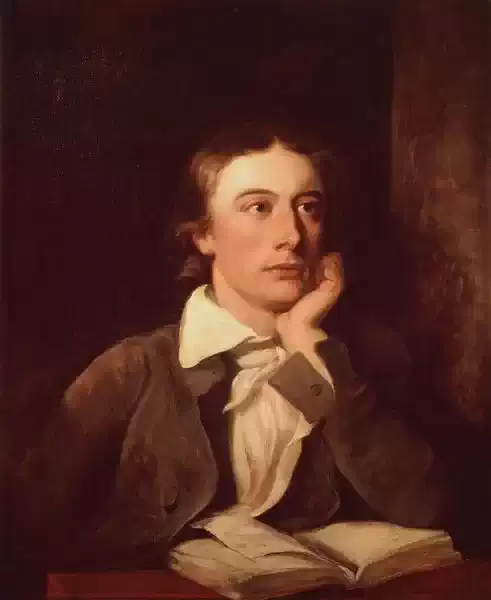
John Keats
The Eve Of Saint Mark. A Fragment
The Eve Of Saint Mark. A Fragment
Upon a Sabbath-day it fell;
Twice holy was the Sabbath-bell
That call'd the folk to evening prayer;
The city streets were clean and fair
From wholesome drench of April rains;
And, on the western window panes,
The chilly sunset faintly told
Of unmatur'd green vallies cold,
Of the green thorny bloomless hedge,
Of rivers new with spring-tide sedge,
Of primroses by shelter'd rills,
And daisies on the aguish hills.
Twice holy was the Sabbath-bell:
The silent streets were crowded well
With staid and pious companies,
Warm from their fire-side orat'ries,
And moving with demurest air
To even-song and vesper prayer.
Each arched porch and entry low
Was fill'd with patient folk and slow,
With whispers hush, and shuffling feet,
While play'd the organ loud and sweet.
The bells had ceas'd, the prayers begun,
And Bertha had not yet half done
A curious volume, patch'd and torn,
That all day long, from earliest morn,
Had taken captive her two eyes
Among its golden broideries;
Perplex'd her with a thousand things,--
The stars of Heaven, and angels' wings,
Martyrs in a fiery blaze,
Azure saints in silver rays,
Moses' breastplate, and the seven
Candlesticks John saw in Heaven,
The winged Lion of Saint Mark,
And the Covenantal Ark
With its many mysteries,
Cherubim and golden mice.
Bertha was a maiden fair,
Dwelling in the old Minster-square;
From her fire-side she could see
Sidelong its rich antiquity,
Far as the Bishop's garden-wall;
Where sycamores and elm-trees tall,
Full-leav'd, the forest had outstript,
By no sharp north-wind ever nipt,
So shelter'd by the mighty pile.
Bertha arose, and read awhile
With forehead 'gainst the window-pane.
Again she try'd, and then again,
Until the dusk eve left her dark
Upon the legend of St. Mark.
From plaited lawn-frill, fine and thin,
She lifted up her soft warm chin,
With aching neck and swimming eyes,
And daz'd with saintly imageries.
All was gloom, and silent all,
Save now and then the still foot-fall
Of one returning homewards late
Past the echoing minster-gate.
The clamorous daws, that all the day
Above tree-tops and towers play,
Pair by pair had gone to rest,
Each in its ancient belfry-nest,
Where asleep they fall betimes
To music of the drowsy chimes.
All was silent, all was gloom
Abroad and in the homely room:
Down she sat, poor cheated soul!
And struck a lamp from the dismal coal;
Lean'd forward with bright drooping hair
And slant book full against the glare.
Her shadow, in uneasy guise,
hover'd about, a giant size,
On ceiling-beam and old oak chair,
The parrot's cage, and panel square;
And the warm angled winter screen,
On which were many monsters seen,
Call'd doves of Siam, Lima mice,
And legless birds of Paradise,
Macaw, and tender Avadavat,
And silken-furr'd Angora cat.
Untir'd she read, her shadow still
Glower'd about as it would fill
The room with wildest forms and shades,
As though some ghostly queen of spades
Had come to mock behind her back,
And dance, and ruffle her garments black.
Untir'd she read the legend page
Of holy Mark, from youth to age,
On land, on sea, in pagan chains,
Rejoicing for his many pains.
Sometimes the learned Eremite
With golden star, or dagger bright,
Referr'd to pious poesies
Written in smallest crow-quill size
Beneath the text; and thus the rhyme
Was parcell'd out from time to time:
---- 'Als writith he of swevenis,
Men han beforne they wake in bliss,
Whanne that hir friendes thinke him bound
In crimped shroude farre under grounde;
And how a litling child mote be
A saint er its nativitie,
Gif that the modre (God her blesse!)
Kepen in solitarinesse,
And kissen devoute the holy croce.
Of Goddes love, and Sathan's force,--
He writith; and thinges many mo
Of swiche thinges I may not show.
Bot I must tellen verilie
Somdel of Sainte Cicilie,
And chieftie what he auctorethe
Of Sainte Markis life and dethe:'
At length her constant eyelids come
Upon the fervent martyrdom;
Then lastly to his holy shrine,
Exalt amid the tapers' shine
At Venice,--
Upon a Sabbath-day it fell;
Twice holy was the Sabbath-bell
That call'd the folk to evening prayer;
The city streets were clean and fair
From wholesome drench of April rains;
And, on the western window panes,
The chilly sunset faintly told
Of unmatur'd green vallies cold,
Of the green thorny bloomless hedge,
Of rivers new with spring-tide sedge,
Of primroses by shelter'd rills,
And daisies on the aguish hills.
Twice holy was the Sabbath-bell:
The silent streets were crowded well
With staid and pious companies,
Warm from their fire-side orat'ries,
And moving with demurest air
To even-song and vesper prayer.
Each arched porch and entry low
Was fill'd with patient folk and slow,
With whispers hush, and shuffling feet,
While play'd the organ loud and sweet.
The bells had ceas'd, the prayers begun,
And Bertha had not yet half done
A curious volume, patch'd and torn,
That all day long, from earliest morn,
Had taken captive her two eyes
Among its golden broideries;
Perplex'd her with a thousand things,--
The stars of Heaven, and angels' wings,
Martyrs in a fiery blaze,
Azure saints in silver rays,
Moses' breastplate, and the seven
Candlesticks John saw in Heaven,
The winged Lion of Saint Mark,
And the Covenantal Ark
With its many mysteries,
Cherubim and golden mice.
Bertha was a maiden fair,
Dwelling in the old Minster-square;
From her fire-side she could see
Sidelong its rich antiquity,
Far as the Bishop's garden-wall;
Where sycamores and elm-trees tall,
Full-leav'd, the forest had outstript,
By no sharp north-wind ever nipt,
So shelter'd by the mighty pile.
Bertha arose, and read awhile
With forehead 'gainst the window-pane.
Again she try'd, and then again,
Until the dusk eve left her dark
Upon the legend of St. Mark.
From plaited lawn-frill, fine and thin,
She lifted up her soft warm chin,
With aching neck and swimming eyes,
And daz'd with saintly imageries.
All was gloom, and silent all,
Save now and then the still foot-fall
Of one returning homewards late
Past the echoing minster-gate.
The clamorous daws, that all the day
Above tree-tops and towers play,
Pair by pair had gone to rest,
Each in its ancient belfry-nest,
Where asleep they fall betimes
To music of the drowsy chimes.
All was silent, all was gloom
Abroad and in the homely room:
Down she sat, poor cheated soul!
And struck a lamp from the dismal coal;
Lean'd forward with bright drooping hair
And slant book full against the glare.
Her shadow, in uneasy guise,
hover'd about, a giant size,
On ceiling-beam and old oak chair,
The parrot's cage, and panel square;
And the warm angled winter screen,
On which were many monsters seen,
Call'd doves of Siam, Lima mice,
And legless birds of Paradise,
Macaw, and tender Avadavat,
And silken-furr'd Angora cat.
Untir'd she read, her shadow still
Glower'd about as it would fill
The room with wildest forms and shades,
As though some ghostly queen of spades
Had come to mock behind her back,
And dance, and ruffle her garments black.
Untir'd she read the legend page
Of holy Mark, from youth to age,
On land, on sea, in pagan chains,
Rejoicing for his many pains.
Sometimes the learned Eremite
With golden star, or dagger bright,
Referr'd to pious poesies
Written in smallest crow-quill size
Beneath the text; and thus the rhyme
Was parcell'd out from time to time:
---- 'Als writith he of swevenis,
Men han beforne they wake in bliss,
Whanne that hir friendes thinke him bound
In crimped shroude farre under grounde;
And how a litling child mote be
A saint er its nativitie,
Gif that the modre (God her blesse!)
Kepen in solitarinesse,
And kissen devoute the holy croce.
Of Goddes love, and Sathan's force,--
He writith; and thinges many mo
Of swiche thinges I may not show.
Bot I must tellen verilie
Somdel of Sainte Cicilie,
And chieftie what he auctorethe
Of Sainte Markis life and dethe:'
At length her constant eyelids come
Upon the fervent martyrdom;
Then lastly to his holy shrine,
Exalt amid the tapers' shine
At Venice,--
488
John Keats
Sonnet: When I Have Fears That I May Cease To Be
Sonnet: When I Have Fears That I May Cease To Be
When I have fears that I may cease to be
Before my pen has glean'd my teeming brain,
Before high piled books, in charactry,
Hold like rich garners the full-ripen'd grain;
When I behold, upon the night's starr'd face,
Huge cloudy symbols of a high romance,
And think that I may never live to trace
Their shadows, with the magic hand of chance;
And when I feel, fair creature of an hour,
That I shall never look upon thee more,
Never have relish in the faery power
Of unreflecting love; -- then on the shore
Of the wide world I stand alone, and think
Till Love and Fame to nothingness do sink.
When I have fears that I may cease to be
Before my pen has glean'd my teeming brain,
Before high piled books, in charactry,
Hold like rich garners the full-ripen'd grain;
When I behold, upon the night's starr'd face,
Huge cloudy symbols of a high romance,
And think that I may never live to trace
Their shadows, with the magic hand of chance;
And when I feel, fair creature of an hour,
That I shall never look upon thee more,
Never have relish in the faery power
Of unreflecting love; -- then on the shore
Of the wide world I stand alone, and think
Till Love and Fame to nothingness do sink.
410
John Keats
Sonnet: After Dark Vapors Have Oppress'd Our Plains
Sonnet: After Dark Vapors Have Oppress'd Our Plains
After dark vapors have oppress'd our plains
For a long dreary season, comes a day
Born of the gentle South, and clears away
From the sick heavens all unseemly stains.
The anxious month, relieved of its pains,
Takes as a long-lost right the feel of May;
The eyelids with the passing coolness play
Like rose leaves with the drip of Summer rains.
The calmest thoughts came round us; as of leaves
Budding -- fruit ripening in stillness -- Autumn suns
Smiling at eve upon the quiet sheaves --
Sweet Sappho's cheek -- a smiling infant's breath --
The gradual sand that through an hour-glass runs --
A woodland rivulet -- a Poet's death.
After dark vapors have oppress'd our plains
For a long dreary season, comes a day
Born of the gentle South, and clears away
From the sick heavens all unseemly stains.
The anxious month, relieved of its pains,
Takes as a long-lost right the feel of May;
The eyelids with the passing coolness play
Like rose leaves with the drip of Summer rains.
The calmest thoughts came round us; as of leaves
Budding -- fruit ripening in stillness -- Autumn suns
Smiling at eve upon the quiet sheaves --
Sweet Sappho's cheek -- a smiling infant's breath --
The gradual sand that through an hour-glass runs --
A woodland rivulet -- a Poet's death.
407
John Keats
Sonnet. Written In Disgust Of Vulgar Superstition
Sonnet. Written In Disgust Of Vulgar Superstition
The church bells toll a melancholy round,
Calling the people to some other prayers,
Some other gloominess, more dreadful cares,
More hearkening to the sermon's horrid sound.
Surely the mind of man is closely bound
In some black spell; seeing that each one tears
Himself from fireside joys, and Lydian airs,
And converse high of those with glory crown'd.
Still, still they toll, and I should feel a damp,--
A chill as from a tomb, did I not know
That they are dying like an outburnt lamp;
That 'tis their sighing, wailing ere they go
Into oblivion; -- that fresh flowers will grow,
And many glories of immortal stamp.
The church bells toll a melancholy round,
Calling the people to some other prayers,
Some other gloominess, more dreadful cares,
More hearkening to the sermon's horrid sound.
Surely the mind of man is closely bound
In some black spell; seeing that each one tears
Himself from fireside joys, and Lydian airs,
And converse high of those with glory crown'd.
Still, still they toll, and I should feel a damp,--
A chill as from a tomb, did I not know
That they are dying like an outburnt lamp;
That 'tis their sighing, wailing ere they go
Into oblivion; -- that fresh flowers will grow,
And many glories of immortal stamp.
429
John Keats
Sonnet. Written In Disgust Of Vulgar Superstition
Sonnet. Written In Disgust Of Vulgar Superstition
The church bells toll a melancholy round,
Calling the people to some other prayers,
Some other gloominess, more dreadful cares,
More hearkening to the sermon's horrid sound.
Surely the mind of man is closely bound
In some black spell; seeing that each one tears
Himself from fireside joys, and Lydian airs,
And converse high of those with glory crown'd.
Still, still they toll, and I should feel a damp,--
A chill as from a tomb, did I not know
That they are dying like an outburnt lamp;
That 'tis their sighing, wailing ere they go
Into oblivion; -- that fresh flowers will grow,
And many glories of immortal stamp.
The church bells toll a melancholy round,
Calling the people to some other prayers,
Some other gloominess, more dreadful cares,
More hearkening to the sermon's horrid sound.
Surely the mind of man is closely bound
In some black spell; seeing that each one tears
Himself from fireside joys, and Lydian airs,
And converse high of those with glory crown'd.
Still, still they toll, and I should feel a damp,--
A chill as from a tomb, did I not know
That they are dying like an outburnt lamp;
That 'tis their sighing, wailing ere they go
Into oblivion; -- that fresh flowers will grow,
And many glories of immortal stamp.
429
John Keats
Sonnet. To A Lady Seen For A Few Moments At Vauxhall
Sonnet. To A Lady Seen For A Few Moments At Vauxhall
Time's sea hath been five years at its slow ebb,
Long hours have to and fro let creep the sand,
Since I was tangled in thy beauty's web,
And snared by the ungloving of thine hand.
And yet I never look on midnight sky,
But I behold thine eyes' well memory'd light;
I cannot look upon the rose's dye,
But to thy cheek my soul doth take its flight.
I cannot look on any budding flower,
But my fond ear, in fancy at thy lips
And hearkening for a love-sound, doth devour
Its sweets in the wrong sense: -- Thou dost eclipse
Every delight with sweet remembering,
And grief unto my darling joys dost bring.
Time's sea hath been five years at its slow ebb,
Long hours have to and fro let creep the sand,
Since I was tangled in thy beauty's web,
And snared by the ungloving of thine hand.
And yet I never look on midnight sky,
But I behold thine eyes' well memory'd light;
I cannot look upon the rose's dye,
But to thy cheek my soul doth take its flight.
I cannot look on any budding flower,
But my fond ear, in fancy at thy lips
And hearkening for a love-sound, doth devour
Its sweets in the wrong sense: -- Thou dost eclipse
Every delight with sweet remembering,
And grief unto my darling joys dost bring.
509
John Keats
Sonnet. Why Did I Laugh Tonight?
Sonnet. Why Did I Laugh Tonight?
Why did I laugh to-night? No voice will tell
No God, no Demon of severe response,
Deigns to reply from Heaven or from Hell
Then to my human heart I turn at once:
Heart! Thou and I are here sad and alone;
I say, why did I laugh? O mortal pain!
O Darkness! Darkness! ever must I moan,
To question Heaven and Hell and Heart in vain.
Why did I laugh? I know this Being's lease,
My fancy to its utmost blisses spreads;
Yet would I on this very midnight cease,
And all the world's gaudy ensigns see in shreds;
Verse, Fame, and Beauty are intense indeed,
But Death intenser -- Death is Life's high meed.
Why did I laugh to-night? No voice will tell
No God, no Demon of severe response,
Deigns to reply from Heaven or from Hell
Then to my human heart I turn at once:
Heart! Thou and I are here sad and alone;
I say, why did I laugh? O mortal pain!
O Darkness! Darkness! ever must I moan,
To question Heaven and Hell and Heart in vain.
Why did I laugh? I know this Being's lease,
My fancy to its utmost blisses spreads;
Yet would I on this very midnight cease,
And all the world's gaudy ensigns see in shreds;
Verse, Fame, and Beauty are intense indeed,
But Death intenser -- Death is Life's high meed.
457
John Keats
Sonnet. Why Did I Laugh Tonight?
Sonnet. Why Did I Laugh Tonight?
Why did I laugh to-night? No voice will tell
No God, no Demon of severe response,
Deigns to reply from Heaven or from Hell
Then to my human heart I turn at once:
Heart! Thou and I are here sad and alone;
I say, why did I laugh? O mortal pain!
O Darkness! Darkness! ever must I moan,
To question Heaven and Hell and Heart in vain.
Why did I laugh? I know this Being's lease,
My fancy to its utmost blisses spreads;
Yet would I on this very midnight cease,
And all the world's gaudy ensigns see in shreds;
Verse, Fame, and Beauty are intense indeed,
But Death intenser -- Death is Life's high meed.
Why did I laugh to-night? No voice will tell
No God, no Demon of severe response,
Deigns to reply from Heaven or from Hell
Then to my human heart I turn at once:
Heart! Thou and I are here sad and alone;
I say, why did I laugh? O mortal pain!
O Darkness! Darkness! ever must I moan,
To question Heaven and Hell and Heart in vain.
Why did I laugh? I know this Being's lease,
My fancy to its utmost blisses spreads;
Yet would I on this very midnight cease,
And all the world's gaudy ensigns see in shreds;
Verse, Fame, and Beauty are intense indeed,
But Death intenser -- Death is Life's high meed.
457
John Keats
Sonnet. On A Picture Of Leander
Sonnet. On A Picture Of Leander
Come hither all sweet Maidens soberly
Down looking aye, and with a chasten'd light
Hid in the fringes of your eyelids white,
And meekly let your fair hands joined be,
As if so gentle that ye could not see,
Untouch'd, a victim of your beauty bright,
Sinking away to his young spirit's night,
Sinking bewilder'd 'mid the dreary sea.
'Tis young Leander toiling to his death.
Nigh swooning he doth purse his weary lips
For Hero's cheek, and smiles against her smile.
O horrid dream! see how his body dips
Dead-heavy; arms and shoulders gleam awhile;
He's gone; up bubbles all his amorous breath!
Come hither all sweet Maidens soberly
Down looking aye, and with a chasten'd light
Hid in the fringes of your eyelids white,
And meekly let your fair hands joined be,
As if so gentle that ye could not see,
Untouch'd, a victim of your beauty bright,
Sinking away to his young spirit's night,
Sinking bewilder'd 'mid the dreary sea.
'Tis young Leander toiling to his death.
Nigh swooning he doth purse his weary lips
For Hero's cheek, and smiles against her smile.
O horrid dream! see how his body dips
Dead-heavy; arms and shoulders gleam awhile;
He's gone; up bubbles all his amorous breath!
533
John Keats
Sonnet VI. To G. A. W.
Sonnet VI. To G. A. W.
Nymph of the downward smile and sidelong glance!
In what diviner moments of the day
Art thou most lovely? -- when gone far astray
Into the labyrinths of sweet utterance,
Or when serenely wandering in a trance
Of sober thought? -- Or when starting away,
With careless robe to meet the morning ray,
Thou sparest the flowers in thy mazy dance?
Haply 'tis when thy ruby lips part sweetly,
And so remain, because thou listenest:
But thou to please wert nurtured so completely
That I can never tell what mood is best;
I shall as soon pronounce which Grace more neatly
Trips it before Apollo than the rest.
Nymph of the downward smile and sidelong glance!
In what diviner moments of the day
Art thou most lovely? -- when gone far astray
Into the labyrinths of sweet utterance,
Or when serenely wandering in a trance
Of sober thought? -- Or when starting away,
With careless robe to meet the morning ray,
Thou sparest the flowers in thy mazy dance?
Haply 'tis when thy ruby lips part sweetly,
And so remain, because thou listenest:
But thou to please wert nurtured so completely
That I can never tell what mood is best;
I shall as soon pronounce which Grace more neatly
Trips it before Apollo than the rest.
355
John Keats
Sonnet To John Hamilton Reynolds
Sonnet To John Hamilton Reynolds
O that a week could be an age, and we
Felt parting and warm meeting every week,
Then one poor year a thousand years would be,
The flush of welcome ever on the cheek:
So could we live long life in little space,
So time itself would be annihilate,
So a day's journey in oblivious haze
To serve ourjoys would lengthen and dilate.
O to arrive each Monday morn from Ind!
To land each Tuesday from the rich Levant!
In little time a host of joys to bind,
And keep our souls in one eternal pant!
This morn, my friend, and yester-evening taught
Me how to harbour such a happy thought.
O that a week could be an age, and we
Felt parting and warm meeting every week,
Then one poor year a thousand years would be,
The flush of welcome ever on the cheek:
So could we live long life in little space,
So time itself would be annihilate,
So a day's journey in oblivious haze
To serve ourjoys would lengthen and dilate.
O to arrive each Monday morn from Ind!
To land each Tuesday from the rich Levant!
In little time a host of joys to bind,
And keep our souls in one eternal pant!
This morn, my friend, and yester-evening taught
Me how to harbour such a happy thought.
452
John Keats
Sonnet To Sleep
Sonnet To Sleep
O soft embalmer of the still midnight!
Shutting, with careful fingers and benign,
Our gloom-pleas'd eyes, embower'd from the light,
Enshaded in forgetfulness divine;
O soothest Sleep! if so it please thee, close,
In midst of this thine hymn, my willing eyes.
Or wait the Amen, ere thy poppy throws
Around my bed its lulling charities;
Then save me, or the passed day will shine
Upon my pillow, breeding many woes;
Save me from curious conscience, that still hoards
Its strength for darkness, burrowing like a mole;
Turn the key deftly in the oiled wards,
And seal the hushed casket of my soul.
O soft embalmer of the still midnight!
Shutting, with careful fingers and benign,
Our gloom-pleas'd eyes, embower'd from the light,
Enshaded in forgetfulness divine;
O soothest Sleep! if so it please thee, close,
In midst of this thine hymn, my willing eyes.
Or wait the Amen, ere thy poppy throws
Around my bed its lulling charities;
Then save me, or the passed day will shine
Upon my pillow, breeding many woes;
Save me from curious conscience, that still hoards
Its strength for darkness, burrowing like a mole;
Turn the key deftly in the oiled wards,
And seal the hushed casket of my soul.
399
John Keats
Sonnet IX. Keen, Fitful Gusts Are
Sonnet IX. Keen, Fitful Gusts Are
Keen, fitful gusts are whisp'ring here and there
Among the bushes half leafless, and dry;
The stars look very cold about the sky,
And I have many miles on foot to fare.
Yet feel I little of the cool bleak air,
Or of the dead leaves rustling drearily,
Or of those silver lamps that burn on high,
Or of the distance from home's pleasant lair:
For I am brimfull of the friendliness
That in a little cottage I have found;
Of fair-hair'd Milton's eloquent distress,
And all his love for gentle Lycid drown'd;
Of lovely Laura in her light green dress,
And faithful Petrarch gloriously crown'd.
Keen, fitful gusts are whisp'ring here and there
Among the bushes half leafless, and dry;
The stars look very cold about the sky,
And I have many miles on foot to fare.
Yet feel I little of the cool bleak air,
Or of the dead leaves rustling drearily,
Or of those silver lamps that burn on high,
Or of the distance from home's pleasant lair:
For I am brimfull of the friendliness
That in a little cottage I have found;
Of fair-hair'd Milton's eloquent distress,
And all his love for gentle Lycid drown'd;
Of lovely Laura in her light green dress,
And faithful Petrarch gloriously crown'd.
499
John Keats
Otho The Great - Act II
Otho The Great - Act II
SCENE I.
An Ante-chamber in the Castle.
Enter LUDOLPH and SIGIFRED.
Ludolph. No more advices, no more cautioning:
I leave it all to fate to any thing!
I cannot square my conduct to time, place,
Or circumstances; to me 'tis all a mist!
Sigifred. I say no more.
Ludolph. It seems I am to wait
Here in the ante-room; that may be a trifle.
You see now how I dance attendance here,
Without that tyrant temper, you so blame,
Snapping the rein. You have medicin'd me
With good advices; and I here remain,
In this most honourable ante-room,
Your patient scholar.
Sigifred. Do not wrong me, Prince.
By Heavens, I'd rather kiss Duke Conrad's slipper,
When in the morning he doth yawn with pride,
Than see you humbled but a half-degree!
Truth is, the Emperor would fain dismiss
The nobles ere he sees you.
Enter GONFRED from the Council-room.
Ludolph. Well, sir! What?
Gonfred. Great honour to the Prince! The Emperor,
Hearing that his brave son had re-appeared,
Instant dismiss 'd the Council from his sight,
As Jove fans off the clouds. Even now they pass.
[Exit.
Enter the Nobles from the Council-room. They cross the stage,
bowing unth respect to LUDOLPH, he frowning on them.
CONRAD follows. Exeunt Nobles.
Ludolph. Not the discoloured poisons of a fen,
Which he who breathes feels warning of his death,
Could taste so nauseous to the bodily sense,
As these prodigious sycophants disgust
The soul's fine palate.
Conrad. Princely Ludolph, hail!
Welcome, thou younger sceptre to the realm!
Strength to thy virgin crownet's golden buds,
That they, against the winter of thy sire,
May burst, and swell, and flourish round thy brows,
Maturing to a weighty diadem!
Yet be that hour far off; and may he live,
Who waits for thee, as the chapp'd earth for rain.
Set my life's star! I have lived long enough,
Since under my glad roof, propitiously,
Father and son each other re-possess.
Ludolph. Fine wording, Duke! but words could never yet
Forestall the fates; have you not learnt that yet?
Let me look well: your features are the same;
Your gait the same; your hair of the same shade;
As one I knew some passed weeks ago,
Who sung far different notes into mine ears.
I have mine own particular comments on 't;
You have your own, perhaps.
Conrad. My gracious Prince,
All men may err. In truth I was deceived
In your great father's nature, as you were.
Had I known that of him I have since known,
And what you soon will learn, I would have turned
My sword to my own throat, rather than held
Its threatening edge against a good King's quiet:
Or with one word fever'd you, gentle Prince,
Who seem'd to me, as rugged times then went,
Indeed too much oppress'd. May I be bold
To tell the Emperor you will haste to him?
Ludolph. Your Dukedom's privilege will grant so much.
[Exit CONRAD
He's very close to Otho, a tight leech!
Your hand I go. Ha! here the thunder comes
Sullen against the wind! If in two angry brows
My safety lies, then Sigifred, I'm safe.
Enter OTHO and CONRAD.
Otho. Will you make Titan play the lackey-page &
To chattering pigmies? I would have you know
That such neglect of our high Majesty
Annuls all feel of kindred. What is son,
Or friend, or brother, or all ties of blood,
When the whole kingdom, centred in ourself,
Is rudely slighted ? Who am I to wait ?
By Peter's chair! I have upon my tongue
A word to fright the proudest spirit here!
Death! and slow tortures to the hardy fool,
Who dares take such large charter from our smiles!
Conrad, we would be private. Sigifred!
Off! And none pass this way on pain of death!
[Exeunt CONRAD and SIGIFRED,
Ludolph. This was but half expected, my good sire,
Yet I am griev'd at it, to the full height,
As though my hopes of favour had been whole.
Otho. How you indulge yourself! What can you hope for?
Ludolph. Nothing, my liege ; I have to hope for nothing.
I come to greet you as a loving son,
And then depart, if I may be so free,
Seeing that blood of yours in my warm veins
Has not yet mitigated into milk.
Otho. What would you, sir?
Ludolph. A lenient banishment;
So please you let me unmolested pass
This Conrad's gates, to the wide air again.
I want no more. A rebel wants no more.
Otho. And shall I let a rebel loose again
To muster kites and eagles 'gainst my head?
No, obstinate boy, you shall be kept cag'd up,
Serv'd with harsh food, with scum for Sunday-drink.
Ludolph. Indeed!
Otho. And chains too heavy for your life:
I'll choose a gaoler, whose swart monstrous face
Shall be a hell to look upon, and she
Ludolph. Ha!
Otho. Shall be your fair Auranthe.
Ludolph. Amaze! Amaze!
Otho. To-day you marry her.
Ludolph. This is a sharp jest!
Otho. No. None at all. When have I said a lie?
Ludolph. If I sleep not, I am a waking wretch.
Otho. Not a word more. Let me embrace my child.
Ludolph. I dare not. 'Twould pollute so good a father!
heavy crime! that your son's blinded eyes
Could not see all his parent's love aright,
As now I see it. Be not kind to me
Punish me not with favour.
Otho. Are you sure,
Ludolph, you have no saving plea in store?
Ludolph. My father, none!
Otho. Then you astonish me.
Ludolph. No, I have no plea. Disobedience,
Rebellion, obstinacy, blasphemy,
Are all my counsellors. If they can make
My crooked deeds show good and plausible,
Then grant me loving pardon, but not else,
Good Gods! not else, in any way, my liege!
Otho. You are a most perplexing, noble boy.
Ludolph. You not less a perplexing noble father.
Otho. Well, you shall have free passport through the gates.
Farewell!
Ludolph. Farewell! and by these tears believe,
And still remember, I repent in pain
All my misdeeds!
Otho. Ludolph, I will! I will!
But, Ludolph, ere you go, I would enquire
If you, in all your wandering, ever met
A certain Arab haunting in these parts.
Ludolph. No, my good lord, I cannot say I did.
Otho. Make not your father blind before his time;
Nor let these arms paternal hunger more
For an embrace, to dull the appetite
Of my great love for thee, my supreme child!
Come close, and let me breathe into thine ear.
knew you through disguise. You are the Arab!
You can't deny it. [Embracing him.
Ludolph. Happiest of days!
Otho. We'll make it so.
Ludolph. 'Stead of one fatted calf
Ten hecatombs shall bellow out their last,
Smote 'twixt the horns by the death-stunning mace
Of Mars, and all the soldiery shall feast
Nobly as Nimrod's masons, when the towers
Of Nineveh new kiss'd the parted clouds!
Otho. Large as a God speak out, where all is thine.
Ludolph. Aye, father, but the fire in my sad breast
Is quench 'd with inward tears! I must rejoice
For you, whose wings so shadow over me
In tender victory, but for myself
I still must mourn. The fair Auranthe mine!
Too great a boon! I prythee let me ask I
What more than I know of could so have changed
Your purpose touching her?
Otho. At a word, this:
In no deed did you give me more offense
Than your rejection of Erminia.
To my appalling, I saw too good proof
Of your keen-eyed suspicion, she is naught!
Ludolph. You are convinced?
Otho. Aye, spite of her sweet looks.
O, that my brother's daughter should so fall!
Her fame has pass'd into the grosser lips
Of soldiers in their cups.
Lndolph. 'Tis very sad.
Otho. No more of her. Auranthe Ludolph, come!
This marriage be the bond of endless peace! [Exeunt.
SCENE II. The Entrance of GERSA'S Tent in the Hungarian Camp.
Enter ERMINIA.
Erminia. Where! where! where shall I find a messenger?
A trusty soul? A good man in the camp?
Shall I go myself? Monstrous wickedness!
O cursed Conrad devilish Auranthe!
Here is proof palpable as the bright sun!
O for a voice to reach the Emperor's ears!
[Shouts in the Camp.
Enter an HUNGARIAN CAPTAIN.
Captain. Fair prisoner, hear you those joyous shouts?
The king aye, now our king, but still your slave,
Young Gersa, from a short captivity
Has just return'd. He bids me say, bright Dame,
That even the homage of his ranged chiefs
Cures not his keen impatience to behold
Such beauty once again. What ails you, lady?
Erminia. Say, is not that a German, yonder? There!
Captain. Methinks by his stout bearing he should be
Yes 'tis one Albert; a brave German knight,
And much in the emperor's favour.
Erminia. I would fain
Enquire of friends and kinsfolk; how they fared
In these rough times. Brave soldier, as you pass
To royal Gersa with my humble thanks,
Will you send yonder knight to me?
Captain. I will. [Exit.
Ermina. Yes, he was ever known to be a man
Frank, open, generous; Albert I may trust.
proof! proof! proof! Albert's an honest man;
Not Ethelbert the monk, if he were here,
Would I hold more trustworthy. Now!
Enter ALBERT.
Albert. Good Gods!
Lady Erminia! are you prisoner
In this beleaguer 'd camp? Or are you here
Of your own will? You pleas'd to send for me.
By Venus, 'tis a pity I knew not
Your plight before, and, by her Son, I swear
To do you every service you can ask.
What would the fairest?
Erminia. Albert, will you swear?
Albert. I have. Well?
Erminia. Albert, you have fame to lose.
If men, in court and camp, lie not outright,
You should be, from a thousand, chosen forth
To do an honest deed. Shall I confide?
Albert. Aye, anything to me, fair creature. Do;
Dictate my task. Sweet woman,
Erminia. Truce with that.
You understand me not; and, in your speech,
see how far the slander is abroad.
Without proof could you think me innocent?
Albert. Lady, I should rejoice to know you so.
Erminia. If you have any pity for a maid,
Suffering a daily death from evil tongues;
Any compassion for that Emperor's niece,
Who, for your bright sword and clear honesty,
Lifted you from the crowd of common men
Into the lap of honour; save me, knight!
Albert. How? Make it clear; if it be possible,
I, by the banner of Saint Maurice, swear
To right you.
Erminia. Possible! Easy. O my heart!
This letter's not so soil'd but you may read it;
Possible! There that letter! Read read it,
[Gives him a letter.
Albert (reading). 'To the Duke Conrad. Forget the threat you
made at parting, and I will forget to send the Emperor letters and
papers of your's I have become possessed of. His life is no trifle to
me; his death you shall find none to yourself.' (Speaks to himself
‘Tis me my life that's pleaded for! (Reads.) 'He, for his
own sake, will be dumb as the grave. Erminia has my shame fix'd
upon her, sure as a wen. We are safe.
AURANTHE.'A she-devil! A dragon! I her imp!
Fire of Hell! Auranthe lewd demon!
Where got you this? Where? When?
Erminia. I found it in the tent, among some spoils
Which, being noble, fell to Gersa's lot.
Come in, and see. [They go in and return.
Albert. Villainy! Villainy!
Conrad's sword, his corslet, and his helm,
And his letter. Caitiff, he shall feel
Erminia. I see you are thunderstruck. Haste, haste away!
Albert. O I am tortured by this villainy.
Erminia. You needs must be. Carry it swift to Otho;
Tell him, moreover, I am prisoner
Here in this camp, where all the sisterhood,
Forc'd from their quiet cells, are parcell'd out
For slaves among these Huns. Away! Away!
Albert. I am gone.
Erminia. Swift be your steed! Within this hour
The Emperor will see it.
Albert. Ere I sleep:
That I can swear. [Hurries out.
Gersa (without). Brave captains! thanks. Enough
Of loyal homage now!
Enter GERSA.
Erminia. Hail, royal Hun!
Gersa. What means this, fair one? Why in such alarm?
Who was it hurried by me so distract?
It seem'd you were in deep discourse together;
Your doctrine has not been so harsh to him
As to my poor deserts. Come, come, be plain.
I am no jealous fool to kill you both,
Or, for such trifles, rob the adorned world
Of such a beauteous vestal.
Erminia. I grieve, my Lord,
To hear you condescend to ribald phrase.
Gersa. This is too much! Hearken, my lady pure!
Erminia. Silence! and hear the magic of a name
Erminia! I am she, the Emperor's niece!
Prais'd be the Heavens, I now dare own myself!
Gersa. Erminia! Indeed! I've heard of her.
Prythee, fair lady, what chance brought you here?
Erminia. Ask your own soldiers.
Gersa. And you dare own your name.
For loveliness you may and for the rest
My vein is not censorious.
Erminia. Alas! poor me!
‘Tis false indeed.
Gersa. Indeed you are too fair:
the swan, soft leaning on her fledgy breast,
When to the stream she launches, looks not back
With such a tender grace ; nor are her wings
So white as your soul is, if that but be
Twin-picture to your face. Erminia!
To-day, for the first day, I am a king,
Yet would I give my unworn crown away
To know you spotless.
Erminia. Trust me one day more,
Generously, without more certain guarantee,
Than this poor face you deign to praise so much;
After that, say and do whate'er you please.
If I have any knowledge of you, sir,
I think, nay I am sure, you will grieve much
To hear my story. O be gentle to me,
For I am sick and faint with many wrongs,
Tir'd out, and weary-worn with contumelies.
Gersa. Poor lady!
Enter ETHELBERT.
Erminia. Gentle Prince, 'tis false indeed.
Good morrow, holy father! I have had
Your prayers, though I look'd for you in vain.
Ethelbert. Blessings upon you, daughter! Sure you look
Too cheerful for these foul pernicious days.
Young man, you heard this virgin say 'twas false,
‘Tis false, I say. What! can you not employ
Your temper elsewhere, 'mong these burly tents,
But you must taunt this dove, for she hath lost
The Eagle Otho to beat off assault?
Fie! fie! But I will be her guard myself;
In the Emperor's name. I here demand of you
Herself, and all her sisterhood. She false!
Gersa. Peace! peace, old man! I cannot think she is.
Ethelbert. Whom I have known from her first infancy,
Baptized her in the bosom of the Church,
Watch'd her, as anxious husbandmen the grain,
From the first shoot till the unripe mid-May,
Then to the tender ear of her June days,
Which, lifting sweet abroad its timid green,
Is blighted by the touch of calumny;
You cannot credit such a monstrous tale.
Gersa. I cannot. Take her. Fair Erminia,
I follow you to Friedburg, is't not so?
Erminia. Aye, so we purpose.
Ethelbert. Daughter, do you so?
How's this? I marvel! Yet you look not mad.
Erminia. I have good news to tell you, Ethelbert.
Gersa. Ho! ho, there! Guards!
Your blessing, father! Sweet Erminia,
Believe me, I am well nigh sure
Erminia . Farewell!
Short time will show. [Enter Chiefs.
Yes, father Ethelbert,
I have news precious as we pass along.
Ethelbert. Dear daughter, you shall guide me.
Erminia. To no ill.
Gersa. Command an escort to the Friedburg lines.
[Exeunt Chiefs.
Pray let me lead. Fair lady, forget not
Gersa, how he believ'd you innocent.
I follow you to Friedburg with all speed. [Exeunt.
SCENE I.
An Ante-chamber in the Castle.
Enter LUDOLPH and SIGIFRED.
Ludolph. No more advices, no more cautioning:
I leave it all to fate to any thing!
I cannot square my conduct to time, place,
Or circumstances; to me 'tis all a mist!
Sigifred. I say no more.
Ludolph. It seems I am to wait
Here in the ante-room; that may be a trifle.
You see now how I dance attendance here,
Without that tyrant temper, you so blame,
Snapping the rein. You have medicin'd me
With good advices; and I here remain,
In this most honourable ante-room,
Your patient scholar.
Sigifred. Do not wrong me, Prince.
By Heavens, I'd rather kiss Duke Conrad's slipper,
When in the morning he doth yawn with pride,
Than see you humbled but a half-degree!
Truth is, the Emperor would fain dismiss
The nobles ere he sees you.
Enter GONFRED from the Council-room.
Ludolph. Well, sir! What?
Gonfred. Great honour to the Prince! The Emperor,
Hearing that his brave son had re-appeared,
Instant dismiss 'd the Council from his sight,
As Jove fans off the clouds. Even now they pass.
[Exit.
Enter the Nobles from the Council-room. They cross the stage,
bowing unth respect to LUDOLPH, he frowning on them.
CONRAD follows. Exeunt Nobles.
Ludolph. Not the discoloured poisons of a fen,
Which he who breathes feels warning of his death,
Could taste so nauseous to the bodily sense,
As these prodigious sycophants disgust
The soul's fine palate.
Conrad. Princely Ludolph, hail!
Welcome, thou younger sceptre to the realm!
Strength to thy virgin crownet's golden buds,
That they, against the winter of thy sire,
May burst, and swell, and flourish round thy brows,
Maturing to a weighty diadem!
Yet be that hour far off; and may he live,
Who waits for thee, as the chapp'd earth for rain.
Set my life's star! I have lived long enough,
Since under my glad roof, propitiously,
Father and son each other re-possess.
Ludolph. Fine wording, Duke! but words could never yet
Forestall the fates; have you not learnt that yet?
Let me look well: your features are the same;
Your gait the same; your hair of the same shade;
As one I knew some passed weeks ago,
Who sung far different notes into mine ears.
I have mine own particular comments on 't;
You have your own, perhaps.
Conrad. My gracious Prince,
All men may err. In truth I was deceived
In your great father's nature, as you were.
Had I known that of him I have since known,
And what you soon will learn, I would have turned
My sword to my own throat, rather than held
Its threatening edge against a good King's quiet:
Or with one word fever'd you, gentle Prince,
Who seem'd to me, as rugged times then went,
Indeed too much oppress'd. May I be bold
To tell the Emperor you will haste to him?
Ludolph. Your Dukedom's privilege will grant so much.
[Exit CONRAD
He's very close to Otho, a tight leech!
Your hand I go. Ha! here the thunder comes
Sullen against the wind! If in two angry brows
My safety lies, then Sigifred, I'm safe.
Enter OTHO and CONRAD.
Otho. Will you make Titan play the lackey-page &
To chattering pigmies? I would have you know
That such neglect of our high Majesty
Annuls all feel of kindred. What is son,
Or friend, or brother, or all ties of blood,
When the whole kingdom, centred in ourself,
Is rudely slighted ? Who am I to wait ?
By Peter's chair! I have upon my tongue
A word to fright the proudest spirit here!
Death! and slow tortures to the hardy fool,
Who dares take such large charter from our smiles!
Conrad, we would be private. Sigifred!
Off! And none pass this way on pain of death!
[Exeunt CONRAD and SIGIFRED,
Ludolph. This was but half expected, my good sire,
Yet I am griev'd at it, to the full height,
As though my hopes of favour had been whole.
Otho. How you indulge yourself! What can you hope for?
Ludolph. Nothing, my liege ; I have to hope for nothing.
I come to greet you as a loving son,
And then depart, if I may be so free,
Seeing that blood of yours in my warm veins
Has not yet mitigated into milk.
Otho. What would you, sir?
Ludolph. A lenient banishment;
So please you let me unmolested pass
This Conrad's gates, to the wide air again.
I want no more. A rebel wants no more.
Otho. And shall I let a rebel loose again
To muster kites and eagles 'gainst my head?
No, obstinate boy, you shall be kept cag'd up,
Serv'd with harsh food, with scum for Sunday-drink.
Ludolph. Indeed!
Otho. And chains too heavy for your life:
I'll choose a gaoler, whose swart monstrous face
Shall be a hell to look upon, and she
Ludolph. Ha!
Otho. Shall be your fair Auranthe.
Ludolph. Amaze! Amaze!
Otho. To-day you marry her.
Ludolph. This is a sharp jest!
Otho. No. None at all. When have I said a lie?
Ludolph. If I sleep not, I am a waking wretch.
Otho. Not a word more. Let me embrace my child.
Ludolph. I dare not. 'Twould pollute so good a father!
heavy crime! that your son's blinded eyes
Could not see all his parent's love aright,
As now I see it. Be not kind to me
Punish me not with favour.
Otho. Are you sure,
Ludolph, you have no saving plea in store?
Ludolph. My father, none!
Otho. Then you astonish me.
Ludolph. No, I have no plea. Disobedience,
Rebellion, obstinacy, blasphemy,
Are all my counsellors. If they can make
My crooked deeds show good and plausible,
Then grant me loving pardon, but not else,
Good Gods! not else, in any way, my liege!
Otho. You are a most perplexing, noble boy.
Ludolph. You not less a perplexing noble father.
Otho. Well, you shall have free passport through the gates.
Farewell!
Ludolph. Farewell! and by these tears believe,
And still remember, I repent in pain
All my misdeeds!
Otho. Ludolph, I will! I will!
But, Ludolph, ere you go, I would enquire
If you, in all your wandering, ever met
A certain Arab haunting in these parts.
Ludolph. No, my good lord, I cannot say I did.
Otho. Make not your father blind before his time;
Nor let these arms paternal hunger more
For an embrace, to dull the appetite
Of my great love for thee, my supreme child!
Come close, and let me breathe into thine ear.
knew you through disguise. You are the Arab!
You can't deny it. [Embracing him.
Ludolph. Happiest of days!
Otho. We'll make it so.
Ludolph. 'Stead of one fatted calf
Ten hecatombs shall bellow out their last,
Smote 'twixt the horns by the death-stunning mace
Of Mars, and all the soldiery shall feast
Nobly as Nimrod's masons, when the towers
Of Nineveh new kiss'd the parted clouds!
Otho. Large as a God speak out, where all is thine.
Ludolph. Aye, father, but the fire in my sad breast
Is quench 'd with inward tears! I must rejoice
For you, whose wings so shadow over me
In tender victory, but for myself
I still must mourn. The fair Auranthe mine!
Too great a boon! I prythee let me ask I
What more than I know of could so have changed
Your purpose touching her?
Otho. At a word, this:
In no deed did you give me more offense
Than your rejection of Erminia.
To my appalling, I saw too good proof
Of your keen-eyed suspicion, she is naught!
Ludolph. You are convinced?
Otho. Aye, spite of her sweet looks.
O, that my brother's daughter should so fall!
Her fame has pass'd into the grosser lips
Of soldiers in their cups.
Lndolph. 'Tis very sad.
Otho. No more of her. Auranthe Ludolph, come!
This marriage be the bond of endless peace! [Exeunt.
SCENE II. The Entrance of GERSA'S Tent in the Hungarian Camp.
Enter ERMINIA.
Erminia. Where! where! where shall I find a messenger?
A trusty soul? A good man in the camp?
Shall I go myself? Monstrous wickedness!
O cursed Conrad devilish Auranthe!
Here is proof palpable as the bright sun!
O for a voice to reach the Emperor's ears!
[Shouts in the Camp.
Enter an HUNGARIAN CAPTAIN.
Captain. Fair prisoner, hear you those joyous shouts?
The king aye, now our king, but still your slave,
Young Gersa, from a short captivity
Has just return'd. He bids me say, bright Dame,
That even the homage of his ranged chiefs
Cures not his keen impatience to behold
Such beauty once again. What ails you, lady?
Erminia. Say, is not that a German, yonder? There!
Captain. Methinks by his stout bearing he should be
Yes 'tis one Albert; a brave German knight,
And much in the emperor's favour.
Erminia. I would fain
Enquire of friends and kinsfolk; how they fared
In these rough times. Brave soldier, as you pass
To royal Gersa with my humble thanks,
Will you send yonder knight to me?
Captain. I will. [Exit.
Ermina. Yes, he was ever known to be a man
Frank, open, generous; Albert I may trust.
proof! proof! proof! Albert's an honest man;
Not Ethelbert the monk, if he were here,
Would I hold more trustworthy. Now!
Enter ALBERT.
Albert. Good Gods!
Lady Erminia! are you prisoner
In this beleaguer 'd camp? Or are you here
Of your own will? You pleas'd to send for me.
By Venus, 'tis a pity I knew not
Your plight before, and, by her Son, I swear
To do you every service you can ask.
What would the fairest?
Erminia. Albert, will you swear?
Albert. I have. Well?
Erminia. Albert, you have fame to lose.
If men, in court and camp, lie not outright,
You should be, from a thousand, chosen forth
To do an honest deed. Shall I confide?
Albert. Aye, anything to me, fair creature. Do;
Dictate my task. Sweet woman,
Erminia. Truce with that.
You understand me not; and, in your speech,
see how far the slander is abroad.
Without proof could you think me innocent?
Albert. Lady, I should rejoice to know you so.
Erminia. If you have any pity for a maid,
Suffering a daily death from evil tongues;
Any compassion for that Emperor's niece,
Who, for your bright sword and clear honesty,
Lifted you from the crowd of common men
Into the lap of honour; save me, knight!
Albert. How? Make it clear; if it be possible,
I, by the banner of Saint Maurice, swear
To right you.
Erminia. Possible! Easy. O my heart!
This letter's not so soil'd but you may read it;
Possible! There that letter! Read read it,
[Gives him a letter.
Albert (reading). 'To the Duke Conrad. Forget the threat you
made at parting, and I will forget to send the Emperor letters and
papers of your's I have become possessed of. His life is no trifle to
me; his death you shall find none to yourself.' (Speaks to himself
‘Tis me my life that's pleaded for! (Reads.) 'He, for his
own sake, will be dumb as the grave. Erminia has my shame fix'd
upon her, sure as a wen. We are safe.
AURANTHE.'A she-devil! A dragon! I her imp!
Fire of Hell! Auranthe lewd demon!
Where got you this? Where? When?
Erminia. I found it in the tent, among some spoils
Which, being noble, fell to Gersa's lot.
Come in, and see. [They go in and return.
Albert. Villainy! Villainy!
Conrad's sword, his corslet, and his helm,
And his letter. Caitiff, he shall feel
Erminia. I see you are thunderstruck. Haste, haste away!
Albert. O I am tortured by this villainy.
Erminia. You needs must be. Carry it swift to Otho;
Tell him, moreover, I am prisoner
Here in this camp, where all the sisterhood,
Forc'd from their quiet cells, are parcell'd out
For slaves among these Huns. Away! Away!
Albert. I am gone.
Erminia. Swift be your steed! Within this hour
The Emperor will see it.
Albert. Ere I sleep:
That I can swear. [Hurries out.
Gersa (without). Brave captains! thanks. Enough
Of loyal homage now!
Enter GERSA.
Erminia. Hail, royal Hun!
Gersa. What means this, fair one? Why in such alarm?
Who was it hurried by me so distract?
It seem'd you were in deep discourse together;
Your doctrine has not been so harsh to him
As to my poor deserts. Come, come, be plain.
I am no jealous fool to kill you both,
Or, for such trifles, rob the adorned world
Of such a beauteous vestal.
Erminia. I grieve, my Lord,
To hear you condescend to ribald phrase.
Gersa. This is too much! Hearken, my lady pure!
Erminia. Silence! and hear the magic of a name
Erminia! I am she, the Emperor's niece!
Prais'd be the Heavens, I now dare own myself!
Gersa. Erminia! Indeed! I've heard of her.
Prythee, fair lady, what chance brought you here?
Erminia. Ask your own soldiers.
Gersa. And you dare own your name.
For loveliness you may and for the rest
My vein is not censorious.
Erminia. Alas! poor me!
‘Tis false indeed.
Gersa. Indeed you are too fair:
the swan, soft leaning on her fledgy breast,
When to the stream she launches, looks not back
With such a tender grace ; nor are her wings
So white as your soul is, if that but be
Twin-picture to your face. Erminia!
To-day, for the first day, I am a king,
Yet would I give my unworn crown away
To know you spotless.
Erminia. Trust me one day more,
Generously, without more certain guarantee,
Than this poor face you deign to praise so much;
After that, say and do whate'er you please.
If I have any knowledge of you, sir,
I think, nay I am sure, you will grieve much
To hear my story. O be gentle to me,
For I am sick and faint with many wrongs,
Tir'd out, and weary-worn with contumelies.
Gersa. Poor lady!
Enter ETHELBERT.
Erminia. Gentle Prince, 'tis false indeed.
Good morrow, holy father! I have had
Your prayers, though I look'd for you in vain.
Ethelbert. Blessings upon you, daughter! Sure you look
Too cheerful for these foul pernicious days.
Young man, you heard this virgin say 'twas false,
‘Tis false, I say. What! can you not employ
Your temper elsewhere, 'mong these burly tents,
But you must taunt this dove, for she hath lost
The Eagle Otho to beat off assault?
Fie! fie! But I will be her guard myself;
In the Emperor's name. I here demand of you
Herself, and all her sisterhood. She false!
Gersa. Peace! peace, old man! I cannot think she is.
Ethelbert. Whom I have known from her first infancy,
Baptized her in the bosom of the Church,
Watch'd her, as anxious husbandmen the grain,
From the first shoot till the unripe mid-May,
Then to the tender ear of her June days,
Which, lifting sweet abroad its timid green,
Is blighted by the touch of calumny;
You cannot credit such a monstrous tale.
Gersa. I cannot. Take her. Fair Erminia,
I follow you to Friedburg, is't not so?
Erminia. Aye, so we purpose.
Ethelbert. Daughter, do you so?
How's this? I marvel! Yet you look not mad.
Erminia. I have good news to tell you, Ethelbert.
Gersa. Ho! ho, there! Guards!
Your blessing, father! Sweet Erminia,
Believe me, I am well nigh sure
Erminia . Farewell!
Short time will show. [Enter Chiefs.
Yes, father Ethelbert,
I have news precious as we pass along.
Ethelbert. Dear daughter, you shall guide me.
Erminia. To no ill.
Gersa. Command an escort to the Friedburg lines.
[Exeunt Chiefs.
Pray let me lead. Fair lady, forget not
Gersa, how he believ'd you innocent.
I follow you to Friedburg with all speed. [Exeunt.
487
John Keats
On Sitting Down to Read King Lear Once Again
On Sitting Down to Read King Lear Once Again
O golden-tongued Romance with serene lute!
Fair plumed Syren! Queen of far away!
Leave melodizing on this wintry day,
Shut up thine olden pages, and be mute:
Adieu! for once again the fierce dispute,
Betwixt damnation and impassion'd clay
Must I burn through; once more humbly assay
The bitter-sweet of this Shakespearian fruit.
Chief Poet! and ye clouds of Albion,
Begetters of our deep eternal theme,
When through the old oak forest I am gone,
Let me not wander in a barren dream,
But when I am consumed in the fire,
Give me new Phoenix wings to fly at my desire.
O golden-tongued Romance with serene lute!
Fair plumed Syren! Queen of far away!
Leave melodizing on this wintry day,
Shut up thine olden pages, and be mute:
Adieu! for once again the fierce dispute,
Betwixt damnation and impassion'd clay
Must I burn through; once more humbly assay
The bitter-sweet of this Shakespearian fruit.
Chief Poet! and ye clouds of Albion,
Begetters of our deep eternal theme,
When through the old oak forest I am gone,
Let me not wander in a barren dream,
But when I am consumed in the fire,
Give me new Phoenix wings to fly at my desire.
393
John Keats
On Death
On Death
1.
Can death be sleep, when life is but a dream,
And scenes of bliss pass as a phantom by?
The transient pleasures as a vision seem,
And yet we think the greatest pain's to die.
2.
How strange it is that man on earth should roam,
And lead a life of woe, but not forsake
His rugged path; nor dare he view alone
His future doom which is but to awake.
1.
Can death be sleep, when life is but a dream,
And scenes of bliss pass as a phantom by?
The transient pleasures as a vision seem,
And yet we think the greatest pain's to die.
2.
How strange it is that man on earth should roam,
And lead a life of woe, but not forsake
His rugged path; nor dare he view alone
His future doom which is but to awake.
409
John Keats
Ode On A Grecian Urn
Ode On A Grecian Urn
Thou still unravish'd bride of quietness,
Thou foster-child of silence and slow time,
Sylvan historian, who canst thus express
A flowery tale more sweetly than our rhyme:
What leaf-fring'd legend haunts about thy shape
Of deities or mortals, or of both,
In Tempe or the dales of Arcady?
What men or gods are these? What maidens loth?
What mad pursuit? What struggle to escape?
What pipes and timbrels? What wild ecstasy?
Heard melodies are sweet, but those unheard
Are sweeter; therefore, ye soft pipes, play on;
Not to the sensual ear, but, more endear'd,
Pipe to the spirit ditties of no tone:
Fair youth, beneath the trees, thou canst not leave
Thy song, nor ever can those trees be bare;
Bold Lover, never, never canst thou kiss,
Though winning near the goal yet, do not grieve;
She cannot fade, though thou hast not thy bliss,
For ever wilt thou love, and she be fair!
Ah, happy, happy boughs! that cannot shed
Your leaves, nor ever bid the Spring adieu;
And, happy melodist, unwearied,
For ever piping songs for ever new;
More happy love! more happy, happy love!
For ever warm and still to be enjoy'd,
For ever panting, and for ever young;
All breathing human passion far above,
That leaves a heart high-sorrowful and cloy'd,
A burning forehead, and a parching tongue.
Who are these coming to the sacrifice?
To what green altar, O mysterious priest,
Lead'st thou that heifer lowing at the skies,
And all her silken flanks with garlands drest?
What little town by river or sea shore,
Or mountain-built with peaceful citadel,
Is emptied of this folk, this pious morn?
And, little town, thy streets for evermore
Will silent be; and not a soul to tell
Why thou art desolate, can e'er return.
O Attic shape! Fair attitude! with brede
Of marble men and maidens overwrought,
With forest branches and the trodden weed;
Thou, silent form, dost tease us out of thought
As doth eternity: Cold Pastoral!
When old age shall this generation waste,
Thou shalt remain, in midst of other woe
Than ours, a friend to man, to whom thou say'st,
"Beauty is truth, truth beauty,--that is all
Ye know on earth, and all ye need to know."
Thou still unravish'd bride of quietness,
Thou foster-child of silence and slow time,
Sylvan historian, who canst thus express
A flowery tale more sweetly than our rhyme:
What leaf-fring'd legend haunts about thy shape
Of deities or mortals, or of both,
In Tempe or the dales of Arcady?
What men or gods are these? What maidens loth?
What mad pursuit? What struggle to escape?
What pipes and timbrels? What wild ecstasy?
Heard melodies are sweet, but those unheard
Are sweeter; therefore, ye soft pipes, play on;
Not to the sensual ear, but, more endear'd,
Pipe to the spirit ditties of no tone:
Fair youth, beneath the trees, thou canst not leave
Thy song, nor ever can those trees be bare;
Bold Lover, never, never canst thou kiss,
Though winning near the goal yet, do not grieve;
She cannot fade, though thou hast not thy bliss,
For ever wilt thou love, and she be fair!
Ah, happy, happy boughs! that cannot shed
Your leaves, nor ever bid the Spring adieu;
And, happy melodist, unwearied,
For ever piping songs for ever new;
More happy love! more happy, happy love!
For ever warm and still to be enjoy'd,
For ever panting, and for ever young;
All breathing human passion far above,
That leaves a heart high-sorrowful and cloy'd,
A burning forehead, and a parching tongue.
Who are these coming to the sacrifice?
To what green altar, O mysterious priest,
Lead'st thou that heifer lowing at the skies,
And all her silken flanks with garlands drest?
What little town by river or sea shore,
Or mountain-built with peaceful citadel,
Is emptied of this folk, this pious morn?
And, little town, thy streets for evermore
Will silent be; and not a soul to tell
Why thou art desolate, can e'er return.
O Attic shape! Fair attitude! with brede
Of marble men and maidens overwrought,
With forest branches and the trodden weed;
Thou, silent form, dost tease us out of thought
As doth eternity: Cold Pastoral!
When old age shall this generation waste,
Thou shalt remain, in midst of other woe
Than ours, a friend to man, to whom thou say'st,
"Beauty is truth, truth beauty,--that is all
Ye know on earth, and all ye need to know."
784
John Keats
O Blush Not So!
O Blush Not So!
O BLUSH not so! O blush not so!
Or I shall think you knowing;
And if you smile the blushing while,
Then maidenheads are going.
There's a blush for want, and a blush for shan't,
And a blush for having done it;
There's a blush for thought, and a blush for nought,
And a blush for just begun it.
O sigh not so! O sigh not so!
For it sounds of Eve's sweet pippin;
By these loosen'd lips you have tasted the pips
And fought in an amorous nipping.
Will you play once more at nice-cut-core,
For it only will last our youth out,
And we have the prime of the kissing time,
We have not one sweet tooth out.
There's a sigh for aye, and a sigh for nay,
And a sigh for "I can't bear it!"
O what can be done, shall we stay or run?
O cut the sweet apple and share it!
O BLUSH not so! O blush not so!
Or I shall think you knowing;
And if you smile the blushing while,
Then maidenheads are going.
There's a blush for want, and a blush for shan't,
And a blush for having done it;
There's a blush for thought, and a blush for nought,
And a blush for just begun it.
O sigh not so! O sigh not so!
For it sounds of Eve's sweet pippin;
By these loosen'd lips you have tasted the pips
And fought in an amorous nipping.
Will you play once more at nice-cut-core,
For it only will last our youth out,
And we have the prime of the kissing time,
We have not one sweet tooth out.
There's a sigh for aye, and a sigh for nay,
And a sigh for "I can't bear it!"
O what can be done, shall we stay or run?
O cut the sweet apple and share it!
548
John Keats
Lines Written In The Highlands After A Visit To Burns's Country
Lines Written In The Highlands After A Visit To Burns's Country
There is a charm in footing slow across a silent plain,
Where patriot battle has been fought, where glory had the gain;
There is a pleasure on the heath where Druids old have been,
Where mantles grey have rustled by and swept the nettles green;
There is a joy in every spot made known by times of old,
New to the feet, although each tale a hundred times be told;
There is a deeper joy than all, more solemn in the heart,
More parching to the tongue than all, of more divine a smart,
When weary steps forget themselves upon a pleasant turf,
Upon hot sand, or flinty road, or sea-shore iron scurf,
Toward the castle or the cot, where long ago was born
One who was great through mortal days, and died of fame unshorn.
Light heather-bells may tremble then, but they are far away;
Wood-lark may sing from sandy fern, -- the Sun may hear this lay;
Runnels may kiss the grass on shelves and shallows clear,
But their low voices are not heard, though come on travels drear;
Blood-red the Sun may set behind the black mountain peaks;
Blue tides may sluice and drench their time in caves and weedy creeks;
Eagles may seem to sleep wing-side upon the air;
Ring-dove may fly convuls'd across to some high-cedar'd lair;
But the forgotten eye is still fast lidded to the ground,
As Palmer's, that with weariness, mid-desert shrine hath found.
At such a time the soul's a child, in childhood is the brain;
Forgotten is the worldly heart -- alone, it beats in vain.--
Aye, if a madman could have leave to pass a healthful day
To tell his forehead's swoon and faint when first began decay,
He might make tremble many a one whose spirit had gone forth
To find a Bard's low cradle-place about the silent North!
Scanty the hour and few the steps, because a longer stay
Would bar return, and make a man forget his mortal way:
O horrible! to lose the sight of well remember'd face,
Of Brother's eyes, of Sister's brow -- constant to every place;
Filling the air, as on we move, with portraiture intense;
More warm than those heroic tints that pain a painter's sense,
When shapes of old come striding by, and visages of old,
Locks shining black, hair scanty grey, and passions manifold.
No, no, that horror cannot be, for at the cable's length
Man feels the gentle anchor pull and gladdens in its strength:--
One hour, half-idiot, he stands by mossy waterfall,
But in the very next he reads his soul's memorial:--
He reads it on the mountain's height, where chance he may sit down
Upon rough marble diadem -- that hill's eternal crown.
Yet be his anchor e'er so fast, room is there for a prayer
That man may never lose his mind on mountains black and bare;
That he may stray league after league some great birth-place to find
And keep his vision clear from speck, his inward sight unblind.
There is a charm in footing slow across a silent plain,
Where patriot battle has been fought, where glory had the gain;
There is a pleasure on the heath where Druids old have been,
Where mantles grey have rustled by and swept the nettles green;
There is a joy in every spot made known by times of old,
New to the feet, although each tale a hundred times be told;
There is a deeper joy than all, more solemn in the heart,
More parching to the tongue than all, of more divine a smart,
When weary steps forget themselves upon a pleasant turf,
Upon hot sand, or flinty road, or sea-shore iron scurf,
Toward the castle or the cot, where long ago was born
One who was great through mortal days, and died of fame unshorn.
Light heather-bells may tremble then, but they are far away;
Wood-lark may sing from sandy fern, -- the Sun may hear this lay;
Runnels may kiss the grass on shelves and shallows clear,
But their low voices are not heard, though come on travels drear;
Blood-red the Sun may set behind the black mountain peaks;
Blue tides may sluice and drench their time in caves and weedy creeks;
Eagles may seem to sleep wing-side upon the air;
Ring-dove may fly convuls'd across to some high-cedar'd lair;
But the forgotten eye is still fast lidded to the ground,
As Palmer's, that with weariness, mid-desert shrine hath found.
At such a time the soul's a child, in childhood is the brain;
Forgotten is the worldly heart -- alone, it beats in vain.--
Aye, if a madman could have leave to pass a healthful day
To tell his forehead's swoon and faint when first began decay,
He might make tremble many a one whose spirit had gone forth
To find a Bard's low cradle-place about the silent North!
Scanty the hour and few the steps, because a longer stay
Would bar return, and make a man forget his mortal way:
O horrible! to lose the sight of well remember'd face,
Of Brother's eyes, of Sister's brow -- constant to every place;
Filling the air, as on we move, with portraiture intense;
More warm than those heroic tints that pain a painter's sense,
When shapes of old come striding by, and visages of old,
Locks shining black, hair scanty grey, and passions manifold.
No, no, that horror cannot be, for at the cable's length
Man feels the gentle anchor pull and gladdens in its strength:--
One hour, half-idiot, he stands by mossy waterfall,
But in the very next he reads his soul's memorial:--
He reads it on the mountain's height, where chance he may sit down
Upon rough marble diadem -- that hill's eternal crown.
Yet be his anchor e'er so fast, room is there for a prayer
That man may never lose his mind on mountains black and bare;
That he may stray league after league some great birth-place to find
And keep his vision clear from speck, his inward sight unblind.
435
John Keats
Lines On Seeing A Lock Of Milton's Hair
Lines On Seeing A Lock Of Milton's Hair
Chief of organic Numbers!
Old Scholar of the Spheres!
Thy spirit never slumbers,
But rolls about our ears
For ever and for ever.
O, what a mad endeavour
Worketh he
Who, to thy sacred and ennobled hearse,
Would offer a burnt sacrifice of verse
And Melody!
How heavenward thou soundedst
Live Temple of sweet noise;
And discord unconfoundedst:
Giving delight new joys,
And Pleasure nobler pinions--
O where are thy Dominions!
Lend thine ear
To a young delian oath--aye, by thy soul,
By all that from thy mortal Lips did roll;
And by the Kernel of thine earthly Love,
Beauty, in things on earth and things above,
When every childish fashion
Has vanish'd from my rhyme
Will I grey-gone in passion
Give to an after-time
Hymning and harmony
Of thee, and of thy Words and of thy Life:
But vain is now the bruning and the strife--
Pangs are in vain -- until I grow high-rife
With Old Philosophy
And mad with glimpses at futurity!
For many years my offerings must be hush'd:
When I do speak I'll think upon this hour,
Because I feel my forehead hot and flush'd,
Even at the simplest vassal of thy Power,--
A Lock of thy bright hair!
Sudden it came,
And I was startled when I heard thy name
Coupled so unaware--
Yet, at the moment, temperate was my blood:
Methought I had beheld it from the flood.
Chief of organic Numbers!
Old Scholar of the Spheres!
Thy spirit never slumbers,
But rolls about our ears
For ever and for ever.
O, what a mad endeavour
Worketh he
Who, to thy sacred and ennobled hearse,
Would offer a burnt sacrifice of verse
And Melody!
How heavenward thou soundedst
Live Temple of sweet noise;
And discord unconfoundedst:
Giving delight new joys,
And Pleasure nobler pinions--
O where are thy Dominions!
Lend thine ear
To a young delian oath--aye, by thy soul,
By all that from thy mortal Lips did roll;
And by the Kernel of thine earthly Love,
Beauty, in things on earth and things above,
When every childish fashion
Has vanish'd from my rhyme
Will I grey-gone in passion
Give to an after-time
Hymning and harmony
Of thee, and of thy Words and of thy Life:
But vain is now the bruning and the strife--
Pangs are in vain -- until I grow high-rife
With Old Philosophy
And mad with glimpses at futurity!
For many years my offerings must be hush'd:
When I do speak I'll think upon this hour,
Because I feel my forehead hot and flush'd,
Even at the simplest vassal of thy Power,--
A Lock of thy bright hair!
Sudden it came,
And I was startled when I heard thy name
Coupled so unaware--
Yet, at the moment, temperate was my blood:
Methought I had beheld it from the flood.
419
John Keats
Lines
Lines
UNFELT unheard, unseen,
I've left my little queen,
Her languid arms in silver slumber lying:
Ah! through their nestling touch,
Who---who could tell how much
There is for madness---cruel, or complying?
Those faery lids how sleek!
Those lips how moist!---they speak,
In ripest quiet, shadows of sweet sounds:
Into my fancy's ear
Melting a burden dear,
How "Love doth know no fulness, nor no bounds."
True!---tender monitors!
I bend unto your laws:
This sweetest day for dalliance was born!
So, without more ado,
I'll feel my heaven anew,
For all the blushing of the hasty morn.
.
UNFELT unheard, unseen,
I've left my little queen,
Her languid arms in silver slumber lying:
Ah! through their nestling touch,
Who---who could tell how much
There is for madness---cruel, or complying?
Those faery lids how sleek!
Those lips how moist!---they speak,
In ripest quiet, shadows of sweet sounds:
Into my fancy's ear
Melting a burden dear,
How "Love doth know no fulness, nor no bounds."
True!---tender monitors!
I bend unto your laws:
This sweetest day for dalliance was born!
So, without more ado,
I'll feel my heaven anew,
For all the blushing of the hasty morn.
.
440
John Keats
Hyperion. Book I
Hyperion. Book I
Deep in the shady sadness of a vale
Far sunken from the healthy breath of morn,
Far from the fiery noon, and eve's one star,
Sat gray-hair'd Saturn, quiet as a stone,
Still as the silence round about his lair;
Forest on forest hung above his head
Like cloud on cloud. No stir of air was there,
Not so much life as on a summer's day
Robs not one light seed from the feather'd grass,
But where the dead leaf fell, there did it rest.
A stream went voiceless by, still deadened more
By reason of his fallen divinity
Spreading a shade: the Naiad 'mid her reeds
Press'd her cold finger closer to her lips.
Along the margin-sand large foot-marks went,
No further than to where his feet had stray'd,
And slept there since. Upon the sodden ground
His old right hand lay nerveless, listless, dead,
Unsceptred; and his realmless eyes were closed;
While his bow'd head seem'd list'ning to the Earth,
His ancient mother, for some comfort yet.
It seem'd no force could wake him from his place;
But there came one, who with a kindred hand
Touch'd his wide shoulders, after bending low
With reverence, though to one who knew it not.
She was a Goddess of the infant world;
By her in stature the tall Amazon
Had stood a pigmy's height: she would have ta'en
Achilles by the hair and bent his neck;
Or with a finger stay'd Ixion's wheel.
Her face was large as that of Memphian sphinx,
Pedestal'd haply in a palace court,
When sages look'd to Egypt for their lore.
But oh! how unlike marble was that face:
How beautiful, if sorrow had not made
Sorrow more beautiful than Beauty's self.
There was a listening fear in her regard,
As if calamity had but begun;
As if the vanward clouds of evil days
Had spent their malice, and the sullen rear
Was with its stored thunder labouring up.
One hand she press'd upon that aching spot
Where beats the human heart, as if just there,
Though an immortal, she felt cruel pain:
The other upon Saturn's bended neck
She laid, and to the level of his ear
Leaning with parted lips, some words she spake
In solemn tenor and deep organ tone:
Some mourning words, which in our feeble tongue
Would come in these like accents; O how frail
To that large utterance of the early Gods!
'Saturn, look up!--though wherefore, poor old King?
I have no comfort for thee, no not one:
I cannot say, 'O wherefore sleepest thou?'
For heaven is parted from thee, and the earth
Knows thee not, thus afflicted, for a God;
And ocean too, with all its solemn noise,
Has from thy sceptre pass'd; and all the air
Is emptied of thine hoary majesty.
Thy thunder, conscious of the new command,
Rumbles reluctant o'er our fallen house;
And thy sharp lightning in unpractised hands
Scorches and burns our once serene domain.
O aching time! O moments big as years!
All as ye pass swell out the monstrous truth,
And press it so upon our weary griefs
That unbelief has not a space to breathe.
Saturn, sleep on:--O thoughtless, why did I
Thus violate thy slumbrous solitude?
Why should I ope thy melancholy eyes?
Saturn, sleep on! while at thy feet I weep.'
As when, upon a tranced summer-night,
Those green-rob'd senators of mighty woods,
Tall oaks, branch-charmed by the earnest stars,
Dream, and so dream all night without a stir,
Save from one gradual solitary gust
Which comes upon the silence, and dies off,
As if the ebbing air had but one wave;
So came these words and went; the while in tears
She touch'd her fair large forehead to the ground,
Just where her fallen hair might be outspread
A soft and silken mat for Saturn's feet.
One moon, with alteration slow, had shed
Her silver seasons four upon the night,
And still these two were postured motionless,
Like natural sculpture in cathedral cavern;
The frozen God still couchant on the earth,
And the sad Goddess weeping at his feet:
Until at length old Saturn lifted up
His faded eyes, and saw his kingdom gone,
And all the gloom and sorrow ofthe place,
And that fair kneeling Goddess; and then spake,
As with a palsied tongue, and while his beard
Shook horrid with such aspen-malady:
'O tender spouse of gold Hyperion,
Thea, I feel thee ere I see thy face;
Look up, and let me see our doom in it;
Look up, and tell me if this feeble shape
Is Saturn's; tell me, if thou hear'st the voice
Of Saturn; tell me, if this wrinkling brow,
Naked and bare of its great diadem,
Peers like the front of Saturn? Who had power
To make me desolate? Whence came the strength?
How was it nurtur'd to such bursting forth,
While Fate seem'd strangled in my nervous grasp?
But it is so; and I am smother'd up,
And buried from all godlike exercise
Of influence benign on planets pale,
Of admonitions to the winds and seas,
Of peaceful sway above man's harvesting,
And all those acts which Deity supreme
Doth ease its heart of love in.--I am gone
Away from my own bosom: I have left
My strong identity, my real self,
Somewhere between the throne, and where I sit
Here on this spot of earth. Search, Thea, search!
Open thine eyes eterne, and sphere them round
Upon all space: space starr'd, and lorn of light;
Space region'd with life-air; and barren void;
Spaces of fire, and all the yawn of hell.--
Search, Thea, search! and tell me, if thou seest
A certain shape or shadow, making way
With wings or chariot fierce to repossess
A heaven he lost erewhile: it must--it must
Be of ripe progress--Saturn must be King.
Yes, there must be a golden victory;
There must be Gods thrown down, and trumpets blown
Of triumph calm, and hymns of festival
Upon the gold clouds metropolitan,
Voices of soft proclaim, and silver stir
Of strings in hollow shells; and there shall be
Beautiful things made new, for the surprise
Of the sky-children; I will give command:
Thea! Thea! Thea! where is Saturn?'
This passion lifted him upon his feet,
And made his hands to struggle in the air,
His Druid locks to shake and ooze with sweat,
His eyes to fever out, his voice to cease.
He stood, and heard not Thea's sobbing deep;
A little time, and then again he snatch'd
Utterance thus.--'But cannot I create?
Cannot I form? Cannot I fashion forth
Another world, another universe,
To overbear and crumble this to nought?
Where is another Chaos? Where?'--That word
Found way unto Olympus, and made quake
The rebel three.--Thea was startled up,
And in her bearing was a sort of hope,
As thus she quick-voic'd spake, yet full of awe.
'This cheers our fallen house: come to our friends,
O Saturn! come away, and give them heart;
I know the covert, for thence came I hither.'
Thus brief; then with beseeching eyes she went
With backward footing through the shade a space:
He follow'd, and she turn'd to lead the way
Through aged boughs, that yielded like the mist
Which eagles cleave upmounting from their nest.
Meanwhile in other realms big tears were shed,
More sorrow like to this, and such like woe,
Too huge for mortal tongue or pen of scribe:
The Titans fierce, self-hid, or prison-bound,
Groan'd for the old allegiance once more,
And listen'd in sharp pain for Saturn's voice.
But one of the whole mammoth-brood still kept
His sov'reigny, and rule, and majesy;--
Blazing Hyperion on his orbed fire
Still sat, still snuff'd the incense, teeming up
From man to the sun's God: yet unsecure:
For as among us mortals omens drear
Fright and perplex, so also shuddered he--
Not at dog's howl, or gloom-bird's hated screech,
Or the familiar visiting of one
Upon the first toll of his passing-bell,
Or prophesyings of the midnight lamp;
But horrors, portion'd to a giant nerve,
Oft made Hyperion ache. His palace bright,
Bastion'd with pyramids of glowing gold,
And touch'd with shade of bronzed obelisks,
Glar'd a blood-red through all its thousand courts,
Arches, and domes, and fiery galleries;
And all its curtains of Aurorian clouds
Flush'd angerly: while sometimes eagles' wings,
Unseen before by Gods or wondering men,
Darken'd the place; and neighing steeds were heard
Not heard before by Gods or wondering men.
Also, when he would taste the spicy wreaths
Of incense, breath'd aloft from sacred hills,
Instead of sweets, his ample palate took
Savor of poisonous brass and metal sick:
And so, when harbor'd in the sleepy west,
After the full completion of fair day,--
For rest divine upon exalted couch,
And slumber in the arms of melody,
He pac'd away the pleasant hours of ease
With stride colossal, on from hall to hall;
While far within each aisle and deep recess,
His winged minions in close clusters stood,
Amaz'd and full offear; like anxious men
Who on wide plains gather in panting troops,
When earthquakes jar their battlements and towers.
Even now, while Saturn, rous'd from icy trance,
Went step for step with Thea through the woods,
Hyperion, leaving twilight in the rear,
Came slope upon the threshold of the west;
Then, as was wont, his palace-door flew ope
In smoothest silence, save what solemn tubes,
Blown by the serious Zephyrs, gave of sweet
And wandering sounds, slow-breathed melodies;
And like a rose in vermeil tint and shape,
In fragrance soft, and coolness to the eye,
That inlet to severe magnificence
Stood full blown, for the God to enter in.
He enter'd, but he enter'd full of wrath;
His flaming robes stream'd out beyond his heels,
And gave a roar, as if of earthly fire,
That scar'd away the meek ethereal Hours
And made their dove-wings tremble. On he flared
From stately nave to nave, from vault to vault,
Through bowers of fragrant and enwreathed light,
And diamond-paved lustrous long arcades,
Until he reach'd the great main cupola;
There standing fierce beneath, he stampt his foot,
And from the basements deep to the high towers
Jarr'd his own golden region; and before
The quavering thunder thereupon had ceas'd,
His voice leapt out, despite of godlike curb,
To this result: 'O dreams of day and night!
O monstrous forms! O effigies of pain!
O spectres busy in a cold, cold gloom!
O lank-eared phantoms of black-weeded pools!
Why do I know ye? why have I seen ye? why
Is my eternal essence thus distraught
To see and to behold these horrors new?
Saturn is fallen, am I too to fall?
Am I to leave this haven of my rest,
This cradle of my glory, this soft clime,
This calm luxuriance of blissful light,
These crystalline pavilions, and pure fanes,
Of all my lucent empire? It is left
Deserted, void, nor any haunt of mine.
The blaze, the splendor, and the symmetry,
I cannot see but darkness, death, and darkness.
Even here, into my centre of repose,
The shady visions come to domineer,
Insult, and blind, and stifle up my pomp.-Fall!--
No, by Tellus and her briny robes!
Over the fiery frontier of my realms
I will advance a terrible right arm
Shall scare that infant thunderer, rebel Jove,
And bid old Saturn take his throne again.'--
He spake, and ceas'd, the while a heavier threat
Held struggle with his throat but came not forth;
For as in theatres of crowded men
Hubbub increases more they call out 'Hush!'
So at Hyperion's words the phantoms pale
Bestirr'd themselves, thrice horrible and cold;
And from the mirror'd level where he stood
A mist arose, as from a scummy marsh.
At this, through all his bulk an agony
Crept gradual, from the feet unto the crown,
Like a lithe serpent vast and muscular
Making slow way, with head and neck convuls'd
From over-strained might. Releas'd, he fled
To the eastern gates, and full six dewy hours
Before the dawn in season due should blush,
He breath'd fierce breath against the sleepy portals,
Clear'd them of heavy vapours, burst them wide
Suddenly on the ocean's chilly streams.
The planet orb of fire, whereon he rode
Each day from east to west the heavens through,
Spun round in sable curtaining of clouds;
Not therefore veiled quite, blindfold, and hid,
But ever and anon the glancing spheres,
Circles, and arcs, and broad-belting colure,
Glow'd through, and wrought upon the muffling dark
Sweet-shaped lightnings from the nadir deep
Up to the zenith,--hieroglyphics old,
Which sages and keen-eyed astrologers
Then living on the earth, with laboring thought
Won from the gaze of many centuries:
Now lost, save what we find on remnants huge
Of stone, or rnarble swart; their import gone,
Their wisdom long since fled.--Two wings this orb
Possess'd for glory, two fair argent wings,
Ever exalted at the God's approach:
And now, from forth the gloom their plumes immense
Rose, one by one, till all outspreaded were;
While still the dazzling globe maintain'd eclipse,
Awaiting for Hyperion's command.
Fain would he have commanded, fain took throne
And bid the day begin, if but for change.
He might not:--No, though a primeval God:
The sacred seasons might not be disturb'd.
Therefore the operations of the dawn
Stay'd in their birth, even as here 'tis told.
Those silver wings expanded sisterly,
Eager to sail their orb; the porches wide
Open'd upon the dusk demesnes of night
And the bright Titan, phrenzied with new woes,
Unus'd to bend, by hard compulsion bent
His spirit to the sorrow of the time;
And all along a dismal rack of clouds,
Upon the boundaries of day and night,
He stretch'd himself in grief and radiance faint.
There as he lay, the Heaven with its stars
Look'd down on him with pity, and the voice
Of Coelus, from the universal space,
Thus whisper'd low and solemn in his ear:
'O brightest of my children dear, earth-born
And sky-engendered, son of mysteries
All unrevealed even to the powers
Which met at thy creating; at whose joys
And palpitations sweet, and pleasures soft,
I, Coelus, wonder, how they came and whence;
And at the fruits thereof what shapes they be,
Distinct, and visible; symbols divine,
Manifestations of that beauteous life
Diffus'd unseen throughout eternal space:
Of these new-form'd art thou, O brightest child!
Of these, thy brethren and the Goddesses!
There is sad feud among ye, and rebellion
Of son against his sire. I saw him fall,
I saw my first-born tumbled from his throne!
To me his arms were spread, to me his voice
Found way from forth the thunders round his head!
Pale wox I, and in vapours hid my face.
Art thou, too, near such doom? vague fear there is:
For I have seen my sons most unlike Gods.
Divine ye were created, and divine
In sad demeanour, solemn, undisturb'd,
Unruffled, like high Gods, ye liv'd and ruled:
Now I behold in you fear, hope, and wrath;
Actions of rage and passion; even as
I see them, on the mortal world beneath,
In men who die.--This is the grief, O son!
Sad sign of ruin, sudden dismay, and fall!
Yet do thou strive; as thou art capable,
As thou canst move about, an evident God;
And canst oppose to each malignant hour
Ethereal presence:--I am but a voice;
My life is but the life of winds and tides,
No more than winds and tides can I avail:--
But thou canst.--Be thou therefore in the van
Of circumstance; yea, seize the arrow's barb
Before the tense string murmur.--To the earth!
For there thou wilt find Saturn, and his woes.
Meantime I will keep watch on thy bright sun,
And of thy seasons be a careful nurse.'--
Ere half this region-whisper had come down,
Hyperion arose, and on the stars
Lifted his curved lids, and kept them wide
Until it ceas'd; and still he kept them wide:
And still they were the same bright, patient stars.
Then with a slow incline of his broad breast,
Like to a diver in the pearly seas,
Forward he stoop'd over the airy shore,
And plung'd all noiseless into the deep night.
Deep in the shady sadness of a vale
Far sunken from the healthy breath of morn,
Far from the fiery noon, and eve's one star,
Sat gray-hair'd Saturn, quiet as a stone,
Still as the silence round about his lair;
Forest on forest hung above his head
Like cloud on cloud. No stir of air was there,
Not so much life as on a summer's day
Robs not one light seed from the feather'd grass,
But where the dead leaf fell, there did it rest.
A stream went voiceless by, still deadened more
By reason of his fallen divinity
Spreading a shade: the Naiad 'mid her reeds
Press'd her cold finger closer to her lips.
Along the margin-sand large foot-marks went,
No further than to where his feet had stray'd,
And slept there since. Upon the sodden ground
His old right hand lay nerveless, listless, dead,
Unsceptred; and his realmless eyes were closed;
While his bow'd head seem'd list'ning to the Earth,
His ancient mother, for some comfort yet.
It seem'd no force could wake him from his place;
But there came one, who with a kindred hand
Touch'd his wide shoulders, after bending low
With reverence, though to one who knew it not.
She was a Goddess of the infant world;
By her in stature the tall Amazon
Had stood a pigmy's height: she would have ta'en
Achilles by the hair and bent his neck;
Or with a finger stay'd Ixion's wheel.
Her face was large as that of Memphian sphinx,
Pedestal'd haply in a palace court,
When sages look'd to Egypt for their lore.
But oh! how unlike marble was that face:
How beautiful, if sorrow had not made
Sorrow more beautiful than Beauty's self.
There was a listening fear in her regard,
As if calamity had but begun;
As if the vanward clouds of evil days
Had spent their malice, and the sullen rear
Was with its stored thunder labouring up.
One hand she press'd upon that aching spot
Where beats the human heart, as if just there,
Though an immortal, she felt cruel pain:
The other upon Saturn's bended neck
She laid, and to the level of his ear
Leaning with parted lips, some words she spake
In solemn tenor and deep organ tone:
Some mourning words, which in our feeble tongue
Would come in these like accents; O how frail
To that large utterance of the early Gods!
'Saturn, look up!--though wherefore, poor old King?
I have no comfort for thee, no not one:
I cannot say, 'O wherefore sleepest thou?'
For heaven is parted from thee, and the earth
Knows thee not, thus afflicted, for a God;
And ocean too, with all its solemn noise,
Has from thy sceptre pass'd; and all the air
Is emptied of thine hoary majesty.
Thy thunder, conscious of the new command,
Rumbles reluctant o'er our fallen house;
And thy sharp lightning in unpractised hands
Scorches and burns our once serene domain.
O aching time! O moments big as years!
All as ye pass swell out the monstrous truth,
And press it so upon our weary griefs
That unbelief has not a space to breathe.
Saturn, sleep on:--O thoughtless, why did I
Thus violate thy slumbrous solitude?
Why should I ope thy melancholy eyes?
Saturn, sleep on! while at thy feet I weep.'
As when, upon a tranced summer-night,
Those green-rob'd senators of mighty woods,
Tall oaks, branch-charmed by the earnest stars,
Dream, and so dream all night without a stir,
Save from one gradual solitary gust
Which comes upon the silence, and dies off,
As if the ebbing air had but one wave;
So came these words and went; the while in tears
She touch'd her fair large forehead to the ground,
Just where her fallen hair might be outspread
A soft and silken mat for Saturn's feet.
One moon, with alteration slow, had shed
Her silver seasons four upon the night,
And still these two were postured motionless,
Like natural sculpture in cathedral cavern;
The frozen God still couchant on the earth,
And the sad Goddess weeping at his feet:
Until at length old Saturn lifted up
His faded eyes, and saw his kingdom gone,
And all the gloom and sorrow ofthe place,
And that fair kneeling Goddess; and then spake,
As with a palsied tongue, and while his beard
Shook horrid with such aspen-malady:
'O tender spouse of gold Hyperion,
Thea, I feel thee ere I see thy face;
Look up, and let me see our doom in it;
Look up, and tell me if this feeble shape
Is Saturn's; tell me, if thou hear'st the voice
Of Saturn; tell me, if this wrinkling brow,
Naked and bare of its great diadem,
Peers like the front of Saturn? Who had power
To make me desolate? Whence came the strength?
How was it nurtur'd to such bursting forth,
While Fate seem'd strangled in my nervous grasp?
But it is so; and I am smother'd up,
And buried from all godlike exercise
Of influence benign on planets pale,
Of admonitions to the winds and seas,
Of peaceful sway above man's harvesting,
And all those acts which Deity supreme
Doth ease its heart of love in.--I am gone
Away from my own bosom: I have left
My strong identity, my real self,
Somewhere between the throne, and where I sit
Here on this spot of earth. Search, Thea, search!
Open thine eyes eterne, and sphere them round
Upon all space: space starr'd, and lorn of light;
Space region'd with life-air; and barren void;
Spaces of fire, and all the yawn of hell.--
Search, Thea, search! and tell me, if thou seest
A certain shape or shadow, making way
With wings or chariot fierce to repossess
A heaven he lost erewhile: it must--it must
Be of ripe progress--Saturn must be King.
Yes, there must be a golden victory;
There must be Gods thrown down, and trumpets blown
Of triumph calm, and hymns of festival
Upon the gold clouds metropolitan,
Voices of soft proclaim, and silver stir
Of strings in hollow shells; and there shall be
Beautiful things made new, for the surprise
Of the sky-children; I will give command:
Thea! Thea! Thea! where is Saturn?'
This passion lifted him upon his feet,
And made his hands to struggle in the air,
His Druid locks to shake and ooze with sweat,
His eyes to fever out, his voice to cease.
He stood, and heard not Thea's sobbing deep;
A little time, and then again he snatch'd
Utterance thus.--'But cannot I create?
Cannot I form? Cannot I fashion forth
Another world, another universe,
To overbear and crumble this to nought?
Where is another Chaos? Where?'--That word
Found way unto Olympus, and made quake
The rebel three.--Thea was startled up,
And in her bearing was a sort of hope,
As thus she quick-voic'd spake, yet full of awe.
'This cheers our fallen house: come to our friends,
O Saturn! come away, and give them heart;
I know the covert, for thence came I hither.'
Thus brief; then with beseeching eyes she went
With backward footing through the shade a space:
He follow'd, and she turn'd to lead the way
Through aged boughs, that yielded like the mist
Which eagles cleave upmounting from their nest.
Meanwhile in other realms big tears were shed,
More sorrow like to this, and such like woe,
Too huge for mortal tongue or pen of scribe:
The Titans fierce, self-hid, or prison-bound,
Groan'd for the old allegiance once more,
And listen'd in sharp pain for Saturn's voice.
But one of the whole mammoth-brood still kept
His sov'reigny, and rule, and majesy;--
Blazing Hyperion on his orbed fire
Still sat, still snuff'd the incense, teeming up
From man to the sun's God: yet unsecure:
For as among us mortals omens drear
Fright and perplex, so also shuddered he--
Not at dog's howl, or gloom-bird's hated screech,
Or the familiar visiting of one
Upon the first toll of his passing-bell,
Or prophesyings of the midnight lamp;
But horrors, portion'd to a giant nerve,
Oft made Hyperion ache. His palace bright,
Bastion'd with pyramids of glowing gold,
And touch'd with shade of bronzed obelisks,
Glar'd a blood-red through all its thousand courts,
Arches, and domes, and fiery galleries;
And all its curtains of Aurorian clouds
Flush'd angerly: while sometimes eagles' wings,
Unseen before by Gods or wondering men,
Darken'd the place; and neighing steeds were heard
Not heard before by Gods or wondering men.
Also, when he would taste the spicy wreaths
Of incense, breath'd aloft from sacred hills,
Instead of sweets, his ample palate took
Savor of poisonous brass and metal sick:
And so, when harbor'd in the sleepy west,
After the full completion of fair day,--
For rest divine upon exalted couch,
And slumber in the arms of melody,
He pac'd away the pleasant hours of ease
With stride colossal, on from hall to hall;
While far within each aisle and deep recess,
His winged minions in close clusters stood,
Amaz'd and full offear; like anxious men
Who on wide plains gather in panting troops,
When earthquakes jar their battlements and towers.
Even now, while Saturn, rous'd from icy trance,
Went step for step with Thea through the woods,
Hyperion, leaving twilight in the rear,
Came slope upon the threshold of the west;
Then, as was wont, his palace-door flew ope
In smoothest silence, save what solemn tubes,
Blown by the serious Zephyrs, gave of sweet
And wandering sounds, slow-breathed melodies;
And like a rose in vermeil tint and shape,
In fragrance soft, and coolness to the eye,
That inlet to severe magnificence
Stood full blown, for the God to enter in.
He enter'd, but he enter'd full of wrath;
His flaming robes stream'd out beyond his heels,
And gave a roar, as if of earthly fire,
That scar'd away the meek ethereal Hours
And made their dove-wings tremble. On he flared
From stately nave to nave, from vault to vault,
Through bowers of fragrant and enwreathed light,
And diamond-paved lustrous long arcades,
Until he reach'd the great main cupola;
There standing fierce beneath, he stampt his foot,
And from the basements deep to the high towers
Jarr'd his own golden region; and before
The quavering thunder thereupon had ceas'd,
His voice leapt out, despite of godlike curb,
To this result: 'O dreams of day and night!
O monstrous forms! O effigies of pain!
O spectres busy in a cold, cold gloom!
O lank-eared phantoms of black-weeded pools!
Why do I know ye? why have I seen ye? why
Is my eternal essence thus distraught
To see and to behold these horrors new?
Saturn is fallen, am I too to fall?
Am I to leave this haven of my rest,
This cradle of my glory, this soft clime,
This calm luxuriance of blissful light,
These crystalline pavilions, and pure fanes,
Of all my lucent empire? It is left
Deserted, void, nor any haunt of mine.
The blaze, the splendor, and the symmetry,
I cannot see but darkness, death, and darkness.
Even here, into my centre of repose,
The shady visions come to domineer,
Insult, and blind, and stifle up my pomp.-Fall!--
No, by Tellus and her briny robes!
Over the fiery frontier of my realms
I will advance a terrible right arm
Shall scare that infant thunderer, rebel Jove,
And bid old Saturn take his throne again.'--
He spake, and ceas'd, the while a heavier threat
Held struggle with his throat but came not forth;
For as in theatres of crowded men
Hubbub increases more they call out 'Hush!'
So at Hyperion's words the phantoms pale
Bestirr'd themselves, thrice horrible and cold;
And from the mirror'd level where he stood
A mist arose, as from a scummy marsh.
At this, through all his bulk an agony
Crept gradual, from the feet unto the crown,
Like a lithe serpent vast and muscular
Making slow way, with head and neck convuls'd
From over-strained might. Releas'd, he fled
To the eastern gates, and full six dewy hours
Before the dawn in season due should blush,
He breath'd fierce breath against the sleepy portals,
Clear'd them of heavy vapours, burst them wide
Suddenly on the ocean's chilly streams.
The planet orb of fire, whereon he rode
Each day from east to west the heavens through,
Spun round in sable curtaining of clouds;
Not therefore veiled quite, blindfold, and hid,
But ever and anon the glancing spheres,
Circles, and arcs, and broad-belting colure,
Glow'd through, and wrought upon the muffling dark
Sweet-shaped lightnings from the nadir deep
Up to the zenith,--hieroglyphics old,
Which sages and keen-eyed astrologers
Then living on the earth, with laboring thought
Won from the gaze of many centuries:
Now lost, save what we find on remnants huge
Of stone, or rnarble swart; their import gone,
Their wisdom long since fled.--Two wings this orb
Possess'd for glory, two fair argent wings,
Ever exalted at the God's approach:
And now, from forth the gloom their plumes immense
Rose, one by one, till all outspreaded were;
While still the dazzling globe maintain'd eclipse,
Awaiting for Hyperion's command.
Fain would he have commanded, fain took throne
And bid the day begin, if but for change.
He might not:--No, though a primeval God:
The sacred seasons might not be disturb'd.
Therefore the operations of the dawn
Stay'd in their birth, even as here 'tis told.
Those silver wings expanded sisterly,
Eager to sail their orb; the porches wide
Open'd upon the dusk demesnes of night
And the bright Titan, phrenzied with new woes,
Unus'd to bend, by hard compulsion bent
His spirit to the sorrow of the time;
And all along a dismal rack of clouds,
Upon the boundaries of day and night,
He stretch'd himself in grief and radiance faint.
There as he lay, the Heaven with its stars
Look'd down on him with pity, and the voice
Of Coelus, from the universal space,
Thus whisper'd low and solemn in his ear:
'O brightest of my children dear, earth-born
And sky-engendered, son of mysteries
All unrevealed even to the powers
Which met at thy creating; at whose joys
And palpitations sweet, and pleasures soft,
I, Coelus, wonder, how they came and whence;
And at the fruits thereof what shapes they be,
Distinct, and visible; symbols divine,
Manifestations of that beauteous life
Diffus'd unseen throughout eternal space:
Of these new-form'd art thou, O brightest child!
Of these, thy brethren and the Goddesses!
There is sad feud among ye, and rebellion
Of son against his sire. I saw him fall,
I saw my first-born tumbled from his throne!
To me his arms were spread, to me his voice
Found way from forth the thunders round his head!
Pale wox I, and in vapours hid my face.
Art thou, too, near such doom? vague fear there is:
For I have seen my sons most unlike Gods.
Divine ye were created, and divine
In sad demeanour, solemn, undisturb'd,
Unruffled, like high Gods, ye liv'd and ruled:
Now I behold in you fear, hope, and wrath;
Actions of rage and passion; even as
I see them, on the mortal world beneath,
In men who die.--This is the grief, O son!
Sad sign of ruin, sudden dismay, and fall!
Yet do thou strive; as thou art capable,
As thou canst move about, an evident God;
And canst oppose to each malignant hour
Ethereal presence:--I am but a voice;
My life is but the life of winds and tides,
No more than winds and tides can I avail:--
But thou canst.--Be thou therefore in the van
Of circumstance; yea, seize the arrow's barb
Before the tense string murmur.--To the earth!
For there thou wilt find Saturn, and his woes.
Meantime I will keep watch on thy bright sun,
And of thy seasons be a careful nurse.'--
Ere half this region-whisper had come down,
Hyperion arose, and on the stars
Lifted his curved lids, and kept them wide
Until it ceas'd; and still he kept them wide:
And still they were the same bright, patient stars.
Then with a slow incline of his broad breast,
Like to a diver in the pearly seas,
Forward he stoop'd over the airy shore,
And plung'd all noiseless into the deep night.
659
John Keats
Hymn To Apollo
Hymn To Apollo
GOD of the golden bow,
And of the golden lyre,
And of the golden hair,
And of the golden fire,
Charioteer
Of the patient year,
Where---where slept thine ire,
When like a blank idiot I put on thy wreath,
Thy laurel, thy glory,
The light of thy story,
Or was I a worm---too low crawling for death?
O Delphic Apollo!
The Thunderer grasp'd and grasp'd,
The Thunderer frown'd and frown'd;
The eagle's feathery mane
For wrath became stiffen'd---the sound
Of breeding thunder
Went drowsily under,
Muttering to be unbound.
O why didst thou pity, and beg for a worm?
Why touch thy soft lute
Till the thunder was mute,
Why was I not crush'd---such a pitiful germ?
O Delphic Apollo!
The Pleiades were up,
Watching the silent air;
The seeds and roots in Earth
Were swelling for summer fare;
The Ocean, its neighbour,
Was at his old labour,
When, who---who did dare
To tie for a moment, thy plant round his brow,
And grin and look proudly,
And blaspheme so loudly,
And live for that honour, to stoop to thee now?
O Delphic Apollo!
GOD of the golden bow,
And of the golden lyre,
And of the golden hair,
And of the golden fire,
Charioteer
Of the patient year,
Where---where slept thine ire,
When like a blank idiot I put on thy wreath,
Thy laurel, thy glory,
The light of thy story,
Or was I a worm---too low crawling for death?
O Delphic Apollo!
The Thunderer grasp'd and grasp'd,
The Thunderer frown'd and frown'd;
The eagle's feathery mane
For wrath became stiffen'd---the sound
Of breeding thunder
Went drowsily under,
Muttering to be unbound.
O why didst thou pity, and beg for a worm?
Why touch thy soft lute
Till the thunder was mute,
Why was I not crush'd---such a pitiful germ?
O Delphic Apollo!
The Pleiades were up,
Watching the silent air;
The seeds and roots in Earth
Were swelling for summer fare;
The Ocean, its neighbour,
Was at his old labour,
When, who---who did dare
To tie for a moment, thy plant round his brow,
And grin and look proudly,
And blaspheme so loudly,
And live for that honour, to stoop to thee now?
O Delphic Apollo!
449
John Keats
Hither, Hither, Love
Hither, Hither, Love
HITHER hither, love--'
Tis a shady mead---
Hither, hither, love!
Let us feed and feed!
Hither, hither, sweet--'
Tis a cowslip bed---
Hither, hither, sweet!
'Tis with dew bespread!
Hither, hither, dear
By the breath of life,
Hither, hither, dear!--Be
the summer's wife!
Though one moment's pleasure
In one moment flies---
Though the passion's treasure
In one moment dies;---
Yet it has not passed--Think
how near, how near!---
And while it doth last,
Think how dear, how dear!
Hither, hither, hither
Love its boon has sent---
If I die and wither
I shall die content!
HITHER hither, love--'
Tis a shady mead---
Hither, hither, love!
Let us feed and feed!
Hither, hither, sweet--'
Tis a cowslip bed---
Hither, hither, sweet!
'Tis with dew bespread!
Hither, hither, dear
By the breath of life,
Hither, hither, dear!--Be
the summer's wife!
Though one moment's pleasure
In one moment flies---
Though the passion's treasure
In one moment dies;---
Yet it has not passed--Think
how near, how near!---
And while it doth last,
Think how dear, how dear!
Hither, hither, hither
Love its boon has sent---
If I die and wither
I shall die content!
401