

Poems in this topic
Society and the World
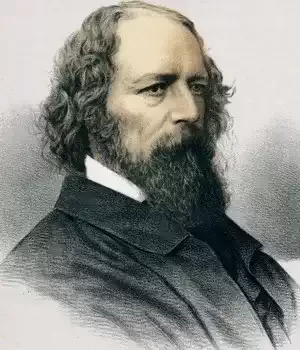
Alfred Lord Tennyson
To Virgil, Written at the Request of the Mantuans for the N
To Virgil, Written at the Request of the Mantuans for the N
Roman Virgil, thou that singest
Ilion's lofty temples robed in fire,
Ilion falling, Rome arising,
wars, and filial faith, and Dido's pyre;
Landscape-lover, lord of language
more than he that sang the "Works and Days,"
All the chosen coin of fancy
flashing out from many a golden phrase;
Thou that singest wheat and woodland,
tilth and vineyard, hive and horse and herd;
All the charm of all the Muses
often flowering in a lonely word;
Poet of the happy Tityrus
piping underneath his beechen bowers;
Poet of the poet-satyr
whom the laughing shepherd bound with flowers;
Chanter of the Pollio, glorying
in the blissful years again to be,
Summers of the snakeless meadow,
unlaborious earth and oarless sea;
Thou that seëst Universal
Nature moved by Universal Mind;
Thou majestic in thy sadness
at the doubtful doom of human kind;
Light among the vanish'd ages;
star that gildest yet this phantom shore;
Golden branch amid the shadows,
kings and realms that pass to rise no more;
Now thy Forum roars no longer,
fallen every purple Cæsar's dome-Tho'
thine ocean-roll of rhythm
sound forever of Imperial Rome-
Now the Rome of slaves hath perish'd,
and the Rome of freemen holds her place,
I, from out the Northern Island
sunder'd once from all the human race,
I salute thee, Mantovano,
I that loved thee since my day began,
Wielder of the stateliest measure
ever moulded by the lips of man.
Roman Virgil, thou that singest
Ilion's lofty temples robed in fire,
Ilion falling, Rome arising,
wars, and filial faith, and Dido's pyre;
Landscape-lover, lord of language
more than he that sang the "Works and Days,"
All the chosen coin of fancy
flashing out from many a golden phrase;
Thou that singest wheat and woodland,
tilth and vineyard, hive and horse and herd;
All the charm of all the Muses
often flowering in a lonely word;
Poet of the happy Tityrus
piping underneath his beechen bowers;
Poet of the poet-satyr
whom the laughing shepherd bound with flowers;
Chanter of the Pollio, glorying
in the blissful years again to be,
Summers of the snakeless meadow,
unlaborious earth and oarless sea;
Thou that seëst Universal
Nature moved by Universal Mind;
Thou majestic in thy sadness
at the doubtful doom of human kind;
Light among the vanish'd ages;
star that gildest yet this phantom shore;
Golden branch amid the shadows,
kings and realms that pass to rise no more;
Now thy Forum roars no longer,
fallen every purple Cæsar's dome-Tho'
thine ocean-roll of rhythm
sound forever of Imperial Rome-
Now the Rome of slaves hath perish'd,
and the Rome of freemen holds her place,
I, from out the Northern Island
sunder'd once from all the human race,
I salute thee, Mantovano,
I that loved thee since my day began,
Wielder of the stateliest measure
ever moulded by the lips of man.
469
Alfred Lord Tennyson
To The Queen
To The Queen
O loyal to the royal in thyself,
And loyal to thy land, as this to thee--
Bear witness, that rememberable day,
When, pale as yet, and fever-worn, the Prince
Who scarce had plucked his flickering life again
From halfway down the shadow of the grave,
Past with thee through thy people and their love,
And London rolled one tide of joy through all
Her trebled millions, and loud leagues of man
And welcome! witness, too, the silent cry,
The prayer of many a race and creed, and clime--
Thunderless lightnings striking under sea
From sunset and sunrise of all thy realm,
And that true North, whereof we lately heard
A strain to shame us 'keep you to yourselves;
So loyal is too costly! friends--your love
Is but a burthen: loose the bond, and go.'
Is this the tone of empire? here the faith
That made us rulers? this, indeed, her voice
And meaning, whom the roar of Hougoumont
Left mightiest of all peoples under heaven?
What shock has fooled her since, that she should speak
So feebly? wealthier--wealthier--hour by hour!
The voice of Britain, or a sinking land,
Some third-rate isle half-lost among her seas?
THERE rang her voice, when the full city pealed
Thee and thy Prince! The loyal to their crown
Are loyal to their own far sons, who love
Our ocean-empire with her boundless homes
For ever-broadening England, and her throne
In our vast Orient, and one isle, one isle,
That knows not her own greatness: if she knows
And dreads it we are fallen. --But thou, my Queen,
Not for itself, but through thy living love
For one to whom I made it o'er his grave
Sacred, accept this old imperfect tale,
New-old, and shadowing Sense at war with Soul,
Ideal manhood closed in real man,
Rather than that gray king, whose name, a ghost,
Streams like a cloud, man-shaped, from mountain peak,
And cleaves to cairn and cromlech still; or him
Of Geoffrey's book, or him of Malleor's, one
Touched by the adulterous finger of a time
That hovered between war and wantonness,
And crownings and dethronements: take withal
Thy poet's blessing, and his trust that Heaven
Will blow the tempest in the distance back
From thine and ours: for some are sacred, who mark,
Or wisely or unwisely, signs of storm,
Waverings of every vane with every wind,
And wordy trucklings to the transient hour,
And fierce or careless looseners of the faith,
And Softness breeding scorn of simple life,
Or Cowardice, the child of lust for gold,
Or Labour, with a groan and not a voice,
Or Art with poisonous honey stolen from France,
And that which knows, but careful for itself,
And that which knows not, ruling that which knows
To its own harm: the goal of this great world
Lies beyond sight: yet--if our slowly-grown
And crowned Republic's crowning common-sense,
That saved her many times, not fail--their fears
Are morning shadows huger than the shapes
That cast them, not those gloomier which forego
The darkness of that battle in the West,
Where all of high and holy dies away.
O loyal to the royal in thyself,
And loyal to thy land, as this to thee--
Bear witness, that rememberable day,
When, pale as yet, and fever-worn, the Prince
Who scarce had plucked his flickering life again
From halfway down the shadow of the grave,
Past with thee through thy people and their love,
And London rolled one tide of joy through all
Her trebled millions, and loud leagues of man
And welcome! witness, too, the silent cry,
The prayer of many a race and creed, and clime--
Thunderless lightnings striking under sea
From sunset and sunrise of all thy realm,
And that true North, whereof we lately heard
A strain to shame us 'keep you to yourselves;
So loyal is too costly! friends--your love
Is but a burthen: loose the bond, and go.'
Is this the tone of empire? here the faith
That made us rulers? this, indeed, her voice
And meaning, whom the roar of Hougoumont
Left mightiest of all peoples under heaven?
What shock has fooled her since, that she should speak
So feebly? wealthier--wealthier--hour by hour!
The voice of Britain, or a sinking land,
Some third-rate isle half-lost among her seas?
THERE rang her voice, when the full city pealed
Thee and thy Prince! The loyal to their crown
Are loyal to their own far sons, who love
Our ocean-empire with her boundless homes
For ever-broadening England, and her throne
In our vast Orient, and one isle, one isle,
That knows not her own greatness: if she knows
And dreads it we are fallen. --But thou, my Queen,
Not for itself, but through thy living love
For one to whom I made it o'er his grave
Sacred, accept this old imperfect tale,
New-old, and shadowing Sense at war with Soul,
Ideal manhood closed in real man,
Rather than that gray king, whose name, a ghost,
Streams like a cloud, man-shaped, from mountain peak,
And cleaves to cairn and cromlech still; or him
Of Geoffrey's book, or him of Malleor's, one
Touched by the adulterous finger of a time
That hovered between war and wantonness,
And crownings and dethronements: take withal
Thy poet's blessing, and his trust that Heaven
Will blow the tempest in the distance back
From thine and ours: for some are sacred, who mark,
Or wisely or unwisely, signs of storm,
Waverings of every vane with every wind,
And wordy trucklings to the transient hour,
And fierce or careless looseners of the faith,
And Softness breeding scorn of simple life,
Or Cowardice, the child of lust for gold,
Or Labour, with a groan and not a voice,
Or Art with poisonous honey stolen from France,
And that which knows, but careful for itself,
And that which knows not, ruling that which knows
To its own harm: the goal of this great world
Lies beyond sight: yet--if our slowly-grown
And crowned Republic's crowning common-sense,
That saved her many times, not fail--their fears
Are morning shadows huger than the shapes
That cast them, not those gloomier which forego
The darkness of that battle in the West,
Where all of high and holy dies away.
479
Alfred Lord Tennyson
To The Queen
To The Queen
O loyal to the royal in thyself,
And loyal to thy land, as this to thee--
Bear witness, that rememberable day,
When, pale as yet, and fever-worn, the Prince
Who scarce had plucked his flickering life again
From halfway down the shadow of the grave,
Past with thee through thy people and their love,
And London rolled one tide of joy through all
Her trebled millions, and loud leagues of man
And welcome! witness, too, the silent cry,
The prayer of many a race and creed, and clime--
Thunderless lightnings striking under sea
From sunset and sunrise of all thy realm,
And that true North, whereof we lately heard
A strain to shame us 'keep you to yourselves;
So loyal is too costly! friends--your love
Is but a burthen: loose the bond, and go.'
Is this the tone of empire? here the faith
That made us rulers? this, indeed, her voice
And meaning, whom the roar of Hougoumont
Left mightiest of all peoples under heaven?
What shock has fooled her since, that she should speak
So feebly? wealthier--wealthier--hour by hour!
The voice of Britain, or a sinking land,
Some third-rate isle half-lost among her seas?
THERE rang her voice, when the full city pealed
Thee and thy Prince! The loyal to their crown
Are loyal to their own far sons, who love
Our ocean-empire with her boundless homes
For ever-broadening England, and her throne
In our vast Orient, and one isle, one isle,
That knows not her own greatness: if she knows
And dreads it we are fallen. --But thou, my Queen,
Not for itself, but through thy living love
For one to whom I made it o'er his grave
Sacred, accept this old imperfect tale,
New-old, and shadowing Sense at war with Soul,
Ideal manhood closed in real man,
Rather than that gray king, whose name, a ghost,
Streams like a cloud, man-shaped, from mountain peak,
And cleaves to cairn and cromlech still; or him
Of Geoffrey's book, or him of Malleor's, one
Touched by the adulterous finger of a time
That hovered between war and wantonness,
And crownings and dethronements: take withal
Thy poet's blessing, and his trust that Heaven
Will blow the tempest in the distance back
From thine and ours: for some are sacred, who mark,
Or wisely or unwisely, signs of storm,
Waverings of every vane with every wind,
And wordy trucklings to the transient hour,
And fierce or careless looseners of the faith,
And Softness breeding scorn of simple life,
Or Cowardice, the child of lust for gold,
Or Labour, with a groan and not a voice,
Or Art with poisonous honey stolen from France,
And that which knows, but careful for itself,
And that which knows not, ruling that which knows
To its own harm: the goal of this great world
Lies beyond sight: yet--if our slowly-grown
And crowned Republic's crowning common-sense,
That saved her many times, not fail--their fears
Are morning shadows huger than the shapes
That cast them, not those gloomier which forego
The darkness of that battle in the West,
Where all of high and holy dies away.
O loyal to the royal in thyself,
And loyal to thy land, as this to thee--
Bear witness, that rememberable day,
When, pale as yet, and fever-worn, the Prince
Who scarce had plucked his flickering life again
From halfway down the shadow of the grave,
Past with thee through thy people and their love,
And London rolled one tide of joy through all
Her trebled millions, and loud leagues of man
And welcome! witness, too, the silent cry,
The prayer of many a race and creed, and clime--
Thunderless lightnings striking under sea
From sunset and sunrise of all thy realm,
And that true North, whereof we lately heard
A strain to shame us 'keep you to yourselves;
So loyal is too costly! friends--your love
Is but a burthen: loose the bond, and go.'
Is this the tone of empire? here the faith
That made us rulers? this, indeed, her voice
And meaning, whom the roar of Hougoumont
Left mightiest of all peoples under heaven?
What shock has fooled her since, that she should speak
So feebly? wealthier--wealthier--hour by hour!
The voice of Britain, or a sinking land,
Some third-rate isle half-lost among her seas?
THERE rang her voice, when the full city pealed
Thee and thy Prince! The loyal to their crown
Are loyal to their own far sons, who love
Our ocean-empire with her boundless homes
For ever-broadening England, and her throne
In our vast Orient, and one isle, one isle,
That knows not her own greatness: if she knows
And dreads it we are fallen. --But thou, my Queen,
Not for itself, but through thy living love
For one to whom I made it o'er his grave
Sacred, accept this old imperfect tale,
New-old, and shadowing Sense at war with Soul,
Ideal manhood closed in real man,
Rather than that gray king, whose name, a ghost,
Streams like a cloud, man-shaped, from mountain peak,
And cleaves to cairn and cromlech still; or him
Of Geoffrey's book, or him of Malleor's, one
Touched by the adulterous finger of a time
That hovered between war and wantonness,
And crownings and dethronements: take withal
Thy poet's blessing, and his trust that Heaven
Will blow the tempest in the distance back
From thine and ours: for some are sacred, who mark,
Or wisely or unwisely, signs of storm,
Waverings of every vane with every wind,
And wordy trucklings to the transient hour,
And fierce or careless looseners of the faith,
And Softness breeding scorn of simple life,
Or Cowardice, the child of lust for gold,
Or Labour, with a groan and not a voice,
Or Art with poisonous honey stolen from France,
And that which knows, but careful for itself,
And that which knows not, ruling that which knows
To its own harm: the goal of this great world
Lies beyond sight: yet--if our slowly-grown
And crowned Republic's crowning common-sense,
That saved her many times, not fail--their fears
Are morning shadows huger than the shapes
That cast them, not those gloomier which forego
The darkness of that battle in the West,
Where all of high and holy dies away.
479
Alfred Lord Tennyson
To The Queen
To The Queen
O loyal to the royal in thyself,
And loyal to thy land, as this to thee--
Bear witness, that rememberable day,
When, pale as yet, and fever-worn, the Prince
Who scarce had plucked his flickering life again
From halfway down the shadow of the grave,
Past with thee through thy people and their love,
And London rolled one tide of joy through all
Her trebled millions, and loud leagues of man
And welcome! witness, too, the silent cry,
The prayer of many a race and creed, and clime--
Thunderless lightnings striking under sea
From sunset and sunrise of all thy realm,
And that true North, whereof we lately heard
A strain to shame us 'keep you to yourselves;
So loyal is too costly! friends--your love
Is but a burthen: loose the bond, and go.'
Is this the tone of empire? here the faith
That made us rulers? this, indeed, her voice
And meaning, whom the roar of Hougoumont
Left mightiest of all peoples under heaven?
What shock has fooled her since, that she should speak
So feebly? wealthier--wealthier--hour by hour!
The voice of Britain, or a sinking land,
Some third-rate isle half-lost among her seas?
THERE rang her voice, when the full city pealed
Thee and thy Prince! The loyal to their crown
Are loyal to their own far sons, who love
Our ocean-empire with her boundless homes
For ever-broadening England, and her throne
In our vast Orient, and one isle, one isle,
That knows not her own greatness: if she knows
And dreads it we are fallen. --But thou, my Queen,
Not for itself, but through thy living love
For one to whom I made it o'er his grave
Sacred, accept this old imperfect tale,
New-old, and shadowing Sense at war with Soul,
Ideal manhood closed in real man,
Rather than that gray king, whose name, a ghost,
Streams like a cloud, man-shaped, from mountain peak,
And cleaves to cairn and cromlech still; or him
Of Geoffrey's book, or him of Malleor's, one
Touched by the adulterous finger of a time
That hovered between war and wantonness,
And crownings and dethronements: take withal
Thy poet's blessing, and his trust that Heaven
Will blow the tempest in the distance back
From thine and ours: for some are sacred, who mark,
Or wisely or unwisely, signs of storm,
Waverings of every vane with every wind,
And wordy trucklings to the transient hour,
And fierce or careless looseners of the faith,
And Softness breeding scorn of simple life,
Or Cowardice, the child of lust for gold,
Or Labour, with a groan and not a voice,
Or Art with poisonous honey stolen from France,
And that which knows, but careful for itself,
And that which knows not, ruling that which knows
To its own harm: the goal of this great world
Lies beyond sight: yet--if our slowly-grown
And crowned Republic's crowning common-sense,
That saved her many times, not fail--their fears
Are morning shadows huger than the shapes
That cast them, not those gloomier which forego
The darkness of that battle in the West,
Where all of high and holy dies away.
O loyal to the royal in thyself,
And loyal to thy land, as this to thee--
Bear witness, that rememberable day,
When, pale as yet, and fever-worn, the Prince
Who scarce had plucked his flickering life again
From halfway down the shadow of the grave,
Past with thee through thy people and their love,
And London rolled one tide of joy through all
Her trebled millions, and loud leagues of man
And welcome! witness, too, the silent cry,
The prayer of many a race and creed, and clime--
Thunderless lightnings striking under sea
From sunset and sunrise of all thy realm,
And that true North, whereof we lately heard
A strain to shame us 'keep you to yourselves;
So loyal is too costly! friends--your love
Is but a burthen: loose the bond, and go.'
Is this the tone of empire? here the faith
That made us rulers? this, indeed, her voice
And meaning, whom the roar of Hougoumont
Left mightiest of all peoples under heaven?
What shock has fooled her since, that she should speak
So feebly? wealthier--wealthier--hour by hour!
The voice of Britain, or a sinking land,
Some third-rate isle half-lost among her seas?
THERE rang her voice, when the full city pealed
Thee and thy Prince! The loyal to their crown
Are loyal to their own far sons, who love
Our ocean-empire with her boundless homes
For ever-broadening England, and her throne
In our vast Orient, and one isle, one isle,
That knows not her own greatness: if she knows
And dreads it we are fallen. --But thou, my Queen,
Not for itself, but through thy living love
For one to whom I made it o'er his grave
Sacred, accept this old imperfect tale,
New-old, and shadowing Sense at war with Soul,
Ideal manhood closed in real man,
Rather than that gray king, whose name, a ghost,
Streams like a cloud, man-shaped, from mountain peak,
And cleaves to cairn and cromlech still; or him
Of Geoffrey's book, or him of Malleor's, one
Touched by the adulterous finger of a time
That hovered between war and wantonness,
And crownings and dethronements: take withal
Thy poet's blessing, and his trust that Heaven
Will blow the tempest in the distance back
From thine and ours: for some are sacred, who mark,
Or wisely or unwisely, signs of storm,
Waverings of every vane with every wind,
And wordy trucklings to the transient hour,
And fierce or careless looseners of the faith,
And Softness breeding scorn of simple life,
Or Cowardice, the child of lust for gold,
Or Labour, with a groan and not a voice,
Or Art with poisonous honey stolen from France,
And that which knows, but careful for itself,
And that which knows not, ruling that which knows
To its own harm: the goal of this great world
Lies beyond sight: yet--if our slowly-grown
And crowned Republic's crowning common-sense,
That saved her many times, not fail--their fears
Are morning shadows huger than the shapes
That cast them, not those gloomier which forego
The darkness of that battle in the West,
Where all of high and holy dies away.
479
Alfred Lord Tennyson
To Edward Lear: on His Travels in Greece
To Edward Lear: on His Travels in Greece
Illyrian woodlands, echoing falls
Of water, sheets of summer glass,
The long divine Peneian pass,
The vast Akrokeraunian walls,
Tomohrit, Athos, all things fair,
With such a pencil, such a pen,
You shadow forth to distant men,
I read and felt that I was there:
And trust me while I turn'd the page,
And track'd you still on classic ground,
I grew in gladness till I found
My spirits in the golden age.
For me the torrent ever pour'd
And glisten'd -- here and there alone
The broad-limb'd gods at random thrown
By fountain urns; -- and Naiads oar'd
A glimmering shoulder under gloom
Of cavern pillars; on the swell
The silver lily heaved and fell;
And many a slope was rich in bloom
From him that on the mountain lea
By dancing rivulets fed his flocks,
To him who sat upon the rocks,
And fluted to the morning sea.
Illyrian woodlands, echoing falls
Of water, sheets of summer glass,
The long divine Peneian pass,
The vast Akrokeraunian walls,
Tomohrit, Athos, all things fair,
With such a pencil, such a pen,
You shadow forth to distant men,
I read and felt that I was there:
And trust me while I turn'd the page,
And track'd you still on classic ground,
I grew in gladness till I found
My spirits in the golden age.
For me the torrent ever pour'd
And glisten'd -- here and there alone
The broad-limb'd gods at random thrown
By fountain urns; -- and Naiads oar'd
A glimmering shoulder under gloom
Of cavern pillars; on the swell
The silver lily heaved and fell;
And many a slope was rich in bloom
From him that on the mountain lea
By dancing rivulets fed his flocks,
To him who sat upon the rocks,
And fluted to the morning sea.
409
Alfred Lord Tennyson
The Ringlet
The Ringlet
'Your ringlets, your ringlets,
That look so golden-gay,
If you will give me one, but one,
To kiss it night and day,
The never chilling touch of Time
Will turn it silver-gray;
And then shall I know it is all true gold
To flame and sparkle and stream as of old.
Till all the comets in heaven are cold,
And all her stars decay.'
'Then take it, love, and put it by;
This cannot change, nor yet can I.'
'My ringlet, my ringlet,
That art so golden-gay,
Now never chilling touch of Time
Can turn thee silver-gray;
And a lad may wink, and a girl may hint,
And a fool may say his say;
For my doubts and fears were all amiss,
And I swear henceforth by this and this,
That a doubt will only come for a kiss,
And a fear to be kiss'd away.'
'Then kiss it, love, and put it by:
If this can change, why so can I.'
O Ringlet, O Ringlet,
I kiss'd you night and day,
And Ringlet, O Ringlet,
You still are golden-gay,
But Ringlet, O Ringlet,
You should be silver-gray:
For what is this which now I'm told,
I that took you for true gold,
She that gave you 's bought and sold,
Sold, sold.
O Ringlet, O Ringlet,
She blush'd a rosy red,
When Ringlet, O Ringlet
She clipt you from her head,
And Ringlet, O Ringlet,
She gave you me, and said,
'Come, kiss it, love and put it by:
If this can change, why so can I.'
O fie, you golden nothing, fie,
You golden lie.
O Ringlet, O Ringlet,
I count you much to blame,
For Ringlet, O Ringlet,
You put me much to shame,
So Ringlet, O Ringlet,
I doom you to the flame.
For what is this which now I learn,
Has given all my faith a turn?
Burn, you glossy heretic, burn,
Burn, burn.
'Your ringlets, your ringlets,
That look so golden-gay,
If you will give me one, but one,
To kiss it night and day,
The never chilling touch of Time
Will turn it silver-gray;
And then shall I know it is all true gold
To flame and sparkle and stream as of old.
Till all the comets in heaven are cold,
And all her stars decay.'
'Then take it, love, and put it by;
This cannot change, nor yet can I.'
'My ringlet, my ringlet,
That art so golden-gay,
Now never chilling touch of Time
Can turn thee silver-gray;
And a lad may wink, and a girl may hint,
And a fool may say his say;
For my doubts and fears were all amiss,
And I swear henceforth by this and this,
That a doubt will only come for a kiss,
And a fear to be kiss'd away.'
'Then kiss it, love, and put it by:
If this can change, why so can I.'
O Ringlet, O Ringlet,
I kiss'd you night and day,
And Ringlet, O Ringlet,
You still are golden-gay,
But Ringlet, O Ringlet,
You should be silver-gray:
For what is this which now I'm told,
I that took you for true gold,
She that gave you 's bought and sold,
Sold, sold.
O Ringlet, O Ringlet,
She blush'd a rosy red,
When Ringlet, O Ringlet
She clipt you from her head,
And Ringlet, O Ringlet,
She gave you me, and said,
'Come, kiss it, love and put it by:
If this can change, why so can I.'
O fie, you golden nothing, fie,
You golden lie.
O Ringlet, O Ringlet,
I count you much to blame,
For Ringlet, O Ringlet,
You put me much to shame,
So Ringlet, O Ringlet,
I doom you to the flame.
For what is this which now I learn,
Has given all my faith a turn?
Burn, you glossy heretic, burn,
Burn, burn.
497
Alfred Lord Tennyson
The Princess: A Medley: Our Enemies have Fall'n
The Princess: A Medley: Our Enemies have Fall'n
Our enemies have fall'n, have fall'n: the seed,
The little seed they laugh'd at in the dark,
Has risen and cleft the soil, and grown a bulk
Of spanless girth, that lays on every side
A thousand arms and rushes to the Sun.
Our enemies have fall'n, have fall'n: they came;
The leaves were wet with women's tears: they heard
A noise of songs they would not understand:
They mark'd it with the red cross to the fall,
And would have strown it, and are fall'n themselves.
Our enemies have fall'n, have fall'n: they came,
The woodmen with their axes: lo the tree!
But we will make it faggots for the hearth,
And shape it plank and beam for roof and floor,
And boats and bridges for the use of men.
Our enemies have fall'n, have fall'n: they struck;
With their own blows they hurt themselves, nor knew
There dwelt an iron nature in the grain:
The glittering axe was broken in their arms,
Their arms were shatter'd to the shoulder blade.
Our enemies have fall'n, but this shall grow
A night of Summer from the heat, a breadth
Of Autumn, dropping fruits of power; and roll'd
With music in the growing breeze of Time,
The tops shall strike from star to star, the fangs
Shall move the stony bases of the world.
Our enemies have fall'n, have fall'n: the seed,
The little seed they laugh'd at in the dark,
Has risen and cleft the soil, and grown a bulk
Of spanless girth, that lays on every side
A thousand arms and rushes to the Sun.
Our enemies have fall'n, have fall'n: they came;
The leaves were wet with women's tears: they heard
A noise of songs they would not understand:
They mark'd it with the red cross to the fall,
And would have strown it, and are fall'n themselves.
Our enemies have fall'n, have fall'n: they came,
The woodmen with their axes: lo the tree!
But we will make it faggots for the hearth,
And shape it plank and beam for roof and floor,
And boats and bridges for the use of men.
Our enemies have fall'n, have fall'n: they struck;
With their own blows they hurt themselves, nor knew
There dwelt an iron nature in the grain:
The glittering axe was broken in their arms,
Their arms were shatter'd to the shoulder blade.
Our enemies have fall'n, but this shall grow
A night of Summer from the heat, a breadth
Of Autumn, dropping fruits of power; and roll'd
With music in the growing breeze of Time,
The tops shall strike from star to star, the fangs
Shall move the stony bases of the world.
409
Alfred Lord Tennyson
The Princess (part 5)
The Princess (part 5)
Now, scarce three paces measured from the mound,
We stumbled on a stationary voice,
And 'Stand, who goes?' 'Two from the palace' I.
'The second two: they wait,' he said, 'pass on;
His Highness wakes:' and one, that clashed in arms,
By glimmering lanes and walls of canvas led
Threading the soldier-city, till we heard
The drowsy folds of our great ensign shake
From blazoned lions o'er the imperial tent
Whispers of war.
Entering, the sudden light
Dazed me half-blind: I stood and seemed to hear,
As in a poplar grove when a light wind wakes
A lisping of the innumerous leaf and dies,
Each hissing in his neighbour's ear; and then
A strangled titter, out of which there brake
On all sides, clamouring etiquette to death,
Unmeasured mirth; while now the two old kings
Began to wag their baldness up and down,
The fresh young captains flashed their glittering teeth,
The huge bush-bearded Barons heaved and blew,
And slain with laughter rolled the gilded Squire.
At length my Sire, his rough cheek wet with tears,
Panted from weary sides 'King, you are free!
We did but keep you surety for our son,
If this be he,--or a dragged mawkin, thou,
That tends to her bristled grunters in the sludge:'
For I was drenched with ooze, and torn with briers,
More crumpled than a poppy from the sheath,
And all one rag, disprinced from head to heel.
Then some one sent beneath his vaulted palm
A whispered jest to some one near him, 'Look,
He has been among his shadows.' 'Satan take
The old women and their shadows! (thus the King
Roared) make yourself a man to fight with men.
Go: Cyril told us all.'
As boys that slink
From ferule and the trespass-chiding eye,
Away we stole, and transient in a trice
From what was left of faded woman-slough
To sheathing splendours and the golden scale
Of harness, issued in the sun, that now
Leapt from the dewy shoulders of the Earth,
And hit the Northern hills. Here Cyril met us.
A little shy at first, but by and by
We twain, with mutual pardon asked and given
For stroke and song, resoldered peace, whereon
Followed his tale. Amazed he fled away
Through the dark land, and later in the night
Had come on Psyche weeping: 'then we fell
Into your father's hand, and there she lies,
But will not speak, or stir.'
He showed a tent
A stone-shot off: we entered in, and there
Among piled arms and rough accoutrements,
Pitiful sight, wrapped in a soldier's cloak,
Like some sweet sculpture draped from head to foot,
And pushed by rude hands from its pedestal,
All her fair length upon the ground she lay:
And at her head a follower of the camp,
A charred and wrinkled piece of womanhood,
Sat watching like the watcher by the dead.
Then Florian knelt, and 'Come' he whispered to her,
'Lift up your head, sweet sister: lie not thus.
What have you done but right? you could not slay
Me, nor your prince: look up: be comforted:
Sweet is it to have done the thing one ought,
When fallen in darker ways.' And likewise I:
'Be comforted: have I not lost her too,
In whose least act abides the nameless charm
That none has else for me?' She heard, she moved,
She moaned, a folded voice; and up she sat,
And raised the cloak from brows as pale and smooth
As those that mourn half-shrouded over death
In deathless marble. 'Her,' she said, 'my friend--
Parted from her--betrayed her cause and mine--
Where shall I breathe? why kept ye not your faith?
O base and bad! what comfort? none for me!'
To whom remorseful Cyril, 'Yet I pray
Take comfort: live, dear lady, for your child!'
At which she lifted up her voice and cried.
'Ah me, my babe, my blossom, ah, my child,
My one sweet child, whom I shall see no more!
For now will cruel Ida keep her back;
And either she will die from want of care,
Or sicken with ill-usage, when they say
The child is hers--for every little fault,
The child is hers; and they will beat my girl
Remembering her mother: O my flower!
Or they will take her, they will make her hard,
And she will pass me by in after-life
With some cold reverence worse than were she dead.
Ill mother that I was to leave her there,
To lag behind, scared by the cry they made,
The horror of the shame among them all:
But I will go and sit beside the doors,
And make a wild petition night and day,
Until they hate to hear me like a wind
Wailing for ever, till they open to me,
And lay my little blossom at my feet,
My babe, my sweet Aglaïa, my one child:
And I will take her up and go my way,
And satisfy my soul with kissing her:
Ah! what might that man not deserve of me
Who gave me back my child?' 'Be comforted,'
Said Cyril, 'you shall have it:' but again
She veiled her brows, and prone she sank, and so
Like tender things that being caught feign death,
Spoke not, nor stirred.
By this a murmur ran
Through all the camp and inward raced the scouts
With rumour of Prince Arab hard at hand.
We left her by the woman, and without
Found the gray kings at parle: and 'Look you' cried
My father 'that our compact be fulfilled:
You have spoilt this child; she laughs at you and man:
She wrongs herself, her sex, and me, and him:
But red-faced war has rods of steel and fire;
She yields, or war.'
Then Gama turned to me:
'We fear, indeed, you spent a stormy time
With our strange girl: and yet they say that still
You love her. Give us, then, your mind at large:
How say you, war or not?'
'Not war, if possible,
O king,' I said, 'lest from the abuse of war,
The desecrated shrine, the trampled year,
The smouldering homestead, and the household flower
Torn from the lintel--all the common wrong--
A smoke go up through which I loom to her
Three times a monster: now she lightens scorn
At him that mars her plan, but then would hate
(And every voice she talked with ratify it,
And every face she looked on justify it)
The general foe. More soluble is this knot,
By gentleness than war. I want her love.
What were I nigher this although we dashed
Your cities into shards with catapults,
She would not love;--or brought her chained, a slave,
The lifting of whose eyelash is my lord,
Not ever would she love; but brooding turn
The book of scorn, till all my flitting chance
Were caught within the record of her wrongs,
And crushed to death: and rather, Sire, than this
I would the old God of war himself were dead,
Forgotten, rusting on his iron hills,
Rotting on some wild shore with ribs of wreck,
Or like an old-world mammoth bulked in ice,
Not to be molten out.'
And roughly spake
My father, 'Tut, you know them not, the girls.
Boy, when I hear you prate I almost think
That idiot legend credible. Look you, Sir!
Man is the hunter; woman is his game:
The sleek and shining creatures of the chase,
We hunt them for the beauty of their skins;
They love us for it, and we ride them down.
Wheedling and siding with them! Out! for shame!
Boy, there's no rose that's half so dear to them
As he that does the thing they dare not do,
Breathing and sounding beauteous battle, comes
With the air of the trumpet round him, and leaps in
Among the women, snares them by the score
Flattered and flustered, wins, though dashed with death
He reddens what he kisses: thus I won
You mother, a good mother, a good wife,
Worth winning; but this firebrand--gentleness
To such as her! if Cyril spake her true,
To catch a dragon in a cherry net,
To trip a tigress with a gossamer
Were wisdom to it.'
'Yea but Sire,' I cried,
'Wild natures need wise curbs. The soldier? No:
What dares not Ida do that she should prize
The soldier? I beheld her, when she rose
The yesternight, and storming in extremes,
Stood for her cause, and flung defiance down
Gagelike to man, and had not shunned the death,
No, not the soldier's: yet I hold her, king,
True woman: you clash them all in one,
That have as many differences as we.
The violet varies from the lily as far
As oak from elm: one loves the soldier, one
The silken priest of peace, one this, one that,
And some unworthily; their sinless faith,
A maiden moon that sparkles on a sty,
Glorifying clown and satyr; whence they need
More breadth of culture: is not Ida right?
They worth it? truer to the law within?
Severer in the logic of a life?
Twice as magnetic to sweet influences
Of earth and heaven? and she of whom you speak,
My mother, looks as whole as some serene
Creation minted in the golden moods
Of sovereign artists; not a thought, a touch,
But pure as lines of green that streak the white
Of the first snowdrop's inner leaves; I say,
Not like the piebald miscellany, man,
Bursts of great heart and slips in sensual mire,
But whole and one: and take them all-in-all,
Were we ourselves but half as good, as kind,
As truthful, much that Ida claims as right
Had ne'er been mooted, but as frankly theirs
As dues of Nature. To our point: not war:
Lest I lose all.'
'Nay, nay, you spake but sense'
Said Gama. 'We remember love ourself
In our sweet youth; we did not rate him then
This red-hot iron to be shaped with blows.
You talk almost like Ida: ~she~ can talk;
And there is something in it as you say:
But you talk kindlier: we esteem you for it.--
He seems a gracious and a gallant Prince,
I would he had our daughter: for the rest,
Our own detention, why, the causes weighed,
Fatherly fears--you used us courteously--
We would do much to gratify your Prince--
We pardon it; and for your ingress here
Upon the skirt and fringe of our fair land,
you did but come as goblins in the night,
Nor in the furrow broke the ploughman's head,
Nor burnt the grange, nor bussed the milking-maid,
Nor robbed the farmer of his bowl of cream:
But let your Prince (our royal word upon it,
He comes back safe) ride with us to our lines,
And speak with Arac: Arac's word is thrice
As ours with Ida: something may be done--
I know not what--and ours shall see us friends.
You, likewise, our late guests, if so you will,
Follow us: who knows? we four may build some plan
Foursquare to opposition.'
Here he reached
White hands of farewell to my sire, who growled
An answer which, half-muffled in his beard,
Let so much out as gave us leave to go.
Then rode we with the old king across the lawns
Beneath huge trees, a thousand rings of Spring
In every bole, a song on every spray
Of birds that piped their Valentines, and woke
Desire in me to infuse my tale of love
In the old king's ears, who promised help, and oozed
All o'er with honeyed answer as we rode
And blossom-fragrant slipt the heavy dews
Gathered by night and peace, with each light air
On our mailed heads: but other thoughts than Peace
Burnt in us, when we saw the embattled squares,
And squadrons of the Prince, trampling the flowers
With clamour: for among them rose a cry
As if to greet the king; they made a halt;
The horses yelled; they clashed their arms; the drum
Beat; merrily-blowing shrilled the martial fife;
And in the blast and bray of the long horn
And serpent-throated bugle, undulated
The banner: anon to meet us lightly pranced
Three captains out; nor ever had I seen
Such thews of men: the midmost and the highest
Was Arac: all about his motion clung
The shadow of his sister, as the beam
Of the East, that played upon them, made them glance
Like those three stars of the airy Giant's zone,
That glitter burnished by the frosty dark;
And as the fiery Sirius alters hue,
And bickers into red and emerald, shone
Their morions, washed with morning, as they came.
And I that prated peace, when first I heard
War-music, felt the blind wildbeast of force,
Whose home is in the sinews of a man,
Stir in me as to strike: then took the king
His three broad sons; with now a wandering hand
And now a pointed finger, told them all:
A common light of smiles at our disguise
Broke from their lips, and, ere the windy jest
Had laboured down within his ample lungs,
The genial giant, Arac, rolled himself
Thrice in the saddle, then burst out in words.
'Our land invaded, 'sdeath! and he himself
Your captive, yet my father wills not war:
And, 'sdeath! myself, what care I, war or no?
but then this question of your troth remains:
And there's a downright honest meaning in her;
She flies too high, she flies too high! and yet
She asked but space and fairplay for her scheme;
She prest and prest it on me--I myself,
What know I of these things? but, life and soul!
I thought her half-right talking of her wrongs;
I say she flies too high, 'sdeath! what of that?
I take her for the flower of womankind,
And so I often told her, right or wrong,
And, Prince, she can be sweet to those she loves,
And, right or wrong, I care not: this is all,
I stand upon her side: she made me swear it-'
Sdeath--and with solemn rites by candle-light--
Swear by St something--I forget her name--
Her that talked down the fifty wisest men;
~She~ was a princess too; and so I swore.
Come, this is all; she will not: waive your claim:
If not, the foughten field, what else, at once
Decides it, 'sdeath! against my father's will.'
I lagged in answer loth to render up
My precontract, and loth by brainless war
To cleave the rift of difference deeper yet;
Till one of those two brothers, half aside
And fingering at the hair about his lip,
To prick us on to combat 'Like to like!
The woman's garment hid the woman's heart.'
A taunt that clenched his purpose like a blow!
For fiery-short was Cyril's counter-scoff,
And sharp I answered, touched upon the point
Where idle boys are cowards to their shame,
'Decide it here: why not? we are three to three.'
Then spake the third 'But three to three? no more?
No more, and in our noble sister's cause?
More, more, for honour: every captain waits
Hungry for honour, angry for his king.
More, more some fifty on a side, that each
May breathe himself, and quick! by overthrow
Of these or those, the question settled die.'
'Yea,' answered I, 'for this wreath of air,
This flake of rainbow flying on the highest
Foam of men's deeds--this honour, if ye will.
It needs must be for honour if at all:
Since, what decision? if we fail, we fail,
And if we win, we fail: she would not keep
Her compact.' ''Sdeath! but we will send to her,'
Said Arac, 'worthy reasons why she should
Bide by this issue: let our missive through,
And you shall have her answer by the word.'
'Boys!' shrieked the old king, but vainlier than a hen
To her false daughters in the pool; for none
Regarded; neither seemed there more to say:
Back rode we to my father's camp, and found
He thrice had sent a herald to the gates,
To learn if Ida yet would cede our claim,
Or by denial flush her babbling wells
With her own people's life: three times he went:
The first, he blew and blew, but none appeared:
He battered at the doors; none came: the next,
An awful voice within had warned him thence:
The third, and those eight daughters of the plough
Came sallying through the gates, and caught his hair,
And so belaboured him on rib and cheek
They made him wild: not less one glance he caught
Through open doors of Ida stationed there
Unshaken, clinging to her purpose, firm
Though compassed by two armies and the noise
Of arms; and standing like a stately Pine
Set in a cataract on an island-crag,
When storm is on the heights, and right and left
Sucked from the dark heart of the long hills roll
The torrents, dashed to the vale: and yet her will
Bred will in me to overcome it or fall.
But when I told the king that I was pledged
To fight in tourney for my bride, he clashed
His iron palms together with a cry;
Himself would tilt it out among the lads:
But overborne by all his bearded lords
With reasons drawn from age and state, perforce
He yielded, wroth and red, with fierce demur:
And many a bold knight started up in heat,
And sware to combat for my claim till death.
All on this side the palace ran the field
Flat to the garden-wall: and likewise here,
Above the garden's glowing blossom-belts,
A columned entry shone and marble stairs,
And great bronze valves, embossed with Tomyris
And what she did to Cyrus after fight,
But now fast barred: so here upon the flat
All that long morn the lists were hammered up,
And all that morn the heralds to and fro,
With message and defiance, went and came;
Last, Ida's answer, in a royal hand,
But shaken here and there, and rolling words
Oration-like. I kissed it and I read.
'O brother, you have known the pangs we felt,
What heats of indignation when we heard
Of those that iron-cramped their women's feet;
Of lands in which at the altar the poor bride
Gives her harsh groom for bridal-gift a scourge;
Of living hearts that crack within the fire
Where smoulder their dead despots; and of those,-Mothers,--
that, with all prophetic pity, fling
Their pretty maids in the running flood, and swoops
The vulture, beak and talon, at the heart
Made for all noble motion: and I saw
That equal baseness lived in sleeker times
With smoother men: the old leaven leavened all:
Millions of throats would bawl for civil rights,
No woman named: therefore I set my face
Against all men, and lived but for mine own.
Far off from men I built a fold for them:
I stored it full of rich memorial:
I fenced it round with gallant institutes,
And biting laws to scare the beasts of prey
And prospered; till a rout of saucy boys
Brake on us at our books, and marred our peace,
Masked like our maids, blustering I know not what
Of insolence and love, some pretext held
Of baby troth, invalid, since my will
Sealed not the bond--the striplings! for their sport!--
I tamed my leopards: shall I not tame these?
Or you? or I? for since you think me touched
In honour--what, I would not aught of false--
Is not our case pure? and whereas I know
Your prowess, Arac, and what mother's blood
You draw from, fight; you failing, I abide
What end soever: fail you will not. Still
Take not his life: he risked it for my own;
His mother lives: yet whatsoe'er you do,
Fight and fight well; strike and strike him. O dear
Brothers, the woman's Angel guards you, you
The sole men to be mingled with our cause,
The sole men we shall prize in the after-time,
Your very armour hallowed, and your statues
Reared, sung to, when, this gad-fly brushed aside,
We plant a solid foot into the Time,
And mould a generation strong to move
With claim on claim from right to right, till she
Whose name is yoked with children's, know herself;
And Knowledge in our own land make her free,
And, ever following those two crownèd twins,
Commerce and conquest, shower the fiery grain
Of freedom broadcast over all the orbs
Between the Northern and the Southern morn.'
Then came a postscript dashed across the rest.
See that there be no traitors in your camp:
We seem a nest of traitors--none to trust
Since our arms failed--this Egypt-plague of men!
Almost our maids were better at their homes,
Than thus man-girdled here: indeed I think
Our chiefest comfort is the little child
Of one unworthy mother; which she left:
She shall not have it back: the child shall grow
To prize the authentic mother of her mind.
I took it for an hour in mine own bed
This morning: there the tender orphan hands
Felt at my heart, and seemed to charm from thence
The wrath I nursed against the world: farewell.'
I ceased; he said, 'Stubborn, but she may sit
Upon a king's right hand in thunder-storms,
And breed up warriors! See now, though yourself
Be dazzled by the wildfire Love to sloughs
That swallow common sense, the spindling king,
This Gama swamped in lazy tolerance.
When the man wants weight, the woman takes it up,
And topples down the scales; but this is fixt
As are the roots of earth and base of all;
Man for the field and woman for the hearth:
Man for the sword and for the needle she:
Man with the head and woman with the heart:
Man to command and woman to obey;
All else confusion. Look you! the gray mare
Is ill to live with, when her whinny shrills
From tile to scullery, and her small goodman
Shrinks in his arm-chair while the fires of Hell
Mix with his hearth: but you--she's yet a colt--
Take, break her: strongly groomed and straitly curbed
She might not rank with those detestable
That let the bantling scald at home, and brawl
Their rights and wrongs like potherbs in the street.
They say she's comely; there's the fairer chance:
~I~ like her none the less for rating at her!
Besides, the woman wed is not as we,
But suffers change of frame. A lusty brace
Of twins may weed her of her folly. Boy,
The bearing and the training of a child
Is woman's wisdom.'
Thus the hard old king:
I took my leave, for it was nearly noon:
I pored upon her letter which I held,
And on the little clause 'take not his life:'
I mused on that wild morning in the woods,
And on the 'Follow, follow, thou shalt win:'
I thought on all the wrathful king had said,
And how the strange betrothment was to end:
Then I remembered that burnt sorcerer's curse
That one should fight with shadows and should fall;
And like a flash the weird affection came:
King, camp and college turned to hollow shows;
I seemed to move in old memorial tilts,
And doing battle with forgotten ghosts,
To dream myself the shadow of a dream:
And ere I woke it was the point of noon,
The lists were ready. Empanoplied and plumed
We entered in, and waited, fifty there
Opposed to fifty, till the trumpet blared
At the barrier like a wild horn in a land
Of echoes, and a moment, and once more
The trumpet, and again: at which the storm
Of galloping hoofs bare on the ridge of spears
And riders front to front, until they closed
In conflict with the crash of shivering points,
And thunder. Yet it seemed a dream, I dreamed
Of fighting. On his haunches rose the steed,
And into fiery splinters leapt the lance,
And out of stricken helmets sprang the fire.
Part sat like rocks: part reeled but kept their seats:
Part rolled on the earth and rose again and drew:
Part stumbled mixt with floundering horses. Down
From those two bulks at Arac's side, and down
From Arac's arm, as from a giant's flail,
The large blows rained, as here and everywhere
He rode the mellay, lord of the ringing lists,
And all the plain,--brand, mace, and shaft, and shield--
Shocked, like an iron-clanging anvil banged
With hammers; till I thought, can this be he
From Gama's dwarfish loins? if this be so,
The mother makes us most--and in my dream
I glanced aside, and saw the palace-front
Alive with fluttering scarfs and ladies' eyes,
And highest, among the statues, statuelike,
Between a cymballed Miriam and a Jael,
With Psyche's babe, was Ida watching us,
A single band of gold about her hair,
Like a Saint's glory up in heaven: but she
No saint--inexorable--no tenderness--
Too hard, too cruel: yet she sees me fight,
Yea, let her see me fall! and with that I drave
Among the thickest and bore down a Prince,
And Cyril, one. Yea, let me make my dream
All that I would. But that large-moulded man,
His visage all agrin as at a wake,
Made at me through the press, and, staggering back
With stroke on stroke the horse and horseman, came
As comes a pillar of electric cloud,
Flaying the roofs and sucking up the drains,
And shadowing down the champaign till it strikes
On a wood, and takes, and breaks, and cracks, and splits,
And twists the grain with such a roar that Earth
Reels, and the herdsmen cry; for everything
Game way before him: only Florian, he
That loved me closer than his own right eye,
Thrust in between; but Arac rode him down:
And Cyril seeing it, pushed against the Prince,
With Psyche's colour round his helmet, tough,
Strong, supple, sinew-corded, apt at arms;
But tougher, heavier, stronger, he that smote
And threw him: last I spurred; I felt my veins
Stretch with fierce heat; a moment hand to hand,
And sword to sword, and horse to horse we hung,
Till I struck out and shouted; the blade glanced,
I did but shear a feather, and dream and truth
Flowed from me; darkness closed me; and I fell.
Home they brought her warrior dead:
She nor swooned, nor uttered cry:
All her maidens, watching, said,
'She must weep or she will die.'
Then they praised him, soft and low,
Called him worthy to be loved,
Truest friend and noblest foe;
Yet she neither spoke nor moved.
Stole a maiden from her place,
Lightly to the warrior stept,
Took the face-cloth from the face;
Yet she neither moved nor wept.
Rose a nurse of ninety years,
Set his child upon her knee--
Like summer tempest came her tears-'
Sweet my child, I live for thee.'
Now, scarce three paces measured from the mound,
We stumbled on a stationary voice,
And 'Stand, who goes?' 'Two from the palace' I.
'The second two: they wait,' he said, 'pass on;
His Highness wakes:' and one, that clashed in arms,
By glimmering lanes and walls of canvas led
Threading the soldier-city, till we heard
The drowsy folds of our great ensign shake
From blazoned lions o'er the imperial tent
Whispers of war.
Entering, the sudden light
Dazed me half-blind: I stood and seemed to hear,
As in a poplar grove when a light wind wakes
A lisping of the innumerous leaf and dies,
Each hissing in his neighbour's ear; and then
A strangled titter, out of which there brake
On all sides, clamouring etiquette to death,
Unmeasured mirth; while now the two old kings
Began to wag their baldness up and down,
The fresh young captains flashed their glittering teeth,
The huge bush-bearded Barons heaved and blew,
And slain with laughter rolled the gilded Squire.
At length my Sire, his rough cheek wet with tears,
Panted from weary sides 'King, you are free!
We did but keep you surety for our son,
If this be he,--or a dragged mawkin, thou,
That tends to her bristled grunters in the sludge:'
For I was drenched with ooze, and torn with briers,
More crumpled than a poppy from the sheath,
And all one rag, disprinced from head to heel.
Then some one sent beneath his vaulted palm
A whispered jest to some one near him, 'Look,
He has been among his shadows.' 'Satan take
The old women and their shadows! (thus the King
Roared) make yourself a man to fight with men.
Go: Cyril told us all.'
As boys that slink
From ferule and the trespass-chiding eye,
Away we stole, and transient in a trice
From what was left of faded woman-slough
To sheathing splendours and the golden scale
Of harness, issued in the sun, that now
Leapt from the dewy shoulders of the Earth,
And hit the Northern hills. Here Cyril met us.
A little shy at first, but by and by
We twain, with mutual pardon asked and given
For stroke and song, resoldered peace, whereon
Followed his tale. Amazed he fled away
Through the dark land, and later in the night
Had come on Psyche weeping: 'then we fell
Into your father's hand, and there she lies,
But will not speak, or stir.'
He showed a tent
A stone-shot off: we entered in, and there
Among piled arms and rough accoutrements,
Pitiful sight, wrapped in a soldier's cloak,
Like some sweet sculpture draped from head to foot,
And pushed by rude hands from its pedestal,
All her fair length upon the ground she lay:
And at her head a follower of the camp,
A charred and wrinkled piece of womanhood,
Sat watching like the watcher by the dead.
Then Florian knelt, and 'Come' he whispered to her,
'Lift up your head, sweet sister: lie not thus.
What have you done but right? you could not slay
Me, nor your prince: look up: be comforted:
Sweet is it to have done the thing one ought,
When fallen in darker ways.' And likewise I:
'Be comforted: have I not lost her too,
In whose least act abides the nameless charm
That none has else for me?' She heard, she moved,
She moaned, a folded voice; and up she sat,
And raised the cloak from brows as pale and smooth
As those that mourn half-shrouded over death
In deathless marble. 'Her,' she said, 'my friend--
Parted from her--betrayed her cause and mine--
Where shall I breathe? why kept ye not your faith?
O base and bad! what comfort? none for me!'
To whom remorseful Cyril, 'Yet I pray
Take comfort: live, dear lady, for your child!'
At which she lifted up her voice and cried.
'Ah me, my babe, my blossom, ah, my child,
My one sweet child, whom I shall see no more!
For now will cruel Ida keep her back;
And either she will die from want of care,
Or sicken with ill-usage, when they say
The child is hers--for every little fault,
The child is hers; and they will beat my girl
Remembering her mother: O my flower!
Or they will take her, they will make her hard,
And she will pass me by in after-life
With some cold reverence worse than were she dead.
Ill mother that I was to leave her there,
To lag behind, scared by the cry they made,
The horror of the shame among them all:
But I will go and sit beside the doors,
And make a wild petition night and day,
Until they hate to hear me like a wind
Wailing for ever, till they open to me,
And lay my little blossom at my feet,
My babe, my sweet Aglaïa, my one child:
And I will take her up and go my way,
And satisfy my soul with kissing her:
Ah! what might that man not deserve of me
Who gave me back my child?' 'Be comforted,'
Said Cyril, 'you shall have it:' but again
She veiled her brows, and prone she sank, and so
Like tender things that being caught feign death,
Spoke not, nor stirred.
By this a murmur ran
Through all the camp and inward raced the scouts
With rumour of Prince Arab hard at hand.
We left her by the woman, and without
Found the gray kings at parle: and 'Look you' cried
My father 'that our compact be fulfilled:
You have spoilt this child; she laughs at you and man:
She wrongs herself, her sex, and me, and him:
But red-faced war has rods of steel and fire;
She yields, or war.'
Then Gama turned to me:
'We fear, indeed, you spent a stormy time
With our strange girl: and yet they say that still
You love her. Give us, then, your mind at large:
How say you, war or not?'
'Not war, if possible,
O king,' I said, 'lest from the abuse of war,
The desecrated shrine, the trampled year,
The smouldering homestead, and the household flower
Torn from the lintel--all the common wrong--
A smoke go up through which I loom to her
Three times a monster: now she lightens scorn
At him that mars her plan, but then would hate
(And every voice she talked with ratify it,
And every face she looked on justify it)
The general foe. More soluble is this knot,
By gentleness than war. I want her love.
What were I nigher this although we dashed
Your cities into shards with catapults,
She would not love;--or brought her chained, a slave,
The lifting of whose eyelash is my lord,
Not ever would she love; but brooding turn
The book of scorn, till all my flitting chance
Were caught within the record of her wrongs,
And crushed to death: and rather, Sire, than this
I would the old God of war himself were dead,
Forgotten, rusting on his iron hills,
Rotting on some wild shore with ribs of wreck,
Or like an old-world mammoth bulked in ice,
Not to be molten out.'
And roughly spake
My father, 'Tut, you know them not, the girls.
Boy, when I hear you prate I almost think
That idiot legend credible. Look you, Sir!
Man is the hunter; woman is his game:
The sleek and shining creatures of the chase,
We hunt them for the beauty of their skins;
They love us for it, and we ride them down.
Wheedling and siding with them! Out! for shame!
Boy, there's no rose that's half so dear to them
As he that does the thing they dare not do,
Breathing and sounding beauteous battle, comes
With the air of the trumpet round him, and leaps in
Among the women, snares them by the score
Flattered and flustered, wins, though dashed with death
He reddens what he kisses: thus I won
You mother, a good mother, a good wife,
Worth winning; but this firebrand--gentleness
To such as her! if Cyril spake her true,
To catch a dragon in a cherry net,
To trip a tigress with a gossamer
Were wisdom to it.'
'Yea but Sire,' I cried,
'Wild natures need wise curbs. The soldier? No:
What dares not Ida do that she should prize
The soldier? I beheld her, when she rose
The yesternight, and storming in extremes,
Stood for her cause, and flung defiance down
Gagelike to man, and had not shunned the death,
No, not the soldier's: yet I hold her, king,
True woman: you clash them all in one,
That have as many differences as we.
The violet varies from the lily as far
As oak from elm: one loves the soldier, one
The silken priest of peace, one this, one that,
And some unworthily; their sinless faith,
A maiden moon that sparkles on a sty,
Glorifying clown and satyr; whence they need
More breadth of culture: is not Ida right?
They worth it? truer to the law within?
Severer in the logic of a life?
Twice as magnetic to sweet influences
Of earth and heaven? and she of whom you speak,
My mother, looks as whole as some serene
Creation minted in the golden moods
Of sovereign artists; not a thought, a touch,
But pure as lines of green that streak the white
Of the first snowdrop's inner leaves; I say,
Not like the piebald miscellany, man,
Bursts of great heart and slips in sensual mire,
But whole and one: and take them all-in-all,
Were we ourselves but half as good, as kind,
As truthful, much that Ida claims as right
Had ne'er been mooted, but as frankly theirs
As dues of Nature. To our point: not war:
Lest I lose all.'
'Nay, nay, you spake but sense'
Said Gama. 'We remember love ourself
In our sweet youth; we did not rate him then
This red-hot iron to be shaped with blows.
You talk almost like Ida: ~she~ can talk;
And there is something in it as you say:
But you talk kindlier: we esteem you for it.--
He seems a gracious and a gallant Prince,
I would he had our daughter: for the rest,
Our own detention, why, the causes weighed,
Fatherly fears--you used us courteously--
We would do much to gratify your Prince--
We pardon it; and for your ingress here
Upon the skirt and fringe of our fair land,
you did but come as goblins in the night,
Nor in the furrow broke the ploughman's head,
Nor burnt the grange, nor bussed the milking-maid,
Nor robbed the farmer of his bowl of cream:
But let your Prince (our royal word upon it,
He comes back safe) ride with us to our lines,
And speak with Arac: Arac's word is thrice
As ours with Ida: something may be done--
I know not what--and ours shall see us friends.
You, likewise, our late guests, if so you will,
Follow us: who knows? we four may build some plan
Foursquare to opposition.'
Here he reached
White hands of farewell to my sire, who growled
An answer which, half-muffled in his beard,
Let so much out as gave us leave to go.
Then rode we with the old king across the lawns
Beneath huge trees, a thousand rings of Spring
In every bole, a song on every spray
Of birds that piped their Valentines, and woke
Desire in me to infuse my tale of love
In the old king's ears, who promised help, and oozed
All o'er with honeyed answer as we rode
And blossom-fragrant slipt the heavy dews
Gathered by night and peace, with each light air
On our mailed heads: but other thoughts than Peace
Burnt in us, when we saw the embattled squares,
And squadrons of the Prince, trampling the flowers
With clamour: for among them rose a cry
As if to greet the king; they made a halt;
The horses yelled; they clashed their arms; the drum
Beat; merrily-blowing shrilled the martial fife;
And in the blast and bray of the long horn
And serpent-throated bugle, undulated
The banner: anon to meet us lightly pranced
Three captains out; nor ever had I seen
Such thews of men: the midmost and the highest
Was Arac: all about his motion clung
The shadow of his sister, as the beam
Of the East, that played upon them, made them glance
Like those three stars of the airy Giant's zone,
That glitter burnished by the frosty dark;
And as the fiery Sirius alters hue,
And bickers into red and emerald, shone
Their morions, washed with morning, as they came.
And I that prated peace, when first I heard
War-music, felt the blind wildbeast of force,
Whose home is in the sinews of a man,
Stir in me as to strike: then took the king
His three broad sons; with now a wandering hand
And now a pointed finger, told them all:
A common light of smiles at our disguise
Broke from their lips, and, ere the windy jest
Had laboured down within his ample lungs,
The genial giant, Arac, rolled himself
Thrice in the saddle, then burst out in words.
'Our land invaded, 'sdeath! and he himself
Your captive, yet my father wills not war:
And, 'sdeath! myself, what care I, war or no?
but then this question of your troth remains:
And there's a downright honest meaning in her;
She flies too high, she flies too high! and yet
She asked but space and fairplay for her scheme;
She prest and prest it on me--I myself,
What know I of these things? but, life and soul!
I thought her half-right talking of her wrongs;
I say she flies too high, 'sdeath! what of that?
I take her for the flower of womankind,
And so I often told her, right or wrong,
And, Prince, she can be sweet to those she loves,
And, right or wrong, I care not: this is all,
I stand upon her side: she made me swear it-'
Sdeath--and with solemn rites by candle-light--
Swear by St something--I forget her name--
Her that talked down the fifty wisest men;
~She~ was a princess too; and so I swore.
Come, this is all; she will not: waive your claim:
If not, the foughten field, what else, at once
Decides it, 'sdeath! against my father's will.'
I lagged in answer loth to render up
My precontract, and loth by brainless war
To cleave the rift of difference deeper yet;
Till one of those two brothers, half aside
And fingering at the hair about his lip,
To prick us on to combat 'Like to like!
The woman's garment hid the woman's heart.'
A taunt that clenched his purpose like a blow!
For fiery-short was Cyril's counter-scoff,
And sharp I answered, touched upon the point
Where idle boys are cowards to their shame,
'Decide it here: why not? we are three to three.'
Then spake the third 'But three to three? no more?
No more, and in our noble sister's cause?
More, more, for honour: every captain waits
Hungry for honour, angry for his king.
More, more some fifty on a side, that each
May breathe himself, and quick! by overthrow
Of these or those, the question settled die.'
'Yea,' answered I, 'for this wreath of air,
This flake of rainbow flying on the highest
Foam of men's deeds--this honour, if ye will.
It needs must be for honour if at all:
Since, what decision? if we fail, we fail,
And if we win, we fail: she would not keep
Her compact.' ''Sdeath! but we will send to her,'
Said Arac, 'worthy reasons why she should
Bide by this issue: let our missive through,
And you shall have her answer by the word.'
'Boys!' shrieked the old king, but vainlier than a hen
To her false daughters in the pool; for none
Regarded; neither seemed there more to say:
Back rode we to my father's camp, and found
He thrice had sent a herald to the gates,
To learn if Ida yet would cede our claim,
Or by denial flush her babbling wells
With her own people's life: three times he went:
The first, he blew and blew, but none appeared:
He battered at the doors; none came: the next,
An awful voice within had warned him thence:
The third, and those eight daughters of the plough
Came sallying through the gates, and caught his hair,
And so belaboured him on rib and cheek
They made him wild: not less one glance he caught
Through open doors of Ida stationed there
Unshaken, clinging to her purpose, firm
Though compassed by two armies and the noise
Of arms; and standing like a stately Pine
Set in a cataract on an island-crag,
When storm is on the heights, and right and left
Sucked from the dark heart of the long hills roll
The torrents, dashed to the vale: and yet her will
Bred will in me to overcome it or fall.
But when I told the king that I was pledged
To fight in tourney for my bride, he clashed
His iron palms together with a cry;
Himself would tilt it out among the lads:
But overborne by all his bearded lords
With reasons drawn from age and state, perforce
He yielded, wroth and red, with fierce demur:
And many a bold knight started up in heat,
And sware to combat for my claim till death.
All on this side the palace ran the field
Flat to the garden-wall: and likewise here,
Above the garden's glowing blossom-belts,
A columned entry shone and marble stairs,
And great bronze valves, embossed with Tomyris
And what she did to Cyrus after fight,
But now fast barred: so here upon the flat
All that long morn the lists were hammered up,
And all that morn the heralds to and fro,
With message and defiance, went and came;
Last, Ida's answer, in a royal hand,
But shaken here and there, and rolling words
Oration-like. I kissed it and I read.
'O brother, you have known the pangs we felt,
What heats of indignation when we heard
Of those that iron-cramped their women's feet;
Of lands in which at the altar the poor bride
Gives her harsh groom for bridal-gift a scourge;
Of living hearts that crack within the fire
Where smoulder their dead despots; and of those,-Mothers,--
that, with all prophetic pity, fling
Their pretty maids in the running flood, and swoops
The vulture, beak and talon, at the heart
Made for all noble motion: and I saw
That equal baseness lived in sleeker times
With smoother men: the old leaven leavened all:
Millions of throats would bawl for civil rights,
No woman named: therefore I set my face
Against all men, and lived but for mine own.
Far off from men I built a fold for them:
I stored it full of rich memorial:
I fenced it round with gallant institutes,
And biting laws to scare the beasts of prey
And prospered; till a rout of saucy boys
Brake on us at our books, and marred our peace,
Masked like our maids, blustering I know not what
Of insolence and love, some pretext held
Of baby troth, invalid, since my will
Sealed not the bond--the striplings! for their sport!--
I tamed my leopards: shall I not tame these?
Or you? or I? for since you think me touched
In honour--what, I would not aught of false--
Is not our case pure? and whereas I know
Your prowess, Arac, and what mother's blood
You draw from, fight; you failing, I abide
What end soever: fail you will not. Still
Take not his life: he risked it for my own;
His mother lives: yet whatsoe'er you do,
Fight and fight well; strike and strike him. O dear
Brothers, the woman's Angel guards you, you
The sole men to be mingled with our cause,
The sole men we shall prize in the after-time,
Your very armour hallowed, and your statues
Reared, sung to, when, this gad-fly brushed aside,
We plant a solid foot into the Time,
And mould a generation strong to move
With claim on claim from right to right, till she
Whose name is yoked with children's, know herself;
And Knowledge in our own land make her free,
And, ever following those two crownèd twins,
Commerce and conquest, shower the fiery grain
Of freedom broadcast over all the orbs
Between the Northern and the Southern morn.'
Then came a postscript dashed across the rest.
See that there be no traitors in your camp:
We seem a nest of traitors--none to trust
Since our arms failed--this Egypt-plague of men!
Almost our maids were better at their homes,
Than thus man-girdled here: indeed I think
Our chiefest comfort is the little child
Of one unworthy mother; which she left:
She shall not have it back: the child shall grow
To prize the authentic mother of her mind.
I took it for an hour in mine own bed
This morning: there the tender orphan hands
Felt at my heart, and seemed to charm from thence
The wrath I nursed against the world: farewell.'
I ceased; he said, 'Stubborn, but she may sit
Upon a king's right hand in thunder-storms,
And breed up warriors! See now, though yourself
Be dazzled by the wildfire Love to sloughs
That swallow common sense, the spindling king,
This Gama swamped in lazy tolerance.
When the man wants weight, the woman takes it up,
And topples down the scales; but this is fixt
As are the roots of earth and base of all;
Man for the field and woman for the hearth:
Man for the sword and for the needle she:
Man with the head and woman with the heart:
Man to command and woman to obey;
All else confusion. Look you! the gray mare
Is ill to live with, when her whinny shrills
From tile to scullery, and her small goodman
Shrinks in his arm-chair while the fires of Hell
Mix with his hearth: but you--she's yet a colt--
Take, break her: strongly groomed and straitly curbed
She might not rank with those detestable
That let the bantling scald at home, and brawl
Their rights and wrongs like potherbs in the street.
They say she's comely; there's the fairer chance:
~I~ like her none the less for rating at her!
Besides, the woman wed is not as we,
But suffers change of frame. A lusty brace
Of twins may weed her of her folly. Boy,
The bearing and the training of a child
Is woman's wisdom.'
Thus the hard old king:
I took my leave, for it was nearly noon:
I pored upon her letter which I held,
And on the little clause 'take not his life:'
I mused on that wild morning in the woods,
And on the 'Follow, follow, thou shalt win:'
I thought on all the wrathful king had said,
And how the strange betrothment was to end:
Then I remembered that burnt sorcerer's curse
That one should fight with shadows and should fall;
And like a flash the weird affection came:
King, camp and college turned to hollow shows;
I seemed to move in old memorial tilts,
And doing battle with forgotten ghosts,
To dream myself the shadow of a dream:
And ere I woke it was the point of noon,
The lists were ready. Empanoplied and plumed
We entered in, and waited, fifty there
Opposed to fifty, till the trumpet blared
At the barrier like a wild horn in a land
Of echoes, and a moment, and once more
The trumpet, and again: at which the storm
Of galloping hoofs bare on the ridge of spears
And riders front to front, until they closed
In conflict with the crash of shivering points,
And thunder. Yet it seemed a dream, I dreamed
Of fighting. On his haunches rose the steed,
And into fiery splinters leapt the lance,
And out of stricken helmets sprang the fire.
Part sat like rocks: part reeled but kept their seats:
Part rolled on the earth and rose again and drew:
Part stumbled mixt with floundering horses. Down
From those two bulks at Arac's side, and down
From Arac's arm, as from a giant's flail,
The large blows rained, as here and everywhere
He rode the mellay, lord of the ringing lists,
And all the plain,--brand, mace, and shaft, and shield--
Shocked, like an iron-clanging anvil banged
With hammers; till I thought, can this be he
From Gama's dwarfish loins? if this be so,
The mother makes us most--and in my dream
I glanced aside, and saw the palace-front
Alive with fluttering scarfs and ladies' eyes,
And highest, among the statues, statuelike,
Between a cymballed Miriam and a Jael,
With Psyche's babe, was Ida watching us,
A single band of gold about her hair,
Like a Saint's glory up in heaven: but she
No saint--inexorable--no tenderness--
Too hard, too cruel: yet she sees me fight,
Yea, let her see me fall! and with that I drave
Among the thickest and bore down a Prince,
And Cyril, one. Yea, let me make my dream
All that I would. But that large-moulded man,
His visage all agrin as at a wake,
Made at me through the press, and, staggering back
With stroke on stroke the horse and horseman, came
As comes a pillar of electric cloud,
Flaying the roofs and sucking up the drains,
And shadowing down the champaign till it strikes
On a wood, and takes, and breaks, and cracks, and splits,
And twists the grain with such a roar that Earth
Reels, and the herdsmen cry; for everything
Game way before him: only Florian, he
That loved me closer than his own right eye,
Thrust in between; but Arac rode him down:
And Cyril seeing it, pushed against the Prince,
With Psyche's colour round his helmet, tough,
Strong, supple, sinew-corded, apt at arms;
But tougher, heavier, stronger, he that smote
And threw him: last I spurred; I felt my veins
Stretch with fierce heat; a moment hand to hand,
And sword to sword, and horse to horse we hung,
Till I struck out and shouted; the blade glanced,
I did but shear a feather, and dream and truth
Flowed from me; darkness closed me; and I fell.
Home they brought her warrior dead:
She nor swooned, nor uttered cry:
All her maidens, watching, said,
'She must weep or she will die.'
Then they praised him, soft and low,
Called him worthy to be loved,
Truest friend and noblest foe;
Yet she neither spoke nor moved.
Stole a maiden from her place,
Lightly to the warrior stept,
Took the face-cloth from the face;
Yet she neither moved nor wept.
Rose a nurse of ninety years,
Set his child upon her knee--
Like summer tempest came her tears-'
Sweet my child, I live for thee.'
529
Alfred Lord Tennyson
The Princess (part 5)
The Princess (part 5)
Now, scarce three paces measured from the mound,
We stumbled on a stationary voice,
And 'Stand, who goes?' 'Two from the palace' I.
'The second two: they wait,' he said, 'pass on;
His Highness wakes:' and one, that clashed in arms,
By glimmering lanes and walls of canvas led
Threading the soldier-city, till we heard
The drowsy folds of our great ensign shake
From blazoned lions o'er the imperial tent
Whispers of war.
Entering, the sudden light
Dazed me half-blind: I stood and seemed to hear,
As in a poplar grove when a light wind wakes
A lisping of the innumerous leaf and dies,
Each hissing in his neighbour's ear; and then
A strangled titter, out of which there brake
On all sides, clamouring etiquette to death,
Unmeasured mirth; while now the two old kings
Began to wag their baldness up and down,
The fresh young captains flashed their glittering teeth,
The huge bush-bearded Barons heaved and blew,
And slain with laughter rolled the gilded Squire.
At length my Sire, his rough cheek wet with tears,
Panted from weary sides 'King, you are free!
We did but keep you surety for our son,
If this be he,--or a dragged mawkin, thou,
That tends to her bristled grunters in the sludge:'
For I was drenched with ooze, and torn with briers,
More crumpled than a poppy from the sheath,
And all one rag, disprinced from head to heel.
Then some one sent beneath his vaulted palm
A whispered jest to some one near him, 'Look,
He has been among his shadows.' 'Satan take
The old women and their shadows! (thus the King
Roared) make yourself a man to fight with men.
Go: Cyril told us all.'
As boys that slink
From ferule and the trespass-chiding eye,
Away we stole, and transient in a trice
From what was left of faded woman-slough
To sheathing splendours and the golden scale
Of harness, issued in the sun, that now
Leapt from the dewy shoulders of the Earth,
And hit the Northern hills. Here Cyril met us.
A little shy at first, but by and by
We twain, with mutual pardon asked and given
For stroke and song, resoldered peace, whereon
Followed his tale. Amazed he fled away
Through the dark land, and later in the night
Had come on Psyche weeping: 'then we fell
Into your father's hand, and there she lies,
But will not speak, or stir.'
He showed a tent
A stone-shot off: we entered in, and there
Among piled arms and rough accoutrements,
Pitiful sight, wrapped in a soldier's cloak,
Like some sweet sculpture draped from head to foot,
And pushed by rude hands from its pedestal,
All her fair length upon the ground she lay:
And at her head a follower of the camp,
A charred and wrinkled piece of womanhood,
Sat watching like the watcher by the dead.
Then Florian knelt, and 'Come' he whispered to her,
'Lift up your head, sweet sister: lie not thus.
What have you done but right? you could not slay
Me, nor your prince: look up: be comforted:
Sweet is it to have done the thing one ought,
When fallen in darker ways.' And likewise I:
'Be comforted: have I not lost her too,
In whose least act abides the nameless charm
That none has else for me?' She heard, she moved,
She moaned, a folded voice; and up she sat,
And raised the cloak from brows as pale and smooth
As those that mourn half-shrouded over death
In deathless marble. 'Her,' she said, 'my friend--
Parted from her--betrayed her cause and mine--
Where shall I breathe? why kept ye not your faith?
O base and bad! what comfort? none for me!'
To whom remorseful Cyril, 'Yet I pray
Take comfort: live, dear lady, for your child!'
At which she lifted up her voice and cried.
'Ah me, my babe, my blossom, ah, my child,
My one sweet child, whom I shall see no more!
For now will cruel Ida keep her back;
And either she will die from want of care,
Or sicken with ill-usage, when they say
The child is hers--for every little fault,
The child is hers; and they will beat my girl
Remembering her mother: O my flower!
Or they will take her, they will make her hard,
And she will pass me by in after-life
With some cold reverence worse than were she dead.
Ill mother that I was to leave her there,
To lag behind, scared by the cry they made,
The horror of the shame among them all:
But I will go and sit beside the doors,
And make a wild petition night and day,
Until they hate to hear me like a wind
Wailing for ever, till they open to me,
And lay my little blossom at my feet,
My babe, my sweet Aglaïa, my one child:
And I will take her up and go my way,
And satisfy my soul with kissing her:
Ah! what might that man not deserve of me
Who gave me back my child?' 'Be comforted,'
Said Cyril, 'you shall have it:' but again
She veiled her brows, and prone she sank, and so
Like tender things that being caught feign death,
Spoke not, nor stirred.
By this a murmur ran
Through all the camp and inward raced the scouts
With rumour of Prince Arab hard at hand.
We left her by the woman, and without
Found the gray kings at parle: and 'Look you' cried
My father 'that our compact be fulfilled:
You have spoilt this child; she laughs at you and man:
She wrongs herself, her sex, and me, and him:
But red-faced war has rods of steel and fire;
She yields, or war.'
Then Gama turned to me:
'We fear, indeed, you spent a stormy time
With our strange girl: and yet they say that still
You love her. Give us, then, your mind at large:
How say you, war or not?'
'Not war, if possible,
O king,' I said, 'lest from the abuse of war,
The desecrated shrine, the trampled year,
The smouldering homestead, and the household flower
Torn from the lintel--all the common wrong--
A smoke go up through which I loom to her
Three times a monster: now she lightens scorn
At him that mars her plan, but then would hate
(And every voice she talked with ratify it,
And every face she looked on justify it)
The general foe. More soluble is this knot,
By gentleness than war. I want her love.
What were I nigher this although we dashed
Your cities into shards with catapults,
She would not love;--or brought her chained, a slave,
The lifting of whose eyelash is my lord,
Not ever would she love; but brooding turn
The book of scorn, till all my flitting chance
Were caught within the record of her wrongs,
And crushed to death: and rather, Sire, than this
I would the old God of war himself were dead,
Forgotten, rusting on his iron hills,
Rotting on some wild shore with ribs of wreck,
Or like an old-world mammoth bulked in ice,
Not to be molten out.'
And roughly spake
My father, 'Tut, you know them not, the girls.
Boy, when I hear you prate I almost think
That idiot legend credible. Look you, Sir!
Man is the hunter; woman is his game:
The sleek and shining creatures of the chase,
We hunt them for the beauty of their skins;
They love us for it, and we ride them down.
Wheedling and siding with them! Out! for shame!
Boy, there's no rose that's half so dear to them
As he that does the thing they dare not do,
Breathing and sounding beauteous battle, comes
With the air of the trumpet round him, and leaps in
Among the women, snares them by the score
Flattered and flustered, wins, though dashed with death
He reddens what he kisses: thus I won
You mother, a good mother, a good wife,
Worth winning; but this firebrand--gentleness
To such as her! if Cyril spake her true,
To catch a dragon in a cherry net,
To trip a tigress with a gossamer
Were wisdom to it.'
'Yea but Sire,' I cried,
'Wild natures need wise curbs. The soldier? No:
What dares not Ida do that she should prize
The soldier? I beheld her, when she rose
The yesternight, and storming in extremes,
Stood for her cause, and flung defiance down
Gagelike to man, and had not shunned the death,
No, not the soldier's: yet I hold her, king,
True woman: you clash them all in one,
That have as many differences as we.
The violet varies from the lily as far
As oak from elm: one loves the soldier, one
The silken priest of peace, one this, one that,
And some unworthily; their sinless faith,
A maiden moon that sparkles on a sty,
Glorifying clown and satyr; whence they need
More breadth of culture: is not Ida right?
They worth it? truer to the law within?
Severer in the logic of a life?
Twice as magnetic to sweet influences
Of earth and heaven? and she of whom you speak,
My mother, looks as whole as some serene
Creation minted in the golden moods
Of sovereign artists; not a thought, a touch,
But pure as lines of green that streak the white
Of the first snowdrop's inner leaves; I say,
Not like the piebald miscellany, man,
Bursts of great heart and slips in sensual mire,
But whole and one: and take them all-in-all,
Were we ourselves but half as good, as kind,
As truthful, much that Ida claims as right
Had ne'er been mooted, but as frankly theirs
As dues of Nature. To our point: not war:
Lest I lose all.'
'Nay, nay, you spake but sense'
Said Gama. 'We remember love ourself
In our sweet youth; we did not rate him then
This red-hot iron to be shaped with blows.
You talk almost like Ida: ~she~ can talk;
And there is something in it as you say:
But you talk kindlier: we esteem you for it.--
He seems a gracious and a gallant Prince,
I would he had our daughter: for the rest,
Our own detention, why, the causes weighed,
Fatherly fears--you used us courteously--
We would do much to gratify your Prince--
We pardon it; and for your ingress here
Upon the skirt and fringe of our fair land,
you did but come as goblins in the night,
Nor in the furrow broke the ploughman's head,
Nor burnt the grange, nor bussed the milking-maid,
Nor robbed the farmer of his bowl of cream:
But let your Prince (our royal word upon it,
He comes back safe) ride with us to our lines,
And speak with Arac: Arac's word is thrice
As ours with Ida: something may be done--
I know not what--and ours shall see us friends.
You, likewise, our late guests, if so you will,
Follow us: who knows? we four may build some plan
Foursquare to opposition.'
Here he reached
White hands of farewell to my sire, who growled
An answer which, half-muffled in his beard,
Let so much out as gave us leave to go.
Then rode we with the old king across the lawns
Beneath huge trees, a thousand rings of Spring
In every bole, a song on every spray
Of birds that piped their Valentines, and woke
Desire in me to infuse my tale of love
In the old king's ears, who promised help, and oozed
All o'er with honeyed answer as we rode
And blossom-fragrant slipt the heavy dews
Gathered by night and peace, with each light air
On our mailed heads: but other thoughts than Peace
Burnt in us, when we saw the embattled squares,
And squadrons of the Prince, trampling the flowers
With clamour: for among them rose a cry
As if to greet the king; they made a halt;
The horses yelled; they clashed their arms; the drum
Beat; merrily-blowing shrilled the martial fife;
And in the blast and bray of the long horn
And serpent-throated bugle, undulated
The banner: anon to meet us lightly pranced
Three captains out; nor ever had I seen
Such thews of men: the midmost and the highest
Was Arac: all about his motion clung
The shadow of his sister, as the beam
Of the East, that played upon them, made them glance
Like those three stars of the airy Giant's zone,
That glitter burnished by the frosty dark;
And as the fiery Sirius alters hue,
And bickers into red and emerald, shone
Their morions, washed with morning, as they came.
And I that prated peace, when first I heard
War-music, felt the blind wildbeast of force,
Whose home is in the sinews of a man,
Stir in me as to strike: then took the king
His three broad sons; with now a wandering hand
And now a pointed finger, told them all:
A common light of smiles at our disguise
Broke from their lips, and, ere the windy jest
Had laboured down within his ample lungs,
The genial giant, Arac, rolled himself
Thrice in the saddle, then burst out in words.
'Our land invaded, 'sdeath! and he himself
Your captive, yet my father wills not war:
And, 'sdeath! myself, what care I, war or no?
but then this question of your troth remains:
And there's a downright honest meaning in her;
She flies too high, she flies too high! and yet
She asked but space and fairplay for her scheme;
She prest and prest it on me--I myself,
What know I of these things? but, life and soul!
I thought her half-right talking of her wrongs;
I say she flies too high, 'sdeath! what of that?
I take her for the flower of womankind,
And so I often told her, right or wrong,
And, Prince, she can be sweet to those she loves,
And, right or wrong, I care not: this is all,
I stand upon her side: she made me swear it-'
Sdeath--and with solemn rites by candle-light--
Swear by St something--I forget her name--
Her that talked down the fifty wisest men;
~She~ was a princess too; and so I swore.
Come, this is all; she will not: waive your claim:
If not, the foughten field, what else, at once
Decides it, 'sdeath! against my father's will.'
I lagged in answer loth to render up
My precontract, and loth by brainless war
To cleave the rift of difference deeper yet;
Till one of those two brothers, half aside
And fingering at the hair about his lip,
To prick us on to combat 'Like to like!
The woman's garment hid the woman's heart.'
A taunt that clenched his purpose like a blow!
For fiery-short was Cyril's counter-scoff,
And sharp I answered, touched upon the point
Where idle boys are cowards to their shame,
'Decide it here: why not? we are three to three.'
Then spake the third 'But three to three? no more?
No more, and in our noble sister's cause?
More, more, for honour: every captain waits
Hungry for honour, angry for his king.
More, more some fifty on a side, that each
May breathe himself, and quick! by overthrow
Of these or those, the question settled die.'
'Yea,' answered I, 'for this wreath of air,
This flake of rainbow flying on the highest
Foam of men's deeds--this honour, if ye will.
It needs must be for honour if at all:
Since, what decision? if we fail, we fail,
And if we win, we fail: she would not keep
Her compact.' ''Sdeath! but we will send to her,'
Said Arac, 'worthy reasons why she should
Bide by this issue: let our missive through,
And you shall have her answer by the word.'
'Boys!' shrieked the old king, but vainlier than a hen
To her false daughters in the pool; for none
Regarded; neither seemed there more to say:
Back rode we to my father's camp, and found
He thrice had sent a herald to the gates,
To learn if Ida yet would cede our claim,
Or by denial flush her babbling wells
With her own people's life: three times he went:
The first, he blew and blew, but none appeared:
He battered at the doors; none came: the next,
An awful voice within had warned him thence:
The third, and those eight daughters of the plough
Came sallying through the gates, and caught his hair,
And so belaboured him on rib and cheek
They made him wild: not less one glance he caught
Through open doors of Ida stationed there
Unshaken, clinging to her purpose, firm
Though compassed by two armies and the noise
Of arms; and standing like a stately Pine
Set in a cataract on an island-crag,
When storm is on the heights, and right and left
Sucked from the dark heart of the long hills roll
The torrents, dashed to the vale: and yet her will
Bred will in me to overcome it or fall.
But when I told the king that I was pledged
To fight in tourney for my bride, he clashed
His iron palms together with a cry;
Himself would tilt it out among the lads:
But overborne by all his bearded lords
With reasons drawn from age and state, perforce
He yielded, wroth and red, with fierce demur:
And many a bold knight started up in heat,
And sware to combat for my claim till death.
All on this side the palace ran the field
Flat to the garden-wall: and likewise here,
Above the garden's glowing blossom-belts,
A columned entry shone and marble stairs,
And great bronze valves, embossed with Tomyris
And what she did to Cyrus after fight,
But now fast barred: so here upon the flat
All that long morn the lists were hammered up,
And all that morn the heralds to and fro,
With message and defiance, went and came;
Last, Ida's answer, in a royal hand,
But shaken here and there, and rolling words
Oration-like. I kissed it and I read.
'O brother, you have known the pangs we felt,
What heats of indignation when we heard
Of those that iron-cramped their women's feet;
Of lands in which at the altar the poor bride
Gives her harsh groom for bridal-gift a scourge;
Of living hearts that crack within the fire
Where smoulder their dead despots; and of those,-Mothers,--
that, with all prophetic pity, fling
Their pretty maids in the running flood, and swoops
The vulture, beak and talon, at the heart
Made for all noble motion: and I saw
That equal baseness lived in sleeker times
With smoother men: the old leaven leavened all:
Millions of throats would bawl for civil rights,
No woman named: therefore I set my face
Against all men, and lived but for mine own.
Far off from men I built a fold for them:
I stored it full of rich memorial:
I fenced it round with gallant institutes,
And biting laws to scare the beasts of prey
And prospered; till a rout of saucy boys
Brake on us at our books, and marred our peace,
Masked like our maids, blustering I know not what
Of insolence and love, some pretext held
Of baby troth, invalid, since my will
Sealed not the bond--the striplings! for their sport!--
I tamed my leopards: shall I not tame these?
Or you? or I? for since you think me touched
In honour--what, I would not aught of false--
Is not our case pure? and whereas I know
Your prowess, Arac, and what mother's blood
You draw from, fight; you failing, I abide
What end soever: fail you will not. Still
Take not his life: he risked it for my own;
His mother lives: yet whatsoe'er you do,
Fight and fight well; strike and strike him. O dear
Brothers, the woman's Angel guards you, you
The sole men to be mingled with our cause,
The sole men we shall prize in the after-time,
Your very armour hallowed, and your statues
Reared, sung to, when, this gad-fly brushed aside,
We plant a solid foot into the Time,
And mould a generation strong to move
With claim on claim from right to right, till she
Whose name is yoked with children's, know herself;
And Knowledge in our own land make her free,
And, ever following those two crownèd twins,
Commerce and conquest, shower the fiery grain
Of freedom broadcast over all the orbs
Between the Northern and the Southern morn.'
Then came a postscript dashed across the rest.
See that there be no traitors in your camp:
We seem a nest of traitors--none to trust
Since our arms failed--this Egypt-plague of men!
Almost our maids were better at their homes,
Than thus man-girdled here: indeed I think
Our chiefest comfort is the little child
Of one unworthy mother; which she left:
She shall not have it back: the child shall grow
To prize the authentic mother of her mind.
I took it for an hour in mine own bed
This morning: there the tender orphan hands
Felt at my heart, and seemed to charm from thence
The wrath I nursed against the world: farewell.'
I ceased; he said, 'Stubborn, but she may sit
Upon a king's right hand in thunder-storms,
And breed up warriors! See now, though yourself
Be dazzled by the wildfire Love to sloughs
That swallow common sense, the spindling king,
This Gama swamped in lazy tolerance.
When the man wants weight, the woman takes it up,
And topples down the scales; but this is fixt
As are the roots of earth and base of all;
Man for the field and woman for the hearth:
Man for the sword and for the needle she:
Man with the head and woman with the heart:
Man to command and woman to obey;
All else confusion. Look you! the gray mare
Is ill to live with, when her whinny shrills
From tile to scullery, and her small goodman
Shrinks in his arm-chair while the fires of Hell
Mix with his hearth: but you--she's yet a colt--
Take, break her: strongly groomed and straitly curbed
She might not rank with those detestable
That let the bantling scald at home, and brawl
Their rights and wrongs like potherbs in the street.
They say she's comely; there's the fairer chance:
~I~ like her none the less for rating at her!
Besides, the woman wed is not as we,
But suffers change of frame. A lusty brace
Of twins may weed her of her folly. Boy,
The bearing and the training of a child
Is woman's wisdom.'
Thus the hard old king:
I took my leave, for it was nearly noon:
I pored upon her letter which I held,
And on the little clause 'take not his life:'
I mused on that wild morning in the woods,
And on the 'Follow, follow, thou shalt win:'
I thought on all the wrathful king had said,
And how the strange betrothment was to end:
Then I remembered that burnt sorcerer's curse
That one should fight with shadows and should fall;
And like a flash the weird affection came:
King, camp and college turned to hollow shows;
I seemed to move in old memorial tilts,
And doing battle with forgotten ghosts,
To dream myself the shadow of a dream:
And ere I woke it was the point of noon,
The lists were ready. Empanoplied and plumed
We entered in, and waited, fifty there
Opposed to fifty, till the trumpet blared
At the barrier like a wild horn in a land
Of echoes, and a moment, and once more
The trumpet, and again: at which the storm
Of galloping hoofs bare on the ridge of spears
And riders front to front, until they closed
In conflict with the crash of shivering points,
And thunder. Yet it seemed a dream, I dreamed
Of fighting. On his haunches rose the steed,
And into fiery splinters leapt the lance,
And out of stricken helmets sprang the fire.
Part sat like rocks: part reeled but kept their seats:
Part rolled on the earth and rose again and drew:
Part stumbled mixt with floundering horses. Down
From those two bulks at Arac's side, and down
From Arac's arm, as from a giant's flail,
The large blows rained, as here and everywhere
He rode the mellay, lord of the ringing lists,
And all the plain,--brand, mace, and shaft, and shield--
Shocked, like an iron-clanging anvil banged
With hammers; till I thought, can this be he
From Gama's dwarfish loins? if this be so,
The mother makes us most--and in my dream
I glanced aside, and saw the palace-front
Alive with fluttering scarfs and ladies' eyes,
And highest, among the statues, statuelike,
Between a cymballed Miriam and a Jael,
With Psyche's babe, was Ida watching us,
A single band of gold about her hair,
Like a Saint's glory up in heaven: but she
No saint--inexorable--no tenderness--
Too hard, too cruel: yet she sees me fight,
Yea, let her see me fall! and with that I drave
Among the thickest and bore down a Prince,
And Cyril, one. Yea, let me make my dream
All that I would. But that large-moulded man,
His visage all agrin as at a wake,
Made at me through the press, and, staggering back
With stroke on stroke the horse and horseman, came
As comes a pillar of electric cloud,
Flaying the roofs and sucking up the drains,
And shadowing down the champaign till it strikes
On a wood, and takes, and breaks, and cracks, and splits,
And twists the grain with such a roar that Earth
Reels, and the herdsmen cry; for everything
Game way before him: only Florian, he
That loved me closer than his own right eye,
Thrust in between; but Arac rode him down:
And Cyril seeing it, pushed against the Prince,
With Psyche's colour round his helmet, tough,
Strong, supple, sinew-corded, apt at arms;
But tougher, heavier, stronger, he that smote
And threw him: last I spurred; I felt my veins
Stretch with fierce heat; a moment hand to hand,
And sword to sword, and horse to horse we hung,
Till I struck out and shouted; the blade glanced,
I did but shear a feather, and dream and truth
Flowed from me; darkness closed me; and I fell.
Home they brought her warrior dead:
She nor swooned, nor uttered cry:
All her maidens, watching, said,
'She must weep or she will die.'
Then they praised him, soft and low,
Called him worthy to be loved,
Truest friend and noblest foe;
Yet she neither spoke nor moved.
Stole a maiden from her place,
Lightly to the warrior stept,
Took the face-cloth from the face;
Yet she neither moved nor wept.
Rose a nurse of ninety years,
Set his child upon her knee--
Like summer tempest came her tears-'
Sweet my child, I live for thee.'
Now, scarce three paces measured from the mound,
We stumbled on a stationary voice,
And 'Stand, who goes?' 'Two from the palace' I.
'The second two: they wait,' he said, 'pass on;
His Highness wakes:' and one, that clashed in arms,
By glimmering lanes and walls of canvas led
Threading the soldier-city, till we heard
The drowsy folds of our great ensign shake
From blazoned lions o'er the imperial tent
Whispers of war.
Entering, the sudden light
Dazed me half-blind: I stood and seemed to hear,
As in a poplar grove when a light wind wakes
A lisping of the innumerous leaf and dies,
Each hissing in his neighbour's ear; and then
A strangled titter, out of which there brake
On all sides, clamouring etiquette to death,
Unmeasured mirth; while now the two old kings
Began to wag their baldness up and down,
The fresh young captains flashed their glittering teeth,
The huge bush-bearded Barons heaved and blew,
And slain with laughter rolled the gilded Squire.
At length my Sire, his rough cheek wet with tears,
Panted from weary sides 'King, you are free!
We did but keep you surety for our son,
If this be he,--or a dragged mawkin, thou,
That tends to her bristled grunters in the sludge:'
For I was drenched with ooze, and torn with briers,
More crumpled than a poppy from the sheath,
And all one rag, disprinced from head to heel.
Then some one sent beneath his vaulted palm
A whispered jest to some one near him, 'Look,
He has been among his shadows.' 'Satan take
The old women and their shadows! (thus the King
Roared) make yourself a man to fight with men.
Go: Cyril told us all.'
As boys that slink
From ferule and the trespass-chiding eye,
Away we stole, and transient in a trice
From what was left of faded woman-slough
To sheathing splendours and the golden scale
Of harness, issued in the sun, that now
Leapt from the dewy shoulders of the Earth,
And hit the Northern hills. Here Cyril met us.
A little shy at first, but by and by
We twain, with mutual pardon asked and given
For stroke and song, resoldered peace, whereon
Followed his tale. Amazed he fled away
Through the dark land, and later in the night
Had come on Psyche weeping: 'then we fell
Into your father's hand, and there she lies,
But will not speak, or stir.'
He showed a tent
A stone-shot off: we entered in, and there
Among piled arms and rough accoutrements,
Pitiful sight, wrapped in a soldier's cloak,
Like some sweet sculpture draped from head to foot,
And pushed by rude hands from its pedestal,
All her fair length upon the ground she lay:
And at her head a follower of the camp,
A charred and wrinkled piece of womanhood,
Sat watching like the watcher by the dead.
Then Florian knelt, and 'Come' he whispered to her,
'Lift up your head, sweet sister: lie not thus.
What have you done but right? you could not slay
Me, nor your prince: look up: be comforted:
Sweet is it to have done the thing one ought,
When fallen in darker ways.' And likewise I:
'Be comforted: have I not lost her too,
In whose least act abides the nameless charm
That none has else for me?' She heard, she moved,
She moaned, a folded voice; and up she sat,
And raised the cloak from brows as pale and smooth
As those that mourn half-shrouded over death
In deathless marble. 'Her,' she said, 'my friend--
Parted from her--betrayed her cause and mine--
Where shall I breathe? why kept ye not your faith?
O base and bad! what comfort? none for me!'
To whom remorseful Cyril, 'Yet I pray
Take comfort: live, dear lady, for your child!'
At which she lifted up her voice and cried.
'Ah me, my babe, my blossom, ah, my child,
My one sweet child, whom I shall see no more!
For now will cruel Ida keep her back;
And either she will die from want of care,
Or sicken with ill-usage, when they say
The child is hers--for every little fault,
The child is hers; and they will beat my girl
Remembering her mother: O my flower!
Or they will take her, they will make her hard,
And she will pass me by in after-life
With some cold reverence worse than were she dead.
Ill mother that I was to leave her there,
To lag behind, scared by the cry they made,
The horror of the shame among them all:
But I will go and sit beside the doors,
And make a wild petition night and day,
Until they hate to hear me like a wind
Wailing for ever, till they open to me,
And lay my little blossom at my feet,
My babe, my sweet Aglaïa, my one child:
And I will take her up and go my way,
And satisfy my soul with kissing her:
Ah! what might that man not deserve of me
Who gave me back my child?' 'Be comforted,'
Said Cyril, 'you shall have it:' but again
She veiled her brows, and prone she sank, and so
Like tender things that being caught feign death,
Spoke not, nor stirred.
By this a murmur ran
Through all the camp and inward raced the scouts
With rumour of Prince Arab hard at hand.
We left her by the woman, and without
Found the gray kings at parle: and 'Look you' cried
My father 'that our compact be fulfilled:
You have spoilt this child; she laughs at you and man:
She wrongs herself, her sex, and me, and him:
But red-faced war has rods of steel and fire;
She yields, or war.'
Then Gama turned to me:
'We fear, indeed, you spent a stormy time
With our strange girl: and yet they say that still
You love her. Give us, then, your mind at large:
How say you, war or not?'
'Not war, if possible,
O king,' I said, 'lest from the abuse of war,
The desecrated shrine, the trampled year,
The smouldering homestead, and the household flower
Torn from the lintel--all the common wrong--
A smoke go up through which I loom to her
Three times a monster: now she lightens scorn
At him that mars her plan, but then would hate
(And every voice she talked with ratify it,
And every face she looked on justify it)
The general foe. More soluble is this knot,
By gentleness than war. I want her love.
What were I nigher this although we dashed
Your cities into shards with catapults,
She would not love;--or brought her chained, a slave,
The lifting of whose eyelash is my lord,
Not ever would she love; but brooding turn
The book of scorn, till all my flitting chance
Were caught within the record of her wrongs,
And crushed to death: and rather, Sire, than this
I would the old God of war himself were dead,
Forgotten, rusting on his iron hills,
Rotting on some wild shore with ribs of wreck,
Or like an old-world mammoth bulked in ice,
Not to be molten out.'
And roughly spake
My father, 'Tut, you know them not, the girls.
Boy, when I hear you prate I almost think
That idiot legend credible. Look you, Sir!
Man is the hunter; woman is his game:
The sleek and shining creatures of the chase,
We hunt them for the beauty of their skins;
They love us for it, and we ride them down.
Wheedling and siding with them! Out! for shame!
Boy, there's no rose that's half so dear to them
As he that does the thing they dare not do,
Breathing and sounding beauteous battle, comes
With the air of the trumpet round him, and leaps in
Among the women, snares them by the score
Flattered and flustered, wins, though dashed with death
He reddens what he kisses: thus I won
You mother, a good mother, a good wife,
Worth winning; but this firebrand--gentleness
To such as her! if Cyril spake her true,
To catch a dragon in a cherry net,
To trip a tigress with a gossamer
Were wisdom to it.'
'Yea but Sire,' I cried,
'Wild natures need wise curbs. The soldier? No:
What dares not Ida do that she should prize
The soldier? I beheld her, when she rose
The yesternight, and storming in extremes,
Stood for her cause, and flung defiance down
Gagelike to man, and had not shunned the death,
No, not the soldier's: yet I hold her, king,
True woman: you clash them all in one,
That have as many differences as we.
The violet varies from the lily as far
As oak from elm: one loves the soldier, one
The silken priest of peace, one this, one that,
And some unworthily; their sinless faith,
A maiden moon that sparkles on a sty,
Glorifying clown and satyr; whence they need
More breadth of culture: is not Ida right?
They worth it? truer to the law within?
Severer in the logic of a life?
Twice as magnetic to sweet influences
Of earth and heaven? and she of whom you speak,
My mother, looks as whole as some serene
Creation minted in the golden moods
Of sovereign artists; not a thought, a touch,
But pure as lines of green that streak the white
Of the first snowdrop's inner leaves; I say,
Not like the piebald miscellany, man,
Bursts of great heart and slips in sensual mire,
But whole and one: and take them all-in-all,
Were we ourselves but half as good, as kind,
As truthful, much that Ida claims as right
Had ne'er been mooted, but as frankly theirs
As dues of Nature. To our point: not war:
Lest I lose all.'
'Nay, nay, you spake but sense'
Said Gama. 'We remember love ourself
In our sweet youth; we did not rate him then
This red-hot iron to be shaped with blows.
You talk almost like Ida: ~she~ can talk;
And there is something in it as you say:
But you talk kindlier: we esteem you for it.--
He seems a gracious and a gallant Prince,
I would he had our daughter: for the rest,
Our own detention, why, the causes weighed,
Fatherly fears--you used us courteously--
We would do much to gratify your Prince--
We pardon it; and for your ingress here
Upon the skirt and fringe of our fair land,
you did but come as goblins in the night,
Nor in the furrow broke the ploughman's head,
Nor burnt the grange, nor bussed the milking-maid,
Nor robbed the farmer of his bowl of cream:
But let your Prince (our royal word upon it,
He comes back safe) ride with us to our lines,
And speak with Arac: Arac's word is thrice
As ours with Ida: something may be done--
I know not what--and ours shall see us friends.
You, likewise, our late guests, if so you will,
Follow us: who knows? we four may build some plan
Foursquare to opposition.'
Here he reached
White hands of farewell to my sire, who growled
An answer which, half-muffled in his beard,
Let so much out as gave us leave to go.
Then rode we with the old king across the lawns
Beneath huge trees, a thousand rings of Spring
In every bole, a song on every spray
Of birds that piped their Valentines, and woke
Desire in me to infuse my tale of love
In the old king's ears, who promised help, and oozed
All o'er with honeyed answer as we rode
And blossom-fragrant slipt the heavy dews
Gathered by night and peace, with each light air
On our mailed heads: but other thoughts than Peace
Burnt in us, when we saw the embattled squares,
And squadrons of the Prince, trampling the flowers
With clamour: for among them rose a cry
As if to greet the king; they made a halt;
The horses yelled; they clashed their arms; the drum
Beat; merrily-blowing shrilled the martial fife;
And in the blast and bray of the long horn
And serpent-throated bugle, undulated
The banner: anon to meet us lightly pranced
Three captains out; nor ever had I seen
Such thews of men: the midmost and the highest
Was Arac: all about his motion clung
The shadow of his sister, as the beam
Of the East, that played upon them, made them glance
Like those three stars of the airy Giant's zone,
That glitter burnished by the frosty dark;
And as the fiery Sirius alters hue,
And bickers into red and emerald, shone
Their morions, washed with morning, as they came.
And I that prated peace, when first I heard
War-music, felt the blind wildbeast of force,
Whose home is in the sinews of a man,
Stir in me as to strike: then took the king
His three broad sons; with now a wandering hand
And now a pointed finger, told them all:
A common light of smiles at our disguise
Broke from their lips, and, ere the windy jest
Had laboured down within his ample lungs,
The genial giant, Arac, rolled himself
Thrice in the saddle, then burst out in words.
'Our land invaded, 'sdeath! and he himself
Your captive, yet my father wills not war:
And, 'sdeath! myself, what care I, war or no?
but then this question of your troth remains:
And there's a downright honest meaning in her;
She flies too high, she flies too high! and yet
She asked but space and fairplay for her scheme;
She prest and prest it on me--I myself,
What know I of these things? but, life and soul!
I thought her half-right talking of her wrongs;
I say she flies too high, 'sdeath! what of that?
I take her for the flower of womankind,
And so I often told her, right or wrong,
And, Prince, she can be sweet to those she loves,
And, right or wrong, I care not: this is all,
I stand upon her side: she made me swear it-'
Sdeath--and with solemn rites by candle-light--
Swear by St something--I forget her name--
Her that talked down the fifty wisest men;
~She~ was a princess too; and so I swore.
Come, this is all; she will not: waive your claim:
If not, the foughten field, what else, at once
Decides it, 'sdeath! against my father's will.'
I lagged in answer loth to render up
My precontract, and loth by brainless war
To cleave the rift of difference deeper yet;
Till one of those two brothers, half aside
And fingering at the hair about his lip,
To prick us on to combat 'Like to like!
The woman's garment hid the woman's heart.'
A taunt that clenched his purpose like a blow!
For fiery-short was Cyril's counter-scoff,
And sharp I answered, touched upon the point
Where idle boys are cowards to their shame,
'Decide it here: why not? we are three to three.'
Then spake the third 'But three to three? no more?
No more, and in our noble sister's cause?
More, more, for honour: every captain waits
Hungry for honour, angry for his king.
More, more some fifty on a side, that each
May breathe himself, and quick! by overthrow
Of these or those, the question settled die.'
'Yea,' answered I, 'for this wreath of air,
This flake of rainbow flying on the highest
Foam of men's deeds--this honour, if ye will.
It needs must be for honour if at all:
Since, what decision? if we fail, we fail,
And if we win, we fail: she would not keep
Her compact.' ''Sdeath! but we will send to her,'
Said Arac, 'worthy reasons why she should
Bide by this issue: let our missive through,
And you shall have her answer by the word.'
'Boys!' shrieked the old king, but vainlier than a hen
To her false daughters in the pool; for none
Regarded; neither seemed there more to say:
Back rode we to my father's camp, and found
He thrice had sent a herald to the gates,
To learn if Ida yet would cede our claim,
Or by denial flush her babbling wells
With her own people's life: three times he went:
The first, he blew and blew, but none appeared:
He battered at the doors; none came: the next,
An awful voice within had warned him thence:
The third, and those eight daughters of the plough
Came sallying through the gates, and caught his hair,
And so belaboured him on rib and cheek
They made him wild: not less one glance he caught
Through open doors of Ida stationed there
Unshaken, clinging to her purpose, firm
Though compassed by two armies and the noise
Of arms; and standing like a stately Pine
Set in a cataract on an island-crag,
When storm is on the heights, and right and left
Sucked from the dark heart of the long hills roll
The torrents, dashed to the vale: and yet her will
Bred will in me to overcome it or fall.
But when I told the king that I was pledged
To fight in tourney for my bride, he clashed
His iron palms together with a cry;
Himself would tilt it out among the lads:
But overborne by all his bearded lords
With reasons drawn from age and state, perforce
He yielded, wroth and red, with fierce demur:
And many a bold knight started up in heat,
And sware to combat for my claim till death.
All on this side the palace ran the field
Flat to the garden-wall: and likewise here,
Above the garden's glowing blossom-belts,
A columned entry shone and marble stairs,
And great bronze valves, embossed with Tomyris
And what she did to Cyrus after fight,
But now fast barred: so here upon the flat
All that long morn the lists were hammered up,
And all that morn the heralds to and fro,
With message and defiance, went and came;
Last, Ida's answer, in a royal hand,
But shaken here and there, and rolling words
Oration-like. I kissed it and I read.
'O brother, you have known the pangs we felt,
What heats of indignation when we heard
Of those that iron-cramped their women's feet;
Of lands in which at the altar the poor bride
Gives her harsh groom for bridal-gift a scourge;
Of living hearts that crack within the fire
Where smoulder their dead despots; and of those,-Mothers,--
that, with all prophetic pity, fling
Their pretty maids in the running flood, and swoops
The vulture, beak and talon, at the heart
Made for all noble motion: and I saw
That equal baseness lived in sleeker times
With smoother men: the old leaven leavened all:
Millions of throats would bawl for civil rights,
No woman named: therefore I set my face
Against all men, and lived but for mine own.
Far off from men I built a fold for them:
I stored it full of rich memorial:
I fenced it round with gallant institutes,
And biting laws to scare the beasts of prey
And prospered; till a rout of saucy boys
Brake on us at our books, and marred our peace,
Masked like our maids, blustering I know not what
Of insolence and love, some pretext held
Of baby troth, invalid, since my will
Sealed not the bond--the striplings! for their sport!--
I tamed my leopards: shall I not tame these?
Or you? or I? for since you think me touched
In honour--what, I would not aught of false--
Is not our case pure? and whereas I know
Your prowess, Arac, and what mother's blood
You draw from, fight; you failing, I abide
What end soever: fail you will not. Still
Take not his life: he risked it for my own;
His mother lives: yet whatsoe'er you do,
Fight and fight well; strike and strike him. O dear
Brothers, the woman's Angel guards you, you
The sole men to be mingled with our cause,
The sole men we shall prize in the after-time,
Your very armour hallowed, and your statues
Reared, sung to, when, this gad-fly brushed aside,
We plant a solid foot into the Time,
And mould a generation strong to move
With claim on claim from right to right, till she
Whose name is yoked with children's, know herself;
And Knowledge in our own land make her free,
And, ever following those two crownèd twins,
Commerce and conquest, shower the fiery grain
Of freedom broadcast over all the orbs
Between the Northern and the Southern morn.'
Then came a postscript dashed across the rest.
See that there be no traitors in your camp:
We seem a nest of traitors--none to trust
Since our arms failed--this Egypt-plague of men!
Almost our maids were better at their homes,
Than thus man-girdled here: indeed I think
Our chiefest comfort is the little child
Of one unworthy mother; which she left:
She shall not have it back: the child shall grow
To prize the authentic mother of her mind.
I took it for an hour in mine own bed
This morning: there the tender orphan hands
Felt at my heart, and seemed to charm from thence
The wrath I nursed against the world: farewell.'
I ceased; he said, 'Stubborn, but she may sit
Upon a king's right hand in thunder-storms,
And breed up warriors! See now, though yourself
Be dazzled by the wildfire Love to sloughs
That swallow common sense, the spindling king,
This Gama swamped in lazy tolerance.
When the man wants weight, the woman takes it up,
And topples down the scales; but this is fixt
As are the roots of earth and base of all;
Man for the field and woman for the hearth:
Man for the sword and for the needle she:
Man with the head and woman with the heart:
Man to command and woman to obey;
All else confusion. Look you! the gray mare
Is ill to live with, when her whinny shrills
From tile to scullery, and her small goodman
Shrinks in his arm-chair while the fires of Hell
Mix with his hearth: but you--she's yet a colt--
Take, break her: strongly groomed and straitly curbed
She might not rank with those detestable
That let the bantling scald at home, and brawl
Their rights and wrongs like potherbs in the street.
They say she's comely; there's the fairer chance:
~I~ like her none the less for rating at her!
Besides, the woman wed is not as we,
But suffers change of frame. A lusty brace
Of twins may weed her of her folly. Boy,
The bearing and the training of a child
Is woman's wisdom.'
Thus the hard old king:
I took my leave, for it was nearly noon:
I pored upon her letter which I held,
And on the little clause 'take not his life:'
I mused on that wild morning in the woods,
And on the 'Follow, follow, thou shalt win:'
I thought on all the wrathful king had said,
And how the strange betrothment was to end:
Then I remembered that burnt sorcerer's curse
That one should fight with shadows and should fall;
And like a flash the weird affection came:
King, camp and college turned to hollow shows;
I seemed to move in old memorial tilts,
And doing battle with forgotten ghosts,
To dream myself the shadow of a dream:
And ere I woke it was the point of noon,
The lists were ready. Empanoplied and plumed
We entered in, and waited, fifty there
Opposed to fifty, till the trumpet blared
At the barrier like a wild horn in a land
Of echoes, and a moment, and once more
The trumpet, and again: at which the storm
Of galloping hoofs bare on the ridge of spears
And riders front to front, until they closed
In conflict with the crash of shivering points,
And thunder. Yet it seemed a dream, I dreamed
Of fighting. On his haunches rose the steed,
And into fiery splinters leapt the lance,
And out of stricken helmets sprang the fire.
Part sat like rocks: part reeled but kept their seats:
Part rolled on the earth and rose again and drew:
Part stumbled mixt with floundering horses. Down
From those two bulks at Arac's side, and down
From Arac's arm, as from a giant's flail,
The large blows rained, as here and everywhere
He rode the mellay, lord of the ringing lists,
And all the plain,--brand, mace, and shaft, and shield--
Shocked, like an iron-clanging anvil banged
With hammers; till I thought, can this be he
From Gama's dwarfish loins? if this be so,
The mother makes us most--and in my dream
I glanced aside, and saw the palace-front
Alive with fluttering scarfs and ladies' eyes,
And highest, among the statues, statuelike,
Between a cymballed Miriam and a Jael,
With Psyche's babe, was Ida watching us,
A single band of gold about her hair,
Like a Saint's glory up in heaven: but she
No saint--inexorable--no tenderness--
Too hard, too cruel: yet she sees me fight,
Yea, let her see me fall! and with that I drave
Among the thickest and bore down a Prince,
And Cyril, one. Yea, let me make my dream
All that I would. But that large-moulded man,
His visage all agrin as at a wake,
Made at me through the press, and, staggering back
With stroke on stroke the horse and horseman, came
As comes a pillar of electric cloud,
Flaying the roofs and sucking up the drains,
And shadowing down the champaign till it strikes
On a wood, and takes, and breaks, and cracks, and splits,
And twists the grain with such a roar that Earth
Reels, and the herdsmen cry; for everything
Game way before him: only Florian, he
That loved me closer than his own right eye,
Thrust in between; but Arac rode him down:
And Cyril seeing it, pushed against the Prince,
With Psyche's colour round his helmet, tough,
Strong, supple, sinew-corded, apt at arms;
But tougher, heavier, stronger, he that smote
And threw him: last I spurred; I felt my veins
Stretch with fierce heat; a moment hand to hand,
And sword to sword, and horse to horse we hung,
Till I struck out and shouted; the blade glanced,
I did but shear a feather, and dream and truth
Flowed from me; darkness closed me; and I fell.
Home they brought her warrior dead:
She nor swooned, nor uttered cry:
All her maidens, watching, said,
'She must weep or she will die.'
Then they praised him, soft and low,
Called him worthy to be loved,
Truest friend and noblest foe;
Yet she neither spoke nor moved.
Stole a maiden from her place,
Lightly to the warrior stept,
Took the face-cloth from the face;
Yet she neither moved nor wept.
Rose a nurse of ninety years,
Set his child upon her knee--
Like summer tempest came her tears-'
Sweet my child, I live for thee.'
529
Alfred Lord Tennyson
The Princess (prologue)
The Princess (prologue)
Sir Walter Vivian all a summer's day
Gave his broad lawns until the set of sun
Up to the people: thither flocked at noon
His tenants, wife and child, and thither half
The neighbouring borough with their Institute
Of which he was the patron. I was there
From college, visiting the son,--the son
A Walter too,--with others of our set,
Five others: we were seven at Vivian-place.
And me that morning Walter showed the house,
Greek, set with busts: from vases in the hall
Flowers of all heavens, and lovelier than their names,
Grew side by side; and on the pavement lay
Carved stones of the Abbey-ruin in the park,
Huge Ammonites, and the first bones of Time;
And on the tables every clime and age
Jumbled together; celts and calumets,
Claymore and snowshoe, toys in lava, fans
Of sandal, amber, ancient rosaries,
Laborious orient ivory sphere in sphere,
The cursed Malayan crease, and battle-clubs
From the isles of palm: and higher on the walls,
Betwixt the monstrous horns of elk and deer,
His own forefathers' arms and armour hung.
And 'this' he said 'was Hugh's at Agincourt;
And that was old Sir Ralph's at Ascalon:
A good knight he! we keep a chronicle
With all about him'--which he brought, and I
Dived in a hoard of tales that dealt with knights,
Half-legend, half-historic, counts and kings
Who laid about them at their wills and died;
And mixt with these, a lady, one that armed
Her own fair head, and sallying through the gate,
Had beat her foes with slaughter from her walls.
'O miracle of women,' said the book,
'O noble heart who, being strait-besieged
By this wild king to force her to his wish,
Nor bent, nor broke, nor shunned a soldier's death,
But now when all was lost or seemed as lost--
Her stature more than mortal in the burst
Of sunrise, her arm lifted, eyes on fire--
Brake with a blast of trumpets from the gate,
And, falling on them like a thunderbolt,
She trampled some beneath her horses' heels,
And some were whelmed with missiles of the wall,
And some were pushed with lances from the rock,
And part were drowned within the whirling brook:
O miracle of noble womanhood!'
So sang the gallant glorious chronicle;
And, I all rapt in this, 'Come out,' he said,
'To the Abbey: there is Aunt Elizabeth
And sister Lilia with the rest.' We went
(I kept the book and had my finger in it)
Down through the park: strange was the sight to me;
For all the sloping pasture murmured, sown
With happy faces and with holiday.
There moved the multitude, a thousand heads:
The patient leaders of their Institute
Taught them with facts. One reared a font of stone
And drew, from butts of water on the slope,
The fountain of the moment, playing, now
A twisted snake, and now a rain of pearls,
Or steep-up spout whereon the gilded ball
Danced like a wisp: and somewhat lower down
A man with knobs and wires and vials fired
A cannon: Echo answered in her sleep
From hollow fields: and here were telescopes
For azure views; and there a group of girls
In circle waited, whom the electric shock
Dislinked with shrieks and laughter: round the lake
A little clock-work steamer paddling plied
And shook the lilies: perched about the knolls
A dozen angry models jetted steam:
A petty railway ran: a fire-balloon
Rose gem-like up before the dusky groves
And dropt a fairy parachute and past:
And there through twenty posts of telegraph
They flashed a saucy message to and fro
Between the mimic stations; so that sport
Went hand in hand with Science; otherwhere
Pure sport; a herd of boys with clamour bowled
And stumped the wicket; babies rolled about
Like tumbled fruit in grass; and men and maids
Arranged a country dance, and flew through light
And shadow, while the twangling violin
Struck up with Soldier-laddie, and overhead
The broad ambrosial aisles of lofty lime
Made noise with bees and breeze from end to end.
Strange was the sight and smacking of the time;
And long we gazed, but satiated at length
Came to the ruins. High-arched and ivy-claspt,
Of finest Gothic lighter than a fire,
Through one wide chasm of time and frost they gave
The park, the crowd, the house; but all within
The sward was trim as any garden lawn:
And here we lit on Aunt Elizabeth,
And Lilia with the rest, and lady friends
From neighbour seats: and there was Ralph himself,
A broken statue propt against the wall,
As gay as any. Lilia, wild with sport,
Half child half woman as she was, had wound
A scarf of orange round the stony helm,
And robed the shoulders in a rosy silk,
That made the old warrior from his ivied nook
Glow like a sunbeam: near his tomb a feast
Shone, silver-set; about it lay the guests,
And there we joined them: then the maiden Aunt
Took this fair day for text, and from it preached
An universal culture for the crowd,
And all things great; but we, unworthier, told
Of college: he had climbed across the spikes,
And he had squeezed himself betwixt the bars,
And he had breathed the Proctor's dogs; and one
Discussed his tutor, rough to common men,
But honeying at the whisper of a lord;
And one the Master, as a rogue in grain
Veneered with sanctimonious theory.
But while they talked, above their heads I saw
The feudal warrior lady-clad; which brought
My book to mind: and opening this I read
Of old Sir Ralph a page or two that rang
With tilt and tourney; then the tale of her
That drove her foes with slaughter from her walls,
And much I praised her nobleness, and 'Where,'
Asked Walter, patting Lilia's head (she lay
Beside him) 'lives there such a woman now?'
Quick answered Lilia 'There are thousands now
Such women, but convention beats them down:
It is but bringing up; no more than that:
You men have done it: how I hate you all!
Ah, were I something great! I wish I were
Some might poetess, I would shame you then,
That love to keep us children! O I wish
That I were some great princess, I would build
Far off from men a college like a man's,
And I would teach them all that men are taught;
We are twice as quick!' And here she shook aside
The hand that played the patron with her curls.
And one said smiling 'Pretty were the sight
If our old halls could change their sex, and flaunt
With prudes for proctors, dowagers for deans,
And sweet girl-graduates in their golden hair.
I think they should not wear our rusty gowns,
But move as rich as Emperor-moths, or Ralph
Who shines so in the corner; yet I fear,
If there were many Lilias in the brood,
However deep you might embower the nest,
Some boy would spy it.'
At this upon the sward
She tapt her tiny silken-sandaled foot:
'That's your light way; but I would make it death
For any male thing but to peep at us.'
Petulant she spoke, and at herself she laughed;
A rosebud set with little wilful thorns,
And sweet as English air could make her, she:
But Walter hailed a score of names upon her,
And 'petty Ogress', and 'ungrateful Puss',
And swore he longed at college, only longed,
All else was well, for she-society.
They boated and they cricketed; they talked
At wine, in clubs, of art, of politics;
They lost their weeks; they vext the souls of deans;
They rode; they betted; made a hundred friends,
And caught the blossom of the flying terms,
But missed the mignonette of Vivian-place,
The little hearth-flower Lilia. Thus he spoke,
Part banter, part affection.
'True,' she said,
'We doubt not that. O yes, you missed us much.
I'll stake my ruby ring upon it you did.'
She held it out; and as a parrot turns
Up through gilt wires a crafty loving eye,
And takes a lady's finger with all care,
And bites it for true heart and not for harm,
So he with Lilia's. Daintily she shrieked
And wrung it. 'Doubt my word again!' he said.
'Come, listen! here is proof that you were missed:
We seven stayed at Christmas up to read;
And there we took one tutor as to read:
The hard-grained Muses of the cube and square
Were out of season: never man, I think,
So mouldered in a sinecure as he:
For while our cloisters echoed frosty feet,
And our long walks were stript as bare as brooms,
We did but talk you over, pledge you all
In wassail; often, like as many girls--
Sick for the hollies and the yews of home--
As many little trifling Lilias--played
Charades and riddles as at Christmas here,
And ~what's my thought~ and ~when~ and ~where~ and ~how~,
As here at Christmas.'
She remembered that:
A pleasant game, she thought: she liked it more
Than magic music, forfeits, all the rest.
But these--what kind of tales did men tell men,
She wondered, by themselves?
A half-disdain
Perched on the pouted blossom of her lips:
And Walter nodded at me; '~He~ began,
The rest would follow, each in turn; and so
We forged a sevenfold story. Kind? what kind?
Chimeras, crotchets, Christmas solecisms,
Seven-headed monsters only made to kill
Time by the fire in winter.'
'Kill him now,
The tyrant! kill him in the summer too,'
Said Lilia; 'Why not now?' the maiden Aunt.
'Why not a summer's as a winter's tale?
A tale for summer as befits the time,
And something it should be to suit the place,
Heroic, for a hero lies beneath,
Grave, solemn!'
Walter warped his mouth at this
To something so mock-solemn, that I laughed
And Lilia woke with sudden-thrilling mirth
An echo like a ghostly woodpecker,
Hid in the ruins; till the maiden Aunt
(A little sense of wrong had touched her face
With colour) turned to me with 'As you will;
Heroic if you will, or what you will,
Or be yourself you hero if you will.'
'Take Lilia, then, for heroine' clamoured he,
'And make her some great Princess, six feet high,
Grand, epic, homicidal; and be you
The Prince to win her!'
'Then follow me, the Prince,'
I answered, 'each be hero in his turn!
Seven and yet one, like shadows in a dream.--
Heroic seems our Princess as required--
But something made to suit with Time and place,
A Gothic ruin and a Grecian house,
A talk of college and of ladies' rights,
A feudal knight in silken masquerade,
And, yonder, shrieks and strange experiments
For which the good Sir Ralph had burnt them all--
This ~were~ a medley! we should have him back
Who told the "Winter's tale" to do it for us.
No matter: we will say whatever comes.
And let the ladies sing us, if they will,
From time to time, some ballad or a song
To give us breathing-space.'
So I began,
And the rest followed: and the women sang
Between the rougher voices of the men,
Like linnets in the pauses of the wind:
And here I give the story and the songs.
Sir Walter Vivian all a summer's day
Gave his broad lawns until the set of sun
Up to the people: thither flocked at noon
His tenants, wife and child, and thither half
The neighbouring borough with their Institute
Of which he was the patron. I was there
From college, visiting the son,--the son
A Walter too,--with others of our set,
Five others: we were seven at Vivian-place.
And me that morning Walter showed the house,
Greek, set with busts: from vases in the hall
Flowers of all heavens, and lovelier than their names,
Grew side by side; and on the pavement lay
Carved stones of the Abbey-ruin in the park,
Huge Ammonites, and the first bones of Time;
And on the tables every clime and age
Jumbled together; celts and calumets,
Claymore and snowshoe, toys in lava, fans
Of sandal, amber, ancient rosaries,
Laborious orient ivory sphere in sphere,
The cursed Malayan crease, and battle-clubs
From the isles of palm: and higher on the walls,
Betwixt the monstrous horns of elk and deer,
His own forefathers' arms and armour hung.
And 'this' he said 'was Hugh's at Agincourt;
And that was old Sir Ralph's at Ascalon:
A good knight he! we keep a chronicle
With all about him'--which he brought, and I
Dived in a hoard of tales that dealt with knights,
Half-legend, half-historic, counts and kings
Who laid about them at their wills and died;
And mixt with these, a lady, one that armed
Her own fair head, and sallying through the gate,
Had beat her foes with slaughter from her walls.
'O miracle of women,' said the book,
'O noble heart who, being strait-besieged
By this wild king to force her to his wish,
Nor bent, nor broke, nor shunned a soldier's death,
But now when all was lost or seemed as lost--
Her stature more than mortal in the burst
Of sunrise, her arm lifted, eyes on fire--
Brake with a blast of trumpets from the gate,
And, falling on them like a thunderbolt,
She trampled some beneath her horses' heels,
And some were whelmed with missiles of the wall,
And some were pushed with lances from the rock,
And part were drowned within the whirling brook:
O miracle of noble womanhood!'
So sang the gallant glorious chronicle;
And, I all rapt in this, 'Come out,' he said,
'To the Abbey: there is Aunt Elizabeth
And sister Lilia with the rest.' We went
(I kept the book and had my finger in it)
Down through the park: strange was the sight to me;
For all the sloping pasture murmured, sown
With happy faces and with holiday.
There moved the multitude, a thousand heads:
The patient leaders of their Institute
Taught them with facts. One reared a font of stone
And drew, from butts of water on the slope,
The fountain of the moment, playing, now
A twisted snake, and now a rain of pearls,
Or steep-up spout whereon the gilded ball
Danced like a wisp: and somewhat lower down
A man with knobs and wires and vials fired
A cannon: Echo answered in her sleep
From hollow fields: and here were telescopes
For azure views; and there a group of girls
In circle waited, whom the electric shock
Dislinked with shrieks and laughter: round the lake
A little clock-work steamer paddling plied
And shook the lilies: perched about the knolls
A dozen angry models jetted steam:
A petty railway ran: a fire-balloon
Rose gem-like up before the dusky groves
And dropt a fairy parachute and past:
And there through twenty posts of telegraph
They flashed a saucy message to and fro
Between the mimic stations; so that sport
Went hand in hand with Science; otherwhere
Pure sport; a herd of boys with clamour bowled
And stumped the wicket; babies rolled about
Like tumbled fruit in grass; and men and maids
Arranged a country dance, and flew through light
And shadow, while the twangling violin
Struck up with Soldier-laddie, and overhead
The broad ambrosial aisles of lofty lime
Made noise with bees and breeze from end to end.
Strange was the sight and smacking of the time;
And long we gazed, but satiated at length
Came to the ruins. High-arched and ivy-claspt,
Of finest Gothic lighter than a fire,
Through one wide chasm of time and frost they gave
The park, the crowd, the house; but all within
The sward was trim as any garden lawn:
And here we lit on Aunt Elizabeth,
And Lilia with the rest, and lady friends
From neighbour seats: and there was Ralph himself,
A broken statue propt against the wall,
As gay as any. Lilia, wild with sport,
Half child half woman as she was, had wound
A scarf of orange round the stony helm,
And robed the shoulders in a rosy silk,
That made the old warrior from his ivied nook
Glow like a sunbeam: near his tomb a feast
Shone, silver-set; about it lay the guests,
And there we joined them: then the maiden Aunt
Took this fair day for text, and from it preached
An universal culture for the crowd,
And all things great; but we, unworthier, told
Of college: he had climbed across the spikes,
And he had squeezed himself betwixt the bars,
And he had breathed the Proctor's dogs; and one
Discussed his tutor, rough to common men,
But honeying at the whisper of a lord;
And one the Master, as a rogue in grain
Veneered with sanctimonious theory.
But while they talked, above their heads I saw
The feudal warrior lady-clad; which brought
My book to mind: and opening this I read
Of old Sir Ralph a page or two that rang
With tilt and tourney; then the tale of her
That drove her foes with slaughter from her walls,
And much I praised her nobleness, and 'Where,'
Asked Walter, patting Lilia's head (she lay
Beside him) 'lives there such a woman now?'
Quick answered Lilia 'There are thousands now
Such women, but convention beats them down:
It is but bringing up; no more than that:
You men have done it: how I hate you all!
Ah, were I something great! I wish I were
Some might poetess, I would shame you then,
That love to keep us children! O I wish
That I were some great princess, I would build
Far off from men a college like a man's,
And I would teach them all that men are taught;
We are twice as quick!' And here she shook aside
The hand that played the patron with her curls.
And one said smiling 'Pretty were the sight
If our old halls could change their sex, and flaunt
With prudes for proctors, dowagers for deans,
And sweet girl-graduates in their golden hair.
I think they should not wear our rusty gowns,
But move as rich as Emperor-moths, or Ralph
Who shines so in the corner; yet I fear,
If there were many Lilias in the brood,
However deep you might embower the nest,
Some boy would spy it.'
At this upon the sward
She tapt her tiny silken-sandaled foot:
'That's your light way; but I would make it death
For any male thing but to peep at us.'
Petulant she spoke, and at herself she laughed;
A rosebud set with little wilful thorns,
And sweet as English air could make her, she:
But Walter hailed a score of names upon her,
And 'petty Ogress', and 'ungrateful Puss',
And swore he longed at college, only longed,
All else was well, for she-society.
They boated and they cricketed; they talked
At wine, in clubs, of art, of politics;
They lost their weeks; they vext the souls of deans;
They rode; they betted; made a hundred friends,
And caught the blossom of the flying terms,
But missed the mignonette of Vivian-place,
The little hearth-flower Lilia. Thus he spoke,
Part banter, part affection.
'True,' she said,
'We doubt not that. O yes, you missed us much.
I'll stake my ruby ring upon it you did.'
She held it out; and as a parrot turns
Up through gilt wires a crafty loving eye,
And takes a lady's finger with all care,
And bites it for true heart and not for harm,
So he with Lilia's. Daintily she shrieked
And wrung it. 'Doubt my word again!' he said.
'Come, listen! here is proof that you were missed:
We seven stayed at Christmas up to read;
And there we took one tutor as to read:
The hard-grained Muses of the cube and square
Were out of season: never man, I think,
So mouldered in a sinecure as he:
For while our cloisters echoed frosty feet,
And our long walks were stript as bare as brooms,
We did but talk you over, pledge you all
In wassail; often, like as many girls--
Sick for the hollies and the yews of home--
As many little trifling Lilias--played
Charades and riddles as at Christmas here,
And ~what's my thought~ and ~when~ and ~where~ and ~how~,
As here at Christmas.'
She remembered that:
A pleasant game, she thought: she liked it more
Than magic music, forfeits, all the rest.
But these--what kind of tales did men tell men,
She wondered, by themselves?
A half-disdain
Perched on the pouted blossom of her lips:
And Walter nodded at me; '~He~ began,
The rest would follow, each in turn; and so
We forged a sevenfold story. Kind? what kind?
Chimeras, crotchets, Christmas solecisms,
Seven-headed monsters only made to kill
Time by the fire in winter.'
'Kill him now,
The tyrant! kill him in the summer too,'
Said Lilia; 'Why not now?' the maiden Aunt.
'Why not a summer's as a winter's tale?
A tale for summer as befits the time,
And something it should be to suit the place,
Heroic, for a hero lies beneath,
Grave, solemn!'
Walter warped his mouth at this
To something so mock-solemn, that I laughed
And Lilia woke with sudden-thrilling mirth
An echo like a ghostly woodpecker,
Hid in the ruins; till the maiden Aunt
(A little sense of wrong had touched her face
With colour) turned to me with 'As you will;
Heroic if you will, or what you will,
Or be yourself you hero if you will.'
'Take Lilia, then, for heroine' clamoured he,
'And make her some great Princess, six feet high,
Grand, epic, homicidal; and be you
The Prince to win her!'
'Then follow me, the Prince,'
I answered, 'each be hero in his turn!
Seven and yet one, like shadows in a dream.--
Heroic seems our Princess as required--
But something made to suit with Time and place,
A Gothic ruin and a Grecian house,
A talk of college and of ladies' rights,
A feudal knight in silken masquerade,
And, yonder, shrieks and strange experiments
For which the good Sir Ralph had burnt them all--
This ~were~ a medley! we should have him back
Who told the "Winter's tale" to do it for us.
No matter: we will say whatever comes.
And let the ladies sing us, if they will,
From time to time, some ballad or a song
To give us breathing-space.'
So I began,
And the rest followed: and the women sang
Between the rougher voices of the men,
Like linnets in the pauses of the wind:
And here I give the story and the songs.
527
Alfred Lord Tennyson
The Princess (part 3)
The Princess (part 3)
Morn in the wake of the morning star
Came furrowing all the orient into gold.
We rose, and each by other drest with care
Descended to the court that lay three parts
In shadow, but the Muses' heads were touched
Above the darkness from their native East.
There while we stood beside the fount, and watched
Or seemed to watch the dancing bubble, approached
Melissa, tinged with wan from lack of sleep,
Or grief, and glowing round her dewy eyes
The circled Iris of a night of tears;
'And fly,' she cried, 'O fly, while yet you may!
My mother knows:' and when I asked her 'how,'
'My fault' she wept 'my fault! and yet not mine;
Yet mine in part. O hear me, pardon me.
My mother, 'tis her wont from night to night
To rail at Lady Psyche and her side.
She says the Princess should have been the Head,
Herself and Lady Psyche the two arms;
And so it was agreed when first they came;
But Lady Psyche was the right hand now,
And the left, or not, or seldom used;
Hers more than half the students, all the love.
And so last night she fell to canvass you:
~Her~ countrywomen! she did not envy her.
"Who ever saw such wild barbarians?
Girls?--more like men!" and at these words the snake,
My secret, seemed to stir within my breast;
And oh, Sirs, could I help it, but my cheek
Began to burn and burn, and her lynx eye
To fix and make me hotter, till she laughed:
"O marvellously modest maiden, you!
Men! girls, like men! why, if they had been men
You need not set your thoughts in rubric thus
For wholesale comment." Pardon, I am shamed
That I must needs repeat for my excuse
What looks so little graceful: "men" (for still
My mother went revolving on the word)
"And so they are,--very like men indeed--
And with that woman closeted for hours!"
Then came these dreadful words out one by one,
"Why--these--~are~--men:" I shuddered: "and you know it."
"O ask me nothing," I said: "And she knows too,
And she conceals it." So my mother clutched
The truth at once, but with no word from me;
And now thus early risen she goes to inform
The Princess: Lady Psyche will be crushed;
But you may yet be saved, and therefore fly;
But heal me with your pardon ere you go.'
'What pardon, sweet Melissa, for a blush?'
Said Cyril: 'Pale one, blush again: than wear
Those lilies, better blush our lives away.
Yet let us breathe for one hour more in Heaven'
He added, 'lest some classic Angel speak
In scorn of us, "They mounted, Ganymedes,
To tumble, Vulcans, on the second morn."
But I will melt this marble into wax
To yield us farther furlough:' and he went.
Melissa shook her doubtful curls, and thought
He scarce would prosper. 'Tell us,' Florian asked,
'How grew this feud betwixt the right and left.'
'O long ago,' she said, 'betwixt these two
Division smoulders hidden; 'tis my mother,
Too jealous, often fretful as the wind
Pent in a crevice: much I bear with her:
I never knew my father, but she says
(God help her) she was wedded to a fool;
And still she railed against the state of things.
She had the care of Lady Ida's youth,
And from the Queen's decease she brought her up.
But when your sister came she won the heart
Of Ida: they were still together, grew
(For so they said themselves) inosculated;
Consonant chords that shiver to one note;
One mind in all things: yet my mother still
Affirms your Psyche thieved her theories,
And angled with them for her pupil's love:
She calls her plagiarist; I know not what:
But I must go: I dare not tarry,' and light,
As flies the shadow of a bird, she fled.
Then murmured Florian gazing after her,
'An open-hearted maiden, true and pure.
If I could love, why this were she: how pretty
Her blushing was, and how she blushed again,
As if to close with Cyril's random wish:
Not like your Princess crammed with erring pride,
Nor like poor Psyche whom she drags in tow.'
'The crane,' I said, 'may chatter of the crane,
The dove may murmur of the dove, but I
An eagle clang an eagle to the sphere.
My princess, O my princess! true she errs,
But in her own grand way: being herself
Three times more noble than three score of men,
She sees herself in every woman else,
And so she wears her error like a crown
To blind the truth and me: for her, and her,
Hebes are they to hand ambrosia, mix
The nectar; but--ah she--whene'er she moves
The Samian Herè rises and she speaks
A Memnon smitten with the morning Sun.'
So saying from the court we paced, and gained
The terrace ranged along the Northern front,
And leaning there on those balusters, high
Above the empurpled champaign, drank the gale
That blown about the foliage underneath,
And sated with the innumerable rose,
Beat balm upon our eyelids. Hither came
Cyril, and yawning 'O hard task,' he cried;
'No fighting shadows here! I forced a way
Through opposition crabbed and gnarled.
Better to clear prime forests, heave and thump
A league of street in summer solstice down,
Than hammer at this reverend gentlewoman.
I knocked and, bidden, entered; found her there
At point to move, and settled in her eyes
The green malignant light of coming storm.
Sir, I was courteous, every phrase well-oiled,
As man's could be; yet maiden-meek I prayed
Concealment: she demanded who we were,
And why we came? I fabled nothing fair,
But, your example pilot, told her all.
Up went the hushed amaze of hand and eye.
But when I dwelt upon your old affiance,
She answered sharply that I talked astray.
I urged the fierce inscription on the gate,
And our three lives. True--we had limed ourselves
With open eyes, and we must take the chance.
But such extremes, I told her, well might harm
The woman's cause. "Not more than now," she said,
"So puddled as it is with favouritism."
I tried the mother's heart. Shame might befall
Melissa, knowing, saying not she knew:
Her answer was "Leave me to deal with that."
I spoke of war to come and many deaths,
And she replied, her duty was to speak,
And duty duty, clear of consequences.
I grew discouraged, Sir; but since I knew
No rock so hard but that a little wave
May beat admission in a thousand years,
I recommenced; "Decide not ere you pause.
I find you here but in the second place,
Some say the third--the authentic foundress you.
I offer boldly: we will seat you highest:
Wink at our advent: help my prince to gain
His rightful bride, and here I promise you
Some palace in our land, where you shall reign
The head and heart of all our fair she-world,
And your great name flow on with broadening time
For ever." Well, she balanced this a little,
And told me she would answer us today,
meantime be mute: thus much, nor more I gained.'
He ceasing, came a message from the Head.
'That afternoon the Princess rode to take
The dip of certain strata to the North.
Would we go with her? we should find the land
Worth seeing; and the river made a fall
Out yonder:' then she pointed on to where
A double hill ran up his furrowy forks
Beyond the thick-leaved platans of the vale.
Agreed to, this, the day fled on through all
Its range of duties to the appointed hour.
Then summoned to the porch we went. She stood
Among her maidens, higher by the head,
Her back against a pillar, her foot on one
Of those tame leopards. Kittenlike he rolled
And pawed about her sandal. I drew near;
I gazed. On a sudden my strange seizure came
Upon me, the weird vision of our house:
The Princess Ida seemed a hollow show,
Her gay-furred cats a painted fantasy,
Her college and her maidens, empty masks,
And I myself the shadow of a dream,
For all things were and were not. Yet I felt
My heart beat thick with passion and with awe;
Then from my breast the involuntary sigh
Brake, as she smote me with the light of eyes
That lent my knee desire to kneel, and shook
My pulses, till to horse we got, and so
Went forth in long retinue following up
The river as it narrowed to the hills.
I rode beside her and to me she said:
'O friend, we trust that you esteemed us not
Too harsh to your companion yestermorn;
Unwillingly we spake.' 'No--not to her,'
I answered, 'but to one of whom we spake
Your Highness might have seemed the thing you say.'
'Again?' she cried, 'are you ambassadresses
From him to me? we give you, being strange,
A license: speak, and let the topic die.'
I stammered that I knew him--could have wished-'
Our king expects--was there no precontract?
There is no truer-hearted--ah, you seem
All he prefigured, and he could not see
The bird of passage flying south but longed
To follow: surely, if your Highness keep
Your purport, you will shock him even to death,
Or baser courses, children of despair.'
'Poor boy,' she said, 'can he not read--no books?
Quoit, tennis, ball--no games? nor deals in that
Which men delight in, martial exercise?
To nurse a blind ideal like a girl,
Methinks he seems no better than a girl;
As girls were once, as we ourself have been:
We had our dreams; perhaps he mixt with them:
We touch on our dead self, nor shun to do it,
Being other--since we learnt our meaning here,
To lift the woman's fallen divinity
Upon an even pedestal with man.'
She paused, and added with a haughtier smile
'And as to precontracts, we move, my friend,
At no man's beck, but know ourself and thee,
O Vashti, noble Vashti! Summoned out
She kept her state, and left the drunken king
To brawl at Shushan underneath the palms.'
'Alas your Highness breathes full East,' I said,
'On that which leans to you. I know the Prince,
I prize his truth: and then how vast a work
To assail this gray preëminence of man!
You grant me license; might I use it? think;
Ere half be done perchance your life may fail;
Then comes the feebler heiress of your plan,
And takes and ruins all; and thus your pains
May only make that footprint upon sand
Which old-recurring waves of prejudice
Resmooth to nothing: might I dread that you,
With only Fame for spouse and your great deeds
For issue, yet may live in vain, and miss,
Meanwhile, what every woman counts her due,
Love, children, happiness?'
And she exclaimed,
'Peace, you young savage of the Northern wild!
What! though your Prince's love were like a God's,
Have we not made ourself the sacrifice?
You are bold indeed: we are not talked to thus:
Yet will we say for children, would they grew
Like field-flowers everywhere! we like them well:
But children die; and let me tell you, girl,
Howe'er you babble, great deeds cannot die;
They with the sun and moon renew their light
For ever, blessing those that look on them.
Children--that men may pluck them from our hearts,
Kill us with pity, break us with ourselves-O--
children--there is nothing upon earth
More miserable than she that has a son
And sees him err: nor would we work for fame;
Though she perhaps might reap the applause of Great,
Who earns the one POU STO whence after-hands
May move the world, though she herself effect
But little: wherefore up and act, nor shrink
For fear our solid aim be dissipated
By frail successors. Would, indeed, we had been,
In lieu of many mortal flies, a race
Of giants living, each, a thousand years,
That we might see our own work out, and watch
The sandy footprint harden into stone.'
I answered nothing, doubtful in myself
If that strange Poet-princess with her grand
Imaginations might at all be won.
And she broke out interpreting my thoughts:
'No doubt we seem a kind of monster to you;
We are used to that: for women, up till this
Cramped under worse than South-sea-isle taboo,
Dwarfs of the gynæceum, fail so far
In high desire, they know not, cannot guess
How much their welfare is a passion to us.
If we could give them surer, quicker proof--
Oh if our end were less achievable
By slow approaches, than by single act
Of immolation, any phase of death,
We were as prompt to spring against the pikes,
Or down the fiery gulf as talk of it,
To compass our dear sisters' liberties.'
She bowed as if to veil a noble tear;
And up we came to where the river sloped
To plunge in cataract, shattering on black blocks
A breadth of thunder. O'er it shook the woods,
And danced the colour, and, below, stuck out
The bones of some vast bulk that lived and roared
Before man was. She gazed awhile and said,
'As these rude bones to us, are we to her
That will be.' 'Dare we dream of that,' I asked,
'Which wrought us, as the workman and his work,
That practice betters?' 'How,' she cried, 'you love
The metaphysics! read and earn our prize,
A golden brooch: beneath an emerald plane
Sits Diotima, teaching him that died
Of hemlock; our device; wrought to the life;
She rapt upon her subject, he on her:
For there are schools for all.' 'And yet' I said
'Methinks I have not found among them all
One anatomic.' 'Nay, we thought of that,'
She answered, 'but it pleased us not: in truth
We shudder but to dream our maids should ape
Those monstrous males that carve the living hound,
And cram him with the fragments of the grave,
Or in the dark dissolving human heart,
And holy secrets of this microcosm,
Dabbling a shameless hand with shameful jest,
Encarnalize their spirits: yet we know
Knowledge is knowledge, and this matter hangs:
Howbeit ourself, foreseeing casualty,
Nor willing men should come among us, learnt,
For many weary moons before we came,
This craft of healing. Were you sick, ourself
Would tend upon you. To your question now,
Which touches on the workman and his work.
Let there be light and there was light: 'tis so:
For was, and is, and will be, are but is;
And all creation is one act at once,
The birth of light: but we that are not all,
As parts, can see but parts, now this, now that,
And live, perforce, from thought to thought, and make
One act a phantom of succession: thus
Our weakness somehow shapes the shadow, Time;
But in the shadow will we work, and mould
The woman to the fuller day.'
She spake
With kindled eyes; we rode a league beyond,
And, o'er a bridge of pinewood crossing, came
On flowery levels underneath the crag,
Full of all beauty. 'O how sweet' I said
(For I was half-oblivious of my mask)
'To linger here with one that loved us.' 'Yea,'
She answered, 'or with fair philosophies
That lift the fancy; for indeed these fields
Are lovely, lovelier not the Elysian lawns,
Where paced the Demigods of old, and saw
The soft white vapour streak the crownèd towers
Built to the Sun:' then, turning to her maids,
'Pitch our pavilion here upon the sward;
Lay out the viands.' At the word, they raised
A tent of satin, elaborately wrought
With fair Corinna's triumph; here she stood,
Engirt with many a florid maiden-cheek,
The woman-conqueror; woman-conquered there
The bearded Victor of ten-thousand hymns,
And all the men mourned at his side: but we
Set forth to climb; then, climbing, Cyril kept
With Psyche, with Melissa Florian, I
With mine affianced. Many a little hand
Glanced like a touch of sunshine on the rocks,
Many a light foot shone like a jewel set
In the dark crag: and then we turned, we wound
About the cliffs, the copses, out and in,
Hammering and clinking, chattering stony names
Of shales and hornblende, rag and trap and tuff,
Amygdaloid and trachyte, till the Sun
Grew broader toward his death and fell, and all
The rosy heights came out above the lawns.
The splendour falls on castle walls
And snowy summits old in story:
The long light shakes across the lakes,
And the wild cataract leaps in glory.
Blow, bugle, blow, set the wild echoes flying,
Blow, bugle; answer, echoes, dying, dying, dying.
O hark, O hear! how thin and clear,
And thinner, clearer, farther going!
O sweet and far from cliff and scar
The horns of Elfland faintly blowing!
Blow, let us hear the purple glens replying:
Blow, bugle; answer, echoes, dying, dying, dying.
O love, they die in yon rich sky,
They faint on hill or field or river:
Our echoes roll from soul to soul,
And grow for ever and for ever.
Blow, bugle, blow, set the wild echoes flying,
And answer, echoes, answer, dying, dying, dying.
Morn in the wake of the morning star
Came furrowing all the orient into gold.
We rose, and each by other drest with care
Descended to the court that lay three parts
In shadow, but the Muses' heads were touched
Above the darkness from their native East.
There while we stood beside the fount, and watched
Or seemed to watch the dancing bubble, approached
Melissa, tinged with wan from lack of sleep,
Or grief, and glowing round her dewy eyes
The circled Iris of a night of tears;
'And fly,' she cried, 'O fly, while yet you may!
My mother knows:' and when I asked her 'how,'
'My fault' she wept 'my fault! and yet not mine;
Yet mine in part. O hear me, pardon me.
My mother, 'tis her wont from night to night
To rail at Lady Psyche and her side.
She says the Princess should have been the Head,
Herself and Lady Psyche the two arms;
And so it was agreed when first they came;
But Lady Psyche was the right hand now,
And the left, or not, or seldom used;
Hers more than half the students, all the love.
And so last night she fell to canvass you:
~Her~ countrywomen! she did not envy her.
"Who ever saw such wild barbarians?
Girls?--more like men!" and at these words the snake,
My secret, seemed to stir within my breast;
And oh, Sirs, could I help it, but my cheek
Began to burn and burn, and her lynx eye
To fix and make me hotter, till she laughed:
"O marvellously modest maiden, you!
Men! girls, like men! why, if they had been men
You need not set your thoughts in rubric thus
For wholesale comment." Pardon, I am shamed
That I must needs repeat for my excuse
What looks so little graceful: "men" (for still
My mother went revolving on the word)
"And so they are,--very like men indeed--
And with that woman closeted for hours!"
Then came these dreadful words out one by one,
"Why--these--~are~--men:" I shuddered: "and you know it."
"O ask me nothing," I said: "And she knows too,
And she conceals it." So my mother clutched
The truth at once, but with no word from me;
And now thus early risen she goes to inform
The Princess: Lady Psyche will be crushed;
But you may yet be saved, and therefore fly;
But heal me with your pardon ere you go.'
'What pardon, sweet Melissa, for a blush?'
Said Cyril: 'Pale one, blush again: than wear
Those lilies, better blush our lives away.
Yet let us breathe for one hour more in Heaven'
He added, 'lest some classic Angel speak
In scorn of us, "They mounted, Ganymedes,
To tumble, Vulcans, on the second morn."
But I will melt this marble into wax
To yield us farther furlough:' and he went.
Melissa shook her doubtful curls, and thought
He scarce would prosper. 'Tell us,' Florian asked,
'How grew this feud betwixt the right and left.'
'O long ago,' she said, 'betwixt these two
Division smoulders hidden; 'tis my mother,
Too jealous, often fretful as the wind
Pent in a crevice: much I bear with her:
I never knew my father, but she says
(God help her) she was wedded to a fool;
And still she railed against the state of things.
She had the care of Lady Ida's youth,
And from the Queen's decease she brought her up.
But when your sister came she won the heart
Of Ida: they were still together, grew
(For so they said themselves) inosculated;
Consonant chords that shiver to one note;
One mind in all things: yet my mother still
Affirms your Psyche thieved her theories,
And angled with them for her pupil's love:
She calls her plagiarist; I know not what:
But I must go: I dare not tarry,' and light,
As flies the shadow of a bird, she fled.
Then murmured Florian gazing after her,
'An open-hearted maiden, true and pure.
If I could love, why this were she: how pretty
Her blushing was, and how she blushed again,
As if to close with Cyril's random wish:
Not like your Princess crammed with erring pride,
Nor like poor Psyche whom she drags in tow.'
'The crane,' I said, 'may chatter of the crane,
The dove may murmur of the dove, but I
An eagle clang an eagle to the sphere.
My princess, O my princess! true she errs,
But in her own grand way: being herself
Three times more noble than three score of men,
She sees herself in every woman else,
And so she wears her error like a crown
To blind the truth and me: for her, and her,
Hebes are they to hand ambrosia, mix
The nectar; but--ah she--whene'er she moves
The Samian Herè rises and she speaks
A Memnon smitten with the morning Sun.'
So saying from the court we paced, and gained
The terrace ranged along the Northern front,
And leaning there on those balusters, high
Above the empurpled champaign, drank the gale
That blown about the foliage underneath,
And sated with the innumerable rose,
Beat balm upon our eyelids. Hither came
Cyril, and yawning 'O hard task,' he cried;
'No fighting shadows here! I forced a way
Through opposition crabbed and gnarled.
Better to clear prime forests, heave and thump
A league of street in summer solstice down,
Than hammer at this reverend gentlewoman.
I knocked and, bidden, entered; found her there
At point to move, and settled in her eyes
The green malignant light of coming storm.
Sir, I was courteous, every phrase well-oiled,
As man's could be; yet maiden-meek I prayed
Concealment: she demanded who we were,
And why we came? I fabled nothing fair,
But, your example pilot, told her all.
Up went the hushed amaze of hand and eye.
But when I dwelt upon your old affiance,
She answered sharply that I talked astray.
I urged the fierce inscription on the gate,
And our three lives. True--we had limed ourselves
With open eyes, and we must take the chance.
But such extremes, I told her, well might harm
The woman's cause. "Not more than now," she said,
"So puddled as it is with favouritism."
I tried the mother's heart. Shame might befall
Melissa, knowing, saying not she knew:
Her answer was "Leave me to deal with that."
I spoke of war to come and many deaths,
And she replied, her duty was to speak,
And duty duty, clear of consequences.
I grew discouraged, Sir; but since I knew
No rock so hard but that a little wave
May beat admission in a thousand years,
I recommenced; "Decide not ere you pause.
I find you here but in the second place,
Some say the third--the authentic foundress you.
I offer boldly: we will seat you highest:
Wink at our advent: help my prince to gain
His rightful bride, and here I promise you
Some palace in our land, where you shall reign
The head and heart of all our fair she-world,
And your great name flow on with broadening time
For ever." Well, she balanced this a little,
And told me she would answer us today,
meantime be mute: thus much, nor more I gained.'
He ceasing, came a message from the Head.
'That afternoon the Princess rode to take
The dip of certain strata to the North.
Would we go with her? we should find the land
Worth seeing; and the river made a fall
Out yonder:' then she pointed on to where
A double hill ran up his furrowy forks
Beyond the thick-leaved platans of the vale.
Agreed to, this, the day fled on through all
Its range of duties to the appointed hour.
Then summoned to the porch we went. She stood
Among her maidens, higher by the head,
Her back against a pillar, her foot on one
Of those tame leopards. Kittenlike he rolled
And pawed about her sandal. I drew near;
I gazed. On a sudden my strange seizure came
Upon me, the weird vision of our house:
The Princess Ida seemed a hollow show,
Her gay-furred cats a painted fantasy,
Her college and her maidens, empty masks,
And I myself the shadow of a dream,
For all things were and were not. Yet I felt
My heart beat thick with passion and with awe;
Then from my breast the involuntary sigh
Brake, as she smote me with the light of eyes
That lent my knee desire to kneel, and shook
My pulses, till to horse we got, and so
Went forth in long retinue following up
The river as it narrowed to the hills.
I rode beside her and to me she said:
'O friend, we trust that you esteemed us not
Too harsh to your companion yestermorn;
Unwillingly we spake.' 'No--not to her,'
I answered, 'but to one of whom we spake
Your Highness might have seemed the thing you say.'
'Again?' she cried, 'are you ambassadresses
From him to me? we give you, being strange,
A license: speak, and let the topic die.'
I stammered that I knew him--could have wished-'
Our king expects--was there no precontract?
There is no truer-hearted--ah, you seem
All he prefigured, and he could not see
The bird of passage flying south but longed
To follow: surely, if your Highness keep
Your purport, you will shock him even to death,
Or baser courses, children of despair.'
'Poor boy,' she said, 'can he not read--no books?
Quoit, tennis, ball--no games? nor deals in that
Which men delight in, martial exercise?
To nurse a blind ideal like a girl,
Methinks he seems no better than a girl;
As girls were once, as we ourself have been:
We had our dreams; perhaps he mixt with them:
We touch on our dead self, nor shun to do it,
Being other--since we learnt our meaning here,
To lift the woman's fallen divinity
Upon an even pedestal with man.'
She paused, and added with a haughtier smile
'And as to precontracts, we move, my friend,
At no man's beck, but know ourself and thee,
O Vashti, noble Vashti! Summoned out
She kept her state, and left the drunken king
To brawl at Shushan underneath the palms.'
'Alas your Highness breathes full East,' I said,
'On that which leans to you. I know the Prince,
I prize his truth: and then how vast a work
To assail this gray preëminence of man!
You grant me license; might I use it? think;
Ere half be done perchance your life may fail;
Then comes the feebler heiress of your plan,
And takes and ruins all; and thus your pains
May only make that footprint upon sand
Which old-recurring waves of prejudice
Resmooth to nothing: might I dread that you,
With only Fame for spouse and your great deeds
For issue, yet may live in vain, and miss,
Meanwhile, what every woman counts her due,
Love, children, happiness?'
And she exclaimed,
'Peace, you young savage of the Northern wild!
What! though your Prince's love were like a God's,
Have we not made ourself the sacrifice?
You are bold indeed: we are not talked to thus:
Yet will we say for children, would they grew
Like field-flowers everywhere! we like them well:
But children die; and let me tell you, girl,
Howe'er you babble, great deeds cannot die;
They with the sun and moon renew their light
For ever, blessing those that look on them.
Children--that men may pluck them from our hearts,
Kill us with pity, break us with ourselves-O--
children--there is nothing upon earth
More miserable than she that has a son
And sees him err: nor would we work for fame;
Though she perhaps might reap the applause of Great,
Who earns the one POU STO whence after-hands
May move the world, though she herself effect
But little: wherefore up and act, nor shrink
For fear our solid aim be dissipated
By frail successors. Would, indeed, we had been,
In lieu of many mortal flies, a race
Of giants living, each, a thousand years,
That we might see our own work out, and watch
The sandy footprint harden into stone.'
I answered nothing, doubtful in myself
If that strange Poet-princess with her grand
Imaginations might at all be won.
And she broke out interpreting my thoughts:
'No doubt we seem a kind of monster to you;
We are used to that: for women, up till this
Cramped under worse than South-sea-isle taboo,
Dwarfs of the gynæceum, fail so far
In high desire, they know not, cannot guess
How much their welfare is a passion to us.
If we could give them surer, quicker proof--
Oh if our end were less achievable
By slow approaches, than by single act
Of immolation, any phase of death,
We were as prompt to spring against the pikes,
Or down the fiery gulf as talk of it,
To compass our dear sisters' liberties.'
She bowed as if to veil a noble tear;
And up we came to where the river sloped
To plunge in cataract, shattering on black blocks
A breadth of thunder. O'er it shook the woods,
And danced the colour, and, below, stuck out
The bones of some vast bulk that lived and roared
Before man was. She gazed awhile and said,
'As these rude bones to us, are we to her
That will be.' 'Dare we dream of that,' I asked,
'Which wrought us, as the workman and his work,
That practice betters?' 'How,' she cried, 'you love
The metaphysics! read and earn our prize,
A golden brooch: beneath an emerald plane
Sits Diotima, teaching him that died
Of hemlock; our device; wrought to the life;
She rapt upon her subject, he on her:
For there are schools for all.' 'And yet' I said
'Methinks I have not found among them all
One anatomic.' 'Nay, we thought of that,'
She answered, 'but it pleased us not: in truth
We shudder but to dream our maids should ape
Those monstrous males that carve the living hound,
And cram him with the fragments of the grave,
Or in the dark dissolving human heart,
And holy secrets of this microcosm,
Dabbling a shameless hand with shameful jest,
Encarnalize their spirits: yet we know
Knowledge is knowledge, and this matter hangs:
Howbeit ourself, foreseeing casualty,
Nor willing men should come among us, learnt,
For many weary moons before we came,
This craft of healing. Were you sick, ourself
Would tend upon you. To your question now,
Which touches on the workman and his work.
Let there be light and there was light: 'tis so:
For was, and is, and will be, are but is;
And all creation is one act at once,
The birth of light: but we that are not all,
As parts, can see but parts, now this, now that,
And live, perforce, from thought to thought, and make
One act a phantom of succession: thus
Our weakness somehow shapes the shadow, Time;
But in the shadow will we work, and mould
The woman to the fuller day.'
She spake
With kindled eyes; we rode a league beyond,
And, o'er a bridge of pinewood crossing, came
On flowery levels underneath the crag,
Full of all beauty. 'O how sweet' I said
(For I was half-oblivious of my mask)
'To linger here with one that loved us.' 'Yea,'
She answered, 'or with fair philosophies
That lift the fancy; for indeed these fields
Are lovely, lovelier not the Elysian lawns,
Where paced the Demigods of old, and saw
The soft white vapour streak the crownèd towers
Built to the Sun:' then, turning to her maids,
'Pitch our pavilion here upon the sward;
Lay out the viands.' At the word, they raised
A tent of satin, elaborately wrought
With fair Corinna's triumph; here she stood,
Engirt with many a florid maiden-cheek,
The woman-conqueror; woman-conquered there
The bearded Victor of ten-thousand hymns,
And all the men mourned at his side: but we
Set forth to climb; then, climbing, Cyril kept
With Psyche, with Melissa Florian, I
With mine affianced. Many a little hand
Glanced like a touch of sunshine on the rocks,
Many a light foot shone like a jewel set
In the dark crag: and then we turned, we wound
About the cliffs, the copses, out and in,
Hammering and clinking, chattering stony names
Of shales and hornblende, rag and trap and tuff,
Amygdaloid and trachyte, till the Sun
Grew broader toward his death and fell, and all
The rosy heights came out above the lawns.
The splendour falls on castle walls
And snowy summits old in story:
The long light shakes across the lakes,
And the wild cataract leaps in glory.
Blow, bugle, blow, set the wild echoes flying,
Blow, bugle; answer, echoes, dying, dying, dying.
O hark, O hear! how thin and clear,
And thinner, clearer, farther going!
O sweet and far from cliff and scar
The horns of Elfland faintly blowing!
Blow, let us hear the purple glens replying:
Blow, bugle; answer, echoes, dying, dying, dying.
O love, they die in yon rich sky,
They faint on hill or field or river:
Our echoes roll from soul to soul,
And grow for ever and for ever.
Blow, bugle, blow, set the wild echoes flying,
And answer, echoes, answer, dying, dying, dying.
458
Alfred Lord Tennyson
The Mermaid
The Mermaid
I
Who would be
A mermaid fair,
Singing alone,
Combing her hair
Under the sea,
In a golden curl
With a comb of pearl,
On a throne?
II
I would be a mermaid fair;
I would sing to myself the whole of the day;
With a comb of pearl I would comb my hair;
And still as I comb'd I would sing and say,
'Who is it loves me? who loves not me?'
I would comb my hair till my ringlets would fall
Low adown, low adown,
From under my starry sea-bud crown
Low adown and around,
And I should look like a fountain of gold
Springing alone
With a shrill inner sound
Over the throne
In the midst of the hall;
Till that great sea-snake under the sea
From his coiled sleeps in the central deeps
Would slowly trail himself sevenfold
Round the hall where I sate, and look in at the gate
With his large calm eyes for the love of me.
And all the mermen under the sea
Would feel their immortality
Die in their hearts for the love of me.
III
But at night I would wander away, away,
I would fling on each side my low-flowing locks,
And lightly vault from the throne and play
With the mermen in and out of the rocks;
We would run to and fro, and hide and seek,
On the broad sea-wolds in the crimson shells,
Whose silvery spikes are nighest the sea.
But if any came near I would call and shriek,
And adown the steep like a wave I would leap
From the diamond-ledges that jut from the dells;
For I would not be kiss'd by all who would list
Of the bold merry mermen under the sea.
They would sue me, and woo me, and flatter me,
In the purple twilights under the sea;
But the king of them all would carry me,
Woo me, and win me, and marry me,
In the branching jaspers under the sea.
Then all the dry-pied things that be
In the hueless mosses under the sea
Would curl round my silver feet silently,
All looking up for the love of me.
And if I should carol aloud, from aloft
All things that are forked, and horned, and soft
Would lean out from the hollow sphere of the sea,
All looking down for the love of me.
I
Who would be
A mermaid fair,
Singing alone,
Combing her hair
Under the sea,
In a golden curl
With a comb of pearl,
On a throne?
II
I would be a mermaid fair;
I would sing to myself the whole of the day;
With a comb of pearl I would comb my hair;
And still as I comb'd I would sing and say,
'Who is it loves me? who loves not me?'
I would comb my hair till my ringlets would fall
Low adown, low adown,
From under my starry sea-bud crown
Low adown and around,
And I should look like a fountain of gold
Springing alone
With a shrill inner sound
Over the throne
In the midst of the hall;
Till that great sea-snake under the sea
From his coiled sleeps in the central deeps
Would slowly trail himself sevenfold
Round the hall where I sate, and look in at the gate
With his large calm eyes for the love of me.
And all the mermen under the sea
Would feel their immortality
Die in their hearts for the love of me.
III
But at night I would wander away, away,
I would fling on each side my low-flowing locks,
And lightly vault from the throne and play
With the mermen in and out of the rocks;
We would run to and fro, and hide and seek,
On the broad sea-wolds in the crimson shells,
Whose silvery spikes are nighest the sea.
But if any came near I would call and shriek,
And adown the steep like a wave I would leap
From the diamond-ledges that jut from the dells;
For I would not be kiss'd by all who would list
Of the bold merry mermen under the sea.
They would sue me, and woo me, and flatter me,
In the purple twilights under the sea;
But the king of them all would carry me,
Woo me, and win me, and marry me,
In the branching jaspers under the sea.
Then all the dry-pied things that be
In the hueless mosses under the sea
Would curl round my silver feet silently,
All looking up for the love of me.
And if I should carol aloud, from aloft
All things that are forked, and horned, and soft
Would lean out from the hollow sphere of the sea,
All looking down for the love of me.
569
Alfred Lord Tennyson
The Letters
The Letters
Still on the tower stood the vane,
A black yew gloomed the stagnant air,
I peered athwart the chancel pane
And saw the altar cold and bare.
A clog of lead was round my feet,
A band of pain across my brow;
"Cold altar, Heaven and earth shall meet
Before you hear my marriage vow."
I turned and hummed a bitter song
That mocked the wholesome human heart,
And then we met in wrath and wrong,
We met, but only met to part.
Full cold my greeting was and dry;
She faintly smiled, she hardly moved;
I saw with half-unconscious eye
She wore the colours I approved.
She took the little ivory chest,
With half a sigh she turned the key,
Then raised her head with lips comprest,
And gave my letters back to me.
And gave the trinkets and the rings,
My gifts, when gifts of mine could please;
As looks a father on the things
Of his dead son, I looked on these.
She told me all her friends had said;
I raged against the public liar;
She talked as if her love were dead,
But in my words were seeds of fire.
"No more of love; your sex is known:
I never will be twice deceived.
Henceforth I trust the man alone,
The woman cannot be believed.
Through slander, meanest spawn of Hell -
And woman's slander is the worst,
And you, whom once I loved so well,
Through you, my life will be accurst."
I spoke with heart, and heat and force,
I shook her breast with vague alarms -
Like torrents from a mountain's source
We rushed into each other's arms.
We parted: sweetly gleamed the stars,
And sweet the vapour-braided blue,
Low breezes fanned the belfry bars,
As homeward by the church I drew.
The very graves appeared to smile,
So fresh they rose in shadowed swells;
"Dark porch," I said, "and silent aisle,
There comes a sound of marriage bells."
Still on the tower stood the vane,
A black yew gloomed the stagnant air,
I peered athwart the chancel pane
And saw the altar cold and bare.
A clog of lead was round my feet,
A band of pain across my brow;
"Cold altar, Heaven and earth shall meet
Before you hear my marriage vow."
I turned and hummed a bitter song
That mocked the wholesome human heart,
And then we met in wrath and wrong,
We met, but only met to part.
Full cold my greeting was and dry;
She faintly smiled, she hardly moved;
I saw with half-unconscious eye
She wore the colours I approved.
She took the little ivory chest,
With half a sigh she turned the key,
Then raised her head with lips comprest,
And gave my letters back to me.
And gave the trinkets and the rings,
My gifts, when gifts of mine could please;
As looks a father on the things
Of his dead son, I looked on these.
She told me all her friends had said;
I raged against the public liar;
She talked as if her love were dead,
But in my words were seeds of fire.
"No more of love; your sex is known:
I never will be twice deceived.
Henceforth I trust the man alone,
The woman cannot be believed.
Through slander, meanest spawn of Hell -
And woman's slander is the worst,
And you, whom once I loved so well,
Through you, my life will be accurst."
I spoke with heart, and heat and force,
I shook her breast with vague alarms -
Like torrents from a mountain's source
We rushed into each other's arms.
We parted: sweetly gleamed the stars,
And sweet the vapour-braided blue,
Low breezes fanned the belfry bars,
As homeward by the church I drew.
The very graves appeared to smile,
So fresh they rose in shadowed swells;
"Dark porch," I said, "and silent aisle,
There comes a sound of marriage bells."
446
Alfred Lord Tennyson
The Holy Grail
The Holy Grail
From noiseful arms, and acts of prowess done
In tournament or tilt, Sir Percivale,
Whom Arthur and his knighthood called The Pure,
Had passed into the silent life of prayer,
Praise, fast, and alms; and leaving for the cowl
The helmet in an abbey far away
From Camelot, there, and not long after, died.
And one, a fellow-monk among the rest,
Ambrosius, loved him much beyond the rest,
And honoured him, and wrought into his heart
A way by love that wakened love within,
To answer that which came: and as they sat
Beneath a world-old yew-tree, darkening half
The cloisters, on a gustful April morn
That puffed the swaying branches into smoke
Above them, ere the summer when he died
The monk Ambrosius questioned Percivale:
`O brother, I have seen this yew-tree smoke,
Spring after spring, for half a hundred years:
For never have I known the world without,
Nor ever strayed beyond the pale: but thee,
When first thou camest--such a courtesy
Spake through the limbs and in the voice--I knew
For one of those who eat in Arthur's hall;
For good ye are and bad, and like to coins,
Some true, some light, but every one of you
Stamped with the image of the King; and now
Tell me, what drove thee from the Table Round,
My brother? was it earthly passion crost?'
`Nay,' said the knight; `for no such passion mine.
But the sweet vision of the Holy Grail
Drove me from all vainglories, rivalries,
And earthly heats that spring and sparkle out
Among us in the jousts, while women watch
Who wins, who falls; and waste the spiritual strength
Within us, better offered up to Heaven.'
To whom the monk: `The Holy Grail!--I trust
We are green in Heaven's eyes; but here too much
We moulder--as to things without I mean--
Yet one of your own knights, a guest of ours,
Told us of this in our refectory,
But spake with such a sadness and so low
We heard not half of what he said. What is it?
The phantom of a cup that comes and goes?'
`Nay, monk! what phantom?' answered Percivale.
`The cup, the cup itself, from which our Lord
Drank at the last sad supper with his own.
This, from the blessd land of Aromat--
After the day of darkness, when the dead
Went wandering o'er Moriah--the good saint
Arimathan Joseph, journeying brought
To Glastonbury, where the winter thorn
Blossoms at Christmas, mindful of our Lord.
And there awhile it bode; and if a man
Could touch or see it, he was healed at once,
By faith, of all his ills. But then the times
Grew to such evil that the holy cup
Was caught away to Heaven, and disappeared.'
To whom the monk: `From our old books I know
That Joseph came of old to Glastonbury,
And there the heathen Prince, Arviragus,
Gave him an isle of marsh whereon to build;
And there he built with wattles from the marsh
A little lonely church in days of yore,
For so they say, these books of ours, but seem
Mute of this miracle, far as I have read.
But who first saw the holy thing today?'
`A woman,' answered Percivale, `a nun,
And one no further off in blood from me
Than sister; and if ever holy maid
With knees of adoration wore the stone,
A holy maid; though never maiden glowed,
But that was in her earlier maidenhood,
With such a fervent flame of human love,
Which being rudely blunted, glanced and shot
Only to holy things; to prayer and praise
She gave herself, to fast and alms. And yet,
Nun as she was, the scandal of the Court,
Sin against Arthur and the Table Round,
And the strange sound of an adulterous race,
Across the iron grating of her cell
Beat, and she prayed and fasted all the more.
`And he to whom she told her sins, or what
Her all but utter whiteness held for sin,
A man wellnigh a hundred winters old,
Spake often with her of the Holy Grail,
A legend handed down through five or six,
And each of these a hundred winters old,
From our Lord's time. And when King Arthur made
His Table Round, and all men's hearts became
Clean for a season, surely he had thought
That now the Holy Grail would come again;
But sin broke out. Ah, Christ, that it would come,
And heal the world of all their wickedness!
"O Father!" asked the maiden, "might it come
To me by prayer and fasting?" "Nay," said he,
"I know not, for thy heart is pure as snow."
And so she prayed and fasted, till the sun
Shone, and the wind blew, through her, and I thought
She might have risen and floated when I saw her.
`For on a day she sent to speak with me.
And when she came to speak, behold her eyes
Beyond my knowing of them, beautiful,
Beyond all knowing of them, wonderful,
Beautiful in the light of holiness.
And "O my brother Percivale," she said,
"Sweet brother, I have seen the Holy Grail:
For, waked at dead of night, I heard a sound
As of a silver horn from o'er the hills
Blown, and I thought, `It is not Arthur's use
To hunt by moonlight;' and the slender sound
As from a distance beyond distance grew
Coming upon me--O never harp nor horn,
Nor aught we blow with breath, or touch with hand,
Was like that music as it came; and then
Streamed through my cell a cold and silver beam,
And down the long beam stole the Holy Grail,
Rose-red with beatings in it, as if alive,
Till all the white walls of my cell were dyed
With rosy colours leaping on the wall;
And then the music faded, and the Grail
Past, and the beam decayed, and from the walls
The rosy quiverings died into the night.
So now the Holy Thing is here again
Among us, brother, fast thou too and pray,
And tell thy brother knights to fast and pray,
That so perchance the vision may be seen
By thee and those, and all the world be healed."
`Then leaving the pale nun, I spake of this
To all men; and myself fasted and prayed
Always, and many among us many a week
Fasted and prayed even to the uttermost,
Expectant of the wonder that would be.
`And one there was among us, ever moved
Among us in white armour, Galahad.
"God make thee good as thou art beautiful,"
Said Arthur, when he dubbed him knight; and none,
In so young youth, was ever made a knight
Till Galahad; and this Galahad, when he heard
My sister's vision, filled me with amaze;
His eyes became so like her own, they seemed
Hers, and himself her brother more than I.
`Sister or brother none had he; but some
Called him a son of Lancelot, and some said
Begotten by enchantment--chatterers they,
Like birds of passage piping up and down,
That gape for flies--we know not whence they come;
For when was Lancelot wanderingly lewd?
`But she, the wan sweet maiden, shore away
Clean from her forehead all that wealth of hair
Which made a silken mat-work for her feet;
And out of this she plaited broad and long
A strong sword-belt, and wove with silver thread
And crimson in the belt a strange device,
A crimson grail within a silver beam;
And saw the bright boy-knight, and bound it on him,
Saying, "My knight, my love, my knight of heaven,
O thou, my love, whose love is one with mine,
I, maiden, round thee, maiden, bind my belt.
Go forth, for thou shalt see what I have seen,
And break through all, till one will crown thee king
Far in the spiritual city:" and as she spake
She sent the deathless passion in her eyes
Through him, and made him hers, and laid her mind
On him, and he believed in her belief.
`Then came a year of miracle: O brother,
In our great hall there stood a vacant chair,
Fashioned by Merlin ere he past away,
And carven with strange figures; and in and out
The figures, like a serpent, ran a scroll
Of letters in a tongue no man could read.
And Merlin called it "The Siege perilous,"
Perilous for good and ill; "for there," he said,
"No man could sit but he should lose himself:"
And once by misadvertence Merlin sat
In his own chair, and so was lost; but he,
Galahad, when he heard of Merlin's doom,
Cried, "If I lose myself, I save myself!"
`Then on a summer night it came to pass,
While the great banquet lay along the hall,
That Galahad would sit down in Merlin's chair.
`And all at once, as there we sat, we heard
A cracking and a riving of the roofs,
And rending, and a blast, and overhead
Thunder, and in the thunder was a cry.
And in the blast there smote along the hall
A beam of light seven times more clear than day:
And down the long beam stole the Holy Grail
All over covered with a luminous cloud.
And none might see who bare it, and it past.
But every knight beheld his fellow's face
As in a glory, and all the knights arose,
And staring each at other like dumb men
Stood, till I found a voice and sware a vow.
`I sware a vow before them all, that I,
Because I had not seen the Grail, would ride
A twelvemonth and a day in quest of it,
Until I found and saw it, as the nun
My sister saw it; and Galahad sware the vow,
And good Sir Bors, our Lancelot's cousin, sware,
And Lancelot sware, and many among the knights,
And Gawain sware, and louder than the rest.'
Then spake the monk Ambrosius, asking him,
`What said the King? Did Arthur take the vow?'
`Nay, for my lord,' said Percivale, `the King,
Was not in hall: for early that same day,
Scaped through a cavern from a bandit hold,
An outraged maiden sprang into the hall
Crying on help: for all her shining hair
Was smeared with earth, and either milky arm
Red-rent with hooks of bramble, and all she wore
Torn as a sail that leaves the rope is torn
In tempest: so the King arose and went
To smoke the scandalous hive of those wild bees
That made such honey in his realm. Howbeit
Some little of this marvel he too saw,
Returning o'er the plain that then began
To darken under Camelot; whence the King
Looked up, calling aloud, "Lo, there! the roofs
Of our great hall are rolled in thunder-smoke!
Pray Heaven, they be not smitten by the bolt."
For dear to Arthur was that hall of ours,
As having there so oft with all his knights
Feasted, and as the stateliest under heaven.
`O brother, had you known our mighty hall,
Which Merlin built for Arthur long ago!
For all the sacred mount of Camelot,
And all the dim rich city, roof by roof,
Tower after tower, spire beyond spire,
By grove, and garden-lawn, and rushing brook,
Climbs to the mighty hall that Merlin built.
And four great zones of sculpture, set betwixt
With many a mystic symbol, gird the hall:
And in the lowest beasts are slaying men,
And in the second men are slaying beasts,
And on the third are warriors, perfect men,
And on the fourth are men with growing wings,
And over all one statue in the mould
Of Arthur, made by Merlin, with a crown,
And peaked wings pointed to the Northern Star.
And eastward fronts the statue, and the crown
And both the wings are made of gold, and flame
At sunrise till the people in far fields,
Wasted so often by the heathen hordes,
Behold it, crying, "We have still a King."
`And, brother, had you known our hall within,
Broader and higher than any in all the lands!
Where twelve great windows blazon Arthur's wars,
And all the light that falls upon the board
Streams through the twelve great battles of our King.
Nay, one there is, and at the eastern end,
Wealthy with wandering lines of mount and mere,
Where Arthur finds the brand Excalibur.
And also one to the west, and counter to it,
And blank: and who shall blazon it? when and how?--
O there, perchance, when all our wars are done,
The brand Excalibur will be cast away.
`So to this hall full quickly rode the King,
In horror lest the work by Merlin wrought,
Dreamlike, should on the sudden vanish, wrapt
In unremorseful folds of rolling fire.
And in he rode, and up I glanced, and saw
The golden dragon sparkling over all:
And many of those who burnt the hold, their arms
Hacked, and their foreheads grimed with smoke, and seared,
Followed, and in among bright faces, ours,
Full of the vision, prest: and then the King
Spake to me, being nearest, "Percivale,"
(Because the hall was all in tumult--some
Vowing, and some protesting), "what is this?"
`O brother, when I told him what had chanced,
My sister's vision, and the rest, his face
Darkened, as I have seen it more than once,
When some brave deed seemed to be done in vain,
Darken; and "Woe is me, my knights," he cried,
"Had I been here, ye had not sworn the vow."
Bold was mine answer, "Had thyself been here,
My King, thou wouldst have sworn." "Yea, yea," said he,
"Art thou so bold and hast not seen the Grail?"
`"Nay, lord, I heard the sound, I saw the light,
But since I did not see the Holy Thing,
I sware a vow to follow it till I saw."
`Then when he asked us, knight by knight, if any
Had seen it, all their answers were as one:
"Nay, lord, and therefore have we sworn our vows."
`"Lo now," said Arthur, "have ye seen a cloud?
What go ye into the wilderness to see?"
`Then Galahad on the sudden, and in a voice
Shrilling along the hall to Arthur, called,
"But I, Sir Arthur, saw the Holy Grail,
I saw the Holy Grail and heard a cry-`
O Galahad, and O Galahad, follow me.'"
`"Ah, Galahad, Galahad," said the King, "for such
As thou art is the vision, not for these.
Thy holy nun and thou have seen a sign--
Holier is none, my Percivale, than she--
A sign to maim this Order which I made.
But ye, that follow but the leader's bell"
(Brother, the King was hard upon his knights)
"Taliessin is our fullest throat of song,
And one hath sung and all the dumb will sing.
Lancelot is Lancelot, and hath overborne
Five knights at once, and every younger knight,
Unproven, holds himself as Lancelot,
Till overborne by one, he learns--and ye,
What are ye? Galahads?--no, nor Percivales"
(For thus it pleased the King to range me close
After Sir Galahad); "nay," said he, "but men
With strength and will to right the wronged, of power
To lay the sudden heads of violence flat,
Knights that in twelve great battles splashed and dyed
The strong White Horse in his own heathen blood--
But one hath seen, and all the blind will see.
Go, since your vows are sacred, being made:
Yet--for ye know the cries of all my realm
Pass through this hall--how often, O my knights,
Your places being vacant at my side,
This chance of noble deeds will come and go
Unchallenged, while ye follow wandering fires
Lost in the quagmire! Many of you, yea most,
Return no more: ye think I show myself
Too dark a prophet: come now, let us meet
The morrow morn once more in one full field
Of gracious pastime, that once more the King,
Before ye leave him for this Quest, may count
The yet-unbroken strength of all his knights,
Rejoicing in that Order which he made."
`So when the sun broke next from under ground,
All the great table of our Arthur closed
And clashed in such a tourney and so full,
So many lances broken--never yet
Had Camelot seen the like, since Arthur came;
And I myself and Galahad, for a strength
Was in us from this vision, overthrew
So many knights that all the people cried,
And almost burst the barriers in their heat,
Shouting, "Sir Galahad and Sir Percivale!"
`But when the next day brake from under ground--
O brother, had you known our Camelot,
Built by old kings, age after age, so old
The King himself had fears that it would fall,
So strange, and rich, and dim; for where the roofs
Tottered toward each other in the sky,
Met foreheads all along the street of those
Who watched us pass; and lower, and where the long
Rich galleries, lady-laden, weighed the necks
Of dragons clinging to the crazy walls,
Thicker than drops from thunder, showers of flowers
Fell as we past; and men and boys astride
On wyvern, lion, dragon, griffin, swan,
At all the corners, named us each by name,
Calling, "God speed!" but in the ways below
The knights and ladies wept, and rich and poor
Wept, and the King himself could hardly speak
For grief, and all in middle street the Queen,
Who rode by Lancelot, wailed and shrieked aloud,
"This madness has come on us for our sins."
So to the Gate of the three Queens we came,
Where Arthur's wars are rendered mystically,
And thence departed every one his way.
`And I was lifted up in heart, and thought
Of all my late-shown prowess in the lists,
How my strong lance had beaten down the knights,
So many and famous names; and never yet
Had heaven appeared so blue, nor earth so green,
For all my blood danced in me, and I knew
That I should light upon the Holy Grail.
`Thereafter, the dark warning of our King,
That most of us would follow wandering fires,
Came like a driving gloom across my mind.
Then every evil word I had spoken once,
And every evil thought I had thought of old,
And every evil deed I ever did,
Awoke and cried, "This Quest is not for thee."
And lifting up mine eyes, I found myself
Alone, and in a land of sand and thorns,
And I was thirsty even unto death;
And I, too, cried, "This Quest is not for thee."
`And on I rode, and when I thought my thirst
Would slay me, saw deep lawns, and then a brook,
With one sharp rapid, where the crisping white
Played ever back upon the sloping wave,
And took both ear and eye; and o'er the brook
Were apple-trees, and apples by the brook
Fallen, and on the lawns. "I will rest here,"
I said, "I am not worthy of the Quest;"
But even while I drank the brook, and ate
The goodly apples, all these things at once
Fell into dust, and I was left alone,
And thirsting, in a land of sand and thorns.
`And then behold a woman at a door
Spinning; and fair the house whereby she sat,
And kind the woman's eyes and innocent,
And all her bearing gracious; and she rose
Opening her arms to meet me, as who should say,
"Rest here;" but when I touched her, lo! she, too,
Fell into dust and nothing, and the house
Became no better than a broken shed,
And in it a dead babe; and also this
Fell into dust, and I was left alone.
`And on I rode, and greater was my thirst.
Then flashed a yellow gleam across the world,
And where it smote the plowshare in the field,
The plowman left his plowing, and fell down
Before it; where it glittered on her pail,
The milkmaid left her milking, and fell down
Before it, and I knew not why, but thought
"The sun is rising," though the sun had risen.
Then was I ware of one that on me moved
In golden armour with a crown of gold
About a casque all jewels; and his horse
In golden armour jewelled everywhere:
And on the splendour came, flashing me blind;
And seemed to me the Lord of all the world,
Being so huge. But when I thought he meant
To crush me, moving on me, lo! he, too,
Opened his arms to embrace me as he came,
And up I went and touched him, and he, too,
Fell into dust, and I was left alone
And wearying in a land of sand and thorns.
`And I rode on and found a mighty hill,
And on the top, a city walled: the spires
Pricked with incredible pinnacles into heaven.
And by the gateway stirred a crowd; and these
Cried to me climbing, "Welcome, Percivale!
Thou mightiest and thou purest among men!"
And glad was I and clomb, but found at top
No man, nor any voice. And thence I past
Far through a ruinous city, and I saw
That man had once dwelt there; but there I found
Only one man of an exceeding age.
"Where is that goodly company," said I,
"That so cried out upon me?" and he had
Scarce any voice to answer, and yet gasped,
"Whence and what art thou?" and even as he spoke
Fell into dust, and disappeared, and I
Was left alone once more, and cried in grief,
"Lo, if I find the Holy Grail itself
And touch it, it will crumble into dust."
`And thence I dropt into a lowly vale,
Low as the hill was high, and where the vale
Was lowest, found a chapel, and thereby
A holy hermit in a hermitage,
To whom I told my phantoms, and he said:
`"O son, thou hast not true humility,
The highest virtue, mother of them all;
For when the Lord of all things made Himself
Naked of glory for His mortal change,
`Take thou my robe,' she said, `for all is thine,'
And all her form shone forth with sudden light
So that the angels were amazed, and she
Followed Him down, and like a flying star
Led on the gray-haired wisdom of the east;
But her thou hast not known: for what is this
Thou thoughtest of thy prowess and thy sins?
Thou hast not lost thyself to save thyself
As Galahad." When the hermit made an end,
In silver armour suddenly Galahad shone
Before us, and against the chapel door
Laid lance, and entered, and we knelt in prayer.
And there the hermit slaked my burning thirst,
And at the sacring of the mass I saw
The holy elements alone; but he,
"Saw ye no more? I, Galahad, saw the Grail,
The Holy Grail, descend upon the shrine:
I saw the fiery face as of a child
That smote itself into the bread, and went;
And hither am I come; and never yet
Hath what thy sister taught me first to see,
This Holy Thing, failed from my side, nor come
Covered, but moving with me night and day,
Fainter by day, but always in the night
Blood-red, and sliding down the blackened marsh
Blood-red, and on the naked mountain top
Blood-red, and in the sleeping mere below
Blood-red. And in the strength of this I rode,
Shattering all evil customs everywhere,
And past through Pagan realms, and made them mine,
And clashed with Pagan hordes, and bore them down,
And broke through all, and in the strength of this
Come victor. But my time is hard at hand,
And hence I go; and one will crown me king
Far in the spiritual city; and come thou, too,
For thou shalt see the vision when I go."
`While thus he spake, his eye, dwelling on mine,
Drew me, with power upon me, till I grew
One with him, to believe as he believed.
Then, when the day began to wane, we went.
`There rose a hill that none but man could climb,
Scarred with a hundred wintry water-courses--
Storm at the top, and when we gained it, storm
Round us and death; for every moment glanced
His silver arms and gloomed: so quick and thick
The lightnings here and there to left and right
Struck, till the dry old trunks about us, dead,
Yea, rotten with a hundred years of death,
Sprang into fire: and at the base we found
On either hand, as far as eye could see,
A great black swamp and of an evil smell,
Part black, part whitened with the bones of men,
Not to be crost, save that some ancient king
Had built a way, where, linked with many a bridge,
A thousand piers ran into the great Sea.
And Galahad fled along them bridge by bridge,
And every bridge as quickly as he crost
Sprang into fire and vanished, though I yearned
To follow; and thrice above him all the heavens
Opened and blazed with thunder such as seemed
Shoutings of all the sons of God: and first
At once I saw him far on the great Sea,
In silver-shining armour starry-clear;
And o'er his head the Holy Vessel hung
Clothed in white samite or a luminous cloud.
And with exceeding swiftness ran the boat,
If boat it were--I saw not whence it came.
And when the heavens opened and blazed again
Roaring, I saw him like a silver star--
And had he set the sail, or had the boat
Become a living creature clad with wings?
And o'er his head the Holy Vessel hung
Redder than any rose, a joy to me,
For now I knew the veil had been withdrawn.
Then in a moment when they blazed again
Opening, I saw the least of little stars
Down on the waste, and straight beyond the star
I saw the spiritual city and all her spires
And gateways in a glory like one pearl--
No larger, though the goal of all the saints--
Strike from the sea; and from the star there shot
A rose-red sparkle to the city, and there
Dwelt, and I knew it was the Holy Grail,
Which never eyes on earth again shall see.
Then fell the floods of heaven drowning the deep.
And how my feet recrost the deathful ridge
No memory in me lives; but that I touched
The chapel-doors at dawn I know; and thence
Taking my war-horse from the holy man,
Glad that no phantom vext me more, returned
To whence I came, the gate of Arthur's wars.'
`O brother,' asked Ambrosius,--`for in sooth
These ancient books--and they would win thee--teem,
Only I find not there this Holy Grail,
With miracles and marvels like to these,
Not all unlike; which oftentime I read,
Who read but on my breviary with ease,
Till my head swims; and then go forth and pass
Down to the little thorpe that lies so close,
And almost plastered like a martin's nest
To these old walls--and mingle with our folk;
And knowing every honest face of theirs
As well as ever shepherd knew his sheep,
And every homely secret in their hearts,
Delight myself with gossip and old wives,
And ills and aches, and teethings, lyings-in,
And mirthful sayings, children of the place,
That have no meaning half a league away:
Or lulling random squabbles when they rise,
Chafferings and chatterings at the market-cross,
Rejoice, small man, in this small world of mine,
Yea, even in their hens and in their eggs--
O brother, saving this Sir Galahad,
Came ye on none but phantoms in your quest,
No man, no woman?'
Then Sir Percivale:
`All men, to one so bound by such a vow,
And women were as phantoms. O, my brother,
Why wilt thou shame me to confess to thee
How far I faltered from my quest and vow?
For after I had lain so many nights
A bedmate of the snail and eft and snake,
In grass and burdock, I was changed to wan
And meagre, and the vision had not come;
And then I chanced upon a goodly town
With one great dwelling in the middle of it;
Thither I made, and there was I disarmed
By maidens each as fair as any flower:
But when they led me into hall, behold,
The Princess of that castle was the one,
Brother, and that one only, who had ever
Made my heart leap; for when I moved of old
A slender page about her father's hall,
And she a slender maiden, all my heart
Went after her with longing: yet we twain
Had never kissed a kiss, or vowed a vow.
And now I came upon her once again,
And one had wedded her, and he was dead,
And all his land and wealth and state were hers.
And while I tarried, every day she set
A banquet richer than the day before
By me; for all her longing and her will
Was toward me as of old; till one fair morn,
I walking to and fro beside a stream
That flashed across her orchard underneath
Her castle-walls, she stole upon my walk,
And calling me the greatest of all knights,
Embraced me, and so kissed me the first time,
And gave herself and all her wealth to me.
Then I remembered Arthur's warning word,
That most of us would follow wandering fires,
And the Quest faded in my heart. Anon,
The heads of all her people drew to me,
With supplication both of knees and tongue:
"We have heard of thee: thou art our greatest knight,
Our Lady says it, and we well believe:
Wed thou our Lady, and rule over us,
And thou shalt be as Arthur in our land."
O me, my brother! but one night my vow
Burnt me within, so that I rose and fled,
But wailed and wept, and hated mine own self,
And even the Holy Quest, and all but her;
Then after I was joined with Galahad
Cared not for her, nor anything upon earth.'
Then said the monk, `Poor men, when yule is cold,
Must be content to sit by little fires.
And this am I, so that ye care for me
Ever so little; yea, and blest be Heaven
That brought thee here to this poor house of ours
Where all the brethren are so hard, to warm
My cold heart with a friend: but O the pity
To find thine own first love once more--to hold,
Hold her a wealthy bride within thine arms,
Or all but hold, and then--cast her aside,
Foregoing all her sweetness, like a weed.
For we that want the warmth of double life,
We that are plagued with dreams of something sweet
Beyond all sweetness in a life so rich,--
Ah, blessd Lord, I speak too earthlywise,
Seeing I never strayed beyond the cell,
But live like an old badger in his earth,
With earth about him everywhere, despite
All fast and penance. Saw ye none beside,
None of your knights?'
`Yea so,' said Percivale:
`One night my pathway swerving east, I saw
The pelican on the casque of our Sir Bors
All in the middle of the rising moon:
And toward him spurred, and hailed him, and he me,
And each made joy of either; then he asked,
"Where is he? hast thou seen him--Lancelot?--Once,"
Said good Sir Bors, "he dashed across me--mad,
And maddening what he rode: and when I cried,
`Ridest thou then so hotly on a quest
So holy,' Lancelot shouted, `Stay me not!
I have been the sluggard, and I ride apace,
For now there is a lion in the way.'
So vanished."
`Then Sir Bors had ridden on
Softly, and sorrowing for our Lancelot,
Because his former madness, once the talk
And scandal of our table, had returned;
For Lancelot's kith and kin so worship him
That ill to him is ill to them; to Bors
Beyond the rest: he well had been content
Not to have seen, so Lancelot might have seen,
The Holy Cup of healing; and, indeed,
Being so clouded with his grief and love,
Small heart was his after the Holy Quest:
If God would send the vision, well: if not,
The Quest and he were in the hands of Heaven.
`And then, with small adventure met, Sir Bors
Rode to the lonest tract of all the realm,
And found a people there among their crags,
Our race and blood, a remnant that were left
Paynim amid their circles, and the stones
They pitch up straight to heaven: and their wise men
Were strong in that old magic which can trace
The wandering of the stars, and scoffed at him
And this high Quest as at a simple thing:
Told him he followed--almost Arthur's words--
A mocking fire: "what other fire than he,
Whereby the blood beats, and the blossom blows,
And the sea rolls, and all the world is warmed?"
And when his answer chafed them, the rough crowd,
Hearing he had a difference with their priests,
Seized him, and bound and plunged him into a cell
Of great piled stones; and lying bounden there
In darkness through innumerable hours
He heard the hollow-ringing heavens sweep
Over him till by miracle--what else?--
Heavy as it was, a great stone slipt and fell,
Such as no wind could move: and through the gap
Glimmered the streaming scud: then came a night
Still as the day was loud; and through the gap
The seven clear stars of Arthur's Table Round--
For, brother, so one night, because they roll
Through such a round in heaven, we named the stars,
Rejoicing in ourselves and in our King--
And these, like bright eyes of familiar friends,
In on him shone: "And then to me, to me,"
Said good Sir Bors, "beyond all hopes of mine,
Who scarce had prayed or asked it for myself--
Across the seven clear stars--O grace to me--
In colour like the fingers of a hand
Before a burning taper, the sweet Grail
Glided and past, and close upon it pealed
A sharp quick thunder." Afterwards, a maid,
Who kept our holy faith among her kin
In secret, entering, loosed and let him go.'
To whom the monk: `And I remember now
That pelican on the casque: Sir Bors it was
Who spake so low and sadly at our board;
And mighty reverent at our grace was he:
A square-set man and honest; and his eyes,
An out-door sign of all the warmth within,
Smiled with his lips--a smile beneath a cloud,
But heaven had meant it for a sunny one:
Ay, ay, Sir Bors, who else? But when ye reached
The city, found ye all your knights returned,
Or was there sooth in Arthur's prophecy,
Tell me, and what said each, and what the King?'
Then answered Percivale: `And that can I,
Brother, and truly; since the living words
Of so great men as Lancelot and our King
Pass not from door to door and out again,
But sit within the house. O, when we reached
The city, our horses stumbling as they trode
On heaps of ruin, hornless unicorns,
Cracked basilisks, and splintered cockatrices,
And shattered talbots, which had left the stones
Raw, that they fell from, brought us to the hall.
`And there sat Arthur on the das-throne,
And those that had gone out upon the Quest,
Wasted and worn, and but a tithe of them,
And those that had not, stood before the King,
Who, when he saw me, rose, and bad me hail,
Saying, "A welfare in thine eye reproves
Our fear of some disastrous chance for thee
On hill, or plain, at sea, or flooding ford.
So fierce a gale made havoc here of late
Among the strange devices of our kings;
Yea, shook this newer, stronger hall of ours,
And from the statue Merlin moulded for us
Half-wrenched a golden wing; but now--the Quest,
This vision--hast thou seen the Holy Cup,
That Joseph brought of old to Glastonbury?"
`So when I told him all thyself hast heard,
Ambrosius, and my fresh but fixt resolve
To pass away into the quiet life,
He answered not, but, sharply turning, asked
Of Gawain, "Gawain, was this Quest for thee?"
`"Nay, lord," said Gawain, "not for such as I.
Therefore I communed with a saintly man,
Who made me sure the Quest was not for me;
For I was much awearied of the Quest:
But found a silk pavilion in a field,
And merry maidens in it; and then this gale
Tore my pavilion from the tenting-pin,
And blew my merry maidens all about
With all discomfort; yea, and but for this,
My twelvemonth and a day were pleasant to me."
`He ceased; and Arthur turned to whom at first
He saw not, for Sir Bors, on entering, pushed
Athwart the throng to Lancelot, caught his hand,
Held it, and there, half-hidden by him, stood,
Until the King espied him, saying to him,
"Hail, Bors! if ever loyal man and true
Could see it, thou hast seen the Grail;" and Bors,
"Ask me not, for I may not speak of it:
I saw it;" and the tears were in his eyes.
`Then there remained but Lancelot, for the rest
Spake but of sundry perils in the storm;
Perhaps, like him of Cana in Holy Writ,
Our Arthur kept his best until the last;
"Thou, too, my Lancelot," asked the king, "my friend,
Our mightiest, hath this Quest availed for thee?"
`"Our mightiest!" answered Lancelot, with a groan;
"O King!"--and when he paused, methought I spied
A dying fire of madness in his eyes-"
O King, my friend, if friend of thine I be,
Happier are those that welter in their sin,
Swine in the mud, that cannot see for slime,
Slime of the ditch: but in me lived a sin
So strange, of such a kind, that all of pure,
Noble, and knightly in me twined and clung
Round that one sin, until the wholesome flower
And poisonous grew together, each as each,
Not to be plucked asunder; and when thy knights
Sware, I sware with them only in the hope
That could I touch or see the Holy Grail
They might be plucked asunder. Then I spake
To one most holy saint, who wept and said,
That save they could be plucked asunder, all
My quest were but in vain; to whom I vowed
That I would work according as he willed.
And forth I went, and while I yearned and strove
To tear the twain asunder in my heart,
My madness came upon me as of old,
And whipt me into waste fields far away;
There was I beaten down by little men,
Mean knights, to whom the moving of my sword
And shadow of my spear had been enow
To scare them from me once; and then I came
All in my folly to the naked shore,
Wide flats, where nothing but coarse grasses grew;
But such a blast, my King, began to blow,
So loud a blast along the shore and sea,
Ye could not hear the waters for the blast,
Though heapt in mounds and ridges all the sea
Drove like a cataract, and all the sand
Swept like a river, and the clouded heavens
Were shaken with the motion and the sound.
And blackening in the sea-foam swayed a boat,
Half-swallowed in it, anchored with a chain;
And in my madness to myself I said,
`I will embark and I will lose myself,
And in the great sea wash away my sin.'
I burst the chain, I sprang into the boat.
Seven days I drove along the dreary deep,
And with me drove the moon and all the stars;
And the wind fell, and on the seventh night
I heard the shingle grinding in the surge,
And felt the boat shock earth, and looking up,
Behold, the enchanted towers of Carbonek,
A castle like a rock upon a rock,
With chasm-like portals open to the sea,
And steps that met the breaker! there was none
Stood near it but a lion on each side
That kept the entry, and the moon was full.
Then from the boat I leapt, and up the stairs.
There drew my sword. With sudden-flaring manes
Those two great beasts rose upright like a man,
Each gript a shoulder, and I stood between;
And, when I would have smitten them, heard a voice,
`Doubt not, go forward; if thou doubt, the beasts
Will tear thee piecemeal.' Then with violence
The sword was dashed from out my hand, and fell.
And up into the sounding hall I past;
But nothing in the sounding hall I saw,
No bench nor table, painting on the wall
Or shield of knight; only the rounded moon
Through the tall oriel on the rolling sea.
But always in the quiet house I heard,
Clear as a lark, high o'er me as a lark,
A sweet voice singing in the topmost tower
To the eastward: up I climbed a thousand steps
With pain: as in a dream I seemed to climb
For ever: at the last I reached a door,
A light was in the crannies, and I heard,
`Glory and joy and honour to our Lord
And to the Holy Vessel of the Grail.'
Then in my madness I essayed the door;
It gave; and through a stormy glare, a heat
As from a seventimes-heated furnace, I,
Blasted and burnt, and blinded as I was,
With such a fierceness that I swooned away--
O, yet methought I saw the Holy Grail,
All palled in crimson samite, and around
Great angels, awful shapes, and wings and eyes.
And but for all my madness and my sin,
And then my swooning, I had sworn I saw
That which I saw; but what I saw was veiled
And covered; and this Quest was not for me."
`So speaking, and here ceasing, Lancelot left
The hall long silent, till Sir Gawain--nay,
Brother, I need not tell thee foolish words,--
A reckless and irreverent knight was he,
Now boldened by the silence of his King,--
Well, I will tell thee: "O King, my liege," he said,
"Hath Gawain failed in any quest of thine?
When have I stinted stroke in foughten field?
But as for thine, my good friend Percivale,
Thy holy nun and thou have driven men mad,
Yea, made our mightiest madder than our least.
But by mine eyes and by mine ears I swear,
I will be deafer than the blue-eyed cat,
And thrice as blind as any noonday owl,
To holy virgins in their ecstasies,
Henceforward."
`"Deafer," said the blameless King,
"Gawain, and blinder unto holy things
Hope not to make thyself by idle vows,
Being too blind to have desire to see.
But if indeed there came a sign from heaven,
Blessd are Bors, Lancelot and Percivale,
For these have seen according to their sight.
For every fiery prophet in old times,
And all the sacred madness of the bard,
When God made music through them, could but speak
His music by the framework and the chord;
And as ye saw it ye have spoken truth.
`"Nay--but thou errest, Lancelot: never yet
Could all of true and noble in knight and man
Twine round one sin, whatever it might be,
With such a closeness, but apart there grew,
Save that he were the swine thou spakest of,
Some root of knighthood and pure nobleness;
Whereto see thou, that it may bear its flower.
`"And spake I not too truly, O my knights?
Was I too dark a prophet when I said
To those who went upon the Holy Quest,
That most of them would follow wandering fires,
Lost in the quagmire?--lost to me and gone,
And left me gazing at a barren board,
And a lean Order--scarce returned a tithe--
And out of those to whom the vision came
My greatest hardly will believe he saw;
Another hath beheld it afar off,
And leaving human wrongs to right themselves,
Cares but to pass into the silent life.
And one hath had the vision face to face,
And now his chair desires him here in vain,
However they may crown him otherwhere.
`"And some among you held, that if the King
Had seen the sight he would have sworn the vow:
Not easily, seeing that the King must guard
That which he rules, and is but as the hind
To whom a space of land is given to plow.
Who may not wander from the allotted field
Before his work be done; but, being done,
Let visions of the night or of the day
Come, as they will; and many a time they come,
Until this earth he walks on seems not earth,
This light that strikes his eyeball is not light,
This air that smites his forehead is not air
But vision--yea, his very hand and foot--
In moments when he feels he cannot die,
And knows himself no vision to himself,
Nor the high God a vision, nor that One
Who rose again: ye have seen what ye have seen."
`So spake the King: I knew not all he meant.'
From noiseful arms, and acts of prowess done
In tournament or tilt, Sir Percivale,
Whom Arthur and his knighthood called The Pure,
Had passed into the silent life of prayer,
Praise, fast, and alms; and leaving for the cowl
The helmet in an abbey far away
From Camelot, there, and not long after, died.
And one, a fellow-monk among the rest,
Ambrosius, loved him much beyond the rest,
And honoured him, and wrought into his heart
A way by love that wakened love within,
To answer that which came: and as they sat
Beneath a world-old yew-tree, darkening half
The cloisters, on a gustful April morn
That puffed the swaying branches into smoke
Above them, ere the summer when he died
The monk Ambrosius questioned Percivale:
`O brother, I have seen this yew-tree smoke,
Spring after spring, for half a hundred years:
For never have I known the world without,
Nor ever strayed beyond the pale: but thee,
When first thou camest--such a courtesy
Spake through the limbs and in the voice--I knew
For one of those who eat in Arthur's hall;
For good ye are and bad, and like to coins,
Some true, some light, but every one of you
Stamped with the image of the King; and now
Tell me, what drove thee from the Table Round,
My brother? was it earthly passion crost?'
`Nay,' said the knight; `for no such passion mine.
But the sweet vision of the Holy Grail
Drove me from all vainglories, rivalries,
And earthly heats that spring and sparkle out
Among us in the jousts, while women watch
Who wins, who falls; and waste the spiritual strength
Within us, better offered up to Heaven.'
To whom the monk: `The Holy Grail!--I trust
We are green in Heaven's eyes; but here too much
We moulder--as to things without I mean--
Yet one of your own knights, a guest of ours,
Told us of this in our refectory,
But spake with such a sadness and so low
We heard not half of what he said. What is it?
The phantom of a cup that comes and goes?'
`Nay, monk! what phantom?' answered Percivale.
`The cup, the cup itself, from which our Lord
Drank at the last sad supper with his own.
This, from the blessd land of Aromat--
After the day of darkness, when the dead
Went wandering o'er Moriah--the good saint
Arimathan Joseph, journeying brought
To Glastonbury, where the winter thorn
Blossoms at Christmas, mindful of our Lord.
And there awhile it bode; and if a man
Could touch or see it, he was healed at once,
By faith, of all his ills. But then the times
Grew to such evil that the holy cup
Was caught away to Heaven, and disappeared.'
To whom the monk: `From our old books I know
That Joseph came of old to Glastonbury,
And there the heathen Prince, Arviragus,
Gave him an isle of marsh whereon to build;
And there he built with wattles from the marsh
A little lonely church in days of yore,
For so they say, these books of ours, but seem
Mute of this miracle, far as I have read.
But who first saw the holy thing today?'
`A woman,' answered Percivale, `a nun,
And one no further off in blood from me
Than sister; and if ever holy maid
With knees of adoration wore the stone,
A holy maid; though never maiden glowed,
But that was in her earlier maidenhood,
With such a fervent flame of human love,
Which being rudely blunted, glanced and shot
Only to holy things; to prayer and praise
She gave herself, to fast and alms. And yet,
Nun as she was, the scandal of the Court,
Sin against Arthur and the Table Round,
And the strange sound of an adulterous race,
Across the iron grating of her cell
Beat, and she prayed and fasted all the more.
`And he to whom she told her sins, or what
Her all but utter whiteness held for sin,
A man wellnigh a hundred winters old,
Spake often with her of the Holy Grail,
A legend handed down through five or six,
And each of these a hundred winters old,
From our Lord's time. And when King Arthur made
His Table Round, and all men's hearts became
Clean for a season, surely he had thought
That now the Holy Grail would come again;
But sin broke out. Ah, Christ, that it would come,
And heal the world of all their wickedness!
"O Father!" asked the maiden, "might it come
To me by prayer and fasting?" "Nay," said he,
"I know not, for thy heart is pure as snow."
And so she prayed and fasted, till the sun
Shone, and the wind blew, through her, and I thought
She might have risen and floated when I saw her.
`For on a day she sent to speak with me.
And when she came to speak, behold her eyes
Beyond my knowing of them, beautiful,
Beyond all knowing of them, wonderful,
Beautiful in the light of holiness.
And "O my brother Percivale," she said,
"Sweet brother, I have seen the Holy Grail:
For, waked at dead of night, I heard a sound
As of a silver horn from o'er the hills
Blown, and I thought, `It is not Arthur's use
To hunt by moonlight;' and the slender sound
As from a distance beyond distance grew
Coming upon me--O never harp nor horn,
Nor aught we blow with breath, or touch with hand,
Was like that music as it came; and then
Streamed through my cell a cold and silver beam,
And down the long beam stole the Holy Grail,
Rose-red with beatings in it, as if alive,
Till all the white walls of my cell were dyed
With rosy colours leaping on the wall;
And then the music faded, and the Grail
Past, and the beam decayed, and from the walls
The rosy quiverings died into the night.
So now the Holy Thing is here again
Among us, brother, fast thou too and pray,
And tell thy brother knights to fast and pray,
That so perchance the vision may be seen
By thee and those, and all the world be healed."
`Then leaving the pale nun, I spake of this
To all men; and myself fasted and prayed
Always, and many among us many a week
Fasted and prayed even to the uttermost,
Expectant of the wonder that would be.
`And one there was among us, ever moved
Among us in white armour, Galahad.
"God make thee good as thou art beautiful,"
Said Arthur, when he dubbed him knight; and none,
In so young youth, was ever made a knight
Till Galahad; and this Galahad, when he heard
My sister's vision, filled me with amaze;
His eyes became so like her own, they seemed
Hers, and himself her brother more than I.
`Sister or brother none had he; but some
Called him a son of Lancelot, and some said
Begotten by enchantment--chatterers they,
Like birds of passage piping up and down,
That gape for flies--we know not whence they come;
For when was Lancelot wanderingly lewd?
`But she, the wan sweet maiden, shore away
Clean from her forehead all that wealth of hair
Which made a silken mat-work for her feet;
And out of this she plaited broad and long
A strong sword-belt, and wove with silver thread
And crimson in the belt a strange device,
A crimson grail within a silver beam;
And saw the bright boy-knight, and bound it on him,
Saying, "My knight, my love, my knight of heaven,
O thou, my love, whose love is one with mine,
I, maiden, round thee, maiden, bind my belt.
Go forth, for thou shalt see what I have seen,
And break through all, till one will crown thee king
Far in the spiritual city:" and as she spake
She sent the deathless passion in her eyes
Through him, and made him hers, and laid her mind
On him, and he believed in her belief.
`Then came a year of miracle: O brother,
In our great hall there stood a vacant chair,
Fashioned by Merlin ere he past away,
And carven with strange figures; and in and out
The figures, like a serpent, ran a scroll
Of letters in a tongue no man could read.
And Merlin called it "The Siege perilous,"
Perilous for good and ill; "for there," he said,
"No man could sit but he should lose himself:"
And once by misadvertence Merlin sat
In his own chair, and so was lost; but he,
Galahad, when he heard of Merlin's doom,
Cried, "If I lose myself, I save myself!"
`Then on a summer night it came to pass,
While the great banquet lay along the hall,
That Galahad would sit down in Merlin's chair.
`And all at once, as there we sat, we heard
A cracking and a riving of the roofs,
And rending, and a blast, and overhead
Thunder, and in the thunder was a cry.
And in the blast there smote along the hall
A beam of light seven times more clear than day:
And down the long beam stole the Holy Grail
All over covered with a luminous cloud.
And none might see who bare it, and it past.
But every knight beheld his fellow's face
As in a glory, and all the knights arose,
And staring each at other like dumb men
Stood, till I found a voice and sware a vow.
`I sware a vow before them all, that I,
Because I had not seen the Grail, would ride
A twelvemonth and a day in quest of it,
Until I found and saw it, as the nun
My sister saw it; and Galahad sware the vow,
And good Sir Bors, our Lancelot's cousin, sware,
And Lancelot sware, and many among the knights,
And Gawain sware, and louder than the rest.'
Then spake the monk Ambrosius, asking him,
`What said the King? Did Arthur take the vow?'
`Nay, for my lord,' said Percivale, `the King,
Was not in hall: for early that same day,
Scaped through a cavern from a bandit hold,
An outraged maiden sprang into the hall
Crying on help: for all her shining hair
Was smeared with earth, and either milky arm
Red-rent with hooks of bramble, and all she wore
Torn as a sail that leaves the rope is torn
In tempest: so the King arose and went
To smoke the scandalous hive of those wild bees
That made such honey in his realm. Howbeit
Some little of this marvel he too saw,
Returning o'er the plain that then began
To darken under Camelot; whence the King
Looked up, calling aloud, "Lo, there! the roofs
Of our great hall are rolled in thunder-smoke!
Pray Heaven, they be not smitten by the bolt."
For dear to Arthur was that hall of ours,
As having there so oft with all his knights
Feasted, and as the stateliest under heaven.
`O brother, had you known our mighty hall,
Which Merlin built for Arthur long ago!
For all the sacred mount of Camelot,
And all the dim rich city, roof by roof,
Tower after tower, spire beyond spire,
By grove, and garden-lawn, and rushing brook,
Climbs to the mighty hall that Merlin built.
And four great zones of sculpture, set betwixt
With many a mystic symbol, gird the hall:
And in the lowest beasts are slaying men,
And in the second men are slaying beasts,
And on the third are warriors, perfect men,
And on the fourth are men with growing wings,
And over all one statue in the mould
Of Arthur, made by Merlin, with a crown,
And peaked wings pointed to the Northern Star.
And eastward fronts the statue, and the crown
And both the wings are made of gold, and flame
At sunrise till the people in far fields,
Wasted so often by the heathen hordes,
Behold it, crying, "We have still a King."
`And, brother, had you known our hall within,
Broader and higher than any in all the lands!
Where twelve great windows blazon Arthur's wars,
And all the light that falls upon the board
Streams through the twelve great battles of our King.
Nay, one there is, and at the eastern end,
Wealthy with wandering lines of mount and mere,
Where Arthur finds the brand Excalibur.
And also one to the west, and counter to it,
And blank: and who shall blazon it? when and how?--
O there, perchance, when all our wars are done,
The brand Excalibur will be cast away.
`So to this hall full quickly rode the King,
In horror lest the work by Merlin wrought,
Dreamlike, should on the sudden vanish, wrapt
In unremorseful folds of rolling fire.
And in he rode, and up I glanced, and saw
The golden dragon sparkling over all:
And many of those who burnt the hold, their arms
Hacked, and their foreheads grimed with smoke, and seared,
Followed, and in among bright faces, ours,
Full of the vision, prest: and then the King
Spake to me, being nearest, "Percivale,"
(Because the hall was all in tumult--some
Vowing, and some protesting), "what is this?"
`O brother, when I told him what had chanced,
My sister's vision, and the rest, his face
Darkened, as I have seen it more than once,
When some brave deed seemed to be done in vain,
Darken; and "Woe is me, my knights," he cried,
"Had I been here, ye had not sworn the vow."
Bold was mine answer, "Had thyself been here,
My King, thou wouldst have sworn." "Yea, yea," said he,
"Art thou so bold and hast not seen the Grail?"
`"Nay, lord, I heard the sound, I saw the light,
But since I did not see the Holy Thing,
I sware a vow to follow it till I saw."
`Then when he asked us, knight by knight, if any
Had seen it, all their answers were as one:
"Nay, lord, and therefore have we sworn our vows."
`"Lo now," said Arthur, "have ye seen a cloud?
What go ye into the wilderness to see?"
`Then Galahad on the sudden, and in a voice
Shrilling along the hall to Arthur, called,
"But I, Sir Arthur, saw the Holy Grail,
I saw the Holy Grail and heard a cry-`
O Galahad, and O Galahad, follow me.'"
`"Ah, Galahad, Galahad," said the King, "for such
As thou art is the vision, not for these.
Thy holy nun and thou have seen a sign--
Holier is none, my Percivale, than she--
A sign to maim this Order which I made.
But ye, that follow but the leader's bell"
(Brother, the King was hard upon his knights)
"Taliessin is our fullest throat of song,
And one hath sung and all the dumb will sing.
Lancelot is Lancelot, and hath overborne
Five knights at once, and every younger knight,
Unproven, holds himself as Lancelot,
Till overborne by one, he learns--and ye,
What are ye? Galahads?--no, nor Percivales"
(For thus it pleased the King to range me close
After Sir Galahad); "nay," said he, "but men
With strength and will to right the wronged, of power
To lay the sudden heads of violence flat,
Knights that in twelve great battles splashed and dyed
The strong White Horse in his own heathen blood--
But one hath seen, and all the blind will see.
Go, since your vows are sacred, being made:
Yet--for ye know the cries of all my realm
Pass through this hall--how often, O my knights,
Your places being vacant at my side,
This chance of noble deeds will come and go
Unchallenged, while ye follow wandering fires
Lost in the quagmire! Many of you, yea most,
Return no more: ye think I show myself
Too dark a prophet: come now, let us meet
The morrow morn once more in one full field
Of gracious pastime, that once more the King,
Before ye leave him for this Quest, may count
The yet-unbroken strength of all his knights,
Rejoicing in that Order which he made."
`So when the sun broke next from under ground,
All the great table of our Arthur closed
And clashed in such a tourney and so full,
So many lances broken--never yet
Had Camelot seen the like, since Arthur came;
And I myself and Galahad, for a strength
Was in us from this vision, overthrew
So many knights that all the people cried,
And almost burst the barriers in their heat,
Shouting, "Sir Galahad and Sir Percivale!"
`But when the next day brake from under ground--
O brother, had you known our Camelot,
Built by old kings, age after age, so old
The King himself had fears that it would fall,
So strange, and rich, and dim; for where the roofs
Tottered toward each other in the sky,
Met foreheads all along the street of those
Who watched us pass; and lower, and where the long
Rich galleries, lady-laden, weighed the necks
Of dragons clinging to the crazy walls,
Thicker than drops from thunder, showers of flowers
Fell as we past; and men and boys astride
On wyvern, lion, dragon, griffin, swan,
At all the corners, named us each by name,
Calling, "God speed!" but in the ways below
The knights and ladies wept, and rich and poor
Wept, and the King himself could hardly speak
For grief, and all in middle street the Queen,
Who rode by Lancelot, wailed and shrieked aloud,
"This madness has come on us for our sins."
So to the Gate of the three Queens we came,
Where Arthur's wars are rendered mystically,
And thence departed every one his way.
`And I was lifted up in heart, and thought
Of all my late-shown prowess in the lists,
How my strong lance had beaten down the knights,
So many and famous names; and never yet
Had heaven appeared so blue, nor earth so green,
For all my blood danced in me, and I knew
That I should light upon the Holy Grail.
`Thereafter, the dark warning of our King,
That most of us would follow wandering fires,
Came like a driving gloom across my mind.
Then every evil word I had spoken once,
And every evil thought I had thought of old,
And every evil deed I ever did,
Awoke and cried, "This Quest is not for thee."
And lifting up mine eyes, I found myself
Alone, and in a land of sand and thorns,
And I was thirsty even unto death;
And I, too, cried, "This Quest is not for thee."
`And on I rode, and when I thought my thirst
Would slay me, saw deep lawns, and then a brook,
With one sharp rapid, where the crisping white
Played ever back upon the sloping wave,
And took both ear and eye; and o'er the brook
Were apple-trees, and apples by the brook
Fallen, and on the lawns. "I will rest here,"
I said, "I am not worthy of the Quest;"
But even while I drank the brook, and ate
The goodly apples, all these things at once
Fell into dust, and I was left alone,
And thirsting, in a land of sand and thorns.
`And then behold a woman at a door
Spinning; and fair the house whereby she sat,
And kind the woman's eyes and innocent,
And all her bearing gracious; and she rose
Opening her arms to meet me, as who should say,
"Rest here;" but when I touched her, lo! she, too,
Fell into dust and nothing, and the house
Became no better than a broken shed,
And in it a dead babe; and also this
Fell into dust, and I was left alone.
`And on I rode, and greater was my thirst.
Then flashed a yellow gleam across the world,
And where it smote the plowshare in the field,
The plowman left his plowing, and fell down
Before it; where it glittered on her pail,
The milkmaid left her milking, and fell down
Before it, and I knew not why, but thought
"The sun is rising," though the sun had risen.
Then was I ware of one that on me moved
In golden armour with a crown of gold
About a casque all jewels; and his horse
In golden armour jewelled everywhere:
And on the splendour came, flashing me blind;
And seemed to me the Lord of all the world,
Being so huge. But when I thought he meant
To crush me, moving on me, lo! he, too,
Opened his arms to embrace me as he came,
And up I went and touched him, and he, too,
Fell into dust, and I was left alone
And wearying in a land of sand and thorns.
`And I rode on and found a mighty hill,
And on the top, a city walled: the spires
Pricked with incredible pinnacles into heaven.
And by the gateway stirred a crowd; and these
Cried to me climbing, "Welcome, Percivale!
Thou mightiest and thou purest among men!"
And glad was I and clomb, but found at top
No man, nor any voice. And thence I past
Far through a ruinous city, and I saw
That man had once dwelt there; but there I found
Only one man of an exceeding age.
"Where is that goodly company," said I,
"That so cried out upon me?" and he had
Scarce any voice to answer, and yet gasped,
"Whence and what art thou?" and even as he spoke
Fell into dust, and disappeared, and I
Was left alone once more, and cried in grief,
"Lo, if I find the Holy Grail itself
And touch it, it will crumble into dust."
`And thence I dropt into a lowly vale,
Low as the hill was high, and where the vale
Was lowest, found a chapel, and thereby
A holy hermit in a hermitage,
To whom I told my phantoms, and he said:
`"O son, thou hast not true humility,
The highest virtue, mother of them all;
For when the Lord of all things made Himself
Naked of glory for His mortal change,
`Take thou my robe,' she said, `for all is thine,'
And all her form shone forth with sudden light
So that the angels were amazed, and she
Followed Him down, and like a flying star
Led on the gray-haired wisdom of the east;
But her thou hast not known: for what is this
Thou thoughtest of thy prowess and thy sins?
Thou hast not lost thyself to save thyself
As Galahad." When the hermit made an end,
In silver armour suddenly Galahad shone
Before us, and against the chapel door
Laid lance, and entered, and we knelt in prayer.
And there the hermit slaked my burning thirst,
And at the sacring of the mass I saw
The holy elements alone; but he,
"Saw ye no more? I, Galahad, saw the Grail,
The Holy Grail, descend upon the shrine:
I saw the fiery face as of a child
That smote itself into the bread, and went;
And hither am I come; and never yet
Hath what thy sister taught me first to see,
This Holy Thing, failed from my side, nor come
Covered, but moving with me night and day,
Fainter by day, but always in the night
Blood-red, and sliding down the blackened marsh
Blood-red, and on the naked mountain top
Blood-red, and in the sleeping mere below
Blood-red. And in the strength of this I rode,
Shattering all evil customs everywhere,
And past through Pagan realms, and made them mine,
And clashed with Pagan hordes, and bore them down,
And broke through all, and in the strength of this
Come victor. But my time is hard at hand,
And hence I go; and one will crown me king
Far in the spiritual city; and come thou, too,
For thou shalt see the vision when I go."
`While thus he spake, his eye, dwelling on mine,
Drew me, with power upon me, till I grew
One with him, to believe as he believed.
Then, when the day began to wane, we went.
`There rose a hill that none but man could climb,
Scarred with a hundred wintry water-courses--
Storm at the top, and when we gained it, storm
Round us and death; for every moment glanced
His silver arms and gloomed: so quick and thick
The lightnings here and there to left and right
Struck, till the dry old trunks about us, dead,
Yea, rotten with a hundred years of death,
Sprang into fire: and at the base we found
On either hand, as far as eye could see,
A great black swamp and of an evil smell,
Part black, part whitened with the bones of men,
Not to be crost, save that some ancient king
Had built a way, where, linked with many a bridge,
A thousand piers ran into the great Sea.
And Galahad fled along them bridge by bridge,
And every bridge as quickly as he crost
Sprang into fire and vanished, though I yearned
To follow; and thrice above him all the heavens
Opened and blazed with thunder such as seemed
Shoutings of all the sons of God: and first
At once I saw him far on the great Sea,
In silver-shining armour starry-clear;
And o'er his head the Holy Vessel hung
Clothed in white samite or a luminous cloud.
And with exceeding swiftness ran the boat,
If boat it were--I saw not whence it came.
And when the heavens opened and blazed again
Roaring, I saw him like a silver star--
And had he set the sail, or had the boat
Become a living creature clad with wings?
And o'er his head the Holy Vessel hung
Redder than any rose, a joy to me,
For now I knew the veil had been withdrawn.
Then in a moment when they blazed again
Opening, I saw the least of little stars
Down on the waste, and straight beyond the star
I saw the spiritual city and all her spires
And gateways in a glory like one pearl--
No larger, though the goal of all the saints--
Strike from the sea; and from the star there shot
A rose-red sparkle to the city, and there
Dwelt, and I knew it was the Holy Grail,
Which never eyes on earth again shall see.
Then fell the floods of heaven drowning the deep.
And how my feet recrost the deathful ridge
No memory in me lives; but that I touched
The chapel-doors at dawn I know; and thence
Taking my war-horse from the holy man,
Glad that no phantom vext me more, returned
To whence I came, the gate of Arthur's wars.'
`O brother,' asked Ambrosius,--`for in sooth
These ancient books--and they would win thee--teem,
Only I find not there this Holy Grail,
With miracles and marvels like to these,
Not all unlike; which oftentime I read,
Who read but on my breviary with ease,
Till my head swims; and then go forth and pass
Down to the little thorpe that lies so close,
And almost plastered like a martin's nest
To these old walls--and mingle with our folk;
And knowing every honest face of theirs
As well as ever shepherd knew his sheep,
And every homely secret in their hearts,
Delight myself with gossip and old wives,
And ills and aches, and teethings, lyings-in,
And mirthful sayings, children of the place,
That have no meaning half a league away:
Or lulling random squabbles when they rise,
Chafferings and chatterings at the market-cross,
Rejoice, small man, in this small world of mine,
Yea, even in their hens and in their eggs--
O brother, saving this Sir Galahad,
Came ye on none but phantoms in your quest,
No man, no woman?'
Then Sir Percivale:
`All men, to one so bound by such a vow,
And women were as phantoms. O, my brother,
Why wilt thou shame me to confess to thee
How far I faltered from my quest and vow?
For after I had lain so many nights
A bedmate of the snail and eft and snake,
In grass and burdock, I was changed to wan
And meagre, and the vision had not come;
And then I chanced upon a goodly town
With one great dwelling in the middle of it;
Thither I made, and there was I disarmed
By maidens each as fair as any flower:
But when they led me into hall, behold,
The Princess of that castle was the one,
Brother, and that one only, who had ever
Made my heart leap; for when I moved of old
A slender page about her father's hall,
And she a slender maiden, all my heart
Went after her with longing: yet we twain
Had never kissed a kiss, or vowed a vow.
And now I came upon her once again,
And one had wedded her, and he was dead,
And all his land and wealth and state were hers.
And while I tarried, every day she set
A banquet richer than the day before
By me; for all her longing and her will
Was toward me as of old; till one fair morn,
I walking to and fro beside a stream
That flashed across her orchard underneath
Her castle-walls, she stole upon my walk,
And calling me the greatest of all knights,
Embraced me, and so kissed me the first time,
And gave herself and all her wealth to me.
Then I remembered Arthur's warning word,
That most of us would follow wandering fires,
And the Quest faded in my heart. Anon,
The heads of all her people drew to me,
With supplication both of knees and tongue:
"We have heard of thee: thou art our greatest knight,
Our Lady says it, and we well believe:
Wed thou our Lady, and rule over us,
And thou shalt be as Arthur in our land."
O me, my brother! but one night my vow
Burnt me within, so that I rose and fled,
But wailed and wept, and hated mine own self,
And even the Holy Quest, and all but her;
Then after I was joined with Galahad
Cared not for her, nor anything upon earth.'
Then said the monk, `Poor men, when yule is cold,
Must be content to sit by little fires.
And this am I, so that ye care for me
Ever so little; yea, and blest be Heaven
That brought thee here to this poor house of ours
Where all the brethren are so hard, to warm
My cold heart with a friend: but O the pity
To find thine own first love once more--to hold,
Hold her a wealthy bride within thine arms,
Or all but hold, and then--cast her aside,
Foregoing all her sweetness, like a weed.
For we that want the warmth of double life,
We that are plagued with dreams of something sweet
Beyond all sweetness in a life so rich,--
Ah, blessd Lord, I speak too earthlywise,
Seeing I never strayed beyond the cell,
But live like an old badger in his earth,
With earth about him everywhere, despite
All fast and penance. Saw ye none beside,
None of your knights?'
`Yea so,' said Percivale:
`One night my pathway swerving east, I saw
The pelican on the casque of our Sir Bors
All in the middle of the rising moon:
And toward him spurred, and hailed him, and he me,
And each made joy of either; then he asked,
"Where is he? hast thou seen him--Lancelot?--Once,"
Said good Sir Bors, "he dashed across me--mad,
And maddening what he rode: and when I cried,
`Ridest thou then so hotly on a quest
So holy,' Lancelot shouted, `Stay me not!
I have been the sluggard, and I ride apace,
For now there is a lion in the way.'
So vanished."
`Then Sir Bors had ridden on
Softly, and sorrowing for our Lancelot,
Because his former madness, once the talk
And scandal of our table, had returned;
For Lancelot's kith and kin so worship him
That ill to him is ill to them; to Bors
Beyond the rest: he well had been content
Not to have seen, so Lancelot might have seen,
The Holy Cup of healing; and, indeed,
Being so clouded with his grief and love,
Small heart was his after the Holy Quest:
If God would send the vision, well: if not,
The Quest and he were in the hands of Heaven.
`And then, with small adventure met, Sir Bors
Rode to the lonest tract of all the realm,
And found a people there among their crags,
Our race and blood, a remnant that were left
Paynim amid their circles, and the stones
They pitch up straight to heaven: and their wise men
Were strong in that old magic which can trace
The wandering of the stars, and scoffed at him
And this high Quest as at a simple thing:
Told him he followed--almost Arthur's words--
A mocking fire: "what other fire than he,
Whereby the blood beats, and the blossom blows,
And the sea rolls, and all the world is warmed?"
And when his answer chafed them, the rough crowd,
Hearing he had a difference with their priests,
Seized him, and bound and plunged him into a cell
Of great piled stones; and lying bounden there
In darkness through innumerable hours
He heard the hollow-ringing heavens sweep
Over him till by miracle--what else?--
Heavy as it was, a great stone slipt and fell,
Such as no wind could move: and through the gap
Glimmered the streaming scud: then came a night
Still as the day was loud; and through the gap
The seven clear stars of Arthur's Table Round--
For, brother, so one night, because they roll
Through such a round in heaven, we named the stars,
Rejoicing in ourselves and in our King--
And these, like bright eyes of familiar friends,
In on him shone: "And then to me, to me,"
Said good Sir Bors, "beyond all hopes of mine,
Who scarce had prayed or asked it for myself--
Across the seven clear stars--O grace to me--
In colour like the fingers of a hand
Before a burning taper, the sweet Grail
Glided and past, and close upon it pealed
A sharp quick thunder." Afterwards, a maid,
Who kept our holy faith among her kin
In secret, entering, loosed and let him go.'
To whom the monk: `And I remember now
That pelican on the casque: Sir Bors it was
Who spake so low and sadly at our board;
And mighty reverent at our grace was he:
A square-set man and honest; and his eyes,
An out-door sign of all the warmth within,
Smiled with his lips--a smile beneath a cloud,
But heaven had meant it for a sunny one:
Ay, ay, Sir Bors, who else? But when ye reached
The city, found ye all your knights returned,
Or was there sooth in Arthur's prophecy,
Tell me, and what said each, and what the King?'
Then answered Percivale: `And that can I,
Brother, and truly; since the living words
Of so great men as Lancelot and our King
Pass not from door to door and out again,
But sit within the house. O, when we reached
The city, our horses stumbling as they trode
On heaps of ruin, hornless unicorns,
Cracked basilisks, and splintered cockatrices,
And shattered talbots, which had left the stones
Raw, that they fell from, brought us to the hall.
`And there sat Arthur on the das-throne,
And those that had gone out upon the Quest,
Wasted and worn, and but a tithe of them,
And those that had not, stood before the King,
Who, when he saw me, rose, and bad me hail,
Saying, "A welfare in thine eye reproves
Our fear of some disastrous chance for thee
On hill, or plain, at sea, or flooding ford.
So fierce a gale made havoc here of late
Among the strange devices of our kings;
Yea, shook this newer, stronger hall of ours,
And from the statue Merlin moulded for us
Half-wrenched a golden wing; but now--the Quest,
This vision--hast thou seen the Holy Cup,
That Joseph brought of old to Glastonbury?"
`So when I told him all thyself hast heard,
Ambrosius, and my fresh but fixt resolve
To pass away into the quiet life,
He answered not, but, sharply turning, asked
Of Gawain, "Gawain, was this Quest for thee?"
`"Nay, lord," said Gawain, "not for such as I.
Therefore I communed with a saintly man,
Who made me sure the Quest was not for me;
For I was much awearied of the Quest:
But found a silk pavilion in a field,
And merry maidens in it; and then this gale
Tore my pavilion from the tenting-pin,
And blew my merry maidens all about
With all discomfort; yea, and but for this,
My twelvemonth and a day were pleasant to me."
`He ceased; and Arthur turned to whom at first
He saw not, for Sir Bors, on entering, pushed
Athwart the throng to Lancelot, caught his hand,
Held it, and there, half-hidden by him, stood,
Until the King espied him, saying to him,
"Hail, Bors! if ever loyal man and true
Could see it, thou hast seen the Grail;" and Bors,
"Ask me not, for I may not speak of it:
I saw it;" and the tears were in his eyes.
`Then there remained but Lancelot, for the rest
Spake but of sundry perils in the storm;
Perhaps, like him of Cana in Holy Writ,
Our Arthur kept his best until the last;
"Thou, too, my Lancelot," asked the king, "my friend,
Our mightiest, hath this Quest availed for thee?"
`"Our mightiest!" answered Lancelot, with a groan;
"O King!"--and when he paused, methought I spied
A dying fire of madness in his eyes-"
O King, my friend, if friend of thine I be,
Happier are those that welter in their sin,
Swine in the mud, that cannot see for slime,
Slime of the ditch: but in me lived a sin
So strange, of such a kind, that all of pure,
Noble, and knightly in me twined and clung
Round that one sin, until the wholesome flower
And poisonous grew together, each as each,
Not to be plucked asunder; and when thy knights
Sware, I sware with them only in the hope
That could I touch or see the Holy Grail
They might be plucked asunder. Then I spake
To one most holy saint, who wept and said,
That save they could be plucked asunder, all
My quest were but in vain; to whom I vowed
That I would work according as he willed.
And forth I went, and while I yearned and strove
To tear the twain asunder in my heart,
My madness came upon me as of old,
And whipt me into waste fields far away;
There was I beaten down by little men,
Mean knights, to whom the moving of my sword
And shadow of my spear had been enow
To scare them from me once; and then I came
All in my folly to the naked shore,
Wide flats, where nothing but coarse grasses grew;
But such a blast, my King, began to blow,
So loud a blast along the shore and sea,
Ye could not hear the waters for the blast,
Though heapt in mounds and ridges all the sea
Drove like a cataract, and all the sand
Swept like a river, and the clouded heavens
Were shaken with the motion and the sound.
And blackening in the sea-foam swayed a boat,
Half-swallowed in it, anchored with a chain;
And in my madness to myself I said,
`I will embark and I will lose myself,
And in the great sea wash away my sin.'
I burst the chain, I sprang into the boat.
Seven days I drove along the dreary deep,
And with me drove the moon and all the stars;
And the wind fell, and on the seventh night
I heard the shingle grinding in the surge,
And felt the boat shock earth, and looking up,
Behold, the enchanted towers of Carbonek,
A castle like a rock upon a rock,
With chasm-like portals open to the sea,
And steps that met the breaker! there was none
Stood near it but a lion on each side
That kept the entry, and the moon was full.
Then from the boat I leapt, and up the stairs.
There drew my sword. With sudden-flaring manes
Those two great beasts rose upright like a man,
Each gript a shoulder, and I stood between;
And, when I would have smitten them, heard a voice,
`Doubt not, go forward; if thou doubt, the beasts
Will tear thee piecemeal.' Then with violence
The sword was dashed from out my hand, and fell.
And up into the sounding hall I past;
But nothing in the sounding hall I saw,
No bench nor table, painting on the wall
Or shield of knight; only the rounded moon
Through the tall oriel on the rolling sea.
But always in the quiet house I heard,
Clear as a lark, high o'er me as a lark,
A sweet voice singing in the topmost tower
To the eastward: up I climbed a thousand steps
With pain: as in a dream I seemed to climb
For ever: at the last I reached a door,
A light was in the crannies, and I heard,
`Glory and joy and honour to our Lord
And to the Holy Vessel of the Grail.'
Then in my madness I essayed the door;
It gave; and through a stormy glare, a heat
As from a seventimes-heated furnace, I,
Blasted and burnt, and blinded as I was,
With such a fierceness that I swooned away--
O, yet methought I saw the Holy Grail,
All palled in crimson samite, and around
Great angels, awful shapes, and wings and eyes.
And but for all my madness and my sin,
And then my swooning, I had sworn I saw
That which I saw; but what I saw was veiled
And covered; and this Quest was not for me."
`So speaking, and here ceasing, Lancelot left
The hall long silent, till Sir Gawain--nay,
Brother, I need not tell thee foolish words,--
A reckless and irreverent knight was he,
Now boldened by the silence of his King,--
Well, I will tell thee: "O King, my liege," he said,
"Hath Gawain failed in any quest of thine?
When have I stinted stroke in foughten field?
But as for thine, my good friend Percivale,
Thy holy nun and thou have driven men mad,
Yea, made our mightiest madder than our least.
But by mine eyes and by mine ears I swear,
I will be deafer than the blue-eyed cat,
And thrice as blind as any noonday owl,
To holy virgins in their ecstasies,
Henceforward."
`"Deafer," said the blameless King,
"Gawain, and blinder unto holy things
Hope not to make thyself by idle vows,
Being too blind to have desire to see.
But if indeed there came a sign from heaven,
Blessd are Bors, Lancelot and Percivale,
For these have seen according to their sight.
For every fiery prophet in old times,
And all the sacred madness of the bard,
When God made music through them, could but speak
His music by the framework and the chord;
And as ye saw it ye have spoken truth.
`"Nay--but thou errest, Lancelot: never yet
Could all of true and noble in knight and man
Twine round one sin, whatever it might be,
With such a closeness, but apart there grew,
Save that he were the swine thou spakest of,
Some root of knighthood and pure nobleness;
Whereto see thou, that it may bear its flower.
`"And spake I not too truly, O my knights?
Was I too dark a prophet when I said
To those who went upon the Holy Quest,
That most of them would follow wandering fires,
Lost in the quagmire?--lost to me and gone,
And left me gazing at a barren board,
And a lean Order--scarce returned a tithe--
And out of those to whom the vision came
My greatest hardly will believe he saw;
Another hath beheld it afar off,
And leaving human wrongs to right themselves,
Cares but to pass into the silent life.
And one hath had the vision face to face,
And now his chair desires him here in vain,
However they may crown him otherwhere.
`"And some among you held, that if the King
Had seen the sight he would have sworn the vow:
Not easily, seeing that the King must guard
That which he rules, and is but as the hind
To whom a space of land is given to plow.
Who may not wander from the allotted field
Before his work be done; but, being done,
Let visions of the night or of the day
Come, as they will; and many a time they come,
Until this earth he walks on seems not earth,
This light that strikes his eyeball is not light,
This air that smites his forehead is not air
But vision--yea, his very hand and foot--
In moments when he feels he cannot die,
And knows himself no vision to himself,
Nor the high God a vision, nor that One
Who rose again: ye have seen what ye have seen."
`So spake the King: I knew not all he meant.'
468
Alfred Lord Tennyson
The Grandmother
The Grandmother
I.
And Willy, my eldest-born, is gone, you say, little Anne?
Ruddy and white, and strong on his legs, he looks like a man.
And Willy's wife has written: she never was over-wise,
Never the wife for Willy: he would n't take my advice.
II.
For, Annie, you see, her father was not the man to save,
Had n't a head to manage, and drank himself into his grave.
Pretty enough, very pretty! but I was against it for one.
Eh!--but he would n't hear me--and Willy, you say, is gone.
III.
Willy, my beauty, my eldest-born, the flower of the flock;
Never a man could fling him: for Willy stood like a rock.
`Here's a leg for a babe of a week!' says doctor; and he would be bound,
There was not his like that year in twenty parishes round.
IV.
Strong of his hands, and strong on his legs, but still of his tongue!
I ought to have gone before him: I wonder he went so young.
I cannot cry for him, Annie: I have not long to stay;
Perhaps I shall see him the sooner, for he lived far away.
V.
Why do you look at me, Annie? you think I am hard and cold;
But all my children have gone before me, I am so old:
I cannot weep for Willy, nor can I weep for the rest;
Only at your age, Annie, I could have wept with the best.
VI.
For I remember a quarrel I had with your father, my dear,
All for a slanderous story, that cost me many a tear.
I mean your grandfather, Annie: it cost me a world of woe,
Seventy years ago, my darling, seventy years ago.
VII.
For Jenny, my cousin, had come to the place, and I knew right well
That Jenny had tript in her time: I knew, but I would not tell.
And she to be coming and slandering me, the base little liar!
But the tongue is a fire as you know, my dear, the tongue is a fire.
VIII.
And the parson made it his text that week, and he said likewise,
That a lie which is half a truth is ever the blackest of lies,
That a lie which is all a lie may be met and fought with outright,
But a lie which is part a truth is a harder matter to fight.
IX.
And Willy had not been down to the farm for a week and a day;
And all things look'd half-dead, tho' it was the middle of May.
Jenny, to slander me, who knew what Jenny had been!
But soiling another, Annie, will never make oneself clean.
X.
And I cried myself well-nigh blind, and all of an evening late
I climb'd to the top of the garth, and stood by the road at the gate.
The moon like a rick on fire was rising over the dale,
And whit, whit, whit, in the bush beside me chirrupt the nightingale.
XI.
All of a sudden he stopt: there past by the gate of the farm,
Willy,--he did n't see me,--and Jenny hung on his arm.
Out into the road I started, and spoke I scarce knew how;
Ah, there's no fool like the old one -- it makes me angry now.
XII.
Willy stood up like a man, and look'd the thing that he meant;
Jenny, the viper, made me a mocking courtesy and went.
And I said, `Let us part: in a hundred years it'll all be the same,
You cannot love me at all, if you love not my good name.'
XIII.
And he turn'd, and I saw his eyes all wet, in the sweet moonshine:
Sweetheart, I love you so well that your good name is mine.
And what do I care for Jane, let her speak of you well of ill;
But marry me out of hand: we two shall be happy still.'
XIV.
`Marry you, Willy!' said I, `but I needs must speak my mind,
And I fear you'll listen to tales, be jealous and hard and unkind.'
But he turn'd and claspt me in his arms, and answer'd, `No, love, no;'
Seventy years ago, my darling, seventy years ago.
XV.
So Willy and I were wedded: I wore a lilac gown;
And the ringers rang with a will, and he gave the ringers a crown.
But the first that ever I bare was dead before he was born,
Shadow and shine is life, little Annie, flower and thorn.
XVI.
That was the first time, too, that ever I thought of death.
There lay the sweet little body that never had drawn a breath.
I had not wept, little Anne, not since I had been a wife;
But I wept like a child that day, for the babe had fought for his life.
XVII.
His dear little face was troubled, as if with anger or pain:
I look'd at the still little body--his trouble had all been in vain.
For Willy I cannot weep, I shall see him another morn:
But I wept like a child for the child that was dead before he was born.
XVIII.
But he cheer'd me, my good man, for he seldom said me nay:
Kind, like a man, was he; like a man, too, would have his way:
Never jealous--not he: we had many a happy year;
And he died, and I could not weep--my own time seem'd so near.
XIX.
But I wish'd it had been God's will that I, too, then could have died:
I began to be tired a little, and fain had slept at his side.
And that was ten years back, or more, if I don't forget:
But as to the children, Annie, they're all about me yet.
XX.
Pattering over the boards, my Annie who left me at two,
Patter she goes, my own little Annie, an Annie like you:
Pattering over the boards, she comes and goes at her will,
While Harry is in the five-acre and Charlie ploughing the hill.
XXI.
And Harry and Charlie, I hear them too--they sing to their team:
Often they come to the door in a pleasant kind of a dream.
They come and sit by my chair, they hover about my bed--
I am not always certain if they be alive or dead.
XXII.
And yet I know for a truth, there's none of them left alive;
For Harry went at sixty, your father at sixty- five:
And Willy, my eldest born, at nigh threescore and ten;
I knew them all as babies, and now they're elderly men.
XXIII.
For mine is a time of peace, it is not often I grieve;
I am oftener sitting at home in my father's farm at eve:
And the neighbors come and laugh and gossip, and so do I;
I find myself often laughing at things that have long gone by.
XXIV.
To be sure the preacher says, our sins should make us sad:
But mine is a time of peace, and there is Grace to be had;
And God, not man, is the Judge of us all when life shall cease;
And in this Book, little Annie, the message is one of Peace.
XXV.
And age is a time of peace, so it be free from pain,
And happy has been my life; but I would not live it again.
I seem to be tired a little, that's all, and long for rest;
Only at your age, Annie, I could have wept with the best.
XXVI.
So Willy has gone, my beauty, my eldest-born, my flower;
But how can I weep for Willy, he has but gone for an hour,--
Gone for a minute, my son, from this room into the next;
I, too, shall go in a minute. What time have I to be vext?
XXVII.
And Willy's wife has written, she never was over-wise.
Get me my glasses, Annie: thank God that I keep my eyes.
There is but a trifle left you, when I shall have past away.
But stay with the old woman now: you cannot have long to stay.
I.
And Willy, my eldest-born, is gone, you say, little Anne?
Ruddy and white, and strong on his legs, he looks like a man.
And Willy's wife has written: she never was over-wise,
Never the wife for Willy: he would n't take my advice.
II.
For, Annie, you see, her father was not the man to save,
Had n't a head to manage, and drank himself into his grave.
Pretty enough, very pretty! but I was against it for one.
Eh!--but he would n't hear me--and Willy, you say, is gone.
III.
Willy, my beauty, my eldest-born, the flower of the flock;
Never a man could fling him: for Willy stood like a rock.
`Here's a leg for a babe of a week!' says doctor; and he would be bound,
There was not his like that year in twenty parishes round.
IV.
Strong of his hands, and strong on his legs, but still of his tongue!
I ought to have gone before him: I wonder he went so young.
I cannot cry for him, Annie: I have not long to stay;
Perhaps I shall see him the sooner, for he lived far away.
V.
Why do you look at me, Annie? you think I am hard and cold;
But all my children have gone before me, I am so old:
I cannot weep for Willy, nor can I weep for the rest;
Only at your age, Annie, I could have wept with the best.
VI.
For I remember a quarrel I had with your father, my dear,
All for a slanderous story, that cost me many a tear.
I mean your grandfather, Annie: it cost me a world of woe,
Seventy years ago, my darling, seventy years ago.
VII.
For Jenny, my cousin, had come to the place, and I knew right well
That Jenny had tript in her time: I knew, but I would not tell.
And she to be coming and slandering me, the base little liar!
But the tongue is a fire as you know, my dear, the tongue is a fire.
VIII.
And the parson made it his text that week, and he said likewise,
That a lie which is half a truth is ever the blackest of lies,
That a lie which is all a lie may be met and fought with outright,
But a lie which is part a truth is a harder matter to fight.
IX.
And Willy had not been down to the farm for a week and a day;
And all things look'd half-dead, tho' it was the middle of May.
Jenny, to slander me, who knew what Jenny had been!
But soiling another, Annie, will never make oneself clean.
X.
And I cried myself well-nigh blind, and all of an evening late
I climb'd to the top of the garth, and stood by the road at the gate.
The moon like a rick on fire was rising over the dale,
And whit, whit, whit, in the bush beside me chirrupt the nightingale.
XI.
All of a sudden he stopt: there past by the gate of the farm,
Willy,--he did n't see me,--and Jenny hung on his arm.
Out into the road I started, and spoke I scarce knew how;
Ah, there's no fool like the old one -- it makes me angry now.
XII.
Willy stood up like a man, and look'd the thing that he meant;
Jenny, the viper, made me a mocking courtesy and went.
And I said, `Let us part: in a hundred years it'll all be the same,
You cannot love me at all, if you love not my good name.'
XIII.
And he turn'd, and I saw his eyes all wet, in the sweet moonshine:
Sweetheart, I love you so well that your good name is mine.
And what do I care for Jane, let her speak of you well of ill;
But marry me out of hand: we two shall be happy still.'
XIV.
`Marry you, Willy!' said I, `but I needs must speak my mind,
And I fear you'll listen to tales, be jealous and hard and unkind.'
But he turn'd and claspt me in his arms, and answer'd, `No, love, no;'
Seventy years ago, my darling, seventy years ago.
XV.
So Willy and I were wedded: I wore a lilac gown;
And the ringers rang with a will, and he gave the ringers a crown.
But the first that ever I bare was dead before he was born,
Shadow and shine is life, little Annie, flower and thorn.
XVI.
That was the first time, too, that ever I thought of death.
There lay the sweet little body that never had drawn a breath.
I had not wept, little Anne, not since I had been a wife;
But I wept like a child that day, for the babe had fought for his life.
XVII.
His dear little face was troubled, as if with anger or pain:
I look'd at the still little body--his trouble had all been in vain.
For Willy I cannot weep, I shall see him another morn:
But I wept like a child for the child that was dead before he was born.
XVIII.
But he cheer'd me, my good man, for he seldom said me nay:
Kind, like a man, was he; like a man, too, would have his way:
Never jealous--not he: we had many a happy year;
And he died, and I could not weep--my own time seem'd so near.
XIX.
But I wish'd it had been God's will that I, too, then could have died:
I began to be tired a little, and fain had slept at his side.
And that was ten years back, or more, if I don't forget:
But as to the children, Annie, they're all about me yet.
XX.
Pattering over the boards, my Annie who left me at two,
Patter she goes, my own little Annie, an Annie like you:
Pattering over the boards, she comes and goes at her will,
While Harry is in the five-acre and Charlie ploughing the hill.
XXI.
And Harry and Charlie, I hear them too--they sing to their team:
Often they come to the door in a pleasant kind of a dream.
They come and sit by my chair, they hover about my bed--
I am not always certain if they be alive or dead.
XXII.
And yet I know for a truth, there's none of them left alive;
For Harry went at sixty, your father at sixty- five:
And Willy, my eldest born, at nigh threescore and ten;
I knew them all as babies, and now they're elderly men.
XXIII.
For mine is a time of peace, it is not often I grieve;
I am oftener sitting at home in my father's farm at eve:
And the neighbors come and laugh and gossip, and so do I;
I find myself often laughing at things that have long gone by.
XXIV.
To be sure the preacher says, our sins should make us sad:
But mine is a time of peace, and there is Grace to be had;
And God, not man, is the Judge of us all when life shall cease;
And in this Book, little Annie, the message is one of Peace.
XXV.
And age is a time of peace, so it be free from pain,
And happy has been my life; but I would not live it again.
I seem to be tired a little, that's all, and long for rest;
Only at your age, Annie, I could have wept with the best.
XXVI.
So Willy has gone, my beauty, my eldest-born, my flower;
But how can I weep for Willy, he has but gone for an hour,--
Gone for a minute, my son, from this room into the next;
I, too, shall go in a minute. What time have I to be vext?
XXVII.
And Willy's wife has written, she never was over-wise.
Get me my glasses, Annie: thank God that I keep my eyes.
There is but a trifle left you, when I shall have past away.
But stay with the old woman now: you cannot have long to stay.
469
Alfred Lord Tennyson
The Defence of Lucknow
The Defence of Lucknow
I
BANNER of England, not for a season, O banner of Britain, hast thou
Floated in conquering battle or flapt to the battle-cry!
Never with mightier glory than when we had rear’d thee on high
Flying at top of the roofs in the ghastly siege of Lucknow—
Shot thro’ the staff or the halyard, but ever we raised thee anew,
And ever upon the topmost roof our banner of England blew.
II.
Frail were the works that defended the hold that we held with our lives—
Women and children among us, God help them, our children and wives!
Hold it we might—and for fifteen days or for twenty at most.
‘Never surrender, I charge you, but every man die at his post!’
Voice of the dead whom we loved, our Lawrence the best of the brave:
Cold were his brows when we kiss’d him—we laid him that night in his grave.
‘Every man die at his post!’ and there hail’d on our houses and halls
Death from their rifle-bullets, and death from their cannon-balls,
Death in our innermost chamber, and death at our slight barricade,
Death while we stood with the musket, and death while we stoopt to the spade,
Death to the dying, and wounds to the wounded, for often there fell,
Striking the hospital wall, crashing thro’ it, their shot and their shell,
Death—for their spies were among us, their marksmen were told of our best,
So that the brute bullet broke thro’ the brain that could think for the rest;
Bullets would sing by our foreheads, and bullets would rain at our feet—
Fire from ten thousand at once of the rebels that girdled us round—
Death at the glimpse of a finger from over the breadth of a street,
Death from the heights of the mosque and the palace, and death in the ground!
Mine? yes, a mine! Countermine! down, down! and creep thro’ the hole!
Keep the revolver in hand! you can hear him—the murderous mole!
Quiet, ah! quiet—wait till the point of the pickaxe be thro’!
Click with the pick, coming nearer and nearer again than before—
Now let it speak, and you fire, and the dark pioneer is no more;
And ever upon the topmost roof our banner of England blew!
III.
Ay, but the foe sprung his mine many times, and it chanced on a day
Soon as the blast of that underground thunderclap echo ‘d away,
Dark thro’ the smoke and the sulphur like so many fiends in their hell—
Cannon-shot, musket-shot, volley on volley, and yell upon yell—
Fiercely on all the defences our myriad enemy fell.
What have they done? where is it? Out yonder. Guard the Redan!
Storm at the Water-gate! storm at the Bailey-gate! storm, and it ran
Surging and swaying all round us, as ocean on every side
Plunges and heaves at a bank that is daily devour’d by the tide—
So many thousands that if they be bold enough, who shall escape?
Kill or be kill’d, live or die, they shall know we are soldiers and men
Ready! take aim at their leaders—their masses are gapp’d with our grape—
Backward they reel like the wave, like the wave flinging forward again,
Flying and foil’d at the last by the handful they could not subdue;
And ever upon the topmost roof our banner of England blew.
IV.
Handful of men as we were, we were English in heart and in limb,
Strong with the strength of the race to command, to obey, to endure,
Each of us fought as if hope for the garrison hung but on him;
Still—could we watch at all points? we were every day fewer and fewer.
There was a whisper among us, but only a whisper that past
‘Children and wives—if the tigers leap into the fold unawares—
Every man die at his post—and the foe may outlive us at last—
Better to fall by the hands that they love, than to fall into theirs!’
Roar upon roar in a moment two mines by the enemy sprung
Clove into perilous chasms our walls and our poor palisades.
Rifleman, true is your heart, but be sure that your hand be as true!
Sharp is the fire of assault, better aimed are your flank fusillades—
Twice do we hurl them to earth from the ladders to which they had clung,
Twice from the ditch where they shelter we drive them with hand-grenades;
And ever upon the topmost roof our banner of England blew.
V.
Then on another wild morning another wild earthquake out-tore
Clean from our lines of defence ten or twelve good paces or more.
Rifleman, high on the roof, hidden there from the light of the sun—
One has leapt up on the breach, crying out: ‘Follow me, follow me!’—
Mark him—he falls! then another, and him too, and down goes he.
Had they been bold enough then, who can tell but the traitors had won?
Boardings and rafters and doors—an embrasure I make way for the gun!
Now double-charge it with grape! It is charged and we fire, and they run.
Praise to our Indian brothers, and let the dark face have his due!
Thanks to the kindly dark faces who fought with us, faithful and few,
Fought with the bravest among us, and drove them, and smote them, and slew,
That ever upon the topmost roof our banner in India blew.
VI.
Men will forget what we suffer and not what we do. We can fight!
But to be soldier all day and be sentinel all thro’ the night—
Ever the mine and assault, our sallies, their lying alarms,
Bugles and drums in the darkness, and shoutings and soundings to arms,
Ever the labour of fifty that had to be done by five,
Ever the marvel among us that one should be left alive,
Ever the day with its traitorous death from the loopholes around,
Ever the night with its coffinless corpse to be laid in the ground,
Heat like the mouth of a hell, or a deluge of cataract skies,
Stench of old offal decaying, and infinite torment of flies.
Thoughts of the breezes of May blowing over an English field,
Cholera, scurvy, and fever, the wound that would not be heal’d,
Lopping away of the limb by the pitiful-pitiless knife,—
Torture and trouble in vain,—for it never could save us a life.
Valour of delicate women who tended the hospital bed,
Horror of women in travail among the dying and dead,
Grief for our perishing children, and never a moment for grief,
Toil and ineffable weariness, faltering hopes of relief,
Havelock baffled, or beaten, or butcher’d for all that we knew—
Then day and night, day and night, coming down on the still-shatter’d walls
Millions of musket-bullets, and thousands of cannon-balls—
But ever upon the topmost roof our banner of England blew.
VII.
Hark cannonade, fusillade! is it true what was told by the scout,
Outram and Havelock breaking their way through the fell mutineers?
Surely the pibroch of Europe is ringing again in our ears!
All on a sudden the garrison utter a jubilant shout,
Havelock’s glorious Highlanders answer with conquering cheers,
Sick from the hospital echo them, women and children come out,
Blessing the wholesome white faces of Havelock’s good fusileers,
Kissing the war-harden’d hand of the Highlander wet with their tears!
Dance to the pibroch!—saved! we are saved!—is it you? is it you?
Saved by the valour of Havelock, saved by the blessing of Heaven!
‘Hold it for fifteen days!’ we have held it for eighty-seven!
And ever aloft on the palace roof the old banner of England blew.
I
BANNER of England, not for a season, O banner of Britain, hast thou
Floated in conquering battle or flapt to the battle-cry!
Never with mightier glory than when we had rear’d thee on high
Flying at top of the roofs in the ghastly siege of Lucknow—
Shot thro’ the staff or the halyard, but ever we raised thee anew,
And ever upon the topmost roof our banner of England blew.
II.
Frail were the works that defended the hold that we held with our lives—
Women and children among us, God help them, our children and wives!
Hold it we might—and for fifteen days or for twenty at most.
‘Never surrender, I charge you, but every man die at his post!’
Voice of the dead whom we loved, our Lawrence the best of the brave:
Cold were his brows when we kiss’d him—we laid him that night in his grave.
‘Every man die at his post!’ and there hail’d on our houses and halls
Death from their rifle-bullets, and death from their cannon-balls,
Death in our innermost chamber, and death at our slight barricade,
Death while we stood with the musket, and death while we stoopt to the spade,
Death to the dying, and wounds to the wounded, for often there fell,
Striking the hospital wall, crashing thro’ it, their shot and their shell,
Death—for their spies were among us, their marksmen were told of our best,
So that the brute bullet broke thro’ the brain that could think for the rest;
Bullets would sing by our foreheads, and bullets would rain at our feet—
Fire from ten thousand at once of the rebels that girdled us round—
Death at the glimpse of a finger from over the breadth of a street,
Death from the heights of the mosque and the palace, and death in the ground!
Mine? yes, a mine! Countermine! down, down! and creep thro’ the hole!
Keep the revolver in hand! you can hear him—the murderous mole!
Quiet, ah! quiet—wait till the point of the pickaxe be thro’!
Click with the pick, coming nearer and nearer again than before—
Now let it speak, and you fire, and the dark pioneer is no more;
And ever upon the topmost roof our banner of England blew!
III.
Ay, but the foe sprung his mine many times, and it chanced on a day
Soon as the blast of that underground thunderclap echo ‘d away,
Dark thro’ the smoke and the sulphur like so many fiends in their hell—
Cannon-shot, musket-shot, volley on volley, and yell upon yell—
Fiercely on all the defences our myriad enemy fell.
What have they done? where is it? Out yonder. Guard the Redan!
Storm at the Water-gate! storm at the Bailey-gate! storm, and it ran
Surging and swaying all round us, as ocean on every side
Plunges and heaves at a bank that is daily devour’d by the tide—
So many thousands that if they be bold enough, who shall escape?
Kill or be kill’d, live or die, they shall know we are soldiers and men
Ready! take aim at their leaders—their masses are gapp’d with our grape—
Backward they reel like the wave, like the wave flinging forward again,
Flying and foil’d at the last by the handful they could not subdue;
And ever upon the topmost roof our banner of England blew.
IV.
Handful of men as we were, we were English in heart and in limb,
Strong with the strength of the race to command, to obey, to endure,
Each of us fought as if hope for the garrison hung but on him;
Still—could we watch at all points? we were every day fewer and fewer.
There was a whisper among us, but only a whisper that past
‘Children and wives—if the tigers leap into the fold unawares—
Every man die at his post—and the foe may outlive us at last—
Better to fall by the hands that they love, than to fall into theirs!’
Roar upon roar in a moment two mines by the enemy sprung
Clove into perilous chasms our walls and our poor palisades.
Rifleman, true is your heart, but be sure that your hand be as true!
Sharp is the fire of assault, better aimed are your flank fusillades—
Twice do we hurl them to earth from the ladders to which they had clung,
Twice from the ditch where they shelter we drive them with hand-grenades;
And ever upon the topmost roof our banner of England blew.
V.
Then on another wild morning another wild earthquake out-tore
Clean from our lines of defence ten or twelve good paces or more.
Rifleman, high on the roof, hidden there from the light of the sun—
One has leapt up on the breach, crying out: ‘Follow me, follow me!’—
Mark him—he falls! then another, and him too, and down goes he.
Had they been bold enough then, who can tell but the traitors had won?
Boardings and rafters and doors—an embrasure I make way for the gun!
Now double-charge it with grape! It is charged and we fire, and they run.
Praise to our Indian brothers, and let the dark face have his due!
Thanks to the kindly dark faces who fought with us, faithful and few,
Fought with the bravest among us, and drove them, and smote them, and slew,
That ever upon the topmost roof our banner in India blew.
VI.
Men will forget what we suffer and not what we do. We can fight!
But to be soldier all day and be sentinel all thro’ the night—
Ever the mine and assault, our sallies, their lying alarms,
Bugles and drums in the darkness, and shoutings and soundings to arms,
Ever the labour of fifty that had to be done by five,
Ever the marvel among us that one should be left alive,
Ever the day with its traitorous death from the loopholes around,
Ever the night with its coffinless corpse to be laid in the ground,
Heat like the mouth of a hell, or a deluge of cataract skies,
Stench of old offal decaying, and infinite torment of flies.
Thoughts of the breezes of May blowing over an English field,
Cholera, scurvy, and fever, the wound that would not be heal’d,
Lopping away of the limb by the pitiful-pitiless knife,—
Torture and trouble in vain,—for it never could save us a life.
Valour of delicate women who tended the hospital bed,
Horror of women in travail among the dying and dead,
Grief for our perishing children, and never a moment for grief,
Toil and ineffable weariness, faltering hopes of relief,
Havelock baffled, or beaten, or butcher’d for all that we knew—
Then day and night, day and night, coming down on the still-shatter’d walls
Millions of musket-bullets, and thousands of cannon-balls—
But ever upon the topmost roof our banner of England blew.
VII.
Hark cannonade, fusillade! is it true what was told by the scout,
Outram and Havelock breaking their way through the fell mutineers?
Surely the pibroch of Europe is ringing again in our ears!
All on a sudden the garrison utter a jubilant shout,
Havelock’s glorious Highlanders answer with conquering cheers,
Sick from the hospital echo them, women and children come out,
Blessing the wholesome white faces of Havelock’s good fusileers,
Kissing the war-harden’d hand of the Highlander wet with their tears!
Dance to the pibroch!—saved! we are saved!—is it you? is it you?
Saved by the valour of Havelock, saved by the blessing of Heaven!
‘Hold it for fifteen days!’ we have held it for eighty-seven!
And ever aloft on the palace roof the old banner of England blew.
534
Alfred Lord Tennyson
The Defence of Lucknow
The Defence of Lucknow
I
BANNER of England, not for a season, O banner of Britain, hast thou
Floated in conquering battle or flapt to the battle-cry!
Never with mightier glory than when we had rear’d thee on high
Flying at top of the roofs in the ghastly siege of Lucknow—
Shot thro’ the staff or the halyard, but ever we raised thee anew,
And ever upon the topmost roof our banner of England blew.
II.
Frail were the works that defended the hold that we held with our lives—
Women and children among us, God help them, our children and wives!
Hold it we might—and for fifteen days or for twenty at most.
‘Never surrender, I charge you, but every man die at his post!’
Voice of the dead whom we loved, our Lawrence the best of the brave:
Cold were his brows when we kiss’d him—we laid him that night in his grave.
‘Every man die at his post!’ and there hail’d on our houses and halls
Death from their rifle-bullets, and death from their cannon-balls,
Death in our innermost chamber, and death at our slight barricade,
Death while we stood with the musket, and death while we stoopt to the spade,
Death to the dying, and wounds to the wounded, for often there fell,
Striking the hospital wall, crashing thro’ it, their shot and their shell,
Death—for their spies were among us, their marksmen were told of our best,
So that the brute bullet broke thro’ the brain that could think for the rest;
Bullets would sing by our foreheads, and bullets would rain at our feet—
Fire from ten thousand at once of the rebels that girdled us round—
Death at the glimpse of a finger from over the breadth of a street,
Death from the heights of the mosque and the palace, and death in the ground!
Mine? yes, a mine! Countermine! down, down! and creep thro’ the hole!
Keep the revolver in hand! you can hear him—the murderous mole!
Quiet, ah! quiet—wait till the point of the pickaxe be thro’!
Click with the pick, coming nearer and nearer again than before—
Now let it speak, and you fire, and the dark pioneer is no more;
And ever upon the topmost roof our banner of England blew!
III.
Ay, but the foe sprung his mine many times, and it chanced on a day
Soon as the blast of that underground thunderclap echo ‘d away,
Dark thro’ the smoke and the sulphur like so many fiends in their hell—
Cannon-shot, musket-shot, volley on volley, and yell upon yell—
Fiercely on all the defences our myriad enemy fell.
What have they done? where is it? Out yonder. Guard the Redan!
Storm at the Water-gate! storm at the Bailey-gate! storm, and it ran
Surging and swaying all round us, as ocean on every side
Plunges and heaves at a bank that is daily devour’d by the tide—
So many thousands that if they be bold enough, who shall escape?
Kill or be kill’d, live or die, they shall know we are soldiers and men
Ready! take aim at their leaders—their masses are gapp’d with our grape—
Backward they reel like the wave, like the wave flinging forward again,
Flying and foil’d at the last by the handful they could not subdue;
And ever upon the topmost roof our banner of England blew.
IV.
Handful of men as we were, we were English in heart and in limb,
Strong with the strength of the race to command, to obey, to endure,
Each of us fought as if hope for the garrison hung but on him;
Still—could we watch at all points? we were every day fewer and fewer.
There was a whisper among us, but only a whisper that past
‘Children and wives—if the tigers leap into the fold unawares—
Every man die at his post—and the foe may outlive us at last—
Better to fall by the hands that they love, than to fall into theirs!’
Roar upon roar in a moment two mines by the enemy sprung
Clove into perilous chasms our walls and our poor palisades.
Rifleman, true is your heart, but be sure that your hand be as true!
Sharp is the fire of assault, better aimed are your flank fusillades—
Twice do we hurl them to earth from the ladders to which they had clung,
Twice from the ditch where they shelter we drive them with hand-grenades;
And ever upon the topmost roof our banner of England blew.
V.
Then on another wild morning another wild earthquake out-tore
Clean from our lines of defence ten or twelve good paces or more.
Rifleman, high on the roof, hidden there from the light of the sun—
One has leapt up on the breach, crying out: ‘Follow me, follow me!’—
Mark him—he falls! then another, and him too, and down goes he.
Had they been bold enough then, who can tell but the traitors had won?
Boardings and rafters and doors—an embrasure I make way for the gun!
Now double-charge it with grape! It is charged and we fire, and they run.
Praise to our Indian brothers, and let the dark face have his due!
Thanks to the kindly dark faces who fought with us, faithful and few,
Fought with the bravest among us, and drove them, and smote them, and slew,
That ever upon the topmost roof our banner in India blew.
VI.
Men will forget what we suffer and not what we do. We can fight!
But to be soldier all day and be sentinel all thro’ the night—
Ever the mine and assault, our sallies, their lying alarms,
Bugles and drums in the darkness, and shoutings and soundings to arms,
Ever the labour of fifty that had to be done by five,
Ever the marvel among us that one should be left alive,
Ever the day with its traitorous death from the loopholes around,
Ever the night with its coffinless corpse to be laid in the ground,
Heat like the mouth of a hell, or a deluge of cataract skies,
Stench of old offal decaying, and infinite torment of flies.
Thoughts of the breezes of May blowing over an English field,
Cholera, scurvy, and fever, the wound that would not be heal’d,
Lopping away of the limb by the pitiful-pitiless knife,—
Torture and trouble in vain,—for it never could save us a life.
Valour of delicate women who tended the hospital bed,
Horror of women in travail among the dying and dead,
Grief for our perishing children, and never a moment for grief,
Toil and ineffable weariness, faltering hopes of relief,
Havelock baffled, or beaten, or butcher’d for all that we knew—
Then day and night, day and night, coming down on the still-shatter’d walls
Millions of musket-bullets, and thousands of cannon-balls—
But ever upon the topmost roof our banner of England blew.
VII.
Hark cannonade, fusillade! is it true what was told by the scout,
Outram and Havelock breaking their way through the fell mutineers?
Surely the pibroch of Europe is ringing again in our ears!
All on a sudden the garrison utter a jubilant shout,
Havelock’s glorious Highlanders answer with conquering cheers,
Sick from the hospital echo them, women and children come out,
Blessing the wholesome white faces of Havelock’s good fusileers,
Kissing the war-harden’d hand of the Highlander wet with their tears!
Dance to the pibroch!—saved! we are saved!—is it you? is it you?
Saved by the valour of Havelock, saved by the blessing of Heaven!
‘Hold it for fifteen days!’ we have held it for eighty-seven!
And ever aloft on the palace roof the old banner of England blew.
I
BANNER of England, not for a season, O banner of Britain, hast thou
Floated in conquering battle or flapt to the battle-cry!
Never with mightier glory than when we had rear’d thee on high
Flying at top of the roofs in the ghastly siege of Lucknow—
Shot thro’ the staff or the halyard, but ever we raised thee anew,
And ever upon the topmost roof our banner of England blew.
II.
Frail were the works that defended the hold that we held with our lives—
Women and children among us, God help them, our children and wives!
Hold it we might—and for fifteen days or for twenty at most.
‘Never surrender, I charge you, but every man die at his post!’
Voice of the dead whom we loved, our Lawrence the best of the brave:
Cold were his brows when we kiss’d him—we laid him that night in his grave.
‘Every man die at his post!’ and there hail’d on our houses and halls
Death from their rifle-bullets, and death from their cannon-balls,
Death in our innermost chamber, and death at our slight barricade,
Death while we stood with the musket, and death while we stoopt to the spade,
Death to the dying, and wounds to the wounded, for often there fell,
Striking the hospital wall, crashing thro’ it, their shot and their shell,
Death—for their spies were among us, their marksmen were told of our best,
So that the brute bullet broke thro’ the brain that could think for the rest;
Bullets would sing by our foreheads, and bullets would rain at our feet—
Fire from ten thousand at once of the rebels that girdled us round—
Death at the glimpse of a finger from over the breadth of a street,
Death from the heights of the mosque and the palace, and death in the ground!
Mine? yes, a mine! Countermine! down, down! and creep thro’ the hole!
Keep the revolver in hand! you can hear him—the murderous mole!
Quiet, ah! quiet—wait till the point of the pickaxe be thro’!
Click with the pick, coming nearer and nearer again than before—
Now let it speak, and you fire, and the dark pioneer is no more;
And ever upon the topmost roof our banner of England blew!
III.
Ay, but the foe sprung his mine many times, and it chanced on a day
Soon as the blast of that underground thunderclap echo ‘d away,
Dark thro’ the smoke and the sulphur like so many fiends in their hell—
Cannon-shot, musket-shot, volley on volley, and yell upon yell—
Fiercely on all the defences our myriad enemy fell.
What have they done? where is it? Out yonder. Guard the Redan!
Storm at the Water-gate! storm at the Bailey-gate! storm, and it ran
Surging and swaying all round us, as ocean on every side
Plunges and heaves at a bank that is daily devour’d by the tide—
So many thousands that if they be bold enough, who shall escape?
Kill or be kill’d, live or die, they shall know we are soldiers and men
Ready! take aim at their leaders—their masses are gapp’d with our grape—
Backward they reel like the wave, like the wave flinging forward again,
Flying and foil’d at the last by the handful they could not subdue;
And ever upon the topmost roof our banner of England blew.
IV.
Handful of men as we were, we were English in heart and in limb,
Strong with the strength of the race to command, to obey, to endure,
Each of us fought as if hope for the garrison hung but on him;
Still—could we watch at all points? we were every day fewer and fewer.
There was a whisper among us, but only a whisper that past
‘Children and wives—if the tigers leap into the fold unawares—
Every man die at his post—and the foe may outlive us at last—
Better to fall by the hands that they love, than to fall into theirs!’
Roar upon roar in a moment two mines by the enemy sprung
Clove into perilous chasms our walls and our poor palisades.
Rifleman, true is your heart, but be sure that your hand be as true!
Sharp is the fire of assault, better aimed are your flank fusillades—
Twice do we hurl them to earth from the ladders to which they had clung,
Twice from the ditch where they shelter we drive them with hand-grenades;
And ever upon the topmost roof our banner of England blew.
V.
Then on another wild morning another wild earthquake out-tore
Clean from our lines of defence ten or twelve good paces or more.
Rifleman, high on the roof, hidden there from the light of the sun—
One has leapt up on the breach, crying out: ‘Follow me, follow me!’—
Mark him—he falls! then another, and him too, and down goes he.
Had they been bold enough then, who can tell but the traitors had won?
Boardings and rafters and doors—an embrasure I make way for the gun!
Now double-charge it with grape! It is charged and we fire, and they run.
Praise to our Indian brothers, and let the dark face have his due!
Thanks to the kindly dark faces who fought with us, faithful and few,
Fought with the bravest among us, and drove them, and smote them, and slew,
That ever upon the topmost roof our banner in India blew.
VI.
Men will forget what we suffer and not what we do. We can fight!
But to be soldier all day and be sentinel all thro’ the night—
Ever the mine and assault, our sallies, their lying alarms,
Bugles and drums in the darkness, and shoutings and soundings to arms,
Ever the labour of fifty that had to be done by five,
Ever the marvel among us that one should be left alive,
Ever the day with its traitorous death from the loopholes around,
Ever the night with its coffinless corpse to be laid in the ground,
Heat like the mouth of a hell, or a deluge of cataract skies,
Stench of old offal decaying, and infinite torment of flies.
Thoughts of the breezes of May blowing over an English field,
Cholera, scurvy, and fever, the wound that would not be heal’d,
Lopping away of the limb by the pitiful-pitiless knife,—
Torture and trouble in vain,—for it never could save us a life.
Valour of delicate women who tended the hospital bed,
Horror of women in travail among the dying and dead,
Grief for our perishing children, and never a moment for grief,
Toil and ineffable weariness, faltering hopes of relief,
Havelock baffled, or beaten, or butcher’d for all that we knew—
Then day and night, day and night, coming down on the still-shatter’d walls
Millions of musket-bullets, and thousands of cannon-balls—
But ever upon the topmost roof our banner of England blew.
VII.
Hark cannonade, fusillade! is it true what was told by the scout,
Outram and Havelock breaking their way through the fell mutineers?
Surely the pibroch of Europe is ringing again in our ears!
All on a sudden the garrison utter a jubilant shout,
Havelock’s glorious Highlanders answer with conquering cheers,
Sick from the hospital echo them, women and children come out,
Blessing the wholesome white faces of Havelock’s good fusileers,
Kissing the war-harden’d hand of the Highlander wet with their tears!
Dance to the pibroch!—saved! we are saved!—is it you? is it you?
Saved by the valour of Havelock, saved by the blessing of Heaven!
‘Hold it for fifteen days!’ we have held it for eighty-seven!
And ever aloft on the palace roof the old banner of England blew.
534
Alfred Lord Tennyson
The Coming Of Arthur
The Coming Of Arthur
Leodogran, the King of Cameliard,
Had one fair daughter, and none other child;
And she was the fairest of all flesh on earth,
Guinevere, and in her his one delight.
For many a petty king ere Arthur came
Ruled in this isle, and ever waging war
Each upon other, wasted all the land;
And still from time to time the heathen host
Swarmed overseas, and harried what was left.
And so there grew great tracts of wilderness,
Wherein the beast was ever more and more,
But man was less and less, till Arthur came.
For first Aurelius lived and fought and died,
And after him King Uther fought and died,
But either failed to make the kingdom one.
And after these King Arthur for a space,
And through the puissance of his Table Round,
Drew all their petty princedoms under him.
Their king and head, and made a realm, and reigned.
And thus the land of Cameliard was waste,
Thick with wet woods, and many a beast therein,
And none or few to scare or chase the beast;
So that wild dog, and wolf and boar and bear
Came night and day, and rooted in the fields,
And wallowed in the gardens of the King.
And ever and anon the wolf would steal
The children and devour, but now and then,
Her own brood lost or dead, lent her fierce teat
To human sucklings; and the children, housed
In her foul den, there at their meat would growl,
And mock their foster mother on four feet,
Till, straightened, they grew up to wolf-like men,
Worse than the wolves. And King Leodogran
Groaned for the Roman legions here again,
And Csar's eagle: then his brother king,
Urien, assailed him: last a heathen horde,
Reddening the sun with smoke and earth with blood,
And on the spike that split the mother's heart
Spitting the child, brake on him, till, amazed,
He knew not whither he should turn for aid.
But--for he heard of Arthur newly crowned,
Though not without an uproar made by those
Who cried, `He is not Uther's son'--the King
Sent to him, saying, `Arise, and help us thou!
For here between the man and beast we die.'
And Arthur yet had done no deed of arms,
But heard the call, and came: and Guinevere
Stood by the castle walls to watch him pass;
But since he neither wore on helm or shield
The golden symbol of his kinglihood,
But rode a simple knight among his knights,
And many of these in richer arms than he,
She saw him not, or marked not, if she saw,
One among many, though his face was bare.
But Arthur, looking downward as he past,
Felt the light of her eyes into his life
Smite on the sudden, yet rode on, and pitched
His tents beside the forest. Then he drave
The heathen; after, slew the beast, and felled
The forest, letting in the sun, and made
Broad pathways for the hunter and the knight
And so returned.
For while he lingered there,
A doubt that ever smouldered in the hearts
Of those great Lords and Barons of his realm
Flashed forth and into war: for most of these,
Colleaguing with a score of petty kings,
Made head against him, crying, `Who is he
That he should rule us? who hath proven him
King Uther's son? for lo! we look at him,
And find nor face nor bearing, limbs nor voice,
Are like to those of Uther whom we knew.
This is the son of Gorlos, not the King;
This is the son of Anton, not the King.'
And Arthur, passing thence to battle, felt
Travail, and throes and agonies of the life,
Desiring to be joined with Guinevere;
And thinking as he rode, `Her father said
That there between the man and beast they die.
Shall I not lift her from this land of beasts
Up to my throne, and side by side with me?
What happiness to reign a lonely king,
Vext--O ye stars that shudder over me,
O earth that soundest hollow under me,
Vext with waste dreams? for saving I be joined
To her that is the fairest under heaven,
I seem as nothing in the mighty world,
And cannot will my will, nor work my work
Wholly, nor make myself in mine own realm
Victor and lord. But were I joined with her,
Then might we live together as one life,
And reigning with one will in everything
Have power on this dark land to lighten it,
And power on this dead world to make it live.'
Thereafter--as he speaks who tells the tale--
When Arthur reached a field-of-battle bright
With pitched pavilions of his foe, the world
Was all so clear about him, that he saw
The smallest rock far on the faintest hill,
And even in high day the morning star.
So when the King had set his banner broad,
At once from either side, with trumpet-blast,
And shouts, and clarions shrilling unto blood,
The long-lanced battle let their horses run.
And now the Barons and the kings prevailed,
And now the King, as here and there that war
Went swaying; but the Powers who walk the world
Made lightnings and great thunders over him,
And dazed all eyes, till Arthur by main might,
And mightier of his hands with every blow,
And leading all his knighthood threw the kings
Cardos, Urien, Cradlemont of Wales,
Claudias, and Clariance of Northumberland,
The King Brandagoras of Latangor,
With Anguisant of Erin, Morganore,
And Lot of Orkney. Then, before a voice
As dreadful as the shout of one who sees
To one who sins, and deems himself alone
And all the world asleep, they swerved and brake
Flying, and Arthur called to stay the brands
That hacked among the flyers, `Ho! they yield!'
So like a painted battle the war stood
Silenced, the living quiet as the dead,
And in the heart of Arthur joy was lord.
He laughed upon his warrior whom he loved
And honoured most. `Thou dost not doubt me King,
So well thine arm hath wrought for me today.'
`Sir and my liege,' he cried, `the fire of God
Descends upon thee in the battle-field:
I know thee for my King!' Whereat the two,
For each had warded either in the fight,
Sware on the field of death a deathless love.
And Arthur said, `Man's word is God in man:
Let chance what will, I trust thee to the death.'
Then quickly from the foughten field he sent
Ulfius, and Brastias, and Bedivere,
His new-made knights, to King Leodogran,
Saying, `If I in aught have served thee well,
Give me thy daughter Guinevere to wife.'
Whom when he heard, Leodogran in heart
Debating--`How should I that am a king,
However much he holp me at my need,
Give my one daughter saving to a king,
And a king's son?'--lifted his voice, and called
A hoary man, his chamberlain, to whom
He trusted all things, and of him required
His counsel: `Knowest thou aught of Arthur's birth?'
Then spake the hoary chamberlain and said,
`Sir King, there be but two old men that know:
And each is twice as old as I; and one
Is Merlin, the wise man that ever served
King Uther through his magic art; and one
Is Merlin's master (so they call him) Bleys,
Who taught him magic, but the scholar ran
Before the master, and so far, that Bleys,
Laid magic by, and sat him down, and wrote
All things and whatsoever Merlin did
In one great annal-book, where after-years
Will learn the secret of our Arthur's birth.'
To whom the King Leodogran replied,
`O friend, had I been holpen half as well
By this King Arthur as by thee today,
Then beast and man had had their share of me:
But summon here before us yet once more
Ulfius, and Brastias, and Bedivere.'
Then, when they came before him, the King said,
`I have seen the cuckoo chased by lesser fowl,
And reason in the chase: but wherefore now
Do these your lords stir up the heat of war,
Some calling Arthur born of Gorlos,
Others of Anton? Tell me, ye yourselves,
Hold ye this Arthur for King Uther's son?'
And Ulfius and Brastias answered, `Ay.'
Then Bedivere, the first of all his knights
Knighted by Arthur at his crowning, spake--
For bold in heart and act and word was he,
Whenever slander breathed against the King-
`Sir, there be many rumours on this head:
For there be those who hate him in their hearts,
Call him baseborn, and since his ways are sweet,
And theirs are bestial, hold him less than man:
And there be those who deem him more than man,
And dream he dropt from heaven: but my belief
In all this matter--so ye care to learn--
Sir, for ye know that in King Uther's time
The prince and warrior Gorlos, he that held
Tintagil castle by the Cornish sea,
Was wedded with a winsome wife, Ygerne:
And daughters had she borne him,--one whereof,
Lot's wife, the Queen of Orkney, Bellicent,
Hath ever like a loyal sister cleaved
To Arthur,--but a son she had not borne.
And Uther cast upon her eyes of love:
But she, a stainless wife to Gorlos,
So loathed the bright dishonour of his love,
That Gorlos and King Uther went to war:
And overthrown was Gorlos and slain.
Then Uther in his wrath and heat besieged
Ygerne within Tintagil, where her men,
Seeing the mighty swarm about their walls,
Left her and fled, and Uther entered in,
And there was none to call to but himself.
So, compassed by the power of the King,
Enforced was she to wed him in her tears,
And with a shameful swiftness: afterward,
Not many moons, King Uther died himself,
Moaning and wailing for an heir to rule
After him, lest the realm should go to wrack.
And that same night, the night of the new year,
By reason of the bitterness and grief
That vext his mother, all before his time
Was Arthur born, and all as soon as born
Delivered at a secret postern-gate
To Merlin, to be holden far apart
Until his hour should come; because the lords
Of that fierce day were as the lords of this,
Wild beasts, and surely would have torn the child
Piecemeal among them, had they known; for each
But sought to rule for his own self and hand,
And many hated Uther for the sake
Of Gorlos. Wherefore Merlin took the child,
And gave him to Sir Anton, an old knight
And ancient friend of Uther; and his wife
Nursed the young prince, and reared him with her own;
And no man knew. And ever since the lords
Have foughten like wild beasts among themselves,
So that the realm has gone to wrack: but now,
This year, when Merlin (for his hour had come)
Brought Arthur forth, and set him in the hall,
Proclaiming, "Here is Uther's heir, your king,"
A hundred voices cried, "Away with him!
No king of ours! a son of Gorlos he,
Or else the child of Anton, and no king,
Or else baseborn." Yet Merlin through his craft,
And while the people clamoured for a king,
Had Arthur crowned; but after, the great lords
Banded, and so brake out in open war.'
Then while the King debated with himself
If Arthur were the child of shamefulness,
Or born the son of Gorlos, after death,
Or Uther's son, and born before his time,
Or whether there were truth in anything
Said by these three, there came to Cameliard,
With Gawain and young Modred, her two sons,
Lot's wife, the Queen of Orkney, Bellicent;
Whom as he could, not as he would, the King
Made feast for, saying, as they sat at meat,
`A doubtful throne is ice on summer seas.
Ye come from Arthur's court. Victor his men
Report him! Yea, but ye--think ye this king--
So many those that hate him, and so strong,
So few his knights, however brave they be--
Hath body enow to hold his foemen down?'
`O King,' she cried, `and I will tell thee: few,
Few, but all brave, all of one mind with him;
For I was near him when the savage yells
Of Uther's peerage died, and Arthur sat
Crowned on the das, and his warriors cried,
"Be thou the king, and we will work thy will
Who love thee." Then the King in low deep tones,
And simple words of great authority,
Bound them by so strait vows to his own self,
That when they rose, knighted from kneeling, some
Were pale as at the passing of a ghost,
Some flushed, and others dazed, as one who wakes
Half-blinded at the coming of a light.
`But when he spake and cheered his Table Round
With large, divine, and comfortable words,
Beyond my tongue to tell thee--I beheld
From eye to eye through all their Order flash
A momentary likeness of the King:
And ere it left their faces, through the cross
And those around it and the Crucified,
Down from the casement over Arthur, smote
Flame-colour, vert and azure, in three rays,
One falling upon each of three fair queens,
Who stood in silence near his throne, the friends
Of Arthur, gazing on him, tall, with bright
Sweet faces, who will help him at his need.
`And there I saw mage Merlin, whose vast wit
And hundred winters are but as the hands
Of loyal vassals toiling for their liege.
`And near him stood the Lady of the Lake,
Who knows a subtler magic than his own--
Clothed in white samite, mystic, wonderful.
She gave the King his huge cross-hilted sword,
Whereby to drive the heathen out: a mist
Of incense curled about her, and her face
Wellnigh was hidden in the minster gloom;
But there was heard among the holy hymns
A voice as of the waters, for she dwells
Down in a deep; calm, whatsoever storms
May shake the world, and when the surface rolls,
Hath power to walk the waters like our Lord.
`There likewise I beheld Excalibur
Before him at his crowning borne, the sword
That rose from out the bosom of the lake,
And Arthur rowed across and took it--rich
With jewels, elfin Urim, on the hilt,
Bewildering heart and eye--the blade so bright
That men are blinded by it--on one side,
Graven in the oldest tongue of all this world,
"Take me," but turn the blade and ye shall see,
And written in the speech ye speak yourself,
"Cast me away!" And sad was Arthur's face
Taking it, but old Merlin counselled him,
"Take thou and strike! the time to cast away
Is yet far-off." So this great brand the king
Took, and by this will beat his foemen down.'
Thereat Leodogran rejoiced, but thought
To sift his doubtings to the last, and asked,
Fixing full eyes of question on her face,
`The swallow and the swift are near akin,
But thou art closer to this noble prince,
Being his own dear sister;' and she said,
`Daughter of Gorlos and Ygerne am I;'
`And therefore Arthur's sister?' asked the King.
She answered, `These be secret things,' and signed
To those two sons to pass, and let them be.
And Gawain went, and breaking into song
Sprang out, and followed by his flying hair
Ran like a colt, and leapt at all he saw:
But Modred laid his ear beside the doors,
And there half-heard; the same that afterward
Struck for the throne, and striking found his doom.
And then the Queen made answer, `What know I?
For dark my mother was in eyes and hair,
And dark in hair and eyes am I; and dark
Was Gorlos, yea and dark was Uther too,
Wellnigh to blackness; but this King is fair
Beyond the race of Britons and of men.
Moreover, always in my mind I hear
A cry from out the dawning of my life,
A mother weeping, and I hear her say,
"O that ye had some brother, pretty one,
To guard thee on the rough ways of the world."'
`Ay,' said the King, `and hear ye such a cry?
But when did Arthur chance upon thee first?'
`O King!' she cried, `and I will tell thee true:
He found me first when yet a little maid:
Beaten I had been for a little fault
Whereof I was not guilty; and out I ran
And flung myself down on a bank of heath,
And hated this fair world and all therein,
And wept, and wished that I were dead; and he--
I know not whether of himself he came,
Or brought by Merlin, who, they say, can walk
Unseen at pleasure--he was at my side,
And spake sweet words, and comforted my heart,
And dried my tears, being a child with me.
And many a time he came, and evermore
As I grew greater grew with me; and sad
At times he seemed, and sad with him was I,
Stern too at times, and then I loved him not,
But sweet again, and then I loved him well.
And now of late I see him less and less,
But those first days had golden hours for me,
For then I surely thought he would be king.
`But let me tell thee now another tale:
For Bleys, our Merlin's master, as they say,
Died but of late, and sent his cry to me,
To hear him speak before he left his life.
Shrunk like a fairy changeling lay the mage;
And when I entered told me that himself
And Merlin ever served about the King,
Uther, before he died; and on the night
When Uther in Tintagil past away
Moaning and wailing for an heir, the two
Left the still King, and passing forth to breathe,
Then from the castle gateway by the chasm
Descending through the dismal night--a night
In which the bounds of heaven and earth were lost--
Beheld, so high upon the dreary deeps
It seemed in heaven, a ship, the shape thereof
A dragon winged, and all from stern to stern
Bright with a shining people on the decks,
And gone as soon as seen. And then the two
Dropt to the cove, and watched the great sea fall,
Wave after wave, each mightier than the last,
Till last, a ninth one, gathering half the deep
And full of voices, slowly rose and plunged
Roaring, and all the wave was in a flame:
And down the wave and in the flame was borne
A naked babe, and rode to Merlin's feet,
Who stoopt and caught the babe, and cried "The King!
Here is an heir for Uther!" And the fringe
Of that great breaker, sweeping up the strand,
Lashed at the wizard as he spake the word,
And all at once all round him rose in fire,
So that the child and he were clothed in fire.
And presently thereafter followed calm,
Free sky and stars: "And this the same child," he said,
"Is he who reigns; nor could I part in peace
Till this were told." And saying this the seer
Went through the strait and dreadful pass of death,
Not ever to be questioned any more
Save on the further side; but when I met
Merlin, and asked him if these things were truth--
The shining dragon and the naked child
Descending in the glory of the seas--
He laughed as is his wont, and answered me
In riddling triplets of old time, and said:
`"Rain, rain, and sun! a rainbow in the sky!
A young man will be wiser by and by;
An old man's wit may wander ere he die.
Rain, rain, and sun! a rainbow on the lea!
And truth is this to me, and that to thee;
And truth or clothed or naked let it be.
Rain, sun, and rain! and the free blossom blows:
Sun, rain, and sun! and where is he who knows?
From the great deep to the great deep he goes."
`So Merlin riddling angered me; but thou
Fear not to give this King thy only child,
Guinevere: so great bards of him will sing
Hereafter; and dark sayings from of old
Ranging and ringing through the minds of men,
And echoed by old folk beside their fires
For comfort after their wage-work is done,
Speak of the King; and Merlin in our time
Hath spoken also, not in jest, and sworn
Though men may wound him that he will not die,
But pass, again to come; and then or now
Utterly smite the heathen underfoot,
Till these and all men hail him for their king.'
She spake and King Leodogran rejoiced,
But musing, `Shall I answer yea or nay?'
Doubted, and drowsed, nodded and slept, and saw,
Dreaming, a slope of land that ever grew,
Field after field, up to a height, the peak
Haze-hidden, and thereon a phantom king,
Now looming, and now lost; and on the slope
The sword rose, the hind fell, the herd was driven,
Fire glimpsed; and all the land from roof and rick,
In drifts of smoke before a rolling wind,
Streamed to the peak, and mingled with the haze
And made it thicker; while the phantom king
Sent out at times a voice; and here or there
Stood one who pointed toward the voice, the rest
Slew on and burnt, crying, `No king of ours,
No son of Uther, and no king of ours;'
Till with a wink his dream was changed, the haze
Descended, and the solid earth became
As nothing, but the King stood out in heaven,
Crowned. And Leodogran awoke, and sent
Ulfius, and Brastias and Bedivere,
Back to the court of Arthur answering yea.
Then Arthur charged his warrior whom he loved
And honoured most, Sir Lancelot, to ride forth
And bring the Queen;--and watched him from the gates:
And Lancelot past away among the flowers,
(For then was latter April) and returned
Among the flowers, in May, with Guinevere.
To whom arrived, by Dubric the high saint,
Chief of the church in Britain, and before
The stateliest of her altar-shrines, the King
That morn was married, while in stainless white,
The fair beginners of a nobler time,
And glorying in their vows and him, his knights
Stood around him, and rejoicing in his joy.
Far shone the fields of May through open door,
The sacred altar blossomed white with May,
The Sun of May descended on their King,
They gazed on all earth's beauty in their Queen,
Rolled incense, and there past along the hymns
A voice as of the waters, while the two
Sware at the shrine of Christ a deathless love:
And Arthur said, `Behold, thy doom is mine.
Let chance what will, I love thee to the death!'
To whom the Queen replied with drooping eyes,
`King and my lord, I love thee to the death!'
And holy Dubric spread his hands and spake,
`Reign ye, and live and love, and make the world
Other, and may thy Queen be one with thee,
And all this Order of thy Table Round
Fulfil the boundless purpose of their King!'
So Dubric said; but when they left the shrine
Great Lords from Rome before the portal stood,
In scornful stillness gazing as they past;
Then while they paced a city all on fire
With sun and cloth of gold, the trumpets blew,
And Arthur's knighthood sang before the King:-
`Blow, trumpet, for the world is white with May;
Blow trumpet, the long night hath rolled away!
Blow through the living world--"Let the King reign."
`Shall Rome or Heathen rule in Arthur's realm?
Flash brand and lance, fall battleaxe upon helm,
Fall battleaxe, and flash brand! Let the King reign.
`Strike for the King and live! his knights have heard
That God hath told the King a secret word.
Fall battleaxe, and flash brand! Let the King reign.
`Blow trumpet! he will lift us from the dust.
Blow trumpet! live the strength and die the lust!
Clang battleaxe, and clash brand! Let the King reign.
`Strike for the King and die! and if thou diest,
The King is King, and ever wills the highest.
Clang battleaxe, and clash brand! Let the King reign.
`Blow, for our Sun is mighty in his May!
Blow, for our Sun is mightier day by day!
Clang battleaxe, and clash brand! Let the King reign.
`The King will follow Christ, and we the King
In whom high God hath breathed a secret thing.
Fall battleaxe, and flash brand! Let the King reign.'
So sang the knighthood, moving to their hall.
There at the banquet those great Lords from Rome,
The slowly-fading mistress of the world,
Strode in, and claimed their tribute as of yore.
But Arthur spake, `Behold, for these have sworn
To wage my wars, and worship me their King;
The old order changeth, yielding place to new;
And we that fight for our fair father Christ,
Seeing that ye be grown too weak and old
To drive the heathen from your Roman wall,
No tribute will we pay:' so those great lords
Drew back in wrath, and Arthur strove with Rome.
And Arthur and his knighthood for a space
Were all one will, and through that strength the King
Drew in the petty princedoms under him,
Fought, and in twelve great battles overcame
The heathen hordes, and made a realm and reigned.
Leodogran, the King of Cameliard,
Had one fair daughter, and none other child;
And she was the fairest of all flesh on earth,
Guinevere, and in her his one delight.
For many a petty king ere Arthur came
Ruled in this isle, and ever waging war
Each upon other, wasted all the land;
And still from time to time the heathen host
Swarmed overseas, and harried what was left.
And so there grew great tracts of wilderness,
Wherein the beast was ever more and more,
But man was less and less, till Arthur came.
For first Aurelius lived and fought and died,
And after him King Uther fought and died,
But either failed to make the kingdom one.
And after these King Arthur for a space,
And through the puissance of his Table Round,
Drew all their petty princedoms under him.
Their king and head, and made a realm, and reigned.
And thus the land of Cameliard was waste,
Thick with wet woods, and many a beast therein,
And none or few to scare or chase the beast;
So that wild dog, and wolf and boar and bear
Came night and day, and rooted in the fields,
And wallowed in the gardens of the King.
And ever and anon the wolf would steal
The children and devour, but now and then,
Her own brood lost or dead, lent her fierce teat
To human sucklings; and the children, housed
In her foul den, there at their meat would growl,
And mock their foster mother on four feet,
Till, straightened, they grew up to wolf-like men,
Worse than the wolves. And King Leodogran
Groaned for the Roman legions here again,
And Csar's eagle: then his brother king,
Urien, assailed him: last a heathen horde,
Reddening the sun with smoke and earth with blood,
And on the spike that split the mother's heart
Spitting the child, brake on him, till, amazed,
He knew not whither he should turn for aid.
But--for he heard of Arthur newly crowned,
Though not without an uproar made by those
Who cried, `He is not Uther's son'--the King
Sent to him, saying, `Arise, and help us thou!
For here between the man and beast we die.'
And Arthur yet had done no deed of arms,
But heard the call, and came: and Guinevere
Stood by the castle walls to watch him pass;
But since he neither wore on helm or shield
The golden symbol of his kinglihood,
But rode a simple knight among his knights,
And many of these in richer arms than he,
She saw him not, or marked not, if she saw,
One among many, though his face was bare.
But Arthur, looking downward as he past,
Felt the light of her eyes into his life
Smite on the sudden, yet rode on, and pitched
His tents beside the forest. Then he drave
The heathen; after, slew the beast, and felled
The forest, letting in the sun, and made
Broad pathways for the hunter and the knight
And so returned.
For while he lingered there,
A doubt that ever smouldered in the hearts
Of those great Lords and Barons of his realm
Flashed forth and into war: for most of these,
Colleaguing with a score of petty kings,
Made head against him, crying, `Who is he
That he should rule us? who hath proven him
King Uther's son? for lo! we look at him,
And find nor face nor bearing, limbs nor voice,
Are like to those of Uther whom we knew.
This is the son of Gorlos, not the King;
This is the son of Anton, not the King.'
And Arthur, passing thence to battle, felt
Travail, and throes and agonies of the life,
Desiring to be joined with Guinevere;
And thinking as he rode, `Her father said
That there between the man and beast they die.
Shall I not lift her from this land of beasts
Up to my throne, and side by side with me?
What happiness to reign a lonely king,
Vext--O ye stars that shudder over me,
O earth that soundest hollow under me,
Vext with waste dreams? for saving I be joined
To her that is the fairest under heaven,
I seem as nothing in the mighty world,
And cannot will my will, nor work my work
Wholly, nor make myself in mine own realm
Victor and lord. But were I joined with her,
Then might we live together as one life,
And reigning with one will in everything
Have power on this dark land to lighten it,
And power on this dead world to make it live.'
Thereafter--as he speaks who tells the tale--
When Arthur reached a field-of-battle bright
With pitched pavilions of his foe, the world
Was all so clear about him, that he saw
The smallest rock far on the faintest hill,
And even in high day the morning star.
So when the King had set his banner broad,
At once from either side, with trumpet-blast,
And shouts, and clarions shrilling unto blood,
The long-lanced battle let their horses run.
And now the Barons and the kings prevailed,
And now the King, as here and there that war
Went swaying; but the Powers who walk the world
Made lightnings and great thunders over him,
And dazed all eyes, till Arthur by main might,
And mightier of his hands with every blow,
And leading all his knighthood threw the kings
Cardos, Urien, Cradlemont of Wales,
Claudias, and Clariance of Northumberland,
The King Brandagoras of Latangor,
With Anguisant of Erin, Morganore,
And Lot of Orkney. Then, before a voice
As dreadful as the shout of one who sees
To one who sins, and deems himself alone
And all the world asleep, they swerved and brake
Flying, and Arthur called to stay the brands
That hacked among the flyers, `Ho! they yield!'
So like a painted battle the war stood
Silenced, the living quiet as the dead,
And in the heart of Arthur joy was lord.
He laughed upon his warrior whom he loved
And honoured most. `Thou dost not doubt me King,
So well thine arm hath wrought for me today.'
`Sir and my liege,' he cried, `the fire of God
Descends upon thee in the battle-field:
I know thee for my King!' Whereat the two,
For each had warded either in the fight,
Sware on the field of death a deathless love.
And Arthur said, `Man's word is God in man:
Let chance what will, I trust thee to the death.'
Then quickly from the foughten field he sent
Ulfius, and Brastias, and Bedivere,
His new-made knights, to King Leodogran,
Saying, `If I in aught have served thee well,
Give me thy daughter Guinevere to wife.'
Whom when he heard, Leodogran in heart
Debating--`How should I that am a king,
However much he holp me at my need,
Give my one daughter saving to a king,
And a king's son?'--lifted his voice, and called
A hoary man, his chamberlain, to whom
He trusted all things, and of him required
His counsel: `Knowest thou aught of Arthur's birth?'
Then spake the hoary chamberlain and said,
`Sir King, there be but two old men that know:
And each is twice as old as I; and one
Is Merlin, the wise man that ever served
King Uther through his magic art; and one
Is Merlin's master (so they call him) Bleys,
Who taught him magic, but the scholar ran
Before the master, and so far, that Bleys,
Laid magic by, and sat him down, and wrote
All things and whatsoever Merlin did
In one great annal-book, where after-years
Will learn the secret of our Arthur's birth.'
To whom the King Leodogran replied,
`O friend, had I been holpen half as well
By this King Arthur as by thee today,
Then beast and man had had their share of me:
But summon here before us yet once more
Ulfius, and Brastias, and Bedivere.'
Then, when they came before him, the King said,
`I have seen the cuckoo chased by lesser fowl,
And reason in the chase: but wherefore now
Do these your lords stir up the heat of war,
Some calling Arthur born of Gorlos,
Others of Anton? Tell me, ye yourselves,
Hold ye this Arthur for King Uther's son?'
And Ulfius and Brastias answered, `Ay.'
Then Bedivere, the first of all his knights
Knighted by Arthur at his crowning, spake--
For bold in heart and act and word was he,
Whenever slander breathed against the King-
`Sir, there be many rumours on this head:
For there be those who hate him in their hearts,
Call him baseborn, and since his ways are sweet,
And theirs are bestial, hold him less than man:
And there be those who deem him more than man,
And dream he dropt from heaven: but my belief
In all this matter--so ye care to learn--
Sir, for ye know that in King Uther's time
The prince and warrior Gorlos, he that held
Tintagil castle by the Cornish sea,
Was wedded with a winsome wife, Ygerne:
And daughters had she borne him,--one whereof,
Lot's wife, the Queen of Orkney, Bellicent,
Hath ever like a loyal sister cleaved
To Arthur,--but a son she had not borne.
And Uther cast upon her eyes of love:
But she, a stainless wife to Gorlos,
So loathed the bright dishonour of his love,
That Gorlos and King Uther went to war:
And overthrown was Gorlos and slain.
Then Uther in his wrath and heat besieged
Ygerne within Tintagil, where her men,
Seeing the mighty swarm about their walls,
Left her and fled, and Uther entered in,
And there was none to call to but himself.
So, compassed by the power of the King,
Enforced was she to wed him in her tears,
And with a shameful swiftness: afterward,
Not many moons, King Uther died himself,
Moaning and wailing for an heir to rule
After him, lest the realm should go to wrack.
And that same night, the night of the new year,
By reason of the bitterness and grief
That vext his mother, all before his time
Was Arthur born, and all as soon as born
Delivered at a secret postern-gate
To Merlin, to be holden far apart
Until his hour should come; because the lords
Of that fierce day were as the lords of this,
Wild beasts, and surely would have torn the child
Piecemeal among them, had they known; for each
But sought to rule for his own self and hand,
And many hated Uther for the sake
Of Gorlos. Wherefore Merlin took the child,
And gave him to Sir Anton, an old knight
And ancient friend of Uther; and his wife
Nursed the young prince, and reared him with her own;
And no man knew. And ever since the lords
Have foughten like wild beasts among themselves,
So that the realm has gone to wrack: but now,
This year, when Merlin (for his hour had come)
Brought Arthur forth, and set him in the hall,
Proclaiming, "Here is Uther's heir, your king,"
A hundred voices cried, "Away with him!
No king of ours! a son of Gorlos he,
Or else the child of Anton, and no king,
Or else baseborn." Yet Merlin through his craft,
And while the people clamoured for a king,
Had Arthur crowned; but after, the great lords
Banded, and so brake out in open war.'
Then while the King debated with himself
If Arthur were the child of shamefulness,
Or born the son of Gorlos, after death,
Or Uther's son, and born before his time,
Or whether there were truth in anything
Said by these three, there came to Cameliard,
With Gawain and young Modred, her two sons,
Lot's wife, the Queen of Orkney, Bellicent;
Whom as he could, not as he would, the King
Made feast for, saying, as they sat at meat,
`A doubtful throne is ice on summer seas.
Ye come from Arthur's court. Victor his men
Report him! Yea, but ye--think ye this king--
So many those that hate him, and so strong,
So few his knights, however brave they be--
Hath body enow to hold his foemen down?'
`O King,' she cried, `and I will tell thee: few,
Few, but all brave, all of one mind with him;
For I was near him when the savage yells
Of Uther's peerage died, and Arthur sat
Crowned on the das, and his warriors cried,
"Be thou the king, and we will work thy will
Who love thee." Then the King in low deep tones,
And simple words of great authority,
Bound them by so strait vows to his own self,
That when they rose, knighted from kneeling, some
Were pale as at the passing of a ghost,
Some flushed, and others dazed, as one who wakes
Half-blinded at the coming of a light.
`But when he spake and cheered his Table Round
With large, divine, and comfortable words,
Beyond my tongue to tell thee--I beheld
From eye to eye through all their Order flash
A momentary likeness of the King:
And ere it left their faces, through the cross
And those around it and the Crucified,
Down from the casement over Arthur, smote
Flame-colour, vert and azure, in three rays,
One falling upon each of three fair queens,
Who stood in silence near his throne, the friends
Of Arthur, gazing on him, tall, with bright
Sweet faces, who will help him at his need.
`And there I saw mage Merlin, whose vast wit
And hundred winters are but as the hands
Of loyal vassals toiling for their liege.
`And near him stood the Lady of the Lake,
Who knows a subtler magic than his own--
Clothed in white samite, mystic, wonderful.
She gave the King his huge cross-hilted sword,
Whereby to drive the heathen out: a mist
Of incense curled about her, and her face
Wellnigh was hidden in the minster gloom;
But there was heard among the holy hymns
A voice as of the waters, for she dwells
Down in a deep; calm, whatsoever storms
May shake the world, and when the surface rolls,
Hath power to walk the waters like our Lord.
`There likewise I beheld Excalibur
Before him at his crowning borne, the sword
That rose from out the bosom of the lake,
And Arthur rowed across and took it--rich
With jewels, elfin Urim, on the hilt,
Bewildering heart and eye--the blade so bright
That men are blinded by it--on one side,
Graven in the oldest tongue of all this world,
"Take me," but turn the blade and ye shall see,
And written in the speech ye speak yourself,
"Cast me away!" And sad was Arthur's face
Taking it, but old Merlin counselled him,
"Take thou and strike! the time to cast away
Is yet far-off." So this great brand the king
Took, and by this will beat his foemen down.'
Thereat Leodogran rejoiced, but thought
To sift his doubtings to the last, and asked,
Fixing full eyes of question on her face,
`The swallow and the swift are near akin,
But thou art closer to this noble prince,
Being his own dear sister;' and she said,
`Daughter of Gorlos and Ygerne am I;'
`And therefore Arthur's sister?' asked the King.
She answered, `These be secret things,' and signed
To those two sons to pass, and let them be.
And Gawain went, and breaking into song
Sprang out, and followed by his flying hair
Ran like a colt, and leapt at all he saw:
But Modred laid his ear beside the doors,
And there half-heard; the same that afterward
Struck for the throne, and striking found his doom.
And then the Queen made answer, `What know I?
For dark my mother was in eyes and hair,
And dark in hair and eyes am I; and dark
Was Gorlos, yea and dark was Uther too,
Wellnigh to blackness; but this King is fair
Beyond the race of Britons and of men.
Moreover, always in my mind I hear
A cry from out the dawning of my life,
A mother weeping, and I hear her say,
"O that ye had some brother, pretty one,
To guard thee on the rough ways of the world."'
`Ay,' said the King, `and hear ye such a cry?
But when did Arthur chance upon thee first?'
`O King!' she cried, `and I will tell thee true:
He found me first when yet a little maid:
Beaten I had been for a little fault
Whereof I was not guilty; and out I ran
And flung myself down on a bank of heath,
And hated this fair world and all therein,
And wept, and wished that I were dead; and he--
I know not whether of himself he came,
Or brought by Merlin, who, they say, can walk
Unseen at pleasure--he was at my side,
And spake sweet words, and comforted my heart,
And dried my tears, being a child with me.
And many a time he came, and evermore
As I grew greater grew with me; and sad
At times he seemed, and sad with him was I,
Stern too at times, and then I loved him not,
But sweet again, and then I loved him well.
And now of late I see him less and less,
But those first days had golden hours for me,
For then I surely thought he would be king.
`But let me tell thee now another tale:
For Bleys, our Merlin's master, as they say,
Died but of late, and sent his cry to me,
To hear him speak before he left his life.
Shrunk like a fairy changeling lay the mage;
And when I entered told me that himself
And Merlin ever served about the King,
Uther, before he died; and on the night
When Uther in Tintagil past away
Moaning and wailing for an heir, the two
Left the still King, and passing forth to breathe,
Then from the castle gateway by the chasm
Descending through the dismal night--a night
In which the bounds of heaven and earth were lost--
Beheld, so high upon the dreary deeps
It seemed in heaven, a ship, the shape thereof
A dragon winged, and all from stern to stern
Bright with a shining people on the decks,
And gone as soon as seen. And then the two
Dropt to the cove, and watched the great sea fall,
Wave after wave, each mightier than the last,
Till last, a ninth one, gathering half the deep
And full of voices, slowly rose and plunged
Roaring, and all the wave was in a flame:
And down the wave and in the flame was borne
A naked babe, and rode to Merlin's feet,
Who stoopt and caught the babe, and cried "The King!
Here is an heir for Uther!" And the fringe
Of that great breaker, sweeping up the strand,
Lashed at the wizard as he spake the word,
And all at once all round him rose in fire,
So that the child and he were clothed in fire.
And presently thereafter followed calm,
Free sky and stars: "And this the same child," he said,
"Is he who reigns; nor could I part in peace
Till this were told." And saying this the seer
Went through the strait and dreadful pass of death,
Not ever to be questioned any more
Save on the further side; but when I met
Merlin, and asked him if these things were truth--
The shining dragon and the naked child
Descending in the glory of the seas--
He laughed as is his wont, and answered me
In riddling triplets of old time, and said:
`"Rain, rain, and sun! a rainbow in the sky!
A young man will be wiser by and by;
An old man's wit may wander ere he die.
Rain, rain, and sun! a rainbow on the lea!
And truth is this to me, and that to thee;
And truth or clothed or naked let it be.
Rain, sun, and rain! and the free blossom blows:
Sun, rain, and sun! and where is he who knows?
From the great deep to the great deep he goes."
`So Merlin riddling angered me; but thou
Fear not to give this King thy only child,
Guinevere: so great bards of him will sing
Hereafter; and dark sayings from of old
Ranging and ringing through the minds of men,
And echoed by old folk beside their fires
For comfort after their wage-work is done,
Speak of the King; and Merlin in our time
Hath spoken also, not in jest, and sworn
Though men may wound him that he will not die,
But pass, again to come; and then or now
Utterly smite the heathen underfoot,
Till these and all men hail him for their king.'
She spake and King Leodogran rejoiced,
But musing, `Shall I answer yea or nay?'
Doubted, and drowsed, nodded and slept, and saw,
Dreaming, a slope of land that ever grew,
Field after field, up to a height, the peak
Haze-hidden, and thereon a phantom king,
Now looming, and now lost; and on the slope
The sword rose, the hind fell, the herd was driven,
Fire glimpsed; and all the land from roof and rick,
In drifts of smoke before a rolling wind,
Streamed to the peak, and mingled with the haze
And made it thicker; while the phantom king
Sent out at times a voice; and here or there
Stood one who pointed toward the voice, the rest
Slew on and burnt, crying, `No king of ours,
No son of Uther, and no king of ours;'
Till with a wink his dream was changed, the haze
Descended, and the solid earth became
As nothing, but the King stood out in heaven,
Crowned. And Leodogran awoke, and sent
Ulfius, and Brastias and Bedivere,
Back to the court of Arthur answering yea.
Then Arthur charged his warrior whom he loved
And honoured most, Sir Lancelot, to ride forth
And bring the Queen;--and watched him from the gates:
And Lancelot past away among the flowers,
(For then was latter April) and returned
Among the flowers, in May, with Guinevere.
To whom arrived, by Dubric the high saint,
Chief of the church in Britain, and before
The stateliest of her altar-shrines, the King
That morn was married, while in stainless white,
The fair beginners of a nobler time,
And glorying in their vows and him, his knights
Stood around him, and rejoicing in his joy.
Far shone the fields of May through open door,
The sacred altar blossomed white with May,
The Sun of May descended on their King,
They gazed on all earth's beauty in their Queen,
Rolled incense, and there past along the hymns
A voice as of the waters, while the two
Sware at the shrine of Christ a deathless love:
And Arthur said, `Behold, thy doom is mine.
Let chance what will, I love thee to the death!'
To whom the Queen replied with drooping eyes,
`King and my lord, I love thee to the death!'
And holy Dubric spread his hands and spake,
`Reign ye, and live and love, and make the world
Other, and may thy Queen be one with thee,
And all this Order of thy Table Round
Fulfil the boundless purpose of their King!'
So Dubric said; but when they left the shrine
Great Lords from Rome before the portal stood,
In scornful stillness gazing as they past;
Then while they paced a city all on fire
With sun and cloth of gold, the trumpets blew,
And Arthur's knighthood sang before the King:-
`Blow, trumpet, for the world is white with May;
Blow trumpet, the long night hath rolled away!
Blow through the living world--"Let the King reign."
`Shall Rome or Heathen rule in Arthur's realm?
Flash brand and lance, fall battleaxe upon helm,
Fall battleaxe, and flash brand! Let the King reign.
`Strike for the King and live! his knights have heard
That God hath told the King a secret word.
Fall battleaxe, and flash brand! Let the King reign.
`Blow trumpet! he will lift us from the dust.
Blow trumpet! live the strength and die the lust!
Clang battleaxe, and clash brand! Let the King reign.
`Strike for the King and die! and if thou diest,
The King is King, and ever wills the highest.
Clang battleaxe, and clash brand! Let the King reign.
`Blow, for our Sun is mighty in his May!
Blow, for our Sun is mightier day by day!
Clang battleaxe, and clash brand! Let the King reign.
`The King will follow Christ, and we the King
In whom high God hath breathed a secret thing.
Fall battleaxe, and flash brand! Let the King reign.'
So sang the knighthood, moving to their hall.
There at the banquet those great Lords from Rome,
The slowly-fading mistress of the world,
Strode in, and claimed their tribute as of yore.
But Arthur spake, `Behold, for these have sworn
To wage my wars, and worship me their King;
The old order changeth, yielding place to new;
And we that fight for our fair father Christ,
Seeing that ye be grown too weak and old
To drive the heathen from your Roman wall,
No tribute will we pay:' so those great lords
Drew back in wrath, and Arthur strove with Rome.
And Arthur and his knighthood for a space
Were all one will, and through that strength the King
Drew in the petty princedoms under him,
Fought, and in twelve great battles overcame
The heathen hordes, and made a realm and reigned.
511
Alfred Lord Tennyson
The Coming Of Arthur
The Coming Of Arthur
Leodogran, the King of Cameliard,
Had one fair daughter, and none other child;
And she was the fairest of all flesh on earth,
Guinevere, and in her his one delight.
For many a petty king ere Arthur came
Ruled in this isle, and ever waging war
Each upon other, wasted all the land;
And still from time to time the heathen host
Swarmed overseas, and harried what was left.
And so there grew great tracts of wilderness,
Wherein the beast was ever more and more,
But man was less and less, till Arthur came.
For first Aurelius lived and fought and died,
And after him King Uther fought and died,
But either failed to make the kingdom one.
And after these King Arthur for a space,
And through the puissance of his Table Round,
Drew all their petty princedoms under him.
Their king and head, and made a realm, and reigned.
And thus the land of Cameliard was waste,
Thick with wet woods, and many a beast therein,
And none or few to scare or chase the beast;
So that wild dog, and wolf and boar and bear
Came night and day, and rooted in the fields,
And wallowed in the gardens of the King.
And ever and anon the wolf would steal
The children and devour, but now and then,
Her own brood lost or dead, lent her fierce teat
To human sucklings; and the children, housed
In her foul den, there at their meat would growl,
And mock their foster mother on four feet,
Till, straightened, they grew up to wolf-like men,
Worse than the wolves. And King Leodogran
Groaned for the Roman legions here again,
And Csar's eagle: then his brother king,
Urien, assailed him: last a heathen horde,
Reddening the sun with smoke and earth with blood,
And on the spike that split the mother's heart
Spitting the child, brake on him, till, amazed,
He knew not whither he should turn for aid.
But--for he heard of Arthur newly crowned,
Though not without an uproar made by those
Who cried, `He is not Uther's son'--the King
Sent to him, saying, `Arise, and help us thou!
For here between the man and beast we die.'
And Arthur yet had done no deed of arms,
But heard the call, and came: and Guinevere
Stood by the castle walls to watch him pass;
But since he neither wore on helm or shield
The golden symbol of his kinglihood,
But rode a simple knight among his knights,
And many of these in richer arms than he,
She saw him not, or marked not, if she saw,
One among many, though his face was bare.
But Arthur, looking downward as he past,
Felt the light of her eyes into his life
Smite on the sudden, yet rode on, and pitched
His tents beside the forest. Then he drave
The heathen; after, slew the beast, and felled
The forest, letting in the sun, and made
Broad pathways for the hunter and the knight
And so returned.
For while he lingered there,
A doubt that ever smouldered in the hearts
Of those great Lords and Barons of his realm
Flashed forth and into war: for most of these,
Colleaguing with a score of petty kings,
Made head against him, crying, `Who is he
That he should rule us? who hath proven him
King Uther's son? for lo! we look at him,
And find nor face nor bearing, limbs nor voice,
Are like to those of Uther whom we knew.
This is the son of Gorlos, not the King;
This is the son of Anton, not the King.'
And Arthur, passing thence to battle, felt
Travail, and throes and agonies of the life,
Desiring to be joined with Guinevere;
And thinking as he rode, `Her father said
That there between the man and beast they die.
Shall I not lift her from this land of beasts
Up to my throne, and side by side with me?
What happiness to reign a lonely king,
Vext--O ye stars that shudder over me,
O earth that soundest hollow under me,
Vext with waste dreams? for saving I be joined
To her that is the fairest under heaven,
I seem as nothing in the mighty world,
And cannot will my will, nor work my work
Wholly, nor make myself in mine own realm
Victor and lord. But were I joined with her,
Then might we live together as one life,
And reigning with one will in everything
Have power on this dark land to lighten it,
And power on this dead world to make it live.'
Thereafter--as he speaks who tells the tale--
When Arthur reached a field-of-battle bright
With pitched pavilions of his foe, the world
Was all so clear about him, that he saw
The smallest rock far on the faintest hill,
And even in high day the morning star.
So when the King had set his banner broad,
At once from either side, with trumpet-blast,
And shouts, and clarions shrilling unto blood,
The long-lanced battle let their horses run.
And now the Barons and the kings prevailed,
And now the King, as here and there that war
Went swaying; but the Powers who walk the world
Made lightnings and great thunders over him,
And dazed all eyes, till Arthur by main might,
And mightier of his hands with every blow,
And leading all his knighthood threw the kings
Cardos, Urien, Cradlemont of Wales,
Claudias, and Clariance of Northumberland,
The King Brandagoras of Latangor,
With Anguisant of Erin, Morganore,
And Lot of Orkney. Then, before a voice
As dreadful as the shout of one who sees
To one who sins, and deems himself alone
And all the world asleep, they swerved and brake
Flying, and Arthur called to stay the brands
That hacked among the flyers, `Ho! they yield!'
So like a painted battle the war stood
Silenced, the living quiet as the dead,
And in the heart of Arthur joy was lord.
He laughed upon his warrior whom he loved
And honoured most. `Thou dost not doubt me King,
So well thine arm hath wrought for me today.'
`Sir and my liege,' he cried, `the fire of God
Descends upon thee in the battle-field:
I know thee for my King!' Whereat the two,
For each had warded either in the fight,
Sware on the field of death a deathless love.
And Arthur said, `Man's word is God in man:
Let chance what will, I trust thee to the death.'
Then quickly from the foughten field he sent
Ulfius, and Brastias, and Bedivere,
His new-made knights, to King Leodogran,
Saying, `If I in aught have served thee well,
Give me thy daughter Guinevere to wife.'
Whom when he heard, Leodogran in heart
Debating--`How should I that am a king,
However much he holp me at my need,
Give my one daughter saving to a king,
And a king's son?'--lifted his voice, and called
A hoary man, his chamberlain, to whom
He trusted all things, and of him required
His counsel: `Knowest thou aught of Arthur's birth?'
Then spake the hoary chamberlain and said,
`Sir King, there be but two old men that know:
And each is twice as old as I; and one
Is Merlin, the wise man that ever served
King Uther through his magic art; and one
Is Merlin's master (so they call him) Bleys,
Who taught him magic, but the scholar ran
Before the master, and so far, that Bleys,
Laid magic by, and sat him down, and wrote
All things and whatsoever Merlin did
In one great annal-book, where after-years
Will learn the secret of our Arthur's birth.'
To whom the King Leodogran replied,
`O friend, had I been holpen half as well
By this King Arthur as by thee today,
Then beast and man had had their share of me:
But summon here before us yet once more
Ulfius, and Brastias, and Bedivere.'
Then, when they came before him, the King said,
`I have seen the cuckoo chased by lesser fowl,
And reason in the chase: but wherefore now
Do these your lords stir up the heat of war,
Some calling Arthur born of Gorlos,
Others of Anton? Tell me, ye yourselves,
Hold ye this Arthur for King Uther's son?'
And Ulfius and Brastias answered, `Ay.'
Then Bedivere, the first of all his knights
Knighted by Arthur at his crowning, spake--
For bold in heart and act and word was he,
Whenever slander breathed against the King-
`Sir, there be many rumours on this head:
For there be those who hate him in their hearts,
Call him baseborn, and since his ways are sweet,
And theirs are bestial, hold him less than man:
And there be those who deem him more than man,
And dream he dropt from heaven: but my belief
In all this matter--so ye care to learn--
Sir, for ye know that in King Uther's time
The prince and warrior Gorlos, he that held
Tintagil castle by the Cornish sea,
Was wedded with a winsome wife, Ygerne:
And daughters had she borne him,--one whereof,
Lot's wife, the Queen of Orkney, Bellicent,
Hath ever like a loyal sister cleaved
To Arthur,--but a son she had not borne.
And Uther cast upon her eyes of love:
But she, a stainless wife to Gorlos,
So loathed the bright dishonour of his love,
That Gorlos and King Uther went to war:
And overthrown was Gorlos and slain.
Then Uther in his wrath and heat besieged
Ygerne within Tintagil, where her men,
Seeing the mighty swarm about their walls,
Left her and fled, and Uther entered in,
And there was none to call to but himself.
So, compassed by the power of the King,
Enforced was she to wed him in her tears,
And with a shameful swiftness: afterward,
Not many moons, King Uther died himself,
Moaning and wailing for an heir to rule
After him, lest the realm should go to wrack.
And that same night, the night of the new year,
By reason of the bitterness and grief
That vext his mother, all before his time
Was Arthur born, and all as soon as born
Delivered at a secret postern-gate
To Merlin, to be holden far apart
Until his hour should come; because the lords
Of that fierce day were as the lords of this,
Wild beasts, and surely would have torn the child
Piecemeal among them, had they known; for each
But sought to rule for his own self and hand,
And many hated Uther for the sake
Of Gorlos. Wherefore Merlin took the child,
And gave him to Sir Anton, an old knight
And ancient friend of Uther; and his wife
Nursed the young prince, and reared him with her own;
And no man knew. And ever since the lords
Have foughten like wild beasts among themselves,
So that the realm has gone to wrack: but now,
This year, when Merlin (for his hour had come)
Brought Arthur forth, and set him in the hall,
Proclaiming, "Here is Uther's heir, your king,"
A hundred voices cried, "Away with him!
No king of ours! a son of Gorlos he,
Or else the child of Anton, and no king,
Or else baseborn." Yet Merlin through his craft,
And while the people clamoured for a king,
Had Arthur crowned; but after, the great lords
Banded, and so brake out in open war.'
Then while the King debated with himself
If Arthur were the child of shamefulness,
Or born the son of Gorlos, after death,
Or Uther's son, and born before his time,
Or whether there were truth in anything
Said by these three, there came to Cameliard,
With Gawain and young Modred, her two sons,
Lot's wife, the Queen of Orkney, Bellicent;
Whom as he could, not as he would, the King
Made feast for, saying, as they sat at meat,
`A doubtful throne is ice on summer seas.
Ye come from Arthur's court. Victor his men
Report him! Yea, but ye--think ye this king--
So many those that hate him, and so strong,
So few his knights, however brave they be--
Hath body enow to hold his foemen down?'
`O King,' she cried, `and I will tell thee: few,
Few, but all brave, all of one mind with him;
For I was near him when the savage yells
Of Uther's peerage died, and Arthur sat
Crowned on the das, and his warriors cried,
"Be thou the king, and we will work thy will
Who love thee." Then the King in low deep tones,
And simple words of great authority,
Bound them by so strait vows to his own self,
That when they rose, knighted from kneeling, some
Were pale as at the passing of a ghost,
Some flushed, and others dazed, as one who wakes
Half-blinded at the coming of a light.
`But when he spake and cheered his Table Round
With large, divine, and comfortable words,
Beyond my tongue to tell thee--I beheld
From eye to eye through all their Order flash
A momentary likeness of the King:
And ere it left their faces, through the cross
And those around it and the Crucified,
Down from the casement over Arthur, smote
Flame-colour, vert and azure, in three rays,
One falling upon each of three fair queens,
Who stood in silence near his throne, the friends
Of Arthur, gazing on him, tall, with bright
Sweet faces, who will help him at his need.
`And there I saw mage Merlin, whose vast wit
And hundred winters are but as the hands
Of loyal vassals toiling for their liege.
`And near him stood the Lady of the Lake,
Who knows a subtler magic than his own--
Clothed in white samite, mystic, wonderful.
She gave the King his huge cross-hilted sword,
Whereby to drive the heathen out: a mist
Of incense curled about her, and her face
Wellnigh was hidden in the minster gloom;
But there was heard among the holy hymns
A voice as of the waters, for she dwells
Down in a deep; calm, whatsoever storms
May shake the world, and when the surface rolls,
Hath power to walk the waters like our Lord.
`There likewise I beheld Excalibur
Before him at his crowning borne, the sword
That rose from out the bosom of the lake,
And Arthur rowed across and took it--rich
With jewels, elfin Urim, on the hilt,
Bewildering heart and eye--the blade so bright
That men are blinded by it--on one side,
Graven in the oldest tongue of all this world,
"Take me," but turn the blade and ye shall see,
And written in the speech ye speak yourself,
"Cast me away!" And sad was Arthur's face
Taking it, but old Merlin counselled him,
"Take thou and strike! the time to cast away
Is yet far-off." So this great brand the king
Took, and by this will beat his foemen down.'
Thereat Leodogran rejoiced, but thought
To sift his doubtings to the last, and asked,
Fixing full eyes of question on her face,
`The swallow and the swift are near akin,
But thou art closer to this noble prince,
Being his own dear sister;' and she said,
`Daughter of Gorlos and Ygerne am I;'
`And therefore Arthur's sister?' asked the King.
She answered, `These be secret things,' and signed
To those two sons to pass, and let them be.
And Gawain went, and breaking into song
Sprang out, and followed by his flying hair
Ran like a colt, and leapt at all he saw:
But Modred laid his ear beside the doors,
And there half-heard; the same that afterward
Struck for the throne, and striking found his doom.
And then the Queen made answer, `What know I?
For dark my mother was in eyes and hair,
And dark in hair and eyes am I; and dark
Was Gorlos, yea and dark was Uther too,
Wellnigh to blackness; but this King is fair
Beyond the race of Britons and of men.
Moreover, always in my mind I hear
A cry from out the dawning of my life,
A mother weeping, and I hear her say,
"O that ye had some brother, pretty one,
To guard thee on the rough ways of the world."'
`Ay,' said the King, `and hear ye such a cry?
But when did Arthur chance upon thee first?'
`O King!' she cried, `and I will tell thee true:
He found me first when yet a little maid:
Beaten I had been for a little fault
Whereof I was not guilty; and out I ran
And flung myself down on a bank of heath,
And hated this fair world and all therein,
And wept, and wished that I were dead; and he--
I know not whether of himself he came,
Or brought by Merlin, who, they say, can walk
Unseen at pleasure--he was at my side,
And spake sweet words, and comforted my heart,
And dried my tears, being a child with me.
And many a time he came, and evermore
As I grew greater grew with me; and sad
At times he seemed, and sad with him was I,
Stern too at times, and then I loved him not,
But sweet again, and then I loved him well.
And now of late I see him less and less,
But those first days had golden hours for me,
For then I surely thought he would be king.
`But let me tell thee now another tale:
For Bleys, our Merlin's master, as they say,
Died but of late, and sent his cry to me,
To hear him speak before he left his life.
Shrunk like a fairy changeling lay the mage;
And when I entered told me that himself
And Merlin ever served about the King,
Uther, before he died; and on the night
When Uther in Tintagil past away
Moaning and wailing for an heir, the two
Left the still King, and passing forth to breathe,
Then from the castle gateway by the chasm
Descending through the dismal night--a night
In which the bounds of heaven and earth were lost--
Beheld, so high upon the dreary deeps
It seemed in heaven, a ship, the shape thereof
A dragon winged, and all from stern to stern
Bright with a shining people on the decks,
And gone as soon as seen. And then the two
Dropt to the cove, and watched the great sea fall,
Wave after wave, each mightier than the last,
Till last, a ninth one, gathering half the deep
And full of voices, slowly rose and plunged
Roaring, and all the wave was in a flame:
And down the wave and in the flame was borne
A naked babe, and rode to Merlin's feet,
Who stoopt and caught the babe, and cried "The King!
Here is an heir for Uther!" And the fringe
Of that great breaker, sweeping up the strand,
Lashed at the wizard as he spake the word,
And all at once all round him rose in fire,
So that the child and he were clothed in fire.
And presently thereafter followed calm,
Free sky and stars: "And this the same child," he said,
"Is he who reigns; nor could I part in peace
Till this were told." And saying this the seer
Went through the strait and dreadful pass of death,
Not ever to be questioned any more
Save on the further side; but when I met
Merlin, and asked him if these things were truth--
The shining dragon and the naked child
Descending in the glory of the seas--
He laughed as is his wont, and answered me
In riddling triplets of old time, and said:
`"Rain, rain, and sun! a rainbow in the sky!
A young man will be wiser by and by;
An old man's wit may wander ere he die.
Rain, rain, and sun! a rainbow on the lea!
And truth is this to me, and that to thee;
And truth or clothed or naked let it be.
Rain, sun, and rain! and the free blossom blows:
Sun, rain, and sun! and where is he who knows?
From the great deep to the great deep he goes."
`So Merlin riddling angered me; but thou
Fear not to give this King thy only child,
Guinevere: so great bards of him will sing
Hereafter; and dark sayings from of old
Ranging and ringing through the minds of men,
And echoed by old folk beside their fires
For comfort after their wage-work is done,
Speak of the King; and Merlin in our time
Hath spoken also, not in jest, and sworn
Though men may wound him that he will not die,
But pass, again to come; and then or now
Utterly smite the heathen underfoot,
Till these and all men hail him for their king.'
She spake and King Leodogran rejoiced,
But musing, `Shall I answer yea or nay?'
Doubted, and drowsed, nodded and slept, and saw,
Dreaming, a slope of land that ever grew,
Field after field, up to a height, the peak
Haze-hidden, and thereon a phantom king,
Now looming, and now lost; and on the slope
The sword rose, the hind fell, the herd was driven,
Fire glimpsed; and all the land from roof and rick,
In drifts of smoke before a rolling wind,
Streamed to the peak, and mingled with the haze
And made it thicker; while the phantom king
Sent out at times a voice; and here or there
Stood one who pointed toward the voice, the rest
Slew on and burnt, crying, `No king of ours,
No son of Uther, and no king of ours;'
Till with a wink his dream was changed, the haze
Descended, and the solid earth became
As nothing, but the King stood out in heaven,
Crowned. And Leodogran awoke, and sent
Ulfius, and Brastias and Bedivere,
Back to the court of Arthur answering yea.
Then Arthur charged his warrior whom he loved
And honoured most, Sir Lancelot, to ride forth
And bring the Queen;--and watched him from the gates:
And Lancelot past away among the flowers,
(For then was latter April) and returned
Among the flowers, in May, with Guinevere.
To whom arrived, by Dubric the high saint,
Chief of the church in Britain, and before
The stateliest of her altar-shrines, the King
That morn was married, while in stainless white,
The fair beginners of a nobler time,
And glorying in their vows and him, his knights
Stood around him, and rejoicing in his joy.
Far shone the fields of May through open door,
The sacred altar blossomed white with May,
The Sun of May descended on their King,
They gazed on all earth's beauty in their Queen,
Rolled incense, and there past along the hymns
A voice as of the waters, while the two
Sware at the shrine of Christ a deathless love:
And Arthur said, `Behold, thy doom is mine.
Let chance what will, I love thee to the death!'
To whom the Queen replied with drooping eyes,
`King and my lord, I love thee to the death!'
And holy Dubric spread his hands and spake,
`Reign ye, and live and love, and make the world
Other, and may thy Queen be one with thee,
And all this Order of thy Table Round
Fulfil the boundless purpose of their King!'
So Dubric said; but when they left the shrine
Great Lords from Rome before the portal stood,
In scornful stillness gazing as they past;
Then while they paced a city all on fire
With sun and cloth of gold, the trumpets blew,
And Arthur's knighthood sang before the King:-
`Blow, trumpet, for the world is white with May;
Blow trumpet, the long night hath rolled away!
Blow through the living world--"Let the King reign."
`Shall Rome or Heathen rule in Arthur's realm?
Flash brand and lance, fall battleaxe upon helm,
Fall battleaxe, and flash brand! Let the King reign.
`Strike for the King and live! his knights have heard
That God hath told the King a secret word.
Fall battleaxe, and flash brand! Let the King reign.
`Blow trumpet! he will lift us from the dust.
Blow trumpet! live the strength and die the lust!
Clang battleaxe, and clash brand! Let the King reign.
`Strike for the King and die! and if thou diest,
The King is King, and ever wills the highest.
Clang battleaxe, and clash brand! Let the King reign.
`Blow, for our Sun is mighty in his May!
Blow, for our Sun is mightier day by day!
Clang battleaxe, and clash brand! Let the King reign.
`The King will follow Christ, and we the King
In whom high God hath breathed a secret thing.
Fall battleaxe, and flash brand! Let the King reign.'
So sang the knighthood, moving to their hall.
There at the banquet those great Lords from Rome,
The slowly-fading mistress of the world,
Strode in, and claimed their tribute as of yore.
But Arthur spake, `Behold, for these have sworn
To wage my wars, and worship me their King;
The old order changeth, yielding place to new;
And we that fight for our fair father Christ,
Seeing that ye be grown too weak and old
To drive the heathen from your Roman wall,
No tribute will we pay:' so those great lords
Drew back in wrath, and Arthur strove with Rome.
And Arthur and his knighthood for a space
Were all one will, and through that strength the King
Drew in the petty princedoms under him,
Fought, and in twelve great battles overcame
The heathen hordes, and made a realm and reigned.
Leodogran, the King of Cameliard,
Had one fair daughter, and none other child;
And she was the fairest of all flesh on earth,
Guinevere, and in her his one delight.
For many a petty king ere Arthur came
Ruled in this isle, and ever waging war
Each upon other, wasted all the land;
And still from time to time the heathen host
Swarmed overseas, and harried what was left.
And so there grew great tracts of wilderness,
Wherein the beast was ever more and more,
But man was less and less, till Arthur came.
For first Aurelius lived and fought and died,
And after him King Uther fought and died,
But either failed to make the kingdom one.
And after these King Arthur for a space,
And through the puissance of his Table Round,
Drew all their petty princedoms under him.
Their king and head, and made a realm, and reigned.
And thus the land of Cameliard was waste,
Thick with wet woods, and many a beast therein,
And none or few to scare or chase the beast;
So that wild dog, and wolf and boar and bear
Came night and day, and rooted in the fields,
And wallowed in the gardens of the King.
And ever and anon the wolf would steal
The children and devour, but now and then,
Her own brood lost or dead, lent her fierce teat
To human sucklings; and the children, housed
In her foul den, there at their meat would growl,
And mock their foster mother on four feet,
Till, straightened, they grew up to wolf-like men,
Worse than the wolves. And King Leodogran
Groaned for the Roman legions here again,
And Csar's eagle: then his brother king,
Urien, assailed him: last a heathen horde,
Reddening the sun with smoke and earth with blood,
And on the spike that split the mother's heart
Spitting the child, brake on him, till, amazed,
He knew not whither he should turn for aid.
But--for he heard of Arthur newly crowned,
Though not without an uproar made by those
Who cried, `He is not Uther's son'--the King
Sent to him, saying, `Arise, and help us thou!
For here between the man and beast we die.'
And Arthur yet had done no deed of arms,
But heard the call, and came: and Guinevere
Stood by the castle walls to watch him pass;
But since he neither wore on helm or shield
The golden symbol of his kinglihood,
But rode a simple knight among his knights,
And many of these in richer arms than he,
She saw him not, or marked not, if she saw,
One among many, though his face was bare.
But Arthur, looking downward as he past,
Felt the light of her eyes into his life
Smite on the sudden, yet rode on, and pitched
His tents beside the forest. Then he drave
The heathen; after, slew the beast, and felled
The forest, letting in the sun, and made
Broad pathways for the hunter and the knight
And so returned.
For while he lingered there,
A doubt that ever smouldered in the hearts
Of those great Lords and Barons of his realm
Flashed forth and into war: for most of these,
Colleaguing with a score of petty kings,
Made head against him, crying, `Who is he
That he should rule us? who hath proven him
King Uther's son? for lo! we look at him,
And find nor face nor bearing, limbs nor voice,
Are like to those of Uther whom we knew.
This is the son of Gorlos, not the King;
This is the son of Anton, not the King.'
And Arthur, passing thence to battle, felt
Travail, and throes and agonies of the life,
Desiring to be joined with Guinevere;
And thinking as he rode, `Her father said
That there between the man and beast they die.
Shall I not lift her from this land of beasts
Up to my throne, and side by side with me?
What happiness to reign a lonely king,
Vext--O ye stars that shudder over me,
O earth that soundest hollow under me,
Vext with waste dreams? for saving I be joined
To her that is the fairest under heaven,
I seem as nothing in the mighty world,
And cannot will my will, nor work my work
Wholly, nor make myself in mine own realm
Victor and lord. But were I joined with her,
Then might we live together as one life,
And reigning with one will in everything
Have power on this dark land to lighten it,
And power on this dead world to make it live.'
Thereafter--as he speaks who tells the tale--
When Arthur reached a field-of-battle bright
With pitched pavilions of his foe, the world
Was all so clear about him, that he saw
The smallest rock far on the faintest hill,
And even in high day the morning star.
So when the King had set his banner broad,
At once from either side, with trumpet-blast,
And shouts, and clarions shrilling unto blood,
The long-lanced battle let their horses run.
And now the Barons and the kings prevailed,
And now the King, as here and there that war
Went swaying; but the Powers who walk the world
Made lightnings and great thunders over him,
And dazed all eyes, till Arthur by main might,
And mightier of his hands with every blow,
And leading all his knighthood threw the kings
Cardos, Urien, Cradlemont of Wales,
Claudias, and Clariance of Northumberland,
The King Brandagoras of Latangor,
With Anguisant of Erin, Morganore,
And Lot of Orkney. Then, before a voice
As dreadful as the shout of one who sees
To one who sins, and deems himself alone
And all the world asleep, they swerved and brake
Flying, and Arthur called to stay the brands
That hacked among the flyers, `Ho! they yield!'
So like a painted battle the war stood
Silenced, the living quiet as the dead,
And in the heart of Arthur joy was lord.
He laughed upon his warrior whom he loved
And honoured most. `Thou dost not doubt me King,
So well thine arm hath wrought for me today.'
`Sir and my liege,' he cried, `the fire of God
Descends upon thee in the battle-field:
I know thee for my King!' Whereat the two,
For each had warded either in the fight,
Sware on the field of death a deathless love.
And Arthur said, `Man's word is God in man:
Let chance what will, I trust thee to the death.'
Then quickly from the foughten field he sent
Ulfius, and Brastias, and Bedivere,
His new-made knights, to King Leodogran,
Saying, `If I in aught have served thee well,
Give me thy daughter Guinevere to wife.'
Whom when he heard, Leodogran in heart
Debating--`How should I that am a king,
However much he holp me at my need,
Give my one daughter saving to a king,
And a king's son?'--lifted his voice, and called
A hoary man, his chamberlain, to whom
He trusted all things, and of him required
His counsel: `Knowest thou aught of Arthur's birth?'
Then spake the hoary chamberlain and said,
`Sir King, there be but two old men that know:
And each is twice as old as I; and one
Is Merlin, the wise man that ever served
King Uther through his magic art; and one
Is Merlin's master (so they call him) Bleys,
Who taught him magic, but the scholar ran
Before the master, and so far, that Bleys,
Laid magic by, and sat him down, and wrote
All things and whatsoever Merlin did
In one great annal-book, where after-years
Will learn the secret of our Arthur's birth.'
To whom the King Leodogran replied,
`O friend, had I been holpen half as well
By this King Arthur as by thee today,
Then beast and man had had their share of me:
But summon here before us yet once more
Ulfius, and Brastias, and Bedivere.'
Then, when they came before him, the King said,
`I have seen the cuckoo chased by lesser fowl,
And reason in the chase: but wherefore now
Do these your lords stir up the heat of war,
Some calling Arthur born of Gorlos,
Others of Anton? Tell me, ye yourselves,
Hold ye this Arthur for King Uther's son?'
And Ulfius and Brastias answered, `Ay.'
Then Bedivere, the first of all his knights
Knighted by Arthur at his crowning, spake--
For bold in heart and act and word was he,
Whenever slander breathed against the King-
`Sir, there be many rumours on this head:
For there be those who hate him in their hearts,
Call him baseborn, and since his ways are sweet,
And theirs are bestial, hold him less than man:
And there be those who deem him more than man,
And dream he dropt from heaven: but my belief
In all this matter--so ye care to learn--
Sir, for ye know that in King Uther's time
The prince and warrior Gorlos, he that held
Tintagil castle by the Cornish sea,
Was wedded with a winsome wife, Ygerne:
And daughters had she borne him,--one whereof,
Lot's wife, the Queen of Orkney, Bellicent,
Hath ever like a loyal sister cleaved
To Arthur,--but a son she had not borne.
And Uther cast upon her eyes of love:
But she, a stainless wife to Gorlos,
So loathed the bright dishonour of his love,
That Gorlos and King Uther went to war:
And overthrown was Gorlos and slain.
Then Uther in his wrath and heat besieged
Ygerne within Tintagil, where her men,
Seeing the mighty swarm about their walls,
Left her and fled, and Uther entered in,
And there was none to call to but himself.
So, compassed by the power of the King,
Enforced was she to wed him in her tears,
And with a shameful swiftness: afterward,
Not many moons, King Uther died himself,
Moaning and wailing for an heir to rule
After him, lest the realm should go to wrack.
And that same night, the night of the new year,
By reason of the bitterness and grief
That vext his mother, all before his time
Was Arthur born, and all as soon as born
Delivered at a secret postern-gate
To Merlin, to be holden far apart
Until his hour should come; because the lords
Of that fierce day were as the lords of this,
Wild beasts, and surely would have torn the child
Piecemeal among them, had they known; for each
But sought to rule for his own self and hand,
And many hated Uther for the sake
Of Gorlos. Wherefore Merlin took the child,
And gave him to Sir Anton, an old knight
And ancient friend of Uther; and his wife
Nursed the young prince, and reared him with her own;
And no man knew. And ever since the lords
Have foughten like wild beasts among themselves,
So that the realm has gone to wrack: but now,
This year, when Merlin (for his hour had come)
Brought Arthur forth, and set him in the hall,
Proclaiming, "Here is Uther's heir, your king,"
A hundred voices cried, "Away with him!
No king of ours! a son of Gorlos he,
Or else the child of Anton, and no king,
Or else baseborn." Yet Merlin through his craft,
And while the people clamoured for a king,
Had Arthur crowned; but after, the great lords
Banded, and so brake out in open war.'
Then while the King debated with himself
If Arthur were the child of shamefulness,
Or born the son of Gorlos, after death,
Or Uther's son, and born before his time,
Or whether there were truth in anything
Said by these three, there came to Cameliard,
With Gawain and young Modred, her two sons,
Lot's wife, the Queen of Orkney, Bellicent;
Whom as he could, not as he would, the King
Made feast for, saying, as they sat at meat,
`A doubtful throne is ice on summer seas.
Ye come from Arthur's court. Victor his men
Report him! Yea, but ye--think ye this king--
So many those that hate him, and so strong,
So few his knights, however brave they be--
Hath body enow to hold his foemen down?'
`O King,' she cried, `and I will tell thee: few,
Few, but all brave, all of one mind with him;
For I was near him when the savage yells
Of Uther's peerage died, and Arthur sat
Crowned on the das, and his warriors cried,
"Be thou the king, and we will work thy will
Who love thee." Then the King in low deep tones,
And simple words of great authority,
Bound them by so strait vows to his own self,
That when they rose, knighted from kneeling, some
Were pale as at the passing of a ghost,
Some flushed, and others dazed, as one who wakes
Half-blinded at the coming of a light.
`But when he spake and cheered his Table Round
With large, divine, and comfortable words,
Beyond my tongue to tell thee--I beheld
From eye to eye through all their Order flash
A momentary likeness of the King:
And ere it left their faces, through the cross
And those around it and the Crucified,
Down from the casement over Arthur, smote
Flame-colour, vert and azure, in three rays,
One falling upon each of three fair queens,
Who stood in silence near his throne, the friends
Of Arthur, gazing on him, tall, with bright
Sweet faces, who will help him at his need.
`And there I saw mage Merlin, whose vast wit
And hundred winters are but as the hands
Of loyal vassals toiling for their liege.
`And near him stood the Lady of the Lake,
Who knows a subtler magic than his own--
Clothed in white samite, mystic, wonderful.
She gave the King his huge cross-hilted sword,
Whereby to drive the heathen out: a mist
Of incense curled about her, and her face
Wellnigh was hidden in the minster gloom;
But there was heard among the holy hymns
A voice as of the waters, for she dwells
Down in a deep; calm, whatsoever storms
May shake the world, and when the surface rolls,
Hath power to walk the waters like our Lord.
`There likewise I beheld Excalibur
Before him at his crowning borne, the sword
That rose from out the bosom of the lake,
And Arthur rowed across and took it--rich
With jewels, elfin Urim, on the hilt,
Bewildering heart and eye--the blade so bright
That men are blinded by it--on one side,
Graven in the oldest tongue of all this world,
"Take me," but turn the blade and ye shall see,
And written in the speech ye speak yourself,
"Cast me away!" And sad was Arthur's face
Taking it, but old Merlin counselled him,
"Take thou and strike! the time to cast away
Is yet far-off." So this great brand the king
Took, and by this will beat his foemen down.'
Thereat Leodogran rejoiced, but thought
To sift his doubtings to the last, and asked,
Fixing full eyes of question on her face,
`The swallow and the swift are near akin,
But thou art closer to this noble prince,
Being his own dear sister;' and she said,
`Daughter of Gorlos and Ygerne am I;'
`And therefore Arthur's sister?' asked the King.
She answered, `These be secret things,' and signed
To those two sons to pass, and let them be.
And Gawain went, and breaking into song
Sprang out, and followed by his flying hair
Ran like a colt, and leapt at all he saw:
But Modred laid his ear beside the doors,
And there half-heard; the same that afterward
Struck for the throne, and striking found his doom.
And then the Queen made answer, `What know I?
For dark my mother was in eyes and hair,
And dark in hair and eyes am I; and dark
Was Gorlos, yea and dark was Uther too,
Wellnigh to blackness; but this King is fair
Beyond the race of Britons and of men.
Moreover, always in my mind I hear
A cry from out the dawning of my life,
A mother weeping, and I hear her say,
"O that ye had some brother, pretty one,
To guard thee on the rough ways of the world."'
`Ay,' said the King, `and hear ye such a cry?
But when did Arthur chance upon thee first?'
`O King!' she cried, `and I will tell thee true:
He found me first when yet a little maid:
Beaten I had been for a little fault
Whereof I was not guilty; and out I ran
And flung myself down on a bank of heath,
And hated this fair world and all therein,
And wept, and wished that I were dead; and he--
I know not whether of himself he came,
Or brought by Merlin, who, they say, can walk
Unseen at pleasure--he was at my side,
And spake sweet words, and comforted my heart,
And dried my tears, being a child with me.
And many a time he came, and evermore
As I grew greater grew with me; and sad
At times he seemed, and sad with him was I,
Stern too at times, and then I loved him not,
But sweet again, and then I loved him well.
And now of late I see him less and less,
But those first days had golden hours for me,
For then I surely thought he would be king.
`But let me tell thee now another tale:
For Bleys, our Merlin's master, as they say,
Died but of late, and sent his cry to me,
To hear him speak before he left his life.
Shrunk like a fairy changeling lay the mage;
And when I entered told me that himself
And Merlin ever served about the King,
Uther, before he died; and on the night
When Uther in Tintagil past away
Moaning and wailing for an heir, the two
Left the still King, and passing forth to breathe,
Then from the castle gateway by the chasm
Descending through the dismal night--a night
In which the bounds of heaven and earth were lost--
Beheld, so high upon the dreary deeps
It seemed in heaven, a ship, the shape thereof
A dragon winged, and all from stern to stern
Bright with a shining people on the decks,
And gone as soon as seen. And then the two
Dropt to the cove, and watched the great sea fall,
Wave after wave, each mightier than the last,
Till last, a ninth one, gathering half the deep
And full of voices, slowly rose and plunged
Roaring, and all the wave was in a flame:
And down the wave and in the flame was borne
A naked babe, and rode to Merlin's feet,
Who stoopt and caught the babe, and cried "The King!
Here is an heir for Uther!" And the fringe
Of that great breaker, sweeping up the strand,
Lashed at the wizard as he spake the word,
And all at once all round him rose in fire,
So that the child and he were clothed in fire.
And presently thereafter followed calm,
Free sky and stars: "And this the same child," he said,
"Is he who reigns; nor could I part in peace
Till this were told." And saying this the seer
Went through the strait and dreadful pass of death,
Not ever to be questioned any more
Save on the further side; but when I met
Merlin, and asked him if these things were truth--
The shining dragon and the naked child
Descending in the glory of the seas--
He laughed as is his wont, and answered me
In riddling triplets of old time, and said:
`"Rain, rain, and sun! a rainbow in the sky!
A young man will be wiser by and by;
An old man's wit may wander ere he die.
Rain, rain, and sun! a rainbow on the lea!
And truth is this to me, and that to thee;
And truth or clothed or naked let it be.
Rain, sun, and rain! and the free blossom blows:
Sun, rain, and sun! and where is he who knows?
From the great deep to the great deep he goes."
`So Merlin riddling angered me; but thou
Fear not to give this King thy only child,
Guinevere: so great bards of him will sing
Hereafter; and dark sayings from of old
Ranging and ringing through the minds of men,
And echoed by old folk beside their fires
For comfort after their wage-work is done,
Speak of the King; and Merlin in our time
Hath spoken also, not in jest, and sworn
Though men may wound him that he will not die,
But pass, again to come; and then or now
Utterly smite the heathen underfoot,
Till these and all men hail him for their king.'
She spake and King Leodogran rejoiced,
But musing, `Shall I answer yea or nay?'
Doubted, and drowsed, nodded and slept, and saw,
Dreaming, a slope of land that ever grew,
Field after field, up to a height, the peak
Haze-hidden, and thereon a phantom king,
Now looming, and now lost; and on the slope
The sword rose, the hind fell, the herd was driven,
Fire glimpsed; and all the land from roof and rick,
In drifts of smoke before a rolling wind,
Streamed to the peak, and mingled with the haze
And made it thicker; while the phantom king
Sent out at times a voice; and here or there
Stood one who pointed toward the voice, the rest
Slew on and burnt, crying, `No king of ours,
No son of Uther, and no king of ours;'
Till with a wink his dream was changed, the haze
Descended, and the solid earth became
As nothing, but the King stood out in heaven,
Crowned. And Leodogran awoke, and sent
Ulfius, and Brastias and Bedivere,
Back to the court of Arthur answering yea.
Then Arthur charged his warrior whom he loved
And honoured most, Sir Lancelot, to ride forth
And bring the Queen;--and watched him from the gates:
And Lancelot past away among the flowers,
(For then was latter April) and returned
Among the flowers, in May, with Guinevere.
To whom arrived, by Dubric the high saint,
Chief of the church in Britain, and before
The stateliest of her altar-shrines, the King
That morn was married, while in stainless white,
The fair beginners of a nobler time,
And glorying in their vows and him, his knights
Stood around him, and rejoicing in his joy.
Far shone the fields of May through open door,
The sacred altar blossomed white with May,
The Sun of May descended on their King,
They gazed on all earth's beauty in their Queen,
Rolled incense, and there past along the hymns
A voice as of the waters, while the two
Sware at the shrine of Christ a deathless love:
And Arthur said, `Behold, thy doom is mine.
Let chance what will, I love thee to the death!'
To whom the Queen replied with drooping eyes,
`King and my lord, I love thee to the death!'
And holy Dubric spread his hands and spake,
`Reign ye, and live and love, and make the world
Other, and may thy Queen be one with thee,
And all this Order of thy Table Round
Fulfil the boundless purpose of their King!'
So Dubric said; but when they left the shrine
Great Lords from Rome before the portal stood,
In scornful stillness gazing as they past;
Then while they paced a city all on fire
With sun and cloth of gold, the trumpets blew,
And Arthur's knighthood sang before the King:-
`Blow, trumpet, for the world is white with May;
Blow trumpet, the long night hath rolled away!
Blow through the living world--"Let the King reign."
`Shall Rome or Heathen rule in Arthur's realm?
Flash brand and lance, fall battleaxe upon helm,
Fall battleaxe, and flash brand! Let the King reign.
`Strike for the King and live! his knights have heard
That God hath told the King a secret word.
Fall battleaxe, and flash brand! Let the King reign.
`Blow trumpet! he will lift us from the dust.
Blow trumpet! live the strength and die the lust!
Clang battleaxe, and clash brand! Let the King reign.
`Strike for the King and die! and if thou diest,
The King is King, and ever wills the highest.
Clang battleaxe, and clash brand! Let the King reign.
`Blow, for our Sun is mighty in his May!
Blow, for our Sun is mightier day by day!
Clang battleaxe, and clash brand! Let the King reign.
`The King will follow Christ, and we the King
In whom high God hath breathed a secret thing.
Fall battleaxe, and flash brand! Let the King reign.'
So sang the knighthood, moving to their hall.
There at the banquet those great Lords from Rome,
The slowly-fading mistress of the world,
Strode in, and claimed their tribute as of yore.
But Arthur spake, `Behold, for these have sworn
To wage my wars, and worship me their King;
The old order changeth, yielding place to new;
And we that fight for our fair father Christ,
Seeing that ye be grown too weak and old
To drive the heathen from your Roman wall,
No tribute will we pay:' so those great lords
Drew back in wrath, and Arthur strove with Rome.
And Arthur and his knighthood for a space
Were all one will, and through that strength the King
Drew in the petty princedoms under him,
Fought, and in twelve great battles overcame
The heathen hordes, and made a realm and reigned.
511
Alfred Lord Tennyson
The Charge Of The Light Brigade
The Charge Of The Light Brigade
Half a league, half a league,
Half a league onward,
All in the valley of Death
Rode the six hundred.
'Forward, the Light Brigade!
Charge for the guns!' he said:
Into the valley of Death
Rode the six hundred.
'Forward, the Light Brigade!'
Was there a man dismay'd ?
Not tho' the soldier knew
Some one had blunder'd:
Their's not to make reply,
Their's not to reason why,
Their's but to do and die:
Into the valley of Death
Rode the six hundred.
Cannon to right of them,
Cannon to left of them,
Cannon in front of them
Volley'd and thunder'd;
Storm'd at with shot and shell,
Boldly they rode and well,
Into the jaws of Death,
Into the mouth of Hell
Rode the six hundred.
Flash'd all their sabres bare,
Flash'd as they turn'd in air
Sabring the gunners there,
Charging an army, while
All the world wonder'd:
Plunged in the battery-smoke
Right thro' the line they broke;
Cossack and Russian
Reel'd from the sabre-stroke
Shatter'd and sunder'd.
Then they rode back, but not
Not the six hundred.
Cannon to right of them,
Cannon to left of them,
Cannon behind them
Volley'd and thunder'd;
Storm'd at with shot and shell,
While horse and hero fell,
They that had fought so well
Came thro' the jaws of Death,
Back from the mouth of Hell,
All that was left of them,
Left of six hundred.
When can their glory fade ?
O the wild charge they made!
All the world wonder'd.
Honour the charge they made!
Honour the Light Brigade,
Noble six hundred!
Half a league, half a league,
Half a league onward,
All in the valley of Death
Rode the six hundred.
'Forward, the Light Brigade!
Charge for the guns!' he said:
Into the valley of Death
Rode the six hundred.
'Forward, the Light Brigade!'
Was there a man dismay'd ?
Not tho' the soldier knew
Some one had blunder'd:
Their's not to make reply,
Their's not to reason why,
Their's but to do and die:
Into the valley of Death
Rode the six hundred.
Cannon to right of them,
Cannon to left of them,
Cannon in front of them
Volley'd and thunder'd;
Storm'd at with shot and shell,
Boldly they rode and well,
Into the jaws of Death,
Into the mouth of Hell
Rode the six hundred.
Flash'd all their sabres bare,
Flash'd as they turn'd in air
Sabring the gunners there,
Charging an army, while
All the world wonder'd:
Plunged in the battery-smoke
Right thro' the line they broke;
Cossack and Russian
Reel'd from the sabre-stroke
Shatter'd and sunder'd.
Then they rode back, but not
Not the six hundred.
Cannon to right of them,
Cannon to left of them,
Cannon behind them
Volley'd and thunder'd;
Storm'd at with shot and shell,
While horse and hero fell,
They that had fought so well
Came thro' the jaws of Death,
Back from the mouth of Hell,
All that was left of them,
Left of six hundred.
When can their glory fade ?
O the wild charge they made!
All the world wonder'd.
Honour the charge they made!
Honour the Light Brigade,
Noble six hundred!
831
Alfred Lord Tennyson
The Charge Of The Light Brigade
The Charge Of The Light Brigade
Half a league, half a league,
Half a league onward,
All in the valley of Death
Rode the six hundred.
'Forward, the Light Brigade!
Charge for the guns!' he said:
Into the valley of Death
Rode the six hundred.
'Forward, the Light Brigade!'
Was there a man dismay'd ?
Not tho' the soldier knew
Some one had blunder'd:
Their's not to make reply,
Their's not to reason why,
Their's but to do and die:
Into the valley of Death
Rode the six hundred.
Cannon to right of them,
Cannon to left of them,
Cannon in front of them
Volley'd and thunder'd;
Storm'd at with shot and shell,
Boldly they rode and well,
Into the jaws of Death,
Into the mouth of Hell
Rode the six hundred.
Flash'd all their sabres bare,
Flash'd as they turn'd in air
Sabring the gunners there,
Charging an army, while
All the world wonder'd:
Plunged in the battery-smoke
Right thro' the line they broke;
Cossack and Russian
Reel'd from the sabre-stroke
Shatter'd and sunder'd.
Then they rode back, but not
Not the six hundred.
Cannon to right of them,
Cannon to left of them,
Cannon behind them
Volley'd and thunder'd;
Storm'd at with shot and shell,
While horse and hero fell,
They that had fought so well
Came thro' the jaws of Death,
Back from the mouth of Hell,
All that was left of them,
Left of six hundred.
When can their glory fade ?
O the wild charge they made!
All the world wonder'd.
Honour the charge they made!
Honour the Light Brigade,
Noble six hundred!
Half a league, half a league,
Half a league onward,
All in the valley of Death
Rode the six hundred.
'Forward, the Light Brigade!
Charge for the guns!' he said:
Into the valley of Death
Rode the six hundred.
'Forward, the Light Brigade!'
Was there a man dismay'd ?
Not tho' the soldier knew
Some one had blunder'd:
Their's not to make reply,
Their's not to reason why,
Their's but to do and die:
Into the valley of Death
Rode the six hundred.
Cannon to right of them,
Cannon to left of them,
Cannon in front of them
Volley'd and thunder'd;
Storm'd at with shot and shell,
Boldly they rode and well,
Into the jaws of Death,
Into the mouth of Hell
Rode the six hundred.
Flash'd all their sabres bare,
Flash'd as they turn'd in air
Sabring the gunners there,
Charging an army, while
All the world wonder'd:
Plunged in the battery-smoke
Right thro' the line they broke;
Cossack and Russian
Reel'd from the sabre-stroke
Shatter'd and sunder'd.
Then they rode back, but not
Not the six hundred.
Cannon to right of them,
Cannon to left of them,
Cannon behind them
Volley'd and thunder'd;
Storm'd at with shot and shell,
While horse and hero fell,
They that had fought so well
Came thro' the jaws of Death,
Back from the mouth of Hell,
All that was left of them,
Left of six hundred.
When can their glory fade ?
O the wild charge they made!
All the world wonder'd.
Honour the charge they made!
Honour the Light Brigade,
Noble six hundred!
831
Alfred Lord Tennyson
Sir Galahad
Sir Galahad
MY good blade carves the casques of men,
My tough lance thrusteth sure,
My strength is as the strength of ten,
Because my heart is pure.
The shattering trumpet shrilleth high,
The hard brands shiver on the steel,
The splinter'd spear-shafts crack and fly,
The horse and rider reel:
They reel, they roll in clanging lists,
And when the tide of combat stands,
Perfume and flowers fall in showers,
That lightly rain from ladies' hands.
How sweet are looks that ladies bend
On whom their favours fall !
For them I battle till the end,
To save from shame and thrall:
But all my heart is drawn above,
My knees are bow'd in crypt and shrine:
I never felt the kiss of love,
Nor maiden's hand in mine.
More bounteous aspects on me beam,
Me mightier transports move and thrill;
So keep I fair thro' faith and prayer
A virgin heart in work and will.
When down the stormy crescent goes,
A light before me swims,
Between dark stems the forest glows,
I hear a noise of hymns:
Then by some secret shrine I ride;
I hear a voice but none are there;
The stalls are void, the doors are wide,
The tapers burning fair.
Fair gleams the snowy altar-cloth,
The silver vessels sparkle clean,
The shrill bell rings, the censer swings,
And solemn chaunts resound between.
Sometimes on lonely mountain-meres
I find a magic bark;
I leap on board: no helmsman steers:
I float till all is dark.
A gentle sound, an awful light !
Three arngels bear the holy Grail:
With folded feet, in stoles of white,
On sleeping wings they sail.
Ah, blessed vision! blood of God!
My spirit beats her mortal bars,
As down dark tides the glory slides,
And star-like mingles with the stars.
When on my goodly charger borne
Thro' dreaming towns I go,
The cock crows ere the Christmas morn,
The streets are dumb with snow.
The tempest crackles on the leads,
And, ringing, springs from brand and mail;
But o'er the dark a glory spreads,
And gilds the driving hail.
I leave the plain, I climb the height;
No branchy thicket shelter yields;
But blessed forms in whistling storms
Fly o'er waste fens and windy fields.
A maiden knight--to me is given
Such hope, I know not fear;
I yearn to breathe the airs of heaven
That often meet me here.
I muse on joy that will not cease,
Pure spaces clothed in living beams,
Pure lilies of eternal peace,
Whose odours haunt my dreams;
And, stricken by an angel's hand,
This mortal armour that I wear,
This weight and size, this heart and eyes,
Are touch'd, are turn'd to finest air.
The clouds are broken in the sky,
And thro' the mountain-walls
A rolling organ-harmony
Swells up, and shakes and falls.
Then move the trees, the copses nod,
Wings flutter, voices hover clear:
'O just and faithful knight of God!
Ride on ! the prize is near.'
So pass I hostel, hall, and grange;
By bridge and ford, by park and pale,
All-arm'd I ride, whate'er betide,
Until I find the holy Grail.
MY good blade carves the casques of men,
My tough lance thrusteth sure,
My strength is as the strength of ten,
Because my heart is pure.
The shattering trumpet shrilleth high,
The hard brands shiver on the steel,
The splinter'd spear-shafts crack and fly,
The horse and rider reel:
They reel, they roll in clanging lists,
And when the tide of combat stands,
Perfume and flowers fall in showers,
That lightly rain from ladies' hands.
How sweet are looks that ladies bend
On whom their favours fall !
For them I battle till the end,
To save from shame and thrall:
But all my heart is drawn above,
My knees are bow'd in crypt and shrine:
I never felt the kiss of love,
Nor maiden's hand in mine.
More bounteous aspects on me beam,
Me mightier transports move and thrill;
So keep I fair thro' faith and prayer
A virgin heart in work and will.
When down the stormy crescent goes,
A light before me swims,
Between dark stems the forest glows,
I hear a noise of hymns:
Then by some secret shrine I ride;
I hear a voice but none are there;
The stalls are void, the doors are wide,
The tapers burning fair.
Fair gleams the snowy altar-cloth,
The silver vessels sparkle clean,
The shrill bell rings, the censer swings,
And solemn chaunts resound between.
Sometimes on lonely mountain-meres
I find a magic bark;
I leap on board: no helmsman steers:
I float till all is dark.
A gentle sound, an awful light !
Three arngels bear the holy Grail:
With folded feet, in stoles of white,
On sleeping wings they sail.
Ah, blessed vision! blood of God!
My spirit beats her mortal bars,
As down dark tides the glory slides,
And star-like mingles with the stars.
When on my goodly charger borne
Thro' dreaming towns I go,
The cock crows ere the Christmas morn,
The streets are dumb with snow.
The tempest crackles on the leads,
And, ringing, springs from brand and mail;
But o'er the dark a glory spreads,
And gilds the driving hail.
I leave the plain, I climb the height;
No branchy thicket shelter yields;
But blessed forms in whistling storms
Fly o'er waste fens and windy fields.
A maiden knight--to me is given
Such hope, I know not fear;
I yearn to breathe the airs of heaven
That often meet me here.
I muse on joy that will not cease,
Pure spaces clothed in living beams,
Pure lilies of eternal peace,
Whose odours haunt my dreams;
And, stricken by an angel's hand,
This mortal armour that I wear,
This weight and size, this heart and eyes,
Are touch'd, are turn'd to finest air.
The clouds are broken in the sky,
And thro' the mountain-walls
A rolling organ-harmony
Swells up, and shakes and falls.
Then move the trees, the copses nod,
Wings flutter, voices hover clear:
'O just and faithful knight of God!
Ride on ! the prize is near.'
So pass I hostel, hall, and grange;
By bridge and ford, by park and pale,
All-arm'd I ride, whate'er betide,
Until I find the holy Grail.
697
Alfred Lord Tennyson
Sir Galahad
Sir Galahad
MY good blade carves the casques of men,
My tough lance thrusteth sure,
My strength is as the strength of ten,
Because my heart is pure.
The shattering trumpet shrilleth high,
The hard brands shiver on the steel,
The splinter'd spear-shafts crack and fly,
The horse and rider reel:
They reel, they roll in clanging lists,
And when the tide of combat stands,
Perfume and flowers fall in showers,
That lightly rain from ladies' hands.
How sweet are looks that ladies bend
On whom their favours fall !
For them I battle till the end,
To save from shame and thrall:
But all my heart is drawn above,
My knees are bow'd in crypt and shrine:
I never felt the kiss of love,
Nor maiden's hand in mine.
More bounteous aspects on me beam,
Me mightier transports move and thrill;
So keep I fair thro' faith and prayer
A virgin heart in work and will.
When down the stormy crescent goes,
A light before me swims,
Between dark stems the forest glows,
I hear a noise of hymns:
Then by some secret shrine I ride;
I hear a voice but none are there;
The stalls are void, the doors are wide,
The tapers burning fair.
Fair gleams the snowy altar-cloth,
The silver vessels sparkle clean,
The shrill bell rings, the censer swings,
And solemn chaunts resound between.
Sometimes on lonely mountain-meres
I find a magic bark;
I leap on board: no helmsman steers:
I float till all is dark.
A gentle sound, an awful light !
Three arngels bear the holy Grail:
With folded feet, in stoles of white,
On sleeping wings they sail.
Ah, blessed vision! blood of God!
My spirit beats her mortal bars,
As down dark tides the glory slides,
And star-like mingles with the stars.
When on my goodly charger borne
Thro' dreaming towns I go,
The cock crows ere the Christmas morn,
The streets are dumb with snow.
The tempest crackles on the leads,
And, ringing, springs from brand and mail;
But o'er the dark a glory spreads,
And gilds the driving hail.
I leave the plain, I climb the height;
No branchy thicket shelter yields;
But blessed forms in whistling storms
Fly o'er waste fens and windy fields.
A maiden knight--to me is given
Such hope, I know not fear;
I yearn to breathe the airs of heaven
That often meet me here.
I muse on joy that will not cease,
Pure spaces clothed in living beams,
Pure lilies of eternal peace,
Whose odours haunt my dreams;
And, stricken by an angel's hand,
This mortal armour that I wear,
This weight and size, this heart and eyes,
Are touch'd, are turn'd to finest air.
The clouds are broken in the sky,
And thro' the mountain-walls
A rolling organ-harmony
Swells up, and shakes and falls.
Then move the trees, the copses nod,
Wings flutter, voices hover clear:
'O just and faithful knight of God!
Ride on ! the prize is near.'
So pass I hostel, hall, and grange;
By bridge and ford, by park and pale,
All-arm'd I ride, whate'er betide,
Until I find the holy Grail.
MY good blade carves the casques of men,
My tough lance thrusteth sure,
My strength is as the strength of ten,
Because my heart is pure.
The shattering trumpet shrilleth high,
The hard brands shiver on the steel,
The splinter'd spear-shafts crack and fly,
The horse and rider reel:
They reel, they roll in clanging lists,
And when the tide of combat stands,
Perfume and flowers fall in showers,
That lightly rain from ladies' hands.
How sweet are looks that ladies bend
On whom their favours fall !
For them I battle till the end,
To save from shame and thrall:
But all my heart is drawn above,
My knees are bow'd in crypt and shrine:
I never felt the kiss of love,
Nor maiden's hand in mine.
More bounteous aspects on me beam,
Me mightier transports move and thrill;
So keep I fair thro' faith and prayer
A virgin heart in work and will.
When down the stormy crescent goes,
A light before me swims,
Between dark stems the forest glows,
I hear a noise of hymns:
Then by some secret shrine I ride;
I hear a voice but none are there;
The stalls are void, the doors are wide,
The tapers burning fair.
Fair gleams the snowy altar-cloth,
The silver vessels sparkle clean,
The shrill bell rings, the censer swings,
And solemn chaunts resound between.
Sometimes on lonely mountain-meres
I find a magic bark;
I leap on board: no helmsman steers:
I float till all is dark.
A gentle sound, an awful light !
Three arngels bear the holy Grail:
With folded feet, in stoles of white,
On sleeping wings they sail.
Ah, blessed vision! blood of God!
My spirit beats her mortal bars,
As down dark tides the glory slides,
And star-like mingles with the stars.
When on my goodly charger borne
Thro' dreaming towns I go,
The cock crows ere the Christmas morn,
The streets are dumb with snow.
The tempest crackles on the leads,
And, ringing, springs from brand and mail;
But o'er the dark a glory spreads,
And gilds the driving hail.
I leave the plain, I climb the height;
No branchy thicket shelter yields;
But blessed forms in whistling storms
Fly o'er waste fens and windy fields.
A maiden knight--to me is given
Such hope, I know not fear;
I yearn to breathe the airs of heaven
That often meet me here.
I muse on joy that will not cease,
Pure spaces clothed in living beams,
Pure lilies of eternal peace,
Whose odours haunt my dreams;
And, stricken by an angel's hand,
This mortal armour that I wear,
This weight and size, this heart and eyes,
Are touch'd, are turn'd to finest air.
The clouds are broken in the sky,
And thro' the mountain-walls
A rolling organ-harmony
Swells up, and shakes and falls.
Then move the trees, the copses nod,
Wings flutter, voices hover clear:
'O just and faithful knight of God!
Ride on ! the prize is near.'
So pass I hostel, hall, and grange;
By bridge and ford, by park and pale,
All-arm'd I ride, whate'er betide,
Until I find the holy Grail.
697
Alfred Lord Tennyson
Ring Out , Wild Bells
Ring Out , Wild Bells
Ring out, wild bells, to the wild sky,
The flying cloud, the frosty light;
The year is dying in the night;
Ring out, wild bells, and let him die.
Ring out the old, ring in the new,
Ring, happy bells, across the snow:
The year is going, let him go;
Ring out the false, ring in the true.
Ring out the grief that saps the mind,
For those that here we see no more,
Ring out the feud of rich and poor,
Ring in redress to all mankind.
Ring out a slowly dying cause,
And ancient forms of party strife;
Ring in the nobler modes of life,
With sweeter manners, purer laws.
Ring out the want, the care the sin,
The faithless coldness of the times;
Ring out, ring out my mournful rhymes,
But ring the fuller minstrel in.
Ring out false pride in place and blood,
The civic slander and the spite;
Ring in the love of truth and right,
Ring in the common love of good.
Ring out old shapes of foul disease,
Ring out the narrowing lust of gold;
Ring out the thousand wars of old,
Ring in the thousand years of peace.
Ring in the valiant man and free,
The larger heart, the kindlier hand;
Ring out the darkness of the land,
Ring in the Christ that is to be.
Ring out, wild bells, to the wild sky,
The flying cloud, the frosty light;
The year is dying in the night;
Ring out, wild bells, and let him die.
Ring out the old, ring in the new,
Ring, happy bells, across the snow:
The year is going, let him go;
Ring out the false, ring in the true.
Ring out the grief that saps the mind,
For those that here we see no more,
Ring out the feud of rich and poor,
Ring in redress to all mankind.
Ring out a slowly dying cause,
And ancient forms of party strife;
Ring in the nobler modes of life,
With sweeter manners, purer laws.
Ring out the want, the care the sin,
The faithless coldness of the times;
Ring out, ring out my mournful rhymes,
But ring the fuller minstrel in.
Ring out false pride in place and blood,
The civic slander and the spite;
Ring in the love of truth and right,
Ring in the common love of good.
Ring out old shapes of foul disease,
Ring out the narrowing lust of gold;
Ring out the thousand wars of old,
Ring in the thousand years of peace.
Ring in the valiant man and free,
The larger heart, the kindlier hand;
Ring out the darkness of the land,
Ring in the Christ that is to be.
714