
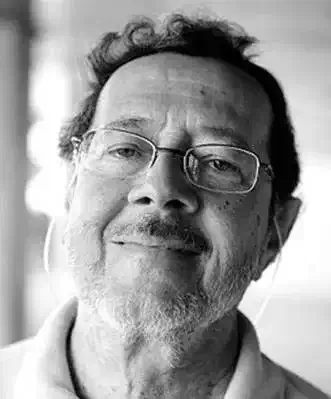
Ruy Espinheira Filho
 BR
BR
Ruy Espinheira Filho was a Brazilian poet whose work explored the complexity of human existence, the ephemerality of time, and the search for meaning amidst modernity. His poetry is marked by deep existential reflection and a dense, imagistic language that oscillates between lyricism and social critique. Through verses that frequently engage with literary tradition and the anxieties of his time, Espinheira Filho established himself as a singular voice in contemporary Brazilian poetry, leaving a legacy of works that invite introspection and questioning.
n. 1942-12-12, Salvador · m. , Salvador, Bahia, Brasil
Bio
Identification and Basic Context
Ruy Espinheira Filho (1941-2016) was a Brazilian poet. His poetic work is characterized by a deep reflection on the human condition, time, memory, and the ephemerality of life, often imbued with a melancholic and existential tone. He lived and produced most of his work in Brazil, writing in Portuguese.Childhood and Education
Ruy Espinheira Filho's childhood and education occurred in a context that, although not detailed in terms of specific influences in general sources, was likely shaped by the cultural and social effervescence of Brazil in the mid-20th century. The poet's literary education seems to have been based on diverse readings, which led him to develop his own style and absorb influences that would manifest in his work.Literary Career
Ruy Espinheira Filho's literary career began with the publication of his first poems, which gradually gained space in the Brazilian literary scene. Throughout his career, his work evolved in terms of themes and language, but maintained a guiding line of deep introspection and existential questioning. He collaborated with various publications and anthologies, consolidating his presence as a poet.Work, Style, and Literary Characteristics
Work, style, and literary characteristics Ruy Espinheira Filho's major works include "O Canto do Vento" (1971), "A Trama do Tempo" (1986), "Palavras em Tinta" (1999), and "O Limite das Horas" (2007). The dominant themes in his poetry are the inexorable passage of time, the fragility of existence, memory, the search for meaning, love, and death. His poetic form, while sometimes experimenting with structures, frequently turns to free verse, with strong musicality and a cadenced rhythm that underscore the melancholy of his verses. Espinheira Filho's language is dense, rich in images and metaphors, with a precise vocabulary that evokes deep sensations and reflections. His tone is predominantly lyrical and confessional, with a poetic voice that oscillates between the personal and the universal, inviting the reader to share his inquiries.Work, Style, and Literary Characteristics
Cultural and Historical Context Ruy Espinheira Filho produced his work during a period of intense transformations in Brazil and the world. Although there is no record of direct political involvement, his poetry reflects the existential anxieties common to human beings in any historical context, but which may have been accentuated by the uncertainties and challenges of Brazil in the last decades of the 20th century and the beginning of the 21st. His work engages with the tradition of Brazilian poetry while seeking a contemporary expression of human anguish.Work, Style, and Literary Characteristics
Personal Life Detailed information about Ruy Espinheira Filho's personal life, including affective relationships, family, friendships, and specific beliefs, is scarce in publicly accessible sources. It is known that his work is marked by an intense inner life, suggesting a reflective and sensitive personality to the nuances of human existence.Work, Style, and Literary Characteristics
Recognition and Reception Poet Ruy Espinheira Filho gained recognition in the Brazilian literary milieu for his contribution to contemporary poetry. His work was welcomed by critics and readers interested in poetry with a more introspective and philosophical bent. Although there is no record of major national awards, his name figures among the relevant poets of his generation.Work, Style, and Literary Characteristics
Influences and Legacy While specific influences from other authors are not widely documented, Ruy Espinheira Filho's style suggests familiarity with lyrical and existential poetry, possibly engaging with authors who explored similar themes. His legacy lies in his ability to articulate, through an elaborate and sensitive poetic language, the complexities of the human condition, the passage of time, and the incessant search for meaning, inspiring readers and potentially other poets to deepen their own reflections.Work, Style, and Literary Characteristics
Interpretation and Critical Analysis Ruy Espinheira Filho's work has been interpreted as an invitation to contemplate existence, with an emphasis on the transience of life and the importance of memory. Critical analyses frequently highlight the lyrical density and philosophical depth of his poems, which address universal themes such as love, loss, and the search for identity in a constantly changing world. Espinheira Filho's poetry lends itself to interpretations that emphasize his ability to evoke the melancholy inherent in the human condition, as well as the beauty found in ephemerality.Work, Style, and Literary Characteristics
Curiosities and Lesser-Known Aspects Focusing on Ruy Espinheira Filho's poetic creation, little is known about curiosities or lesser-known aspects of his life or writing habits. His work, however, suggests a meticulous creative process, focused on word and image, and a deep immersion in the existential questions that permeate his literary production.Work, Style, and Literary Characteristics
Death and Memory Ruy Espinheira Filho passed away in 2016. His memory is preserved through his poetic work, which continues to be read and studied, keeping alive the reflection on the themes that inspired him throughout his life.Poems
0No poems found
Comments (0)
No comments yet. Be the first to comment.