
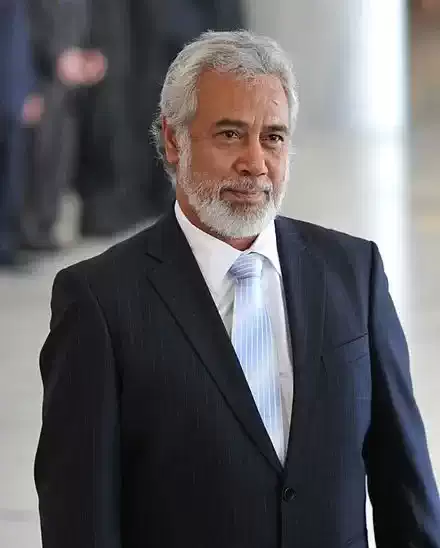
Xanana Gusmão
b. 1946
 TL
TL
TL
Xanana Gusmão is a prominent figure in the struggle for the independence of Timor-Leste, having played a crucial role as a political and military leader. His journey is marked by resistance against the Indonesian occupation and subsequent leadership in the nation-building of Timor-Leste. Beyond his political activity, Gusmão also has a facet as a writer, with poems that reflect his experiences and his vision of identity and freedom.
n. 1946-06-20, Laleia
45
Views
Bio
Identification and basic context
José Alexandre Gusmão, better known as Xanana Gusmão, is a politician and leader in the struggle for the independence of Timor-Leste. Born in Laleia, Açare, Manatuto, Portuguese Timor, he is a central figure in the contemporary history of his country. His nationality is Timorese, and the main language of writing, when he expresses himself literarily, is Portuguese.Childhood and education
Details about Xanana Gusmão's childhood and education are less documented in terms of formal literary background. It is known that he grew up in difficult circumstances and observed the sociopolitical complexities of Timor-Leste under colonial administration and, subsequently, under occupation.Literary career
Xanana Gusmão's writing, although not his primary activity, emerges as a form of personal expression and sharing of reflections. His poems, often laden with symbolism and emotion, appear as a counterpoint to his political responsibilities, offering a more intimate glimpse into his thoughts and soul.Work, style, and literary characteristics
Xanana Gusmão's poetic work, though not extensive, addresses themes such as freedom, national identity, resistance, and hope. His style is marked by direct yet evocative language, conveying a strong sense of belonging and struggle. The poetic form used tends to be free, prioritizing expressiveness and message over rigid metrics.Work, style, and literary characteristics
Cultural and historical context Xanana Gusmão is inseparable from the historical context of the struggle for Timor-Leste's independence. His poetic work reflects the aspirations and sacrifices of a people seeking self-determination. He is intrinsically linked to the resistance movements and the formation of the new Timorese nation.Work, style, and literary characteristics
Personal life Xanana Gusmão's personal life is largely dedicated to the Timorese cause. His experiences as a resistance leader, the hardships faced, imprisonment, and subsequent political leadership have profoundly shaped his worldview and artistic expression. His dedication to his homeland is a distinctive trait of his personality.Work, style, and literary characteristics
Recognition and reception As a political leader, Xanana Gusmão has received vast national and international recognition. His facet as a writer is also appreciated by many, especially in the Timorese context and among those who follow his trajectory and work. His poetry is seen as a testament to the struggle and the soul of Timor-Leste.Work, style, and literary characteristics
Influences and legacy Gusmão's influences in poetry may stem from his experiences, Timorese culture, and readings that marked his intellectual and political formation. His literary legacy, although secondary to his political one, contributes to the cultural heritage of Timor-Leste, offering an authentic perspective on its history and people.Work, style, and literary characteristics
Interpretation and critical analysis Xanana Gusmão's poetry can be interpreted as a mirror of his struggles and aspirations. The themes addressed refer to the human condition, resilience, and the search for a better future, always with a strong rooting in the Timorese reality.Work, style, and literary characteristics
Curiosities and lesser-known aspects Beyond his public role, Gusmão's poetic facet reveals a more introspective and sensitive side. Poetry possibly serves as a space for him to process the complexities of leadership and nation-building.Work, style, and literary characteristics
Death and memory Currently, Xanana Gusmão is alive and continues to play an active role in the political life of Timor-Leste. His memory is intrinsically linked to the history of his country's independence.Poems
0No poems found
Comments (0)
Log in
to post a comment.
No comments yet. Be the first to comment.