
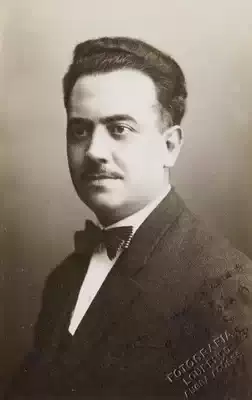
Armando Cortes-Rodrigues
1891–1971
· vivió 80 años
 PT
PT
PT
Armando Cortes-Rodrigues was a Portuguese poet and writer, whose work is part of the Symbolism and Modernism currents. His poetry is marked by a profound musicality, a melancholic tone, and an exploration of themes such as death, time, and saudade, often evoked through a language rich in symbolism and sensory imagery. He was also an important disseminator of Portuguese literature and culture.
n. 1891-02-28, Vila Franca do Campo · m. 1971-10-14, Ponta Delgada
43
Visualizaciones
Biografía
Identification and basic context
Armando de Campos Cortes-Rodrigues, known as Armando Cortes-Rodrigues, was a Portuguese poet, essayist, literary critic, and professor. He was born in 1906 and died in 1971. His poetic work is often associated with the Symbolist and Modernist currents, and he was one of the founders of the magazine "Presença", a landmark of Portuguese Modernism. He held a degree in Germanic Philology from the Faculty of Arts of the University of Coimbra.Childhood and education
Armando Cortes-Rodrigues was born and raised in an environment that allowed him access to a solid academic education. His degree in Germanic Philology in Coimbra reveals an early interest in literature and languages, as well as an openness to foreign literary influences. His intellectual training was fundamental to the development of his critical thinking and aesthetic sensibility, absorbing the literary and cultural trends of his time.Literary career
Armando Cortes-Rodrigues's literary career was multifaceted. He first distinguished himself as a poet, publishing works that placed him in the literary scene of the time. He was one of the founders and active collaborators of the influential magazine "Presença", demonstrating his central role in the Portuguese modernist movement. In addition to poetry, he dedicated himself to essays, literary criticism, and translation, contributing to the dissemination and analysis of Portuguese and foreign literature. His activity as a university professor, especially in Coimbra, also marked his career.Work, style, and literary characteristics
Armando Cortes-Rodrigues's poetic work is notable for its musicality, dense lyricism, and exploration of themes such as death, time, saudade, and the ephemerality of existence. His style is often classified as Symbolist, with careful language, rich in sensory images and evocative metaphors. The use of verse, sometimes with influences of free verse, contributes to the fluidity and rhythm of his compositions. The tone of his poetry is sometimes elegiac and introspective. In addition to poetry, his essays and literary criticism are important for understanding his thought and the literary context of the time. His work dialogues with the Portuguese poetic tradition but incorporates the innovations and sensibilities of Modernism.Cultural and historical context
Armando Cortes-Rodrigues lived in a period of great transformations in Portugal and Europe. The "Presença" movement, of which he was a founder, sought to renew Portuguese literature, aligning it with European avant-gardes. His work as a professor in Coimbra placed him at the center of the country's intellectual and academic life. His position as a critic and literary theorist allowed him to intervene in the cultural debates of his time, establishing dialogues and, at times, tensions with other writers and literary currents.Personal life
Armando Cortes-Rodrigues led a life dedicated to study, writing, and teaching. His personal and affective relationships, although less publicly documented, certainly shaped his worldview and influenced his work. His dedication to his academic and literary career suggests a focused and intellectually active personality. His philosophical and cultural positions are more evident in his essayistic and critical work than in detailed autobiographical revelations.Recognition and reception
Armando Cortes-Rodrigues's recognition was significant, especially in the intellectual and academic circles. His founding of the magazine "Presença" and his active participation in the modernist movement consolidated his importance. His poetic work is appreciated for its aesthetic quality and the depth of the themes addressed, being studied and valued by literary critics. His role as a professor also earned him a respected status.Influences and legacy
Cortes-Rodrigues was influenced by European Symbolist poets and the Portuguese lyrical tradition. His work, in turn, influenced later generations of poets and critics, especially regarding the renewal of poetic language and the exploration of existential themes. His legacy lies not only in his literary production but also in his role as a promoter of Modernism in Portugal through the magazine "Presença" and his academic activity.Interpretation and critical analysis
Armando Cortes-Rodrigues's work has been the subject of various critical interpretations, highlighting his formal mastery, symbolic complexity, and the resonance of his existential themes. The analysis of his poetry reveals a deep reflection on the human condition, the passage of time, and the search for transcendence.Curiosities and less-known aspects
Less-known aspects of Armando Cortes-Rodrigues's life, such as his relationship with the city of Coimbra beyond his academic career, or details about his writing and research habits, could enrich the understanding of his profile. The analysis of correspondence or unpublished manuscripts, if they exist, could reveal additional facets of his personality and creative process.Death and memory
Armando Cortes-Rodrigues died in 1971. His memory is kept alive through his work, which continues to be read and studied, and through his historical role in promoting Portuguese Modernism. Posthumous publications or revised editions of his work consolidate his place in Portuguese literature and culture.Poemas
0No se encontraron poemas
Comentarios (0)
Iniciar sesión
para publicar un comentario.
Aún no hay comentarios. Sé el primero en comentar.