
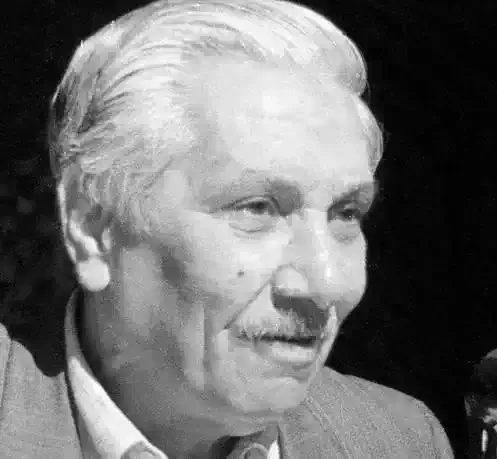
Abd al-Wahhab Al-Bayati
1926–1999
· lived 72 years
 IQ
IQ
IQ
Abd al-Wahhab Al-Bayati was a prominent Iraqi poet, considered one of the pioneers of modern Arabic poetry. His work is deeply marked by the experience of exile, the struggle against oppression, and the pursuit of social justice and freedom. Al-Bayati is known for his powerful poetic voice and his ability to blend Arab tradition with Western influences, creating poetry that resonates with universal themes of identity, hope, and resistance.
n. 1926-12-19, Bagdá · m. 1999-08-03, Damasco
39
Views
Bio
Identification and basic context
Abd al-Wahhab Al-Bayati (or Abdul Wahab Al-Bayati) was one of the most important Iraqi poets of the 20th century. Born in Baghdad, he became a central figure in modern Arabic poetry, often associated with the existentialist current and social engagement.Childhood and education
Al-Bayati grew up in an Iraq under British influence and witnessed the political and social changes of the time. His education included studies in literature and law. The experience of exile, which marked a large part of his adult life, certainly shaped his worldview and his poetic output, giving him a unique perspective on identity and homeland.Literary career
The beginning of his literary career took place during a period of cultural effervescence in the Arab world. Al-Bayati was one of the first poets to break away from the traditional forms of Arabic poetry, adopting free verse and introducing more modern and existential themes. His career was largely marked by exile, having lived in several countries, including Egypt, Lebanon, Syria, Iraq, Spain, and the United Kingdom. This nomadic life enriched his work with different cultural perspectives and intensified his themes of searching for a home and freedom.Work, style, and literary characteristics
The work of Al-Bayati is vast and diverse, addressing themes such as exile, lost homeland, social injustice, the struggle against tyranny, hope, and the pursuit of freedom and human dignity. His style is characterized by the fusion of the richness of Arab poetic tradition with influences from modern Western poetry, such as existentialism and symbolism. He masterfully used free verse, giving rhythm and musicality to his poems, which often possess a strong imagistic charge and a confessional and lyrical tone. His metaphors are powerful and evocative, reflecting his deep reflection on the human condition and political reality. Notable works include "The Song of Kara" (Lan Yantahi al-Ghurub - The Sunset Will Not End), "The Poem of the Last Night on the Island," and "The Poem of the City of X of X."Cultural and historical context
Al-Bayati lived and wrote during a period of intense political and social transformations in the Arab world, including the struggle for independence, nationalism, and regional conflicts. His political engagement and his desire for justice are clearly reflected in his poetry. He was an intellectual committed to the Arab cause and a fierce critic of authoritarian regimes. His work dialogues with the Arab literary tradition, but also with Western poetry, reflecting a cosmopolitan spirit and a search for a universal language.Personal life
Al-Bayati's personal life was profoundly influenced by his political activism and his convictions. Exile, which was a constant in his life, shaped his worldview and his work, giving him a particular sensitivity to issues of identity, belonging, and loss. His personal relationships and experiences permeated his poetry, giving it a confessional and authentic tone.Recognition and reception
Abd al-Wahhab Al-Bayati is widely recognized as one of the greatest Arab poets of the 20th century. He received several awards and distinctions throughout his career, and his work is studied and admired throughout the Arab world and internationally. He is considered a seminal figure in the modernization of Arabic poetry, influencing generations of later poets.Influences and legacy
Al-Bayati was influenced by classical Arab poets, as well as by figures of Western poetry such as T.S. Eliot and Pablo Neruda. His legacy is immense, having left an indelible mark on Arabic poetry, paving the way for new forms of expression and for a deeper engagement with social and political issues. His work continues to be a source of inspiration for poets and readers seeking poetry that is both aesthetically rich and socially conscious.Interpretation and critical analysis
Al-Bayati's poetry is often interpreted as a testimony to the experience of exile and the struggle for freedom. Critics highlight his ability to articulate the pain of separation from the homeland with hope for social transformation. His work can be seen as an exploration of Arab identity in the modern world, confronted with tradition and modernity.Curiosities and lesser-known aspects
Al-Bayati was known for his passionate temperament and his unwavering commitment to his ideals. His poetry, although often melancholic due to the themes of exile, is also marked by a vital force and a belief in the human capacity to overcome adversity.Death and memory
Abd al-Wahhab Al-Bayati passed away in Damascus, Syria. His death marked the end of an era for modern Arabic poetry, but his legacy endures through his vast work and the profound influence he had on Arabic literature and thought.Poems
0No poems found
Comments (0)
Log in
to post a comment.
No comments yet. Be the first to comment.