
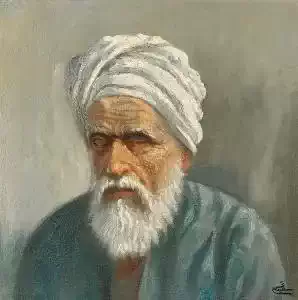
Abul ʿAla Al-Maʿarri

Abul ʿAla Al-Maʿarri was a prominent Arab poet, philosopher, and lexicographer of the Islamic Golden Age. Known for his profound scholarship and skeptical thought, his poetic work explores themes such as mortality, the nature of belief, and the absurdity of human existence. Al-Maʿarri, who lost his sight in childhood, became a respected and influential intellectual figure, although his sometimes controversial philosophical views generated debate.
n. 973, Maarate Anumane · m. 1057-05-09, Maarate Anumane
41
Views
Bio
Identification and Basic Context
Full Name: Ahmad ibn Abd Allah ibn Muhammad al-Ma'arri, known as Abul ʿAla Al-Maʿarri. Pseudonyms or Heteronyms: Not applicable. Date and Place of Birth: Born in Ma'arrat al-Nu'man, Syria, in 973 AD. Family Background, Social Class, and Originating Cultural Context: Hailing from a middle-class family in Ma'arrat al-Nu'man. Grew up in a rich cultural environment within the Abbasid Caliphate. Nationality and Language(s) of Writing: Arabic. Historical Context in Which He Lived: Lived during the period of the Abbasid Caliphate, a time of cultural and intellectual flourishing in the Islamic world, but also of political instability and sectarian conflicts.Childhood and Education
Al-Maʿarri lost his sight at the age of four due to smallpox, which led him to a period of isolation but also to intense dedication to his studies. He studied in Aleppo and Antioch, where he had access to vast libraries and renowned teachers. His education was profoundly marked by the study of the Quran, classical Arabic literature, and Greek philosophy.Literary Career
He began his literary career early, distinguishing himself with his prodigious memory and his ability to compose poetry and prose. After a period of travel and study, he returned to Ma'arrat al-Nu'man, where he dedicated himself to teaching and writing. His work is vast and covers poetry, philosophy, lexicography, and literary criticism.Work, Style, and Literary Characteristics
His most famous works include the "Luzumiyyat" (a collection of poems with obligatory rhymes) and the "Risalat al-Ghufran" (Epistle of Forgiveness), an allegorical work that anticipated elements of Dante's Divine Comedy. The central themes of his poetry are reflections on life and death, criticism of organized religion, philosophical skepticism, social injustice, and the ephemerality of existence. His style is characterized by complexity, irony, pessimism, and a rich, erudite vocabulary. He was known for his use of complex rhymes and meters, and for his tendency towards formal experimentation.Cultural and Historical Context
Al-Maʿarri lived in a period when the Islamic world was a center of knowledge, but also the stage for religious and political tensions. His works reflect a critical and independent spirit, at times at odds with the religious and social orthodoxies of his time. He maintained contact with other intellectuals, but his fame and his sometimes controversial ideas led him to be seen as a singular and isolated figure.Personal Life
Al-Maʿarri led an ascetic life dedicated to study. He never married nor had children. His blindness from childhood profoundly influenced his perception of the world and his work, leading him to constant introspection.Recognition and Reception
During his lifetime, Al-Maʿarri was widely respected as one of the greatest poets and scholars of his era. However, his philosophical and religious ideas, particularly his skepticism and his criticism of dogma, generated controversy and criticism from some religious circles. Posthumously, his recognition grew, and he is now considered a fundamental figure in Arabic literature and philosophy.Influences and Legacy
Al-Maʿarri was influenced by Greek philosophy and the Arab poetic tradition. His legacy is immense, not only for his vast literary and lexicographical work but also for his profound influence on philosophical thought and Arabic poetry. He is considered a precursor of skeptical and existentialist ideas.Interpretation and Critical Analysis
Al-Maʿarri's work is often interpreted as a meditation on the human condition, the pursuit of knowledge, and a critique of hypocrisy. His reflections on religion and morality continue to provoke debate and inspire critical analysis.Curiosities and Lesser-Known Aspects
Al-Maʿarri lived as a recluse in the final years of his life, dedicating himself entirely to writing and study. He was known to be a vegetarian and to hold a critical view of slavery.Death and Memory
Abul ʿAla Al-Maʿarri passed away in 1057 AD in Ma'arrat al-Nu'man. His memory is kept alive through his writings and his lasting impact on Arab and world culture.Poems
0No poems found
Comments (0)
Log in
to post a comment.
No comments yet. Be the first to comment.