
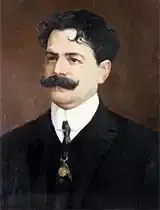
Afrânio Peixoto
 BR
BR
Afrânio Peixoto was a Brazilian physician, professor, politician, and writer, a prominent figure in the culture and literature of his time. His work ranges from poetry to historical and literary studies, always with a keen eye on the particularities of Brazil and its language. Peixoto demonstrated a deep appreciation for literary tradition, while simultaneously engaging in the intellectual debates of his time, defending the importance of national culture and the purity of the Portuguese language. His work as an educator and a member of institutions such as the Brazilian Academy of Letters consolidated his position as an influential intellectual. Through his writings, he sought not only to express his poetic sensibility but also to contribute to the formation of a Brazilian cultural identity, revisiting and reinterpreting the country's history and literature.
n. 1876-12-17, Lençóis · m. 1947-01-12, Rio de Janeiro
Bio
Identification and basic context
Full name: Afrânio da Silva Peixoto Pseudonyms or heteronyms: No known pseudonyms. Date and place of birth (and death, if applicable): Born on February 18, 1894, in Rio de Janeiro, RJ. Died on August 13, 1959, in Rio de Janeiro. Family background, social class, and cultural context of origin: Son of the renowned physician and writer Afrânio Peixoto (1867-1959) and Maria da Glória Peixoto. He belonged to a family of intellectuals and physicians, embedded in the cultural and social elite of Rio de Janeiro. Nationality and writing language(s): Brazilian, wrote in Portuguese. Historical context in which he lived: He lived most of his life during the First Republic and the Estado Novo period in Brazil, experiencing significant social, political, and cultural transformations. He was a witness and participant in the intellectual scene of Rio de Janeiro and the discussions about national identity and the country's modernization.Childhood and education
Family background and social environment: He grew up in an intellectual household, strongly influenced by his father, Afrânio Peixoto, who was a central figure in the Brazilian Academy of Letters and medicine. This upbringing provided him with an environment conducive to intellectual and literary development. Formal education and self-teaching: He graduated in Medicine from the Faculty of Medicine of Rio de Janeiro. In addition to his academic training, he dedicated himself intensely to literary, historical, and philological studies, demonstrating vast self-taught knowledge. Early influences (readings, culture, religion, politics): He was influenced by the classics of Brazilian and universal literature, by the grammatical and philological tradition, and by the intellectual discussions promoted by his father and his circle of friends. Academic culture and a passion for the Portuguese language were decisive. Literary, philosophical, or artistic movements he absorbed: Although his work is rooted in tradition, he absorbed elements of Parnassianism and Symbolism, but his more conservative stance regarding language and form distanced him from the more radical modernist avant-gardes. Significant events in his youth: His close connection to the intellectual and literary milieu of Rio de Janeiro, through his father, marked his youth, giving him access to discussions and debates that shaped his thinking.Literary career
Start of writing (when and how it began): He began writing early, influenced by his family environment and his passion for literature and the Portuguese language. His literary career developed in parallel with his medical and academic activities. Evolution over time (phases, changes in style): His poetic work maintained a relative constancy in style, guided by erudition and lyricism. However, his production expanded to critical, philological, and historical studies, where his erudition manifested with greater vigor. Chronological evolution of his work: He published books of poetry and essays throughout his life, with notable contributions to literary criticism and the history of Brazilian literature. Collaborations in magazines, newspapers, and anthologies: He actively collaborated in various cultural and scientific publications, such as the "Revista Brasileira de Filologia" and the "Jornal de Letras." Activity as critic, translator, or editor: He stood out as a literary critic, philologist, and historian of literature. He also worked as a professor and academic, dedicating himself to studies on the Portuguese language and the work of great Brazilian authors.Work, style, and literary characteristics
Work, style, and literary characteristics Main works with dates and production context: * *A Língua Latina no Brasil* (1918) - Study on the influence of Latin. * *Abreu e o Arcadismo Mineiro* (1922) - Critical analysis of Arcadism. * *A Poesia da Bahia* (1926) - Overview of Bahian poetic production. * *O Poeta e a sua Musa* (1927) - Essay on poetic creation. Dominant themes — love, death, time, nature, identity, spirituality, etc.: In his poetry, themes of the homeland, history, the Portuguese language, saudade (longing), and a certain existential melancholy are recurrent. His essays address Brazilian literature, philology, and history. Form and structure — use of sonnet, free verse, fixed form, metric experimentation: His poetry tended to follow more traditional forms, with meter and rhyme, approaching a refined Parnassian aesthetic, but with modern sensibility. Poetic resources (metaphor, rhythm, musicality): He used resources such as metaphor and alliteration, seeking musicality and formal rigor. Tone and poetic voice — lyrical, satirical, elegiac, epic, ironic, confessional: The predominant tone is lyrical and reflective, at times elegiac, with a voice that exalts tradition and the beauty of language. Poetic voice (personal, universal, fragmented, etc.): His poetic voice was personal and erudite, but sought universality through the exploration of perennial themes such as identity and memory. Language and style — vocabulary, imagery density, preferred rhetorical devices: His language is cultured, precise, and elegant, with a rich vocabulary and judicious use of rhetorical devices. He avoided radical experimentation in favor of clarity and formal beauty. Formal or thematic innovations introduced in literature: He was not a radical innovator in terms of form, but his dedication to the study and valorization of Brazilian literature and the Portuguese language, during a period of intense change, was a significant contribution. Relationship with tradition and modernity: He maintained a respectful dialogue with literary tradition, defending the solidity of language and form, while positioning himself in relation to the intellectual debates of his time. Literary movements associated (e.g., symbolism, modernism): Although he lived alongside Modernism, his poetic work maintained affinities with Parnassianism and Symbolism, without fully adhering to the avant-garde proposals. Lesser-known or unpublished works: Information about unpublished works is scarce in general bibliography.Work, style, and literary characteristics
Cultural and historical context Relationship with historical events (wars, revolutions, regimes): He lived through the First Republic, the Week of Modern Art, the Vargas Era, and the beginning of redemocratization. His work reflects a context of seeking a national identity and debates about the role of culture. Relationship with other writers or literary circles: He maintained relationships with important intellectuals of his time, such as his father, and frequented the literary circles of Rio de Janeiro, being an active member of the Brazilian Academy of Letters. Generation or movement to which he belongs (e.g., Romanticism, Modernism): He can be associated with a generation that, although contemporary to Modernism, maintained a more conservative and academic stance in literature, valuing tradition and educated norms. Political or philosophical position: A defender of a conservative view of language and culture, with a strong nationalist sentiment and attachment to academic values. Influence of society and culture on his work: Brazilian society, with its identity dilemmas and the richness of its language, was a central theme in his writings, both poetic and essayistic. Dialogues and tensions with contemporaries: He played a role as mediator and guardian of tradition amidst the effervescent modernist proposals. His positions were sometimes contrasting with the more experimental writers. Critical reception during his lifetime vs. posthumous recognition: He was respected during his lifetime as an intellectual and poet, especially in academic and conservative circles. His posthumous recognition continues in studies of Portuguese language and literature.Work, style, and literary characteristics
Personal life Significant affective and family relationships and how they shaped his work: His relationship with his father, Afrânio Peixoto, was fundamental, directly influencing his intellectual and literary formation. Details about other affective relationships are less prominent in his public biography. Literary friendships and rivalries: He frequented literary and academic circles, maintaining comradely relationships with many intellectuals. His more conservative positions could lead to disagreements with the more radical modernists, but there are no records of major explicit rivalries. Personal experiences and crises, illnesses, or conflicts: Information about deep personal crises or significant conflicts in his life is limited in the available bibliography. Parallel professions (if he didn't live solely from poetry): He was a physician, university professor, and held public office related to education and culture. His life was marked by a diversity of intellectual and professional activities. Religious, spiritual, or philosophical beliefs: There are no prominent records of specific religious or philosophical beliefs that explicitly marked his work, although a certain lyricism and melancholy may suggest a reflection on the existential. Political positions and civic engagement: He held public office and actively participated in academic and cultural life, demonstrating civic engagement focused on preserving Brazilian culture and language.Work, style, and literary characteristics
Recognition and reception Place in national and international literature: He is a recognized name in Brazilian literature, primarily as a scholar of language and literary history, and as a poet of a more traditional bent. His international projection is more limited. Awards, distinctions, and institutional recognition: Member of the Brazilian Academy of Letters, he occupied chair number 1. Critical reception during his lifetime and over time: During his lifetime, he was a respected and listened-to intellectual. His poetry is valued for its erudition and lyricism, although it does not have the avant-garde impact of other authors of his time. His essayistic work on Brazilian language and literature is fundamental for studies in the field. Popularity vs. academic recognition: His recognition is predominantly academic and within specialized literary circles, with less popularity among the general public.Work, style, and literary characteristics
Influences and legacy Authors who influenced him: His father, Afrânio Peixoto, the classics of Portuguese and Brazilian literature (Camões, Gregório de Matos), and the Parnassian and Symbolist authors. Poets and movements he influenced: His influence falls upon poets and scholars who value form, meter, and linguistic rigor, and who dedicate themselves to the study of Brazilian literary history and criticism. He did not directly influence avant-garde movements. Impact on national and world literature and subsequent generations of poets: His impact is more notable in the fields of philology, literary criticism, and the maintenance of a certain poetic tradition. He was a guardian of language and literary history. Entry into the literary canon: He is included in the Brazilian literary canon as a poet and, mainly, as an essayist and literary critic. Translations and international dissemination: Information on translations and international dissemination of his work is limited. Adaptations (music, theater, cinema): There are no prominent records of adaptations of his poetic work into other media. Academic studies dedicated to his work: His work has been the subject of academic studies, especially concerning philology, literary criticism, and the history of Brazilian literature.Work, style, and literary characteristics
Interpretation and critical analysis Possible readings of his work: His poetry can be read as a lyrical expression of saudade, time, and homeland, with a focus on formal beauty and tradition. His essays are read as important documents for understanding the evolution of Brazilian language and literature. Philosophical and existential themes: He addresses themes such as the ephemerality of time, national identity, and the permanence of art and language. Controversies or critical debates: His conservative positions regarding language and art, in contrast to the modernist avant-gardes, generated debates and positioned him as a representative of a more traditional strand of Brazilian literary thought.Work, style, and literary characteristics
Curiosities and lesser-known aspects Lesser-known aspects of his personality: Sometimes portrayed as an erudite and somewhat formal intellectual, his private life is less publicly known compared to his public activities. Contradictions between life and work: There are no evident contradictions between his life and work; both seem harmoniously dedicated to the defense of Brazilian culture and language. Significant or anecdotal episodes that illuminate the author's profile: His dedication to the Brazilian Academy of Letters and to the study of the Portuguese language is a striking trait of his profile. Objects, places, or rituals associated with poetic creation: The intellectual environment of Rio de Janeiro, libraries, and literary gatherings were likely frequented and influential in his production. Writing habits: It is presumed that his writing was methodical and erudite, aligned with his training and intellectual posture. Curious episodes: His relationship with his father, from whom he inherited his name and intellectual career, is a point of interest. Manuscripts, diaries, or correspondence: Details about the existence and content of manuscripts, diaries, or correspondence are scarce in the general bibliography.Work, style, and literary characteristics
Death and memory Circumstances of death: Died of pneumonia at the age of 65. Posthumous publications: Some of his works or studies may have been reissued or compiled posthumously, but there is no record of major unpublished works published after his death.Poems
0No poems found
Comments (0)
No comments yet. Be the first to comment.