
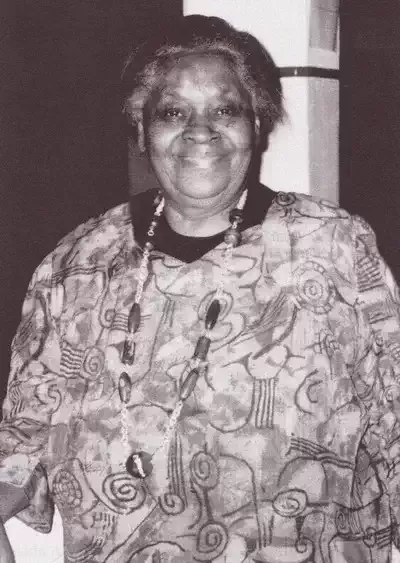
Alda do Espírito Santo
 ST
ST
Alda do Espírito Santo was a Santomean poet, writer, and educator, a prominent figure in Portuguese-language African literature. Her poetic work, deeply marked by identity, the struggle for liberation, and the valorization of African and Santomean culture, is a testament to her experiences and her social and political commitment. With a lyrical and expressive language, she explored themes such as the land, ancestry, women, justice, and hope. She was an essential voice in the construction of the national identity of São Tomé and Príncipe and in the affirmation of its literature on the Lusophone and global stage.
n. 1926-04-30, São Tomé e Príncipe · m. 2010-03-09, Luanda
Bio
Identification and basic context
Alda Maria dos Espírito Santo Silva was a Santomean poet, short-story writer, pedagogue, and political activist. Born in São Tomé, she was an unavoidable figure in the literature and struggle for the independence of São Tomé and Príncipe. Her name is intrinsically linked to the affirmation of Santomean identity and culture.Childhood and education
Alda do Espírito Santo grew up in a São Tomé under Portuguese colonial rule. Her education included formal schooling, which equipped her with tools for writing and civic intervention. Experiencing colonial reality, social injustices, and the pursuit of self-determination were elements that shaped her worldview and her literary output.Literary career
Alda do Espírito Santo's literary career began with the publication of her poems, which quickly stood out for their expressive power and commitment to the land and the Santomean people. She was one of the most important poetic voices of her generation, contributing to the consolidation of São Tomé and Príncipe's literature. Her political activism and participation in the struggle for independence also intertwined with her work, giving it a character of denunciation and hope.Work, style, and literary characteristics
Alda do Espírito Santo's poetry is marked by strong lyricism, a deep connection to the land and nature of São Tomé and Príncipe, and a tone of revolt against colonial oppression. She explored themes such as African identity, longing for the homeland, the condition of women, exploitation, the struggle for freedom, and the construction of a more just future. Her style is characterized by clear and emotional language, the musicality of her verses, and a strong symbolic charge. Works like "Escravos de Diamantes" and "O Poema de uma Vida" are examples of her sensitivity and engagement.Cultural and historical context
Alda do Espírito Santo lived through a crucial period in the history of São Tomé and Príncipe, a time of struggle for independence and national affirmation. She was one of the important figures of the Movement for the Liberation of São Tomé and Príncipe (MLSTP). Her work reflects the aspirations of her people and the search for a distinct cultural identity, free from colonial subjugation. She maintained dialogue with other African and Lusophone writers, actively participating in the dissemination of African culture.Personal life
Beyond her literary and political activities, Alda do Espírito Santo dedicated herself to education, being a defender of teaching and literacy in São Tomé and Príncipe. Her life experiences, her familiarity with colonial reality, and the struggle for independence shaped her worldview and her work, giving her an authentic and combative voice.Recognition and reception
Alda do Espírito Santo's work is widely recognized in São Tomé and Príncipe and within the context of Portuguese-language African literature. She is considered a pillar of Santomean cultural identity and an essential voice in Lusophone literature. Her contributions to education and the struggle for independence are also valued.Influences and legacy
Alda do Espírito Santo drew inspiration from African roots, Santomean culture, and liberation struggles. Her legacy lies in her poetry, which celebrates the land, the identity, and the dignity of the Santomean people, as well as in her civic and political engagement. She is a reference for younger generations of writers and activists in São Tomé and Príncipe and throughout Africa.Interpretation and critical analysis
Alda do Espírito Santo's work is seen as an important document of the history and culture of São Tomé and Príncipe. Her poetry is analyzed for its ability to express the pains and hopes of a people seeking freedom and self-affirmation.Curiosities and lesser-known aspects
Her dedication to education and the promotion of Santomean language and culture was an important facet of her life, often parallel to her literary and political activities.Death and memory
Alda do Espírito Santo passed away in Lisbon, but her body was repatriated to São Tomé, where she was honored as a national hero. Her memory is preserved as that of one of the greatest Portuguese-language poets and a fundamental figure in the history of São Tomé and Príncipe.Poems
0No poems found
Comments (0)
No comments yet. Be the first to comment.