
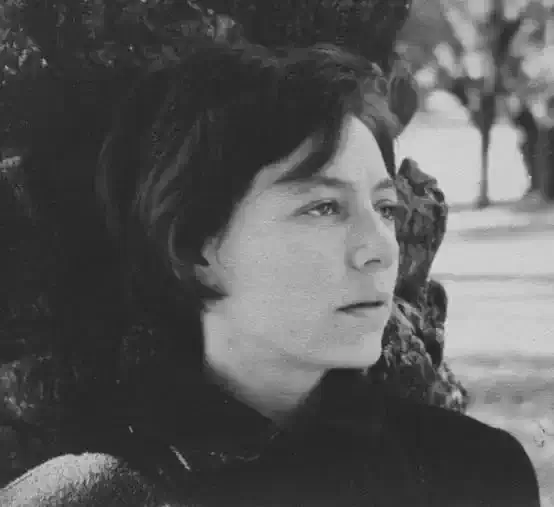
Alejandra Pizarnik
 AR
AR
Alejandra Pizarnik was an internationally renowned Argentine poet, known for her work marked by existential anguish, the exploration of silence, and the incessant search for a language capable of naming the unspeakable. Her poetry, often dark and introspective, delves into themes such as death, emptiness, solitude, lost childhood, and the desire for annihilation. With an aesthetic that oscillates between the dreamlike and the nightmarish, Pizarnik used concise and fragmented language, laden with striking imagery and a unique musicality, which made her an iconic figure in 20th-century Latin American poetry. Her life, marked by crises and profound melancholy, is reflected in the intensity and vulnerability of her writing.
n. 1936-04-29, Avellaneda · m. 1972-09-25, Buenos Aires
Bio
Identification and basic context
Alejandra Pizarnik was an Argentine poet, born in Buenos Aires, known for her deeply introspective work marked by existential anguish. She also used the pseudonym "Laura" at times. Her nationality was Argentine and she wrote in Spanish. She lived during a period of intense social and cultural transformations in Argentina and the world.Childhood and education
Born into a family of Russian Jewish immigrants, her childhood was marked by feelings of rootlessness and the search for identity. She studied philosophy and literature at the University of Buenos Aires, but dropped out to dedicate herself entirely to literature. She was influenced by poets such as Arthur Rimbaud, Emily Dickinson, and Comte de Lautréamont, as well as movements like surrealism and psychoanalysis.Literary career
She began her literary career early, publishing her first poems in literary magazines. Her work evolved over time, deepening the exploration of themes of solitude, death, and language. She published important books such as "La tierra más ajena" (1955), "La última inocencia" (1956), "Las aventuras perdidas" (1958), "Árbol de Diana" (1960), "Los trabajos y las noches" (1965), "Extración de la piedra de locura" (1968), and "La condesa sangrienta" (1971). Her work as a literary critic and translator was also significant.Work, style, and literary characteristics
Pizarnik's works are characterized by the exploration of themes such as death, emptiness, solitude, lost childhood, the desire for annihilation, and the difficulty of communication. Her language is concise, fragmented, and loaded with striking imagery, often dreamlike or nightmarish. She masterfully uses free verse, creating a dark and disturbing musicality. Her poetic voice is deeply personal, confessional, and at times desperate. Pizarnik is associated with surrealism, but her work transcends labels, with a unique aesthetic that dialogues with tradition and modernity. She introduced a form of lyric expressionism that marked poetry in the Spanish language.Cultural and historical context
Pizarnik lived during a period of cultural effervescence in Argentina, with the emergence of new literary and artistic movements. Her work engaged with surrealism and psychoanalysis, significant influences of her time. She maintained contact with other writers and artists, participating in literary circles in Buenos Aires and Paris, where she lived for a time.Personal life
Her life was marked by existential crises, feelings of inadequacy, and emotional instability, which were intensely reflected in her poetry. She had significant relationships but also experienced profound loneliness. Her struggles with mental health and substance use are well-known aspects of her biography.Recognition and reception
Although she had more limited recognition during her lifetime, Alejandra Pizarnik achieved broad international recognition after her death. Her work is studied in universities and admired for its originality and depth. She is considered one of the most important voices in 20th-century Latin American poetry.Influences and legacy
She was influenced by poets such as Arthur Rimbaud, Emily Dickinson, and Comte de Lautréamont. Her legacy is immense, inspiring generations of poets with her radical exploration of language and subjectivity. Her work continues to be translated and studied worldwide, consolidating her position in the literary canon.Interpretation and critical analysis
Pizarnik's work is fertile ground for critical analysis, with interpretations that address her relationship with the unconscious, metalanguage, critique of language, and the exploration of the feminine and the tragic. Debates about her work often revolve around the difficulty of classifying her style and the depth of her anguish.Curiosities and lesser-known aspects
Pizarnik was known for her extreme shyness and her complex relationship with writing, sometimes considered an act of self-flagellation. Her notebooks and manuscripts reveal a meticulous creative process and constant self-demand. Her stay in Paris and contact with the surrealist circle were important moments in her trajectory.Death and memory
Alejandra Pizarnik died tragically in 1972 in Buenos Aires, from a barbiturate overdose, in an act that many interpret as a premeditated end. Her memory is kept alive through her work, which continues to resonate with readers and critics for its power and originality.Poems
0No poems found
Comments (0)
No comments yet. Be the first to comment.