
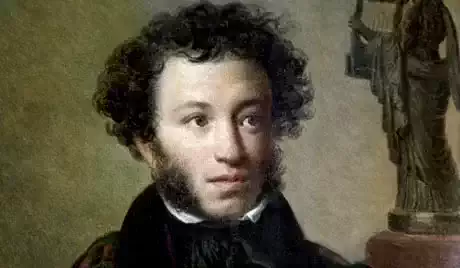
Alexandre Pushkin
1799–1837
· lived 37 years
 RU
RU
RU
Alexander Pushkin is widely regarded as the greatest Russian poet and the founder of modern Russian literature. His work spans a vast range of genres, including lyric, epic, narrative poetry, and drama. With a style that blends the colloquial and the elevated, Pushkin explored themes such as love, freedom, honor, and destiny, leaving an indelible legacy on Russian and world culture.
n. 1799-05-26, Moscovo · m. 1837-01-29, São Petersburgo
59
Views
Bio
Identification and Basic Context
Alexandr Sergeyevich Pushkin (in Russian: Александр Сергеевич Пушкин) was born in Moscow on June 6, 1799 (May 26 Julian calendar) and died in Saint Petersburg on February 10, 1837 (January 29 Julian calendar). He is considered the most important Russian poet and the founder of modern Russian literature. He was a nobleman by birth, descended from Russian and African lineages (through his great-grandfather Abram Petrovich Gannibal, an Ethiopian who became a military officer in Russia).Childhood and Education
Pushkin spent his childhood in Moscow, surrounded by his family and by nannies who told him Russian folk tales. He received a meticulous education, with French tutors, but his true passion for the Russian language and literature was awakened later, especially during his years at the Lyceum of Tsarskoye Selo (1811-1817), where he studied with other future intellectuals and poets. It was during this period that he began to write poetry, absorbing influences from classical and contemporary literature, as well as from Enlightenment ideas.Literary Career
Pushkin's writing began in his adolescence. His literary ascent was rapid, with the publication of "Ruslan and Ludmila" (1820) causing a sensation. Throughout his career, Pushkin went through different phases, from the initial "romanticism," influenced by Lord Byron, to a maturity that masterfully explored the Russian language. He published in various literary journals and almanacs of the time, such as "The Contemporary" (which he founded in 1836), and was an active translator and literary critic.Work, Style, and Literary Characteristics
Pushkin's main works include the narrative poem "The Prisoner of the Caucasus" (1822), "The Gypsies" (1827), the novel in verse "Eugene Onegin" (completed in 1833, published in parts between 1825-1832), the novella "The Queen of Spades" (1834), and the drama "Boris Godunov" (1825). The dominant themes in his work are love, freedom, friendship, honor, destiny, power, and the history of Russia. Pushkin mastered a wide range of poetic forms, from the sonnet to free verse, being especially notable for his ability to create "Eugene Onegin," a novel in verse with its own meter and style (the "Onegin stanza"). His poetic resources include vivid metaphors, captivating rhythm, and unmistakable musicality. The tone of his poetic voice varies enormously, from the lyrical and passionate to the satirical and ironic, from the elegiac to the epic. Pushkin's language is at once precise and rich, combining scholarly vocabulary with popular speech, which gave it an unprecedented naturalness and vitality in Russian literature. He innovated by merging Russian literary tradition with European trends, creating a distinctive national style. He is associated with Romanticism, but transcended its limits, anticipating Realism.Cultural and Historical Context
Pushkin lived in a period of intense political and social turmoil in Russia, under the autocratic rule of Tsars Alexander I and Nicholas I. He was friends with many intellectuals and Decembrists, and his own liberal ideas put him in conflict with the authorities, leading to exiles. His work reflects the tensions between tradition and modernity, the West and Russia. He is one of the pillars of Russian Romanticism and a central figure of the "Golden Age" of Russian literature.Personal Life
Pushkin had an intense and often tumultuous personal life. He married Natalia Goncharova, a renowned beauty, in 1831, with whom he had four children. His relationships, including love affairs and deep friendships (with poets like Zhukovsky and Vyazemsky), shaped his poetry. He had literary rivalries, notably with other poets and critics. His life was marked by debts, gambling, and constant friction with censorship and high society.Recognition and Reception
In his lifetime, Pushkin was already immensely popular and admired as Russia's greatest poet. He received some institutional recognition, but also faced the distrust and censorship of the government. His recognition exploded after his death, making him a national hero and a central figure in the Russian literary canon.Influences and Legacy
Pushkin was influenced by poets such as Alexander Griboyedov, Vasily Zhukovsky, and, internationally, by Lord Byron. His legacy is immense: he is the father of modern Russian literature, influenced generations of Russian writers such as Dostoevsky, Tolstoy, Turgenev, Chekhov, and also poets worldwide. His work is universally studied, and his influence can be seen in countless musical (operas by Tchaikovsky, Rimsky-Korsakov), theatrical, and film adaptations.Interpretation and Critical Analysis
Pushkin's work is often analyzed from the perspective of individual freedom, the conflict between the artist and power, the nature of love, and Russian identity. Philosophically and existentially, he addressed the ephemerality of life and the search for meaning in a changing world. His life and work have generated debates about his political role and his relationship with Russian autocracy.Curiosities and Lesser-Known Aspects
Pushkin was known for his impulsive temperament and physical courage, which led him to participate in duels. His writing was often frantic, with lapses of memory and a direct style. He had a sharp sense of humor. His manuscripts and diaries reveal an intense and detailed creative process.Death and Memory
Pushkin died tragically at the age of 37, from wounds sustained in a duel with Georges-Charles de Heeckeren d'Anthès, who was courting his wife. His death shocked Russia and solidified his status as a martyr and national hero. Posthumous publications continued to expand the knowledge of his vast work.Poems
0No poems found
Quotes
6No poems found
Comments (0)
Log in
to post a comment.
No comments yet. Be the first to comment.