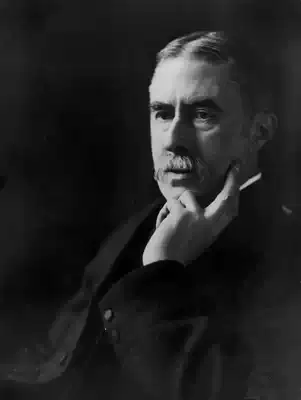
Identification and basic context
Full name: Alfred Edward Housman
Pseudonyms or heteronyms: Often used the initials A. E. Housman, but not known for significant pseudonyms or heteronyms in his creative work.
Date and place of birth (and death, if applicable): Born March 26, 1859, in Bromsgrove, Worcestershire, England. Died April 30, 1936, in Cambridge, England.
Family background, social class, and cultural context of origin: The eldest of seven children, his father, Alfred Housman, was a solicitor. His mother, Sarah Jane Green, died when he was twelve, a loss that profoundly affected him and perhaps influenced his melancholic themes. He came from a middle-class family with intellectual and professional aspirations.
Nationality and language(s) of writing: English; English.
Historical context in which they lived: Housman lived through the late Victorian era, the Edwardian period, and the early years of the reign of King George VI, including World War I. This was a time of great social and political change in Britain, marked by imperial expansion, industrialization, and the eventual dismantling of traditional certainties.
Childhood and education
Family background and social environment: His upbringing was marked by a stern, traditional, and somewhat remote father, and the early loss of his mother. This environment may have contributed to his reserved and introspective nature. His family valued education and scholarship.
Formal education and self-education: He was educated at Bromsgrove School, where he distinguished himself academically. He then attended St John's College, Oxford, on a scholarship, where he studied Classics. His time at Oxford was not entirely successful academically, and he failed to obtain a degree, a fact that deeply embarrassed him and possibly fueled a sense of personal failure.
Early influences (readings, culture, religion, politics): His early reading included classical literature, English poetry, and works that explored themes of fate and stoicism. His father's legal background might have instilled a sense of order and logic. His experiences at Oxford, including a close friendship with Moses Jackson and a subsequent unrequited love for him, are often cited as significant personal influences on his poetry.
Literary, philosophical, or artistic movements absorbed: Housman's work is characterized by a return to more traditional poetic forms and a rejection of the more elaborate, ornate styles of some Victorian poets. He is sometimes seen as a late Romantic or an echo of classical stoicism, though he stands somewhat apart from major movements.
Significant events in youth: The death of his mother and his disappointing performance at Oxford were significant events. His intense emotional experiences, particularly his unrequited love, are believed to have been a major source of inspiration for his poetry.
Literary trajectory
Beginning of writing (when and how it started): Housman began writing poetry early in his life, but his first major publication, "A Shropshire Lad," appeared in 1896, after years of private composition. He initially pursued a career in classical scholarship, and his poetry often drew upon his knowledge of ancient Greece and Rome.
Development over time (phases, changes in style): His poetic output was relatively limited. "A Shropshire Lad" established his characteristic style. "Last Poems" (1922) and "More Poems" (1936), published posthumously, largely continued in the same vein, characterized by their consistent tone and thematic concerns.
Chronological evolution of the work: His poetry is not marked by significant stylistic evolution. The core themes and voice remained consistent throughout his published collections.
Contributions to magazines, newspapers, and anthologies: He published poems in various journals and anthologies, but his major collections are the primary source of his poetic legacy.
Activity as a critic, translator, or editor: Housman was a highly respected classical scholar, holding professorships at University College, London, and later at Cambridge. He published critical editions of Roman poets, notably Manilius's "Astronomia," and was a formidable literary critic. His critical work often displayed a sharp, witty, and sometimes acerbic style.
Works, style, and literary characteristics
Major works with dates and context of production: "A Shropshire Lad" (1896) - published privately, gained popularity later, especially during WWI. "Last Poems" (1922) - a collection of poems written over many years. "More Poems" (1936) - published shortly after his death.
Dominant themes — love, death, time, nature, identity, homeland, spirituality, etc.: Mortality, the transience of life and beauty, the inevitability of decay and death, lost youth, unrequited love, the romanticized rural landscape (especially Shropshire), stoicism in the face of suffering, patriotism, and the harshness of fate.
Form and structure — use of the sonnet, free verse, fixed forms, metrical experimentation: Housman largely favored traditional forms, often using quatrains with regular rhyme schemes (ABAB, ABCB) and meters (often iambic). His poems are characterized by their musicality and conciseness.
Poetic devices (metaphor, rhythm, musicality): His use of imagery is stark and memorable, often juxtaposing idyllic rural scenes with the grim reality of death. Rhythm and musicality are paramount, contributing to the songs like quality of many of his poems. He employed simple, direct language but achieved profound emotional impact.
Tone and poetic voice — lyrical, satirical, elegiac, epic, ironic, confessional: The dominant tone is elegiac, melancholic, and stoic. There is often an undercurrent of disillusionment and fatalism, but also a brave acceptance of life's hardships. His voice is deeply personal yet often universal in its exploration of human vulnerability.
Poetic voice (personal, universal, fragmented, etc.): While deeply personal, rooted in his own experiences and philosophical outlook, his voice often achieves a universal resonance through its exploration of common human fears and desires.
Language and style — vocabulary, imagery density, preferred rhetorical devices: His language is remarkably pure, precise, and unadorned, often using simple Anglo-Saxon words. He eschews elaborate metaphor in favor of direct statement and striking, often grim, images. His rhetorical devices are subtle, relying on repetition, alliteration, and assonance to create mood and emphasis.
Formal or thematic innovations introduced into literature: Housman's innovation lay less in formal experimentation and more in his powerful distillation of themes of mortality and loss into perfectly crafted, deceptively simple lyrics. He brought a modern sensibility of disillusionment and stoicism to traditional forms.
Relationship with tradition and modernity: He looked back to classical poetic traditions and to earlier English poets, but infused them with a distinctly modern sense of existential anxiety and disillusionment.
Associated literary movements (e.g., symbolism, modernism): While active during the Modernist period, Housman did not align himself with its experimental trends. He is best understood as a transitional figure, a unique voice that bridged Victorian sensibility with the concerns of the 20th century, sometimes associated with the "Decadent" or "Aesthetic" movements for his focus on beauty and transience, but more broadly a post-Victorian lyricist.
Lesser-known or unpublished works: "The Shropshire Lad" contains 63 poems, and his subsequent collections added to this body of work. Much of his work was published during his lifetime or shortly after.
Cultural and historical context
Relationship with historical events (wars, revolutions, regimes): "A Shropshire Lad" saw a significant resurgence in popularity during World War I, as its themes of youth, loss, and the briefness of life resonated with soldiers facing death on the front lines. His poems offered a stoic perspective on sacrifice and fate.
Relationship with other writers or literary circles: Housman was somewhat reclusive and maintained limited contact with contemporary literary circles. He was respected for his scholarship but often kept his poetry private. He was known to be critical of some of his more flamboyant contemporaries.
Generation or movement to which they belong (e.g., Romanticism, Modernism, Surrealism): He is often considered part of the "Newbolt" generation of poets, who wrote about patriotism and rural England, but Housman's work is far more complex and melancholic than much of that group's output. He stands somewhat apart, often classified as a post-Victorian or early 20th-century lyric poet.
Political or philosophical stance: Housman was generally apolitical in his public life, though his poetry reflects a deeply pessimistic worldview that questions fate and human destiny. His philosophy is one of hard-won stoicism and acceptance of life's suffering.
Influence of society and culture on the work: The changing social landscape of Britain, the industrialization that threatened rural life, and the general sense of impending upheaval and war may have contributed to the melancholic and fatalistic undertones in his poetry. His academic life at Oxford and London also shaped his intellectual outlook.
Dialogues and tensions with contemporaries: He was often critical of the sentimentality he perceived in other poets. His precise, unsentimental approach to difficult themes set him apart from many contemporaries who engaged more directly with social or political issues.
Critical reception during life vs. posthumous recognition: During his life, Housman was recognized primarily as a distinguished classical scholar. His poetry, though appreciated by some, did not achieve widespread fame until later, particularly during WWI. Posthumously, his reputation as a poet grew significantly, and he is now considered one of the major English lyric poets of his era.
Personal life
Significant emotional and family relationships and how they shaped the work: The death of his mother was a profound and lasting trauma. His close, but apparently unrequited, affection for Moses Jackson at Oxford is widely believed to have been the source of much of the emotion in "A Shropshire Lad." His relationships with his siblings were complex.
Friendships and literary rivalries: He maintained close friendships, notably with Moses Jackson and his brother Laurence Housman, who was also a writer. He was known to be acerbic and critical of literary figures he did not respect, but this was more a feature of his scholarly persona than active rivalry.
Personal experiences and crises, illnesses, or conflicts: His perceived academic failure at Oxford and the emotional pain stemming from unrequited love are the most significant personal crises reflected in his work. He suffered from bouts of depression.
Parallel professions (if they did not live solely from poetry): He lived almost entirely as a classical scholar and professor, holding prestigious academic positions at University College, London, and Trinity College, Cambridge. Poetry was a more private, though deeply felt, pursuit.
Religious, spiritual, or philosophical beliefs: Housman was an agnostic and deeply skeptical of organized religion and conventional morality. His poetry reflects a secular, often bleak, but stoic view of life, emphasizing the importance of courage and endurance in a meaningless universe.
Political positions and civic engagement: He was largely disengaged from politics and public life, focusing on his academic work. His poetry touches on patriotism but from a detached, often fatalistic, perspective.
Recognition and reception
Place in national and international literature: Housman is considered one of the most important English lyric poets of the 20th century. His work has had a significant impact on English poetry and is widely studied internationally.
Awards, distinctions, and institutional recognition: He received numerous honors for his scholarship, including fellowships at Oxford and Cambridge, and was appointed Poet Laureate of the Second World War poets, though he did not hold an official title. He was made a Companion of Honour in 1932.
Critical reception at the time and over time: Initially, his poetry was not widely acclaimed. Critics sometimes found it too bleak or too simple. However, its power and unique voice were recognized by a discerning audience. Over time, his reputation as a master lyricist and profound explorer of human experience grew, and he is now highly praised for his precision, emotional depth, and philosophical resonance.
Popularity vs. academic recognition: "A Shropshire Lad" achieved considerable popularity, particularly among young men and soldiers. Academically, he is highly regarded for both his scholarship and his poetry. His poems remain staples in anthologies and are frequently studied at all levels.
Influences and legacy
Authors who influenced them: Classical poets such as Horace and Virgil, and English poets like William Shakespeare, A. H. Clough, and Christina Rossetti. His own deeply personal experiences were also a primary influence.
Poets and movements they influenced: Housman's precise, unsentimental, and melancholic lyricism influenced many poets of the 20th century, including W. H. Auden, who dedicated his collection "The Double Man" (1941) to Housman's memory. His stoic themes and formal control are widely admired.
Impact on national and world literature and on later generations of poets: His enduring poems have become part of the English literary consciousness, particularly his exploration of youth, mortality, and the bittersweetness of memory. He provided a model for lyrical expression grounded in emotional honesty and formal mastery.
Inclusion in the literary canon: Housman is a firmly established figure in the English literary canon, particularly in collections of poetry from the late Victorian and 20th centuries.
Translations and international dissemination: His poetry has been translated into numerous languages, and he is recognized internationally for his contribution to lyric poetry.
Adaptations (music, theater, film): Many of his poems have been set to music by composers such as George Butterworth, Ralph Vaughan Williams, and John Ireland. His work has also inspired theatrical pieces.
Academic studies dedicated to the work: Housman's poetry and his classical scholarship have been the subject of extensive academic study, focusing on his themes, style, influences, and biographical context.
Interpretation and critical analysis
Possible readings of the work: His poems can be read as expressions of personal loss and disillusionment, as meditations on the human condition, or as explorations of the aesthetic of transient beauty. His work is often seen as embodying a modern, secular pessimism tempered by stoic acceptance.
Philosophical and existential themes: Central themes include the awareness of mortality, the loss of innocence, the fleeting nature of happiness, the capriciousness of fate, and the search for meaning in a seemingly indifferent universe. His stoicism offers a way to confront these existential challenges.
Controversies or critical debates: Housman's perceived pessimism and his formal conservatism have been subjects of debate. Some critics have questioned whether his poetry is overly narrow in its thematic scope, while others champion its precision and emotional depth.
Curiosities and lesser-known aspects
Lesser-known aspects of personality: Despite his formidable intellect and often biting wit in print, Housman was known to be shy and reserved in person. He had a deep, almost obsessive, interest in classical texts.
Contradictions between life and work: Some find a contradiction between his outwardly stoic and reserved public persona and the raw emotional intensity of his poetry. However, many see his poetry as a carefully controlled expression of profound inner feeling.
Significant or anecdotal episodes that illuminate the author’s profile: His obsessive dedication to editing the Roman poet Manilius, which occupied him for decades, illustrates his scholarly rigor and his capacity for sustained focus. His occasional lectures were noted for their wit and intellectual sharpness.
Objects, places, or rituals associated with poetic creation: The landscape of Shropshire, though often idealized or melancholically remembered, is a central motif. His academic studies in libraries and studies were the settings for his scholarly and poetic reflections.
Writing habits: Housman was a meticulous craftsman, revising his poems extensively. His poetic output was not prolific, suggesting a deliberate and painstaking creative process.
Curious episodes: He famously corrected a misquoted line of Shakespeare in a public theatre, much to the embarrassment of the actor. This incident highlights his sharp intellect and intolerance for error.
Manuscripts, diaries, or correspondence: His surviving manuscripts and correspondence reveal his meticulous editing process and offer insights into his personal relationships and intellectual life. His brother Laurence Housman also wrote about him.
Death and memory
Circumstances of death: Died peacefully in his sleep at his home in Cambridge.
Posthumous publications: "More Poems" was published shortly after his death, containing poems he had kept private. His collected poems are widely available.