Alice Walker

Alice Walker

b. 1944 US US

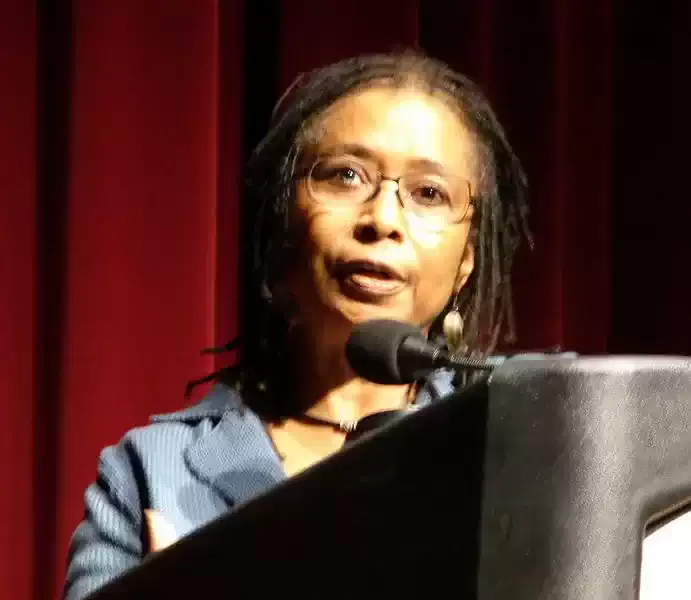
Alice Walker is a celebrated American novelist, poet, and activist. Her work often explores themes of race, gender, and identity, particularly within the African American experience. She is widely recognized for her powerful storytelling and her commitment to social justice, drawing inspiration from her own life and the struggles of her community. Her writings are characterized by a deep empathy and a sharp, incisive social commentary.

n. 1944-02-09, Eatonton

6,958 Views

When You Thought Me Poor

When You Thought Me Poor

When you thought me poor,
my poverty was shaming.
When blackness was unwelcome
we found it best
that I stay home.


When by the miracle
of fierce dreaming and hard work
Life fulfilled our every want
you found me crassly
well off;
not trimly,
inconspicuously wealthy
like your rich friends.


Still black too,
now
I owned too much and too many
of everything.


Woe is me: I became a
success! Blackness, who
knows how?
Became suddenly
in!


What to do?
Now that Fate appears
(for the moment anyhow)
to have dismissed
abject failure
in any case?
Now that moonlight and night
have blessed me.


Now that the sun
unaffected by criticism
of any sort,
implacably beams
the kiss filled magic that creates
the dark and radiant wonder
of my face.
Read full poem
Bio

Identification and basic context

Alice Walker is an American novelist, poet, essayist, and activist. She is best known for her novel "The Color Purple." Her work frequently delves into themes of race, gender, identity, and the African American experience. She is a significant voice in contemporary American literature, engaging with issues of social justice and cultural heritage.

Childhood and education

Walker grew up in a sharecropping family in Eatonton, Georgia. Her childhood was marked by the realities of racial segregation and poverty in the American South. She was an avid reader from a young age and demonstrated early literary talent. She attended Spelman College on a scholarship and later transferred to Sarah Lawrence College, where she studied creative writing.

Literary trajectory

Walker began her literary career as a poet and essayist before achieving widespread acclaim for her novels. Her early works often explored themes of Black identity and the Civil Rights Movement. "The Third Life of Grange Copeland" (1970) was one of her first major novels. Her breakthrough came with "The Color Purple" (1982), which won the Pulitzer Prize for Fiction and was adapted into a highly successful film.

Works, style, and literary characteristics

Major works include "The Third Life of Grange Copeland" (1970), "Meridian" (1976), "The Color Purple" (1982), and "Possessing the Secret of Joy" (1992). Her themes often revolve around the oppression and resilience of Black women, the legacy of slavery, and the search for self-acceptance and spiritual healing. Walker's style is characterized by vivid imagery, lyrical prose, and a powerful emotional resonance. She often employs epistolary forms or multiple perspectives to explore complex characters and their relationships. Her poetry is known for its directness and its engagement with social and political issues.

Cultural and historical context

Walker's work is deeply embedded in the context of the Civil Rights Movement and the ongoing struggle for racial equality in the United States. She was influenced by figures like Martin Luther King Jr. and Fannie Lou Hamer. Her writing reflects the social and political upheavals of the mid-to-late 20th century, engaging with issues of feminism, Black nationalism, and postcolonial thought.

Personal life

Walker has been married and divorced, and has a daughter. She has been a vocal activist for various causes, including civil rights, women's rights, and animal rights. Her personal experiences, including a childhood injury that temporarily blinded one eye, have informed her perspective and her writing.

Recognition and reception

Alice Walker is the recipient of numerous awards, most notably the Pulitzer Prize for Fiction and the National Book Award for "The Color Purple." Her work has been widely translated and has achieved both popular and critical success, though it has also faced controversy and debate.

Influences and legacy

She has been influenced by writers such as Zora Neale Hurston, Langston Hughes, and Richard Wright. Walker's own work has significantly influenced subsequent generations of writers exploring themes of race, gender, and social justice. She is credited with bringing greater attention to the experiences of Black women in literature and popular culture.

Interpretation and critical analysis

Her work is often analyzed through the lenses of feminist theory, postcolonial studies, and critical race theory. "The Color Purple," in particular, has been the subject of extensive critical debate regarding its portrayal of Black male-female relationships and its spiritual dimensions.

Curiosities and lesser-known aspects

Walker is also a practicing Buddhist and has expressed interest in environmentalism and peace activism. She has explored various spiritual paths throughout her life, which often inform the characters and themes in her writing.

Death and memory

As of her current status, Alice Walker is alive and continues to be an active writer and public figure.

Poems

14

Blessed Are The Poor In Spirit

Blessed Are The Poor In Spirit

Did you ever understand this?
If my spirit was poor, how could I enter heaven?
Was I depressed?
Understanding editing,
I see how a comma, removed or inserted
with careful plan,
can change everything.
I was reminded of this
when a poor young man
in Tunisia
desperate to live
and humiliated for trying
set himself ablaze;
I felt uncomfortably warm
as if scalded by his shame.
I do not have to sell vegetables from a cart as he did
or live in narrow rooms too small for spacious thought;
and, at this late date,
I do not worry that someone will
remove every single opportunity
for me to thrive.
Still, I am connected to, inseparable from,
this young man.
Blessed are the poor, in spirit, for theirs is the kingdom of heaven.
Jesus. (Commas restored) .
Jesus was as usual talking about solidarity: about how we join with others
and, in spirit, feel the world, and suffering, the same as them.
This is the kingdom of owning the other as self, the self as other;
that transforms grief into
peace and delight.
I, and you, might enter the heaven
of right here
through this door.
In this spirit, knowing we are blessed,
we might remain poor
284

Don’t be like Those who Ask for Everything

Don’t be like Those who Ask for Everything

Don’t be like those who ask for everything:
praise, a blurb, a free ride in my rented
limousine. They ask for everything but never offer
anything in return.
Be like those who can see that my feet ache
from across a crowded room
that a foot rub
if I’m agreeable
never mind the staring
is the best way to smile
& say hello
to me.
242

Be Nobody's Darling

Be Nobody's Darling

Be nobody's darling;
Be an outcast.
Take the contradictions
Of your life
And wrap around
You like a shawl,
To parry stones
To keep you warm.
Watch the people succumb
To madness
With ample cheer;
Let them look askance at you
And you askance reply.
Be an outcast;
Be pleased to walk alone
(Uncool)
Or line the crowded
River beds
With other impetuous
Fools.


Make a merry gathering
On the bank
Where thousands perished
For brave hurt words
They said.


But be nobody's darling;
Be an outcast.
Qualified to live
Among your dead.
279

like it

like it
anyway!

I get to spend time with myself
whenever I want!

I get to feel
more love
than I ever thought
existed!
Everything appears to be made
of the stuff!

I feel this
especially for You! Though I may not remember
exactly which You
you are!
How cool is this!
Still, I get to spend time with myself
whenever I want!
And that is just a taste
as the old people used to say
down in Georgia
when I was a child
of what you get
for getting old.

Reminding us, as they witnessed our curiosity about them, that no matter the losses,
there's something fabulous going on at every stage of Life, something to let go of,
maybe, but for darn sure, something to get!
241

Quotes

35

Videos

50

Comments (0)

Share
Log in to post a comment.

No comments yet. Be the first to comment.