
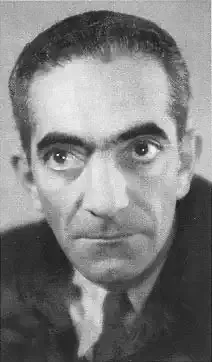
Almada Negreiros
 PT
PT
José de Almada Negreiros was a multifaceted Portuguese artist, a central figure of Modernism in Portugal. A writer, painter, draftsman, and choreographer, his work is marked by a deep restlessness, a constant search for renewal, and experimentation in various artistic fields. He moved with mastery between literature and the visual arts, leaving a unique legacy. His literary production is characterized by formal boldness, humor, social satire, and a critical view of Portuguese reality. In his paintings, vibrant lines, intense colors, and the representation of movement and national identity stand out. Almada Negreiros is one of the most important and representative figures of 20th-century Portuguese culture.
n. 1893-04-07, Ilha de São Tomé · m. 1970-06-15, Lisboa
Bio
Identification and Basic Context
José de Almada Negreiros, known simply as Almada Negreiros, was born on April 7, 1893, in Trancoso, Portugal, but spent most of his life in Lisbon. He often used the pseudonym "Maria" in his early writings. He was a central and polymathic figure of Portuguese Modernism, acting as a writer, painter, draftsman, dancer, and choreographer. His work encompassed various artistic manifestations, always with an innovative and experimental spirit.Childhood and Education
Almada Negreiros had a childhood marked by a family of humble origins, with African ancestry on his mother's side. He lost his mother very early and was raised by his father, who was a farm administrator. He studied in religious schools and later attended the Engineering course at the University of Coimbra, which he abandoned to dedicate himself to the arts. His self-taught education and his intense cultural experience were crucial to his artistic development.Literary Career
The beginning of his literary career occurred with the publication of texts in newspapers and magazines. His first significant work was the novel "A Engomadeira" (1910), still under the pseudonym Maria. However, it was with his active participation in the modernist movement, especially after the "Semana de Arte Moderna" of 1922 (although he did not participate directly), that his work gained greater prominence. He collaborated in important publications such as the magazine "Orpheu" and "Portugal Futurista." Almada was also an active art critic and a cultural promoter.Work, Style, and Literary Characteristics
Almada Negreiros's best-known literary works include the novel "A Mulher Obstinada" (1922), "Belo, Belo, Belo" (1926), the manifesto "Manifesto Anti-Dantas" (1915), "A Cena do Ódio" (1915), and "Novos Contos" (1929). His writing is marked by irreverence, humor, social satire, and criticism of the customs and intellectualism of his time. He experimented with language, using free verse, poetic prose, and innovative narrative forms. Recurring themes include Portuguese identity, criticism of the bourgeoisie, the human condition, and the search for creative freedom. In his visual arts, Almada Negreiros is known for his portraits, large-format paintings (such as the panels in the Church of Nossa Senhora de Fátima in Lisbon), and drawings of figures in motion. His visual style is characterized by strong and expressive lines, vibrant colors, and a search for formal synthesis.Cultural and Historical Context
Almada Negreiros was one of the greatest exponents of Portuguese Modernism, a movement that sought to break with academic traditions and redefine the artistic and cultural identity of Portugal. He lived in a period of profound social and political transformations, including the First Republic, the Military Dictatorship, and the Estado Novo. His critical and contesting stance put him in conflict with authoritarian regimes and conservative intellectualism.Personal Life
Almada Negreiros was a charismatic and controversial figure. He had two wives: Sarah Affonso, a painter whom he married in 1919 and who accompanied him throughout his artistic journey, and Maria Adelaide Moreira, whom he married in 1952. His vibrant personality and restless spirit led him to explore various forms of artistic expression, including dance, where he worked as a choreographer and dancer in innovative performances.Recognition and Reception
Although he faced resistance and misunderstanding during part of his career, Almada Negreiros is today widely recognized as one of the greatest Portuguese artists of the 20th century. His work, in both literature and visual arts, is celebrated for its originality, boldness, and ability to capture the spirit of his time. He received several honors, such as the Acquisition Prize at the São Paulo Biennial in 1957.Influences and Legacy
Almada Negreiros was influenced by European avant-garde movements such as Futurism and Cubism, but he managed to create a personal and profoundly Portuguese artistic language. His legacy is vast and encompasses the renewal of painting, drawing, and literature in Portugal. He influenced generations of artists and writers, consolidating modernity in Portuguese culture.Interpretation and Critical Analysis
Almada Negreiros's work is rich in interpretations. His social and political criticism, humor, and formal experimentation in his literary works, as well as the energy and representation of the Portuguese soul in his paintings, are constant themes of analysis. The duality between the artist and the man, the avant-garde and the traditional, is one of the points of critical interest.Curiosities and Lesser-Known Aspects
Almada Negreiros was a natural performer and loved controversy. He even performed a "Flight over the Tagus" in 1924, using an aircraft he designed himself, demonstrating his inventive spirit and boldness.Death and Memory
José de Almada Negreiros passed away on July 7, 1970, in Lisbon, at the age of 77. His death was felt as the loss of one of the pillars of modern Portuguese culture. His legacy is kept alive through exhibitions, publications, and studies of his work, which continues to inspire and provoke audiences.Poems
0No poems found
Comments (0)
No comments yet. Be the first to comment.