
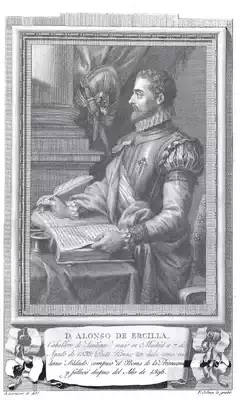
Alonso de Ercilla
 --
--
Alonso de Ercilla y Zúñiga was a Spanish soldier and poet, author of "La Araucana", one of the most important epic poems in Spanish literature and the first major work of Chilean literature. His life was marked by his participation in the wars of conquest in America, especially in the Arauco War, where he fought against the Mapuche. His work is a direct testimony of these campaigns, combining historical chronicle with the exaltation of the bravery of the conquerors and, at the same time, showing respect for the courage of the indigenous people.
n. 1533-08-07, Madrid · m. 1594-11-29, Madrid
Bio
Identification and Basic Context
Alonso de Ercilla y Zúñiga was a Spanish soldier, nobleman, and poet of the Golden Age. He is famous for being the author of "La Araucana", an epic poem that narrates the wars between the Spanish and the Mapuche people in Chile. He was born in Madrid and his life was marked by adventure and war, especially in the New World.Childhood and Education
He came from a noble family of Basque origin. He received a meticulous education, appropriate for his social class. He served as a page to Philip II, which allowed him to gain courtly and military experience. He traveled throughout Europe, participating in military campaigns in Italy and France.Literary Career
His masterpiece, "La Araucana", he began writing during his campaigns in Chile, between 1555 and 1563. The work was published in three parts: the first in 1569, the second in 1578, and the third in 1589. Ercilla did not consider himself primarily a writer, but a soldier, and "La Araucana" arose from his direct battlefield experience, as an attempt to immortalize the war exploits and, at the same time, to leave a testimony of indigenous resistance.Work, Style, and Literary Characteristics
"La Araucana" is an extensive epic poem in royal octaves that narrates the early years of the conquest of Chile. It stands out for its realism, the detail of its war descriptions, and the humanity with which it portrays both the Spaniards and the Mapuche indigenous people. Ercilla shows admiration for the valor and fierceness of the Araucanians, whom he describes as a brave and warlike people. The poem combines historical narration with mythological and allegorical elements. His style is vigorous and clear, despite the complexity of the subject matter and the length of the work. It is considered a precursor to the chivalric novel and a milestone in Renaissance epic poetry.Cultural and Historical Context
Ercilla lived during the era of the Spanish Empire's expansion and the conquest of America. "La Araucana" is framed within the epic of conquest, a literary genre that glorified the exploits of the Spanish in the New World. However, Ercilla's work is distinguished by its objectivity and its admiration for the enemy's bravery, which sets it apart from other war poems of the time. His personal experience in the Arauco War gave him a unique and direct perspective on events.Personal Life
His life was dedicated to a military career and adventure. He actively participated in the Arauco War, where he demonstrated great courage and leadership. Despite his service to the Crown, he had conflicts with authorities and was even imprisoned. He married María de Bazán and returned to Spain, where he continued his military and literary career.Recognition and Reception
"La Araucana" had great editorial success in its time and was read and admired by important figures in Spanish literature. It is considered the foundational work of Chilean literature and a classic of Spanish epic poetry. Despite its importance, Ercilla did not always receive the official recognition he deserved.Influences and Legacy
Ercilla was inspired by the classics of epic poetry, such as Virgil's "Aeneid" and Ariosto's "Orlando Furioso". "La Araucana" influenced later poets and Chilean and Latin American literature, laying the groundwork for the literary representation of the continent's history and conflicts. His work is a fundamental legacy for understanding the vision of conquest and indigenous resistance in literature.Interpretation and Critical Analysis
Ercilla's work has been the subject of various critical analyses, highlighting his skill in historical chronicle, his treatment of characters, and his vision of war. There is debate about his objectivity and his possible sympathy towards the Mapuche, whom he describes with great admiration. "La Araucana" is seen as a historical and literary document of great value.Childhood and Education
It is said that Ercilla wrote parts of "La Araucana" on the battlefield, on animal hides, due to the scarcity of paper. His determination to leave a testimony of the war and bravery was so great that he overcame the difficulties of the time.Death and Memory
Alonso de Ercilla died in Madrid. "La Araucana" continued to be a reference work in Spanish and Chilean literature, and his figure as an epic poet and witness to the conquest endures in literary memory.Poems
0No poems found
Comments (0)
No comments yet. Be the first to comment.