
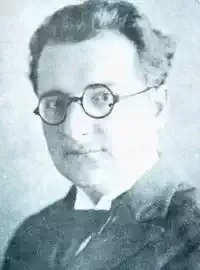
Álvaro Moreyra
1888–1964
· lived 75 years
 BR
BR
BR
Álvaro Moreyra was a poet, essayist, and translator whose work was marked by introspection and the pursuit of a purified poetic language. His writing explores themes such as the ephemerality of time, human solitude, and reflection on poetic art itself, often with a melancholic and contemplative tone. He stood out for his erudition and the formal quality of his verses, integrating himself into the Portuguese literary landscape with a unique voice and a careful style.
n. 1888-11-23, Porto Alegre · m. 1964-09-12, Rio de Janeiro
31
Views
Bio
Identification and basic context
Full name: Álvaro de Sousa Moreyra Date and place of birth: September 19, 1886, Lisbon Date and place of death: January 15, 1972, Lisbon Nationality: Portuguese Language of writing: Portuguese Historical context in which he lived: He lived during a period of profound transformations in Portugal, including the First Republic, the Estado Novo, and the transition to democracy, his work being shaped by the social, political, and cultural tensions of the time.Childhood and education
Moreyra had a childhood marked by a rigorous education. He attended the Faculty of Law at the University of Coimbra, where he graduated, but his literary vocation manifested early. He absorbed influences from Symbolist and Parnassian poetry, as well as from the philosophy that permeated the intellectual circles of Coimbra.Literary career
He began his literary activity with the publication of poems in academic and literary magazines while still young. Over time, his work evolved towards greater thematic and stylistic depth, exploring the human condition with a critical and introspective gaze. He was also an active translator and essayist, contributing to the dissemination of foreign authors in Portugal.Work, style, and literary characteristics
His main works include "Vértice" (1916), "O Livro do Ócio" (1922), and "O Mar" (1931). The dominant themes in his poetry are the passage of time, solitude, melancholy, and reflection on art and nature. Moreyra often used more classical forms, such as the sonnet, but also experimented with free verse, always with great formal concern and musicality. His style is erudite, with a rich and precise vocabulary, imagistic density, and a confessional and elegiac tone. His work is associated with Portuguese Modernism, although he maintained a connection with the literary tradition.Work, style, and literary characteristics
Cultural and historical context Álvaro Moreyra lived in a period of great cultural effervescence in Portugal. He was a contemporary of other great names in Portuguese literature, with whom he maintained relationships of conviviality and, at times, literary debate. His generation, although diverse, shared the search for new forms of artistic expression in response to the country's social and political changes.Work, style, and literary characteristics
Personal life Moreyra dedicated a large part of his life to literature, also holding public office which allowed him to reconcile his passion with the need for sustenance. His personal relationships and life experiences influenced the melancholy and introspection present in his work. His philosophical and spiritual beliefs, although not explicitly stated in a dogmatic way, permeate his reflection on existence.Work, style, and literary characteristics
Recognition and reception His place in Portuguese literature is that of a poet of undeniable quality, although sometimes less publicized than other contemporaries. He received some institutional recognition, but his work has been rediscovered and valued by critics and more attentive readers, consolidating him as a sure asset of 20th-century Portuguese poetry.Work, style, and literary characteristics
Influences and legacy He was influenced by Symbolist and Parnassian poets, but developed his own style. His legacy lies in the quality of his poetic language, the depth of his reflections, and his contribution to the renewal of Portuguese poetry. His work continues to be studied and appreciated by later generations of poets and literary critics.Work, style, and literary characteristics
Interpretation and critical analysis Moreyra's work has been interpreted through the lens of existential anguish, the search for transcendence, and reflection on art as a way of dealing with human finitude. His poetry invites contemplation and introspection, exploring the complexity of the human condition.Work, style, and literary characteristics
Curiosities and lesser-known aspects Moreyra was known for his discretion and intellectual rigor. His dedication to poetry was almost monastic, with literary creation being the center of his life. His writing habits were methodical and required great effort in verbal refinement.Work, style, and literary characteristics
Death and memory He died in Lisbon, leaving behind a body of work that continues to be a testament to his sensitivity and poetic talent. Posthumous publications have kept his work alive in literary memory.Poems
0No poems found
Comments (0)
Log in
to post a comment.
No comments yet. Be the first to comment.