
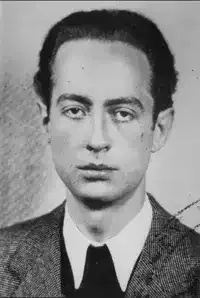
André Pieyre de Mandiargues
1909–1991
· lived 82 years
 FR
FR
FR
André Pieyre de Mandiargues was a French writer, poet, and essayist, associated with surrealism, although he maintained a critical distance from the movement. His work is characterized by an exploration of the erotic, the mysterious, the dreamlike, and the transgressive, using precise and evocative language. He was also an important art critic and a scholar of the work of Benjamin Péret.
n. 1909-03-14, 17.º arrondissement de Paris · m. 1991-12-13, 4.º arrondissement de Paris
72
Views
Bio
Identification and basic context
André Pieyre de Mandiargues was a French writer, poet, and essayist. Date and place of birth: January 14, 1909, Paris, France. Date and place of death: November 8, 1991, Aix-en-Provence, France. Family background: Bourgeois family. Nationality: French. Language of writing: French. Historical context: Lived through most of the 20th century, experiencing two world wars and witnessing the social and cultural transformations of Europe.Childhood and education
Raised in a wealthy family, Pieyre de Mandiargues received a careful education. From an early age, he showed an interest in the arts and literature, developing a taste for the exotic and the unusual. His education was marked by diverse readings, which brought him closer to avant-garde aesthetic currents.Literary career
He began his literary career as a poet, publishing "Poèmes" in 1932. His work evolved into prose, exploring short stories and novels that delved into themes such as eroticism, the fantastic, and transgression. He maintained a close connection with the surrealist group, although he never officially joined, appreciating creative freedom and the exploration of the unconscious. He was also an art critic and a dedicated scholar of other artists and writers.Work, style, and literary characteristics
Major works include "Le Masochiste" (1933), "Soleil aux abois" (1947), and "Félicité" (1947). The central themes of his work revolve around desire, eroticism, death, mystery, and the exploration of dreamlike and fantastic universes. His language is marked by precision, musicality, and a strong charge of sensuality and suggestion. He explores free verse in poetry and in prose uses an elaborate syntax and a rich vocabulary. His style, often classified as surrealist or post-surrealist, is characterized by the fusion of the real and the imaginary, the exploration of the subconscious, and an atmosphere of enchantment and strangeness.Cultural and historical context
Pieyre de Mandiargues was part of the vibrant Parisian cultural scene of the 20th century, engaging with surrealism, but also with other avant-garde movements. His work reflects the concerns and freedoms of an era of profound artistic and social changes.Personal life
His personal relationships and experiences, often marked by a refined sensitivity to the world of the senses and desire, are reflected in his work. His personal life remained relatively discreet, focused on artistic and intellectual creation.Recognition and reception
He received the Apollinaire Prize in 1947 for his poetic work. Recognition of his work grew over time, especially among admirers of avant-garde literature and surrealism.Influences and legacy
Influenced by authors such as Lautréamont and by surrealism, Pieyre de Mandiargues left a legacy in French literature for his bold exploration of eroticism and the fantastic, paving the way for new approaches to subjectivity and desire.Interpretation and critical analysis
Pieyre de Mandiargues' work is often analyzed from a psychoanalytic perspective, focusing on the exploration of desire, the unconscious, and eroticism. His ability to create dense and enigmatic atmospheres is a central point in criticism.Curiosities and lesser-known aspects
He was also an admirer of photography and an attentive art critic, paying special attention to artists with an equally transgressive and innovative vision.Death and memory
He passed away in 1991, leaving behind a body of work that continues to be rediscovered for its originality and its unique approach to the human and the unusual.Poems
0No poems found
Videos
50
Comments (0)
Log in
to post a comment.
No comments yet. Be the first to comment.