
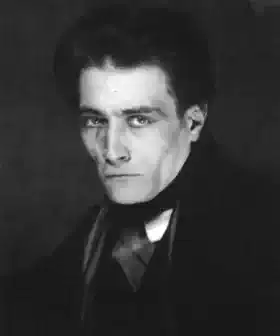
Antonin Artaud
 FR
FR
Antonin Artaud was a French playwright, poet, actor, and theater theorist, a central figure of surrealism and the creator of the concept of "Theater of Cruelty." His work is marked by radical experimentation, the pursuit of a language that transcends spoken text, and the exploration of the limits of the mind and body. His life was marked by intense existential crises and mental health problems. Artaud revolutionized theatrical thought with his ideas on staging, the use of space, sound, and gesture, aiming for a visceral impact on the audience. His influence extends beyond the theater, impacting literature, cinema, and visual arts.
n. 1896-09-04, Marselha · m. 1948-03-04, Paris
Bio
Identification and basic context
Antonin Artaud was an influential French playwright, poet, actor, theater director, and theorist. Born in Marseille, he is one of the most radical and enigmatic figures in 20th-century theater and literature. He is best known for his theory of the "Theater of Cruelty," which proposed a return to theater as a cosmic and ritualistic event, with the aim of awakening humanity's primal forces.Childhood and education
Artaud had a childhood marked by illness and emotional instability. His education was eclectic, with literary, philosophical, and mystical influences. The experience of mental illness and psychiatric treatments throughout his life had a profound impact on his work and worldview.Literary career
Artaud's career is intrinsically linked to his theatrical and poetic exploration. He participated in the surrealist movement, where he developed his ideas on the unconscious and language. His poetic work, such as "Moon Shoulder" and "To Have Done with the Judgment of God," is marked by raw and visceral language. His acting, though less prolific, was significant, with appearances in films like Abel Gance's "La Roue" and Carl Theodor Dreyer's "Vampyr."Work, style, and literary characteristics
Artaud's work is revolutionary and challenging. The "Theater of Cruelty" (Le Théâtre et son double) proposes a theater that abandons the primacy of text and word, exploring sound, gesture, light, and the body to achieve a metaphysical and therapeutic dimension. His poetry is marked by the breakdown of syntax, the exploration of striking images, and the search for a language that expresses the unspeakable. "To Have Done with the Judgment of God" is an experimental radio play that caused great controversy.Cultural and historical context
Artaud lived in a period of great cultural effervescence in Europe, especially in Paris, in the early decades of the 20th century. His connection with surrealism brought him into contact with artists and intellectuals who sought to break with established conventions. World War I and the social and political crises of the time influenced his somber vision and his search for more authentic and visceral forms of expression.Personal life
Artaud's life was tormented by psychological crises and hospitalizations in psychiatric institutions. His search for alternative therapies and his dedication to writing and theater were constant, despite adversity. His personal experiences, including trips to Mexico and Ireland, enriched his worldview and his work.Recognition and reception
During his lifetime, Artaud had limited and often controversial recognition. His radical ideas were difficult to fully comprehend and accept. However, after his death, his work was rediscovered, and his influence on theater, literature, and the arts became immense, establishing him as one of the most important thinkers of the 20th century.Influences and legacy
Artaud influenced generations of playwrights, theater directors, poets, and visual artists. His concept of the "Theater of Cruelty" transformed the way theater was thought about, opening paths for experimentation and for a more physical and visceral approach to performance. His work is a landmark in the history of modern theater and artistic avant-garde.Interpretation and critical analysis
Artaud's work is the subject of intense critical debate. His theories on theater are seen as a call for authenticity and transcendence, while his poetry is analyzed for its ability to expose the depths of the human psyche. The relationship between cruelty, healing, and transcendence is a central theme in his analyses.Curiosities and lesser-known aspects
In his writings and performances, Artaud used practices involving drugs, rituals, and a search for altered states of consciousness to access new forms of expression. His relationship with indigenous cultures, especially in Mexico, was significant and influenced his vision of the sacred in theater.Death and memory
Antonin Artaud died in 1948, victim of cancer. His death marked the end of an intense and tormented life, but the beginning of a posthumous recognition that solidified his place as one of the great innovators of the 20th century. His work continues to inspire and provoke the art world.Poems
0No poems found
Quotes
2Comments (0)
No comments yet. Be the first to comment.