
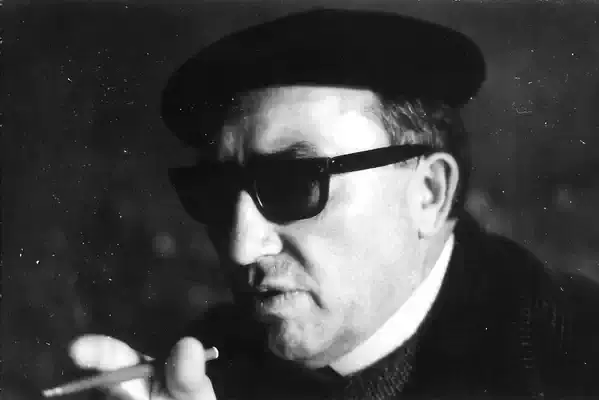
António Aragão
1925–2008
· lived 82 years
 PT
PT
PT
António Aragão was a Portuguese poet, essayist, and visual artist, a central figure of concretism in Portugal. His poetic work, marked by visual and linguistic experimentation, explores the materiality of the word and the relationship between text and image. He was also an important disseminator of experimental poetry.
n. 1925-09-22, São Vicente · m. 2008-08-11, Funchal
33
Views
Bio
Identification and Basic Context
António Osório de Aragão was a Portuguese poet, essayist, art critic, and visual artist, born on February 27, 1937, in Coimbra, and died on March 10, 2015, in Lisbon. Son of [family origin, social class, and cultural background], he was one of the main proponents of the concrete movement in Portugal, writing predominantly in Portuguese.Childhood and Education
António Aragão's childhood took place in Coimbra, where he had access to a cultural environment conducive to the development of his artistic talents. His academic education involved studies in [describe education, if known], complemented by intense self-study in literature, visual arts, and graphic arts. His initial readings and contact with the cultural effervescence of the time, particularly with European artistic avant-gardes, were crucial to his formation. He absorbed influences from movements such as concretism, neoconcretism, and other currents of experimental poetry.Literary Career
His poetic and artistic activity began in the 1950s. Aragão stood out for his constant evolution, exploring visual poetry, concrete poetry, and language experimentation. His work evolved chronologically, going through different phases of aesthetic and thematic exploration. He was a regular contributor to various publications, including the magazine Poesia 61 and other anthologies and newspapers dedicated to avant-garde art and literature. In addition to his work as a poet, he was an attentive art critic and an editor of works by other artists and poets.Work, Style, and Literary Characteristics
António Aragão's main works include books such as "Poesia Experimental" (1965), "10 Poemas" (1972), "Obra Poética" (2001), and several limited editions and exhibition catalogs. The central themes of his work revolve around the visuality of the word, the deconstruction of language, the relationship between sound and image, and the materiality of the book itself as an artistic object. He explored free verse and fixed form, but with a strong inclination towards metrical and visual experimentation, creating object-poems and poetic installations. His style is marked by conciseness, rationality in the organization of graphic space, and the search for more direct and sensory communication. The poetic voice is often impersonal or takes on an interventionist and reflective character about art itself. He introduced significant formal innovations in Portuguese poetry, notably by popularizing and adapting the principles of concretism. His work dialogues with the tradition of avant-garde poetry and the modernity of visual arts.Cultural and Historical Context
António Aragão lived and produced during a period of great cultural effervescence in Portugal, but also of political repression under the Estado Novo. His work, with its experimental and innovative nature, sometimes confronted the more conservative structures of society and literary criticism. He was part of the Poesia 61 movement and concretism, establishing dialogues with other artists and writers of his generation, such as E. M. de Melo e Castro, Fiama Hasse Pais Brandão, among others. His position, although not openly political in a partisan sense, was one of intervention and questioning established norms through art.Personal Life
Aspects of António Aragão's personal life are less explored in detail, but it is known that he dedicated his life to art and poetry. His relationships with other artists and his participation in avant-garde circles were fundamental to his trajectory. His main profession, besides artistic creation, may have involved areas related to graphic arts or teaching, although his dedication to poetry and art was predominant.Recognition and Reception
Although his more experimental work did not always receive immediate reception from the general public, António Aragão earned a place of respect and admiration in artistic and academic circles, especially regarding concrete and visual poetry. The recognition of his importance as a pioneer of concretism in Portugal has grown over time, culminating in complete works editions and retrospective exhibitions.Influences and Legacy
António Aragão was influenced by international concrete poets and avant-garde artists. In turn, his work had a significant impact on Portuguese experimental poetry, influencing later generations of artists who explore the intersection between word and image. His work is considered fundamental for understanding concrete poetry in Portugal and has been the subject of study in academic contexts.Interpretation and Critical Analysis
Aragão's work invites an analysis that transcends mere textual reading, requiring consideration of the visual and spatial aspects of the poem. Interpretations often focus on the dematerialization of verse and the exploration of the word as a graphic and sonic element. His contribution is seen as a milestone in the modernization of Portuguese poetry.Curiosities and Lesser-Known Aspects
A curiosity about António Aragão is his multifaceted artistic production, which ranged from visual poetry to painting and installations. His ability to move between different artistic languages is a testament to his versatility and his integrated vision of art. His writing habits involved deep reflection on form and content, with particular attention to the graphic arrangement of verbal elements.Death and Memory
António Aragão passed away in Lisbon, leaving behind an artistic and poetic legacy of great value. His memory is celebrated through the preservation and dissemination of his work, as well as the continued recognition of his pioneering role in concretism and Portuguese experimental poetry.Poems
0No poems found
Comments (0)
Log in
to post a comment.
No comments yet. Be the first to comment.